

EN 378-4:2008+A1:2012
(Main)Refrigerating systems and heat pumps - Safety and environmental requirements - Part 4: Operation, maintenance, repair and recovery
- Abstract
The scope of EN 378-1:2008 is applicable.
This European Standard specifies requirements for safety and environmental aspects in relation to operation, maintenance, and repair of refrigerating systems and the recovery, reuse and disposal of all types of refriger-ant, refrigerant oil, heat transfer medium, refrigerating system and part thereof.
These requirements are intended to minimise risks of injury to persons and damage to property and the envi-ronment resulting from improper handling of the refrigerants or from contaminants leading to system break-down and resultant emission of the refrigerant.
Certain clauses and subclauses of this European Standard are not applicable to unit systems self contained systems and systems built on site which operate with charges of refrigerant up to 3 kg of refrigerant.
These subclauses are 4.1.1, 4.1.2, 4.2, 4.3, 5.1.1 to 5.1.4, 5.2, 5.3.1, 5.3.3 and 6.6.
For these systems, the necessary maintenance has to be described in the instruction manual and should
repairs be necessary, contact the nearest authorised repair service centre.
- Status
- Withdrawn
- Publication Date
- 22-May-2012
- Withdrawal Date
- 29-Sep-2026
- Technical Committee
- CEN/TC 182 - Refrigerating systems, safety and environmental requirements
- Drafting Committee
- CEN/TC 182/WG 6 - Revision of EN 378
- Current Stage
- 9960 - Withdrawal effective - Withdrawal
- Start Date
- 30-Nov-2016
- Completion Date
- 30-Sep-2026

Relations
- Effective Date
- 18-Jan-2012
- Effective Date
- 07-Dec-2016
- Effective Date
- 25-Aug-2026
- Effective Date
- 28-Jan-2026
- Effective Date
- 28-Jan-2026
- Effective Date
- 28-Jan-2026
Get Certified
Connect with accredited certification bodies for this standard

DNV
DNV is an independent assurance and risk management provider.

Lloyd's Register
Lloyd's Register is a global professional services organisation specialising in engineering and technology.
DNV Energy Systems
Energy and renewable energy certification.
Sponsored listings
Frequently Asked Questions
EN 378-4:2008+A1:2012 is a standard published by the European Committee for Standardization (CEN). Its full title is "Refrigerating systems and heat pumps - Safety and environmental requirements - Part 4: Operation, maintenance, repair and recovery". This standard covers: The scope of EN 378-1:2008 is applicable. This European Standard specifies requirements for safety and environmental aspects in relation to operation, maintenance, and repair of refrigerating systems and the recovery, reuse and disposal of all types of refriger-ant, refrigerant oil, heat transfer medium, refrigerating system and part thereof. These requirements are intended to minimise risks of injury to persons and damage to property and the envi-ronment resulting from improper handling of the refrigerants or from contaminants leading to system break-down and resultant emission of the refrigerant. Certain clauses and subclauses of this European Standard are not applicable to unit systems self contained systems and systems built on site which operate with charges of refrigerant up to 3 kg of refrigerant. These subclauses are 4.1.1, 4.1.2, 4.2, 4.3, 5.1.1 to 5.1.4, 5.2, 5.3.1, 5.3.3 and 6.6. For these systems, the necessary maintenance has to be described in the instruction manual and should repairs be necessary, contact the nearest authorised repair service centre.
The scope of EN 378-1:2008 is applicable. This European Standard specifies requirements for safety and environmental aspects in relation to operation, maintenance, and repair of refrigerating systems and the recovery, reuse and disposal of all types of refriger-ant, refrigerant oil, heat transfer medium, refrigerating system and part thereof. These requirements are intended to minimise risks of injury to persons and damage to property and the envi-ronment resulting from improper handling of the refrigerants or from contaminants leading to system break-down and resultant emission of the refrigerant. Certain clauses and subclauses of this European Standard are not applicable to unit systems self contained systems and systems built on site which operate with charges of refrigerant up to 3 kg of refrigerant. These subclauses are 4.1.1, 4.1.2, 4.2, 4.3, 5.1.1 to 5.1.4, 5.2, 5.3.1, 5.3.3 and 6.6. For these systems, the necessary maintenance has to be described in the instruction manual and should repairs be necessary, contact the nearest authorised repair service centre.
EN 378-4:2008+A1:2012 is classified under the following ICS (International Classification for Standards) categories: 27.080 - Heat pumps; 27.200 - Refrigerating technology. The ICS classification helps identify the subject area and facilitates finding related standards.
EN 378-4:2008+A1:2012 has the following relationships with other standards: It is inter standard links to EN 378-4:2008, EN 378-4:2016, ISO 11650:1999, EN 378-1:2008+A2:2012, EN 378-3:2008+A1:2012, EN 378-2:2008+A2:2012. Understanding these relationships helps ensure you are using the most current and applicable version of the standard.
EN 378-4:2008+A1:2012 is available in PDF format for immediate download after purchase. The document can be added to your cart and obtained through the secure checkout process. Digital delivery ensures instant access to the complete standard document.
Standards Content (Sample)
2003-01.Slovenski inštitut za standardizacijo. Razmnoževanje celote ali delov tega standarda ni dovoljeno.Kälteanlagen und Wärmepumpen - Sicherheitstechnische und umweltrelevante Anforderungen - Teil 4: Betrieb, Instandhaltung, Instandsetzung und RückgewinnungSystèmes de réfrigération et pompes à chaleur - Exigences de sécurité et d'environnement - Partie 4: Fonctionnement, maintenance, réparation et récupérationRefrigerating systems and heat pumps - Safety and environmental requirements - Part 4: Operation, maintenance, repair and recovery27.200Hladilna tehnologijaRefrigerating technology27.080Heat pumpsICS:Ta slovenski standard je istoveten z:EN 378-4:2008+A1:2012SIST EN 378-4:2008+A1:2012en,fr,de01-julij-2012SIST EN 378-4:2008+A1:2012SLOVENSKI
STANDARD
EUROPEAN STANDARD NORME EUROPÉENNE EUROPÄISCHE NORM
EN 378-4:2008+A1
May 2012 ICS 27.080; 27.200 Supersedes EN 378-4:2008English Version
Refrigerating systems and heat pumps - Safety and environmental requirements - Part 4: Operation, maintenance, repair and recovery
Systèmes de réfrigération et pompes à chaleur - Exigences de sécurité et d'environnement - Partie 4: Fonctionnement, maintenance, réparation et récupération
Kälteanlagen und Wärmepumpen - Sicherheitstechnische und umweltrelevante Anforderungen - Teil 4: Betrieb, Instandhaltung, Instandsetzung und Rückgewinnung This European Standard was approved by CEN on 13 October 2007 and includes Amendment 1 approved by CEN on 23 January 2012.
CEN members are bound to comply with the CEN/CENELEC Internal Regulations which stipulate the conditions for giving this European Standard the status of a national standard without any alteration. Up-to-date lists and bibliographical references concerning such national standards may be obtained on application to the CEN-CENELEC Management Centre or to any CEN member.
This European Standard exists in three official versions (English, French, German). A version in any other language made by translation under the responsibility of a CEN member into its own language and notified to the CEN-CENELEC Management Centre has the same status as the official versions.
CEN members are the national standards bodies of Austria, Belgium, Bulgaria, Croatia, Cyprus, Czech Republic, Denmark, Estonia, Finland, France, Germany, Greece, Hungary, Iceland, Ireland, Italy, Latvia, Lithuania, Luxembourg, Malta, Netherlands, Norway, Poland, Portugal, Romania, Slovakia, Slovenia, Spain, Sweden, Switzerland, Turkey and United Kingdom.
EUROPEAN COMMITTEE FOR STANDARDIZATION
COMITÉ EUROPÉEN DE NORMALISATION EUROPÄISCHES KOMITEE FÜR NORMUNG
Management Centre:
Avenue Marnix 17,
B-1000 Brussels © 2012 CEN All rights of exploitation in any form and by any means reserved worldwide for CEN national Members. Ref. No. EN 378-4:2008+A1:2012: ESIST EN 378-4:2008+A1:2012
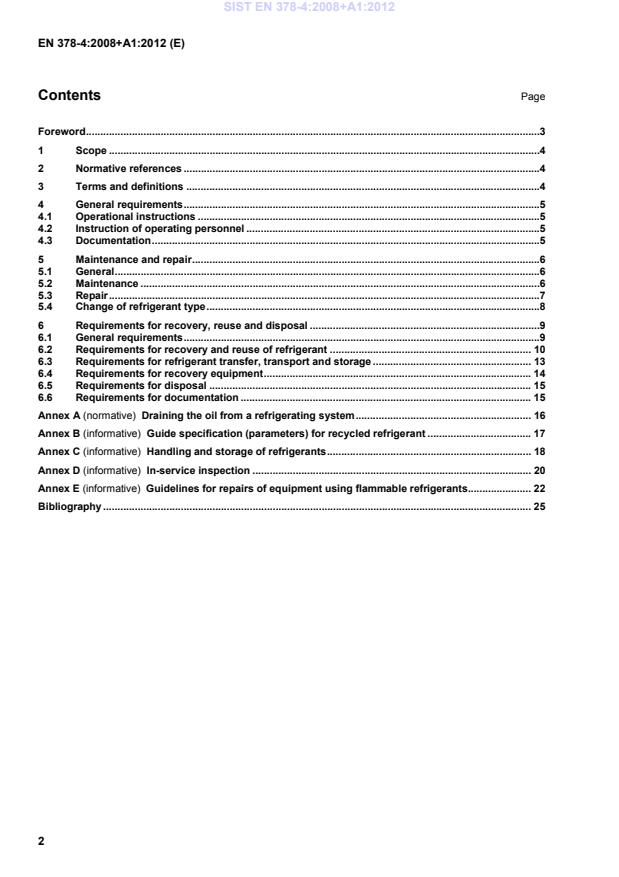
Draining the oil from a refrigerating system . 16Annex B (informative)
Guide specification (parameters) for recycled refrigerant . 17Annex C (informative)
Handling and storage of refrigerants . 18Annex D (informative)
In-service inspection . 20Annex E (informative)
Guidelines for repairs of equipment using flammable refrigerants . 22Bibliography . 25 SIST EN 378-4:2008+A1:2012
repairs be necessary, contact the nearest authorised repair service centre. 2 Normative references The following referenced documents are indispensable for the application of this document. For dated refer-ences, only the edition cited applies. For undated references, the latest edition of the referenced document (including any amendments) applies. !EN 378-1:2008+A2:2012", Refrigerating systems and heat pumps — Safety and environmental re-quirements — Part 1: Basic requirements, definitions, classification and selection criteria !EN 378-2:2008+A2:2012", Refrigerating systems and heat pumps — Safety and environmental re-quirements — Part 2: Design, construction, testing, marking and documentation !EN 378-3:2008+A1:2012", Refrigerating systems and heat pumps — Safety and environmental re-quirements — Part 3: Installation site and personal protection ISO 11650, Performance of refrigerant recovery and/or recycling equipment 3 Terms and definitions For the purposes of this document, the terms and definitions given in !EN 378-1:2008+A2:2012" apply. SIST EN 378-4:2008+A1:2012
instructed on the basis of the instruction manual about the construction, supervision, operation and mainte-nance of the refrigerating system, as well as the safety measures to be observed, if necessary the required personal protection equipment (see !EN 378-3:2008+A1:2012", Annex A) and the properties and han-dling of the refrigerant used. NOTE It is advisable that the operating personnel are present during evacuation, charging with refrigerant and
adjustment of the refrigerating system as well as, if possible, during assembly on site. 4.3 Documentation 4.3.1 The owner / operator shall keep an updated logbook of the refrigerating system if the refrigerant charge exceeds 3 kg. 4.3.2 In the logbook the following information shall be recorded: a) details of all maintenance and repair work; b) quantities and kind of (new, reused or recycled) refrigerant which have been charged on each occasion, and the quantities of refrigerant which have been transferred from the system on each occasion, see also 6.6; c) analysis of a reused refrigerant, if available, the results of which shall also be kept in the log-book; d) source of the reused refrigerant; e) changes and replacements of components of the system; f) results of all periodic routine tests; g) record of significant periods of non-use. 4.3.3 The log-book shall either be kept by the owner / operator and in the machinery room, or the data shall be stored in a computer with a printout in the machinery room, in which case the information shall be accessi-ble to the competent person when servicing or testing. SIST EN 378-4:2008+A1:2012
instruction manual, see EN 378-2. NOTE 1 The frequency of such maintenance depends on the type, size, age, use etc. of the system. In many cases more than one maintenance service is required in the course of one year in accordance with legal requirements. NOTE 2 For personal protective equipment against refrigerants see EN 378-3. 5.1.2 The user / owner concerned for the refrigerating system shall ensure that the system is inspected, regularly supervised and maintained in a satisfactory manner. 5.1.3 Systems with a charge larger than 3 kg should be subject to tightness inspection at least on an annual basis. If, during the inspection the suspicion of a leak exists, e.g. through refrigerant temperature checks or capacity reduction, then leak has to be located with suitable detection equipment and should be repaired and checked again after the repair in accordance with national regulations. The results of the inspection and measures taken afterwards should be included in the logbook. Refer to Annex D for detailed specification regarding in service inspection. 5.1.4 The parties concerned for the refrigerating system shall also be responsible when another person uses the refrigerating system, unless another division of responsibility has been agreed upon. 5.1.5 Regular maintenance which does not include interference with, nor adjustment of, the refrigerating system and which requires no specialised knowledge of refrigeration can be carried out by a person of appro-priate competence employed by the person responsible. Examples of such non-specialist maintenance include air-side cleaning of heat exchangers, cleaning of
condensate systems. 5.1.6 It is not permitted to charge a refrigerating system with a refrigerant type that does not comply with the machine card nor with the specifications of the manufacturer. In the case of appliances, the refrigerant type has to conform to the rating label data. In the case of retrofitting of an installation, see 5.4. 5.1.7 In the case of refrigerating systems located within an enclosure and considered as indirect systems under EN 378-1, no unauthorised persons shall remain in the occupancy during maintenance and
repair operations since the separation between refrigerant containing parts and occupants of the room is no more effective and leaks of refrigerant into the occupancy become possible. 5.1.8 Ensure that any marking to the compressor or equipment is replaced if any of the existing text has become unreadable. 5.2 Maintenance 5.2.1 Maintenance shall be undertaken in such a way that: a) accidents to personnel are minimised; b) damage to goods is minimised; c) components of the system remain in good working order; d) the purpose and availability of the system are maintained; e) leakage of refrigerant or oil are identified and remedied; SIST EN 378-4:2008+A1:2012
piping); d) emptying and evacuating; e) cleaning and purging respectively (e.g. with nitrogen); f) releasing for repair; Welding or the use of arc — and flame-producing apparatus requires specific personnel and welding or braz-ing procedure approvals. g) carrying out the repair; h) testing and checking of the repaired component (pressure test, leakage test, functional test, see EN 378-2); i) replacing, evacuating and recharging with refrigerant. 5.3.2 Refrigerant leaks shall be identified and repaired as soon as practicable by a competent person. 5.3.3 During each periodic maintenance and following each repair, if appropriate, at least the following tasks shall be performed: a) all safety, control and measurement devices as well as alarm systems shall be checked to verify their
correct operation and perfect working order; b) leakage tests shall be carried out at the relevant part of the refrigerating system; c) evacuating; d) adjustment of refrigerant charge; SIST EN 378-4:2008+A1:2012
Figure 1 — Simplified representation of the relationship between the processes 6.1.3 Parts of refrigerating systems All parts of refrigerating systems, e.g. refrigerant, oil, heat-transfer medium, filter, drier, insulation material, shall be recovered, reused and/or disposed of properly, see 6.5. 6.1.4 Refrigerants All refrigerants shall be recovered for reuse, recycled or reclaimed for reuse, or shall be disposed of properly, see 6.5. Destruction of refrigerants can require an authorised facility for destruction. 6.1.5 Handling The method of handling of the refrigerant shall be decided before it is removed from the refrigerating system or the equipment, see also Annex C. SIST EN 378-4:2008+A1:2012
Figure 2 — Flow chart for recovered refrigerant 6.2.2 Recovery for general reuse For general reuse, recovered refrigerants shall be reclaimed and comply with the appropriate specification for new refrigerants. 6.2.3 Recovery for reuse in the same or similar system 6.2.3.1 For reuse in the same system For a halocarbon refrigerant, an acid test shall be carried out. SIST EN 378-4:2008+A1:2012
returning the refrigerant to the refrigerating system. NOTE 4 It is recommended that the refrigerant is recharged through a filter drier to remove moisture which may have contaminated the fluid during recovery. 6.2.3.2 For use in a similar system The use of recycled refrigerant in a refrigerating system, which is similar in function and components, shall comply with the following requirements: system is serviced by the competent person or company who recycled the refrigerant; recycling equipment complies with the requirements of 6.2.4; history of the refrigerant and the refrigerating system is known from the date of commissioning; competent person or company informs the party concerned when recycled refrigerant is used and the source from which it comes and the result of the tests or, if necessary, of the analysis. The acid test shall be carried out in accordance with 6.2.3.1. If any of the above conditions is not met or the history of the refrigerant indicates a heavy contamination of the refrigerant, e.g. motor burnout, then the refrigerant shall be either reclaimed or disposed of properly. NOTE A recycled refrigerant should comply with the specifications in Annex B. 6.2.4 Requirements for refrigerant recycling equipment and procedures Recycling equipment for halocarbon refrigerants shall comply with ISO 11650 or similar standard require-ments. Recycling equipment shall be regularly inspected to verify that equipment and instruments are well maintained and in good order. Equipment and instruments shall be function tested and calibrated regularly. 6.2.5 Reclaim 6.2.5.1 Analysis A refrigerant sent for reclaim shall be analysed and either reclaimed or disposed of properly. SIST EN 378-4:2008+A1:2012
...