EN 13657:2002
(Main)Characterization of waste - Digestion for subsequent determination of aqua regia soluble portion of elements
Characterization of waste - Digestion for subsequent determination of aqua regia soluble portion of elements
This standard specifies methods of digestion with aqua regia. Solutions produced by the methods are suitable for analysis e.g. by atomic absorption spectrometry (FLAAS, HGAAS, CVAAS, GFAAS), inductively coupled plasma emission spectrometry (ICP-OES) and inductive coupled plasma mass spectrometry (ICP-MS). The method is applicable to the digestion of waste for example for the following elements: Al, Sb, As, B, Ba, Be, Cd, Ca, Cr, Co, Cu, Fe, Pb, Mg, Mn, Hg, Mo, Ni, P, K, Se, Ag, S, Na, Sr, Sn, Te, Ti, Tl, V, Zn.
Charakterisierung von Abfällen - Aufschluss zur anschließenden Bestimmung des in Königswasser löslichen Anteils an Elementen in Abfällen
Diese Norm legt Verfahren zum Aufschluß mit Königswasser fest. Die nach den Verfahren hergestellten Lösungen sind z.B. für Analysen mittels Flammen- Atomabsorptionsspektrometrie (FAAS), Hydrid-Atomabsorptionsspektrometrie (HGAAS), Kaltdampf-Atomabsorptionsspektrometrie (CVAAS), Graphitrohrofen- Atomabsorptionsspektrometrie (GFAAS), optischer Emissionsspektrometrie mit induktiv gekoppeltem Plasma (ICP-OES) und mit induktiv gekoppelter Plasma-Emissions-Massenspektrometrie (ICP-MS) geeignet.
Caractérisation des déchets - Digestion en vue de la détermination ultérieure de la part des éléments solubles dans l'eau régale contenus dans les déchets
La présente Norme européenne spécifie des méthodes de digestion avec de l'eau régale. Les solutions produites par ces méthodes sont appropriées pour l'analyse, par exemple par spectrométrie d'absorption atomique (FLAAS, HGAAS, CVAAS, GFAAS), par spectrométrie d'émission par un plasma à couplage inductif (ICP-OES) et par spectrométrie de masse par un plasma à couplage inductif (ICP-MS).
La digestion avec de l'eau régale ne libérera pas nécessairement complètement tous les éléments. Toutefois, pour la plupart des applications à l'environnement et pour la caractérisation des déchets, les résultats correspondent au but recherché.
La méthode est applicable à la digestion de déchets, par exemple pour les éléments suivants : Al, Sb, As, B, Ba, Be, Ca, Cd, Cr, Co, Cu, Fe, Pb, Mg, Mn, Hg, Mo, Ni, P, K, Se, Ag, S, Na, Sr, Sn, Te, Ti, Tl, V, Zn.
Karakterizacija odpadkov - Razklop z zlatotopko za določanje elementov
General Information
- Status
- Withdrawn
- Publication Date
- 15-Oct-2002
- Withdrawal Date
- 25-Nov-2025
- Technical Committee
- CEN/TC 444 - Environmental characterization
- Drafting Committee
- CEN/TC 444/WG 3 - Inorganic analysis
- Current Stage
- 9060 - Closure of 2 Year Review Enquiry - Review Enquiry
- Start Date
- 02-Sep-2024
- Completion Date
- 02-Sep-2024
- Directive
- 99/31/EC - Landfill of waste
Relations
- Effective Date
- 26-Nov-2025
Frequently Asked Questions
EN 13657:2002 is a standard published by the European Committee for Standardization (CEN). Its full title is "Characterization of waste - Digestion for subsequent determination of aqua regia soluble portion of elements". This standard covers: This standard specifies methods of digestion with aqua regia. Solutions produced by the methods are suitable for analysis e.g. by atomic absorption spectrometry (FLAAS, HGAAS, CVAAS, GFAAS), inductively coupled plasma emission spectrometry (ICP-OES) and inductive coupled plasma mass spectrometry (ICP-MS). The method is applicable to the digestion of waste for example for the following elements: Al, Sb, As, B, Ba, Be, Cd, Ca, Cr, Co, Cu, Fe, Pb, Mg, Mn, Hg, Mo, Ni, P, K, Se, Ag, S, Na, Sr, Sn, Te, Ti, Tl, V, Zn.
This standard specifies methods of digestion with aqua regia. Solutions produced by the methods are suitable for analysis e.g. by atomic absorption spectrometry (FLAAS, HGAAS, CVAAS, GFAAS), inductively coupled plasma emission spectrometry (ICP-OES) and inductive coupled plasma mass spectrometry (ICP-MS). The method is applicable to the digestion of waste for example for the following elements: Al, Sb, As, B, Ba, Be, Cd, Ca, Cr, Co, Cu, Fe, Pb, Mg, Mn, Hg, Mo, Ni, P, K, Se, Ag, S, Na, Sr, Sn, Te, Ti, Tl, V, Zn.
EN 13657:2002 is classified under the following ICS (International Classification for Standards) categories: 13.030.40 - Installations and equipment for waste disposal and treatment. The ICS classification helps identify the subject area and facilitates finding related standards.
EN 13657:2002 has the following relationships with other standards: It is inter standard links to EN ISO 54321:2021. Understanding these relationships helps ensure you are using the most current and applicable version of the standard.
EN 13657:2002 is associated with the following European legislation: EU Directives/Regulations: 99/31/EC; Standardization Mandates: M/326. When a standard is cited in the Official Journal of the European Union, products manufactured in conformity with it benefit from a presumption of conformity with the essential requirements of the corresponding EU directive or regulation.
You can purchase EN 13657:2002 directly from iTeh Standards. The document is available in PDF format and is delivered instantly after payment. Add the standard to your cart and complete the secure checkout process. iTeh Standards is an authorized distributor of CEN standards.
Standards Content (Sample)
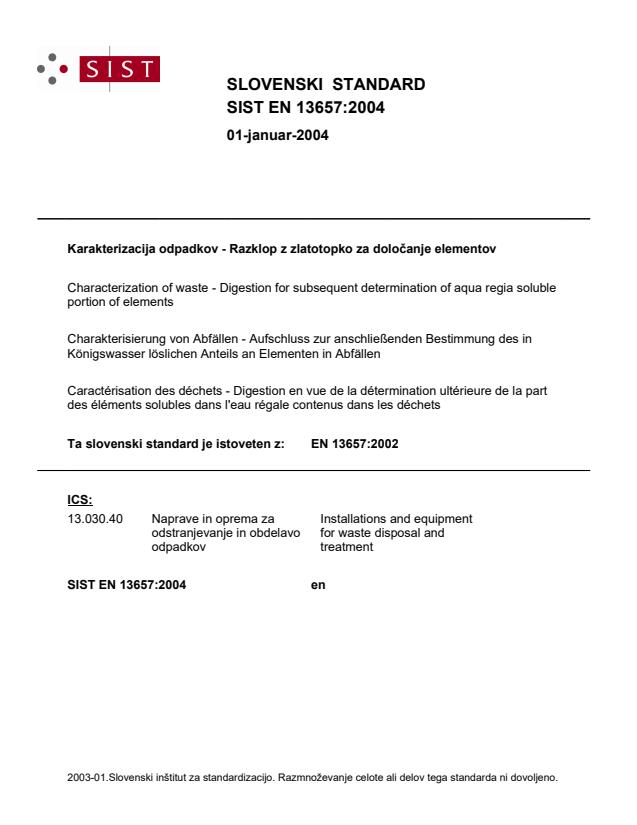
2003-01.Slovenski inštitut za standardizacijo. Razmnoževanje celote ali delov tega standarda ni dovoljeno.HQWRYCharakterisierung von Abfällen - Aufschluss zur anschließenden Bestimmung des in Königswasser löslichen Anteils an Elementen in AbfällenCaractérisation des déchets - Digestion en vue de la détermination ultérieure de la part des éléments solubles dans l'eau régale contenus dans les déchetsCharacterization of waste - Digestion for subsequent determination of aqua regia soluble portion of elements13.030.40Naprave in oprema za odstranjevanje in obdelavo odpadkovInstallations and equipment for waste disposal and treatmentICS:Ta slovenski standard je istoveten z:EN 13657:2002SIST EN 13657:2004en01-januar-2004SIST EN 13657:2004SLOVENSKI
STANDARD
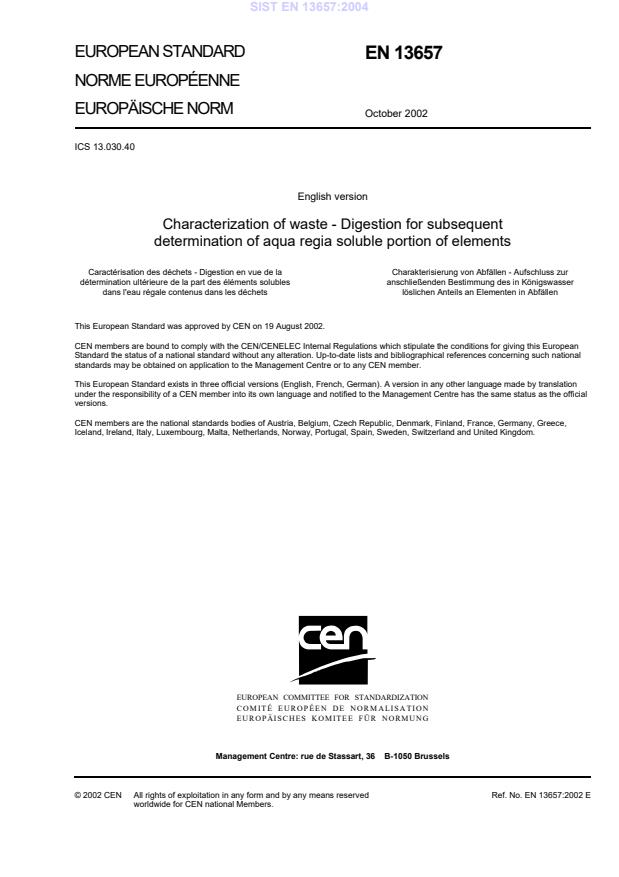
EUROPEAN STANDARDNORME EUROPÉENNEEUROPÄISCHE NORMEN 13657October 2002ICS 13.030.40English versionCharacterization of waste - Digestion for subsequentdetermination of aqua regia soluble portion of elementsCaractérisation des déchets - Digestion en vue de ladétermination ultérieure de la part des éléments solublesdans l'eau régale contenus dans les déchetsCharakterisierung von Abfällen - Aufschluss zuranschließenden Bestimmung des in Königswasserlöslichen Anteils an Elementen in AbfällenThis European Standard was approved by CEN on 19 August 2002.CEN members are bound to comply with the CEN/CENELEC Internal Regulations which stipulate the conditions for giving this EuropeanStandard the status of a national standard without any alteration. Up-to-date lists and bibliographical references concerning such nationalstandards may be obtained on application to the Management Centre or to any CEN member.This European Standard exists in three official versions (English, French, German). A version in any other language made by translationunder the responsibility of a CEN member into its own language and notified to the Management Centre has the same status as the officialversions.CEN members are the national standards bodies of Austria, Belgium, Czech Republic, Denmark, Finland, France, Germany, Greece,Iceland, Ireland, Italy, Luxembourg, Malta, Netherlands, Norway, Portugal, Spain, Sweden, Switzerland and United Kingdom.EUROPEAN COMMITTEE FOR STANDARDIZATIONCOMITÉ EUROPÉEN DE NORMALISATIONEUROPÄISCHES KOMITEE FÜR NORMUNGManagement Centre: rue de Stassart, 36
B-1050 Brussels© 2002 CENAll rights of exploitation in any form and by any means reservedworldwide for CEN national Members.Ref. No. EN 13657:2002 ESIST EN 13657:2004
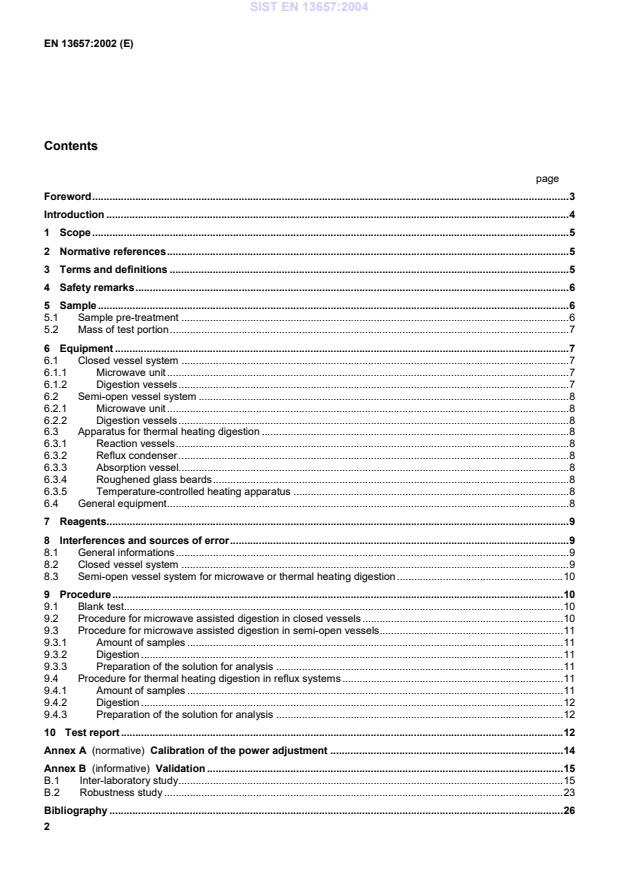
(normative)
Calibration of the power adjustment.14Annex B
(informative)
Validation.15B.1Inter-laboratory study.15B.2Robustness study.23Bibliography.26SIST EN 13657:2004
...
EN 13657:2002は、廃棄物の特性評価に関する重要な標準であり、特にアクアレジアによる消化法を通じて、元素のアクアレジア可溶部分を決定することに重点を置いています。この標準は、廃棄物の消化においてアルミニウム(Al)、アンチモン(Sb)、砒素(As)、ホウ素(B)、バリウム(Ba)、ベリリウム(Be)、カドミウム(Cd)、カルシウム(Ca)、クロム(Cr)、コバルト(Co)、銅(Cu)、鉄(Fe)、鉛(Pb)、マグネシウム(Mg)、マンガン(Mn)、水銀(Hg)、モリブデン(Mo)、ニッケル(Ni)、リン(P)、カリウム(K)、セレン(Se)、銀(Ag)、硫黄(S)、ナトリウム(Na)、ストロンチウム(Sr)、スズ(Sn)、テルル(Te)、チタン(Ti)、タリウム(Tl)、バナジウム(V)、亜鉛(Zn)を含む多様な元素の分析に適用可能です。 この標準の強みは、アクアレジアによる消化法が提供する高い汎用性にあります。この方法で得られる溶液は、原子吸光分光法(FLAAS、HGAAS、CVAAS、GFAAS)、誘導結合プラズマ発光分光法(ICP-OES)、および誘導結合プラズマ質量分析法(ICP-MS)を含む高度な分析手法に対して適しており、これにより分析の精度と再現性が大幅に向上しています。 EN 13657:2002は、環境管理や廃棄物処理の分野において、その適用範囲が広く、多くの産業での重要な基準となっています。そのため、廃棄物の特性評価を行う際には、この標準に従った手法を採用することが推奨されます。これにより、施設や企業は、環境規制の遵守を簡易化し、持続可能な運営を実現するための基盤を築くことができます。
La norme EN 13657:2002, intitulée "Caractérisation des déchets - Digestion pour la détermination ultérieure de la fraction soluble dans l'eau régale des éléments", se concentre sur des méthodes précises pour la digestion de déchets à l'aide de l'eau régale. Cette norme est essentielle pour assurer une analyse fiable des éléments en question à travers diverses techniques de spectrométrie, telles que la spectrométrie d'absorption atomique (FLAAS, HGAAS, CVAAS, GFAAS) ainsi que la spectrométrie d'émission par plasma à couplage inductif (ICP-OES) et la spectrométrie de masse par plasma à couplage inductif (ICP-MS). L'un des principaux atouts de cette norme réside dans son ample éventail d'applications. En effet, la méthode de digestion est adaptée à une vaste gamme d'éléments, notamment Al, Sb, As, B, Ba, Be, Cd, Ca, Cr, Co, Cu, Fe, Pb, Mg, Mn, Hg, Mo, Ni, P, K, Se, Ag, S, Na, Sr, Sn, Te, Ti, Tl, V, Zn, ce qui la rend extrêmement pertinente dans le cadre de la gestion et de l'analyse des déchets. Cette variabilité permet aux laboratoires de s'appuyer sur un seul et même standard pour analyser plusieurs catégories d'éléments, optimisant ainsi le processus analytique. En outre, cette norme garantit la qualité et la précision des résultats d'analyse, ce qui est crucial pour le respect des réglementations en matière de gestion des déchets. Elle répond aux besoins croissants en matière de sécurité environnementale et de santé publique, en offrant une méthode normalisée qui peut être utilisée à l'échelle internationale. L'importance de l'EN 13657:2002 est donc indéniable, tant pour le secteur industriel que pour les organismes de recherche, contribuant à une meilleure compréhension de la composition des déchets et à une gestion plus efficace des ressources.
표준 EN 13657:2002는 폐기물의 특성화에 대한 중요하고 구체적인 절차를 제공합니다. 이 표준의 주요 특징은 아쿠아 레지아를 이용한 소화 방법을 명확히 규정하고 있다는 점입니다. 사용자가 이 방법을 통해 생성된 용액은 원자 흡수 분광법(예: FLAAS, HGAAS, CVAAS, GFAAS), 유도 결합 플라즈마 방출 분광법(ICP-OES), 유도 결합 플라즈마 질량 분광법(ICP-MS)과 같은 다양한 분석 기법에 적합하다는 것입니다. 이 표준의 적용 범위는 알루미늄(Al), 안티모니(Sb), 비소(As), 붕소(B), 바륨(Ba), 베릴륨(Be), 카드뮴(Cd), 칼슘(Ca), 크롬(Cr), 코발트(Co), 구리(Cu), 철(Fe), 납(Pb), 마그네슘(Mg), 망간(Mn), 수은(Hg), 몰리브데넘(Mo), 니켈(Ni), 인(P), 칼륨(K), 셀레늄(Se), 은(Ag), 유황(S), 나트륨(Na), 스트론튬(Sr), 주석(Sn), 텔루륨(Te), 티타늄(Ti), 탈륨(Tl), 바나듐(V), 아연(Zn)과 같은 여러 원소의 소화에 해당된다. 이러한 폭넓은 원소 분석 기능은 폐기물 관리 및 환경 보호에 있어 중요한 접근 방식을 제시합니다. EN 13657:2002는 신뢰할 수 있는 결과를 제공하며, 다양한 실험실 환경에서 일관된 분석 결과를 보장하는 강점을 가지고 있습니다. 또한, 폐기물 특성화 과정에서의 표준화를 통해 데이터의 신뢰성을 높이고, 국제적으로 통용되는 분석 방법을 통해 연구자와 기술자들이 유효한 결과를 도출하는 데 기여합니다. 이 표준은 폐기물 관리와 환경에 대한 의식이 높아진 오늘날, 매우 중요한 역할을 하고 있습니다.
Die Norm EN 13657:2002 bietet eine umfassende Anleitung zur Charakterisierung von Abfällen durch die Methode der Verdauung mit Aqua Regia, um anschließend die löslichen Anteile von Elementen zu bestimmen. Der Anwendungsbereich dieser Norm ist entscheidend für die analytische Chemie, insbesondere in der Abfallbewirtschaftung und Umweltanalytik. Die Stärken der Norm liegen in der detaillierten Beschreibung der Verdauungsmethoden, die eine hohe Genauigkeit und Präzision bei der Analyse gewährleisten. Sie ermöglicht die Untersuchung einer breiten Palette von Elementen, darunter Aluminium (Al), Antimon (Sb), Arsen (As), Barium (Ba), Cadmium (Cd), Kupfer (Cu), Eisen (Fe), Blei (Pb), Quecksilber (Hg) und Zink (Zn). Dies macht sie zu einem wertvollen Instrument für Labore, die sich mit der Analyse von gefährlichen Abfällen und deren Umweltverträglichkeit befassen. Die Relevanz der EN 13657:2002 ist unbestreitbar, da sie nicht nur die Qualität der Analysen verbessert, sondern auch die Einhaltung gesetzlicher Vorgaben fördert. Die erstellten Lösungen sind für verschiedene Analysemethoden, einschließlich der Atomabsorptionsspektrometrie (FLAAS, HGAAS, CVAAS, GFAAS) sowie der induktiv gekoppelten Plasmaspektroskopie (ICP-OES, ICP-MS), geeignet. Dadurch wird sichergestellt, dass die Ergebnisse zuverlässig und reproduzierbar sind. Zusammenfassend lässt sich sagen, dass die EN 13657:2002 eine essentielle Norm für die Charakterisierung von Abfällen darstellt, die durch ihre präzisen Methoden und die breit gefächerte Anwendbarkeit in der Analyse von chemisch belasteten Abfällen beeindruckt.
The EN 13657:2002 standard provides a comprehensive framework for the characterization of waste materials through the digestion process using aqua regia. The primary scope of this standard is to establish standardized methods that facilitate the extraction of aqua regia soluble elements from various waste matrices. This process is critical for subsequent analytical determination of these elements, ensuring that results are both precise and comparable across different testing laboratories. One of the key strengths of EN 13657:2002 is its applicability to a broad range of elements including heavy metals and metalloids, such as Al, Cu, Pb, Hg, and As, among others. The inclusion of numerous elements ensures the standard addresses significant environmental and health concerns associated with waste materials, enhancing its relevance in ongoing waste assessment practices. Moreover, the document specifies that the digestion solutions produced through this standard can be analyzed using various advanced techniques, including atomic absorption spectrometry (FLAAS, HGAAS, CVAAS, GFAAS) and inductively coupled plasma methods (ICP-OES and ICP-MS). This versatility in analytical methods allows for flexibility in laboratory choice and capability, accommodating different instrumentation and expertise levels. Additionally, the standard provides clear procedural guidelines that promote consistency in testing, crucial for regulatory compliance and environmental monitoring. This emphasis on standardization enhances the credibility of waste characterization efforts, ensuring that data derived from such analyses can be reliably used for decision-making processes related to waste management. Given its robust methodology and broad applicability, EN 13657:2002 serves as a vital instrument for environmental professionals engaged in waste characterization, underlining its significance in the field of environmental science and waste management. Its strengths in standardizing the digestion of waste with aqua regia position it as an essential reference for ensuring accurate and reliable analysis of potentially hazardous elements.


Questions, Comments and Discussion
Ask us and Technical Secretary will try to provide an answer. You can facilitate discussion about the standard in here.
Loading comments...