

EN 10300:2005
(Main)Steel tubes and fittings for onshore and offshore pipelines - Bituminous hot applied materials for external coating
- Abstract
This European Standard specifies requirements for the application of factory applied external bitumen based hot applied coatings for the corrosion protection of steel tubes and fittings for onshore and offshore pipelines.
This specification covers the use of bitumen based enamel when the design temperature of the pipeline is within the following limits:
- oxidized bitumen - 15 °C to + 75 °C;
- modified bitumen - 30 °C to + 90 °C.
The coatings described in this European Standard can be applied to longitudinally or spirally welded tubes or to seamless tubes and fittings used for the construction of pipelines for the conveyance of liquids or gases.
NOTE Tubes coated with bitumen based enamel may be further protected by means of cathodic protection.
- Status
- Published
- Publication Date
- 08-Nov-2005
- Withdrawal Date
- 30-May-2006
- Technical Committee
- ECISS/TC 110 - Steel tubes, and iron and steel fittings
- Drafting Committee
- ECISS/TC 29/SC 4 - Coatings
- Current Stage
- 9093 - Decision to confirm - Review Enquiry
- Start Date
- 05-Jun-2026
- Completion Date
- 07-Oct-2026


Overview
EN 10300:2005 (CEN) - Steel tubes and fittings for onshore and offshore pipelines: bituminous hot applied materials for external coating - specifies requirements for factory-applied, bitumen-based hot coatings used for the corrosion protection of steel tubes and fittings. It covers coatings based on oxidized bitumen and modified bitumen (bitumen-based enamel) for pipelines conveying liquids or gases, applicable to longitudinally or spirally welded and seamless tubes and fittings.
Design temperature limits:
- Oxidized bitumen: −15 °C to +75 °C
- Modified bitumen: −30 °C to +90 °C
Note: EN 10300 allows use of these coatings in combination with cathodic protection and with additional mechanical protection (e.g., concrete weight coating) by agreement.
Key Topics and Requirements
- Coating composition: primer, bitumen-based enamel (with filler), inner-wrap glass fabric, outer-wrap glass/composite fabric, and optional solar/weather protection.
- Material identification & traceability: manufacturer, manufacture date, batch, standard reference, material type/grade and expiry (where applicable).
- Primer types: Primer Type 1 (chlorinated rubber-based) and Primer Type 2 (hydrocarbon resin-based) for cold application; specified flow, flash point and volatile-matter limits.
- Coating categories & grades:
- Category 1 = oxidized bitumen enamel (grades a, b, c)
- Category 2 = modified bitumen enamel (grades a, b)
Each grade has defined filler content, density, softening point, penetration, flash point, and performance targets.
- Performance tests: sag test, impact disbonding, peel (initial & delayed), bend test, cathodic disbonding, porosity, holiday detection, field bond test, inspection of coating thickness and more (numerous normative annexes detail test methods).
- Filler specification: non-hygroscopic mineral powder, stable at application temperature; grading requirements given (e.g., passing 90 µm ≥ 93%).
- Application, inspection & repairs: methods for factory application, quality control, handling, transport, storage, marking and repair procedures are defined.
Applications and Who Uses This Standard
- Pipeline manufacturers and coating companies applying factory bituminous hot-applied coatings.
- EPC contractors, pipeline engineers, asset owners and operators specifying external pipeline corrosion protection.
- Quality inspectors, testing laboratories and certification bodies performing coatings testing (sag, peel, cathodic disbonding, holiday testing).
- Procurement/spec writers creating technical specifications and tenders for onshore and offshore pipeline systems.
Keywords: EN 10300:2005, bituminous hot applied coatings, bitumen based enamel, pipeline external coating, steel tubes and fittings, corrosion protection, onshore offshore pipelines, coating testing, primer, filler, cathodic protection.
Related standards
Normative references included in EN 10300:2005 (selection): EN 1426, EN 1427, EN 1849‑1, EN 12311‑1, EN ISO 2431, EN ISO 2592, EN ISO 8501‑1, EN ISO 13736, ISO 719, ISO 2591‑1 and ASTM D737.
Relations
- Effective Date
- 10-Jun-2026
- Effective Date
- 10-Jun-2026
- Effective Date
- 27-May-2026
- Effective Date
- 28-Jan-2026
- Effective Date
- 28-Jan-2026
- Effective Date
- 28-Jan-2026
- Effective Date
- 28-Jan-2026
- Effective Date
- 28-Jan-2026
- Effective Date
- 28-Jan-2026
- Effective Date
- 28-Jan-2026
- Effective Date
- 28-Jan-2026
- Effective Date
- 28-Jan-2026
- Effective Date
- 28-Jan-2026
- Effective Date
- 28-Jan-2026
- Effective Date
- 28-Jan-2026
Get Certified
Connect with accredited certification bodies for this standard

DVS-ZERT GmbH
German welding certification society.

Element Materials Technology
Materials testing and product certification.
Institut za varilstvo d.o.o. (Welding Institute)
Slovenia's leading welding institute since 1952. ISO 3834, EN 1090, pressure equipment certification, NDT personnel, welder qualification. Only IIW Au
Sponsored listings
Frequently Asked Questions
EN 10300:2005 is a standard published by the European Committee for Standardization (CEN). Its full title is "Steel tubes and fittings for onshore and offshore pipelines - Bituminous hot applied materials for external coating". This standard covers: This European Standard specifies requirements for the application of factory applied external bitumen based hot applied coatings for the corrosion protection of steel tubes and fittings for onshore and offshore pipelines. This specification covers the use of bitumen based enamel when the design temperature of the pipeline is within the following limits: - oxidized bitumen - 15 °C to + 75 °C; - modified bitumen - 30 °C to + 90 °C. The coatings described in this European Standard can be applied to longitudinally or spirally welded tubes or to seamless tubes and fittings used for the construction of pipelines for the conveyance of liquids or gases. NOTE Tubes coated with bitumen based enamel may be further protected by means of cathodic protection.
This European Standard specifies requirements for the application of factory applied external bitumen based hot applied coatings for the corrosion protection of steel tubes and fittings for onshore and offshore pipelines. This specification covers the use of bitumen based enamel when the design temperature of the pipeline is within the following limits: - oxidized bitumen - 15 °C to + 75 °C; - modified bitumen - 30 °C to + 90 °C. The coatings described in this European Standard can be applied to longitudinally or spirally welded tubes or to seamless tubes and fittings used for the construction of pipelines for the conveyance of liquids or gases. NOTE Tubes coated with bitumen based enamel may be further protected by means of cathodic protection.
EN 10300:2005 is classified under the following ICS (International Classification for Standards) categories: 23.040.99 - Other pipeline components; 25.220.60 - Organic coatings; 75.180.10 - Exploratory, drilling and extraction equipment. The ICS classification helps identify the subject area and facilitates finding related standards.
EN 10300:2005 has the following relationships with other standards: It is inter standard links to ISO 719:1985, ISO 2591-1:1988, EN 1427:2026, EN ISO 8501-1:2007, EN ISO 11125-3:1997, EN ISO 13736:2021, EN 1426:2024, EN ISO 13230:1999, EN 1427:2015, EN ISO 2431:2019, EN 1849-1:1999, EN 12311-1:1999, EN ISO 2592:2017, EN ISO 20257-2:2021, EN ISO 10418:2019. Understanding these relationships helps ensure you are using the most current and applicable version of the standard.
EN 10300:2005 is associated with the following European legislation: Standardization Mandates: M/005. When a standard is cited in the Official Journal of the European Union, products manufactured in conformity with it benefit from a presumption of conformity with the essential requirements of the corresponding EU directive or regulation.
EN 10300:2005 is available in PDF format for immediate download after purchase. The document can be added to your cart and obtained through the secure checkout process. Digital delivery ensures instant access to the complete standard document.
Standards Content (Sample)
2003-01.Slovenski inštitut za standardizacijo. Razmnoževanje celote ali delov tega standarda ni dovoljeno.Jeklene cevi in fitingi za obalne in priobalne cevovode – Bitumenski materiali za zunanje prevlekeStahlrohre und -formstücke für erd- und wasserverlegte Rohrleitungen - Werksumhüllungen aus heiß aufgebrachtem BitumenTubes en acier et raccords pour canalisations enterrées et immergées - Revetements externes au moyen de matériaux hydrocarbonésSteel tubes and fittings for onshore and offshore pipelines - Bituminous hot applied materials for external coating77.140.75Jeklene cevi in cevni profili za posebne nameneSteel pipes and tubes for specific use25.220.60Organske prevlekeOrganic coatingsICS:Ta slovenski standard je istoveten z:EN 10300:2005SIST EN 10300:2006en01-januar-2006SIST EN 10300:2006SLOVENSKI
STANDARD
EUROPEAN STANDARDNORME EUROPÉENNEEUROPÄISCHE NORMEN 10300November 2005ICS 23.040.99; 25.220.60; 75.180.10 English VersionSteel tubes and fittings for onshore and offshore pipelines -Bituminous hot applied materials for external coatingTubes en acier et raccords pour canalisations enterrées etimmergées - Revêtements externes au moyen dematériaux hydrocarbonésStahlrohre und -formstücke für erd- und wasserverlegteRohrleitungen - Werksumhüllungen aus heißaufgebrachtem BitumenThis European Standard was approved by CEN on 25 March 2005.CEN members are bound to comply with the CEN/CENELEC Internal Regulations which stipulate the conditions for giving this EuropeanStandard the status of a national standard without any alteration. Up-to-date lists and bibliographical references concerning such nationalstandards may be obtained on application to the Central Secretariat or to any CEN member.This European Standard exists in three official versions (English, French, German). A version in any other language made by translationunder the responsibility of a CEN member into its own language and notified to the Central Secretariat has the same status as the officialversions.CEN members are the national standards bodies of Austria, Belgium, Cyprus, Czech Republic, Denmark, Estonia, Finland, France,Germany, Greece, Hungary, Iceland, Ireland, Italy, Latvia, Lithuania, Luxembourg, Malta, Netherlands, Norway, Poland, Portugal, Slovakia,Slovenia, Spain, Sweden, Switzerland and United Kingdom.EUROPEAN COMMITTEE FOR STANDARDIZATIONCOMITÉ EUROPÉEN DE NORMALISATIONEUROPÄISCHES KOMITEE FÜR NORMUNGManagement Centre: rue de Stassart, 36
B-1050 Brussels© 2005 CENAll rights of exploitation in any form and by any means reservedworldwide for CEN national Members.Ref. No. EN 10300:2005: ESIST EN 10300:2006
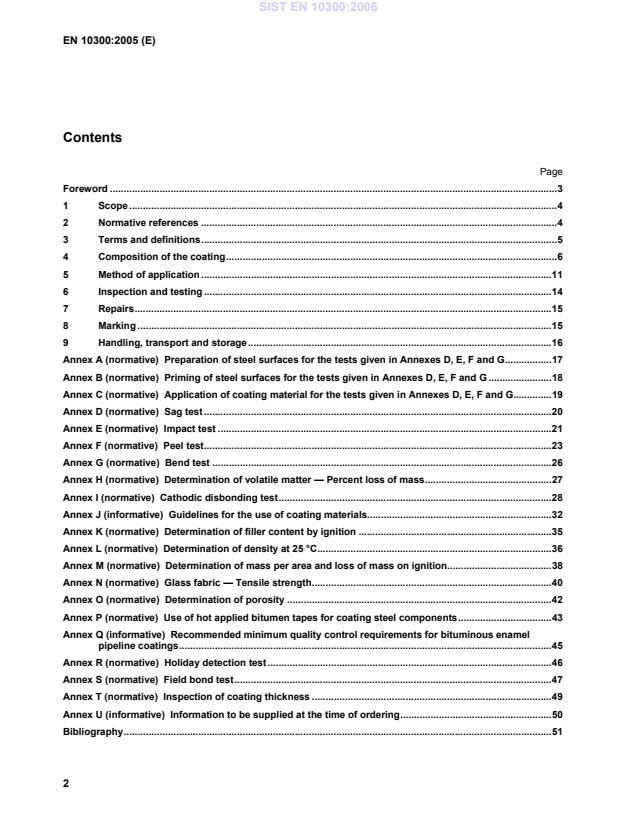
Preparation of steel surfaces for the tests given in Annexes D, E, F and G.17 Annex B (normative)
Priming of steel surfaces for the tests given in Annexes D, E, F and G.18 Annex C (normative)
Application of coating material for the tests given in Annexes D, E, F and G.19 Annex D (normative)
Sag test.20 Annex E (normative)
Impact test.21 Annex F (normative)
Peel test.23 Annex G (normative)
Bend test.26 Annex H (normative)
Determination of volatile matter — Percent loss of mass.27 Annex I (normative)
Cathodic disbonding test.28 Annex J (informative)
Guidelines for the use of coating materials.32 Annex K (normative)
Determination of filler content by ignition.35 Annex L (normative)
Determination of density at 25 °C.36 Annex M (normative)
Determination of mass per area and loss of mass on ignition.38 Annex N (normative)
Glass fabric — Tensile strength.40 Annex O (normative)
Determination of porosity.42 Annex P (normative)
Use of hot applied bitumen tapes for coating steel components.43 Annex Q (informative)
Recommended minimum quality control requirements for bituminous enamel pipeline coatings.45 Annex R (normative)
Holiday detection test.46 Annex S (normative)
Field bond test.47 Annex T (normative)
Inspection of coating thickness.49 Annex U (informative)
Information to be supplied at the time of ordering.50 Bibliography.51
% 20 Annex M Tensile strength, minimum
- longitudinally N/50 mm 150 - transverse
N/50 mm 50 EN 12311-1 modified as in Annex N Thickness, minimum mm 0,33 EN 1849-1a Porosity Pa 6 to 19 ASTM D737-96, Annex O a Modified to give a cross-sectional area of 645 mm2 and a pressure of 13,8 kPa. 4.2.6 Outer-wrap The outer-wrap shall have a uniform porosity which allows the air and fumes to escape and the hot coating to bleed through the outer-wrap ensuring it is fused into the outer surface. The outer-wrap shall have a uniform appearance free from holes, slits and other visible faults. The reinforcement yarns shall be spaced evenly across the width. At the time of unrolling at ambient temperature the successive layers of outer-wrap shall not stick to each other. The bitumen based material used for impregnation shall be compatible with the bitumen based enamel coating material. The outer-wrap shall meet the requirements of the type selected from Table 7. NOTE For Guidelines on the use of outer-wrap, see Annex J. SIST EN 10300:2006
A B C D E F
Type of base glass/carrier
non-woven glass fibre tissue non-woven glass fibre tissue woven glass fibre
composite glass fibre
composite glass/ polyester fibre
composite glass/ polyester fibre
Mass per area of base glass before impregnation, minimum g/m2 50 80 170 90 70 110 Annex M Outer-wrap Mass per area, minimum g/m2 450 550 250 500 450 450 Annex M Thickness, minimum mm 0,6 0,76 0,76 0,76 0,5 0,6 EN 1849-1 a Tensile strength, minimum
- longitudinal N/50 mm 300 300 800 700 400 800 - transverse N/50 mm 150 230 800 700 200 800 EN 12311-1 modified as in Annex N a Modified to give a cross-sectional area of 645 mm2 and a pressure of 13,8 kPa. 4.2.7 Hot applied bitumen based tapes NOTE Tubes may be coated by the use of pre-formed hot applied bitumen based tapes. The process is analogous to flood coating or extrusion coating but differs significantly in its detail. For guidelines on the use of hot applied bitumen based tapes, see Annex J. Composition, use and application of hot applied bitumen based tapes shall be in accordance with Annex P. 5 Method of application 5.1 Surface preparation 5.1.1 General Tubes and components shall be maintained at least 3 °C above the dew point temperature at all times during the cleaning and coating process. NOTE At the time of application, particularly when the weather is damp and cold, it may be necessary to pre-heat the tubes and components, and this operation should not be prejudicial to the cleanliness of the surface or to the conditions required for the application of the primer. 5.1.2 Pre-blast requirements Immediately prior to blast cleaning, the tubes shall be inspected for surface contamination (oil, grease, temporary corrosion protection, etc.). Where oil, grease or other surface contaminants are present they shall be removed (without spreading over the surface) with a suitable solvent (e.g. Xylene) or a biodegradable emulsifier. SIST EN 10300:2006
100 mm × 20 mm in size shall be taken immediately after coating from one tube in twenty. One sample shall be taken along the weld. The samples shall be examined in cross-section to ascertain the distribution of the inner-wraps through the enamel. For Category 1 enamels, the inner-wraps shall be completely embedded within the enamel. The position of the inner-wraps shall be such that they are evenly spaced through the enamel and at no point more than 1 mm from the surface of the metal or 1 mm from the outside surface of the coating. Each reinforcement shall be free from folds, wrinkles and voids. If any of the three samples indicates that the coating does not meet the requirements specified in 4.2.5, then the coating shall be considered defective and shall be stripped and re-coated. 6.3 Holiday detection Holiday detection shall be carried out on every coated tube as specified in Annex R. The coating shall be free from holidays. 6.4 Adhesion A field bond test shall be conducted on the coated tubes 24 h after coating on one tube in every 20. Three tests shall be conducted on each selected tube. The coating shall adhere to the steel in accordance with the limits specified in Annex S. SIST EN 10300:2006
Preparation of steel surfaces for the tests given in Annexes D, E, F and G Prepare the steel surfaces used in the tests given in Annexes D, E, F and G as follows. Clean the surface of the steel plate from all contamination by oil and grease. Then, blast it to a uniform steel grey finish, removing rust, scale and all other foreign matter to achieve a minimum standard of Sa 2½ (according to
EN ISO 8501-1) and so that the surface profile is 75 µm ± 25 µm. NOTE It is important to ensure that blasted steel surfaces are free from traces of previous coating materials and do not subsequently become contaminated with oil or grease. SIST EN 10300:2006
Priming of steel surfaces for the tests given in Annexes D, E, F and G B.1 General After preparing the steel surfaces by the method given in Annex A, prime them using an appropriate primer as specified in 4.2.2.1. B.2 Method for primer Types 1 and 2 See 4.2.2.2 and 4.2.2.3. Apply the primer with a clean flat bristle brush of 25 mm width to the plates lying in a horizontal position. Apply the primer at the coverage rate detailed in 5.2 in such a manner that the surface is uniformly covered with an even film free from air bubbles. Allow the primer to dry at an air temperature of not less than 15 °C, in a well ventilated atmosphere having a relative humidity not greater than 60 %. B.3 Coating When the film is hard dry, apply coating material to the plate by the method given in Annex C, not less than 1 h after application of the primer. B.4 Other primer types See 4.2.2.4. NOTE Other primer types and the subsequent enamel should be applied in accordance with the manufacturer’s recommendations. SIST EN 10300:2006
Application of coating material for the tests given in Annexes D, E, F and G Break approximately 7 kg of the coating material, according to the number of tests required, into pieces not greater than 50 mm size. Melt the pieces in a container of uniform cross-section not less than 150 mm or more than 300 mm in diameter, and fitted with a lid. Heat the container so that the coating material reaches the application temperature recommended by the manufacturer within 2 h. NOTE 1 Heating may be by any convenient method such as a fluidized or liquid bath, electric hot-plate or gas. If gas is used, interpose a steel plate of not less than 6 mm thickness between the container and the gas flame. Stir the material frequently until it reaches the application temperature recommended by the manufacturer, replacing the lid between intervals of stirring. Immediately after it has reached the application temperature, pour the coating material over the primed surface of each plate, held in a horizontal position and at a temperature between 15 °C and 30 °C, in such a manner that fresh enamel constantly flows onto the specimen surface. Apply the coating material to a thickness of 1,5 mm to 2,5 mm to each test specimen. NOTE 2 It is convenient to adjust to this thickness immediately after coating by sweeping off the surplus hot enamel with a warmed blade moved along guide rails set for the required thickness. SIST EN 10300:2006
Sag test D.1 Principle Measurement of resistance of the coating to slump under its own weight. D.2 Apparatus Oven, capable of maintaining a temperature of 70 ºC ± 2 ºC. D.3 Preparation of test specimens Prepare one steel test plate, measuring at least 300 mm × 300 mm × 3 mm, by the method given in Annex A, prime it by the method given in Annex B and coat it with coating material prepared by the method given in Annex C. Leave a 15 mm uncoated border around the four edges of the plate. Draw three lines parallel with one edge at 75 mm intervals across the surface of the coating material and continued on the uncoated surface of the plate to the edges. Draw the lines in such a way that the prepared surface is not damaged. D.4 Procedure Store the plate in a vertical position in an oven. Maintain the oven (see Clause D.2.1) at the temperature and for the period specified for the appropriate grades in Table 4 and Table 6. At the end of this period remove the plate and allow it to cool to room temperature. Measure the maximum sag of each line on the plate. In cases of disagreement, repeat the test on two fresh specimens. D.5 Measurement of results Record the sag of the coating material as the average of the maximum sags of the three lines. D.6 Test report Report the average sag in mm at the test temperature. SIST EN 10300:2006
Impact test E.1 Principle The area of disbonded coating resulting from the impact of a steel ball dropped from a height of 2,45 m is measured. E.2 Apparatus E.2.1 Refrigerator. E.2.2 Lint-free paper towel. E.2.3 Cold cabinet. E.2.4 Block of wood. E.3 Preparation of test specimens E.3.1 General Prepare a test plate, measuring approximately 300 mm × 300 mm × 12,5 mm, by the method given in Annex A, prime it by the method given in Annex B and coat it with coating material prepared by the method given in Annex C. E.3.2 For test at 0 °C After preparation allow the plate to reach room temperature and then maintain it at a temperature of 0 °C ± 1 °C in a refrigerator (see E.2.1) for 6 h before testing. Remove the plate quickly from the refrigerator, dry it with a lint-free paper towel (see E.2.2) if necessary and subject it to the impact test. E.3.3 For test at 25 °C Allow the plate to reach room temperature and then maintain it at a temperature of 25 °C ± 1 °C in an oven for at least 6 h before testing. Remove the plate quickly from the oven, dry it with a lint-free paper towel if necessary and subject it to the impact test. E.3.4 For test at - 10 °C Allow the plate to reach room temperature and then maintain it at a temperature of − 10 °C ± 1 °C in a cold cabinet (see E.2.3) for at least 6 h before testing. Remove the plate quickly from the cold cabinet, dry it with a lint-free paper towel if necessary and subject it to the impact test. E.4 Procedure for tests at - 10 °C, 0 °C and 25 °C Support the plate on a flat horizontal surface of a block of wood (see E.2.4) with the coated face uppermost. Drop a 630 g to 650 g spherical steel ball with a well polished surface from a height of 2,45 m above the surface of the plate, so as to strike the coating material at the centre of the plate. SIST EN 10300:2006
...