

EN 14394:2005+A1:2008
(Main + Amendment)Heating boilers - Heating boilers with forced draught burners - Nominal heat output not exceeding 10 MW and maximum operating temperature of 110 °C
General Information
- Abstract
This European Standard specifies the requirements and test methods for the design, manufacturing, safe operation and the rational energy usage for standard boilers and low temperature boilers (with "boiler" in the sense of "boiler body") from steel and cast iron to be equipped with separately marketed forced draught burners according to the relevant burner standards (for automatic forced draught burners for gaseous fuels see EN 676 and for atomising oil burners see EN 267) up to a nominal heat output of 10 MW. They are operated, either with negative pressure (natural draught boiler) or with positive pressure (pressurised boiler) in the combustion chamber, in accordance with the boiler manufacturer's instructions."
This European Standard specifies requirements for boilers with normal operating temperatures between 100 °C and 110 °C and has a "dual structure":
- For boilers where the shut off temperature of the safety temperature limiter does not exceed 110 °C the Pressure Equipment Directive (PED) requires" Sound Engineering Practice",
- For boilers where the shut off temperature of the safety temperature limiter exceeds 110 °C this European Standard specifies the requirements of the PED as stated in Annex ZB.
NOTE 1 The "maximum allowable temperature TS" is defined in the PED and its Guidelines."
Boilers in accordance with this European Standard are designed for the heating of central heating installations in which the heat carrier is water, and the maximum allowable operating temperature of which is up to 110 C and the maximum safety temperature limiter of 120 C. The maximum allowable operating pressure is 10 bar.
This standard does not apply to gas boilers with atmospheric burners, boilers for solid fuels, oil or gas fired condensation boilers, boilers with oil vaporisation burners. For these boilers there are further requirements.
For gas-fired central heating boilers equipped with a forced draught burner of nominal heat out put not exceeding 1000 kW,
- Status
- Published
- Publication Date
- 05-Aug-2008
- Technical Committee
- CEN/TC 57 - Central heating boilers
- Drafting Committee
- CEN/TC 57/WG 4 - Low pressure boilers
- Current Stage
- 9060 - Closure of 2 Year Review Enquiry - Review Enquiry
- Start Date
- 04-Mar-2022
- Completion Date
- 04-Mar-2022
- Directive
- 2014/68/EU - Directive 2014/68/EU of the European Parliament and of the Council of 15 May 2014 on the harmonisation of the laws of the Member States relating to the making available on the market of pressure equipmentOJ Ref: C 293/01 OJ Date: 12-Aug-2016
97/23/EC - Pressure equipmentOJ Ref: C, C 81 OJ Date: 04-Apr-2009


Overview
EN 14394:2005+A1:2008 is a CEN European Standard for heating boilers with forced draught burners. It applies to steel and cast‑iron boiler bodies designed for central heating systems with a nominal heat output up to 10 MW and a maximum operating temperature of 110 °C. The standard sets requirements and test methods for design, manufacture, safe operation and rational energy use of such boilers when fitted with separately marketed forced‑draught burners (gas burners per EN 676, oil atomising burners per EN 267).
Key limits:
- Maximum operating temperature: 110 °C
- Maximum safety temperature limiter: 120 °C
- Maximum allowable operating pressure: 10 bar
EN 14394 has a dual structure addressing the relationship with the Pressure Equipment Directive (PED):
- For boilers with safety limiter shut‑off ≤ 110 °C, the PED requires Sound Engineering Practice.
- For boilers with shut‑off > 110 °C the standard specifies PED requirements (see informative Annex ZB).
Key topics and requirements
- Design and manufacturing criteria for standard and low‑temperature boilers (boiler body definition).
- Materials and welding: references to steel, cast iron and relevant welding qualification and procedure standards.
- Safety and protection: safety temperature limiter, pressure limits, and safeguards against excessive pressure.
- Testing and performance: factory and type tests, test pressures, efficiency/heat output definitions and measurement.
- Technical documentation: required documentation to demonstrate conformity and safe operation.
- Energy efficiency and operation: guidance on rational energy use and operation with negative or positive combustion chamber pressure.
- Normative references: linked standards for testing, burners, piping, welding, electrical controls and heating system design.
Practical applications
EN 14394 is intended for:
- Design and production of non‑condensing, forced‑draught central heating boilers (steel or cast iron bodies).
- Type testing and factory testing programs for boiler manufacturers.
- Specifying safety and performance requirements in tender documents and procurement.
- Compliance assessment where PED interfaces with boiler operating temperatures.
It excludes gas boilers with atmospheric burners, boilers for solid fuels, condensing boilers and oil vapourisation burners - these have separate requirements.
Who should use this standard
- Boiler manufacturers and designers
- Product compliance and PED conformity engineers
- Testing laboratories and notified bodies
- Installers, system designers and HVAC engineers specifying central heating plant
- Procurement/specification professionals and regulatory authorities
Related standards
- EN 676 (automatic forced‑draught gas burners)
- EN 267 (atomising oil burners)
- EN 303‑3 / EN 303 series (related heating boiler parts and assemblies)
- EN 12953 (shell boilers > 10 MW)
- Various EN/ISO welding, tubing, piping and electrical control standards referenced in EN 14394
Keywords: EN 14394, heating boilers, forced draught burners, 10 MW, 110 °C, Pressure Equipment Directive, central heating boilers, boiler testing, boiler design.
Relations
- Effective Date
- 18-Jan-2023
- Effective Date
- 22-Dec-2008
- Effective Date
- 25-Aug-2026
- Effective Date
- 25-Aug-2026
- Effective Date
- 25-Aug-2026
- Effective Date
- 25-Aug-2026
- Effective Date
- 25-Aug-2026
- Effective Date
- 07-Jul-2026
- Effective Date
- 09-Feb-2026
- Effective Date
- 09-Feb-2026
- Effective Date
- 09-Feb-2026
- Effective Date
- 28-Jan-2026
- Effective Date
- 28-Jan-2026
- Effective Date
- 28-Jan-2026
- Effective Date
- 28-Jan-2026
Get Certified
Connect with accredited certification bodies for this standard

DIBt (Deutsches Institut für Bautechnik)
German Institute for Building Technology.
DIN CERTCO
DIN Group product certification.

Aboma Certification B.V.
Specialized in construction, metal, and transport sectors.
Sponsored listings
Frequently Asked Questions
EN 14394:2005+A1:2008 is a standard published by the European Committee for Standardization (CEN). Its full title is "Heating boilers - Heating boilers with forced draught burners - Nominal heat output not exceeding 10 MW and maximum operating temperature of 110 °C". This standard covers: This European Standard specifies the requirements and test methods for the design, manufacturing, safe operation and the rational energy usage for standard boilers and low temperature boilers (with "boiler" in the sense of "boiler body") from steel and cast iron to be equipped with separately marketed forced draught burners according to the relevant burner standards (for automatic forced draught burners for gaseous fuels see EN 676 and for atomising oil burners see EN 267) up to a nominal heat output of 10 MW. They are operated, either with negative pressure (natural draught boiler) or with positive pressure (pressurised boiler) in the combustion chamber, in accordance with the boiler manufacturer's instructions." This European Standard specifies requirements for boilers with normal operating temperatures between 100 °C and 110 °C and has a "dual structure": - For boilers where the shut off temperature of the safety temperature limiter does not exceed 110 °C the Pressure Equipment Directive (PED) requires" Sound Engineering Practice", - For boilers where the shut off temperature of the safety temperature limiter exceeds 110 °C this European Standard specifies the requirements of the PED as stated in Annex ZB. NOTE 1 The "maximum allowable temperature TS" is defined in the PED and its Guidelines." Boilers in accordance with this European Standard are designed for the heating of central heating installations in which the heat carrier is water, and the maximum allowable operating temperature of which is up to 110 C and the maximum safety temperature limiter of 120 C. The maximum allowable operating pressure is 10 bar. This standard does not apply to gas boilers with atmospheric burners, boilers for solid fuels, oil or gas fired condensation boilers, boilers with oil vaporisation burners. For these boilers there are further requirements. For gas-fired central heating boilers equipped with a forced draught burner of nominal heat out put not exceeding 1000 kW,
This European Standard specifies the requirements and test methods for the design, manufacturing, safe operation and the rational energy usage for standard boilers and low temperature boilers (with "boiler" in the sense of "boiler body") from steel and cast iron to be equipped with separately marketed forced draught burners according to the relevant burner standards (for automatic forced draught burners for gaseous fuels see EN 676 and for atomising oil burners see EN 267) up to a nominal heat output of 10 MW. They are operated, either with negative pressure (natural draught boiler) or with positive pressure (pressurised boiler) in the combustion chamber, in accordance with the boiler manufacturer's instructions." This European Standard specifies requirements for boilers with normal operating temperatures between 100 °C and 110 °C and has a "dual structure": - For boilers where the shut off temperature of the safety temperature limiter does not exceed 110 °C the Pressure Equipment Directive (PED) requires" Sound Engineering Practice", - For boilers where the shut off temperature of the safety temperature limiter exceeds 110 °C this European Standard specifies the requirements of the PED as stated in Annex ZB. NOTE 1 The "maximum allowable temperature TS" is defined in the PED and its Guidelines." Boilers in accordance with this European Standard are designed for the heating of central heating installations in which the heat carrier is water, and the maximum allowable operating temperature of which is up to 110 C and the maximum safety temperature limiter of 120 C. The maximum allowable operating pressure is 10 bar. This standard does not apply to gas boilers with atmospheric burners, boilers for solid fuels, oil or gas fired condensation boilers, boilers with oil vaporisation burners. For these boilers there are further requirements. For gas-fired central heating boilers equipped with a forced draught burner of nominal heat out put not exceeding 1000 kW,
EN 14394:2005+A1:2008 is classified under the following ICS (International Classification for Standards) categories: 01.040.91 - Construction materials and building (Vocabularies); 91.140.10 - Central heating systems. The ICS classification helps identify the subject area and facilitates finding related standards.
EN 14394:2005+A1:2008 has the following relationships with other standards: It is inter standard links to EN 14394:2005/prA1, EN 14394:2005, ISO 185:2005, ISO 7005-2:1988, ISO 857-1:1998, ISO 7005-1:1992, ISO 7005-3:1988, EN IEC 60730-2-9:2026, EN IEC 60335-1:2023, EN 60529:1991, EN IEC 60730-2-9:2019, EN 304:2017, EN 10226-1:2004, EN 12828:2012+A1:2014, EN 10088-1:2023. Understanding these relationships helps ensure you are using the most current and applicable version of the standard.
EN 14394:2005+A1:2008 is associated with the following European legislation: EU Directives/Regulations: 2014/68/EU, 92/42/EEC, 97/23/EC; Standardization Mandates: M/066, M/071. When a standard is cited in the Official Journal of the European Union, products manufactured in conformity with it benefit from a presumption of conformity with the essential requirements of the corresponding EU directive or regulation.
EN 14394:2005+A1:2008 is available in PDF format for immediate download after purchase. The document can be added to your cart and obtained through the secure checkout process. Digital delivery ensures instant access to the complete standard document.
Standards Content (Sample)
2003-01.Slovenski inštitut za standardizacijo. Razmnoževanje celote ali delov tega standarda ni dovoljeno.Heizkessel - Heizkessel mit Gebläsebrennern - Nennwärmeleistung kleiner oder gleich 10 MW und einer maximalen Betriebstemperatur von 110 °CChaudières de chauffage - Chaudières avec brûleurs à air soufflé - Puissance utile inférieure ou égale à 10 MV et température maximale de service de 110 °CHeating boilers - Heating boilers with forced draught burners - Nominal heat output not exceeding 10 MW and maximum operating temperature of 110 °C91.140.10Sistemi centralnega ogrevanjaCentral heating systemsICS:Ta slovenski standard je istoveten z:EN 14394:2005+A1:2008SIST EN 14394:2006+A1:2008en,fr,de01-december-2008SIST EN 14394:2006+A1:2008SLOVENSKI
STANDARD
EUROPEAN STANDARD NORME EUROPÉENNE EUROPÄISCHE NORM
EN 14394:2005+A1
August 2008 ICS 01.040.91; 91.140.10 Supersedes EN 14394:2005 English Version
Heating boilers - Heating boilers with forced draught burners - Nominal heat output not exceeding 10 MW and maximum operating temperature of 110 °C
Chaudières de chauffage - Chaudières avec brûleurs à air soufflé - Puissance utile inférieure ou égale à 10 MW et température maximale de service de 110 °C
Heizkessel - Heizkessel mit Gebläsebrennern - Nennwärmeleistung kleiner oder gleich 10 MW und einer maximalen Betriebstemperatur von 110 °C This European Standard was approved by CEN on 14 October 2005 and includes Amendment 1 approved by CEN on 28 June 2008.
CEN members are bound to comply with the CEN/CENELEC Internal Regulations which stipulate the conditions for giving this European Standard the status of a national standard without any alteration. Up-to-date lists and bibliographical references concerning such national standards may be obtained on application to the CEN Management Centre or to any CEN member.
This European Standard exists in three official versions (English, French, German). A version in any other language made by translation under the responsibility of a CEN member into its own language and notified to the CEN Management Centre has the same status as the official versions.
CEN members are the national standards bodies of Austria, Belgium, Bulgaria, Cyprus, Czech Republic, Denmark, Estonia, Finland, France, Germany, Greece, Hungary, Iceland, Ireland, Italy, Latvia, Lithuania, Luxembourg, Malta, Netherlands, Norway, Poland, Portugal, Romania, Slovakia, Slovenia, Spain, Sweden, Switzerland and United Kingdom.
EUROPEAN COMMITTEE FOR STANDARDIZATION
COMITÉ EUROPÉEN DE NORMALISATION EUROPÄISCHES KOMITEE FÜR NORMUNG
Management Centre: rue de Stassart, 36
B-1050 Brussels © 2008 CEN All rights of exploitation in any form and by any means reserved worldwide for CEN national Members. Ref. No. EN 14394:2005+A1:2008: ESIST EN 14394:2006+A1:2008
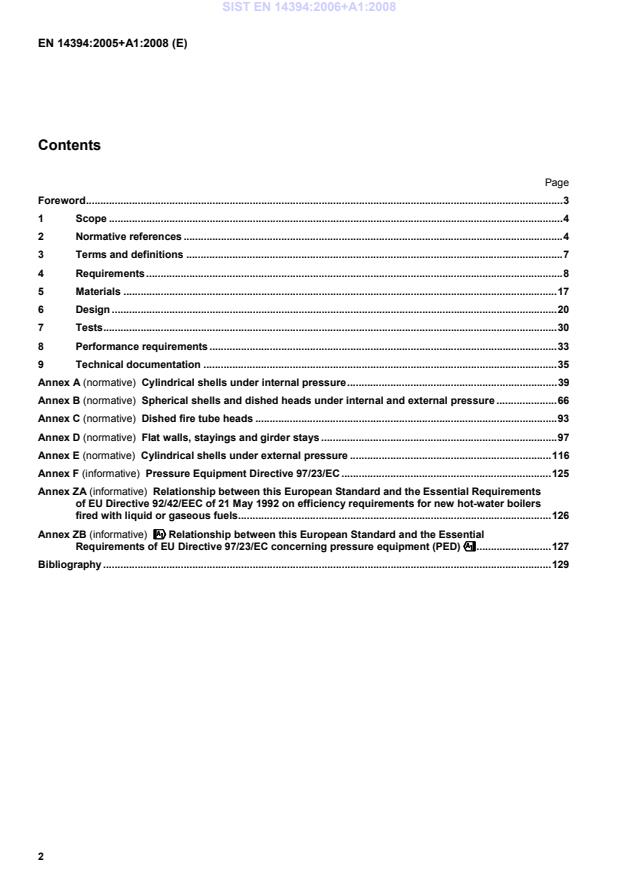
Cylindrical shells under internal pressure.39 Annex B (normative)
Spherical shells and dished heads under internal and external pressure.66 Annex C (normative)
Dished fire tube heads.93 Annex D (normative)
Flat walls, stayings and girder stays.97 Annex E (normative)
Cylindrical shells under external pressure.116 Annex F (informative)
Pressure Equipment Directive 97/23/EC.125 Annex ZA (informative)
Relationship between this European Standard and the Essential Requirements of EU Directive 92/42/EEC of 21 May 1992 on efficiency requirements for new hot-water boilers fired with liquid or gaseous fuels.126 Annex ZB (informative)
!!!!Relationship between this European Standard and the Essential Requirements of EU Directive 97/23/EC concerning pressure equipment (PED)"""".127 Bibliography.129
— Consideration of the Directive 97/23/EC Pressure Equipment Directive (PED) and including of Annex ZB;
— Correction of some typing errors. This document has been prepared under a mandate given to CEN by the European Commission and the European Free Trade Association and supports essential requirements of EU Directives. !For relationship with EU Directives, see informative Annexes ZA and ZB, which are integral parts of this document." !The requirements and test methods related to the Essential Requirements of the Council Directive 90/396/EEC relating to appliances burning gaseous fuels (Gas Appliance Directive – GAD) for assemblies made up of a boiler body complying with EN 303-1 and a forced draught gas burner complying with EN 676 with a nominal heat output not exceeding 1.000 kW are covered in the Harmonized European Standard EN 303-3:1998 and its Amendment A2:2004. For assemblies with a heat output between 1.000 kW and 10 MW however no Harmonized European Standard does exist at the moment. The relevant clauses of EN 303-3:1998 can be taken as a basis to prove conformity with the essential requirements of the GAD." This European Standard specifies requirements for boilers operating with a temperature of 100 °C and 110 °C which are not covered by the Pressure Equipment Directive (PED, TS < 110 °C), on the other hand the document specifies requirements for those boilers, which have a maximum allowable temperature TS > 110 °C (according to the PED). According to the CEN/CENELEC Internal Regulations, the national standards organizations of the following countries are bound to implement this European Standard: Austria, Belgium, Bulgaria, Cyprus, Czech Republic, Denmark, Estonia, Finland, France, Germany, Greece, Hungary, Iceland, Ireland, Italy, Latvia, Lithuania, Luxembourg, Malta, Netherlands, Norway, Poland, Portugal, Romania, Slovakia, Slovenia, Spain, Sweden, Switzerland and United Kingdom. SIST EN 14394:2006+A1:2008
1 Scope !This European Standard specifies the requirements and test methods for the design, manufacturing, safe operation and the rational energy usage for standard boilers and low temperature boilers (with „boiler" in the sense of „boiler body") from steel and cast iron to be equipped with separately marketed forced draught burners according to the relevant burner standards (for automatic forced draught burners for gaseous fuels see EN 676 and for atomising oil burners see EN 267) up to a nominal heat output of 10 MW. They are operated, either with negative pressure (natural draught boiler) or with positive pressure (pressurised boiler) in the combustion chamber, in accordance with the boiler manufacturer's instructions." !This European Standard specifies requirements for boilers with normal operating temperatures between 100 °C and 110 °C and has a "dual structure": • For boilers where the shut off temperature of the safety temperature limiter does not exceed 110 °C the Pressure Equipment Directive (PED) requires" Sound Engineering Practice",
• For boilers where the shut off temperature of the safety temperature limiter exceeds 110 °C this European Standard specifies the requirements of the PED as stated in Annex ZB. NOTE 1 The "maximum allowable temperature TS" is defined in the PED and its Guidelines." Boilers in accordance with this European Standard are designed for the heating of central heating installations in which the heat carrier is water, and the maximum allowable operating temperature of which is up to 110 °C and the maximum safety temperature limiter of 120 °C. The maximum allowable operating pressure is 10 bar. This standard does not apply to gas boilers with atmospheric burners, boilers for solid fuels, oil or gas fired condensation boilers, boilers with oil vaporisation burners. For these boilers there are further requirements. For gas-fired central heating boilers equipped with a forced draught burner of nominal heat out put not exceeding 1000 kW, see !EN 303-7". For shell boilers with a nominal heat output exceeding 10 MW and a maximum safety temperature limiter exceeding 120 °C, see EN 12953 series. !NOTE 2 Definitions for standard boiler and low temperature boiler see Council Directive 92/42/EEC." 2 Normative references The following referenced documents are indispensable for the application of this European Standard. For dated references, only the edition cited applies. For undated references, the latest edition of the referenced document (including any amendments) applies. EN 267, Forced draught oil burners – Definitions, requirements, testing, marking EN 287–1, Qualification test of welders – Fusion welding – Part 1: Steels !deleted text" EN 303–1, Heating boilers - Part 1: Heating boilers with forced draught burners - Terminology, general requirements, testing and marking EN 303-2, Heating boilers - Part 2: Heating boilers with forced draught burners - Special requirements for boilers with atomising oil burners !EN 303-3, Heating boilers - Part 3: Gas-fired central heating boilers - Assembly comprising a boiler body and a forced draught burner" SIST EN 14394:2006+A1:2008
EN 10217-4, Welded steel tubes for pressure purposes - Technical delivery conditions - Part 4: Electric welded non-alloy steel tubes with specified low temperature properties EN 10217-5, Welded steel tubes for pressure purposes - Technical delivery conditions - Part 5: Submerged arc welded non-alloy and alloy steel tubes with specified elevated temperature properties EN 10217-6, Welded steel tubes for pressure purposes - Technical delivery conditions - Part 6: Submerged arc welded non-alloy steel tubes with specified low temperature properties EN 10217-7, Welded steel tubes for pressure purposes - Technical delivery conditions - Part 7: Stainless steel tubes EN 10226-1, Pipe threads where pressure tight joints are made on the threads - Part 1: Taper external threads and parallel internal threads - Dimensions, tolerances and designation
EN 10226-3, Pipes threads where pressure tight joint are made on the threads - Part 3: Verification by means of limit gauges SIST EN 14394:2006+A1:2008
maximum/minimum temperatures for which the equipment is designed, as specified by the manufacturer 3.4.2 operating temperature maximum allowable temperature at which the boiler can be operated under normal operation conditions at the maximum setting of the boiler's water temperature controller 3.5 heat output P (heat output range) amount of heat transferred to the water per unit of time The heat output range is the span of output below the nominal heat output specified by the manufacturer over which the boiler meets the requirements of this standard and over which it can be used. 3.6 nominal heat output !!!!Pn"""" continuous output specified by the manufacturer in accordance with the requirements of this standard. It is the maximum useful quantity of heat transferred to the heat carrier per hour 3.7
heat input QB amount of heat in unit time which is supplied to the furnace of the heating boiler by the fuel based on its net calorific value Hi 3.8 boiler efficiency !!!!K"""" ratio of the nominal output (Pn) to the heat input (QB) supplied by the fuel BnKQP=η 3.9 required draught pressure differential between the static air pressure in the place of installation and the static pressure of the exhaust gases, as measured in the exhaust gas measuring section, which is required for correct operation of the boiler at nominal output SIST EN 14394:2006+A1:2008
EN ISO 15614-2, EN ISO 15610, EN ISO 15611, EN ISO 15612 and EN ISO 15613 !deleted text". SIST EN 14394:2006+A1:2008
Remarks 1.1 Square butt weld
one side
both sides
≤ 6
(8)
135 12 131 (111)
Permissible up to t = 8 mm on use of deep penetration electrodes or welding on both sides 1.2 Square butt weld
≥
6 up to 12
Root gap b =
2 mm to 4 mm with stiffener, powder holder necessary 1.3 Square butt weld (double)
>
8 up to 12
135 12 (111)
Root gap b = 2 mm to 4 mm Deep penetration electrodes shall be used for manual electro welding SIST EN 14394:2006+A1:2008
Table 1 (continued) No. Term Material thick-ness t in mm Welding process a
Remarks 1.4 Single-V butt weld
up to 12
(111)
Weld preparation V-seam 60° 1.5 Single-V butt weld
a) 30 ° to 50 °
up to 12
135 12
Weld preparation V-seam 30° to 50° depending on thickness of material 1.6 Double-V butt weld
a) 30 ° to 50 °
greater than 12
135 12
Weld preparation double V-seam 30° to 50° depending on material thickness
Remarks 1.7 Butt weld between plates with raised edges
≤ 6
135 141 131 (111)
Only permissible in exceptional cases for parts welded in. Moreover, the welds have to be kept largely free from bending stresses. Not suitable for directly fired wall parts s = 0,8 t 2 Fillet weld
≤ 6
135 12 (111)
Welds of this type are to be kept largely free from bending stressesa = t
≤ 12
135 12 (111)
a = t 2.1 Double fillet weld
> 12 135 12 (111) a = 2/3 t SIST EN 14394:2006+A1:2008
Remarks
≤ 12
135 12 (111)
A = t 2.2 Double-bevel butt weld
> 12 135 12 (111)
a = 2/3 t
≤ 12
135 12 (111)
For (111) β = 60° 2.3 Single-bevel butt weld
> 12 135 12 For 135, 12 β = 45° to 50° 2.4 Single-bevel butt weld
≤ 12
135 12 (111)
For (111) β = 60° For 135, 12 β = 45° to 50° SIST EN 14394:2006+A1:2008
Table 1 (continued) No. Term Material thick-ness t in mmWelding process a Remarks 2.5
≤ 12
(111)
Tube end shall not project beyond fillet weld if it is subjected to heat radiation 2.6
≤ 6
135 (111)
Welding in of tube under high thermal stress a ≥ t SIST EN 14394:2006+A1:2008
Table 1 (continued) No. Term Material thick-ness t in mmWelding process a Remarks 2.7
135 (111)
Welding in of tube under high thermal stress For (111) β = 60° For 135 β = 45° to 50° a Reference numbers of welding processes in accordance with ISO 857-1 or EN ISO 4063. Reference number Process 12 111 131 135 141 Submerged arc welding Metal-arc welding with covered electrode Metal-arc inert gas welding; MIG welding Metal-arc-active gas welding; MAG welding Tungsten inert gas arc welding; TIG welding
4.2 !!!!Burner matching 4.2.1 Matching with forced draught oil burner according to EN 267 - The requirements according to EN 303-2 have to be met, or
in case of nominal heat input exceeds the range of the scope according to EN 303-2, - the tests according EN 303-2 have to be carried out. 4.2.2 Matching with automatic forced draught burner for gaseous fuels according to EN 676 - The requirements according to EN 303-3 have to be met, or in case of nominal heat input exceeds the range of the scope according to EN 303-3, - the tests according to EN 303-3 have to be carried out."
5.2 Steel boiler 5.2.1 The following plates and forgings from carbon steels according to EN 10025-1 to -3 should apply within the following limits: grade S 235 JRG 2 for wall thickness up to 20 mm.
A particular material appraisal is required to confirm that the material has sufficient ductility for the application.
These grades are only permitted for a max. temperature of 300 °C to determine from the reference temperature and the temperature allowance according to Table 5. These grades are not applicable for flame tubes and other similar components in contact with fire for steam boilers with an allowable operating pressure greater than 6 bar. 5.2.2 The following plates from carbon steels according to EN 10028-2 should apply within the following limits: grade P 235 GH, P 265 GH and P 295 GH. These grades apply for heated cylindrical shells under external pressure (flame tubes) for wall thickness up to 22 mm and for heated straight wall thickness up to 25 mm. 5.2.3 For tubes, see EN 10216-1 to EN 10216-5 (seamless steel tubes for pressure purposes) and EN 10217-1 to EN 10217-7 (welded steel tubes for pressure purposes). 5.2.4 Plates and strips of stainless steels All materials according to EN 10088-1 and EN 10088-2 can be used. A particular material appraisal is required to confirm that the material has sufficient ductility for the application. 5.3 Boilers of cast materials 5.3.1 General The manufacturer shall have personnel and equipment capable of carrying out the necessary material tests. During the manufacture of the boiler and other cast iron parts subject to pressure the following tests shall be carried out using separately cast test pieces for each batch: a) tensile test in accordance with ISO 185, Type A; the values given in Table 2 are to be confirmed by the tensile test; SIST EN 14394:2006+A1:2008
Table 2 −−−− Minimum requirements on cast iron Cast iron with lamellar graphite a
(EN 1561) – Tensile strength Rm ≥ 200 N/mm2 – Brinell hardness according to EN 1561 EN-GJL 200
160 HB to 220 HB 2,5/187,5 Spheroidal graphite iron (ferritically annealed; EN 1563): – Tensile strength Rm ≥ 400 N/mm2 – Impact value according to EN 1563 EN-GJS 400 ≥ 23 J/cm2 a In agreement with the competent person a lamellar graphite with a minimum tensile strength (determined at tensile test piece) can be used which is 10 % below the value of the minimum tensile strength.
5.3.3 Cast parts of non-ferrous metals subject to pressure according to Table 3 and 4 Table 3 −−−− Examples of aluminium and aluminium alloys
ThicknessTensile strengthRm Temperature range
Mm N/mm2 °C Al 99,5 up to 50 75 min. up to 300 Al Mg2 Mn 0,8 up to 50 275 min. up to 250
Table 4 −−−− Examples for copper and copper alloys
ThicknessTensile strengthRm Temperature range
mm N/mm2 °C SF - Cu up to 5 200 up to 250 Cu Ni 30 Fe up to 10 310 up to 350
5.3.4 Tube connections for heating boilers from cast and valves of copper alloys Tube connections from cast up to G1½:
this applies only for a max. allowable operating pressure of ≤ 6 bar. Valves with a nominal diameter ≤ DN 200:
made from cast with lamellar graphite. Valves of copper alloys:
G-CuSn5ZnPb, G-CuSn10Zn, G-CuSn10, G-Cu5SZnMn, G-CuAl9, G-CuPb5Sn, GK-CuZn37Pb and CuZn40. SIST EN 14394:2006+A1:2008
6.1.1 The boilers are designed by calculation as given below. For materials given in 5.1 the calculated values of Table 5 may be used. For the calculated strength-test the calculation for predominantly loads due to internal or external pressure is sufficient. !An experimental design method can be applied. The wall thickness shall not in any case be less than that given in Table 6." 6.1.2 For boilers up to a nominal heat output of ≤ 350 kW with a max. allowable operating pressure up to 6 bar - the calculation for the strength according to 6.1.1 - can be replaced by a hydraulic pressure test with a max. permissible operating pressure of 2 x p1. During the test the boiler shall not shown any visible deformation and leakage. 6.1.3 For boilers up to a nominal heat output of > 350 kW and ≤ 2000 kW with a max. allowable operating pressure ≤ 6 bar, the calculation for the strength according to 6.1.1 can be limited on components accessible for calculation, if the hydraulic pressure test carried out with a test pressure of 2 x p1. Table 5 −−−− Calculation values for yield stress at room temperature and the 0,2 %-proof stress at higher temperature for plates of steel S 235 JRG 2 (according to EN 10025-1 to -3) Wall thickness
Yield stress at room temperature 0,2 %-proof stress a
in N/mm2 mm N/mm2 100 °C 200 °C 250 °C 300 °C≤ 16 205 187 161 143 122 > 16 195 180 155 136 117 a The strength values for 100 °C apply also for 120 °C. For the other ranges a linear interpolation may be applied; up-rounding is not permissible.
in kW Minimum wall thickness a
in mm
Ferritic steels Austenitic steels according to EN 10088-1 and
EN 10088-2 and other stainless steels For walls of the combustion chamber in contact with fire and water and flat walls of the convection heating surface ≤ 100 4 2
> 100 ≤ 300 5 3
> 300 ≤
4000 6 4
> 4000 8 4 For walls only in contact with water and for rigidly stable ≤ 100 3 1
> 100 ≤ 300 4 2
> 300 5 2 Other tubes
2,9; 2 mm for outside diameter < 17,2 mm, non-heated tubes 1 a Deviations are possible if calculated - according to Annexes A to E – within the fixed limits (see A.7) or if no calculation is possible and the boiler has passed the test
6.1.4 Basis for calculation 6.1.4.1 The calculation applies for static loads. 6.1.4.2 Deviations from the calculation equations are possible if it is provided by other means e. g. material testing, experiments, stress analyses, or the like that the safety requirements are meet. 6.1.4.3 Some important values for calculation to be used and symbols/units are given in Table 7. The meaning of the head indicators and subscripts is explained in Table 8. 6.1.4.4 !The design pressure p1 shall be greater than or equal to the maximum allowable pressure PS." 6.1.4.5 The design temperature is composed of the reference temperature and the temperature allowance according to Table 9. The temperature allowances shall be considered minimum values. For boilers with reliable, thermostatically controlled flow temperature (type-tested safety temperature limiters are considered to be reliable). 6.1.4.6 The allowable stress σzul is decisive for the dimensioning due to predominantly static loading and is obtained from Equation (1) to read SK = σzul (1) in which case the resulting smallest value is decisive which is obtained from the ratio of the design strength values K to the safety factors S from Table 10. SIST EN 14394:2006+A1:2008
for equipment subjected to destructive and non-destructive tests which confirm that the whole series of joints show no significant defects: 1; for equipment subject to random non-destructive testing: 0,85; for equipment not subjected to non-destructive testing other than visual inspection: 0,7. If necessary, the type of stress and the mechanical and technological properties of the joint may also be taken into account. The non-destructive tests (NDT) of permanent joints shall be carried out by suitable qualified personnel.
Table 7 −−−− Design values with symbols and units Symbol Design value Unit B Width mm c Wall thickness allowance mm d Diameter mm h Height mm L Length mm p Design pressure (gauge) N/mm2 P0 Absolute pressure (thermodynamic and hydrodynamic parameter) N/mm2 PS
Maximum allowable pressure N/mm2 P2 Allowable total pressure (gauge) (e. g. for hot water generators) N/mm2 P3 Barometric pressure (atmospheric air pressure) N/mm2 P4 (Applicable) working gauge pressure N/mm2 P5 Hydrostatic head N/mm2 P6 Dynamic pressure drop (pressure drops due to friction, acceleration, deflection, etc.) N/mm2 P' Test pressure N/mm2 r Radius mm s Required wall thickness of main body weakened by openings, and with allowance mm
Table 7 (continued) Symbol Design value Unit se Actual wall thickness mm so Wall thickness of main body, without openings, and without allowances mm v Ligament efficiency, weld factor − A Area mm2 E Modulus of elasticity N/mm2 F Force N G Shear modulus N/mm2 I Second moment of area mm4 K Design strength value N/mm2 M Moment N/mm S Safety factor − S' Safety factor, during pressure test − U Out-of-roundness % δ5 Elongation at fracture (gauge length ration = 5) % ϑ Design temperature °C υ Poisson's ratio = 0,3 for steel − ϕ Angle degrees σ Stress N/mm2 σ Mean stress N/mm2 σ1 Longitudinal stress N/mm2 σu Circumferential stress N/mm2 σv Stress intensity N/mm2 σzul Allowable stress under static loading N/mm2 !σ~" Allowable stress under cyclic loading N/mm2 σ( Minimum value for tensile strength at 20 °C N/mm2 σS Allowable stress under test pressure p N/mm2
Table 8 −−−− Head superscript and subscripts Superscript or subscript Meaning Head superscript ^ Maximum value, e. g. pˆ Head superscript ∨ Minimum value, e. g. p( Head superscript – Mean value, e. g. σφHeadφsuperscriptφ~φPulsating,φe.φg.φσ~ Head superscript ' Pertaining to pressure test, e. g. p' Subscript Numerical index, e. g. ni
Unheated components Heated components
Heating predominantly by Screened against radiation
Radiation Convection
Water, or water/steam mixture Saturation temperature at allowable working gauge pressure p1, or allowable total pressure p2, respectively 0 °C 50 °C for headers (30 + 3 x se) °C, at least 50 °C (15 + 2 x se) °C, but 50 °C max. 20 °C
Table 10 −−−− The design strength values K and related safety factors S for rolled and forged steels with acceptance test certificate to EN 10204 for material (δδδδ5 ≥≥≥≥ 14 %) Design strength values
K covering materials Safety factor
S
for internal pressure for external pressure Bσ( at 20 °C 2,4 2,4 ϑσ/S( or σ0.2/'ϑ 1,5 1,8
Table 11 −−−− Design strength values K and related safety factors S at test pressure p' Material Design strength values
K a
Safety factors
S a Rolled and forged steels σS at 20 °C 1,05 Cast steel σS at 20 °C 1,33 Cast iron with nodular graphite σS at 20 °C 2,2 Cast iron with lamellar graphite σS at 20 °C 5,0 a Only for components without openings or branches
6.1.5 Cylindrical shells under internal pressure See Annex A. 6.1.6 Spherical shells and dished heads under internal and external pressure See Annex B. 6.1.7 Dished fire tube heads See Annex C. SIST EN 14394:2006+A1:2008
lamellar graphite, aluminium mm Spheroidal ferritic graphite-annealed copper mm !Pn" ≤ 30 3,5 3,0 30 < !Pn" ≤ 70 4,0 3,5 70 < !Pn" ≤ 300 4,5 4,0 300 < !Pn" ≤ 1000 5,5 5,0 1000 < !Pn" 6,5 6,0
6.3 Further requirements 6.3.1 Venting of the water space and flue gas passages The boiler and its parts shall be designed in such a way that the water spaces can be properly vented. The boiler shall be so designed that under normal operation in accordance with the manufacturer's instructions no undue boiling noises occur. The combustion chamber and the flue gas passages shall be designed in such a way that no dangerous accumulation of combustible gases is possible. 6.3.2 Cleaning of heating surfaces The heating surfaces shall be accessible from the flue gas side for inspection and cleaning with chemical agents and brushes by means of a sufficient number and appropriate arrangement of cleaning openings. If special tools (for example special brushes) are required for cleaning and maintenance of the boiler these shall be supplied. 6.3.3 Inspection of the flame A facility shall be provided which allows inspection of the flame. It shall permit assessment of the flame and shall be SIST EN 14394:2006+A1:2008
EN 14394:2005+A1:20
...