

EN 17968:2026
(Main)Rough-terrain variable-reach tractors - Safety requirements and verification for permanently mounted equipment
- Abstract
This document specifies the safety requirements relevant to load-handling functions for rough-terrain variable reach tractors (RTVR tractors). This includes the safety requirements for their permanently mounted equipment (PME).
Fork arms are considered to be part of the PME. RTVR tractors can also be equipped with a variety of attachments (e.g. bale spikes, mowers, sweepers).
This document deals with all the significant hazards, hazardous situations and events relevant to the operation of the PME of RTVR tractors when they are used as intended and under conditions of misuse which are reasonably foreseeable by the manufacturer (see Annex A).
This document does not apply to:
— rough-terrain variable-reach trucks covered by EN 1459 1:2025;
— slewing rough-terrain variable-reach trucks covered by EN 1459 2:2015+A1:2018;
— industrial variable reach trucks covered by EN ISO 3691 2:2023;
— lorry-mounted variable-reach trucks covered by ISO 20297 1:2017;
— RTVR tractors fitted with tilting or elevating operator position;
— mobile cranes covered by EN 13000:2010+A1:2014;
— machines designed primarily for earth moving, even if their buckets and blades are replaced with forks (see the EN 474 series);
— RTVR tractors designed primarily with variable length load suspension elements (e.g. chain, ropes) from which the load can swing freely in all directions;
— RTVR tractors designed primarily for container handling;
— RTVR tractors on tracks;
— RTVR tractors with articulated chassis;
— front loaders covered by EN 12525:2000+A2:2010;
— attachments.
Determination and declaration of sound power level is not addressed by this document.
This document does not cover sales literature.
Consistency of single lever (if fitted) and movement of the RTVR tractor when travelling in the forward direction is not covered by this document.
This document does not address hazards linked to:
— operation of the RTVR tractor from a position other than the normal operating position or the remote control;
— gas power systems;
— gasoline engine systems.
This document does not address hazards which can occur:
a) when handling suspended loads which can swing freely (additional requirements are given in EN 1459 4:2020+A1:2025);
b) when using RTVR tractors on public roads;
c) when operating in potentially explosive atmospheres (additional requirements are given in EN 1755:2024);
d) when operating underground;
e) when towing trailers;
f) when fitted with a personnel work platform (additional requirements are given in EN 1459 3:2015 and EN 1459 9:2021);
g) when using system capable of controlling the speed of the RTVR tractor as set by the operator (cruise-control).
This document does not provide a method of calculation for fatigue and strength of material.
This document is not applicable to RTVR tractors manufactured before the date of its publication.
- Status
- Published
- Publication Date
- 27-Oct-2026
- Technical Committee
- CEN/TC 150 - Industrial Trucks - Safety
- Drafting Committee
- CEN/TC 150/WG 2 - Variable reach trucks
- Current Stage
- 6060 - Definitive text made available (DAV) - Publishing
- Start Date
- 28-Oct-2026
- Due Date
- 31-Mar-2025
- Completion Date
- 31-Mar-2025

EN 17968:2026 is a CEN European Standard for rough-terrain variable-reach tractors (RTVR tractors) and their permanently mounted equipment (PME). It specifies safety requirements and verification methods for load-handling functions, including fork arms as part of the PME, so manufacturers, test labs, safety bodies, users and service teams can judge whether a machine is covered and how to check it.
What does EN 17968:2026 specify?
EN 17968:2026 specifies the safety requirements relevant to load-handling functions on RTVR tractors, and it covers the hazards that arise when the PME is used as intended or in reasonably foreseeable misuse. It also sets out how those requirements are verified and how the machine is to be marked and described for use.
The scope is focused on RTVR tractors with permanently mounted load-handling equipment. It excludes other machine families and special applications, so it is not the right document for a machine outside that narrow category.
Main exclusions include:
- rough-terrain variable-reach trucks covered by EN 1459-1:2025 and EN 1459-2:2015+A1:2018
- industrial variable reach trucks, lorry-mounted variable-reach trucks, mobile cranes, front loaders, machines for earth moving, container handling machines, tracked machines and articulated-chassis machines
- RTVR tractors with tilting or elevating operator position, with suspended-load handling by free-swinging load suspension elements, or fitted with a personnel work platform
- attachments, sound power declaration, sales literature, public-road use, underground use, explosive atmospheres, towing trailers and cruise-control
The document is arranged in six main clauses:
- Clause 1 Scope
- Clause 2 Normative references
- Clause 3 Terms and definitions
- Clause 4 Safety requirements and/or protective/risk reduction measures
- Clause 5 Verification of safety requirements and/or protective/risk reduction measures
- Clause 6 Information for use
It also has three annexes:
- Annex A, informative, lists significant hazards
- Annex B, informative, gives consistency of motions
- Annex C, normative, gives rules for pedal construction and layout
What are the key requirements of EN 17968:2026?
EN 17968:2026 turns the risk areas of an RTVR tractor into concrete design, verification and instruction duties. The main practical message is that the machine must not only work, it must also control unintended movement, protect the operator, stay stable, and be usable and maintainable in a predictable way.
Safety functions and control behaviour
Clause 4.2 requires protection against unauthorized starting, unintended movement and uncontrolled motion. The machine must not start with the drive system engaged, powered travel must not occur when the operator is away from the normal operating position, and the parking brake must not create unsafe automatic behaviour when it is applied or released.
Clause 4.3 requires braking performance that can hold the laden machine on the maximum slope permitted by the manufacturer. In practice, that means the brake design must be checked against the heaviest real use case, not just against an empty machine.
Clause 4.4 requires safety-related parts of control systems to meet a required performance level required (PLr) or safety integrity level (SIL) according to Table 2, and it sets protection against ingress, wiring identification and electric shock protection. The practical effect is that safety functions such as motion interlocks and remote-control safety cannot be left to informal design choices.
Operator controls, remote control and stability aids
Clause 4.5 governs controls at the normal operating position. It covers differential locking, steering direction, load-handling controls, multi-function controls, stabilizing device controls, sway and levelling control, and axle oscillation locking. Annex C adds the pedal layout rules, so foot controls have a fixed and understandable arrangement.
Clause 4.6 covers remote control for boom and carriage motion. When remote control is used, the normal operating-position controls are largely excluded, and an emergency stop must be available at the normal operating position. This matters because the operator must not be able to command conflicting movements from two places.
Clause 4.8 and 4.14 require stabilizing devices, load holding and overall stability measures to support safe lifting. The machine must carry a longitudinal load moment indicator (LLMI) and a longitudinal load moment control (LLMC), and it must meet the relevant stability tests. That means the manufacturer must set load limits and stability conditions that the operator can actually follow.
Lifting, structure and the operator’s station
Clause 4.10 covers chains, wire ropes, the hydraulic system, load holding, stroke limitation, fork arms and the attachment interface. It sets strength and protection expectations for the parts that carry the load, so failure of one component does not lead to a drop, over-travel or disconnection.
Clause 4.11 and 4.13 focus on the operator’s station and protective structures. The standard requires restraint, visibility, lighting, hot-part protection, guards, and Roll-Over Protective Structures (ROPS) and Falling-Object Protective Structures (FOPS). In practice, the operator must be protected not only from normal operation but also from falling objects, crush points and loss of visibility.
Clause 4.9 covers maintenance safety, including boom support devices and support devices for tiltable cabs. That matters because some hazards only appear during servicing, when parts are raised, opened or partly dismantled.
Verification, markings and instructions
Clause 5 says the manufacturer must verify the design by checks, measurements, visual examination and tests. Structural verification includes static and dynamic tests on the fully assembled machine, and load holding is verified separately. This gives buyers and inspectors a clear route from the design claim to a checkable result.
Clause 6 requires markings, warning symbols, an instruction handbook, PME marking and load charts. The operator needs the approved load chart, the warnings and the operating and maintenance instructions to use the machine within its intended limits.
What terms does EN 17968:2026 define?
- Rough-terrain variable-reach tractor (RTVR tractor) - a tractor with one telescopic articulated arm that is non-slewing, or slews only a small amount around the longitudinal axis, for stacking loads.
- Permanently mounted equipment (PME) - the load-handling part of the RTVR tractor that is not intended to be removed in normal use and carries the load handling device.
- Compact rough-terrain variable-reach tractor - an RTVR tractor with a maximum height in normal travel mode of 2 150 mm and meeting the size or operating-mass condition in the definition.
- Actual capacity (Q) - the maximum load the manufacturer establishes for a given configuration, based on strength and stability.
- Rated capacity (Q1) - the maximum load permitted on fork arms in normal conditions with the boom fully retracted.
- Reach (d) - the horizontal distance used to define how far the load is from the front tyres.
- Lift height (H) - the vertical distance from the upper face of the fork arms to the ground.
- Stabilizing devices - extendable or pivoting supports that improve stability when the machine is stationary.
Who uses EN 17968:2026?
EN 17968:2026 is used by machine manufacturers, safety bodies, users, employers and service providers. Manufacturers use it for design, risk reduction, verification, marking and the instruction handbook. Safety bodies and market surveillance teams use it to assess whether a machine’s control functions, stability features, load charts and warnings match a common safety baseline. Buyers, operators and maintenance teams use it to compare equipment, check operating limits and plan safe use and servicing.
What changed in EN 17968:2026 from the previous edition?
EN 17968:2026 supersedes CEN/TS 1459-8:2018. The European foreword states these changes from the previous edition:
- alignment to EN 1459-1:2025
- update of normative references
- other minor changes, mainly editorial clarifications of existing requirements
Which standards are used with EN 17968:2026?
| Standard | What it contributes |
|---|---|
| EN ISO 12100 | Risk assessment, risk reduction and general rules for information for use |
| EN ISO 13849-1 and EN IEC 62061 | Functional safety of safety-related control parts |
| EN ISO 4413 | Hydraulic system safety rules |
| EN ISO 3471 and EN ISO 3449 | ROPS and FOPS requirements |
| ISO 22915-14, ISO 22915-10 and ISO 22915-20 | Stability verification and special stability tests |
| EN 15000 | Longitudinal load moment indicator and limiter requirements and related testing |
| EN 15830 | Visibility test methods and verification |
| EN 12053 and EN 13059 | Noise and vibration test methods |
| ISO 15817 and ISO 15818 | Remote control systems and lifting/tie-down attachment points |
| EN 1459-5 | Attachment interface requirements |
| EN ISO 13850 and EN ISO 13857 | Emergency stop and safety distances |
| EN 60529 | Degrees of protection for enclosures |
| EN ISO 6683 and EN 17314 | Operator restraint systems |
What does the EN 17968:2026 document contain?
EN 17968:2026 contains detailed clauses for the main hazard groups on RTVR tractors, including starting and stopping, braking, electrical systems, controls, remote control, power systems, stabilizing devices, lifting and reaching, operator station design, access, protective structures, stability, visibility, lighting, fire protection, retrieval and lifting points, noise and electromagnetic radiation. It also includes verification methods such as design checks, functional tests, static and dynamic structural tests, load-holding verification and measurement-based checks.
The document includes Table 2 for safety-related control system performance, Table 3 for chain strength factors, Figure 2 for capacity and reach parameters, and Figure 14 as an example load chart. Annex C includes pedal definitions, layout rules and a pedal-layout figure, which is useful when checking whether the machine’s foot controls are arranged and marked consistently.
Relations
- Effective Date
- 28-Dec-2022
- Effective Date
- 22-Nov-2026
- Effective Date
- 22-Nov-2026
- Effective Date
- 22-Nov-2026
- Effective Date
- 22-Nov-2026
- Effective Date
- 22-Nov-2026
- Refers
EN 15830:2012 - Rough-terrain variable reach trucks - Visibility - Test methods and verification - Effective Date
- 22-Nov-2026
- Effective Date
- 22-Nov-2026
- Effective Date
- 22-Nov-2026
- Effective Date
- 22-Nov-2026
- Effective Date
- 22-Nov-2026
- Effective Date
- 22-Nov-2026
- Effective Date
- 22-Nov-2026
- Effective Date
- 22-Nov-2026
- Effective Date
- 22-Nov-2026
Get Certified
Connect with accredited certification bodies for this standard

Control Union Certifications
Global certification for agriculture and sustainability.

ECOCERT
Organic and sustainability certification.

FSC International
Forest Stewardship Council certification.
Sponsored listings
Frequently Asked Questions
EN 17968:2026 is a draft published by the European Committee for Standardization (CEN). Its full title is "Rough-terrain variable-reach tractors - Safety requirements and verification for permanently mounted equipment". This standard covers: This document specifies the safety requirements relevant to load-handling functions for rough-terrain variable reach tractors (RTVR tractors). This includes the safety requirements for their permanently mounted equipment (PME). Fork arms are considered to be part of the PME. RTVR tractors can also be equipped with a variety of attachments (e.g. bale spikes, mowers, sweepers). This document deals with all the significant hazards, hazardous situations and events relevant to the operation of the PME of RTVR tractors when they are used as intended and under conditions of misuse which are reasonably foreseeable by the manufacturer (see Annex A). This document does not apply to: — rough-terrain variable-reach trucks covered by EN 1459 1:2025; — slewing rough-terrain variable-reach trucks covered by EN 1459 2:2015+A1:2018; — industrial variable reach trucks covered by EN ISO 3691 2:2023; — lorry-mounted variable-reach trucks covered by ISO 20297 1:2017; — RTVR tractors fitted with tilting or elevating operator position; — mobile cranes covered by EN 13000:2010+A1:2014; — machines designed primarily for earth moving, even if their buckets and blades are replaced with forks (see the EN 474 series); — RTVR tractors designed primarily with variable length load suspension elements (e.g. chain, ropes) from which the load can swing freely in all directions; — RTVR tractors designed primarily for container handling; — RTVR tractors on tracks; — RTVR tractors with articulated chassis; — front loaders covered by EN 12525:2000+A2:2010; — attachments. Determination and declaration of sound power level is not addressed by this document. This document does not cover sales literature. Consistency of single lever (if fitted) and movement of the RTVR tractor when travelling in the forward direction is not covered by this document. This document does not address hazards linked to: — operation of the RTVR tractor from a position other than the normal operating position or the remote control; — gas power systems; — gasoline engine systems. This document does not address hazards which can occur: a) when handling suspended loads which can swing freely (additional requirements are given in EN 1459 4:2020+A1:2025); b) when using RTVR tractors on public roads; c) when operating in potentially explosive atmospheres (additional requirements are given in EN 1755:2024); d) when operating underground; e) when towing trailers; f) when fitted with a personnel work platform (additional requirements are given in EN 1459 3:2015 and EN 1459 9:2021); g) when using system capable of controlling the speed of the RTVR tractor as set by the operator (cruise-control). This document does not provide a method of calculation for fatigue and strength of material. This document is not applicable to RTVR tractors manufactured before the date of its publication.
This document specifies the safety requirements relevant to load-handling functions for rough-terrain variable reach tractors (RTVR tractors). This includes the safety requirements for their permanently mounted equipment (PME). Fork arms are considered to be part of the PME. RTVR tractors can also be equipped with a variety of attachments (e.g. bale spikes, mowers, sweepers). This document deals with all the significant hazards, hazardous situations and events relevant to the operation of the PME of RTVR tractors when they are used as intended and under conditions of misuse which are reasonably foreseeable by the manufacturer (see Annex A). This document does not apply to: — rough-terrain variable-reach trucks covered by EN 1459 1:2025; — slewing rough-terrain variable-reach trucks covered by EN 1459 2:2015+A1:2018; — industrial variable reach trucks covered by EN ISO 3691 2:2023; — lorry-mounted variable-reach trucks covered by ISO 20297 1:2017; — RTVR tractors fitted with tilting or elevating operator position; — mobile cranes covered by EN 13000:2010+A1:2014; — machines designed primarily for earth moving, even if their buckets and blades are replaced with forks (see the EN 474 series); — RTVR tractors designed primarily with variable length load suspension elements (e.g. chain, ropes) from which the load can swing freely in all directions; — RTVR tractors designed primarily for container handling; — RTVR tractors on tracks; — RTVR tractors with articulated chassis; — front loaders covered by EN 12525:2000+A2:2010; — attachments. Determination and declaration of sound power level is not addressed by this document. This document does not cover sales literature. Consistency of single lever (if fitted) and movement of the RTVR tractor when travelling in the forward direction is not covered by this document. This document does not address hazards linked to: — operation of the RTVR tractor from a position other than the normal operating position or the remote control; — gas power systems; — gasoline engine systems. This document does not address hazards which can occur: a) when handling suspended loads which can swing freely (additional requirements are given in EN 1459 4:2020+A1:2025); b) when using RTVR tractors on public roads; c) when operating in potentially explosive atmospheres (additional requirements are given in EN 1755:2024); d) when operating underground; e) when towing trailers; f) when fitted with a personnel work platform (additional requirements are given in EN 1459 3:2015 and EN 1459 9:2021); g) when using system capable of controlling the speed of the RTVR tractor as set by the operator (cruise-control). This document does not provide a method of calculation for fatigue and strength of material. This document is not applicable to RTVR tractors manufactured before the date of its publication.
EN 17968:2026 is classified under the following ICS (International Classification for Standards) categories: 53.060 - Industrial trucks; 65.060.10 - Agricultural tractors and trailed vehicles. The ICS classification helps identify the subject area and facilitates finding related standards.
EN 17968:2026 has the following relationships with other standards: It is inter standard links to CEN/TS 1459-8:2018, ISO 2330:2002, ISO 10263-4:2009, ISO 16528-2:2007, EN ISO 13857:2019, EN 1459-5:2020+A1:2025, EN 15830:2012, EN 13059:2002+A1:2008, EN 60529:1991, EN ISO 13850:2015, EN 60529:1991/A1:2000, ISO 22915-14:2010, EN ISO 12100:2010, ISO 15818:2017, ISO 3864-1:2011. Understanding these relationships helps ensure you are using the most current and applicable version of the standard.
EN 17968:2026 is associated with the following European legislation: EU Directives/Regulations: 2006/42/EC. When a standard is cited in the Official Journal of the European Union, products manufactured in conformity with it benefit from a presumption of conformity with the essential requirements of the corresponding EU directive or regulation.
EN 17968:2026 is available in PDF format for immediate download after purchase. The document can be added to your cart and obtained through the secure checkout process. Digital delivery ensures instant access to the complete standard document.
Standards Content (Sample)
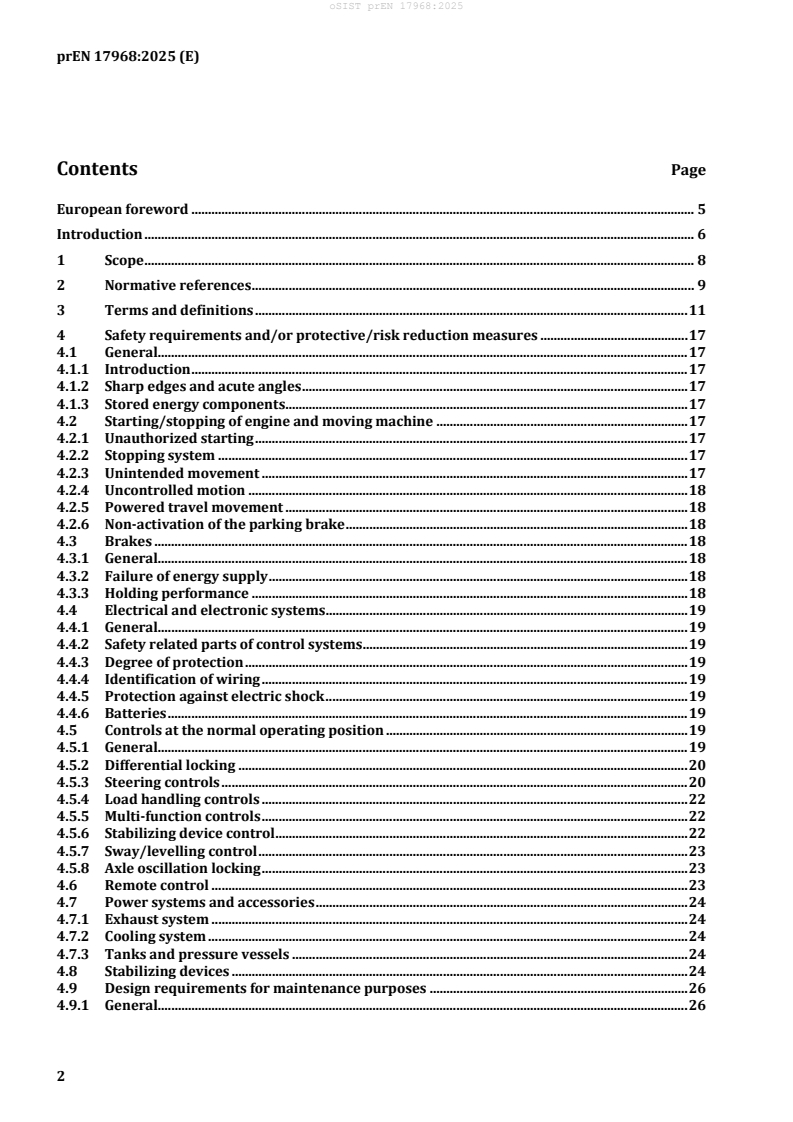
Contents
- Introduction
- 1 Scope
- 2 Normative references
- 3 Terms and definitions
- 3.1 tractor
- 3.2 rough-terrain variable-reach tractor
- 3.3 compact rough-terrain variable-reach tractor
- 3.4 actual capacity
- 3.5 rated capacity
- 3.6 reach
- 3.7 lift height
- 3.8 standard load centre distance
- 3.9 axle oscillation lock
- 3.10 stabilising devices
- 3.11 lateral levelling
- 3.12 forks
- 3.13 boom
- 3.14 crab steering mode
- 3.15 normal operating position
- 3.16 attachment bracket
- 3.17 boom float
- 3.18 maximum working pressure
- 3.19 level ground
- 3.20 operating mass
- 3.21 technically permissible maximum operating mass
- 3.22 operator’s station
- 3.23 enclosed cab
- 3.24 open cab
- 3.25 permanently mounted equipment
- 4 Safety requirements and/or protective/risk reduction measures
- 4.1 General
- 4.2 Starting/stopping of engine and moving machine
- 4.3 Brakes
- 4.4 Electrical and electronic systems
- 4.5 Controls at the normal operating position
- 4.6 Remote control
- 4.7 Power systems and accessories
- 4.8 Stabilizing devices
- 4.9 Design requirements for maintenance purposes
- 4.10 Systems for lifting, tilting and reaching
- 4.11 Operator’s station
- 4.12 Operator access
- 4.13 Protective measures and devices
- 4.14 Stability requirements
- 4.15 Visibility
- 4.16 Lighting
- 4.17 Fire protection
- 4.18 Retrieval, transportation and lifting
- 4.19 Noise
- 4.20 Electromagnetic radiation
- 5 Verification of safety requirements and/or protective/risk reduction
- 5.1 General
- 5.2 Functional verification
- 5.3 Structural verification
- 5.4 Load holding verification
- 6 Information for use
- 6.1 General
- 6.2 Graphical symbols and warning
- 6.3 Instruction handbook
- 6.4 Marking of PME
- 6.5 Load chart
- Annex A
- 1 Mechanical hazards
- 1.1 Crushing, shearing, cutting, severing, 4.1.2 Sharp edges and acute angles
- 4.3 Brakes
- 4.5 Controls
- 4.15 Visibility
- 1.2 Impact hazard
- 4.9 Design requirements for maintenance
- 1.3 Stabbing or puncture hazard 4.1.2 Sharp edges and acute angles
- 4.9 Design requirements for maintenance
- 1.4 High pressure fluid ejection or ejection 4.1.3 Stored energy components
- 2 Electrical hazards 4.4.1 Electrical and electronic systems -
- 3 Thermal hazards
- 4.17 Fire protection
- 4 Hazards generated by noise 4.19 Noise
- 5 Hazards generated by materials
- 4.17 Fire protection
- 6 Hazards generated by neglecting
- 4.12 Operator access
Introduction
This document covers general safety requirements and the means for verification of these requirements for rough-terrain variable-reach tractors (RTVR tractors).
All quantities are in SI units, and this includes metric units. This document is a type C standard as stated in EN ISO 12100:2010. This document is of relevance, in particular, for the following stakeholder groups representing the market players with regard to machinery safety:
- machine manufacturers (small, medium and large enterprises);
- health and safety bodies (regulators, accident prevention organizations, market surveillance etc.). Others can be affected by the level of machinery safety achieved with the means of the document by the above-mentioned stakeholder groups:
- machine users/employers (small, medium and large enterprises);
- machine users/employees (e.g. trade unions, organizations for people with special needs);
- service providers, e.g. for maintenance (small, medium and large enterprises);
- consumers (in case of machinery intended for use by consumers). The above-mentioned stakeholder groups have been given the possibility to participate at the drafting process of this document.
The machinery concerned and the extent to which hazards, hazardous situations or hazardous events are covered are indicated in the scope of this document.
When provisions of this type C standard are different from those which are stated in type A or B standards, the provisions of this type C standard take precedence over the provisions of the other standards, for machines that have been designed and built according to the provisions of this type C standard.
Two legislative frameworks involve RTVR tractors:
- Regulation (EU) No 167/2013 providing requirements for the type-approval of agricultural and forestry vehicles, also known as Tractor Mother Regulation (TMR), which trucks are homologated according to. A number of additional Regulations supplements this one, such as:
- Delegated Regulation (EU) No 1322/2014 with regard to construction and general requirements of agricultural and forestry vehicles;
- Delegated Regulation (EU) 2015/208 with regard to functional safety requirements of agricultural and forestry vehicles;
- Delegated Regulation (EU) 2015/68 with regard to braking systems of agricultural and forestry vehicles;
- Delegated Regulation (EU) 2018/985 as regards environmental and propulsion unit performance requirements for agricultural and forestry vehicles and their engines;
- Implementing Regulation (EU) 2015/504 with regard to the administrative requirements of agricultural and forestry vehicles.
oSIST prEN 17968:2025 prEN 17968:2025 (E) - Directive 2006/42/EC as the permanently mounted equipment (PME), that RTVR tractors are equipped with, falls under the definition of machinery in Article 2 (a) third indent as "an assembly referred to in the first and second indents, ready to be installed and able to function as it stands only if mounted on a means of transport".
A CEN/TR “Mapping between the clauses in EN 17968 and the European frameworks involving roughterrain variable-reach tractors” is under development. This document is based on requirements of EN 1459-1:2025.
oSIST prEN 17968:2025 prEN 17968:2025 (E)
1 Scope
This document specifies the safety requirements relevant to load-handling functions for rough-terrain variable reach tractors (RTVR tractors). This includes the safety requirements for their permanently mounted equipment (PME).
Fork arms are considered to be part of the PME. RTVR tractors can also be equipped with a variety of attachments (e.g. bale spikes, mowers, sweepers).
This document deals with all the significant hazards, hazardous situations and events relevant to the operation of the PME of RTVR tractors when they are used as intended and under conditions of misuse which are reasonably foreseeable by the manufacturer (see Annex A). This document does not apply to:
- rough-terrain variable-reach trucks covered by EN 1459-1:2025;
- slewing rough-terrain variable-reach trucks covered by EN 1459-2:2015+A1:2018;
- industrial variable reach trucks covered by EN ISO 3691-2:2023;
- lorry-mounted variable-reach trucks covered by ISO 20297-1:2017;
- variable-reach trucks fitted with tilting or elevating operator position;
- mobile cranes covered by EN 13000:2010+A1:2014;
- machines designed primarily for earth moving, even if their buckets and blades are replaced with forks (see EN 474 series);
- trucks designed primarily with variable length load suspension elements (e.g. chain, ropes) from which the load can swing freely in all directions;
- trucks designed primarily for container handling;
- trucks on tracks;
- trucks with articulated chassis;
- front loaders covered by EN 12525:2000+A2:2010;
- attachments.
Determination and declaration of sound power level is not addressed by this document. This document does not cover sales literature.
This document does not address hazards linked to:
- operation of the RTVR tractor from a position other than the normal operating position or the remote control;
- hybrid power systems;
- gas power systems;
- gasoline engine systems;
oSIST prEN 17968:2025 prEN 17968:2025 (E) - battery power systems.
This document does not address hazards which can occur:
a) when handling suspended loads which can swing freely (additional requirements are given in EN 1459-4:2024+A1:2025); b) when using RTVR tractors on public roads; c) when operating in potentially explosive atmospheres (additional requirements are given in EN 1755:2024); d) when operating underground; e) when towing trailers; f) when fitted with a personnel work platform (additional requirements are given in EN 1459-3:2015 and EN 1459-9:2021); g) when using system capable of controlling the speed of the RTVR tractor as set by the operator (cruise-control).
This document does not provide a method of calculation for fatigue and strength of material. This document is not applicable to RTVR tractors manufactured before the date of its publication.
2 Normative references
The following documents are referred to in the text in such a way that some or all of their content constitutes requirements of this document. For dated references, only the edition cited applies. For undated references, the latest edition of the referenced document (including any amendments) applies.
EN 1459-5:2020, Rough-terrain trucks — Safety requirements and verification — Part 5: Attachment interface EN 12053:2001+A1:2008, Safety of industrial trucks — Test methods for measuring noise emissions EN 13059:2002+A1:2008, Safety of industrial trucks — Test methods for measuring vibration EN 15000:2008, Safety of industrial trucks — Self-propelled variable reach trucks — Specification, performance and test requirements for longitudinal load moment indicators and longitudinal load moment limiters EN 15830:2012, Rough-terrain variable reach trucks — Visibility — Test methods and verification EN 17314:2020, Industrial trucks — Specifications and test methods — Operator restraint systems other than lap-type seat belts
EN 60529:1991, Degrees of protection provided by enclosures (IP Code) (IEC 60529:1989) EN IEC 62061:2021, Safety of machinery — Functional safety of safety-related electrical, electronic and programmable electronic control systems (IEC 62061:2021)
This document is impacted by EN 1459-5:2020/prA1:202x.
This document is impacted by the amendments EN 60529:1991/A1:2000 and EN 60529:1991/A2:2013.
oSIST prEN 17968:2025 prEN 17968:2025 (E) EN ISO 3449:2008, Earth-moving machinery — Falling-object protective structures — Laboratory tests and performance requirements (ISO 3449:2005) EN ISO 3457:2008, Earth-moving machinery — Guards — Definitions and requirements (ISO 3457:2003) EN ISO 3471:2008, Earth-moving machinery — Roll-over protective structures — Laboratory tests and performance requirements (ISO 3471:2008) EN ISO 4413:2010, Hydraulic fluid power — General rules and safety requirements for systems and their components (ISO 4413:2010) EN ISO 6683:2008, Earth-moving machinery — Seat belts and seat belt anchorages — Performance requirements and tests (ISO 6683:2005) EN ISO 11688-1:2009, Acoustics — Recommended practice for the design of low-noise machinery and equipment — Part 1: Planning (ISO/TR 11688-1:1995) EN ISO 12100:2010, Safety of machinery — General principles for design — Risk assessment and risk reduction (ISO 12100:2010) EN ISO 13849-1:2023, Safety of machinery — Safety-related parts of control systems — Part 1: General principles for design (ISO 13849-1:2023) EN ISO 13850:2015, Safety of machinery — Emergency stop function — Principles for design (ISO 13850:2015) EN ISO 13857:2019, Safety of machinery — Safety distances to prevent hazard zones being reached by upper and lower limbs (ISO 13857:2019) ISO 2328:2011, Fork-lift trucks — Hook-on type fork arms and fork arm carriages — Mounting dimensions ISO 2330:2002, Fork-lift trucks — Fork arms — Technical characteristics and testing ISO 3864-1:2011, Graphical symbols — Safety colours and safety sign — Part 1: Design principles for safety signs and safety markings ISO 3864-2:2016, Graphical symbols — Safety colours and safety sign — Part 2: Design principles for product safety labels ISO 3864-3:2024, Graphical symbols — Safety colours and safety sign — Part 3: Design principles for graphical symbols for use in safety signs ISO 3864-4:2011, Graphical symbols — Safety colours and safety sign — Part 4: Colorimetric and photometric properties of safety sign materials ISO 5053-1:2020, Industrial trucks — Vocabulary — Part 1: Types of industrial trucks ISO 6011:2003, Earth-moving machinery — Visual display of machine operation ISO 7000:2019, Graphical symbols for use on equipment — Registered symbols
oSIST prEN 17968:2025 prEN 17968:2025 (E)
ISO 9244:2008 , Graphical symbols for use on equipment — Registered symbols ISO 10263-2:2009, Earth-moving machinery — Operator enclosure environment — Part 2: Air filter element test method ISO 10263-4:2009, Earth-moving machinery — Operator enclosure environment — Part 4: Heating, ventilating and air conditioning (HVAC) test method and performance ISO 12509:2023, Earth-moving machinery and rough-terrain trucks — Lighting, signalling and marking lights, and reflex reflectors ISO 13333:1994, Earth-moving machinery — Dumper body support and operator's cab tilt support devices ISO 15817:2012, Earth-moving machinery — Safety requirements for remote operator control systems ISO 15818:2017, Earth-moving machinery — Lifting and tying-down attachment points — Performance requirements ISO 15870:2000, Powered industrial trucks — Safety signs and hazard pictorials — General principles ISO 16528-1:2007, Boilers and pressure vessels — Part 1: Performance requirements ISO 16528-2:2007, Boilers and pressure vessels — Part 2: Procedures for fulfilling the requirements of ISO 16528-1 ISO 21507:2010, Earth-moving machinery — Performance requirements for non-metallic fuel tanks ISO 22915-10:2023, Industrial trucks — Verification of stability — Part 10: Additional stability test for trucks operating in the special condition of stacking with load laterally displaced by powered devices ISO 22915-14:2010, Industrial trucks — Verification of stability — Part 14: Rough-terrain variable-reach trucks ISO 22915-20:2023, Industrial trucks — Verification of stability — Part 20: Additional stability test for trucks operating in the special condition of offset load, offset by utilization
3 Terms and definitions
For the purposes of this document, the terms and definitions given in EN ISO 12100:2010, ISO 5053- 1:2020 and the following apply.
ISO and IEC maintain terminology databases for use in standardization at the following addresses:
- ISO Online browsing platform: available at https://www.iso.org/obp
- IEC Electropedia: available at https://www.electropedia.org/
3.1 tractor
motorised, wheeled agricultural or forestry vehicle having two axles and a maximum design speed of not less than 6 km/h, the main function of which lies in its tractive power and which has been especially
As impacted by ISO 9244:2008/Amd 1:2016.
oSIST prEN 17968:2025 prEN 17968:2025 (E) designed to pull, push, carry and actuate certain interchangeable equipment designed to perform agricultural or forestry work, or to tow agricultural or forestry trailers or equipment [SOURCE: Regulation (EU) No 167/2013, Article 3(8), modified]
3.2 rough-terrain variable-reach tractor
RTVR tractor tractor having one telescopic articulated arm, non-slewing or having a slewing movement of not more than 5° either side of the longitudinal axis of the RTVR tractor used for stacking loads Note 1 to entry: See Figure 1.
Figure 1 — RTVR tractor
3.3 compact rough-terrain variable-reach tractor
RTVR tractor having a maximum height in normal travel mode of 2 150 mm and at least one of the following conditions:
- a maximum operating mass of 7 000 kg;
- a maximum width in normal travel mode of 2 000 mm Note 1 to entry: These dimensions do not include equipment such as working lights, mirrors, etc.
3.4 actual capacity
Q maximum load, established by the manufacturer based on components strength and RTVR tractor stability, that the RTVR tractor can carry, lift and stack to a specified height, at a specified standard load centre distance and reach, in normal operating conditions Note 1 to entry: The actual capacity depends on the configuration of the RTVR tractor in terms of such variables as:
- lift height;
- reach of the boom;
- standard load centre distance;
oSIST prEN 17968:2025 prEN 17968:2025 (E) - load handling device (fork arms or attachment fitted); - stabilizing devices.
Note 2 to entry: This actual capacity defines the load handling ability of the particular RTVR tractor as equipped. Additional actual capacity ratings with removable attachments may also be established where permitted by the appropriate stability test or by calculation verified by empirical data.
3.5 rated capacity
Q1 maximum load permitted by the manufacturer at the standard load centre distance (D) that the RTVR tractor is capable of lifting and transporting on fork arms in normal conditions with the boom fully retracted
3.6 reach
d distance between two vertical parallel planes, one plane tangent to the front of the outside diameter of the front tyres, the other plane described by the vertical projection of the centre-of-gravity of the load to the ground Note 1 to entry: The centre-of-gravity of the load (G) is defined in Table 1. Note 2 to entry: See Figure 2 for examples of reach.
Note 3 to entry: For practical matters, d can be measured referring to point g, being g the vertical projection of the centre-of-gravity (G) of the load onto the plane of the top surface of the fork arms.
oSIST prEN 17968:2025 prEN 17968:2025 (E)
Key d reach D standard load centre distance G centre of gravity of the load g the vertical projection of the centre-of-gravity (G) of the load onto the plane of the top surface of the fork arms H height of the load Q actual capacity Q1 rated capacity Q2 actual capacity at maximum height or elevation Q3 actual capacity at maximum reach Figure 2 — Parameters for the designation of the actual capacity of the RTVR tractor with fork
oSIST prEN 17968:2025 prEN 17968:2025 (E)
3.7 lift height
H vertical distance between the upper face of the fork arms and the ground Note to entry: See Figure 2.
3.8 standard load centre distance
D distance from the centre of gravity (G) of the load measured horizontally back to the front of the fork shanks and vertically down to the upper faces of the fork arms, as specified in Table 1 Note 1 to entry: See Figure 2, for example.
Note 2 to entry: Typical standard load centre distances are given in Table 1. Trucks may be rated for special applications with load centres related to those applications which may be different from those listed in Table 1. Table 1 — Typical standard load centre distance Rated capacity Q in kg Standard load centre distance D in mm 400 500 600 900 1 200 0 < 1 000 X ≥ 1 000 < 5 000 X ≥ 5 000 ≤ 10 000 X > 10 000 < 20 000 X X X ≥ 20 000 < 25 000 X X ≥ 25 000 X
3.9 axle oscillation lock
mechanism designed to prevent oscillation of an axle to improve RTVR tractor stability
3.10 stabilising devices
extendable and/or pivoting mechanical supports used to improve stability of a RTVR tractor when stationary
3.11 lateral levelling
changing the lateral inclination angle between the chassis and the ground to ensure the boom operates in a vertical plane even when the RTVR tractor is positioned on a side slope
3.12 forks
device comprising two or more solid fork arms, each consisting of a shank (vertical portion) and blade, which is hook- or shaft-mounted, fitted on the carriage and usually adjusted manually
3.13 boom
pivoting support member that permits horizontal and vertical positioning of the load or attachment
oSIST prEN 17968:2025 prEN 17968:2025 (E)
3.14 crab steering mode
steering mode where all wheels of the RTVR tractor steer in the same direction
3.15 normal operating position
position specified by the manufacturer in which the operator is able to control the RTVR tractor operations, including load handling functions
3.16 attachment bracket
device fitted at the end of the boom to mount interchangeable attachments to facilitate quick interchange of attachment
3.17 boom float
operating mode that uses gravity to allow an attachment at the end of the boom to follow a contour (e.g. the ground)
3.18 maximum working pressure
maximum pressure in the hydraulic circuit during normal operation Note to entry: This definition is derived from ISO 10972-3:2003, 3.2.
3.19 level ground
ground with a gradient of (0 ± 2) %
3.20 operating mass
mass of the RTVR tractor equipped with forks, unladen, and with the operator (75 kg), full fuel tank and all fluid systems (i.e. hydraulic oil, transmission oil, engine oil, engine coolant) at the levels specified by the manufacturer
3.21 technically permissible maximum operating mass
operating mass without the forks and including the heaviest permitted attachment without load
3.22 operator’s station
part of the machine which surrounds the normal operating position
3.23 enclosed cab
cab where door(s) or windows are fitted to all openings
3.24 open cab
cab which is not an enclosed cab
oSIST prEN 17968:2025 prEN 17968:2025 (E)
3.25 permanently mounted equipment
PME part of the RTVR tractor intended for loads handling, which includes one or more telescopic articulated arms, not intended to be removed during normal use, on which a load handling device (e.g. carriage and fork arms) is fitted Note to entry: The PME includes all “aspects” of the RTVR tractor not covered by Regulation (EU) No 167/2013. These can correspond to physical parts in full, e.g. boom and load controls, LLMC and LLMI, stabilizers, or partially, e.g. cab protective structures.
4 Safety requirements and/or protective/risk reduction measures
4.1 General
4.1.1 Introduction
RTVR tractors shall comply with the safety requirements and/or protective measures of this clause. In addition, the RTVR tractors shall be designed according to the principles of EN ISO 12100 for relevant but not significant hazards, which are not dealt with by this document.
4.1.2 Sharp edges and acute angles
A CEN/TR “Mapping between the clauses in EN 17968 and the European frameworks involving roughterrain variable-reach tractors” is under development.
...