

EN 14563:2008
(Main)Chemical disinfectants and antiseptics - Quantitative carrier test for the evaluation of mycobactericidal or tuberculocidal activity of chemical disinfectants used for instruments in the medical area - Test method and requirements (phase 2, step 2)
- Abstract
This European Standard specifies a test method and the minimum requirements for mycobactericidal or tuberculocidal activity of chemical disinfectant products that form a homogeneous, physically stable preparation when diluted with hard water, or – in the case of ready-to-use products – with water.
This European Standard applies to products that are used in the medical area for disinfecting instruments by immersion – even if they are not covered by the EEC/93/42 Directive on Medical Devices.
This European Standard applies to areas and situations where disinfection is medically indicated. Such indications occur in patient care, for example:
in hospitals, in community medical facilities and in dental institutions;
in clinics of schools, kindergartens and nursing homes;
and may occur in the workplace and in the home. It may also include services such as laundries and kitchens supplying products directly for the patients.
EN 14885 specifies in detail the relationship of the various tests to one another and to "use recommendations".
NOTE This method corresponds to a phase 2, step 2 test.
- Status
- Published
- Publication Date
- 25-Nov-2008
- Withdrawal Date
- 30-May-2009
- Technical Committee
- CEN/TC 216 - Chemical disinfectants and antiseptics
- Drafting Committee
- CEN/TC 216/WG 1 - Human medicine
- Current Stage
- 9060 - Closure of 2 Year Review Enquiry - Review Enquiry
- Start Date
- 02-Sep-2021
- Completion Date
- 02-Sep-2021
- Directive
- 93/42/EEC - Medical devicesOJ Ref: C, C 41 OJ Date: 19-Feb-2009

Overview
EN 14563:2008 (CEN) defines a quantitative carrier test (phase 2, step 2) for assessing the mycobactericidal or tuberculocidal activity of chemical disinfectants and antiseptics used for disinfecting medical instruments by immersion. The standard specifies test method, obligatory conditions and minimum efficacy requirements for products that form a homogeneous, physically stable preparation when diluted with hard water (or with water for ready‑to‑use products). It simulates practical conditions (dried bacteria on carriers, contact time, temperature and interfering substances) to support reproducible, comparable performance claims.
Key topics and requirements
- Test type: Quantitative carrier test (phase 2, step 2) for immersion disinfection of instruments.
- Target organisms:
- Mycobacterium avium and Mycobacterium terrae for mycobactericidal activity.
- Mycobacterium terrae for tuberculocidal activity.
- Obligatory test conditions:
- Temperature: 20 °C ± 1 °C
- Contact time: 60 min (specified tolerance in standard)
- Interfering substances: simulated clean (0.3 g/L bovine albumin) and simulated dirty (3.0 g/L bovine albumin + 3.0 mL/L washed sheep erythrocytes) depending on intended use.
- Minimum efficacy: At least a 4 log10 (decimal) reduction in viable mycobacterial counts under the selected obligatory conditions.
- Method elements covered: Preparation of test organisms, carrier inoculation and drying, product dilution with hard water, neutralizer validation, recovery and enumeration of survivors, data calculation and interpretation.
- Materials and validation: Uses standardized media (e.g., Middlebrook 7H10 with OADC), defined hard water preparation, and requires validation of neutralizers and methodology for the product under test.
- Regulatory link: Informative annexes include relationships to EU Directive 93/42/EEC and references to EN 14885 and EN 12353.
Applications and users
- Who uses EN 14563:
- Microbiological testing laboratories and contract test houses.
- Chemical disinfectant and antiseptic manufacturers developing instrument‑immersion products.
- Medical device manufacturers and sterilization procurement teams evaluating compatibility and efficacy.
- Infection prevention and control professionals and regulatory assessors reviewing product claims.
- Practical uses: Demonstrating mycobactericidal/tuberculocidal claims on product labels, supporting conformity assessment and purchase decisions for hospitals, dental clinics, laboratories and other healthcare settings where immersion disinfection of instruments is required.
Related standards
- EN 14885 – Application of European standards for chemical disinfectants and antiseptics (relationship of tests to use recommendations).
- EN 12353 – Preservation of test organisms used for efficacy testing.
- EU Directive 93/42/EEC (informative Annex ZA) – relationship to essential requirements for medical devices where applicable.
Keywords: EN 14563, mycobactericidal, tuberculocidal, chemical disinfectants, carrier test, medical instruments, CEN, phase 2 step 2, immersion disinfection.
Relations
- Effective Date
- 28-Jan-2026
- Effective Date
- 28-Jan-2026
- Effective Date
- 28-Jan-2026
- Effective Date
- 28-Jan-2026
- Effective Date
- 28-Jan-2026
Get Certified
Connect with accredited certification bodies for this standard

BSI Group
BSI (British Standards Institution) is the business standards company that helps organizations make excellence a habit.

TÜV Rheinland
TÜV Rheinland is a leading international provider of technical services.

TÜV SÜD
TÜV SÜD is a trusted partner of choice for safety, security and sustainability solutions.
Sponsored listings
Frequently Asked Questions
EN 14563:2008 is a standard published by the European Committee for Standardization (CEN). Its full title is "Chemical disinfectants and antiseptics - Quantitative carrier test for the evaluation of mycobactericidal or tuberculocidal activity of chemical disinfectants used for instruments in the medical area - Test method and requirements (phase 2, step 2)". This standard covers: This European Standard specifies a test method and the minimum requirements for mycobactericidal or tuberculocidal activity of chemical disinfectant products that form a homogeneous, physically stable preparation when diluted with hard water, or – in the case of ready-to-use products – with water. This European Standard applies to products that are used in the medical area for disinfecting instruments by immersion – even if they are not covered by the EEC/93/42 Directive on Medical Devices. This European Standard applies to areas and situations where disinfection is medically indicated. Such indications occur in patient care, for example: in hospitals, in community medical facilities and in dental institutions; in clinics of schools, kindergartens and nursing homes; and may occur in the workplace and in the home. It may also include services such as laundries and kitchens supplying products directly for the patients. EN 14885 specifies in detail the relationship of the various tests to one another and to "use recommendations". NOTE This method corresponds to a phase 2, step 2 test.
This European Standard specifies a test method and the minimum requirements for mycobactericidal or tuberculocidal activity of chemical disinfectant products that form a homogeneous, physically stable preparation when diluted with hard water, or – in the case of ready-to-use products – with water. This European Standard applies to products that are used in the medical area for disinfecting instruments by immersion – even if they are not covered by the EEC/93/42 Directive on Medical Devices. This European Standard applies to areas and situations where disinfection is medically indicated. Such indications occur in patient care, for example: in hospitals, in community medical facilities and in dental institutions; in clinics of schools, kindergartens and nursing homes; and may occur in the workplace and in the home. It may also include services such as laundries and kitchens supplying products directly for the patients. EN 14885 specifies in detail the relationship of the various tests to one another and to "use recommendations". NOTE This method corresponds to a phase 2, step 2 test.
EN 14563:2008 is classified under the following ICS (International Classification for Standards) categories: 11.080.20 - Disinfectants and antiseptics. The ICS classification helps identify the subject area and facilitates finding related standards.
EN 14563:2008 has the following relationships with other standards: It is inter standard links to EN 14885:2022, EN 12353:2021, EN 14885:2006, EN 14885:2018, EN 14885:2015. Understanding these relationships helps ensure you are using the most current and applicable version of the standard.
EN 14563:2008 is associated with the following European legislation: EU Directives/Regulations: 93/42/EEC; Standardization Mandates: M/BC/CEN/89/9. When a standard is cited in the Official Journal of the European Union, products manufactured in conformity with it benefit from a presumption of conformity with the essential requirements of the corresponding EU directive or regulation.
EN 14563:2008 is available in PDF format for immediate download after purchase. The document can be added to your cart and obtained through the secure checkout process. Digital delivery ensures instant access to the complete standard document.
Standards Content (Sample)
2003-01.Slovenski inštitut za standardizacijo. Razmnoževanje celote ali delov tega standarda ni dovoljeno.Chemische Desinfektionsmittel und Antiseptika - Quantitativer Keimträgerversuch zur Prüfung der mykobakteriziden oder tuberkuloziden Wirkung chemischer Desinfektionsmittel für Instrumente im humanmedizinischen Bereich - Prüfverfahren und Anforderungen (Phase 2, Stufe 2)Désinfectants chimiques et antiseptiques - Essai quantitatif de porte germe pour l'évaluation de l'activité mycobactéricide ou tuberculocide des désinfectants chimiques utilisés pour instruments en médecine humaine - Méthode d'essai et prescriptions (phase 2, étape 2)Chemical disinfectants and antiseptics - Quantitative carrier test for the evaluation of mycobactericidal or tuberculocidal activity of chemical disinfectants used for instruments in the medical area - Test method and requirements (phase 2, step 2)11.080.20Dezinfektanti in antiseptikiDisinfectants and antisepticsICS:Ta slovenski standard je istoveten z:EN 14563:2008SIST EN 14563:2009en,fr,de01-marec-2009SIST EN 14563:2009SLOVENSKI
STANDARD
EUROPEAN STANDARDNORME EUROPÉENNEEUROPÄISCHE NORMEN 14563November 2008ICS 11.080.20 English VersionChemical disinfectants and antiseptics - Quantitative carrier testfor the evaluation of mycobactericidal or tuberculocidal activity ofchemical disinfectants used for instruments in the medical area -Test method and requirements (phase 2, step 2)Désinfectants et antiseptiques chimiques - Essai quantitatifde porte-germe pour l'évaluation de l'activitémycobactéricide ou tuberculocide des désinfectantschimiques utilisés pour instruments en médecine humaine -Méthode d'essai et prescriptions (phase 2, étape 2)Chemische Desinfektionsmittel und Antiseptika -Quantitativer Keimträgerversuch zur Prüfung dermykobakteriziden oder tuberkuloziden Wirkung chemischerDesinfektionsmittel für Instrumente imhumanmedizinischen Bereich - Prüfverfahren undAnforderungen (Phase 2, Stufe 2)This European Standard was approved by CEN on 18 October 2008.CEN members are bound to comply with the CEN/CENELEC Internal Regulations which stipulate the conditions for giving this EuropeanStandard the status of a national standard without any alteration. Up-to-date lists and bibliographical references concerning such nationalstandards may be obtained on application to the CEN Management Centre or to any CEN member.This European Standard exists in three official versions (English, French, German). A version in any other language made by translationunder the responsibility of a CEN member into its own language and notified to the CEN Management Centre has the same status as theofficial versions.CEN members are the national standards bodies of Austria, Belgium, Bulgaria, Cyprus, Czech Republic, Denmark, Estonia, Finland,France, Germany, Greece, Hungary, Iceland, Ireland, Italy, Latvia, Lithuania, Luxembourg, Malta, Netherlands, Norway, Poland, Portugal,Romania, Slovakia, Slovenia, Spain, Sweden, Switzerland and United Kingdom.EUROPEAN COMMITTEE FOR STANDARDIZATIONCOMITÉ EUROPÉEN DE NORMALISATIONEUROPÄISCHES KOMITEE FÜR NORMUNGManagement Centre: rue de Stassart, 36
B-1050 Brussels© 2008 CENAll rights of exploitation in any form and by any means reservedworldwide for CEN national Members.Ref. No. EN 14563:2008: ESIST EN 14563:2009
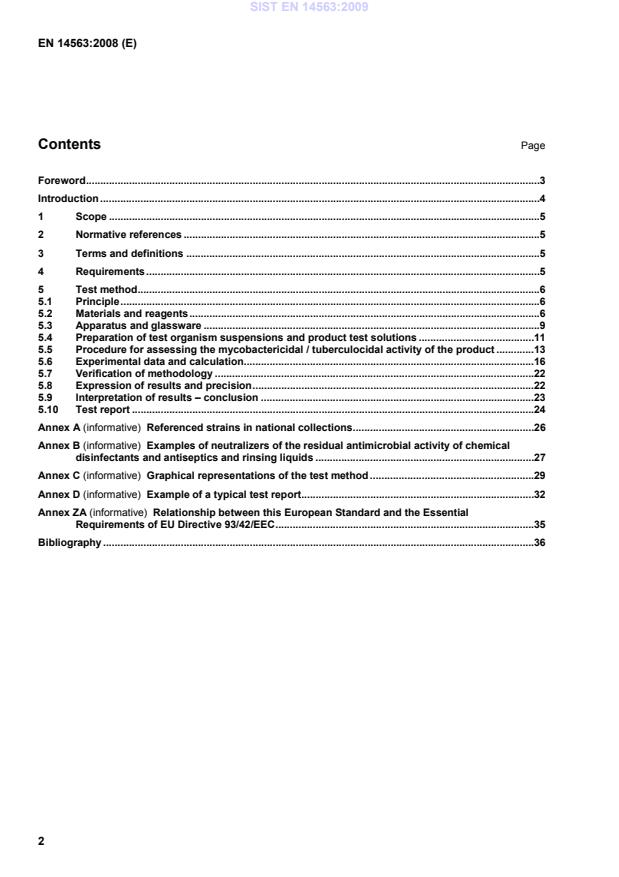
Referenced strains in national collections.26 Annex B (informative)
Examples of neutralizers of the residual antimicrobial activity of chemical disinfectants and antiseptics and rinsing liquids.27 Annex C (informative)
Graphical representations of the test method.29 Annex D (informative)
Example of a typical test report.32 Annex ZA (informative)
Relationship between this European Standard and the Essential Requirements of EU Directive 93/42/EEC.35 Bibliography.36
The obligatory conditions are intended to cover general purposes and to allow reference between laboratories and product types. Each utilization concentration of the chemical disinfectant found by this test corresponds to defined experimental conditions. However, for some applications the recommendations of use of a product may differ and therefore additional test conditions need to be used.
This European Standard applies to products that are used in the medical area for disinfecting instruments by immersion – even if they are not covered by the EEC/93/42 Directive on Medical Devices. This European Standard applies to areas and situations where disinfection is medically indicated. Such indications occur in patient care, for example: in hospitals, in community medical facilities and in dental institutions; in clinics of schools, kindergartens and nursing homes; and may occur in the workplace and in the home. It may also include services such as laundries and kitchens supplying products directly for the patients. EN 14885 specifies in detail the relationship of the various tests to one another and to "use recommendations". NOTE This method corresponds to a phase 2, step 2 test. 2 Normative references The following referenced documents are indispensable for the application of this document. For dated references, only the edition cited applies. For undated references, the latest edition of the referenced document (including any amendments) applies. EN 12353, Chemical disinfectants and antiseptics – Preservation of test organisms used for the determination of bactericidal, mycobactericidal, sporicidal and fungicidal activity EN 14885, Chemical disinfectants and antiseptics – Application of European Standards for chemical disinfectants and antiseptics 3 Terms and definitions For the purposes of this European Standard, the terms and definitions given in EN 14885 apply. 4 Requirements The product, when tested in accordance with Clause 5 under simulated clean conditions (0,3 g/l bovine albumin solution) or simulated dirty conditions (3,0 g/l bovine albumin solution, plus 3,0 ml/l washed sheep erythrocytes) according to its practical applications and under the obligatory test conditions, (one or two selected test organisms, 20 °C, 60 min), shall demonstrate at least a decimal log (lg) reduction in counts of 4.
The mycobactericidal activity shall be evaluated using the following two test organisms: Mycobacterium avium and Mycobacterium terrae. The tuberculocidal activity shall be evaluated using the following test organism: Mycobacterium terrae. SIST EN 14563:2009
NOTE For these additional conditions, the concentration defined as a result can be lower than the one obtained under the obligatory test conditions.
5 Test method 5.1 Principle 5.1.1 A test suspension of mycobacteria in a solution of interfering substances is spread on a glass carrier. After drying the carrier is immersed into a sample of the product as delivered and/or diluted with hard water (for ready to use products: water). The carrier is maintained at 20 °C ± 1 °C for 60 min ± 10 s (obligatory test conditions). At the end of this contact time, the carrier is transferred into a neutralizer containing glass beads. The mycobacteria are to be severed from the surface by shaking. The numbers of surviving mycobacteria in each sample are determined and the reduction is calculated. 5.1.2 The test is performed using Mycobacterium avium and Mycobacterium terrae or only Mycobacterium terrae as test organisms (obligatory test conditions). 5.1.3 Additional and optional contact times and temperatures are specified. Additional interfering substances may be used. 5.2 Materials and reagents 5.2.1 Test organisms The mycobactericidal activity shall be evaluated using the following two test-organisms1):
Mycobacterium avium
ATCC
Mycobacterium terrae
ATCC
15755 The tuberculocidal activity shall be evaluated using only Mycobacterium terrae. NOTE See Annex A for strain reference in some other culture collections. 5.2.2 Culture media and reagents 5.2.2.1 General All weights of chemical substances given in this European Standard refer to the anhydrous salts. Hydrated forms may be used as an alternative, but the weights required shall be adjusted to allow for consequent molecular weight differences. The reagents shall be of analytical grade and/or appropriate for microbiological purposes. They shall be free from substances that are toxic or inhibitory to the test organisms.
1) The ATCC numbers are the collection numbers of strains supplied by the American Type Culture Collections (ATCC). This information is given for the convenience of users of this European Standard and does not constitute an endorsement by CEN of the product named. SIST EN 14563:2009
NOTE 2 For each culture medium and reagent a time limitation for use should be fixed. 5.2.2.2 Water The water shall be freshly glass distilled water and not demineralized water. If distilled water of adequate quality is not available, water for injections (see bibliographic reference [1]) may be used. Sterilize in the autoclave (5.3.1). Sterilization is not necessary if the water is used – e.g. for preparation of culture media – and subsequently sterilized. NOTE See 5.2.2.7 for the procedure to prepare hard water. 5.2.2.3 Middlebrook and Cohn 7H10 medium enriched by 10 % OADC (MCO) Middlebrook 7H10 agar – powder
19,0 g Glycerol (C3H8O3) (see bibliographic reference [2])
5,0 ml Water (5.2.2.2)
to 900,0 ml Heat to boiling to dissolve completely. Sterilize in the autoclave (5.3.1) and cool to 50 °C to 55 °C. Add 100 ml Middlebrook OADC enrichment under aseptic conditions. Fill 18 – 20 ml per plate (5.3.2.10). The pH of the medium shall be equivalent to 6,6 ± 0,2 when measured at 25 °C. NOTE In special circumstances (problems with neutralization – see 5.5.1.2 and 5.5.1.3) it may be necessary to add neutralizer to MCO (see Annex B). It is not recommended to use neutralizer that causes opalescence in the agar.
5.2.2.4
Diluent Tryptone Sodium Chloride Solution: Tryptone, pancreatic digest of casein 1,0 g Sodium chloride (NaCl) 8,5 g Water (5.2.2.2) to 1 000,0 mlSterilize in the autoclave (5.3.1). After sterilization the pH of the diluent shall be equivalent to 7,0 ± 0,2 when measured at (20 ± 1) °C. 5.2.2.5 Neutralizer The neutralizer shall be validated for the product being tested in accordance with 5.5.1 and 5.5.2. The neutralizer shall be sterile. NOTE Information on neutralizers that have been found to be suitable for some categories of products is given in Annex B. 5.2.2.6 Sterile defibrinated sheep blood The sterile defibrinated sheep blood can be acquired from a commercial supplier or prepared according to EN 14820. SIST EN 14563:2009
Solution B: Dissolve 35,02 g sodium bicarbonate (NaHCO3) in water (5.2.2.2) and dilute to 1 000 ml. Sterilize by membrane filtration (5.3.2.7). Store the solution in a refrigerator (5.3.2.8) for no longer than one week. Hard water: For the preparation of 1 l hard water, place 600 ml – 700 ml water (5.2.2.2) in a 1 000 ml volumetric flask (5.3.2.12) and add 6,0 ml of solution A, then 8,0 ml of solution B. Mix and dilute to 1 000 ml with water (5.2.2.2). The pH of the hard water shall be 7,0 ± 0,2 when measured at (20 ± 1) °C. If necessary adjust the pH by using a solution of approximately 40 g/l (about 1 mol/l) of sodium hydroxide (NaOH) or approximately 36,5 g/l (about 1 mol/l) of hydrochloric acid (HCl). The hard water shall be freshly prepared under aseptic conditions and used within 12 h. NOTE When preparing the product test solutions (see 5.4.2) the addition of the product to this hard water produces a different final water hardness in each test tube. In any case the final hardness is lower than 300 mg/l of calcium carbonate (CaCO3) in the test tube. 5.2.2.8 Interfering substance 5.2.2.8.1 General The interfering substance shall be chosen according to the conditions of use laid down for the product.
The interfering substance shall be sterile and prepared at 10 times its final concentration in the test. The ionic composition (e.g. pH, calcium and/or magnesium hardness) and chemical composition, (e.g. mineral substances, protein, carbohydrates, lipids, detergents) shall be defined.
NOTE In the following, the term “interfering substance” is used even if it contains more than one substance. 5.2.2.8.2 Clean conditions (bovine albumin solution – low concentration) Dissolve 0,30 g of bovine albumin fraction V (suitable for microbiological purposes) in 100 ml of diluent (5.2.2.4).
Sterilize by membrane filtration (5.3.2.7), keep in a refrigerator (5.3.2.8) and use within 1 month. The final concentration of the bovine albumin in the test procedure (see 5.5) is 0,3 g/l. 5.2.2.8.3 Dirty conditions (Mixture of bovine albumin solutions – high concentration with sheep erythrocytes (see 5.2.2.6)) Dissolve 3,00 g of bovine albumin fraction V (suitable for microbiological purposes) in 97 ml of diluent (5.2.2.4). Sterilize by membrane filtration (5.3.2.7). Prepare at least 8,0 ml fresh sterile defibrinated sheep blood (5.2.2.6). Centrifuge the sheep blood at 800 gN for 10 min. After discarding the supernatant, resuspend erythrocytes in diluent (5.2.2.4). Repeat this procedure at least 3 times, until the supernatant is colourless. Resuspend 3 ml of the packed sheep SIST EN 14563:2009
1213 0°+ for a minimum holding time of 15 min; b) for dry heat sterilization, a hot air oven capable of being maintained at (1805 0
+) °C for a minimum holding time of 30 min, at (1705 0
+) °C for a minimum holding time of 1 h or at (1605 0
+) °C for a minimum holding time of 2 h. 5.3.2.2 Water baths, capable of being controlled at 20 °C ± 1 °C, at 50 °C to 55 °C (to prepare the MCO – see 5.2.2.3) and at additional test temperatures ± 1 °C (5.5.1). 5.3.2.3 Incubator, capable of being controlled at either 36 °C ± 1 °C or at 37 °C ± 1°C.
NOTE 1 The same temperature should be used for all incubations performed during a test and its controls and validation.
NOTE 2 A CO2 incubator and a temperature of 36 °C ± 1 °C are better suited for the test organisms. If a CO2 incubator is not used, the inoculated plates should be protected from drying by sealing with insulating tape or packing them into polyethylene bags. 5.3.2.4 pH-meter, having an inaccuracy of calibration of not more than ± 0,1 pH units at (20 ± 1) °C. NOTE For measuring the pH of the agar-media (5.2.2.3) a puncture electrode or a flat membrane electrode should be used. 5.3.2.5 Stopwatch.
2) Disposable sterile equipment is an acceptable alternative to reusable glassware.
Electromechanical agitator, e.g. Vortex® mixer3). b)
Mechanical shaker 5.3.2.7 Membrane filtration apparatus, constructed of a material compatible with the substances to be filtered, with a filter holder of at least 50 ml volume, and suitable for use of filters of diameter 47 mm to 50 mm and 0,45 µm pore size for sterilization of hard water (5.2.2.7) and bovine albumin (5.2.2.8). The vacuum source used shall give an even filtration flow rate.
5.3.2.8 Refrigerator, capable of being controlled at 2 °C to 8 °C. 5.3.2.9 Graduated pipettes of nominal capacities 10 ml and 1,0 ml and 0,1 ml. Calibrated automatic pipettes may be used. 5.3.2.10 Petri dishes (plates) of size 90 mm to 100 mm. 5.3.2.11 Glass beads (Diameter: 3 mm to 4 mm). 5.3.2.12 Volumetric flasks. 5.3.2.13 Glass beads (Diameter: 0,25 mm to 0,5 mm). 5.3.2.14 Centrifuge (800 gN and 2 000 gN).
5.3.2.15 Cylindrical plastic screw cap tubes, contents of about 15 ml, diameter about 18 mm (for the carrier). 5.3.2.16
Coned bottom screw cap tubes, contents of 50 ml (diameter about 28 mm). 5.3.2.17
Frosted glass carriers, 15 mm x 60 mm x 1 mm, one surface sandblasted.
Glass carriers shall be used once only. For preparation the glass carrier is boiled 10 min in a suitable detergent, cleaned minimum 3 times with water (5.2.2.2) and at the end once with ethanol (70 Vol.%). Mark a 10 mm square at one end of the dried carrier on its sandblasted surface, about 2 mm off the three edges. Sterilize in the heat oven [5.3.1b)]. After the sterilization process the markings of the “inoculation square” shall be clearly visible.
Key 1 Inoculation square Figure 1 — Frosted glass carrier with markings
3) Vortex® in an example of a suitable product available commercially. This information is given for the convenience of users of this European Standard and does not constitute an endorsement by CEN of this product. SIST EN 14563:2009
General For each test organism two different suspensions shall be prepared: the “test suspension” to perform the test and the “validation suspension” to perform the controls and method validation. 5.4.1.2
Preservation of test organisms The test organisms shall be prepared and kept in accordance with EN 12353.
5.4.1.3
Working culture of test organisms In order to prepare the working culture of test organisms (5.2.1), subculture directly from the defrosted cryovials (5.4.1.2) by streaking onto at least two plates containing MCO (5.2.2.3) and incubate (5.3.2.3). After 21 days prepare a second subculture from the first subculture in the same way and incubate for 21 days. The first and/or the second subculture is/are the working culture(s). Never produce and use a third subculture. 5.4.1.4
Test suspension (N) a) Prepare a suitable homogeneous suspension from the working cultures (5.4.1.3) using
either the homogenization by glass beads: with the aid of a plastic disposable loop transfer the test organisms from at least two plates of the working culture (5.4.1.3) into a coned bottom screw cap tube (5.3.2.16) containing 6-7 g of dry glass beads (5.3.2.11). The test organisms are homogenized by mixing [5.3.2.6a)] for at least 5 min to distribute them homogeneously on the beads and on most of the parts of the screw cap tube’s internal surface. Add 10 ml water (5.2.2.2) drop by drop and resuspend them by mixing [5.3.2.6a)]. After 20 min sedimentation time the supernatant is transferred to a tube.
or the homogenization by Potter S 1 apparatus: pipette 5,0 ml water (5.2.2.2) on each of the plates (at least two) of the working culture (5.4.1.3) and recover with a glass spatula the test organisms. Pipette all of the liquid from the plates into a 25 ml centrifugation tube. Add up to 18 ml water (5.2.2.2). Wash with water (5.2.2.2), centrifuging 3 times at approximately 2 000 gN for 15 min. After each centrifuging, discard the supernatant, resuspend by mixing [5.3.2.6a)] and fill up to the original volume with water (5.2.2.2).
After the last centrifuging discard the supernatant and transfer the sediment into a 15 ml glass vessel of the Potter S 1 apparatus. Fill up to 15 ml with water (5.2.2.2). Mix, cool with ice and homogenize for 15 min. After 20 min sedimentation time, during which enough ice for cooling should be present, the supernatant is transferred to a tube. NOTE 1 Other methods of homogenization are allowed provided that the number of colony forming unit(s) per millilitre (cfu/ml) obtained is appropriate and stable during the time of the test and microscopic examination shows that the suspension is as homogeneous as after the two procedures described above.
NOTE 2 Do not use tensio-active substances (surfactants). SIST EN 14563:2009
cfu/ml4) to 5,0 x 10⁹ cfu/ml using water (5.2.2.2). Maintain this test suspension in the water bath at 20 °C ± 1 °C and use at the day of preparation. Adjust the temperature according to 5.5.1.1a) and 5.5.1.4 only immediately before the start of the test. NOTE The use of a spectrophotometer for adjusting the number of cells is highly recommended (about 620 nm wavelength - cuvette 10 mm path length). Each laboratory should therefore produce a calibration curve for each test organism knowing that suitable values of optical density are generally found between 0,200 and 0,400. To achieve reproducible results of this measurement it may be necessary to dilute the test suspension, e.g. 1+9. A colorimeter is a suitable alternative. c) For counting prepare 10-7 and 10-8 dilutions of the test suspension using water (5.2.2.2). Mix [(5.3.2.6a)]. d) Take a sample of 1,0 ml of each dilution in duplicate. Divide each sample in two nearly equal amounts and spread onto separate surface dried plates (5.3.2.10) containing MCO (5.2.2.3), i.e. four plates per duplicate 1,0 ml samples. For incubation and counting see 5.4.1.6. 5.4.1.5
Validation suspension (NV) a) To prepare the validation suspension, dilute the test suspension (5.4.1.4) with water (5.2.2.2) to obtain 3,0 x 10² cfu/ml to 1,6 x 10³ cfu/ml [about one fourth (1 + 3) of the 10-6 dilution]. b) For counting prepare a 10-1 dilution with water (5.2.2.2). Mix [5.3.2.6a)]. Take a sample of 1,0 ml in duplicate. Divide each sample in two nearly equal amounts and spread onto separate surface dried plates (5.3.2.10) containing MCO (5.2.2.3). For incubation and counting see 5.4.1.6. 5.4.1.6
Incubation and counting of the test and the validation suspensions a) Incubate (5.3.2.3) the plates for 21 days. Discard any plates which are not countable (for any reason). Count the plates and determine the number of colony forming units (cfu) for each plate.
b) Note for each plate the exact number of colonies but record "> 330" for any counts higher than 330 and determine the VC-values according to 5.6.2.2. c) Calculate the numbers of cfu/ml in the test suspension N and in the validation suspension NV using the method given in 5.6.2.3 or 5.6.2.5. Verify according to 5.7. 5.4.2 Product test solution Product test solutions shall be prepared in hard water (5.2.2.7) at minimum three different concentrations to include one concentration in the active range and one concentration in the non-active range. The product as received may be used as one of the product test solutions.
Dilutions of ready-to-use products, i.e. products which are not diluted when applied, shall be prepared in water (5.2.2.2) instead of hard water. For solid products, dissolve the product as received by weighing at least 1 g ± 10 mg of the product in a volumetric flask and filling up with hard water (5.2.2.7). Subsequent dilutions (i.e. lower concentrations) shall be prepared in volumetric flasks (5.3.2.12) on a volume/volume basis in hard water (5.2.2.7).
4) cfu/ml = colony forming unit(s) per millilitre. SIST EN 14563:2009
(in °C): obligatory temperature to be tested is θ
= 20 °C; additional temperatures (Clause 4) may be chosen according to the manufacturer’s recommendation, but not higher than 60 °C; allowed deviation for each chosen temperature is ± 1 °C. b) contact time t (in min): obligatory contact time to be tested is t = 60 min; additional contact times (Clause 4) may be chosen from 5 min, 15 min and 30 min; allowed deviation for each chosen contact time is ± 10 s. c) interfering substance: obligatory interfering substance to be tested is 0,30 g/l bovine albumin (5.2.2.8.2) under clean or a mixture of 3 ml/l sheep erythrocytes and 3,0 g/l bovine albumin (5.2.2.8.3) under dirty conditions – according to practical applications.
Additional interfering substances may be tested according to specific fields of application.
d) test organisms: obligatory test organisms for testing mycobactericidal activity are:
Mycobacterium avium and Mycobacterium terrae (5.2.1). obligatory test organism for testing tuberculocidal activity is: Mycobacterium terrae. SIST EN 14563:2009
NOTE In special circumstances it may be necessary to add neutralizer to MCO (5.2.2.3). If neutralizer is added to MCO the same amount should be added to MCO used in the test procedure. 5.5.1.3 Validation and control procedures – General instructions The neutralization and/or removal of the mycobactericidal and/or mycobacteriostatic activity of the product shall be controlled and validated – only for the highest product test concentration – for each of the used test organisms and for each experimental condition (interfering substance, temperature, contact time). These procedures (experimental condition control, neutralizer control and method validation) shall be performed always at the same time with the test and with the same neutralizer used in the test. In the case of ready-to-use-products use water (5.2.2.2) instead of hard water. If because of problems with neutralization, neutralizer has been added to the MCO (5.5.1.2) used for the validation and control procedures, the MCO used for the test shall contain the same amount of this neutralizer as well. 5.5.1.4 Equilibration of temperature Prior to testing, equilibrate all reagents (product test solutions (5.4.2), test suspension (5.4.1.4), validation suspension (5.4.1.5), hard water (5.2.2.7) and interfering substance (5.2.2.8)) to the test temperature of θ using the water bath (5.3.2.2) controlled at θ. Observe the provisions laid down in 5.4.1.4.b). Check that the temperature of the reagents is stabilized at θ. The neutralizer (5.2.2.5) and water (5.2.2.2) shall be equilibrated at a temperature of 20 °C ± 1 °C. In the case of ready-to-use-products, water (5.2.2.2) shall be additionally equilibrated to the test temperature of θ. 5.5.1.5 Precautions for manipulation of test organisms Do not touch the upper part of the test tube sides when adding the test or the validation suspensions. 5.5.1.6 Inoculation of the carriers
Pipette 1,0 ml of interfering substances (5.2.2.8) into a tube. Add 9,0 ml of the test suspension (5.4.1.4). Mix [5.3.2.6a)] and pipette 0,05 ml of this mixture on the “inoculation square” of a carrier (5.3.2.17) and distribute equally inside the square, e.g. with the tip of the pipette. Let the inoculum dry at 36 °C ± 1 °C until visible dryness, maximum 60 min. Use the carrier immediately after the end of the drying time.
Note the drying time in the test report.
5.5.2.1 General
The test and the control and validation procedures (see 5.5.2.2 until 5.5.2.6) shall be carried out in parallel – separately for each experimental condition (see 5.5.1.1). 5.5.2.2 Test Na (Determination of bactericidal concentrations), water control NW a) Pipette 10 ml of one of the product test solutions (5.4.2) into a cylindrical screw cap tube (5.3.2.15) placed in a water bath controlled at the chosen test temperature of θ [5.5.1.1a)]. Immerse an inoculated carrier (5.5.1.6) immediately after the drying process has been finished. Secure that the inoculation square is completely covered by the product test solution (5.4.2). Start the stopwatch and leave for the chosen contact time t [5.5.1.1b)]. b) At the end of t transfer the carrier into a second cylindrical screw cap tube (5.3.2.15), placed in a water bath controlled at 20 ºC and filled with 10 ml of neutralizer (5.2.2.5) and approximately 1 ml of glass beads (5.3.2.13). Restart the stopwatch and mix [5.3.2.6a)] for 15 s. After a neutralization time of 5 min ± 10 s, mix [5.3.2.6a)] and immediately take a sample of 1,0 ml of the neutralized test mixture Na (containing neutralizer, product test solution, interfering substance, test suspension) in duplicate. Divide each sample in two portions of approximately equal size and spread onto separate surface dried plates containing MCO (5.2.2.3). Additionally transfer 0,5 ml of the test mixture Na into a tube containing 4,5 ml of neutralizer (10-1 dilution of Na), mix [5.3.2.6a)] and dilute accordingly to produce 10-2 and 10-3 dilutions of Na with neutralizer. Take samples of 1,0 ml from each dilution tube in duplicate. Divide and spread as described above. The number of 1,0 ml samples of Na shall be altogether 8. For incubation and counting see 5.5.2.6. c) Perform the procedure a) – b) using the other product test solutions at the same time.
d) Water control NW: Perform the procedure a) - b), but instead of the product test solution pipette 10 ml of hard water (5.2.2.7) or – in the case of ready-to-use products – water (5.2.2.2). Deviating from b) produce 10-4 and 10-5 dilutions from the neutralized test mixture NW for incubation and counting (total number of 1,0 ml samples: 4 = duplicate of 10-4 + 10-5). e) Perform the procedure a) – d) applying the other obligatory and – if appropriate – other additional experimental conditions (5.5.1.1). 5.5.2.3 Experimental condition control “A” (Validation of the selected experimental conditions or verification of the absence of any lethal effect in the test conditions) a) Pipette 1,0 ml of the interfering substance used in the test (5.5.2.2) into a tube. Add 1,0 ml of the validation suspension (5.4.1.5). Start the stopwatch immediately, mix [5.3.2.6a)] and place the tube in a water bath controlled at θ for 2 min ± 10 s. At the end of this time add 8,0 ml of hard water (5.2.2.7). (In the case of ready-to-use products: water (5.2.2.2) instead of hard water). Restart the stopwatch at the beginning of the addition. Mix [5.3.2.6a)] and place the tube in a water bath controlled at θ
for t. Just before the end of t, mix [5.3.2.6a)] again.
b) At the end of t, take a sample of 1,0 ml of this mixture A in duplicate. Divide and spread as described in 5.5.2.2 b). For incubation and counting see 5.5.2.6.
5) For a graphical representation of this method see Annex C. SIST EN 14563:2009
± 1 °C for 5 min ± 10 s. Just before the end of this time, mix [5.3.2.6a)]. b) At the end of this time take a sample of 1,0 ml of this mixture B in duplicate. Divide and spread as described in 5.5.2.2.b). For incubation and counting see 5.5.2.6. 5.5.2.5 Method validation “C” (Dilution-neutralization validation)
a) Pipette 1,0 ml of the interfering substance used in the test (5.5.2.2) into a tube. Add 1,0 ml of water (5.2.2.2) and then, starting a stopwatch, 8,0 ml of the product test solution only of the highest concentration used in the test (5.5.2.2). Mix [5.3.2.6a)] and place the tube in a water bath controlled at θ for t. Just before the end of t, mix [5.3.2.6a)] again. NOTE It is not necessary to prepare the highest concentration of the product test solution 1,25 times higher than the derived (actually tested) concentration though it is diluted during the method validation by interfering substance and water (8+1+1). In the test Na the amount of neutralizer in relation to the product test solution is much higher. b) At the end of t transfer 1,0 ml of the mixture into a tube containing 8,0 ml of neutralizer (used in 5.5.2.2). Restart the stopwatch at the beginning of the addition, mix [5.3.2.6a)] and place the tube in a water bath controlled at 20 °C ± 1 °C for 5 min ± 10 s. Add 1,0 ml of the validation suspension (5.4.1.5). Start a stopwatch at the beginning of the addition and mix [5.3.2.6a)]. Place the tube in a water bath controlled at 20 °C ± 1 °C for 30 min ± 1 min. Just before the end of this time, mix [5.3.2.6a)] again. At the end of this time take a sample of 1,0 ml of the mixture C in duplicate. Divide and spread as described in 5.5.2.2. b). For incubation and counting see 5.5.2.6. 5.5.2.6 Incubation and counting of the test mixture and the control and validation mixtures a) Incubate (5.3.2.3) the plates for 21 days. Discard any plates which are not countable (for any reason). Count the plates and determine the number of cfu for each plate.
b) Note for each plate the exact number of colonies but record "> 330" for any counts higher than 330 and determine the VC-values according to 5.6.2.2.
c) Calculate the numbers of cfu/ml in the test mixtures Na and NW and in the validation mixtures A, B and C using the methods given in 5.6.2.3b), 5.6.2.4 and 5.6.2.6. Verify according to 5.7. 5.6 Experimental data and calculation 5.6.1 Explanation of terms and abbreviations 5.6.1.1 Overview of the different suspensions / test mixtures: N and NV represent the mycobacterial suspensions, Na represents the mycobactericidal test mixture, NW represents the test mixture in the water control, A (experimental conditions control), B (neutralizer control), C (method validation) represent the different control test mixtures. N, NV, NV0, Na, and A, B, C represent the number of cells counted per ml in the different test mixtures according to Table 1: SIST EN 14563:2009
Number of cells
per ml in the mycobacterial suspensions Number of cells per ml in the test mixtures at the beginning of the contact time (time 0) Number of survivors per ml in the test mixtures at the end of the contact-time t (A) or of 5 min (B) or of 30 min (C) Test N
Test suspension N/20 (= theoretical number on the carrier) Na, Nw
(before neutralization) Controls Nv
Validation suspension Nv0
(Nv0 = Nv/10) A, B, C
5.6.1.2 VC-values All experimental data are reported as VC-values:
VC-value is the number of cfu counted per 1,0 ml sample 5.6.2 Calculation
5.6.2.1
General The first step is the determination of the VC-values, the second the calculation of N, Na, NW, NV, NV0, A, B and C. The third step is the calculation of the reduction R (5.8). 5.6.2.2
Determination of VC-values a) The usual limits for counting mycobacteria on agar plates are between 15 and 300 colonies. In this European Standard a deviation of 10% is accepted, so the limits are 14 and 330. NOTE 1 The lower limit (14) is based on the fact that the variability increases the smaller the number counted in the sample (1 ml) is and therefore subsequent calculations may lead to wrong results. The lower limit refers only to the sample (and not necessarily to the counting on one plate), e.g. two plates per 1 ml sample with 11 cfu and 5 cfu give a VC-value of 16. The upper limit (330) reflects the imprecision of counting confluent colonies and growth inhibition due to nutriment depletion. It refers only to the counting on one plate, and not necessarily to the sample. b) According to the number of plates used per 1 ml sample (5.6.1.2), determine and record the VC-values. NOTE 2 The countings per plate should be noted.
If the count on one plate is higher than 330 the number should be reported “> 330”. If at least one of the plates per 1 ml sample shows a number higher than 330 the number of this VC-value should be reported as “more than sum of the counts”, e.g. for “>330, 308”, “> 638” should be reported. If a VC-value is lower than 14 report the number but substitute by “< 14” for further calculations in the case of
Na . c) Only VC-values within the respective counting limits are taken into account for further calculation, except in the case of Na (5.6.2.4). 5.6.2.3
Calculation of N and NW a) N is the number of cells per ml in the test suspension (5.4.1.4). Since two dilutions of the test suspension (5.4.1.4 in connection with 5.4.1.6) are evaluated, calculate the number of cfu/ml as the weighted mean count using the formula (1): SIST EN 14563:2009
10 )2 1,01( 7-nnc+
(1) where c sum of VC-values taken into account; n1
number of VC-values taken into account at the first dilution (10-7); n2 number of VC-values taken into account at the second dilution (10-8); 10-7 dilution factor corresponding to the lowest dilution. Round off the results calculated to two
...