

EN 12353:2021
(Main)Chemical disinfectants and antiseptics - Preservation of test organisms used for the determination of bactericidal (including Legionella), mycobactericidal, sporicidal, fungicidal and virucidal (including bacteriophages) activity
- Abstract
This document specifies methods for keeping test organisms used and defined in European Standards for the determination of bactericidal (incl. Legionella pneumophila), mycobactericidal, sporicidal, fungicidal and virucidal (incl. bacteriophages) activity of chemical disinfectants and antiseptics drawn up by CEN/TC 216. These methods for keeping test organisms can only be carried out in connection with at least one of those standards where a reference to this document is established.
NOTE 1 Annex A (informative) contains a non-exhaustive list of test organisms for which this document can be applied.
NOTE 2 European Standards (EN) where this document is referenced are listed in the Bibliography.
NOTE 3 A specific description on the preservation of bacterial spores could be added once the results of the ongoing ring trials are available.
- Status
- Published
- Publication Date
- 31-Aug-2021
- Withdrawal Date
- 30-Mar-2022
- Technical Committee
- CEN/TC 216 - Chemical disinfectants and antiseptics
- Drafting Committee
- CEN/TC 216/WG 5 - Strategy Group
- Current Stage
- 6060 - Definitive text made available (DAV) - Publishing
- Start Date
- 01-Sep-2021
- Due Date
- 03-Apr-2021
- Completion Date
- 01-Sep-2021



Overview
EN 12353:2021 (CEN) specifies methods for the preservation and handling of test organisms used in European standards for evaluating the efficacy of chemical disinfectants and antiseptics. It covers organisms used to determine bactericidal (including Legionella pneumophila), mycobactericidal, sporicidal, fungicidal and virucidal (including bacteriophages) activity. The standard describes how to obtain, store and maintain test strains so that their identity, purity and biological behaviour remain stable for use in standardized efficacy tests.
Key topics and requirements
- Scope and linkage: Preservation methods in EN 12353 are intended to be applied in conjunction with CEN/TC 216 test standards that reference this document.
- Typical workflow: Obtain freeze‑dried or frozen strains from culture collections → reconstitute and culture → prepare and aliquot stock cultures → store in deep freeze → derive working cultures for testing.
- Organisms covered: Bacteria (including Legionella), mycobacteria, moulds (e.g., Aspergillus brasiliensis), yeasts, viruses, and bacteriophages. Annex A gives a non‑exhaustive list of applicable test organisms and culture collection references.
- Verification: Regular checks of purity and identity during preparation and storage. For longer storage (>14 months) susceptibility should be re‑checked to ensure no drift in response to reference substances.
- Documentation: Detailed record‑keeping for source strains, storage conditions, stock and working cultures and verification results is required.
- Methods and materials: Guidance on culture media, reagents, apparatus and handling (including cell culture considerations for viruses). The document updates include more detailed viral preservation guidance and added media descriptions (e.g., BCYE for Legionella).
- Pending items: Specific procedures for preservation of bacterial spores may be added after completion of ongoing ring trials.
Practical applications and users
EN 12353:2021 is essential for:
- Microbiology and efficacy testing laboratories performing standardized disinfectant and antiseptic tests.
- Manufacturers of chemical disinfectants and antiseptics who need validated test organisms for product claims.
- Quality assurance and regulatory bodies assessing conformity with European standards.
- Culture collections supplying reference strains and organizations maintaining laboratory strain repositories.
Using EN 12353 ensures reproducible test results, traceability of organisms, and compliance when claiming bactericidal, mycobactericidal, sporicidal, fungicidal or virucidal activity.
Related standards
- EN 14885 - Application of European standards for chemical disinfectants and antiseptics (overview of product claims and relevant ENs)
- Test methods referenced for susceptibility checks: EN 1040, EN 1275, EN 14348, EN 13623, EN 14476, EN 13610
Keywords: EN 12353:2021, CEN, preservation of test organisms, chemical disinfectants, bactericidal, mycobactericidal, sporicidal, fungicidal, virucidal, Legionella, bacteriophages.
Relations
- Effective Date
- 08-Sep-2021
- Effective Date
- 28-Jan-2026
- Effective Date
- 28-Jan-2026
- Effective Date
- 29-Apr-2026
- Effective Date
- 28-Jan-2026
- Effective Date
- 28-Jan-2026
- Effective Date
- 28-Jan-2026
- Effective Date
- 28-Jan-2026
- Effective Date
- 28-Jan-2026
- Effective Date
- 28-Jan-2026
- Effective Date
- 28-Jan-2026
- Effective Date
- 28-Jan-2026
- Effective Date
- 28-Jan-2026
- Effective Date
- 28-Jan-2026
- Effective Date
- 28-Jan-2026
Get Certified
Connect with accredited certification bodies for this standard

BSI Group
BSI (British Standards Institution) is the business standards company that helps organizations make excellence a habit.

TÜV Rheinland
TÜV Rheinland is a leading international provider of technical services.

TÜV SÜD
TÜV SÜD is a trusted partner of choice for safety, security and sustainability solutions.
Sponsored listings
Frequently Asked Questions
EN 12353:2021 is a standard published by the European Committee for Standardization (CEN). Its full title is "Chemical disinfectants and antiseptics - Preservation of test organisms used for the determination of bactericidal (including Legionella), mycobactericidal, sporicidal, fungicidal and virucidal (including bacteriophages) activity". This standard covers: This document specifies methods for keeping test organisms used and defined in European Standards for the determination of bactericidal (incl. Legionella pneumophila), mycobactericidal, sporicidal, fungicidal and virucidal (incl. bacteriophages) activity of chemical disinfectants and antiseptics drawn up by CEN/TC 216. These methods for keeping test organisms can only be carried out in connection with at least one of those standards where a reference to this document is established. NOTE 1 Annex A (informative) contains a non-exhaustive list of test organisms for which this document can be applied. NOTE 2 European Standards (EN) where this document is referenced are listed in the Bibliography. NOTE 3 A specific description on the preservation of bacterial spores could be added once the results of the ongoing ring trials are available.
This document specifies methods for keeping test organisms used and defined in European Standards for the determination of bactericidal (incl. Legionella pneumophila), mycobactericidal, sporicidal, fungicidal and virucidal (incl. bacteriophages) activity of chemical disinfectants and antiseptics drawn up by CEN/TC 216. These methods for keeping test organisms can only be carried out in connection with at least one of those standards where a reference to this document is established. NOTE 1 Annex A (informative) contains a non-exhaustive list of test organisms for which this document can be applied. NOTE 2 European Standards (EN) where this document is referenced are listed in the Bibliography. NOTE 3 A specific description on the preservation of bacterial spores could be added once the results of the ongoing ring trials are available.
EN 12353:2021 is classified under the following ICS (International Classification for Standards) categories: 11.080.20 - Disinfectants and antiseptics; 71.100.35 - Chemicals for industrial and domestic disinfection purposes. The ICS classification helps identify the subject area and facilitates finding related standards.
EN 12353:2021 has the following relationships with other standards: It is inter standard links to EN 12353:2013, EN 14885:2022, EN 13610:2002, EN 16615:2026, EN 14347:2005, EN 17915:2025, EN 13697:2015+A1:2019, EN 17846:2023, EN 1657:2016, EN 13624:2003, EN 14476:2013+A1:2015, EN ISO 15883-7:2025, EN 1040:2005, EN 16437:2014, EN 14563:2008. Understanding these relationships helps ensure you are using the most current and applicable version of the standard.
EN 12353:2021 is available in PDF format for immediate download after purchase. The document can be added to your cart and obtained through the secure checkout process. Digital delivery ensures instant access to the complete standard document.
Standards Content (Sample)
SLOVENSKI STANDARD
01-januar-2022
Nadomešča:
SIST EN 12353:2013
Kemična razkužila in antiseptiki - Shranjevanje preskusnih organizmov za
določanje baktericidnega (vključno Legionella), mikobaktericidnega,
sporocidnega, fungicidnega in virucidnega (vključno bakteriofagi) delovanja
Chemical disinfectants and antiseptics - Preservation of test organisms used for the
determination of bactericidal (including Legionella), mycobactericidal, sporicidal,
fungicidal and virucidal (including bacteriophages) activity
Chemische Desinfektionsmittel und Antiseptika - Aufbewahrung von Prüforganismen für
die Prüfung der bakteriziden (einschließlich Legionella), mykobakteriziden, sporiziden,
fungiziden und viruziden (einschließlich Bakteriophagen) Wirkung
Antiseptiques et désinfectants chimiques - Conservation des micro-organismes d'essai
utilisés pour la détermination de l'activité bactéricide (Legionella incluses),
mycobactéricide, sporicide, fongicide et virucide (bactériophages inclus))
Ta slovenski standard je istoveten z: EN 12353:2021
ICS:
07.100.99 Drugi standardi v zvezi z Other standards related to
mikrobiologijo microbiology
71.100.35 Kemikalije za dezinfekcijo v Chemicals for industrial and
industriji in doma domestic disinfection
purposes
2003-01.Slovenski inštitut za standardizacijo. Razmnoževanje celote ali delov tega standarda ni dovoljeno.
EN 12353
EUROPEAN STANDARD
NORME EUROPÉENNE
September 2021
EUROPÄISCHE NORM
ICS 11.080.20; 71.100.35 Supersedes EN 12353:2013
English Version
Chemical disinfectants and antiseptics - Preservation of
test organisms used for the determination of bactericidal
(including Legionella), mycobactericidal, sporicidal,
fungicidal and virucidal (including bacteriophages) activity
Antiseptiques et désinfectants chimiques - Chemische Desinfektionsmittel und Antiseptika -
Conservation des micro-organismes d'essai utilisés Aufbewahrung von Prüforganismen für die Prüfung
pour la détermination de l'activité bactéricide der bakteriziden (einschließlich Legionella),
(Legionella incluses), mycobactéricide, sporicide, mykobakteriziden, sporiziden, fungiziden und
fongicide et virucide (bactériophages inclus) viruziden (einschließlich Bakteriophagen) Wirkung
This European Standard was approved by CEN on 1 February 2021.
CEN members are bound to comply with the CEN/CENELEC Internal Regulations which stipulate the conditions for giving this
European Standard the status of a national standard without any alteration. Up-to-date lists and bibliographical references
concerning such national standards may be obtained on application to the CEN-CENELEC Management Centre or to any CEN
member.
This European Standard exists in three official versions (English, French, German). A version in any other language made by
translation under the responsibility of a CEN member into its own language and notified to the CEN-CENELEC Management
Centre has the same status as the official versions.
CEN members are the national standards bodies of Austria, Belgium, Bulgaria, Croatia, Cyprus, Czech Republic, Denmark, Estonia,
Finland, France, Germany, Greece, Hungary, Iceland, Ireland, Italy, Latvia, Lithuania, Luxembourg, Malta, Netherlands, Norway,
Poland, Portugal, Republic of North Macedonia, Romania, Serbia, Slovakia, Slovenia, Spain, Sweden, Switzerland, Turkey and
United Kingdom.
EUROPEAN COMMITTEE FOR STANDARDIZATION
COMITÉ EUROPÉEN DE NORMALISATION
EUROPÄISCHES KOMITEE FÜR NORMUNG
CEN-CENELEC Management Centre: Rue de la Science 23, B-1040 Brussels
© 2021 CEN All rights of exploitation in any form and by any means reserved Ref. No. EN 12353:2021 E
worldwide for CEN national Members.
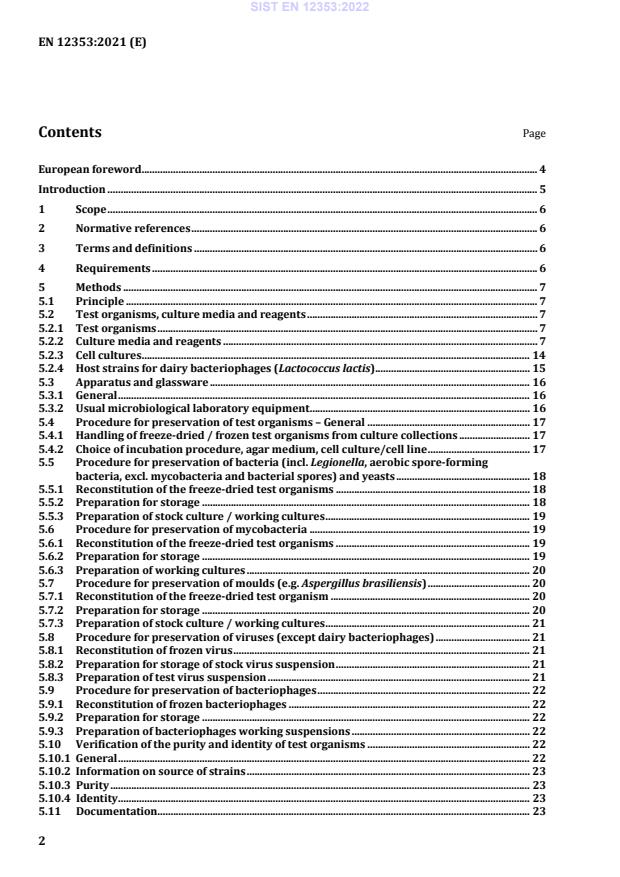
Contents Page
European foreword . 4
Introduction . 5
1 Scope . 6
2 Normative references . 6
3 Terms and definitions . 6
4 Requirements . 6
5 Methods . 7
5.1 Principle . 7
5.2 Test organisms, culture media and reagents . 7
5.2.1 Test organisms . 7
5.2.2 Culture media and reagents . 7
5.2.3 Cell cultures . 14
5.2.4 Host strains for dairy bacteriophages (Lactococcus lactis) . 15
5.3 Apparatus and glassware . 16
5.3.1 General . 16
5.3.2 Usual microbiological laboratory equipment . 16
5.4 Procedure for preservation of test organisms – General . 17
5.4.1 Handling of freeze-dried / frozen test organisms from culture collections . 17
5.4.2 Choice of incubation procedure, agar medium, cell culture/cell line . 17
5.5 Procedure for preservation of bacteria (incl. Legionella, aerobic spore-forming
bacteria, excl. mycobacteria and bacterial spores) and yeasts . 18
5.5.1 Reconstitution of the freeze-dried test organisms . 18
5.5.2 Preparation for storage . 18
5.5.3 Preparation of stock culture / working cultures . 19
5.6 Procedure for preservation of mycobacteria . 19
5.6.1 Reconstitution of the freeze-dried test organisms . 19
5.6.2 Preparation for storage . 19
5.6.3 Preparation of working cultures . 20
5.7 Procedure for preservation of moulds (e.g. Aspergillus brasiliensis) . 20
5.7.1 Reconstitution of the freeze-dried test organism . 20
5.7.2 Preparation for storage . 20
5.7.3 Preparation of stock culture / working cultures . 21
5.8 Procedure for preservation of viruses (except dairy bacteriophages) . 21
5.8.1 Reconstitution of frozen virus . 21
5.8.2 Preparation for storage of stock virus suspension . 21
5.8.3 Preparation of test virus suspension . 21
5.9 Procedure for preservation of bacteriophages . 22
5.9.1 Reconstitution of frozen bacteriophages . 22
5.9.2 Preparation for storage . 22
5.9.3 Preparation of bacteriophages working suspensions . 22
5.10 Verification of the purity and identity of test organisms . 22
5.10.1 General . 22
5.10.2 Information on source of strains . 23
5.10.3 Purity . 23
5.10.4 Identity . 23
5.11 Documentation . 23
5.11.1 General . 23
5.11.2 Freeze-dried test organism / frozen viruses . 23
5.11.3 Cryovials of frozen test organism . 23
5.11.4 Stock culture . 24
5.11.5 Verification of purity and identity . 24
5.11.6 Storage of documentation . 24
Annex A (informative) Test organisms – Culture collection references and relation to
CEN/TC 216 standards . 25
Annex B (informative) Graphical representations . 29
Bibliography . 34
European foreword
This document (EN 12353:2021) has been prepared by Technical Committee CEN/TC 216 “Chemical
disinfectants and antiseptics”, the secretariat of which is held by AFNOR.
This European Standard shall be given the status of a national standard, either by publication of an
identical text or by endorsement, at the latest by March 2022, and conflicting national standards shall
be withdrawn at the latest by March 2022.
Attention is drawn to the possibility that some of the elements of this document may be the subject of
patent rights. CEN shall not be held responsible for identifying any or all such patent rights.
This document supersedes EN 12353:2013.
The document was revised to adapt it to the latest state of science, to correct errors and ambiguities.
The following are the significant technical changes since the last edition:
— the methods of preservation of viruses are described more detailed (5.8);
— MEM is not the only suitable cell culture medium, therefore it was replaced by the general term
“cell culture medium” (5.2.2.17 and in the whole text);
— the description of BCYE Agar for Legionella was added (5.2.2.24);
— the information on source of strains was added (5.10.2);
— the information of the storage of documentation was added (5.11.6);
— Clostrioides difficile (A.3.3) was added;
— the CIP numbers for fungi were deleted (replaced by UMIP numbers) (see A.4);
— the used virus strains are re-drafted (see A.5).
The changes mentioned above have no impact on the test results obtained with reference to the
previous version. Those results are still valid.
Any feedback and questions on this document should be directed to the users’ national standards body.
A complete listing of these bodies can be found on the CEN website.
According to the CEN-CENELEC Internal Regulations, the national standards organisations of the
following countries are bound to implement this European Standard: Austria, Belgium, Bulgaria,
Croatia, Cyprus, Czech Republic, Denmark, Estonia, Finland, France, Germany, Greece, Hungary, Iceland,
Ireland, Italy, Latvia, Lithuania, Luxembourg, Malta, Netherlands, Norway, Poland, Portugal, Republic of
North Macedonia, Romania, Serbia, Slovakia, Slovenia, Spain, Sweden, Switzerland, Turkey and the
United Kingdom.
Introduction
Standardized tests for the determination of bactericidal (incl. Legionella pneumophila),
mycobactericidal, sporicidal, fungicidal and virucidal (incl. bacteriophages) activity of chemical
disinfectants and antiseptics necessitate the use of test organisms whose purity and identity have been
verified and whose biological behaviour remains stable. Therefore, it is essential to specify the storage
requirements.
This document aims to describe methods for preservation of test organisms used for such purposes.
1 Scope
This document specifies methods for keeping test organisms used and defined in European Standards
for the determination of bactericidal (incl. Legionella pneumophila), mycobactericidal, sporicidal,
fungicidal and virucidal (incl. bacteriophages) activity of chemical disinfectants and antiseptics drawn
up by CEN/TC 216. These methods for keeping test organisms can only be carried out in connection
with at least one of those standards where a reference to this document is established.
NOTE 1 Annex A (informative) contains a non-exhaustive list of test organisms for which this document can be
applied.
NOTE 2 European Standards (EN) where this document is referenced are listed in the Bibliography.
NOTE 3 A specific description on the preservation of bacterial spores could be added once the results of the
ongoing ring trials are available.
2 Normative references
The following documents are referred to in the text in such a way that some or all of their content
constitutes requirements of this document. For dated references, only the edition cited applies. For
undated references, the latest edition of the referenced document (including any amendments) applies.
EN 13610, Chemical disinfectants — Quantitative suspension test for the evaluation of virucidal activity
against bacteriophages of chemical disinfectants used in food and industrial areas — Test method and
requirements (phase 2, step 1)
EN 14885, Chemical disinfectants and antiseptics — Application of European Standards for chemical
disinfectants and antiseptics
3 Terms and definitions
No terms and definitions are listed in this document.
ISO and IEC maintain terminological databases for use in standardization at the following addresses:
• IEC Electropedia: available at http://www.electropedia.org/
• ISO Online browsing platform: available at https://www.iso.org/obp
4 Requirements
Each test organism specified in a CEN/TC 216 European Standard and referred to in this document shall
be handled as described in this document. An overview of the CEN/TC 216 standards and the
specification of which standards products shall comply with in order to support specific microbicidal
activity claims are summarised in EN 14885.
The purity and identity of the preserved test organism shall be verified during the preparation and
regularly during the storage, except for viruses where only the identity is checked before the stock virus
suspension is stored.
The preserved test organisms – including the viruses especially in connection with the used cell lines -
should be checked at regular intervals (at least in the case of longer storage than 14 months) to ensure
that its susceptibility to products has not changed. For all standards where there is no internal standard
implemented the test organisms' susceptibility should be checked using relevant reference substances.
As long as CEN/TC 216 has not developed specific tests for this purpose any suitable method can be
used e.g. EN 1040 for bacteria, EN 1275 for fungi, EN 14348 for mycobacteria, EN 13623 for Legionella
pneumophila, EN 14476 for viruses or EN 13610 for dairy bacteriophages.
5 Methods
5.1 Principle
A sample of the test organism – in general in freeze-dried form – is obtained from a culture collection.
This sample is cultured, prepared for storage, filled into storage vessels and placed in the deep freeze.
From this sample a stock culture is prepared and subsequently used to prepare working cultures for the
test procedure. In some cases the working cultures are directly prepared from the deep freeze samples.
5.2 Test organisms, culture media and reagents
5.2.1 Test organisms
See Annex A for examples of test organisms.
The documentation on the test organisms should follow 5.10.2 and 5.11.
5.2.2 Culture media and reagents
5.2.2.1 General
The formulas of all media and reagents are given in case commercial ready-to-use material is not used.
It is to be checked that each commercial supplier has established an appropriate quality control system.
All weights of chemical substances given in this document refer to the anhydrous salts unless otherwise
stated. Hydrated forms may be used as an alternative, but the weights required shall be adjusted to
allow for consequent molecular weight differences.
The reagents shall be of analytical grade and/or appropriate for microbiological purposes. They shall be
free from substances that are toxic or inhibitory to the test organisms.
To improve reproducibility, it is recommended that whenever possible, commercially available
dehydrated material is used for the preparation of culture media. The manufacturer's instructions
relating to the preparation of these products should be rigorously followed.
All specified pH values are measured at (20 ± 1) °C.
The media and substances mentioned in 5.2.2 shall be stored under controlled conditions according to
manufacturer's recommendation.
For each culture medium, cell culture and reagent a limitation for use should be fixed.
5.2.2.2 Water
The water shall be freshly glass distilled water and not demineralized water. If distilled water of
adequate quality is not available, water for injections (see bibliography [30]) can be used.
Sterilize in the autoclave (5.3.2.1a). Sterilization is not necessary if the water is used for e.g. preparation
of culture media and subsequently sterilized.
5.2.2.3 Tryptone Soya Broth (TSB) for bacteria, except Legionella
Tryptone soya broth, consisting of:
Tryptone, pancreatic digest of casein 17,0 g
Soya peptone, papaic digest of soybean meal 3,0 g
Sodium chloride (NaCl) 5,0 g
Water (5.2.2.2) 800,0 ml
Dipotassium phosphate (K HPO ) 2,5 g
2 4
Glucose 2,5 g
Water (5.2.2.2) to 1 000,0 ml
Sterilize in the autoclave (5.3.2.1a). After sterilization the pH of the medium shall be equivalent to
7,2 ± 0,2.
5.2.2.4 Malt Extract Broth (MEB) for fungi
Malt extract broth, consisting of:
Malt extract (food grade, e.g. Christomalt powder from Difal or equivalent that is not highly purified
and not only based on maltose, e.g.
20,0 g
malt extract from OXOID)
Water (5.2.2.2) to 1 000,0 ml
Sterilize in the autoclave (5.3.2.1a). After sterilization the pH of the medium shall be equivalent to
5,6 ± 0,2.
5.2.2.5 Cryoprotectant solution for bacteria and fungi
Cryoprotectant solution, consisting of:
Beef extract 3,0 g
Tryptone, pancreatic digest of casein 5,0 g
Glycerol (C H O ) [31] 150,0 g
3 8 3
Water (5.2.2.2) to 1 000,0 ml
Dissolve the constituents in boiling water. Sterilize in the autoclave (5.3.2.1a). After sterilization the pH
of the solution shall be equivalent to 6,9 ± 0,2.
Any commercially available cryoprotectant containing glycerol for preservation of test organisms
equivalent to the solution described above may be used.
If justified, any other equivalent cryoprotectant solution may be used, e.g. for Legionella (5.5.2).
This information is given for the information of users of this standard and does not constitute an endorsement of the
products named. Corresponding products supplied by other manufacturers may be used if they can be shown to lead to the
same results.
5.2.2.6 Middlebrook 7 H 9 broth with 10 % ADC enrichment and glycerol as reconstituent and
cryoprotectant solution for mycobacteria (MADC)
Middlebrook 7 H 9 broth, consisting of:
Middlebrook 7 H 9 broth powder 4,7 g
Glycerol (C H O ) [31] 100,0 ml
3 8 3
Water (5.2.2.2) 800,0 ml
Treat in the autoclave (5.3.2.1a) for a holding time of only 10 min and cool to 45 °C. Add under aseptic
conditions 100 ml Middlebrook ADC enrichment to obtain approximately 1 000,0 ml. The pH of the
medium shall be equivalent to 6,6 ± 0,2.
5.2.2.7 Polysorbate 80 solution
Polysorbate 80 solution, consisting of:
Polysorbate 80 0,5 g
Water (5.2.2.2) to 1 000,0 ml
Sterilize in the autoclave (5.3.2.1a).
5.2.2.8 DMSO as cryoprotectant for cell culture freezing
Dimethyl sulphoxide (DMSO) is used to help protect the cells from rupture by the formation of ice
crystals.
WARNING — Since DMSO is toxic it should be handled with care. It can be absorbed through the skin
and may cause irritation and/or burns. It is teratogenic and an allergen. Suitable gloves should be worn
when handling it.
5.2.2.9 Glutamine solution (3 % m/V solution)
Dissolve 12 g Glutamine in 400 ml of water (5.2.2.2) and sterilize by membrane filtration. The solution
is stored at (−22,5 ± 2,5) °C.
5.2.2.10 TV (Trypsin-Versene)
Dissolve 0,05 g Trypsin in 100 ml of 0,53 mM EDTA (Ethylene diamine tetra acetic acid) and sterilize by
membrane filtration. Store at (4 ± 1) °C.
5.2.2.11 Antibiotic suspension
Chemicals
50 million units Penicillin-G
(e.g. Sigma PENNA)
50 g Streptomycin sulfate (approx. equal to 750 IU/mg)
(e.g. Sigma Cat: S 6501)
25 × 500 000 units Mycostatin
(e.g. Nystatin: Sigma N 3503)
Water (5.2.2.2) to 2,5 l.
This information is given for the information of users of this standard and does not constitute an endorsement of the
products named. Corresponding products supplied by other manufacturers may be used if they can be shown to lead to the
same results.
Preparation
Dissolve vial contents of antibiotics in water (5.2.2.2) and fill up to 2,5 l.
Dispense aseptically into 50 ml and 5 ml aliquots.
Store at − 20 °C. Shake the bottle after thawing.
Dilute the aliquots 200folds (e. g. 5 ml per l) to obtain a final concentration of:
Penicillin 100 units/ml
Streptomycin 100 µg/ml
Mycostatin 25 units/ml
5.2.2.12 Phosphate-buffered saline solution (PBS)
Sodium chloride (NaCl) 8,00 g
Potassium chloride (KCl) 0,20 g
Disodium hydrogen phosphate, 12-hydrate (Na HPO · 12H O) 2,89 g
2 4 2
Potassium phosphate, monobasic (KH PO ) 0,20 g
2 4
Water (5.2.2.2) to 1 000,0 ml
5.2.2.13 Fetal calf serum (FCS)
FCS shall be certified free of viruses and mycoplasma.
Extraneous viruses and mycoplasma may interfere with cell and virus growth resulting in false results.
5.2.2.14 Earle’s BSS
Sodium chloride (NaCl) 68,0 g
Potassium chloride (KCl) 4,0 g
Calcium chloride (CaCl ) 2,0 g
Magnesium sulfate, 7-hydrate (MgSO · 7H O) 2,0 g
4 2
Sodium hydrogenphosphate, 2-hydrate (NaH PO · 2H O) 1,4 g
2 2 2
Glucose 10,0 g
Phenol red, 1 % (5.2.2.15) 20,0 ml
Water (5.2.2.2) to 1 000,0 ml
CaCl should be dissolved separately in 100 ml of water (5.2.2.2) and added to the other dissolved
reagents just before the solution is brought to its final volume. The solution is 10-fold concentrated. It is
sterilized by membrane filtration through a 0,22 µm Millipore or Seitz-type filter and can be stored at
(4 ± 1) °C for 4 weeks.
For use the solution is diluted 10-fold with water (5.2.2.2) and buffered by the addition of 2,5 % of an
8,8 % Sodium hydrogen carbonate (NaHCO ) solution.
3 ® ®
Millipore and Seitz are examples of suitable products available commercially. This information is given for
the convenience of users of this standard and does not constitute an endorsement by CEN of this product.
5.2.2.15 Phenol red (1 % m/V solution)
a) A 1,0 N Sodium hydroxide (NaOH) solution is prepared.
b) 10 g of alcohol soluble Phenol red, European Pharmacopeia [31] are placed in a 100 ml flask
(5.3.2.12); 20 ml of the NaOH solution are added, mixed and allowed to stand for a few minutes.
c) The dissolved dye is transferred in a 1 000 ml volumetric flask (5.3.2.12).
d) Additional 10 ml amounts of the NaOH solution are added to the flask and the dissolved material is
added to the volumetric flask. No more than a total of 70 ml of the NaOH solution should be used.
e) The solution is brought to a final volume of 1 000 ml with water (5.2.2.2) and stored at room
temperature.
5.2.2.16 Sodium bicarbonate (8,8 % w/v solution)
Dissolve 8,8 g sodium bicarbonate in water (5.2.2.2) to 100 ml and sterilize by autoclaving (5.3.2.1a).
Store at (4 ± 1) °C.
5.2.2.17 Cell culture medium
A suitable cell culture medium shall be selected according to the requirements of the cell bank.
5.2.2.18 M17-broth
For maintenance of bacterial host strain (Lactococcus lactis) and propagation of dairy bacteriophages.
Phytone peptone (from soya meal) 5,00 g
Polypeptone peptone (from casein and animal tissue) 5,00 g
Beef extract powder 5,00 g
Yeast extract 2,50 g
D(+)-lactose 5,00 g
Ascorbic acid 0,50 g
Sodium-ß-glycerophosphate 19,00 g
Magnesium sulfate heptahydrate, 7 H O 0,25 g
Water (5.2.2.2) 1 000 ml
Sterilize in the autoclave (5.3.2.1a). After sterilization the pH of the medium shall be equivalent to
7,0 ± 0,2.
5.2.2.19 M17-agar (bottom agar)
Bottom agar for quantitative counting of lysis zones (plaques) derived from single infective
bacteriophage particles in the bacterial lawn of the host bacteria.
Add 15 g of agar to 1 000 ml of M17-broth (5.2.2.18). Dissolve the agar by boiling with constant stirring.
Sterilize in the autoclave (5.3.2.1a). After sterilization the pH of the medium shall be equivalent to
7,0 ± 0,2 when measured at 20 °C. When the agar is cooled down to (47 ± 1) °C, add 10 ml of a sterile
1 mol/l CaCl -stock solution (5.2.2.21). Mix gently and pour 15 ml to 18 ml of agar into Petri dishes
(5.3.2.10).
5.2.2.20 Overlay agar (top agar, soft agar)
For counting bacteriophages: Dissolve 6,5 g agar in 1 000 ml M17-broth (5.2.2.18) and heat until boiling
with constant stirring. Dispense the molten agar in test tubes (2,5 to 3 ml each).
Sterilize in the autoclave (5.3.2.1a).
For achieving clear phage-derived lysis zones (plaques) in the lawn of host bacterial cells only well-
defined agar should be used which is specified by the supplier for phage enumeration by the overlay
technique.
5.2.2.21 CaCl -stock solutions (1 mol/l and 0,05 mol/l)
Dissolve either 110,99 or 5,55 g anhydrous CaCl in water (5.2.2.2) and dilute to 1 000 ml to obtain the
1 mol/l or the 0,05 mol/l stock solution, respectively. Sterilize in the autoclave (5.3.2.1a).
5.2.2.22 Reconstituted skim milk
Prepare the reconstituted skimmed milk (15 g/l fat) as follows:
Skimmed powdered milk, guaranteed antibiotic-free and additive-free, reconstituted at 100 g powder
per 1 l water (5.2.2.2).
+3
Sterilize 30 min at (105 ± 3) °C [or 5 min at ( 115 ) °C].
NOTE Undiluted reconstituted skim milk is used for maintenance of the bacterial host strain (5.2.4 and 5.9).
To obtain a volume fraction of 10 % working solution, dilute 1 part of reconstituted skim milk with 9
parts of water (5.2.2.2) which is required as an optional interfering substance for the phage suspension
test, see EN 13610.
Store the volume fraction of 10% of reconstituted skim milk (= 10 g/l milk powder) in a refrigerator
(5.3.2.8) for up to 1 month.
The final concentration of reconstituted skim milk in the test procedure shall be 1% of reconstituted
skim milk (= 1 g/l milk powder) in final during the test, see EN 13610.
5.2.2.23 Buffered Charcoal Yeast Extract (BCYE) Broth, for Legionella
BCYE, consisting of:
Yeast extract (bacteriological grade) 10,0 g;
Activated charcoal 2,0 g;
α-ketoglutarate, monopotassium salt 1,0 g;
ACES buffer (N-2-acetamido-2-aminoethanesulfonic acid) 10,0 g;
Potassium hydroxide (KOH) (pellets) 2,8 g;
L-cysteine hydrochloride monohydrate 0,4 g;
Iron(III)pyrophosphate [Fe (P O ) ] 0,25 g;
4 2 7 3
Water (5.2.2.2) to 1 000,0 ml.
Preparation of BCYE
a) Cysteine and iron solutions
Prepare fresh solutions of L-cysteine hydrochloride and iron (III)pyrophosphate by adding 0,4 g
and 0,25 g respectively to 10-ml-volumes of water (5.2.2.2). Sterilize each solution by membrane
filtration (5.3.2.16). Store in clean sterile containers at (20 ± 3) °C for not more than three months.
b) ACES buffer
Add the ACES granules to 500 ml of water (5.2.2.2) and dissolve by standing in a water bath at 45 °C
to 50 °C. To a separate 480 ml of water (5.2.2.2), add all the potassium hydroxide pellets and
dissolve with gentle shaking. To prepare the ACES buffer, mix the two solutions.
NOTE ACES buffer can cause denaturation of the yeast extract if the following sequence is not followed.
c) Final medium
Add sequentially to the 980 ml of ACES buffer, the charcoal, yeast extract and α-ketoglutarate.
Prepare a 0,1 mol/l solution of potassium hydroxide (KOH) by dissolving 5,6 g in 1 l of water
(5.2.2.2). Prepare a 0,1 mol/l solution of sulphuric acid (H SO ) by carefully adding 5,3 ml of H SO
2 4 2 4
to 1 l of water (5.2.2.2). Use the solutions of 0,1 mol/l potassium hydroxide or 0,1 mol/l sulphuric
acid as appropriate to adjust the pH to 6,9 ± 0,2. After autoclaving, allow to cool to (47 ± 2) °C in a
water bath (5.3.2.2).
Add the L-cysteine and the iron(III)pyrophosphate solutions aseptically, mixing well between additions.
The pH of the final medium is 6,9 ± 0,2 at 20 °C.
Prolonged heating during sterilization or heating at too high a temperature shall be avoided, as it can
affect the nutritional qualities of BCYE medium. Batch-to-batch variation of the ingredients of the
medium (particularly α-ketoglutarate) can also affect its performance. Therefore it is essential to check
the quality of each newly prepared batch of media for its ability to support the growth of the test
organism within three days of incubation. This is assessed quantitatively using either known quantities
of the obligatory Legionella strain or by direct comparison to previous batches.
5.2.2.24 Buffered Charcoal Yeast Extract (BCYE) Agar, for Legionella
See 5.2.2.23 for preparation of the base medium. After the pH adjustment to 6,9 ± 0,2, add 15g/l of
bacteriological grade agar before autoclaving.
5.2.2.25 Page’s saline (cryoprotective solution for Legionella)
Saline solution, consisting of:
Sodium chloride (NaCl) 0,120 g;
Magnesium sulfate (MgSO · 7H 0) 0,004 g;
4 2
Calcium chloride (CaCl · 2H 0) 0,004 g;
2 2
Disodium hydrogen phosphate (Na HPO ) 0,142 g;
2 4
Potassium dihydrogenphosphate (KH PO ) 0,136 g;
2 4
Water (5.2.2.2) to 1 000,0 ml.
Sterilize in the autoclave (5.3.2.1a).
To aid accurate preparation, it is recommended that a 10 l volume of Page’s Saline is prepared and
dispensed in smaller volumes as required for autoclaving. Alternatively the salt solutions may be made
up individually in concentrated form for dilution when the product is required.
5.2.3 Cell cultures
5.2.3.1 Storage of cell cultures
a) Actively growing cell cultures (log phase) shall be used for storage. Grow cell culture in cell culture
medium (5.2.2.17) supplemented with 10 % FCS (5.2.2.13). Aspirate the growth medium from the
flask and rinse the cells with PBS - for a 75 cm flask, use 5 ml to 10 ml. Aspirate PBS (5.2.2.12) and
pipette 5 ml of TV (5.2.2.10) (at 37 °C) onto the monolayer in the flask. RAW 264.7 cells shall not be
trypsinized, as this is a macrophage culture that does not grow adherently. Treatment with trypsin
reduces the susceptibility of the cells for infection with murine norovirus. Incubate at 37 °C for 2
min to 5 min. Bump the side of the flask against the palm of the hand to help detach the cells. Wait
until the cells are detached. Some cell lines can only be brought into suspension by scraping (cell
scraper), e.g. RAW 264.7 cells. Add 5 ml of cell culture medium (5.2.2.17) + 10 % FCS (5.2.2.13)
with a 10 ml pipette and vigorously wash to detach any remaining cell from the bottom of the flask
and to separate any cell clumps. Then transfer the cell suspension into a centrifuge tube. Save a
sample for counting and then centrifuge at 100 g to 150 g (5.3.2.14) for 5 min. Remove the
N N
supernatant and re-suspend the cells in enough FCS (5.2.2.13) + 6 % to 10 % DMSO (5.2.2.8) to
6 6
obtain a final cell concentration of 1 x 10 cells/ml to 2 x 10 cells/ml. The suspension is dispensed
into cryovials (approximately 1,8 ml/each).
b) Place tubes briefly on ice: start the freezing procedure within 5 min. The cells should be frozen
slowly (at −1 °C/min). This is most easily done using a programmable cooler. If such a cooler is not
available, transfer the tubes from ice to an insulated pre-cooled box (or wrapped in cotton wool)
and place for 2 h in a freezer at (−22,5 ± 2,5) °C (5.3.2.13); then place in a (−80 ± 10) °C freezer for
one or two days. Finally transfer the vials into a deep freezer for storage at −196° C (liquid
nitrogen) (5.3.2.13) for long-term storage.
5.2.3.2 Preparation of new cell cultures
a) Remove a vial [5.2.3.1b)] from the liquid nitrogen and rapidly thaw it in a 37 °C water bath. Avoid
total immersion.
b) Transfer the suspension into a 15 ml centrifuge tube, add 5 ml of cell culture medium (5.2.2.17) +
10 % FCS (5.2.2.13) and centrifuge at 100 g for 5 min (5.3.2.14). Remove the supernatant fluid,
N
resuspend the cells in 5 ml of cell culture medium + 10 % FCS and inoculate in a new flask
(5.3.2.15) containing 10 ml to 15 ml of cell culture medium + 10 % FCS – for a 75 cm flask use
15 ml to 22 ml of culture medium. Incubate at 37 °C (5.3.2.3).
c) Cells can be subcultured at 1:3 or higher ratio for up to several passages (sometimes up to 40),
before discarding them and taking a fresh aliquot from the liquid nitrogen stocks.
To subculture, aspirate the growth medium from the flask and rinse the cells with PBS (5.2.2.12) -
for a 75 cm flask use 5 ml to 10 ml. Aspirate PBS and pipette 5 ml of TV (5.2.2.10) (at 37 °C) onto
the monolayer in the flask. Incubate at 37 °C for 2 min to 5 min. Bump the side of the flask against
the palm of the hand to help detach the cells. Wait until the cells are detached. Some cell lines can
only be brought into suspension by scraping (cell scraper), e.g. RAW 264.7 cells. Add 5 ml of cell
culture medium (5.2.2.17) + 10 % FCS (5.2.2.13) with a 10 ml pipette and vigorously wash to
detach any remaining cell from the bottom of the flask and to separate any cell clumps. Take an
aliquot of the cells, appropriate to the desired ratio, and add them into fresh cell culture medium
(5.2.2.17) + 10 % FCS (5.2.2.13) in a new flask (15 ml to 22 ml for a 75 cm flask).
d) Cell cultures should be regularly checked for the absence of mycoplasma and contaminating
viruses. The cell lines shall be routinely screened for mycoplasma infection by a highly sensitive
method, e.g. PCR. Sources of mycoplasma contamination might be culture reagents (predominantly
fetal bovine serum), laboratory staff and cross-contamination from infected cultures. In the
literature, 90 % to 95 % of the contaminants were identified as either M. orale, M. hyorhinis, M.
arginini, M. fermentans, M. hominis or Acholeplasma laidlawii. It is suggested to supply cells from
reliable cell banks, since the main source of mycoplasma contamination comes from outside the
laboratory. One indicator for microbial contamination in cell culture is to grow them antibiotic free.
Contamination is than easily detectable by turbidity, colour changes in cell culture medium,
alteration of cell morphology or cell growth defects.
5.2.3.3 Passages
The original cell line shall derive from an official cell culture collection (e.g. ATCC). Aliquots of the first
passage are frozen and stored at < −196 °C and represent the working cell bank (WCB). This working
cell bank is refereed as “working passage 0”. Cells for plate preparation may be used up to passage 30
calculated from the “working passage 0”.
Primary cells may be used in lower passages.
5.2.4 Host strains for dairy bacteriophages (Lactococcus lactis)
5.2.4.1 Stock culture of host bacteria
Inoculate (1 % volume fraction) Lactococcus lactis subsp. lactis F 7/2 (DSM 4366) in M17-broth
(5.2.2.18) and incubate for 24 h at 30 °C (5.3.2.3).
Inoculate skim milk (5.2.2.22) with a volume fraction of 1 % liquid culture, incubate for 2 h at
(30 ± 1) °C (5.3.2.3) and maintain this stock culture of the host strain in skim milk in a refrigerator
(5.3.2.8). In 2-weeks-intervals, let these stock cultures grow overnight at (30 ± 1) °C and repeat the
method to obtain a fresh stock culture.
If prolonged storage is necessary, freeze the skim milk cultures at (−19 ± 1) °C or lower.
Alternatively use lyophilized cultures and reactivate according to the supplier’s recommendation or
inoculate Lactococcus lactis subsp. lactis F7/2 (DSM 4366) on an M17 agar (5.2.2.19) plate or slope and
maintain this stock culture in a refrigerator (5.3.2.8).
5.2.4.2 Working culture of host bacteria
In order to prepare the working culture of host bacteria, subculture from the stock culture (5.2.4.1) in
M17-broth (5.2.2.18) and incubate at (30 ± 1) °C (5.3.2.3). Use a volume fraction of 1 % inoculum from
liquid culture or a loop of bacteria from a M17-slope or agar plate.
After 16 h to 24 h prepare a second subculture from the first subculture in M17 broth (a volume
fraction of 1 % inoculum) and incubate for 16 h to 24 h at (30 ± 1) °C.
From the second subculture, a third subculture may be produced in the same way. The second and/or
third subculture are the working culture(s).
If it is not possible to prepare the second subculture on a particular day, a 48 h subculture may be used
for subsequent subculturing, provided that the subculture has been kept after a 2-h-incubation at
(30 ± 1) °C in the refrigerator (5.3.2.8). In these circumstances, prepare a further 16 h to 24 h
subculture before proceeding. Do not use a fourth subculture.
5.3 Apparatus and glassware
5.3.1 General
Sterilize all glassware and parts of the apparatus that will come into contact with the culture media and
reagents or the sample, except those which are supplied sterile, by one of the following methods:
a) by moist heat, in the autoclave (5.3.2.1 a);
b) by dry heat, in the hot air oven (5.3.2.1 b).
5.3.2 Usual microbiological laboratory equipment
and, in particular, the following:
5.3.2.1 Apparatus for sterilization (moist and dry heat)
+3
a) for moist heat sterilization, an autoclave capable of being maintained at ( 121 ) °C
for a minimum holding time of 15 min; other temperature/time combinations may be used for a
specific purpose;
+5
b) for dry heat sterilization, a hot air oven capable of being maintained at ( 180 ) °C for a minimum
+5 +5
holding time of 30 min, at ( 170 ) °C for a minimum holding time of 1 h or at ( 160 ) °C for a
0 0
minimum holding time of 2 h.
5.3.2.2 Water baths, capable of being controlled at (20 ± 1) °C, (37 ± 1) °C and at (45 ± 1) °C if pour
plate technique is used.
5.3.2.3 Incubator, capable of being controlled at either (36 ± 1) °C or at (37 ± 1) °C [for bacteria
(incl. Legionella), mycobacteria and viruses] or at (30 ± 1) °C (for fungi and Lactococcus lactis host
strains for dairy bacteriophages). For mycobacteria and eukaryotic cell cultures a CO – incubator (95 %
air, 5 % CO ) and a temperature of (36 ± 1) °C is recommended. For mycobacteria, if a CO – incubator is
2 2
not used, the inoculated plates should be protected from drying by sealing with insulating tape or
packing them into polyethylene bags.
5.3.2.4 pH-meter, having an inaccuracy of calibration of no more than ± 0,1 pH units at (20 ± 1) °C.
A puncture electrode or a flat membrane electrode should be used for measuring the pH of the agar
media (5.4.2).
5.3.2.5 Fritted filter: porosity of 40 µm to 100 µm (ISO 4793 [29]).
® 5
5.3.2.6 Electromechanical agitator e.g. Vortex mixer .
5.3.2.7 Forceps or wire
5.3.2.8 Refrigerator, capable of being controlled at (5 ± 3) °C.
Disposable sterile equipment is an acceptable alternative to reusable glassware.
5 ®
Vortex is an example of a suitable product available commercially. This information is given for the
convenience of users of this standard and does not constitute an endorsement by CEN of this product.
5.3.2.9 Graduated pipettes, of nominal capacities 10 ml and 1 ml and 0,1 ml. Calibrated automatic
pipettes may be used.
5.3.2.10 Petri dishes (plates), of size 90 mm to 100 mm.
5.3.2.11 Glass or ceramic beads, 3 mm to 4 mm in diameter.
5.3.2.12 Volumetric flasks
5.3.2.13 Equipment for deep freezing tes
...