

EN 14347:2005
(Main)Chemical disinfectants and antiseptics - Basic sporicidal activity - Test method and requirements (phase 1)
- Abstract
This document specifies a test method (phase 1) and the minimum requirements for sporicidal activity of chemical disinfectant or antiseptic products that form a homogeneous, physically stable preparation when diluted with water. Products can only be tested at a concentration of 80 % or less as some dilution is always produced by adding the test organisms.
This document applies to products that are used in in agricultural (but not crop protection), domestic service, food hygiene and other industrial fields, institutional, medical and veterinary applications.
NOTE 1 This method cannot be applied for testing sporicidal activity of a product against spores of Clostridium spec.
NOTE 2 This document does not evaluate the activity of a product for an intended use. More specific test methods described in European Standards (see introduction) are used for further assessement of the efficacy of chemical disinfectants and antiseptics for a defined purpose.
NOTE 3 This method corresponds to a phase 1 test (see Annex E).
- Status
- Published
- Publication Date
- 15-Mar-2005
- Withdrawal Date
- 29-Sep-2005
- Technical Committee
- CEN/TC 216 - Chemical disinfectants and antiseptics
- Drafting Committee
- CEN/TC 216/WG 4 - Horizontal working group
- Current Stage
- 9093 - Decision to confirm - Review Enquiry
- Start Date
- 11-Apr-2022
- Completion Date
- 07-Oct-2026


Overview - EN 14347:2005 (phase 1)
EN 14347:2005 is a CEN European Standard that defines a phase 1 suspension test and the minimum requirements for basic sporicidal activity of chemical disinfectants and antiseptics that form a homogeneous, water‑dilutable preparation. The standard is intended as an initial pre‑screening method to determine whether a product demonstrates sporicidal potential; it is not a full evaluation for a specific intended use.
Key topics and technical requirements
- Test scope: Products used in agricultural (not crop protection), domestic service, food hygiene, industrial, institutional, medical and veterinary fields.
- Test organisms: Dormant spores of Bacillus subtilis subsp. spizizenii (ATCC 6633) and Bacillus cereus (ATCC 12826). (The method cannot be used for Clostridium spp. spores.)
- Test format: Suspension test - a defined spore suspension is added to the product sample (as‑delivered or diluted).
- Maximum test concentration: Products may be tested at concentrations up to 80% (some dilution occurs when adding the organisms).
- Obligatory test conditions: 20 °C ±1 °C with contact times 30 min, 60 min or 120 min (specific tolerances given).
- Acceptance criterion: Demonstration of at least a 4 log10 (decimal) reduction in viable spore counts under the obligatory conditions, plus evidence of successful neutralization (original neutralization tube shows growth control).
- Neutralization and validation: Neutralizers must be validated for each product; media, incubation and neutralization controls are required. Annexes provide strain references, graphical procedures, test report format and precision data.
- Phase indication: This is a Phase 1 basic efficacy test. Further, use‑specific tests (phase 2/3) are required to claim efficacy for particular applications.
Applications - practical value and users
- Who uses it: Manufacturers of disinfectants and antiseptics, independent testing laboratories, quality control teams, regulatory assessors and infection control professionals.
- Practical uses:
- Early screening during product development to confirm sporicidal potential.
- Supporting dossiers for regulatory or conformity assessment workflows.
- Comparative laboratory evaluation between formulations before phase 2/3 testing.
- Establishing baseline activity against Bacillus spores for industrial, medical or veterinary products.
- Limitations: Does not substitute for application‑specific efficacy testing; not suitable for Clostridium spores.
Related standards
- EN 12353 - preservation of microbial strains used in efficacy testing.
- EN 14079 - performance and test methods for absorbent gauze (referenced equipment/material).
- Other CEN phase 2/3 standards - for further assessment under practical use conditions (see Annex E of EN 14347:2005).
Keywords: EN 14347:2005, sporicidal activity, chemical disinfectants and antiseptics, phase 1 test, Bacillus subtilis, Bacillus cereus, suspension test, neutralizer validation, 4 log reduction.
Relations
- Effective Date
- 28-Jan-2026
- Effective Date
- 28-Jan-2026
Get Certified
Connect with accredited certification bodies for this standard

BSI Group
BSI (British Standards Institution) is the business standards company that helps organizations make excellence a habit.

TÜV Rheinland
TÜV Rheinland is a leading international provider of technical services.

TÜV SÜD
TÜV SÜD is a trusted partner of choice for safety, security and sustainability solutions.
Sponsored listings
Frequently Asked Questions
EN 14347:2005 is a standard published by the European Committee for Standardization (CEN). Its full title is "Chemical disinfectants and antiseptics - Basic sporicidal activity - Test method and requirements (phase 1)". This standard covers: This document specifies a test method (phase 1) and the minimum requirements for sporicidal activity of chemical disinfectant or antiseptic products that form a homogeneous, physically stable preparation when diluted with water. Products can only be tested at a concentration of 80 % or less as some dilution is always produced by adding the test organisms. This document applies to products that are used in in agricultural (but not crop protection), domestic service, food hygiene and other industrial fields, institutional, medical and veterinary applications. NOTE 1 This method cannot be applied for testing sporicidal activity of a product against spores of Clostridium spec. NOTE 2 This document does not evaluate the activity of a product for an intended use. More specific test methods described in European Standards (see introduction) are used for further assessement of the efficacy of chemical disinfectants and antiseptics for a defined purpose. NOTE 3 This method corresponds to a phase 1 test (see Annex E).
This document specifies a test method (phase 1) and the minimum requirements for sporicidal activity of chemical disinfectant or antiseptic products that form a homogeneous, physically stable preparation when diluted with water. Products can only be tested at a concentration of 80 % or less as some dilution is always produced by adding the test organisms. This document applies to products that are used in in agricultural (but not crop protection), domestic service, food hygiene and other industrial fields, institutional, medical and veterinary applications. NOTE 1 This method cannot be applied for testing sporicidal activity of a product against spores of Clostridium spec. NOTE 2 This document does not evaluate the activity of a product for an intended use. More specific test methods described in European Standards (see introduction) are used for further assessement of the efficacy of chemical disinfectants and antiseptics for a defined purpose. NOTE 3 This method corresponds to a phase 1 test (see Annex E).
EN 14347:2005 is classified under the following ICS (International Classification for Standards) categories: 11.080.20 - Disinfectants and antiseptics; 71.100.35 - Chemicals for industrial and domestic disinfection purposes. The ICS classification helps identify the subject area and facilitates finding related standards.
EN 14347:2005 has the following relationships with other standards: It is inter standard links to EN 14079:2003, EN 12353:2021. Understanding these relationships helps ensure you are using the most current and applicable version of the standard.
EN 14347:2005 is available in PDF format for immediate download after purchase. The document can be added to your cart and obtained through the secure checkout process. Digital delivery ensures instant access to the complete standard document.
Standards Content (Sample)
2003-01.Slovenski inštitut za standardizacijo. Razmnoževanje celote ali delov tega standarda ni dovoljeno.Chemische Desinfektionsmittel und Antiseptika - Sporizide Wirkung (Basistest) - Prüfverfahren und Anforderungen (Phase 1)Désinfectants et antiseptiques chimiques - Activité sporicide de base - Méthode d'essai et prescriptions (phase 1)Chemical disinfectants and antiseptics - Basic sporicidal activity - Test method and requirements (phase 1)71.100.35Kemikalije za dezinfekcijo v industriji in domaChemicals for industrial and domestic disinfection purposesICS:Ta slovenski standard je istoveten z:EN 14347:2005SIST EN 14347:2005en,fr,de01-junij-2005SIST EN 14347:2005SLOVENSKI
STANDARD
EUROPEAN STANDARDNORME EUROPÉENNEEUROPÄISCHE NORMEN 14347March 2005ICS 11.080.20; 71.100.35English versionChemical disinfectants and antiseptics - Basic sporicidal activity- Test method and requirements (phase 1, step 1)Désinfectants chimiques - Activité sporicide de base -Méthode d'essai et exigencesChemische Desinfektionsmittel und Antiseptika - SporizideWirkung (Basistest) - Prüfverfahren und Anforderungen(Phase 1, Stufe 1)This European Standard was approved by CEN on 8 December 2004.CEN members are bound to comply with the CEN/CENELEC Internal Regulations which stipulate the conditions for giving this EuropeanStandard the status of a national standard without any alteration. Up-to-date lists and bibliographical references concerning such nationalstandards may be obtained on application to the Central Secretariat or to any CEN member.This European Standard exists in three official versions (English, French, German). A version in any other language made by translationunder the responsibility of a CEN member into its own language and notified to the Central Secretariat has the same status as the officialversions.CEN members are the national standards bodies of Austria, Belgium, Cyprus, Czech Republic, Denmark, Estonia, Finland, France,Germany, Greece, Hungary, Iceland, Ireland, Italy, Latvia, Lithuania, Luxembourg, Malta, Netherlands, Norway, Poland, Portugal, Slovakia,Slovenia, Spain, Sweden, Switzerland and United Kingdom.EUROPEAN COMMITTEE FOR STANDARDIZATIONCOMITÉ EUROPÉEN DE NORMALISATIONEUROPÄISCHES KOMITEE FÜR NORMUNGManagement Centre: rue de Stassart, 36
B-1050 Brussels© 2005 CENAll rights of exploitation in any form and by any means reservedworldwide for CEN national Members.Ref. No. EN 14347:2005: ESIST EN 14347:2005
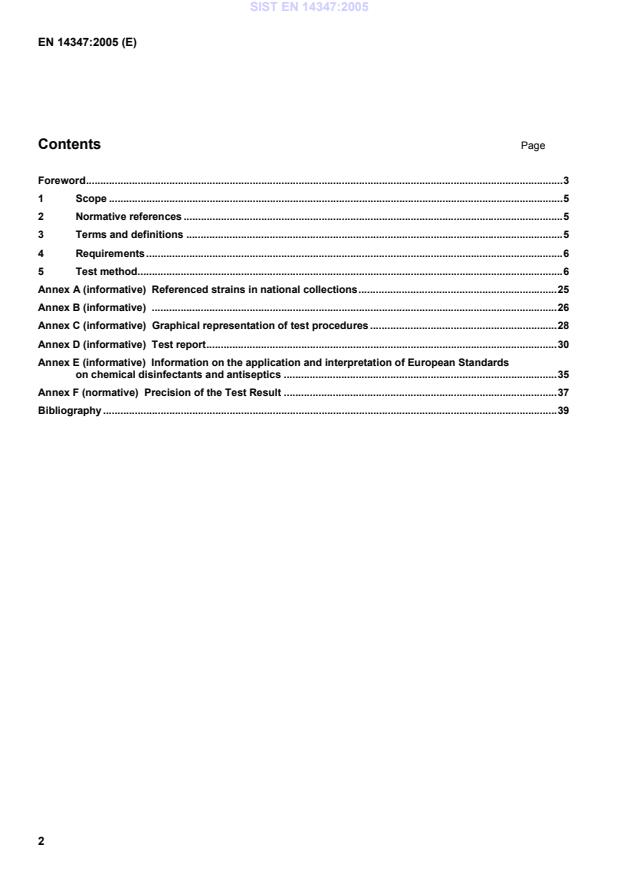
Referenced strains in national collections.25 Annex B (informative)
.............................................................................................................................................26 Annex C (informative)
Graphical representation of test procedures.28 Annex D (informative)
Test report.30 Annex E (informative)
Information on the application and interpretation of European Standards on chemical disinfectants and antiseptics.35 Annex F (normative)
Precision of the Test Result.37 Bibliography.39
1) The ATCC numbers are the collection numbers of strains supplied by the American Type Culture Collection (ATCC). This information is given for the convenience of users of this document and does not constitute an endorsement by CEN of the product named. SIST EN 14347:2005
NOTE 2 For each culture medium and reagent a limitation for use should be fixed. 5.2.2.2 Water The water shall be freshly glass distilled water and not demineralized water. Sterilize in the autoclave [5.3.2.1 a)]. NOTE 1 Sterilization is not necessary if the water is used - e.g. for preparation of culture media - and subsequently sterilized. NOTE 2 If water of adequate quality is not available, water for injections (see bibliographic reference [2]) can be used. 5.2.2.3 Tryptone Soya Agar (TSA) Tryptone, pancreatic digest of casein 15,0 g Soya peptone, papaic digest of Soybean meal 5,0 g Sodium chloride (NaCl) 5,0 g Agar 15,0 g Water (5.2.2.2) to 1 000,0 ml Sterilize in the autoclave [5.3.2.1 a)]. After sterilization the pH of the medium shall be equivalent to 7,2 ± 0,2 when measured at 20 °C. NOTE In special circumstances (problems with neutralization - see 5.5.1.2 and 5.5.1.3) it may be necessary to add neutralizer to TSA (Annex B.3). SIST EN 14347:2005
Protease peptone 15,0 g Liver digest 2,5 g Yeast extract 5,0 g Sodium chloride (NaCl) 5,0 g Agar 12,0 g Water (5.2.2.2) to 1 000,0 ml Defibrinated sterile sheep blood 70 ml to 100 ml Sterilize in the autoclave excluding the sheep blood [5.3.2.1 a)]. After sterilization cool down to
45 °C to 50 °C and add the sterile defibrinated sheep blood and mix thoroughly. Fill into Petri dishes. 5.2.2.5 Neutralizer The neutralizer shall be validated for the product being tested in accordance with 5.5.2.4. The neutralizer shall be sterile. NOTE 1 Information on neutralizers that have been found to be suitable for some categories of products is given in Annex B. NOTE 2 The neutralizer has to form a homogenous, clear, not cloudy preparation when added to TSB [5.2.2.6 b)]. 5.2.2.6 Tryptone Soya Broth (TSB) a) Composition of Tryptone Soya Broth (TSB) Tryptone, pancreatic digest of casein 17,0 g Soya peptone, papaic digest of Soybean meal 3,0 g Sodium chloride (NaCl) 5,0 g Dipotassiumhydrogenphosphat (K2HPO4) 2,5 g Water (5.2.2.2) to 1 000,0 ml Sterilize in the autoclave [5.3.2.1 a)]. After sterilization the pH of the medium shall be equivalent to 7,3 ± 0,2 when measured at 20 °C. b) Trypone Soya Broth (TSB) with neutralizer. TSB [5.2.2.6 a)]. An adequate neutralizer shall be added according to its chemical properties before or after autoclaving (5.2.2.5). TSB plus neutralizer should be filled into glass tubes both in portions of 9 ml and 10 ml.
2) OXOID blood agar base in an example of a suitable product available commercially. SIST EN 14347:2005
and in particular, the following: 5.3.2.1 Apparatus for sterilization: a) for moist heat sterilization, an autoclave capable of being maintained at (1213 0
+) °C for a minimum holding time of 15 min; a) for dry heat sterilization, a hot air oven capable of being maintained at (1805 0
+) °C for a minimum holding time of 30 min, at (1705 0
+) °C for a minimum holding time of 1 h or at (1605 0
+) °C for a minimum holding time of 2 h. 5.3.2.2 Water baths capable of being controlled at 20 °C ± 1 °C, at 45 °C ± 1 °C (to maintain melted TSA in case of pour plate technique) and at additional test temperatures ± 1 °C (5.5.1.1). 5.3.2.3 Incubator, capable of being controlled either at 36 °C ± 1 °C or at 37 °C ± 1 °C and at 30 °C ± 1 °C.
The same temperature shall be used for all incubations performed during a test and its control and validation. 5.3.2.4 pH-meter, having an accuracy of calibration of ± 0,1 pH units at 25 °C. For measuring the pH of the agar media (5.2.2.3, 5.2.2.4 and 5.2.2.7) a puncture electrode or a flat membrane electrode shall be used.
3) Disposable sterile equipment is an acceptable alternative to reusable glassware. SIST EN 14347:2005
5.3.2.12 Orbital mechanical shaker. 5.3.2.13 Centrifuge, capable of 3 000 g and capable of being controlled at 10 °C to 15 °C. 5.3.2.14 Screw capped tubes of suitable capacity. 5.3.2.15 1 000 ml-glass-Roux bottles with straight neck. 5.3.2.16 Microscope, preferably, a phase-contrast type, with magnification of at least x 400. 5.3.2.17 Gauze (EN 14079). 5.3.2.18 Glass funnel (Diameter: 20 cm to 30 cm). 5.3.2.19 Refrigerator, capable of being controlled at 2 °C to 8 °C. 5.4 Preparation of bacterial spore suspensions and product test solutions 5.4.1 Test organism suspensions (Test and validation suspension) Two different bacterial spore suspensions of the test organism have to be prepared: the “test suspension” to perform the test and the “validation suspension” to perform the controls and method validation. 5.4.1.1 Stock culture of test organisms Stock cultures shall be kept in accordance with the requirements of EN 12353. NOTE A freeze dried sample of the test organism is obtained from a culture collection. This sample is cultured, prepared for storage, filled into storage vessels and placed in the deep freeze according to EN 12353. From the deep freeze samples a stock culture is prepared and subsequently used to prepare working cultures for the test procedure. Defrost a deep freeze sample at room temperature. Inoculate a blood agar plate (5.2.2.4) with this suspension and incubate (5.3.2.3). Use the culture as stock culture and control culture for purity by visual examination. From the stock culture the bacterial spore suspension can be prepared (5.4.1.2).
4) Vortex® in an example of a suitable product available commercially. This information is given for the convenience of users of this document and does not constitute an endorsement by CEN of this product. SIST EN 14347:2005
5) Glutaraldehyde: 50% Glutaraldehyde. SIST EN 14347:2005
c) To prepare the 0,05 % peracetic acid (PA6)) standard dissolve 0,25 ml 15 % PA in 59,75 ml water (5.2.2.2). The pH shall be equivalent to 3,2 ± 0,2 when measured at 20 °C. d) To prepare the 0,1 % peracetic acid (PA) standard dissolve 0,5 ml 15 % PA in 59,5 ml water (5.2.2.2). The pH shall be equivalent to 3,1 ± 0,2 when measured at 20 °C. 5.5 Procedure for assessing the sporicidal activity of the product 5.5.1 General 5.5.1.1 Experimental conditions (obligatory and additional) Besides the obligatory temperature, contact times and test organisms additional experimental conditions may be selected according to the practical use considered for the product (4): a) temperature (θ in °C): obligatory temperature to be tested is θ
= 20 °C; allowed deviation for each chosen temperature is
1 °C ; b) contact time (t in min):
obligatory contact times to be tested are t = 30 min, 60 min or 120 min; allowed deviation for each chosen contact time is
10 s, for 120 min
60 s; c) test organisms: obligatory test organisms are: Bacillus cereus and Bacillus subtilis (5.2.1); If required for specific applications, additional test organisms may be chosen. 5.5.1.2 Selection of neutralizer The method of choice is dilution-neutralization method. To determine a suitable neutralizer carry out the validation of the dilution neutralization method (5.5.2.3 and 5.5.2.4 in connection with 5.5.2.5) using a suitable neutralizer, chosen according to laboratory experience and published data. The neutralizer has to form a homogenous, clear and not cloudy preparation when added to TSB. If this neutralizer is not valid, repeat the validation test using an alternative neutralizer (Annex B) containing a combination of polysorbate 80 (30 g/l), saponin (30 g/l), L-histidine (1 g/l), lecithin (3 g/l), sodiumthiosulphate (5 g/l). NOTE In special circumstances it may be necessary to add neutralizer to TSA (5.2.2.3). If neutralizer is added to TSA the same amount shall be added to TSA used in the test procedure.
6) Peracetic acid 15 %: aqueous solution of peracetic acid (min. 15 % acetic acid + max. 24 % Hydrogene peroxide + min. 16 % peracetic acid + min. 40 % H2O). Stored at 4 °C to 8 °C. SIST EN 14347:2005
by the spread plate or by the pour plate technique on TSA (5.4.1.3) in order to determine Nw. For incubation and counting see 5.5.2.5. e) Perform the procedure a) – c) applying the other obligatory and - if appropriate - other additional experimental conditions (5.5.1.1). The principle is given in Figure C.1. 5.5.2.2 Control of bacterial spore suspension with reference substances Perform the test procedure described in 5.5.2.1 a) – b) using the glutaraldehyde (GA) and peracetic acid (PA) standard (5.4.3) instead of the product test solution. Suitable neutralizers are 20 g/l histidine for glutaraldehyde and 10 g/l sodium thiosulfate for peracetic acid. The results obtained shall meet the requirements fixed in Annex F and Annex G. 5.5.2.3 Neutralizer control "B" (Verification of the absence of toxicity of the neutralizer) a) Pipette 1,0 ml of the spore test suspension “N1” (5.4.1.3) into a tube. Add 9,0 ml of water (5.2.2.2). Start the stopwatch at the beginning of the addition, mix (5.3.2.6), and place the tube in a water bath controlled at 20 °C ± 1 °C for the longest contact time in the test; b) At the end of this time mix (5.3.2.6) and transfer a sample of 0,1 ml of this mixture “B” in 10 ml TSB with neutralizer (ONT) [5.2.2.6 b)]. Mix (5.3.2.6), and place the tube in a water bath controlled at 20 °C ± 1 °C. After 30 min ± 10 s mix and prepare 10-2, 10-3 and 10-4 dilutions out of the mixture “B” in
9 ml TSB with neutralizer and determine the spore count by the spread plate or by the pour plate technique on TSA (5.4.1.3) in order to determine B. For incubation and counting see 5.5.2.5. 5.5.2.4 Method validation “C” (Dilution-neutralization validation) and long time toxicity control For validation of dilution-neutralization prepare 3 different dilutions of the disinfectant. One in the concentration, one with double concentration and one with half the concentration to be tested in the actual test. Prepare twice as much tubes with 10 ml of TSB with neutralizer [5.2.2.6 b], for dilution-neutralization-validation) and TSB without neutralizer [5.2.2.6 a)], for determination of sporistatic activity) as product-dilution steps to be tested. For long time toxicity control prepare one tube with 9 ml TSB with neutralizer [5.2.2.6 b] and add 1,0 ml water (5.2.2.2). Pipette 0,1 ml of the validation suspension “Nv” (5.4.1.4) into the tube and mix. a)
For validation of dilution-neutralization pipette 0,1 ml of the validation suspension “Nv” (5.4.1.4) into each tube and mix. Add 0,1 ml of the corresponding product-dilution to each tube. Start a stopwatch at the beginning of the addition, mix (5.3.2.6) and place the tubes in a water bath controlled at 20 °C ± 1 °C;
b) After 30 min ± 1 min neutralization time mix (5.3.2.6) again and make a serial of ten-fold dilutions out of each tube in 9 ml TSB with neutralizer from the corresponding tubes and in TSB alone from the tubes without neutralizer and determine the spore count by the spread plate or by the pour plate technique on TSA (5.4.1.3) in order to determine C. SIST EN 14347:2005
Number of cells per ml in the bacterial spore suspensions Number of survivors per ml in the test mixtures at the end of the contact-time t of 30 min (C) Test N1 Test suspension Na, Nw, B (before neutralisation) Controls Nv Validation suspension C SIST EN 14347:2005
21+=, where c is the sum of Vc-values taken into account; SIST EN 14347:2005
is the number of Vc-values taken into account in the lower dilution, i.e. (10-6); n2 is the number of Vc-values taken into account in the higher dilution, i.e. (10-7); d is the dilution factor corresponding to the lower dilution. Round off the results calculated to two significant figures. For this, if the last figure is below 5, the preceding figure is not modified; if the last figure is more than 5 the preceding figure is increased by one unit; if the last figure is equal to 5, round off the preceding figure to the next nearest even figure. Proceed stepwise until two significant figures are obtained. As a result the number of cfu/ml is expressed by a number between 1,0 and 9,9 multiplied by the appropriate power of 10. EXAMPLE N = cfu/ml) (in109110
2242610)2102(25
,
=
,
=
,
=
, +
--××××+++ 5.6.2.3 Calculation of Na and Nw a) Na is the number of survivors per ml in the test mixture [5.5.2.1 a)] at the end of the contact time and before neutralization. It is hundredfold higher than the Vc values due to the sample volume of 0,1 ml transferred into ONT (dilution 1:100) [5.5.2.1 b)]; b) Nw is the number of cells per ml in the test mixture [5.5.2.1 d)] at the end of the contact time and before neutralization. It is hundredfold higher than the Vc values due to the sample volume of 0,1 ml transferred into ONT (dilution 1:100) [5.5.2.1 d)]. Calculate Na and Nw using the following formula: Na, Nw
= dc××n 100 where c is the sum of Vc-values taken into account; n is the number of Vc-values taken into account; d is the dilution factor corresponding to the dilution taken into account. If one or both of the duplicate Vc-values are either below the lower limit or above the higher limit, express the results as “less than” or “more than”. EXAMPLES
a) duplicate Vc values in dilution step Na0: 2, 16 Na = cfu/ml) (in1051 10
...