

EN 13624:2003
(Main)Chemical disinfectants and antiseptics - Quantitative suspension test for the evaluation of fungicidal activity of chemical disinfectants for instruments used in the medical area - Test method and requirements (phase 2, step 1)
- Abstract
This European Standard specifies a test method and the minimum requirements for fungicidal or yeasticidal activity of chemical disinfectant products that form a homogeneous, physically stable preparation when diluted with hard water or - in the case of ready-to-use products - with water. Products can only be tested at a concentration of 80 % or less as some dilution is always produced by adding the test organisms and interfering substance.
This European Standard applies to products that are used in the medical area for disinfecting instruments by immersion - even if they are not covered by the EEC/93/42 Directive on Medical Devices.
This European Standard applies to areas and situations where disinfection is medically indicated. Such indications occur in patient care, for example :
- in hospitals, in community medical facilities and in dental institutions ;
- in clinics of schools, of kindergartens and of nursing homes ;
and may occur in the workplace and in the home. It may also include services such as laundries and kitchens supplying products directly for the patients.
NOTE 1 The method described is intended to determine the activity of commercial formulations or active substances under the conditions in which they are used.
NOTE 2 This method corresponds to a phase 2 step 1 test (see annex E).
- Status
- Withdrawn
- Publication Date
- 02-Dec-2003
- Withdrawal Date
- 24-Sep-2013
- Technical Committee
- CEN/TC 216 - Chemical disinfectants and antiseptics
- Drafting Committee
- CEN/TC 216/WG 1 - Human medicine
- Current Stage
- 9960 - Withdrawal effective - Withdrawal
- Start Date
- 25-Sep-2013
- Completion Date
- 25-Sep-2013
- Directive
- 93/42/EEC - Medical devicesOJ Ref: C, C 16 OJ Date: 18-Jan-2011

Relations
- Effective Date
- 02-Oct-2013
- Effective Date
- 03-Jun-2026
- Effective Date
- 03-Jun-2026
- Effective Date
- 28-Jan-2026
- Effective Date
- 28-Jan-2026
Get Certified
Connect with accredited certification bodies for this standard

BSI Group
BSI (British Standards Institution) is the business standards company that helps organizations make excellence a habit.

TÜV Rheinland
TÜV Rheinland is a leading international provider of technical services.

TÜV SÜD
TÜV SÜD is a trusted partner of choice for safety, security and sustainability solutions.
Sponsored listings
Frequently Asked Questions
EN 13624:2003 is a standard published by the European Committee for Standardization (CEN). Its full title is "Chemical disinfectants and antiseptics - Quantitative suspension test for the evaluation of fungicidal activity of chemical disinfectants for instruments used in the medical area - Test method and requirements (phase 2, step 1)". This standard covers: This European Standard specifies a test method and the minimum requirements for fungicidal or yeasticidal activity of chemical disinfectant products that form a homogeneous, physically stable preparation when diluted with hard water or - in the case of ready-to-use products - with water. Products can only be tested at a concentration of 80 % or less as some dilution is always produced by adding the test organisms and interfering substance. This European Standard applies to products that are used in the medical area for disinfecting instruments by immersion - even if they are not covered by the EEC/93/42 Directive on Medical Devices. This European Standard applies to areas and situations where disinfection is medically indicated. Such indications occur in patient care, for example : - in hospitals, in community medical facilities and in dental institutions ; - in clinics of schools, of kindergartens and of nursing homes ; and may occur in the workplace and in the home. It may also include services such as laundries and kitchens supplying products directly for the patients. NOTE 1 The method described is intended to determine the activity of commercial formulations or active substances under the conditions in which they are used. NOTE 2 This method corresponds to a phase 2 step 1 test (see annex E).
This European Standard specifies a test method and the minimum requirements for fungicidal or yeasticidal activity of chemical disinfectant products that form a homogeneous, physically stable preparation when diluted with hard water or - in the case of ready-to-use products - with water. Products can only be tested at a concentration of 80 % or less as some dilution is always produced by adding the test organisms and interfering substance. This European Standard applies to products that are used in the medical area for disinfecting instruments by immersion - even if they are not covered by the EEC/93/42 Directive on Medical Devices. This European Standard applies to areas and situations where disinfection is medically indicated. Such indications occur in patient care, for example : - in hospitals, in community medical facilities and in dental institutions ; - in clinics of schools, of kindergartens and of nursing homes ; and may occur in the workplace and in the home. It may also include services such as laundries and kitchens supplying products directly for the patients. NOTE 1 The method described is intended to determine the activity of commercial formulations or active substances under the conditions in which they are used. NOTE 2 This method corresponds to a phase 2 step 1 test (see annex E).
EN 13624:2003 is classified under the following ICS (International Classification for Standards) categories: 11.080.20 - Disinfectants and antiseptics. The ICS classification helps identify the subject area and facilitates finding related standards.
EN 13624:2003 has the following relationships with other standards: It is inter standard links to EN 13624:2013, ISO 4793:1980, ISO 6710:1995, EN 12928:2000, EN 12353:2021. Understanding these relationships helps ensure you are using the most current and applicable version of the standard.
EN 13624:2003 is associated with the following European legislation: EU Directives/Regulations: 93/42/EEC; Standardization Mandates: M/BC/CEN/89/9. When a standard is cited in the Official Journal of the European Union, products manufactured in conformity with it benefit from a presumption of conformity with the essential requirements of the corresponding EU directive or regulation.
EN 13624:2003 is available in PDF format for immediate download after purchase. The document can be added to your cart and obtained through the secure checkout process. Digital delivery ensures instant access to the complete standard document.
Standards Content (Sample)
2003-01.Slovenski inštitut za standardizacijo. Razmnoževanje celote ali delov tega standarda ni dovoljeno.Chemische Desinfektionsmittel und Antiseptika - Quantitativer Suspensionsversuch zur Prüfung der fungiziden Wirkung chemischer Desinfektionsmittel für Instrumente im humanmedizinischen Bereich - Prüfverfahren und Andforderungen (Phase 2, Stufe 1)Antiseptiques et désinfectants chimiques - Essai quantitatif de suspension pour l'évaluation de l'activité fongicide des désinfectants chimiques utilisés pour les instruments en médecine - Méthode d'essai et exigences (phase 2, étape 1)Chemical disinfectants and antiseptics - Quantitative suspension test for the evaluation of fungicidal activity of chemical disinfectants for instruments used in the medical area - Test method and requirements (phase 2, step 1)11.080.20Dezinfektanti in antiseptikiDisinfectants and antisepticsICS:Ta slovenski standard je istoveten z:EN 13624:2003SIST EN 13624:2004en,fr,de01-februar-2004SIST EN 13624:2004SLOVENSKI
STANDARD
EUROPEAN STANDARDNORME EUROPÉENNEEUROPÄISCHE NORMEN 13624December 2003ICS 11.080.20English versionChemical disinfectants and antiseptics - Quantitative suspensiontest for the evaluation of fungicidal activity of chemicaldisinfectants for instruments used in the medical area - Testmethod and requirements (phase 2, step 1)Antiseptiques et désinfectants chimiques - Essai quantitatifde suspension pour l'évaluation de l'activité fongicidedesdésinfectants chimiques utilisés pour les instruments enmédecine - Méthode d'essai et prescriptions (phase 2,étape 1)Chemische Desinfektionsmittel und Antiseptika -Quantitativer Suspensionsversuch zur Prüfung derfungiziden Wirkung chemischer Desinfektionsmittel fürInstrumente im humanmedizinischen Bereich -Prüfverfahren und Andforderungen (Phase 2, Stufe 1)This European Standard was approved by CEN on 3 November 2003.CEN members are bound to comply with the CEN/CENELEC Internal Regulations which stipulate the conditions for giving this EuropeanStandard the status of a national standard without any alteration. Up-to-date lists and bibliographical references concerning such nationalstandards may be obtained on application to the Management Centre or to any CEN member.This European Standard exists in three official versions (English, French, German). A version in any other language made by translationunder the responsibility of a CEN member into its own language and notified to the Management Centre has the same status as the officialversions.CEN members are the national standards bodies of Austria, Belgium, Czech Republic, Denmark, Finland, France, Germany, Greece,Hungary, Iceland, Ireland, Italy, Luxembourg, Malta, Netherlands, Norway, Portugal, Slovakia, Spain, Sweden, Switzerland and UnitedKingdom.EUROPEAN COMMITTEE FOR STANDARDIZATIONCOMITÉ EUROPÉEN DE NORMALISATIONEUROPÄISCHES KOMITEE FÜR NORMUNGManagement Centre: rue de Stassart, 36
B-1050 Brussels© 2003 CENAll rights of exploitation in any form and by any means reservedworldwide for CEN national Members.Ref. No. EN 13624:2003 ESIST EN 13624:2004
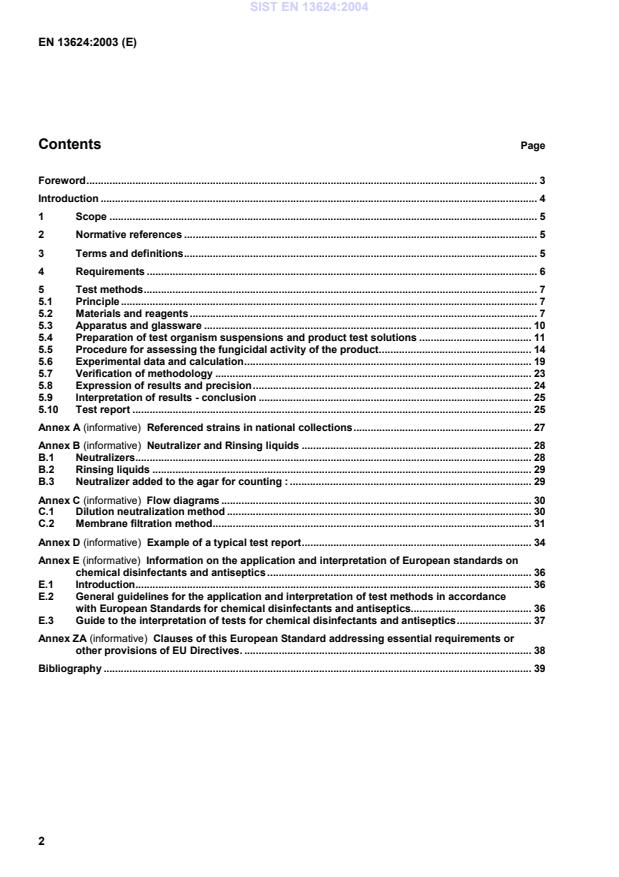
Referenced strains in national collections.27Annex B (informative)
Neutralizer and Rinsing liquids.28B.1Neutralizers.28B.2Rinsing liquids.29B.3Neutralizer added to the agar for counting :.29Annex C (informative)
Flow diagrams.30C.1Dilution neutralization method.30C.2Membrane filtration method.31Annex D (informative)
Example of a typical test report.34Annex E (informative)
Information on the application and interpretation of European standards onchemical disinfectants and antiseptics.36E.1Introduction.36E.2General guidelines for the application and interpretation of test methods in accordancewith European Standards for chemical disinfectants and antiseptics.36E.3Guide to the interpretation of tests for chemical disinfectants and antiseptics.37Annex ZA (informative)
Clauses of this European Standard addressing essential requirements orother provisions of EU Directives.38Bibliography.39SIST EN 13624:2004
1)The ATCC numbers are the collection numbers of strains supplied by the American Type Culture Collection (ATCC).This information is given for the convenience of users of this standard and does not constitute an endorsement by CEN ofthe product named.SIST EN 13624:2004
2)Disposable equipment is an acceptable alternative to reusable glassware.3)Vortex® in an example of a suitable product available commercially. This information is given for the convenience ofusers of this standard and does not constitute an endorsement by CEN of this product.SIST EN 13624:2004
4)cfu/ml = colony forming unit(s) per millilitreSIST EN 13624:2004
5)Malassez is an example of a suitable product available commercially. This information is given for the convenience ofusers of this standard and does not constitute an endorsement by CEN of this product.SIST EN 13624:2004
and 30 min ;¾ allowed deviation for each chosen contact time is ± 10 s.c) Interfering substance :¾ obligatory interfering substance to be tested is 0,30 g/l bovine albumin (see 5.2.2.8.2) under clean ora mixture of 3 ml/l sheep erythrocytes and 3,0 g/l bovine albumin (see 5.2.2.8.3) under dirtyconditions – according to practical applications ;¾ additional interfering substances may be tested according to specific field of application.
d) Test organisms :¾ obligatory test organisms are: Candida albicans and Aspergillus niger or only Candida albicans (see5.2.1).5.5.1.2 Choice of test methodThe method of choice is the dilution-neutralization method (see 5.5.2). To determine a suitable neutralizercarry out the validation of the dilution neutralization method (see 5.5.2.3, 5.5.2.4 and 5.5.2.5 in connectionwith 5.5.2.6) using a neutralizer, chosen according to laboratory experience and published data.If this neutralizer is not valid, repeat the validation test using an alternative neutralizer containing acombination of polysorbate 80
(30 g/l), saponin (30 g/l), L-histidine (1 g/l), lecithin (3 g/l), sodium thiosulfate(5 g/l) in either diluent (see 5.2.2.4) or in phosphate buffer 0,0025 mol/l (see B.1).If both neutralizers are found to be invalid, the membrane filtration method (see 5.5.3) may be used in place ofthe dilution-neutralization method.NOTEIn special circumstances it may be necessary to add neutralizer to MEA (see 5.2.2.3).If neutralizer is added to MEA the same amount shall be added to MEA used in the test procedure.5.5.1.3 Validation and control procedures - General instructionsThe neutralization and/or removal of the fungicidal and/or fungistatic activity of the product shall be controlledand validated - only for the highest product test concentration - for each of the used test organisms and foreach experimental condition (interfering substance, temperature, contact time). These procedures(experimental condition control, neutralizer or filtration control and method validation) shall be performed atthe same time with the test and with the same neutralizer – or rinsing liquid – used in the test.In the case of ready-to-use-products use water (see 5.2.2.2) instead of hard water.If because of problems with neutralization a neutralizer has been added to MEA (see 5.5.1.3) used for thevalidation and control procedures the MEA used for the test shall contain the same amount of this neutralizeras well.5.5.1.4 Equilibration of temperaturePrior to testing, equilibrate all reagents (product test solutions (see 5.4.2), test suspension (see 5.4.1.4),validation suspension (see 5.4.1.5), diluent (see 5.2.2.4), hard water (see 5.2.2.7) interfering substances(see 5.2.2.8) to the test temperature of q
using the water bath (see 5.3.2.2) controlled at q. Check that thetemperature of the reagents is stabilized at q.The neutralizer (see 5.2.2.5) or the rinsing liquid (see 5.2.2.6) and water (see 5.2.2.2) shall be equilibrated ata temperature of 20 °C ± 1 °C.SIST EN 13624:2004
(see 5.5.1.1 a) for 2 min ± 10 s. At the end of this time, add 8,0 ml of one ofthe product test solutions (see 5.4.2). Restart the stopwatch at the beginning of the addition, mix (see5.3.2.6) and place the tube in a water bath controlled at q for the chosen contact time t (see 5.5.1.1 b).Just before the end of t, mix (see 5.3.2.6) again ;b) At the end of t take a 1,0 ml sample of the test mixture Na and transfer into a tube containing 8,0 mlneutralizer (see 5.2.2.5) and 1,0 ml water (see 5.2.2.2). Mix (see 5.3.2.6) and place in a water bathcontrolled at 20 °C . After a neutralization time of 5 min ± 10 s, immediately take a sample of 1,0 ml of theneutralized test mixture Na (containing neutralizer, product test solution, interfering substance, testsuspension) in duplicate and inoculate using the pour plate or the spread plate technique ;c) Perform the procedure a) to b) using the other product test solutions at the same time ;d) Perform the procedure a) to c) applying the other obligatory and - if appropriate - other additionalexperimental conditions (see 5.5.1.1.).5.5.2.3 Experimental condition control “A” (Validation of the selected experimental conditions orverification of the absence of any lethal effect in the test conditions)a) Pipette 1,0 ml of the interfering substance used in the test (see 5.5.2.2) into a tube. Add 1,0 ml of thevalidation suspension (see 5.4.1.5). Start the stopwatch immediately, mix (see 5.3.2.6) and place the tube min ± 10 s. At the end of this time add 8,0 ml of hard water(see 5.2.2.7). (In the case of ready-to-use products: water (see 5.2.2.2) instead of hard water). Restartthe stopwatch at the beginning of the addition, mix (see 5.3.2.6) and place the tube in a water batht. Just before the end of t, mix (see 5.3.2.6) again;b) At the end of t, take a sample of 1,0 ml of this mixture A in duplicate and inoculate using the pour plate orthe spread plate technique (see 5.5.2.2b).Incubation and counting see 5.5.2.6.
6)For a graphical representation of this method see C.1SIST EN 13624:2004
...