

EN 12043:2000+A1:2010
(Main + Amendment)Food processing machinery - Intermediate provers - Safety and hygiene requirements
- Abstract
This standard specifies safety and hygiene requirements for the design and manufacture of intermediate provers with moving pocket carriers !as described in Clause 3" used in the food industry, pastry-making, bakeries, etc. for giving a resting time to dough between dividing and moulding processes.
!This European Standard specifies all significant hazards, hazardous situations and events relevant to the installation, adjustment, operation, cleaning, maintenance, dismantling, disabling and scrapping of intermediate provers with moving pocket carriers when they are used as intended and under conditions of misuse which are reasonably foreseeable by the manufacturer (see Clause 4)."
The significant hazards covered by the standard are mechanical (shearing, trapping, cutting, loss of stability), electrical, ergonomic and also those resulting from inhalation of flour dust and lack of hygiene.
Noise is not considered to be a significant hazard from intermediate provers. This does not mean that the manufacturer of the machine is absolved from reducing noise and making a noise declaration. Therefore a noise test code is proposed in Annex B.
!deleted text"
The following machines are excluded:
- rack provers;
- experimental and testing machines under development by the manufacturer.
!This standard is not applicable to intermediate provers with moving pocket carriers which are manufactured before the date of its publication as EN."
- Status
- Withdrawn
- Publication Date
- 21-Sep-2010
- Withdrawal Date
- 06-Oct-2026
- Technical Committee
- CEN/TC 153 - Food processing machinery - Safety and hygiene specifications
- Drafting Committee
- CEN/TC 153/WG 1 - Bakery equipment
- Current Stage
- 9960 - Withdrawal effective - Withdrawal
- Start Date
- 26-Nov-2014
- Completion Date
- 07-Oct-2026
- Directive
- 2006/42/EC - Directive 2006/42/EC of the European Parliament and of the Council of 17 May 2006 on machinery, and amending Directive 95/16/EC (recast)OJ Ref: C, C 110 OJ Date: 08-Apr-2011

Relations
- Effective Date
- 17-Jul-2010
- Merged From
EN 12043:2000 - Food processing machinery - Intermediate provers - Safety and hygiene requirements - Effective Date
- 17-Jul-2010
- Replaced By
EN 12043:2014 - Food processing machinery - Intermediate provers - Safety and hygiene requirements - Effective Date
- 17-Jul-2010
- Effective Date
- 25-Aug-2026
- Effective Date
- 09-Feb-2026
- Effective Date
- 28-Jan-2026
- Effective Date
- 28-Jan-2026
- Effective Date
- 28-Jan-2026
- Effective Date
- 28-Jan-2026
- Effective Date
- 28-Jan-2026
- Effective Date
- 28-Jan-2026
- Effective Date
- 28-Jan-2026
- Effective Date
- 28-Jan-2026
- Effective Date
- 28-Jan-2026
- Effective Date
- 28-Jan-2026
Get Certified
Connect with accredited certification bodies for this standard

BSI Group
BSI (British Standards Institution) is the business standards company that helps organizations make excellence a habit.

Bureau Veritas
Bureau Veritas is a world leader in laboratory testing, inspection and certification services.

DNV
DNV is an independent assurance and risk management provider.
Sponsored listings
Frequently Asked Questions
EN 12043:2000+A1:2010 is a standard published by the European Committee for Standardization (CEN). Its full title is "Food processing machinery - Intermediate provers - Safety and hygiene requirements". This standard covers: This standard specifies safety and hygiene requirements for the design and manufacture of intermediate provers with moving pocket carriers !as described in Clause 3" used in the food industry, pastry-making, bakeries, etc. for giving a resting time to dough between dividing and moulding processes. !This European Standard specifies all significant hazards, hazardous situations and events relevant to the installation, adjustment, operation, cleaning, maintenance, dismantling, disabling and scrapping of intermediate provers with moving pocket carriers when they are used as intended and under conditions of misuse which are reasonably foreseeable by the manufacturer (see Clause 4)." The significant hazards covered by the standard are mechanical (shearing, trapping, cutting, loss of stability), electrical, ergonomic and also those resulting from inhalation of flour dust and lack of hygiene. Noise is not considered to be a significant hazard from intermediate provers. This does not mean that the manufacturer of the machine is absolved from reducing noise and making a noise declaration. Therefore a noise test code is proposed in Annex B. !deleted text" The following machines are excluded: - rack provers; - experimental and testing machines under development by the manufacturer. !This standard is not applicable to intermediate provers with moving pocket carriers which are manufactured before the date of its publication as EN."
This standard specifies safety and hygiene requirements for the design and manufacture of intermediate provers with moving pocket carriers !as described in Clause 3" used in the food industry, pastry-making, bakeries, etc. for giving a resting time to dough between dividing and moulding processes. !This European Standard specifies all significant hazards, hazardous situations and events relevant to the installation, adjustment, operation, cleaning, maintenance, dismantling, disabling and scrapping of intermediate provers with moving pocket carriers when they are used as intended and under conditions of misuse which are reasonably foreseeable by the manufacturer (see Clause 4)." The significant hazards covered by the standard are mechanical (shearing, trapping, cutting, loss of stability), electrical, ergonomic and also those resulting from inhalation of flour dust and lack of hygiene. Noise is not considered to be a significant hazard from intermediate provers. This does not mean that the manufacturer of the machine is absolved from reducing noise and making a noise declaration. Therefore a noise test code is proposed in Annex B. !deleted text" The following machines are excluded: - rack provers; - experimental and testing machines under development by the manufacturer. !This standard is not applicable to intermediate provers with moving pocket carriers which are manufactured before the date of its publication as EN."
EN 12043:2000+A1:2010 is classified under the following ICS (International Classification for Standards) categories: 67.260 - Plants and equipment for the food industry. The ICS classification helps identify the subject area and facilitates finding related standards.
EN 12043:2000+A1:2010 has the following relationships with other standards: It is inter standard links to EN 12043:2000/FprA1, EN 12043:2000, EN 12043:2014, ISO 8598:1996, EN 60529:1991, EN 1088:1995+A2:2008, EN ISO 3743-1:2009, EN ISO 3744:2009, EN 2286:1989, EN ISO 4287:1998, EN ISO 13849-1:2008, EN ISO 12100-2:2003, EN ISO 12001:2009, EN 954-1:1996, EN ISO 11688-1:2009. Understanding these relationships helps ensure you are using the most current and applicable version of the standard.
EN 12043:2000+A1:2010 is associated with the following European legislation: EU Directives/Regulations: 2006/42/EC; Standardization Mandates: M/396. When a standard is cited in the Official Journal of the European Union, products manufactured in conformity with it benefit from a presumption of conformity with the essential requirements of the corresponding EU directive or regulation.
EN 12043:2000+A1:2010 is available in PDF format for immediate download after purchase. The document can be added to your cart and obtained through the secure checkout process. Digital delivery ensures instant access to the complete standard document.
Standards Content (Sample)
2003-01.Slovenski inštitut za standardizacijo. Razmnoževanje celote ali delov tega standarda ni dovoljeno.Nahrungsmittelmaschinen - Zwischengärschrank - Sicherheits-und HygieneanforderungenMachines pour les produits alimentaires - Chambres de repos - Prescriptions relatives à la sécurité et à l'hygièneFood processing machinery - Intermediate provers - Safety and hygiene requirements67.260Tovarne in oprema za živilsko industrijoPlants and equipment for the food industryICS:Ta slovenski standard je istoveten z:EN 12043:2000+A1:2010SIST EN 12043:2002+A1:2011en,fr,de01-januar-2011SIST EN 12043:2002+A1:2011SLOVENSKI
STANDARDSIST EN 12043:20021DGRPHãþD
EUROPEAN STANDARD NORME EUROPÉENNE EUROPÄISCHE NORM
EN 12043:2000+A1
September 2010 ICS 67.260 Supersedes EN 12043:2000English Version
Food processing machinery - Intermediate provers - Safety and hygiene requirements
Machines pour les produits alimentaires - Chambres de repos -Prescriptions relatives à la sécurité et à l'hygiène
Nahrungsmittelmaschinen - Zwischengärschrank - Sicherheits-und Hygieneanforderungen This European Standard was approved by CEN on 3 July 2000 and includes Amendment 1 approved by CEN on 12 August 2010.
CEN members are bound to comply with the CEN/CENELEC Internal Regulations which stipulate the conditions for giving this European Standard the status of a national standard without any alteration. Up-to-date lists and bibliographical references concerning such national standards may be obtained on application to the CEN Management Centre or to any CEN member.
This European Standard exists in three official versions (English, French, German). A version in any other language made by translation under the responsibility of a CEN member into its own language and notified to the CEN Management Centre has the same status as the official versions.
CEN members are the national standards bodies of Austria, Belgium, Bulgaria, Croatia, Cyprus, Czech Republic, Denmark, Estonia, Finland, France, Germany, Greece, Hungary, Iceland, Ireland, Italy, Latvia, Lithuania, Luxembourg, Malta, Netherlands, Norway, Poland, Portugal, Romania, Slovakia, Slovenia, Spain, Sweden, Switzerland and United Kingdom.
EUROPEAN COMMITTEE FOR STANDARDIZATION
COMITÉ EUROPÉEN DE NORMALISATION EUROPÄISCHES KOMITEE FÜR NORMUNG
Management Centre:
Avenue Marnix 17,
B-1000 Brussels © 2010 CEN All rights of exploitation in any form and by any means reserved worldwide for CEN national Members. Ref. No. EN 12043:2000+A1:2010: ESIST EN 12043:2002+A1:2011
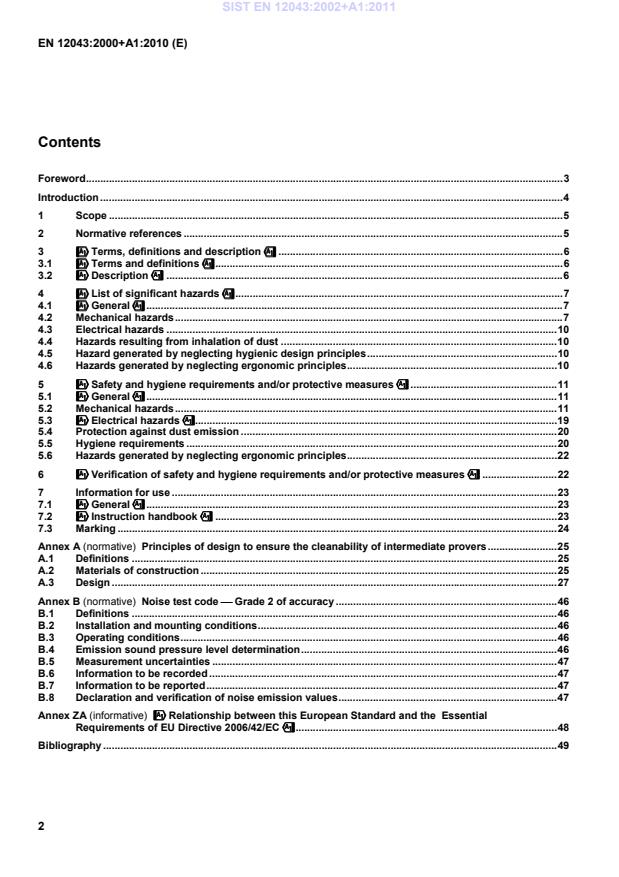
Principles of design to ensure the cleanability of intermediate provers . 25A.1Definitions . 25A.2Materials of construction . 25A.3Design . 27Annex B (normative)
Noise test code Grade 2 of accuracy . 46B.1Definitions . 46B.2Installation and mounting conditions . 46B.3Operating conditions . 46B.4Emission sound pressure level determination . 46B.5Measurement uncertainties . 47B.6Information to be recorded . 47B.7Information to be reported . 47B.8Declaration and verification of noise emission values . 47Annex ZA (informative)
!!!!Relationship between this European Standard and the
Essential Requirements of EU Directive 2006/42/EC"""" . 48Bibliography . 49 SIST EN 12043:2002+A1:2011
As shown in Figure 1, an intermediate prover consists of: a variable number of fixed or hinged pockets supported in a carrier into which dough pieces are loaded. One pocket may hold more than one dough piece; a mechanical transfer system moving the pocket carrier along a fixed path inside the machine; a frame supporting or containing the transmission machinery." The following features may also be included: an automatic device to control the temperature and/or humidity inside the machine; a flour dusting device; SIST EN 12043:2002+A1:2011
Figure 1 a) Front loading, side unloading
Figure 1 b) Front loading, rear unloading
Figure 1 c) Front loading, front unloading
Figure 1 d) Manual loading and unloading in the same position Figure 1 Danger zones for various types of intermediate provers
4.3 Electrical hazards Hazard of electric shock from direct or indirect contact with live components. Hazard of external influences on electrical equipment (e.g. cleaning with water). 4.4 Hazards resulting from inhalation of dust Use of flour dusters may expose operators to dust including flour and ingredients which may be harmful to their health, causing rhinitis (running noses), watering eyes and possibly occupational asthma. 4.5 Hazard generated by neglecting hygienic design principles The neglection of hygienic principles can create unacceptable modification of foodstuff and therefore a risk to human health, i.e. through physical, chemical or microbial pollution. 4.6 Hazards generated by neglecting ergonomic principles During operation, cleaning and maintenance, there is a risk of injury or chronic damage to the body resulting from awkward body postures. SIST EN 12043:2002+A1:2011
In addition, the machine shall be designed according to the principles of EN ISO 12100-2 for relevant but not significant hazards, which are not dealt with by this document. The safety related parts of the control systems shall meet at least category 1 of 6.2.2 of EN 954-1:1996 or present at least a performance level c defined in accordance with EN ISO 13849-1:2008. When fixed guards, or parts of the machine acting as such, are not permanently fixed e.g. by welding, their fixing systems shall remain attached to the guards or to the machinery when the guards are removed." 5.2 Mechanical hazards Where reference is made to interlocking devices, they shall comply with 4.2.1 and clauses 5 and 6 of !EN 1088:1995+A2:2008". Where the interlocking mechanism has movable parts, e.g. position switches, these shall be protected from contamination with dough or dry ingredients, e. g. by mounting them within the machine body. Alternatively, magnetic switches may be used if total removal of any guard is required. Where switches may be exposed to water, e.g. during cleaning, they shall be protected to an appropriate IP rating (EN 60529: 1991, e. g. IPX5). !deleted text" 5.2.1 Zone 1: Zone of loading and unloading of the dough portions 5.2.1.1 The risk of trapping the arm between the moving pocket carrier and the fixed edges of the loading or unloading openings shall be prevented by any of the following: ensuring the distance between the fixed edge of the opening and the nearest rigid part of the pocket carrier is a minimum of 120 mm (see Figures 2 a) and 2b); providing a pressure sensitive trip bar or wire (see !EN 1760-2") covering the opening where the trapping may occur (see Figure 2 c) with a stopping time less than or equal to 1 s; ensuring the force required to stop the motion of the pocket carrier does not exceed 150 N either loaded or unloaded; this could be achieved e.g. by a torque limiting device; where pocket carrier movement is not continuous, the pressure sensitive bar or wire is not required. The indexing movement may be controlled by a timer or the operation of a manual control device. This method can only be used where both the loading and the unloading area are visible from the position of the control device. 5.2.1.2 The risk of trapping between adjacent descending and ascending pocket carriers shall be prevented by any of the following: ensuring the distance between the axis of the ascending pocket and the axis of the descending pocket carrier is a minimum of 200 mm (see Figure 2 d)); SIST EN 12043:2002+A1:2011
Key
1 Movement of tilting pocket 2 Movement of soft pocket 3 Movement of rigid pocket Figure 2 a) Gap between fixed edge and moving pocket carrier
Key
1 Fixed pocket or temporarily fixed during loading
Figure 2 b) Gap between fixed edge and pocket carrier SIST EN 12043:2002+A1:2011
Key 1 Trip device 2 Fixed pocket or temporarily fixed during loading 3 Tilting pocket Figure 2 c) Safeguarding by trip device SIST EN 12043:2002+A1:2011
Key 1 Tilting pockets Figure 2 d) Gap between ascending and descending pocket carrier
Figure 2 e) Safeguarding of inrunning nip between gear and chain Figure 2 Protective measures against mechanical hazards
Figure 3 a) Pocket feeding device The pockets of the intermediate prover are individually fed by dough pieces coming e.g. directly from a conical rounder.
Figure 3 b) Simple tipping device A conveyor belt tips when it is totally filled, in order to drop the dough pieces in the next carrier of the intermediate prover.
Figure 3 c) Opening moulding belts When the moulding belts are totally filled, they rotate apart in order to drop the dough pieces in the next carrier of the intermediate prover.
Figure 3 d) Pushing device A full conveyor belt is discharged by a pushing device, into the next carrier of the intermediate prover. Figure 3 Examples of automatic loading systems
The machines shall have sufficient immunity to electromagnetic disturbances to enable them to operate safely as intended and not fail to danger when exposed to the levels and types of disturbances intended by the manufacturer. The manufacturer of the machines shall design, install and wire the equipment and sub-assemblies taking into account the recommendations of the suppliers of these sub-assemblies. 5.3.3 Protection against electric shock The electrical equipment shall comply with Clause 6 of EN 60204-1:2006. 5.3.4 Power circuits Devices for detection and interruption of over-current
...