

EN 1853:2017
(Main)Agricultural machinery - Trailers - Safety
- Abstract
This European Standard specifies safety requirements and their verification for the design and construction of trailers with a tipping body, balanced or semi-mounted, used in agriculture, as defined in 3.1. It includes also hook-lift trailers and trailers with conveyor device as defined in 3.9.
This European Standard does not deal with trailers equipped with pick-up devices and/or rear spreading devices.
Trailers with a load push/push-off device, slats or alternating moving floor may be removed from this standard, provided a new work item on loader wagons and forage transport wagons (prEN ISO 4254-17) is accepted.
This European Standard does not give Required Performance Levels for the identified safety functions.
This European Standard, taken together with EN ISO 4254-1, deals with the significant hazards, hazardous situations and events relevant to agricultural trailers, when they are used as intended and under the conditions of misuse which are reasonably foreseeable by the manufacturer (see Table A.1), excepting the hazards arising from:
- hazards related to conveying devices other than those defined in 3.9.1 and 3.9.2, for example load push/push-off device;
- hazards related to the environment and road safety;
- hazards related to braking.
In addition, it specifies the type of information on safe working practices to be provided by the manufacturer.
This document is not applicable to trailers which are manufactured before the date of its publication as EN.
- Status
- Withdrawn
- Publication Date
- 17-Oct-2017
- Withdrawal Date
- 13-Oct-2026
- Technical Committee
- CEN/TC 144 - Tractors and machinery for agriculture and forestry
- Drafting Committee
- CEN/TC 144/WG 3 - Mobile machines and trailers
- Current Stage
- 9960 - Withdrawal effective - Withdrawal
- Start Date
- 29-May-2019
- Completion Date
- 14-Oct-2026
- Directive
- 2006/42/EC - Directive 2006/42/EC of the European Parliament and of the Council of 17 May 2006 on machinery, and amending Directive 95/16/EC (recast)OJ Ref: L, L 75 OJ Date: 13-Mar-2019

Relations
- Effective Date
- 04-Dec-2013
- Effective Date
- 24-Oct-2018
- Effective Date
- 25-Aug-2026
- Effective Date
- 25-Aug-2026
- Refers
ISO 15817:2012 - Earth-moving machinery — Safety requirements for remote operator control systems - Effective Date
- 09-Feb-2026
- Effective Date
- 28-Jan-2026
- Effective Date
- 28-Jan-2026
- Effective Date
- 28-Jan-2026
- Effective Date
- 28-Jan-2026
- Effective Date
- 28-Jan-2026
- Effective Date
- 28-Jan-2026
- Effective Date
- 28-Jan-2026
Get Certified
Connect with accredited certification bodies for this standard

Control Union Certifications
Global certification for agriculture and sustainability.

ECOCERT
Organic and sustainability certification.

FSC International
Forest Stewardship Council certification.
Sponsored listings
Frequently Asked Questions
EN 1853:2017 is a standard published by the European Committee for Standardization (CEN). Its full title is "Agricultural machinery - Trailers - Safety". This standard covers: This European Standard specifies safety requirements and their verification for the design and construction of trailers with a tipping body, balanced or semi-mounted, used in agriculture, as defined in 3.1. It includes also hook-lift trailers and trailers with conveyor device as defined in 3.9. This European Standard does not deal with trailers equipped with pick-up devices and/or rear spreading devices. Trailers with a load push/push-off device, slats or alternating moving floor may be removed from this standard, provided a new work item on loader wagons and forage transport wagons (prEN ISO 4254-17) is accepted. This European Standard does not give Required Performance Levels for the identified safety functions. This European Standard, taken together with EN ISO 4254-1, deals with the significant hazards, hazardous situations and events relevant to agricultural trailers, when they are used as intended and under the conditions of misuse which are reasonably foreseeable by the manufacturer (see Table A.1), excepting the hazards arising from: - hazards related to conveying devices other than those defined in 3.9.1 and 3.9.2, for example load push/push-off device; - hazards related to the environment and road safety; - hazards related to braking. In addition, it specifies the type of information on safe working practices to be provided by the manufacturer. This document is not applicable to trailers which are manufactured before the date of its publication as EN.
This European Standard specifies safety requirements and their verification for the design and construction of trailers with a tipping body, balanced or semi-mounted, used in agriculture, as defined in 3.1. It includes also hook-lift trailers and trailers with conveyor device as defined in 3.9. This European Standard does not deal with trailers equipped with pick-up devices and/or rear spreading devices. Trailers with a load push/push-off device, slats or alternating moving floor may be removed from this standard, provided a new work item on loader wagons and forage transport wagons (prEN ISO 4254-17) is accepted. This European Standard does not give Required Performance Levels for the identified safety functions. This European Standard, taken together with EN ISO 4254-1, deals with the significant hazards, hazardous situations and events relevant to agricultural trailers, when they are used as intended and under the conditions of misuse which are reasonably foreseeable by the manufacturer (see Table A.1), excepting the hazards arising from: - hazards related to conveying devices other than those defined in 3.9.1 and 3.9.2, for example load push/push-off device; - hazards related to the environment and road safety; - hazards related to braking. In addition, it specifies the type of information on safe working practices to be provided by the manufacturer. This document is not applicable to trailers which are manufactured before the date of its publication as EN.
EN 1853:2017 is classified under the following ICS (International Classification for Standards) categories: 65.060.10 - Agricultural tractors and trailed vehicles. The ICS classification helps identify the subject area and facilitates finding related standards.
EN 1853:2017 has the following relationships with other standards: It is inter standard links to EN 1853:1999+A1:2009, EN 1853:2017+AC:2019, ISO 5676:1983, ISO 16028:1999, ISO 15817:2012, EN 349:1993+A1:2008, EN ISO 5353:1998, EN ISO 12100:2010, EN ISO 13857:2008, EN 1679-1:1998/FprA1, EN ISO 4254-1:2015, EN ISO 3758:2005. Understanding these relationships helps ensure you are using the most current and applicable version of the standard.
EN 1853:2017 is associated with the following European legislation: EU Directives/Regulations: 2006/42/EC; Standardization Mandates: M/396. When a standard is cited in the Official Journal of the European Union, products manufactured in conformity with it benefit from a presumption of conformity with the essential requirements of the corresponding EU directive or regulation.
EN 1853:2017 is available in PDF format for immediate download after purchase. The document can be added to your cart and obtained through the secure checkout process. Digital delivery ensures instant access to the complete standard document.
Standards Content (Sample)
2003-01.Slovenski inštitut za standardizacijo. Razmnoževanje celote ali delov tega standarda ni dovoljeno.Kmetijski stroji - Prikolice s prekucnim kesonom - VarnostLandmaschinen - Anhänger mit Kippaufbauten - SicherheitMatériel agricole - Remorques à benne basculante - SécuritéAgricultural machinery - Trailers with tipping body - Safety65.060.10Kmetijski traktorji in prikoliceAgricultural tractors and trailed vehiclesICS:Ta slovenski standard je istoveten z:EN 1853:2017SIST EN 1853:2018en01-februar-2018SIST EN 1853:2018SLOVENSKI
STANDARDSIST EN 1853:1999+A1:20101DGRPHãþD
EUROPEAN STANDARD NORME EUROPÉENNE EUROPÄISCHE NORM
EN 1853
October
t r s y ICS
x wä r x rä s r Supersedes EN
s z w uã s { { { ªA sã t r r {English Version
Agricultural machinery æ Trailers æ Safety Matériel agricole æ Remorques æ Sécurité
Landmaschinen æ Anhänger æ Sicherheit This European Standard was approved by CEN on
s t June
t r s yä
egulations which stipulate the conditions for giving this European Standard the status of a national standard without any alterationä Upætoædate lists and bibliographical references concerning such national standards may be obtained on application to the CENæCENELEC Management Centre or to any CEN memberä
translation under the responsibility of a CEN member into its own language and notified to the CENæCENELEC Management Centre has the same status as the official versionsä
CEN members are the national standards bodies of Austriaá Belgiumá Bulgariaá Croatiaá Cyprusá Czech Republicá Denmarká Estoniaá Finlandá Former Yugoslav Republic of Macedoniaá Franceá Germanyá Greeceá Hungaryá Icelandá Irelandá Italyá Latviaá Lithuaniaá Luxembourgá Maltaá Netherlandsá Norwayá Polandá Portugalá Romaniaá Serbiaá Slovakiaá Sloveniaá Spainá Swedená Switzerlandá Turkey and United Kingdomä
EUROPEAN COMMITTEE FOR STANDARDIZATION COMITÉ EUROPÉEN DE NORMALISATION EUROPÄISCHES KOMITEE FÜR NORMUNG
CEN-CENELEC Management Centre:
Avenue Marnix 17,
B-1000 Brussels
t r s y CEN All rights of exploitation in any form and by any means reserved worldwide for CEN national Membersä Refä Noä EN
s z w uã t r s y ESIST EN 1853:2018
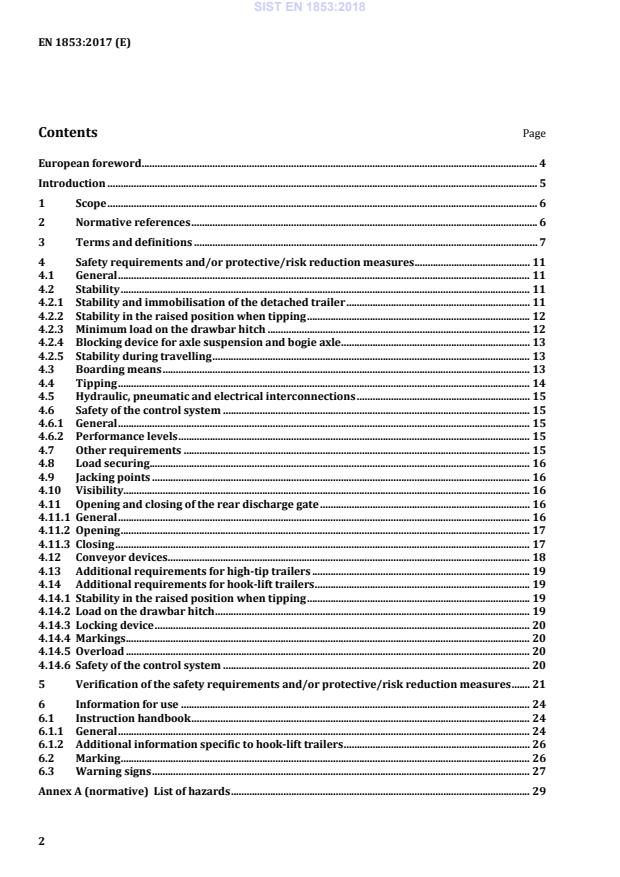
List of hazards . 29 SIST EN 1853:2018
Stability tests (rear tipping trailers) . 34 B.1 Scope . 34 B.2 Test equipment . 34 B.3 Test procedure . 34 B.4 Test acceptance . 35 Annex C (normative)
Verification of stability by calculation . 36 C.1 Scope . 36 C.2 Calculation method . 36 C.3 Basic assumptions for the calculation . 36 C.4 Input data . 36 C.5 Coordinate systems . 38 C.6 Stability criterion . 39 C.7 Calculation procedure . 39 C.8 Stability check . 40 Annex D (normative)
Calculation method of vertical force in the tractor coupling device during exchange . 43 Annex E (normative)
Scraper floor. 44 E.1 Guarding . 44 E.1.1 General . 44 E.1.2 Moving path of scraper floor . 44 E.1.3 Front turning points . 47 E.1.4 Rear turning points . 49 E.2 Adjustment of scraper floor . 50 Annex F (normative)
Visibility . 51 Annex ZA (informative)
Relationship between this European Standard and the Essential Requirements of Directive 2006/42/EC aimed to be covered . 52 Bibliography . 53
Figure 1 — Examples of balanced trailer 3.1.2 semi-mounted trailer trailer from which part of vertical load is transferred to the towing vehicle Note 1 to entry: See Figure 2.
Figure 2 — Examples of semi-mounted trailer SIST EN 1853:2018
Key 1 tipping axis Figure 3 — Examples of high-tip trailer 3.1.4 hook-lift trailer trailer including a hook-lift system for picking up, transporting, tipping and exchanging of roll off loading platforms, e.g. containers, dump bodies, frames Note 1 to entry: See Figure 4. SIST EN 1853:2018
a) Transporting mode
b) Tipping mode
c) Exchange mode Figure 4 — Example of hook-lift trailer 3.4 height in the highest tipping position vertical distance between ground plane and the highest part of the raised load body when in maximum tipping position Note 1 to entry: See Figure 5. SIST EN 1853:2018
a) Semi-mounted trailer b) High-tip trailer Key H height in the highest tipping position Figure 5 — Height in the highest tipping position 3.5 sideboard fixed or movable wall that constitutes a load retaining side of the body and which may be hinged on the platform of the trailer 3.6 load body volume consisting of a platform with a front wall, two sideboards and a rear wall or discharge gate to contain the load for its transport and discharging [SOURCE: EN 690:2013, 3.2 modified] 3.7 tipping action that allows the load carried in the trailer to be discharged by tilting the body Note 1 to entry: The tipping can be lateral or to the rear. 3.9 conveyor device device able to convey/move/carry the material in the load body, that are of different types such as scraper floor, conveyor belt, load push/push-off device or alternating moving floor Note 1 to entry: A combination of these devices is possible. [SOURCE: EN 690:2013, 3.3 modified] 3.9.1 scraper floor conveyor device made by two or more dragging chains and by a number of slats [SOURCE: EN 690:2013, 3.3.1] SIST EN 1853:2018
Key A direction of travel B load body 1 platform 2 handrail 3 knee-rail (intermediate rail) 4 toe plate (foot guard) 5 ladder Figure 6 — Platform dimensions Verification: by measurement. 4.4 Tipping 4.4.1 It shall always be possible to actuate the tipping control(s) (up and down) from the driving position. For trailers with an independent hydraulic system powered by PTO, when the control activating the lowering is released, the load body shall hold in its position. When additional controls are provided on the trailer, they shall be located outside hazardous zones. Controls shall be of the hold-to-run type and conform with EN ISO 4254-1:2015, 6.1. 4.4.2 The hydraulic tipping system and the hydraulic braking system shall not be controlled by the same hydraulic circuit. 4.4.3 Trailers shall be constructed so that the highest permissible tipping position cannot be exceeded. Verification: by functional test and measurement and design check. SIST EN 1853:2018
EN ISO 4254-1:2015, 4.18 (EMC), 4.19 (Emergency stop) and 4.20 (safety related control). Where the remote control is a wireless control, it shall comply with ISO 15817:2012. Power supply interruptions or restoration, of any kind and reason, shall not create hazards, e.g. crushing hazard due to lowering of the load body. Verification: by calculation and/or functional tests. 4.6.2 Performance levels The safety related control functions shall comply with performance levels determined according to
EN ISO 4254-1:2015, 4.20. The following control functions, where fitted, shall be regarded as safety related: Tipping; Load exchange; Stability interlocking control; working mode of operation control; Emergency stop; load body locking device; rear discharge gate. NOTE Required performance levels will be provided in a future Amendment to this standard. Verification: by design check. 4.7 Other requirements 4.7.1 To avoid unintended lowering of the load body in case of hydraulic failure (e.g. hose rupture, leakages, etc.), a safety device shall be fitted. When a load hold valve (hose burst valve) is fitted against hose rupture, it shall be directly connected to the body of the cylinder or by a rigid connection. Verification: by design check and inspection. 4.7.2 A mechanical support hinged to the trailer, in conformity with the requirements given in EN ISO 4254-1:2015, 4.11 shall be provided to secure the body in high position during maintenance operations. In addition to EN ISO 4254-1:2015, 4.11.1.2, the articulated mechanical support shall not require the presence of an operator in the hazardous zone to hold it in position during the lowering of the load body. Verification: by functional test. 4.7.3 Sideboard and discharge gate locking devices shall be so located that the operator can actuate them from outside the swinging range of the board or gate. SIST EN 1853:2018
Key A Area A – Horizontal distance between 120 mm and 500 mm from the edge of load body floor to the lower edge of the rotating discharge gate over whole width of the load body Figure 7 — Closing of a rotating discharge gate 4.11.3.3 Additional requirements for trailers with fully powered discharge gate closure If, for technical reasons, trailers with fully powered discharge gate closure do not comply with one or all requirements in 4.11.3.2, they shall fulfil the following: — an audible warning signal shall be provided to warn bystanders, during the closing motion of the discharge gate; and — the time for closing of the tailgate from the fully opened position shall not be less than 10 s. 4.12 Conveyor devices For trailers with scraper floor, requirements of Annex E shall be applied. Verification: by inspection and measurement. SIST EN 1853:2018
Key 1 hitch stabilization 2 blocking device for axle suspension and bogie axle 3 outriggers Figure 8 — Example of additional stability measures which reduce or eliminate reactive lifting forces in the tractor hitch system during load exchange, side view Hook-lift trailers shall be designed taking into account the maximum downward load that can be applied to relevant tractor towing hitches. Verification: by design check. 4.14.3 Locking device The trailer shall be equipped with a device(s) (e.g. locking system) to hold the load body on the trailer in all directions. Verification: by visual inspection or design check. 4.14.4 Markings To avoid overloading the tractor drawbar during transport, hook-lift trailers with a telescopic loading and tipping frame shall have markings, e.g. arrows, to guide the user when placing the load platform on the chassis (see 6.2). Verification: by visual inspection. 4.14.5 Overload Hook-lift trailers shall be designed to prevent loading of load bodies that exceed the allowed maximum load. Verification: by design check 4.14.6 Safety of the control system Load exchange, stability control activation and de-activation shall be controlled by hold-to-run controls. For different modes of operation, e.g. transport, tipping, load exchange, a change of mode shall not create hazardous movements. It shall only be possible to control the hook-lift trailer from the driver's position. Verification: by functional test or design check. SIST EN 1853:2018
by calculation or by the following test: The trailer shall stand, loaded at its maximum permissible load, and with any steerable axles in the most unfavourable angle on a firm surface with a slope of 8,5°. The trailer shall be positioned on the slope in the most unfavourable orientation. The parking brake or chocks shall be engaged. During the test, all supports (i.e. wheels, supporting devices) shall remain on the test surface. 4.2.1.2 Ground pressure
X or calculation 4.2.1.3.1 Brakes
standing the trailer, loaded at its maximum permissible load, and with any steerable axles in the straight ahead position most unfavourable angle on a firm surface with a slope of 18 %. This test shall be carried out with the trailer positioned on the slope in the up and down gradient. most unfavourable orientation which shall be recorded. During the test, the trailer shall not move. 4.2.1.3.2 Chocks X X
4.2.2 Stability in the raised position when tipping
Annex B or calculation acc to Annex C (rear tipping trailers) Lateral tipping on 5° X
by functional test or design check SIST EN 1853:2018
X
4.2.4 Blocking device for axle suspension and bogie axle X
by calculation or test with the trailer fully laden and a minimum static tipping angle of 23°. 4.2.5 Stability during travelling
4.3 Boarding means
X
4.4 Ti
...