

EN 815:1996+A2:2008
(Main + Amendment)Safety of unshielded tunnel boring machines and rodless shaft boring machines for rock - Safety requirements
- Abstract
1.1 Field of application
This standard is applicable to unshieldsed tunnel boring machines, TBM's, and rodless shaft boring machines, SBM's, and their towed or attached back-up equipment for driving tunnels or shafts in rock where the whole area is excavated in one or more steps by mechanical means. It specifies essential safety requirements for the design, construction and maintenance of such machines when used in non-explosive atmosphere together with the methods of verification. The standard specifies monitoring for hazardous atmosphere.
For TBM's and SBM's which are to be used continuously in explosive atmosphere, additional relevant standards also apply.
This European Standard deals with all significant hazards pertinent to unshielded tunnel boring machines and rodless shaft boring machines for rock, when they are used as intended and under the conditions foreseen by the manufacturer (see clause 4). This European Standard specifies the appropriate technical measures to eliminate or reduce risks arising from the significant hazards.
1.2 Description of the machines
The general term "unshielded tunnel boring machines" encompasses various kinds of machines for mechanical excavation of underground openings such as tunnels and inclined shafts. This is done in a continuous process, without blasting, using a rotating cutter head.
Depending on the hardness of the material being excavated, tools of different types are used to cut the rock. Normally, rolling discs are employed in medium to very hard rock. All tunnel boring machines, TBM's, and rodless shaft boring machines, SBM's, have the tools mounted on a cutter head which rotates under thrust against the rock. The torque required to rotate the cutter head is developed by electric or hydraulic motors and the thrust is normally delivered by hydraulically powered cylinders.
The torque and thrust reactions created by a TBM or SBM have to be resisted by anchoring the complete machine inside the bore itself by means
- Status
- Withdrawn
- Publication Date
- 09-Sep-2008
- Withdrawal Date
- 20-May-2014
- Technical Committee
- CEN/TC 151 - Construction equipment and building material machines - Safety
- Drafting Committee
- CEN/TC 151/WG 4 - Tunnelling machines - Safety
- Current Stage
- 9960 - Withdrawal effective - Withdrawal
- Start Date
- 21-May-2014
- Completion Date
- 21-May-2014
- Directive
- 2006/42/EC - Directive 2006/42/EC of the European Parliament and of the Council of 17 May 2006 on machinery, and amending Directive 95/16/EC (recast)OJ Ref: C, C 214 OJ Date: 08-Sep-2009
98/37/EC - MachineryOJ Ref: C, C 22 OJ Date: 28-Jan-2009



Relations
- Effective Date
- 19-Jan-2023
- Merged From
EN 815:1996 - Safety of unshielded tunnel boring machines and rodless shaft boring machines for rock - Effective Date
- 18-Jan-2023
- Effective Date
- 10-Oct-2009
- Effective Date
- 25-Aug-2026
- Effective Date
- 25-Aug-2026
- Effective Date
- 09-Feb-2026
- Effective Date
- 09-Feb-2026
- Effective Date
- 09-Feb-2026
- Refers
EN 50014:1992 - Electrical apparatus for potentially explosive atmospheres - General requirements - Effective Date
- 09-Feb-2026
- Effective Date
- 09-Feb-2026
- Effective Date
- 09-Feb-2026
- Effective Date
- 28-Jan-2026
- Effective Date
- 28-Jan-2026
- Effective Date
- 28-Jan-2026
- Effective Date
- 28-Jan-2026
Get Certified
Connect with accredited certification bodies for this standard

DIBt (Deutsches Institut für Bautechnik)
German Institute for Building Technology.
DIN CERTCO
DIN Group product certification.
Zavod za gradbeništvo Slovenije (ZAG) - Inšpekcija
ZAG inspection body for construction products, structures, and materials.
Sponsored listings
Frequently Asked Questions
EN 815:1996+A2:2008 is a standard published by the European Committee for Standardization (CEN). Its full title is "Safety of unshielded tunnel boring machines and rodless shaft boring machines for rock - Safety requirements". This standard covers: 1.1 Field of application This standard is applicable to unshieldsed tunnel boring machines, TBM's, and rodless shaft boring machines, SBM's, and their towed or attached back-up equipment for driving tunnels or shafts in rock where the whole area is excavated in one or more steps by mechanical means. It specifies essential safety requirements for the design, construction and maintenance of such machines when used in non-explosive atmosphere together with the methods of verification. The standard specifies monitoring for hazardous atmosphere. For TBM's and SBM's which are to be used continuously in explosive atmosphere, additional relevant standards also apply. This European Standard deals with all significant hazards pertinent to unshielded tunnel boring machines and rodless shaft boring machines for rock, when they are used as intended and under the conditions foreseen by the manufacturer (see clause 4). This European Standard specifies the appropriate technical measures to eliminate or reduce risks arising from the significant hazards. 1.2 Description of the machines The general term "unshielded tunnel boring machines" encompasses various kinds of machines for mechanical excavation of underground openings such as tunnels and inclined shafts. This is done in a continuous process, without blasting, using a rotating cutter head. Depending on the hardness of the material being excavated, tools of different types are used to cut the rock. Normally, rolling discs are employed in medium to very hard rock. All tunnel boring machines, TBM's, and rodless shaft boring machines, SBM's, have the tools mounted on a cutter head which rotates under thrust against the rock. The torque required to rotate the cutter head is developed by electric or hydraulic motors and the thrust is normally delivered by hydraulically powered cylinders. The torque and thrust reactions created by a TBM or SBM have to be resisted by anchoring the complete machine inside the bore itself by means
1.1 Field of application This standard is applicable to unshieldsed tunnel boring machines, TBM's, and rodless shaft boring machines, SBM's, and their towed or attached back-up equipment for driving tunnels or shafts in rock where the whole area is excavated in one or more steps by mechanical means. It specifies essential safety requirements for the design, construction and maintenance of such machines when used in non-explosive atmosphere together with the methods of verification. The standard specifies monitoring for hazardous atmosphere. For TBM's and SBM's which are to be used continuously in explosive atmosphere, additional relevant standards also apply. This European Standard deals with all significant hazards pertinent to unshielded tunnel boring machines and rodless shaft boring machines for rock, when they are used as intended and under the conditions foreseen by the manufacturer (see clause 4). This European Standard specifies the appropriate technical measures to eliminate or reduce risks arising from the significant hazards. 1.2 Description of the machines The general term "unshielded tunnel boring machines" encompasses various kinds of machines for mechanical excavation of underground openings such as tunnels and inclined shafts. This is done in a continuous process, without blasting, using a rotating cutter head. Depending on the hardness of the material being excavated, tools of different types are used to cut the rock. Normally, rolling discs are employed in medium to very hard rock. All tunnel boring machines, TBM's, and rodless shaft boring machines, SBM's, have the tools mounted on a cutter head which rotates under thrust against the rock. The torque required to rotate the cutter head is developed by electric or hydraulic motors and the thrust is normally delivered by hydraulically powered cylinders. The torque and thrust reactions created by a TBM or SBM have to be resisted by anchoring the complete machine inside the bore itself by means
EN 815:1996+A2:2008 is classified under the following ICS (International Classification for Standards) categories: 91.220 - Construction equipment; 93.060 - Tunnel construction. The ICS classification helps identify the subject area and facilitates finding related standards.
EN 815:1996+A2:2008 has the following relationships with other standards: It is inter standard links to EN 815:1996/A1:2005, EN 815:1996, EN 16191:2014, ISO 3795:1989, ISO 3864:1984, EN 60529:1991, EN 60439-1:1994, EN 60204-1:1992, EN 50014:1992, ISO 3287:1999, EN 61310-1:1995, EN 418:1992, EN 1060-1:1995/A1:2002, EN 547-1:1996, EN 894-3:2000. Understanding these relationships helps ensure you are using the most current and applicable version of the standard.
EN 815:1996+A2:2008 is associated with the following European legislation: EU Directives/Regulations: 2006/42/EC, 98/37/EC; Standardization Mandates: M/079, M/396. When a standard is cited in the Official Journal of the European Union, products manufactured in conformity with it benefit from a presumption of conformity with the essential requirements of the corresponding EU directive or regulation.
EN 815:1996+A2:2008 is available in PDF format for immediate download after purchase. The document can be added to your cart and obtained through the secure checkout process. Digital delivery ensures instant access to the complete standard document.
Standards Content (Sample)
SLOVENSKI STANDARD
01-december-2008
Varnost strojev za vrtanje predorov (TBM) in jaškov (SBM) v kamnini - Varnostne
zahteve
Safety of unshielded tunnel boring machines and rodless shaft boring machines for rock -
Safety requirements
Sicherheit von Tunnelbohrmaschinen ohne Schild und gestängelosen
Schachtbohrmaschinen zum Einsatz in Fels - Sicherheitsanforderungen
Sécurité de tunneliers sans bouclier et des machines foreuses pour puits sans tige de
traction - Exigences de sécurité
Ta slovenski standard je istoveten z: EN 815:1996+A2:2008
ICS:
91.220 Gradbena oprema Construction equipment
93.060 Gradnja predorov Tunnel construction
2003-01.Slovenski inštitut za standardizacijo. Razmnoževanje celote ali delov tega standarda ni dovoljeno.
EUROPEAN STANDARD
EN 815:1996+A2
NORME EUROPÉENNE
EUROPÄISCHE NORM
September 2008
ICS 91.220; 93.060 Supersedes EN 815:1996
English Version
Safety of unshielded tunnel boring machines and rodless shaft
boring machines for rock - Safety requirements
Sécurité de tunneliers sans boucliers et des machines Sicherheit von Tunnelbohrmaschinen ohne Schild und
foreuses pour puits sans tige de traction - Exigences de gestängelosen Schachtbohrmaschinen zum Einsatz in Fels
sécurité - Sicherheitsanforderungen
This European Standard was approved by CEN on 5 August 1996 and includes Amendment 1 approved by CEN on 22 December 2004
and Amendment 2 approved by CEN on 9 July 2008.
CEN members are bound to comply with the CEN/CENELEC Internal Regulations which stipulate the conditions for giving this European
Standard the status of a national standard without any alteration. Up-to-date lists and bibliographical references concerning such national
standards may be obtained on application to the CEN Management Centre or to any CEN member.
This European Standard exists in three official versions (English, French, German). A version in any other language made by translation
under the responsibility of a CEN member into its own language and notified to the CEN Management Centre has the same status as the
official versions.
CEN members are the national standards bodies of Austria, Belgium, Bulgaria, Cyprus, Czech Republic, Denmark, Estonia, Finland,
France, Germany, Greece, Hungary, Iceland, Ireland, Italy, Latvia, Lithuania, Luxembourg, Malta, Netherlands, Norway, Poland, Portugal,
Romania, Slovakia, Slovenia, Spain, Sweden, Switzerland and United Kingdom.
EUROPEAN COMMITTEE FOR STANDARDIZATION
COMITÉ EUROPÉEN DE NORMALISATION
EUROPÄISCHES KOMITEE FÜR NORMUNG
Management Centre: rue de Stassart, 36 B-1050 Brussels
© 2008 CEN All rights of exploitation in any form and by any means reserved Ref. No. EN 815:1996+A2:2008: E
worldwide for CEN national Members.
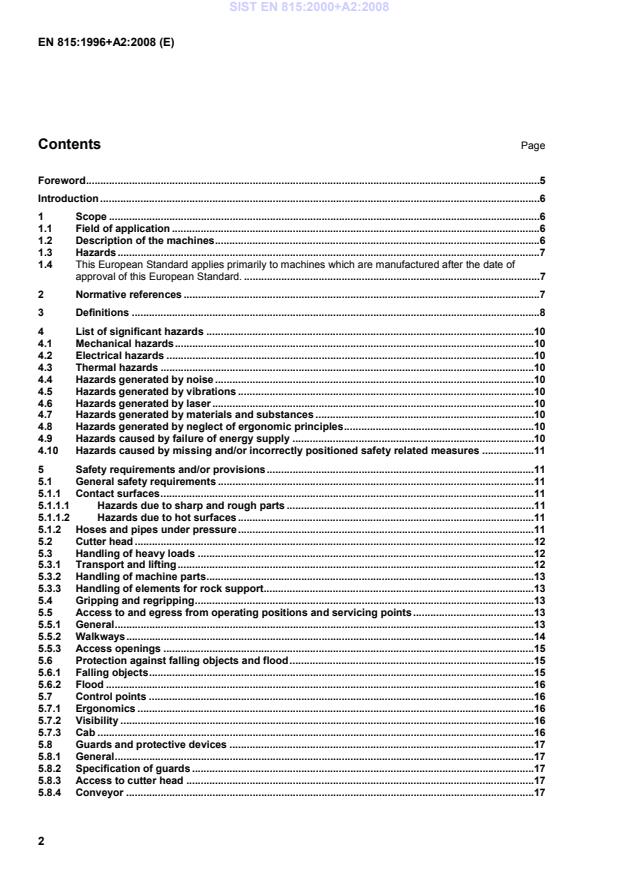
Contents Page
Foreword.5
Introduction .6
1 Scope .6
1.1 Field of application .6
1.2 Description of the machines.6
1.3 Hazards .7
1.4 This European Standard applies primarily to machines which are manufactured after the date of
approval of this European Standard. .7
2 Normative references .7
3 Definitions .8
4 List of significant hazards .10
4.1 Mechanical hazards.10
4.2 Electrical hazards .10
4.3 Thermal hazards .10
4.4 Hazards generated by noise .10
4.5 Hazards generated by vibrations .10
4.6 Hazards generated by laser .10
4.7 Hazards generated by materials and substances .10
4.8 Hazards generated by neglect of ergonomic principles.10
4.9 Hazards caused by failure of energy supply .10
4.10 Hazards caused by missing and/or incorrectly positioned safety related measures .11
5 Safety requirements and/or provisions.11
5.1 General safety requirements .11
5.1.1 Contact surfaces.11
5.1.1.1 Hazards due to sharp and rough parts .11
5.1.1.2 Hazards due to hot surfaces .11
5.1.2 Hoses and pipes under pressure.11
5.2 Cutter head .12
5.3 Handling of heavy loads .12
5.3.1 Transport and lifting.12
5.3.2 Handling of machine parts.13
5.3.3 Handling of elements for rock support.13
5.4 Gripping and regripping.13
5.5 Access to and egress from operating positions and servicing points.13
5.5.1 General.13
5.5.2 Walkways.14
5.5.3 Access openings .15
5.6 Protection against falling objects and flood.15
5.6.1 Falling objects.15
5.6.2 Flood .16
5.7 Control points .16
5.7.1 Ergonomics .16
5.7.2 Visibility .16
5.7.3 Cab .16
5.8 Guards and protective devices .17
5.8.1 General.17
5.8.2 Specification of guards .17
5.8.3 Access to cutter head .17
5.8.4 Conveyor .17
5.9 Control systems and devices.17
5.9.1 General .17
5.9.2 Control systems .17
5.9.3 Control devices.18
5.9.4 Starting, warning systems, stopping and emergency stopping.19
5.9.4.1 Starting.19
5.9.4.2 Warning systems .19
5.9.4.3 Stopping.20
5.9.4.4 Emergency stopping .20
5.9.5 Failure of the power supply.21
5.10 Towing connection.21
5.11 Laser guidance .21
5.12 Ventilation, control of dust and gas .22
5.12.1 General .22
5.12.2 Dust suppression .22
5.12.3 Dedusting .22
5.12.4 Atmospheric changes.22
5.12.4.1 General.22
5.12.4.2 Methane monitoring.22
5.12.4.3 Monitoring for other gases .23
5.13 Noise.23
5.14 Electrical equipment .23
5.14.1 General .23
5.14.2 Protective measures .24
5.14.3 Cables and leads .24
5.14.4 Transformers .24
5.14.5 Bonding .24
5.14.6 Switch gear .24
5.14.7 Lighting.25
5.14.8 Emergency lighting .25
5.15 Isolation of power supply .25
5.16 Energy supply other than electricity .25
5.17 !Fire protection".26
5.17.1 Fire extinguishing system .26
5.17.2 Fixed fire extinguishing systems.26
5.17.3 Installation of portable fire extinguishers.27
5.17.4 Water sprays .27
5.18 Storage of safety equipment for personnel.27
5.19 Indicators.27
5.19.1 Marking.27
5.19.2 Warning signs.28
5.19.3 Warning devices .28
5.19.4 Symbols.28
5.20 Maintenance.28
6 Verification of safety measures and/or provisions.28
7 Information for use.29
7.1 General .29
7.2 Instruction handbooks.29
7.2.1 General .29
7.2.2 Identification of handbooks.29
7.2.3 Content of operator's handbook.30
7.2.4 Content of maintenance handbook .31
7.2.5 Spare parts list.32
Annex A (normative) Protective measures for electrical accessories and lighting.33
Annex B (informative) Bibliography.34
Annex C (informative) Figures.35
Annex ZA (informative) #Relationship between this European Standard and the Essential
Requirements of EU Directive 98/37/EC$.39
Annex ZB (informative) #Relationship between this European Standard and the Essential
Requirements of EU Directive 2006/42/EC$.40
Foreword
This document (EN 815:1996+A2:2008) has been prepared by Technical Committee CEN/TC 151
“Construction equipment and building material machines - Safety”, the secretariat of which is held by DIN.
This European Standard shall be given the status of a national standard, either by publication of an identical
text or by endorsement, at the latest by March 2009, and conflicting national standards shall be withdrawn at
the latest by December 2009.
This document includes Amendment 1, approved by CEN on 2004-12-22 and Amendment 2, approved by
CEN on 2008-07-09.
This document supersedes EN 815:1996.
The start and finish of text introduced or altered by amendment is indicated in the text by tags ! " and
# $.
This European Standard has been prepared under a mandate given to CEN by the European Commission
and the European Free Trade Association, and supports essential requirements of EU Directive(s).
#For relationship with EU Directive(s), see informative Annexes ZA and ZB, which are integral parts of this
document.$
According to the CEN/CENELEC Internal Regulations, the national standards organizations of the following
countries are bound to implement this European Standard: Austria, Belgium, Bulgaria, Cyprus, Czech
Republic, Denmark, Estonia, Finland, France, Germany, Greece, Hungary, Iceland, Ireland, Italy, Latvia,
Lithuania, Luxembourg, Malta, Netherlands, Norway, Poland, Portugal, Romania, Slovakia, Slovenia, Spain,
Sweden, Switzerland and United Kingdom.
Introduction
This European Standard is a Type C-standard as defined in EN 292-1:1991.
The machinery concerned and the extent to which hazards are covered is indicated in the scope of this
standard.
1 Scope
1.1 Field of application
This standard is applicable to unshieldsed tunnel boring machines, TBM's, and rodless shaft boring machines,
SBM's, and their towed or attached back-up equipment for driving tunnels or shafts in rock where the whole
area is excavated in one or more steps by mechanical means. It specifies essential safety requirements for
the design, construction and maintenance of such machines when used in non-explosive atmosphere together
with the methods of verification. The standard specifies monitoring for hazardous atmosphere.
For TBM's and SBM's which are to be used continuously in explosive atmosphere, additional relevant
standards also apply.
This European Standard deals with all significant hazards pertinent to unshielded tunnel boring machines and
rodless shaft boring machines for rock, when they are used as intended and under the conditions foreseen by
the manufacturer (see clause 4). This European Standard specifies the appropriate technical measures to
eliminate or reduce risks arising from the significant hazards.
1.2 Description of the machines
The general term "unshielded tunnel boring machines" encompasses various kinds of machines for
mechanical excavation of underground openings such as tunnels and inclined shafts. This is done in a
continuous process, without blasting, using a rotating cutter head.
Depending on the hardness of the material being excavated, tools of different types are used to cut the rock.
Normally, rolling discs are employed in medium to very hard rock. All tunnel boring machines, TBM's, and
rodless shaft boring machines, SBM's, have the tools mounted on a cutter head which rotates under thrust
against the rock. The torque required to rotate the cutter head is developed by electric or hydraulic motors and
the thrust is normally delivered by hydraulically powered cylinders.
The torque and thrust reactions created by a TBM or SBM have to be resisted by anchoring the complete
machine inside the bore itself by means of a gripping system which is reset after each boring stroke and
allows the machine to be steered in the desired direction.
TBM's normally operate in a near to horizontal direction but can also be used to drive inclined tunnels. When
the incline becomes too steep, a second anchoring system will be provided to prevent the machine from
sliding down while the primary grippers are reset.
In most cases TBM's work the full face of the tunnel. However, in some cases the tunnel is driven in two or
more phases, by starting with a pilot hole which is enlarged in one or more steps. This method is called
reaming. The machines used are in principle the same as a TBM driving the whole tunnel area in one step.
SBM's resemble closely TBM's but operate in vertical direction. The shaft is in many cases sunk in a
multistage operation, that is (i.e.), first a pilot hole is bored using a raise bore machine and the pilot hole is
reamed by using the SBM. Normally for this method, the shaft bottom is already undercut to provide adequate
room for the muck and its removal. The full face of the shaft can also be bored in one step. In this case the
muck is transported to the top of the shaft.
TBM's and SBM's intended for work in unstable rock are provided with equipment for the erection and
handling of rock reinforcement and/or lining.
The specified requirements of this standard conform to the European Standards EN 292-1 and EN 292-2.
1.3 Hazards
This standard deals with all identified significant hazards caused by TBM's and SBM's, when they are used
under the conditions stated by the manufacturer in the operator's handbook.
NOTE When TBM's and SBM's are to be used in explosive atmospheres the additional relevant standards apply.
1.4 This European Standard applies primarily to machines which are manufactured after the date of
approval of this European Standard.
2 Normative references
This European Standard incorporates by dated or undated references, provisions from other publications.
These normative references are cited at the appropriate places in the text and the publications are listed
hereafter. For dated references, subsequent amendments to or revisions of any of these publications apply to
this European Standard only when incorporated in it by amendment or revision. For undated references the
latest edition of the publication referred to applies.
EN 3:1975, Portable fire extinguishers.
EN 292-1:1991, Safety of machinery - Basic concepts, general principles for design - Part 1: Basic
terminology, methodology.
EN 292-2:1991/A1:1995, Safety of machinery - Basic concepts, general principles for design - Part 2:
Technical principles and specifications.
EN 418:1992, Safety of machinery - Emergency stop equipment, functional aspects - Principles for design.
prEN 547-1:1994, Safety of machinery – Human body measurements – Part 1: Principles for determining the
dimensions required for openings for whole body access into machinery.
prEN 547-2:1994, Safety of machinery – Human body measurements – Part 2: Principles for determining the
dimensions required for access openings.
EN 563:1994, Safety of machinery - Temperatures of touchable surfaces – Ergonomics data to establish
temperature limit values for hot surfaces.
prEN 894-1:1992, Safety of machinery – Ergonomic requirements for the design of displays and control
actuators – Part 1: Human interactions with displays and control actuators.
prEN 894-2:1992, Safety of machinery – Ergonomic requirements for the design of displays and control
actuators – Part 2: Displays.
prEN 894-3:1993, Safety of machinery – Ergonomic requirements for the design of displays and control
actuators – Part 3: Control actuators.
prEN 953:1992, Safety of machinery – General requirements for the design and construction of guards (fixed,
moveable).
EN 954-1, Safety of machinery - Safety related parts of control systems - Part 1: General principles for design.
EN 981:1995, Safety of machinery – System of danger and non-danger signals with sound and light.
EN 982:1996, Safety requirements for fluid power systems and components - Hydraulics
EN 983:1996, Safety requirements for fluid power systems and components - Pneumatics
ENV 1070:1993, Safety of machinery – Terminology.
EN 23411:1988, Earth-moving machinery – Human physical dimensions of operators and minimum operator
space envelope.
EN 50014:1992, Electric apparatus for potentially explosive atmospheres – General requirements.
EN 61310-1:1995, Safety of machinery – Indicating, marking and actuating principles – Part 1: Visual, audible
and tactile signals.
EN 61310-2:1995, Safety of machinery – Indicating, marking and actuating principles – Part 2: Marking.
EN 60204:1993, Safety of machinery – Electrical equipment of machines – Part 1: General requirements.
EN 60439-1:1993, Low voltage switch gear and control gear assemblies – Part 1: Requirements for type-
tested and partially type-tested assemblies.
EN 60529:1991, Classification of degrees of protection provided by enclosures.
EN 60825:1994, Laser – Radiation safety of laser products, equipment classification, requirements and user's
guide.
EN 60947-1:1991, Low voltage switch gear and control gear – Part 1: General rules.
EN ISO 3457:1995, Earth-moving machinery – Guards and shields – Definitions and specifications.
ISO 3795:1989, Road vehicles, tractors and machinery for agriculture and forestry – Determination of burning
behaviour of interior materials.
ISO 3864:1984, Safety colours and safety signs.
EN ISO 11202:1996, Acoustics – Noise emitted by machinery and equipment – Measurement of emission
sound pressure levels at the work-station and at other specified positions – Survey method in situ.
3 Definitions
For the purposes of this European Standard the definitions stated in ENV 1070:1993 apply.
3.1
unshielded tunnel boring machine, TBM
machine for full face mechanical excavation of underground openings such as tunnels and inclined shafts
using a rotating cutter head. The machine has no shield for tunnel support but can have a shield for the
protection of the cutter head. See figure C.2.
3.2
reaming TBM
tunnel boring machine that enlarges a pilot hole in one or more steps.
3.3
shaft boring machine, SBM
Rodless shaft boring machine operating downwards in a vertical direction. The SBM may ream a pilot hole in
one or more steps in which case the muck is falling down to an undercut space. See figure C.1. The full face
can also be bored in one step (blind boring). In this case the muck is removed up to the top of the shaft.
3.4
BM
Abbreviation for boring machines, covering all machines according to 3.1 – 3.3 for which common
specifications apply.
3.5
back-up equipment
Assembly of equipment, normally towed behind or attached to a BM to provide the BM with services for the
operation and its crew with facilities for their work and comfort. See figure C.2.
3.6
erecting device
Tunnel support erection and handling equipment situated within a TBM and its back-up equipment which is
used to install any tunnel support which acts structurally to maintain the tunnel void.
3.7
main control point
The control point from where the boring operation and advance of the BM is controlled.
3.8
control point
Any location from where one or more functions of the BM or its separate working units are controlled by an
operator.
3.9
exposed person
Any person wholly or partially in a danger zone.
3.10
walkway
part of the access system that permits walking or crawling between locations on a BM and its back-up
equipment.
3.11
walkway surface
The footpath within the walkway.
3.12
access opening
Opening within a BM and its back-up equipment, for example (e.g.) in the bulkhead or the cutter head through
which man access may be made to servicing points.
3.13
servicing point
Any location on a BM and its back-up equipment where maintenance or servicing is normally carried out.
4 List of significant hazards
This clause contains all hazards, as far as they are dealt with in this European Standard, identified by risk
assessments significant for this type of machinery and which require action to eliminate or reduce risk.
See clause
4.1 Mechanical hazards
a) Crushing hazard 5.2, 5.3, 5.5, 5.6, 5.8.3, 5.8.4, 7.2.3, 7.2.4
b) Friction or abrasive hazard 5.1.1.1
c) High pressure fluid ejection hazard 5.1.2
d) Loss of stability 5.4, 7.2.3
e) Slip, trip and fall hazards 5.5
4.2 Electrical hazards
a) Electrical contact, direct or indirect 5.14, 5.15
b) External influences on electrical equipment 5.14
4.3 Thermal hazards 5.1.1.2, 7.2.3
5.13
4.4 Hazards generated by noise
5.7.1, 5.7.3
4.5 Hazards generated by vibrations
4.6 Hazards generated by laser 5.11
4.7 Hazards generated by materials and substances
a) Dust and gas 5.12
b) Fire or explosion 5.7.3, 5.12, 5.16, 5.17, 7.2.3
c) Falling objects and flood 5.6
4.8 Hazards generated by neglect of ergonomic
principles
a) Unhealthy posture or excessive efforts 5.7.1, 5.7.2, 5.7.3
b) Neglected use of personal protection equipment 5.13, 5.18, 7.2.3
c) Inadequate local lighting 5.14.7, 5.14.8
4.9 Hazards caused by failure of energy supply
a) Failure of energy supply 5.9.5, 5.16
b) Failure of control system 5.9
See clause
4.10 Hazards caused by missing and/or incorrectly
positioned safety related measures
a) All kinds of guards 5.8
b) All kinds of safety related devices 5.9, 5.10, 5.12
c) Starting and stopping devices 5.9.3, 5.9.4
d) Safety signs and tags 5.19.2
e) All kinds of information or warning devices 5.9.4.2, 5.19, 7.2.3
f) Emergency stop devices 5.9.4.4
g) Safe handling of machinery and parts 5.3
h) Essential equipment and accessories for safe 7.2.3, 7.2.4
adjusting and/or maintaining
i) Equipment for evacuating gases 5.12
5 Safety requirements and/or provisions
Machinery shall comply with the safety requirements and/or technical provisions of this clause and in addition
with EN 292-2:1991 and EN 292-2:1991 for hazards relevant but not significant which are not covered by this
standard.
5.1 General safety requirements
This clause gives the requirements and measures for those hazards, for which particular action appears
necessary. So for applicable requirements and measures which are already contained in other standards,
specifically in EN 292 in its annex A or in type B – standards, reference is made to them, to relevant
subclauses and to the applicable performance category.
Unless stipulated otherwise in this standard, the BM shall satisfy the general safety requirements – as
appropriate – set down in type A or B standards and particularly in EN 292 with special reference to annex A
of part 2.
5.1.1 Contact surfaces
5.1.1.1 Hazards due to sharp and rough parts
Accessible parts of a BM shall be designed and manufactured to avoid an exposed person's contact with
sharp edges, angles or rough surfaces which are likely to cause injury. See 3.1 of EN 292-2.
5.1.1.2 Hazards due to hot surfaces
Where there is a risk of human contact with hot surfaces, protective covers for cases of normal access shall
be provided. For other cases warning signs shall be provided. See EN 563.
5.1.2 Hoses and pipes under pressure
Hoses, pipes and fittings shall be able to withstand the stresses from the pressure. The hoses shall be marked
with the rated working pressure. The requirements of prEN 982 and prEN 983 shall be complied with.
Where there is a risk that a rupture of a hose or pipe at a control point could cause a hazard to the operator,
the hoses and pipes shall be firmly secured and be provided with protective guards in accordance with 4.9 of
EN ISO 3457:1995.
5.2 Cutter head
In order to carry out inspection and maintenance work in safety, e.g. replacement of cutters, depending on the
size of the BM and the rock conditions for which the BM is designed one of the following alternative measures
shall be taken:
For stable rock conditions no action is required;
For unstable rock conditions and where the size of the cutter head allows, the cutter head shall be so
designed that replacement of cutters can be done without entering the area in front of the cutter head,
e.g. back loaded cutters;
For unstable rock conditions, where access to the area in front of the cutter head is required, the user
shall provide protective measures, e.g. temporary rock support or pre-treatment of the rock for the area in
front of the cutter head.
The following two additional requirements for SBM's apply:
The cutter head shall be equipped with hydraulically extendable and mechanically lockable supports to
hold the cutter head in place during maintenance;
Adequate anchoring points for safety harnesses shall be provided for personnel working on the cutter
head.
The measures foreseen above, the rock conditions for which the BM has been designed and warnings against
residual risks shall be listed in the operator's handbook as required in 7.2.3.
To gain access through a bulkhead or a dust shield to the area behind a cutter head and similarly through a
cutter head to the area in front of it, access openings of adequate size shall be provided. See 5.5.3.
Access shall be prevented during normal working operation by an interlocking barrier or door, e.g. by a key
trapped exchange system interlocked with the main control. See also 5.9.2.
The cutter head of the TBM shall be equipped with a holding brake system to prevent unintentional rotational
movement of the head. This system shall be actuated prior to access being made to the cutter head, e.g.
initiated by the access interlock. The brake shall be capable of holding an unbalanced mass of at least 500 kg
at maximum radius.
Verification of the holding brake system shall be by test.
Regarding work on the cutter head, see also 7.2.3.
5.3 Handling of heavy loads
5.3.1 Transport and lifting
Systems for the transport and lifting of heavy loads in the BM and its back-up area shall be provided to
minimise the need for manual handling.
Equipment shall be provided for lifting of such parts which require regular replacement, e.g. cutters.
All hydraulic and pneumatic rams and motors which sustain load shall hold the load in the event of a circuit
failure. See EN 982 and EN 983.
In all cases, winches and drive motors shall be fitted with brakes which are released during operation.
Due to the varied designs of BM's, no specific requirements can be given for the design of lifting equipment.
5.3.2 Handling of machine parts
Where the weight of parts exceeds 25 kg the parts shall be either:
Fitted with attachments for lifting gear;
Or so designed that they can be fitted with such attachments;
Or shaped in such a way that standard lifting gear can easily be attached.
See also 7.2.4.
5.3.3 Handling of elements for rock support
When a rock support system requires the lifting of units weighing more than 50 kg an erecting or lifting device
shall be fitted.
Such devices may be either stationary, with winch wires and levers moving the elements, or rotary where the
elements can be lifted directly to any position around the circumference of the tunnel.
5.4 Gripping and regripping
To prevent rotation or sliding backwards of the BM the gripping system shall ensure that the cutter head
rotation can be activated and the thrust force applied only when the minimum gripping pressure required has
been reached.
If the gripping pressure falls below this minimum, the cutter head rotation and the thrust force shall be shut off
automatically.
For duty in tunnels and inclined shafts with an inclination of 25 % or more to the horizontal, a device shall be
provided to prevent the TBM and its back-up equipment from sliding backwards during regripping or in the
case of failure of the gripping device, e.g. a spring loaded gripping system. This device shall be independent
of the hydraulic system and of external power sources. In the case of regripping or loss of power to the TBM, it
shall be activated automatically.
This additional gripping device shall be able to hold the TBM with a force equal to at least 1,25 times the
component of the dead weight of the TBM which is parallel to the shaft. This device shall, when operating, not
cause any additional risk.
Verification shall be by calculation and by inspection during manufacture.
5.5 Access to and egress from operating positions and servicing points
5.5.1 General
Tunnelling can involve work in very confined spaces. During tunnelling operations, access to a BM can only
be gained through the tunnel which is being driven and the available space is therefore limited. The
specification of walkways, access and egress openings in 5.5.2 and 5.5.3 give minimum requirements.
Wherever feasible the dimensions prescribed by prEN 547 shall be respected, see in particular figure 4.5 of
prEN 547-1:1991.
The BM shall be provided with stairs, ladders and walkways to allow safe access to and egress from all
working areas. Parts of BM where personnel are able to move about or stand shall be designed and
constructed to minimise risk of falls and to prevent crushing.
The areas of a BM and its back-up equipment where transfer of materials to and from the tunnel transport
system takes place shall be designed and constructed to ensure that safe access and egress for personnel is
possible.
The requirement for rescue by stretchers and supply of fresh air to emergency personnel shall be taken into
account.
5.5.2 Walkways
Walkways within the BM and between the BM and the tunnel wall shall have a minimum cross sectional area
of at least 0,5 m within which there shall be a rectangular clear body opening with a vertical dimension of at
least 700 mm and a horizontal dimension of at least 450 mm. Walkway surfaces should be at least 300 mm
wide but if they are less than 300 mm or where injury can be caused by falling then handrails and toeboards
shall be provided. See figure 1.
Storage areas for materials and equipment shall not be situated so that walkways and access openings can
be obstructed.
Whenever possible, changes in level and alignment of the walkway shall be avoided. Where ramps and
stairways are necessary, handrails or handholds to at least one side of the walkway shall be fitted. Small BM's
without stairs or ladders shall be equipped with handrails, footsteps, non-slip surfaces and anchoring points
for safety wires. ISO 2867 clauses 6 and 7 and EN 22860 are referred to for guidance but the above
requirements shall prevail.
Verification shall be by measurement during manufacture.
Dimensions in millimetres
Key
1 conveyor
Figure 1 — Walkway clearances
(Examples of the application of the requirements of 5.5.2)
3 2
NOTE Areas within broken lines 0,5 m
Areas hatched = 700 mm x 450 mm
5.5.3 Access openings
Access openings, e.g. to bulkheads and cutter head, shall have a clear body opening with a minimum
sectional dimension of 400 mm and a minimum area of 0,2 m .
Verification shall be by measurement during manufacture.
5.6 Protection against falling objects and flood
5.6.1 Falling objects
The main control point of the BM shall be provided with a cab or protective roof to protect against falling rock
and other falling objects such as tools and spare parts. The roof of the cab or the protective roof shall be able
to carry a point load of at least 2000 N at any position.
The main control point shall be located in areas where the risk of falling objects is minimised.
Space for extra equipment for rock stabilisation shall be provided. This standard does not cover the extra
equipment needed, but their interaction to the BM shall be considered. See also 7.2.3.
This extra equipment shall be mounted as close to the tunnel face as practicable. The manufacturer shall
inform the user in the operator's handbook regarding the intended use and limits of the BM and also warn
against residual risks if any, and of protective measures recommended.
When driving inclined shafts of 25 % inclination or more to the horizontal, the main control point shall be
protected from rolling or falling objects by
...