

EN 15220-1:2008+A1:2011
(Main + Amendment)Railway applications - Brake indicators - Part 1: Pneumatically operated brake indicators
- Abstract
This European Standard specifies the requirements for the design, dimensions, performance and testing of single/double brake indicators with or without electrical contacts. It applies to pneumatically operated brake indicators visible from the outside of the vehicle.
NOTE Brake indicators are for giving precise and accurate information about release and application of the brake.
This European Standard applies to brake indicators on railway vehicles used on the main national networks, urban networks, underground railways, trams and private networks (regional railways, company railways etc.).
- Status
- Withdrawn
- Publication Date
- 10-May-2011
- Withdrawal Date
- 06-Oct-2026
- Technical Committee
- CEN/TC 256 - Railway applications
- Drafting Committee
- CEN/TC 256/SC 3/WG 24 - Components
- Current Stage
- 9960 - Withdrawal effective - Withdrawal
- Start Date
- 17-Aug-2016
- Completion Date
- 07-Oct-2026
- Directive
- 2008/57/EC - DIRECTIVE 2008/57/EC OF THE EUROPEAN PARLIAMENT AND OF THE COUNCIL of 17 June 2008 on the interoperability of the rail system within the Community (Recast)OJ Ref: C, C 345 OJ Date: 26-Nov-2013

Relations
- Effective Date
- 18-Jan-2023
- Effective Date
- 24-Aug-2016
- Effective Date
- 25-Aug-2026
- Effective Date
- 09-Feb-2026
- Effective Date
- 09-Feb-2026
- Effective Date
- 09-Feb-2026
- Effective Date
- 09-Feb-2026
- Effective Date
- 09-Feb-2026
- Effective Date
- 28-Jan-2026
- Effective Date
- 28-Jan-2026
- Refers
EN ISO 9227:2022 - Corrosion tests in artificial atmospheres - Salt spray tests (ISO 9227:2022) - Effective Date
- 28-Jan-2026
Get Certified
Connect with accredited certification bodies for this standard

IRIS Certification (UNIFE)
International Railway Industry Standard certification.

TÜV SÜD Rail GmbH
TÜV SÜD railway certification services.

Bureau Veritas Railway Certification
Railway and transportation certification.
Sponsored listings
Frequently Asked Questions
EN 15220-1:2008+A1:2011 is a standard published by the European Committee for Standardization (CEN). Its full title is "Railway applications - Brake indicators - Part 1: Pneumatically operated brake indicators". This standard covers: This European Standard specifies the requirements for the design, dimensions, performance and testing of single/double brake indicators with or without electrical contacts. It applies to pneumatically operated brake indicators visible from the outside of the vehicle. NOTE Brake indicators are for giving precise and accurate information about release and application of the brake. This European Standard applies to brake indicators on railway vehicles used on the main national networks, urban networks, underground railways, trams and private networks (regional railways, company railways etc.).
This European Standard specifies the requirements for the design, dimensions, performance and testing of single/double brake indicators with or without electrical contacts. It applies to pneumatically operated brake indicators visible from the outside of the vehicle. NOTE Brake indicators are for giving precise and accurate information about release and application of the brake. This European Standard applies to brake indicators on railway vehicles used on the main national networks, urban networks, underground railways, trams and private networks (regional railways, company railways etc.).
EN 15220-1:2008+A1:2011 is classified under the following ICS (International Classification for Standards) categories: 45.060.01 - Railway rolling stock in general. The ICS classification helps identify the subject area and facilitates finding related standards.
EN 15220-1:2008+A1:2011 has the following relationships with other standards: It is inter standard links to EN 15220-1:2008, EN 15220:2016, ISO 8573-1:2001, EN 61373:1999, EN 50125-1:2014, EN 50155:2007, ISO 5208:2008, EN 60529:1991, EN 14478:2005, EN ISO 228-2:2003, EN ISO 9227:2022. Understanding these relationships helps ensure you are using the most current and applicable version of the standard.
EN 15220-1:2008+A1:2011 is associated with the following European legislation: EU Directives/Regulations: 2008/57/EC, 93/38/EEC; Standardization Mandates: M/024, M/275, M/334, M/483. When a standard is cited in the Official Journal of the European Union, products manufactured in conformity with it benefit from a presumption of conformity with the essential requirements of the corresponding EU directive or regulation.
EN 15220-1:2008+A1:2011 is available in PDF format for immediate download after purchase. The document can be added to your cart and obtained through the secure checkout process. Digital delivery ensures instant access to the complete standard document.
Standards Content (Sample)
2003-01.Slovenski inštitut za standardizacijo. Razmnoževanje celote ali delov tega standarda ni dovoljeno.Bahnanwendungen - Bremsanzeigevorrichtungen - Teil 1: Pneumatische BremsanzeigerApplications ferroviaires - Indicateurs de frein - Partie 1: Indicateurs de frein pneumatiquesRailway applications - Brake indicators - Part 1: Pneumatically operated brake indicators45.040Materiali in deli za železniško tehnikoMaterials and components for railway engineeringICS:Ta slovenski standard je istoveten z:EN 15220-1:2008+A1:2011SIST EN 15220-1:2009+A1:2011en,fr,de01-september-2011SIST EN 15220-1:2009+A1:2011SLOVENSKI
STANDARD
EUROPEAN STANDARD NORME EUROPÉENNE EUROPÄISCHE NORM
EN 15220-1:2008+A1
May 2011 ICS 45.060.01 Supersedes EN 15220-1:2008English Version
Railway applications - Brake indicators - Part 1: Pneumatically operated brake indicators
Applications ferroviaires - Indicateurs de frein - Partie 1: Indicateurs de frein pneumatiques
Bahnanwendungen - Bremsanzeigevorrichtungen - Teil 1: Pneumatische Bremsanzeiger This European Standard was approved by CEN on 13 September 2008 and includes Amendment 1 approved by CEN on 3 April 2011.
CEN members are bound to comply with the CEN/CENELEC Internal Regulations which stipulate the conditions for giving this European Standard the status of a national standard without any alteration. Up-to-date lists and bibliographical references concerning such national standards may be obtained on application to the CEN-CENELEC Management Centre or to any CEN member.
This European Standard exists in three official versions (English, French, German). A version in any other language made by translation under the responsibility of a CEN member into its own language and notified to the CEN-CENELEC Management Centre has the same status as the official versions.
CEN members are the national standards bodies of Austria, Belgium, Bulgaria, Croatia, Cyprus, Czech Republic, Denmark, Estonia, Finland, France, Germany, Greece, Hungary, Iceland, Ireland, Italy, Latvia, Lithuania, Luxembourg, Malta, Netherlands, Norway, Poland, Portugal, Romania, Slovakia, Slovenia, Spain, Sweden, Switzerland and United Kingdom.
EUROPEAN COMMITTEE FOR STANDARDIZATION
COMITÉ EUROPÉEN DE NORMALISATION EUROPÄISCHES KOMITEE FÜR NORMUNG
Management Centre:
Avenue Marnix 17,
B-1000 Brussels © 2011 CEN All rights of exploitation in any form and by any means reserved worldwide for CEN national Members. Ref. No. EN 15220-1:2008+A1:2011: ESIST EN 15220-1:2009+A1:2011
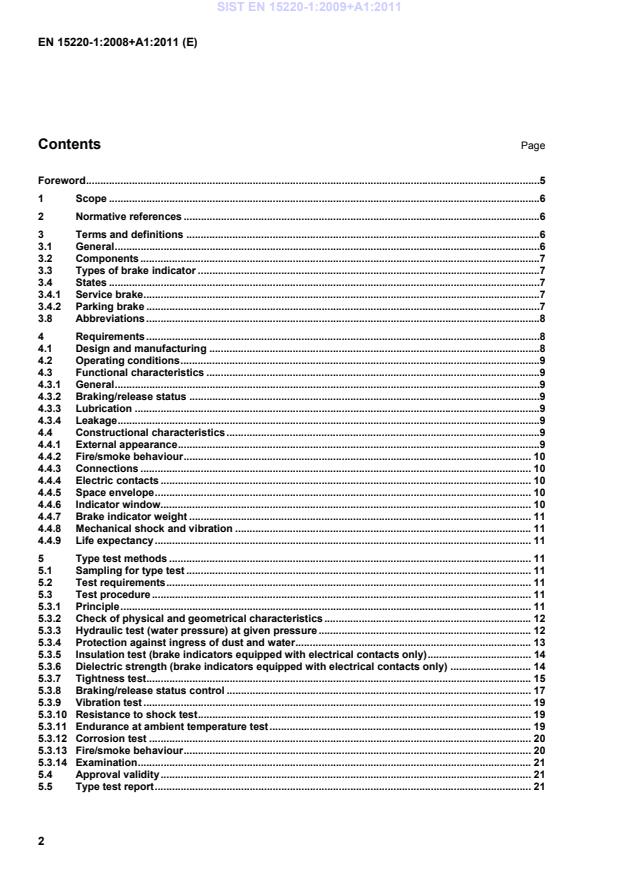
Brake indicator and parking brake indicator overall dimensions . 24Annex ZA (informative)
!!!!Relationship between this European Standard and the Essential Requirements of EU Directive 2008/57/EC of the European Parliament and of the Council of 17 June 2008 on the interoperability of the rail system within the Community (Recast)"""" . 29Figures Figure 1 — Standard nozzle . 14 Figure 2 — Air tightness equipment . 15 Figure 3 — Tightness cycle test . 16 Figure 4 — Tightness cycle test . 16 Figure 5 — Braking/release status control equipment . 18 Figure 6 — Braking/release cycle test . 18 Figure 7 — Endurance cycle test . 20 Figure A.1 — Single brake indicator and single parking brake indicator overall dimensions . 24 Figure A.2 — Single brake indicator and single parking brake indicator with switch overall dimensions . 25 Figure A.3 — Double brake indicator and double parking brake indicator overall dimensions . 26 Figure A.4 — Single brake indicator and single parking brake indicator overall dimensions . 27 Figure A.5 — Double brake indicator and double parking brake indicator overall dimensions with uncertain braking status indication . 28 Tables Table 1 — Operations to be carried out for conformity assessment . 12Table 2 — Leakage permitted at test temperatures . 16Table 3 — Leakage permitted at test temperatures . 17Table 4 — Test programme . 23Table ZA.1 – Correspondence between this European Standard, the HS TSI RST published in the OJEU dated 26 March 2008 and Directive 2008/57/EC . 30Table ZA.2 – Correspondence between this European Standard, the CR TSI RST Freight Wagons dated July 2006, published in the OJEU on 8 December 2006 and its intermediate revision published in the OJEU on 14 February 2009 and Directive 2008/57/EC . 31SIST EN 15220-1:2009+A1:2011
inch IP
International Protection NOTE IP is a coding system to indicate the degrees of protection provided by an enclosure against access to hazardous particles, ingress of solid foreign objects, ingress of water and to give additional information in connection with such protection. Un
nominal voltage 4 Requirements 4.1 Design and manufacturing The design and manufacture of the brake indicator shall, for all intended operating conditions, conform to the requirements of 4.2, 4.3 and 4.4. NOTE Each manufacturer is responsible for ensuring that the quality of design, workmanship and construction is in accordance with good engineering practice.
1) Can be purchased from: Beuth Verlag GmbH, 10772 Berlin. SIST EN 15220-1:2009+A1:2011
EN ISO 228-2 to the brake cylinder pipe(s). If required by the purchaser, the body can have an electric connector(s). This requirement shall be checked while testing the other constructional features in accordance with 5.3.2. 4.4.4 Electric contacts The contacts shall have "snap action operation" and be capable of operating within voltage limits of 0,7 Un and 1,25 Un.
NOTE Contact characteristics (voltage, current, protection etc.) and cabling will be declared by the supplier. 4.4.5 Space envelope The brake indicator shall be contained in the space envelope of Figure A.1, A.2, A.3, A.4 and A.5. Sizes shall be checked in accordance with 5.3.2. 4.4.6 Indicator window The brake indicator shall have a window not less than 2 400 mm2 for viewing: red flag: in the middle this flag shall have a black line 10 mm wide or a black dot 15 mm diameter; green flag. NOTE White flag with black cross may be used to indicate uncertain braking status of a parking brake by physically operating in front of the red/green indicator window.
The following colours shall be used: red colour according to RAL 3020; green colour according to RAL 6018; black colour
no RAL; white colour
no RAL. The colours shall remain recognisable during the overhaul period or lifetime of the indicator and shall be resistant to fading du
...