

EN 981:1996+A1:2008
(Main)Safety of machinery - System of auditory and visual danger and information signals
- Abstract
To reduce risks associated with misinterpretation of visual and auditory danger signals, a system of danger and information signals is specified taking into account the different degrees of urgency.
This European Standard is applicable to all danger and information signals which have to be clearly perceived and differentiated as specified in 5.3 of EN 292-2:1991, by other requirements or by the work situation, and to all degrees of urgency – from extreme urgency to an ALL CLEAR situation. Where visual signals are to be complementary to sound signals, the signal character is specified for both.
This European Standard does not apply to certain fields covered by specific standards or other conventions in force (international or national); in particular, fire alarms, medical alarms, alarms used in the field of public transport, navigation signals and signals for special fields of activity (for example, military). When new signals are being planned, however, this European Standard should be considered in order to avoid inconsistency.
For auditory signals, the system of signal character is a guideline for a signal language based on message categories which are classified according to urgency. Certain characters are specified for purposes which require safe and rapid recognition. Certain categories allow possibilities for variants, e.g. control and warning signals at workplaces where the signalling is intended for personnel with specific training.
For visual signals, the established meanings of the safety colours are not affected by this European Standard. For different needs, complementary meanings have been assigned to the signals by timed patterns, and in a very few cases by alternating colours.
- Status
- Published
- Publication Date
- 23-Sep-2008
- Withdrawal Date
- 27-Dec-2009
- Technical Committee
- CEN/TC 122 - Ergonomics
- Drafting Committee
- CEN/TC 122/WG 11 - Ergonomics of the Physical Environment
- Current Stage
- 9093 - Decision to confirm - Review Enquiry
- Start Date
- 20-Sep-2022
- Completion Date
- 30-Sep-2026
- Directive
- 2006/42/EC - Directive 2006/42/EC of the European Parliament and of the Council of 17 May 2006 on machinery, and amending Directive 95/16/EC (recast)OJ Ref: C, C 214 OJ Date: 08-Sep-2009
98/37/EC - MachineryOJ Ref: C, C 22 OJ Date: 28-Jan-2009

Overview
EN 981:1996+A1:2008 - published by CEN - defines a harmonized system of auditory and visual danger and information signals for machinery. Its purpose is to reduce misinterpretation and ensure rapid, reliable recognition of signals across different degrees of urgency (from extreme danger to an ALL CLEAR). The standard applies where signals must be clearly perceived and differentiated (see EN 292-2) and specifies both signal character (temporal and spectral features) and visual colour coding where visual signals complement sound.
Key Topics and Requirements
- Scope and applicability
- Applies to machine-related danger and information signals; excludes specialised fields (fire alarms, medical, public transport, navigation, military), though it should be consulted to avoid inconsistency when new signals are designed.
- Ergonomic principles
- Signals must be rapidly recognizable under anticipated environmental conditions; false alarms must be minimised.
- Consideration of panic effects and the need for informative follow-up messaging.
- Auditory signal character
- Message categories classified by urgency (e.g., DANGER, CAUTION, COMMAND, ANNOUNCEMENT, ALL CLEAR).
- High-urgency signals may use sweeping or alternating frequency; constant frequency patterns, bursts or pulses for lower urgency.
- Temporal rules: alternating segments ≥ 0.15 s; bursts pulse period approx. 0.125–0.25 s; quick-pulse/flash durations < 0.5 s. Ratio of segment lengths should not be less than 1:3.
- Higher pitch is associated with greater urgency, but exact frequency distributions are not prescribed.
- Speech signals and communication guidelines reference ISO 9921-1.
- Visual signal character
- Uses established safety colours (Red, Yellow, Blue, Green) for meanings; complementary meanings achieved by timed patterns or, rarely, alternating colours.
- Design and luminous requirements referenced to EN 842 and ISO 8995.
- Testing and maintenance
- Regular testing per EN 457 (auditory) and EN 842 (visual), including checks for detectability and understanding.
- Normative references
- Key related standards: EN 292-2, EN 457, EN 842, EN 60073, ISO 11429, ISO 8995.
Applications and Users
- Intended for: machine designers, safety engineers, control-panel and HMI designers, plant managers, ergonomic specialists, conformity assessors and notified bodies.
- Practical uses:
- Designing machine alarms, operator panels and plant-wide signalling.
- Developing consistent auditory/visual languages for multi-machine environments.
- Ensuring compliance with machine safety directives (relationship to EU 2006/42/EC is addressed in annexes).
Related Standards
- EN 457 - Auditory danger signals (design & testing)
- EN 842 - Visual danger signals (design & testing)
- EN 292-2 - Machinery safety principles
- EN 60073 - Colour coding of indicators
- ISO 11429 - International equivalent (note: EN 981 does not cover the emergency evacuation signal handled in ISO 11429)
- ISO 8995, ISO 9921-1 - Visual ergonomics and speech communication
Keywords: EN 981, auditory signals, visual signals, danger signals, safety of machinery, signal character, signal colours, machinery safety standards, CEN.
Relations
- Merged From
EN 981:1996 - Safety of machinery - System of auditory and visual danger and information signals - Effective Date
- 22-Dec-2008
- Effective Date
- 25-Aug-2026
- Effective Date
- 25-Aug-2026
- Effective Date
- 09-Feb-2026
- Refers
EN 842:1996 - Safety of machinery - Visual danger signals - General requirements, design and testing - Effective Date
- 28-Jan-2026
- Effective Date
- 28-Jan-2026
- Effective Date
- 28-Jan-2026
- Effective Date
- 28-Jan-2026
- Effective Date
- 28-Jan-2026
- Effective Date
- 28-Jan-2026
- Effective Date
- 28-Jan-2026
- Referred By
EN 1829-1:2021 - High-pressure water jet machines - Safety requirements - Part 1: Machines - Effective Date
- 28-Jan-2026
- Effective Date
- 28-Jan-2026
- Effective Date
- 28-Jan-2026
- Effective Date
- 28-Jan-2026
Get Certified
Connect with accredited certification bodies for this standard

CIS Institut d.o.o.
Personal Protective Equipment (PPE) certification body. Notified Body NB-2890 for EU Regulation 2016/425 PPE.

Kiwa BDA Testing
Building and construction product certification.
Kmetijski inštitut Slovenije
Agricultural Institute of Slovenia. Soil testing, plant health, agricultural product analysis.
Sponsored listings
Frequently Asked Questions
EN 981:1996+A1:2008 is a standard published by the European Committee for Standardization (CEN). Its full title is "Safety of machinery - System of auditory and visual danger and information signals". This standard covers: To reduce risks associated with misinterpretation of visual and auditory danger signals, a system of danger and information signals is specified taking into account the different degrees of urgency. This European Standard is applicable to all danger and information signals which have to be clearly perceived and differentiated as specified in 5.3 of EN 292-2:1991, by other requirements or by the work situation, and to all degrees of urgency – from extreme urgency to an ALL CLEAR situation. Where visual signals are to be complementary to sound signals, the signal character is specified for both. This European Standard does not apply to certain fields covered by specific standards or other conventions in force (international or national); in particular, fire alarms, medical alarms, alarms used in the field of public transport, navigation signals and signals for special fields of activity (for example, military). When new signals are being planned, however, this European Standard should be considered in order to avoid inconsistency. For auditory signals, the system of signal character is a guideline for a signal language based on message categories which are classified according to urgency. Certain characters are specified for purposes which require safe and rapid recognition. Certain categories allow possibilities for variants, e.g. control and warning signals at workplaces where the signalling is intended for personnel with specific training. For visual signals, the established meanings of the safety colours are not affected by this European Standard. For different needs, complementary meanings have been assigned to the signals by timed patterns, and in a very few cases by alternating colours.
To reduce risks associated with misinterpretation of visual and auditory danger signals, a system of danger and information signals is specified taking into account the different degrees of urgency. This European Standard is applicable to all danger and information signals which have to be clearly perceived and differentiated as specified in 5.3 of EN 292-2:1991, by other requirements or by the work situation, and to all degrees of urgency – from extreme urgency to an ALL CLEAR situation. Where visual signals are to be complementary to sound signals, the signal character is specified for both. This European Standard does not apply to certain fields covered by specific standards or other conventions in force (international or national); in particular, fire alarms, medical alarms, alarms used in the field of public transport, navigation signals and signals for special fields of activity (for example, military). When new signals are being planned, however, this European Standard should be considered in order to avoid inconsistency. For auditory signals, the system of signal character is a guideline for a signal language based on message categories which are classified according to urgency. Certain characters are specified for purposes which require safe and rapid recognition. Certain categories allow possibilities for variants, e.g. control and warning signals at workplaces where the signalling is intended for personnel with specific training. For visual signals, the established meanings of the safety colours are not affected by this European Standard. For different needs, complementary meanings have been assigned to the signals by timed patterns, and in a very few cases by alternating colours.
EN 981:1996+A1:2008 is classified under the following ICS (International Classification for Standards) categories: 13.110 - Safety of machinery. The ICS classification helps identify the subject area and facilitates finding related standards.
EN 981:1996+A1:2008 has the following relationships with other standards: It is inter standard links to EN 981:1996, ISO 8995:1989, ISO 9921-1:1996, EN 60073:2002, EN 842:1996, EN 3946:2001, EN 292-2:1991/A1:1995, EN 457:1992, EN 1777:2010, EN 13155:2020, EN 1804-3:2020, EN 1829-1:2021, EN 15746-2:2010+A1:2011, EN 15094:2022, EN 14677:2008. Understanding these relationships helps ensure you are using the most current and applicable version of the standard.
EN 981:1996+A1:2008 is associated with the following European legislation: EU Directives/Regulations: 2006/42/EC, 98/37/EC; Standardization Mandates: M/079, M/396. When a standard is cited in the Official Journal of the European Union, products manufactured in conformity with it benefit from a presumption of conformity with the essential requirements of the corresponding EU directive or regulation.
EN 981:1996+A1:2008 is available in PDF format for immediate download after purchase. The document can be added to your cart and obtained through the secure checkout process. Digital delivery ensures instant access to the complete standard document.
Standards Content (Sample)
SLOVENSKI STANDARD
01-december-2008
Varnost strojev - Sistem slišnih in vidnih nevarnostnih ali obvestilnih signalov
Safety of machinery - System of auditory and visual danger and information signals
Sicherheit von Maschinen - System akustischer und optischer Gefahrensignale und
Informationssignale
Sécurité des machines - Système de signaux auditifs et visuels de danger et
d'information
Ta slovenski standard je istoveten z: EN 981:1996+A1:2008
ICS:
13.110 Varnost strojev Safety of machinery
2003-01.Slovenski inštitut za standardizacijo. Razmnoževanje celote ali delov tega standarda ni dovoljeno.
EUROPEAN STANDARD
EN 981:1996+A1
NORME EUROPÉENNE
EUROPÄISCHE NORM
September 2008
ICS 13.110 Supersedes EN 981:1996
English Version
Safety of machinery - System of auditory and visual danger and
information signals
Sécurité des machines - Système de signaux auditifs et Sicherheit von Maschinen - System akustischer und
visuels de danger et d'information optischer Gefahrensignale und Informationssignale
This European Standard was approved by CEN on 21 October 1996 and includes Amendment 1 approved by CEN on 14 August 2008.
CEN members are bound to comply with the CEN/CENELEC Internal Regulations which stipulate the conditions for giving this European
Standard the status of a national standard without any alteration. Up-to-date lists and bibliographical references concerning such national
standards may be obtained on application to the CEN Management Centre or to any CEN member.
This European Standard exists in three official versions (English, French, German). A version in any other language made by translation
under the responsibility of a CEN member into its own language and notified to the CEN Management Centre has the same status as the
official versions.
CEN members are the national standards bodies of Austria, Belgium, Bulgaria, Cyprus, Czech Republic, Denmark, Estonia, Finland,
France, Germany, Greece, Hungary, Iceland, Ireland, Italy, Latvia, Lithuania, Luxembourg, Malta, Netherlands, Norway, Poland, Portugal,
Romania, Slovakia, Slovenia, Spain, Sweden, Switzerland and United Kingdom.
EUROPEAN COMMITTEE FOR STANDARDIZATION
COMITÉ EUROPÉEN DE NORMALISATION
EUROPÄISCHES KOMITEE FÜR NORMUNG
Management Centre: rue de Stassart, 36 B-1050 Brussels
© 2008 CEN All rights of exploitation in any form and by any means reserved Ref. No. EN 981:1996+A1:2008: E
worldwide for CEN national Members.
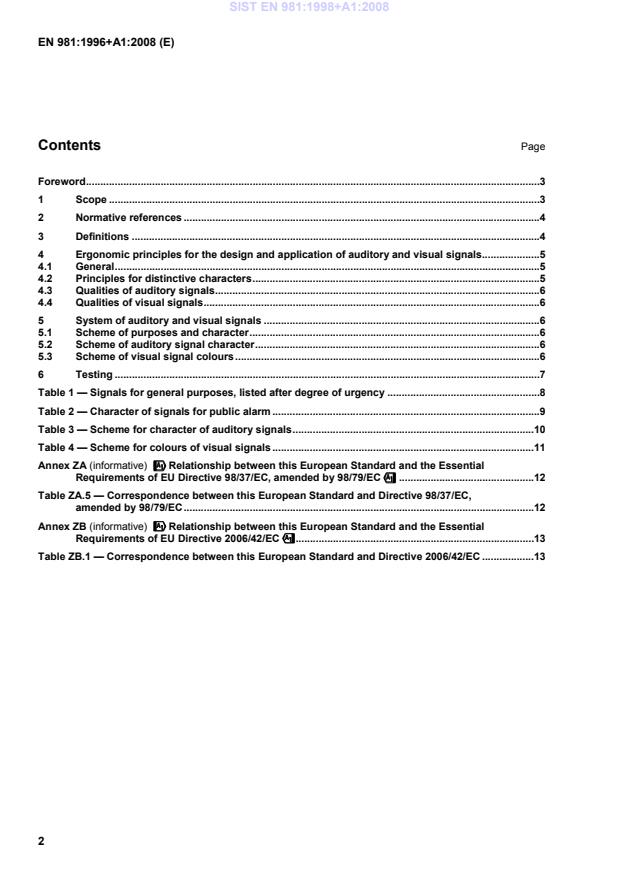
Contents Page
Foreword.3
1 Scope .3
2 Normative references .4
3 Definitions .4
4 Ergonomic principles for the design and application of auditory and visual signals.5
4.1 General.5
4.2 Principles for distinctive characters.5
4.3 Qualities of auditory signals.6
4.4 Qualities of visual signals.6
5 System of auditory and visual signals .6
5.1 Scheme of purposes and character.6
5.2 Scheme of auditory signal character.6
5.3 Scheme of visual signal colours.6
6 Testing .7
Table 1 — Signals for general purposes, listed after degree of urgency .8
Table 2 — Character of signals for public alarm .9
Table 3 — Scheme for character of auditory signals.10
Table 4 — Scheme for colours of visual signals .11
Annex ZA (informative) !!!!Relationship between this European Standard and the Essential
Requirements of EU Directive 98/37/EC, amended by 98/79/EC"""" .12
Table ZA.5 — Correspondence between this European Standard and Directive 98/37/EC,
amended by 98/79/EC.12
Annex ZB (informative) !!!!Relationship between this European Standard and the Essential
Requirements of EU Directive 2006/42/EC"""".13
Table ZB.1 — Correspondence between this European Standard and Directive 2006/42/EC .13
Foreword
This document (EN 981:1996+A1:2008) has been prepared by Technical Committee CEN/TC 122
“Ergonomics”, the secretariat of which is held by DIN.
This European Standard shall be given the status of a national standard, either by publication of an identical
text or by endorsement, at the latest by March 2009, and conflicting national standards shall be withdrawn at
the latest by December 2009.
This document includes Amendment 1, approved by CEN on 2008-08-14.
This document supersedes EN 981:1996.
The start and finish of text introduced or altered by amendment is indicated in the text by tags ! ".
This European Standard has been prepared under a mandate given to CEN by the European Commission
and the European Free Trade Association, and supports essential requirements of EU Directive(s).
!For relationship with EU Directive(s), see informative Annexes ZA and ZB, which are integral parts of this
document."
On the international level the International Standard ISO 11429 "Ergonomics – System of auditory and visual
danger and information signals" has been prepared by WG 3 "Danger signals and speech communication in
noisy environments" of ISO/TC 159/SC 5 "Ergonomics of the physical environment". The technical content of
both the European Standard !EN 981" and the International Standard ISO 11429 is identical, with the
exception of the emergency evacuation signal which is not dealt with in this European standard, however the
limits of applicability of the standards to other technical fields are different.
Due to the different limits of applicability still existing on the European and international level direct
transformation of the International Standard into a European Standard is not possible. The reason is that EN
981 has been prepared in order to fulfil the essential safety and health requirements of annex I of the Council
Directive 89/392/EEC of 14 June 1989 on the approximation of the laws of the Member States relating to
machinery: Essential health and safety requirements relating to the design and construction of machinery (see
Annex A of EN 292-2:1991/A1:1995) and that therefore the limits of applicability of the European Standard is
restricted to this Directive.
According to the CEN/CENELEC Internal Regulations, the national standards organizations of the following
countries are bound to implement this European Standard: Austria, Belgium, Bulgaria, Cyprus, Czech
Republic, Denmark, Estonia, Finland, France, Germany, Greece, Hungary, Iceland, Ireland, Italy, Latvia,
Lithuania, Luxembourg, Malta, Netherlands, Norway, Poland, Portugal, Romania, Slovakia, Slovenia, Spain,
Sweden, Switzerland and United Kingdom.
1 Scope
To reduce risks associated with misinterpretation of visual and auditory danger signals, a system of danger
and information signals is specified taking into account the different degrees of urgency.
This European Standard is applicable to all danger and information signals which have to be clearly perceived
and differentiated as specified in 5.3 of EN 292-2:1991, by other requirements or by the work situation, and to
all degrees of urgency – from extreme urgency to an ALL CLEAR situation. Where visual signals are to be
complementary to sound signals, the signal character is specified for both.
This European Standard does not apply to certain fields covered by specific standards or other conventions in
force (international or national); in particular, fire alarms, medical alarms, alarms used in the field of public
transport, navigation signals and signals for special fields of activity (for example, military). When new signals
are being planned, however, this European Standard should be considered in order to avoid inconsistency.
For auditory signals, the system of signal character is a guideline for a signal language based on message
categories which are classified according to urgency. Certain characters are specified for purposes which
require safe and rapid recognition. Certain categories allow possibilities for variants, e.g. control and warning
signals at workplaces where the signalling is intended for personnel with specific training.
For visual signals, the established meanings of the safety colours are not affected by this European Standard.
For different needs, complementary meanings have been assigned to the signals by timed patterns, and in a
very few cases by alternating colours.
2 Normative references
This European Standard incorporates by dated or undated reference, provisions from other publications.
These normative references are cited at the appropriate places in the text and the publications are listed
hereafter. For dated references, subsequent amendments to or revisions of any of these publications apply to
this European Standard only when incorporated in it by amendment or revision. For undated references the
latest edition of the publication referred to applies.
EN 292-2:1991/A1:1995, Safety of machinery – Basic concepts, general principles for design – Part 2:
Technical principles and specifications.
EN 457:1992, Safety of machinery – Auditory danger signals – General requirements, design and testing (ISO
7731:1986 modified).
EN 842:1996, Safety of machinery – Visual danger signals – General requirements, design and testing.
EN 60073, Coding of indicating devices and actuators by colours and supplementary means (IEC 73:1991).
ISO 8995, Principles of visual ergonomics – The lighting of indoor work systems.
ISO 9921-1, Ergonomic assessment of speech communication – Part 1: Speech interference level and
communication distances for persons with normal hearing capacity in direct communication (SIL method).
3 Definitions
For the purposes of this standard the following definitions apply:
3.1
alternating sound [light]
shifts between two or three acoustical [optical] spectra, with equal duration of the segments, at least 0,15 s
each
3.2
bursts of sound
normally recurrent group of sound pulses with short but distinct interruptions, the pulse period, including
interruption, being between 0,25 s and 0,125 s
3.3
character of a signal
combination of one or more auditory or visual components differentiating one signal from another
EN 981:199
...