


EN 13803-2:2006
(Main)Railway applications - Track - Track alignment design parameters - Track gauges 1435 mm and wider - Part 2: Switches and crossings and comparable alignment design situations with abrupt changes of curvature
General Information
- Abstract
This European Standard specifies the rules and values for the track alignment design parameters used to
determine the maximum operating speeds over tracks with abrupt changes in curvature and, consequently,
abrupt changes of cant deficiency. Such conditions occur in the following situations:
- in the diverging tracks in switch and crossing layouts;
- when it is not practical to design an alignment with transition curves;
- if the length of a transition curve is less than the minimum required for plain line track.
Engineering requirements specific to the mechanical behaviour of switch and crossing components and
subsystems are to be found in the relevant standards.
This European Standard presupposes that the homologation of the operating vehicles will be valid and
specified for conditions corresponding to the limiting values specified in this European Standard.
This European Standard is applicable to abrupt changes in curvature in switch and crossing layouts and plain
lines with track gauges of 1435 mm and wider. Annex C is applicable to track gauges wider than 1435 mm.
This European Standard specifies the requirements for preventing buffer locking.
The limiting values specified in this European Standard, when applied at the switch toe, are for switches with
tangential geometry (as defined in EN 13232-1).
This European Standard need not be applicable to certain urban and suburban lines.
This European Standard is not applicable to track alignment requirements for tilting body vehicles. However,
Annex H draws the designer’s attention to the consequences and the restrictions imposed when tilting
vehicles are operated over switch and crossing layouts and alignments without transition curves.
- Status
- Withdrawn
- Publication Date
- 12-Dec-2006
- Withdrawal Date
- 17-Nov-2009
- Technical Committee
- CEN/TC 256 - Railway applications
- Drafting Committee
- CEN/TC 256/SC 1/WG 15 - Track alignment design parameters
- Current Stage
- 9960 - Withdrawal effective - Withdrawal
- Start Date
- 18-Nov-2009
- Completion Date
- 18-Nov-2009

Relations
- Effective Date
- 19-Jan-2023
- Replaced By
EN 13606-4:2007 - Health informatics - Electronic health record communication - Part 4: Security - Effective Date
- 24-Aug-2022
- Effective Date
- 22-Dec-2008
Get Certified
Connect with accredited certification bodies for this standard

Zavod za gradbeništvo Slovenije (ZAG) - Inšpekcija
ZAG inspection body for construction products, structures, and materials.
Sponsored listings
Frequently Asked Questions
EN 13803-2:2006 is a standard published by the European Committee for Standardization (CEN). Its full title is "Railway applications - Track - Track alignment design parameters - Track gauges 1435 mm and wider - Part 2: Switches and crossings and comparable alignment design situations with abrupt changes of curvature". This standard covers: This European Standard specifies the rules and values for the track alignment design parameters used to determine the maximum operating speeds over tracks with abrupt changes in curvature and, consequently, abrupt changes of cant deficiency. Such conditions occur in the following situations: - in the diverging tracks in switch and crossing layouts; - when it is not practical to design an alignment with transition curves; - if the length of a transition curve is less than the minimum required for plain line track. Engineering requirements specific to the mechanical behaviour of switch and crossing components and subsystems are to be found in the relevant standards. This European Standard presupposes that the homologation of the operating vehicles will be valid and specified for conditions corresponding to the limiting values specified in this European Standard. This European Standard is applicable to abrupt changes in curvature in switch and crossing layouts and plain lines with track gauges of 1435 mm and wider. Annex C is applicable to track gauges wider than 1435 mm. This European Standard specifies the requirements for preventing buffer locking. The limiting values specified in this European Standard, when applied at the switch toe, are for switches with tangential geometry (as defined in EN 13232-1). This European Standard need not be applicable to certain urban and suburban lines. This European Standard is not applicable to track alignment requirements for tilting body vehicles. However, Annex H draws the designer’s attention to the consequences and the restrictions imposed when tilting vehicles are operated over switch and crossing layouts and alignments without transition curves.
This European Standard specifies the rules and values for the track alignment design parameters used to determine the maximum operating speeds over tracks with abrupt changes in curvature and, consequently, abrupt changes of cant deficiency. Such conditions occur in the following situations: - in the diverging tracks in switch and crossing layouts; - when it is not practical to design an alignment with transition curves; - if the length of a transition curve is less than the minimum required for plain line track. Engineering requirements specific to the mechanical behaviour of switch and crossing components and subsystems are to be found in the relevant standards. This European Standard presupposes that the homologation of the operating vehicles will be valid and specified for conditions corresponding to the limiting values specified in this European Standard. This European Standard is applicable to abrupt changes in curvature in switch and crossing layouts and plain lines with track gauges of 1435 mm and wider. Annex C is applicable to track gauges wider than 1435 mm. This European Standard specifies the requirements for preventing buffer locking. The limiting values specified in this European Standard, when applied at the switch toe, are for switches with tangential geometry (as defined in EN 13232-1). This European Standard need not be applicable to certain urban and suburban lines. This European Standard is not applicable to track alignment requirements for tilting body vehicles. However, Annex H draws the designer’s attention to the consequences and the restrictions imposed when tilting vehicles are operated over switch and crossing layouts and alignments without transition curves.
EN 13803-2:2006 is classified under the following ICS (International Classification for Standards) categories: 93.100 - Construction of railways. The ICS classification helps identify the subject area and facilitates finding related standards.
EN 13803-2:2006 has the following relationships with other standards: It is inter standard links to EN 13803-2:2006+A1:2009, EN 13606-4:2007, EN 13803-2:2006/AC:2007. Understanding these relationships helps ensure you are using the most current and applicable version of the standard.
EN 13803-2:2006 is associated with the following European legislation: EU Directives/Regulations: 93/38/EEC, 96/48/EC; Standardization Mandates: M/024, M/275. When a standard is cited in the Official Journal of the European Union, products manufactured in conformity with it benefit from a presumption of conformity with the essential requirements of the corresponding EU directive or regulation.
EN 13803-2:2006 is available in PDF format for immediate download after purchase. The document can be added to your cart and obtained through the secure checkout process. Digital delivery ensures instant access to the complete standard document.
Standards Content (Sample)
2003-01.Slovenski inštitut za standardizacijo. Razmnoževanje celote ali delov tega standarda ni dovoljeno.Railway applications - Track - Track alignment design parameters - Track gauges 1435 mm and wider - Part 2: Switches and crossings and comparable alignment design situations with abrupt changes of curvatureApplications ferroviaires - Parametres de conception du tracé de la voie - Ecartement 1435 mm et plus large - Partie 2: Appareils de voie et situations comparables de conception du tracé avec changements brusques de courbureBahnanwendungen - Oberbau - Linienführung in Gleisen - Spurweiten 1 435 mm und größer - Teil 2: Weichen und Kreuzungen sowie vergleichbare Trassierungselemente mit unvermitteltem KrümmungswechselTa slovenski standard je istoveten z:EN 13803-2:2006SIST EN 13803-2:2007en93.100Gradnja železnicConstruction of railways45.080Rails and railway componentsICS:SLOVENSKI
STANDARDSIST EN 13803-2:200701-marec-2007
EUROPEAN STANDARDNORME EUROPÉENNEEUROPÄISCHE NORMEN 13803-2December 2006ICS 93.100 English VersionRailway applications - Track - Track alignment designparameters - Track gauges 1435 mm and wider - Part 2:Switches and crossings and comparable alignment designsituations with abrupt changes of curvatureApplications ferroviaires - Paramètres de conception dutracé de la voie - Ecartement 1435 mm et plus large -Partie 2: Appareils de voie et situations comparables deconception du tracé avec changements brusques decourbureBahnanwendungen - Oberbau - Linienführung in Gleisen -Spurweiten 1 435 mm und größer - Teil 2: Weichen undKrezungen sowie vergleichbare Trassierungselemente mitunvermitteltem KrümmungswechselThis European Standard was approved by CEN on 4 November 2006.CEN members are bound to comply with the CEN/CENELEC Internal Regulations which stipulate the conditions for giving this EuropeanStandard the status of a national standard without any alteration. Up-to-date lists and bibliographical references concerning such nationalstandards may be obtained on application to the Central Secretariat or to any CEN member.This European Standard exists in three official versions (English, French, German). A version in any other language made by translationunder the responsibility of a CEN member into its own language and notified to the Central Secretariat has the same status as the officialversions.CEN members are the national standards bodies of Austria, Belgium, Cyprus, Czech Republic, Denmark, Estonia, Finland, France,Germany, Greece, Hungary, Iceland, Ireland, Italy, Latvia, Lithuania, Luxembourg, Malta, Netherlands, Norway, Poland, Portugal, Romania,Slovakia, Slovenia, Spain, Sweden, Switzerland and United Kingdom.EUROPEAN COMMITTEE FOR STANDARDIZATIONCOMITÉ EUROPÉEN DE NORMALISATIONEUROPÄISCHES KOMITEE FÜR NORMUNGManagement Centre: rue de Stassart, 36
B-1050 Brussels© 2006 CENAll rights of exploitation in any form and by any means reservedworldwide for CEN national Members.Ref. No. EN 13803-2:2006: E
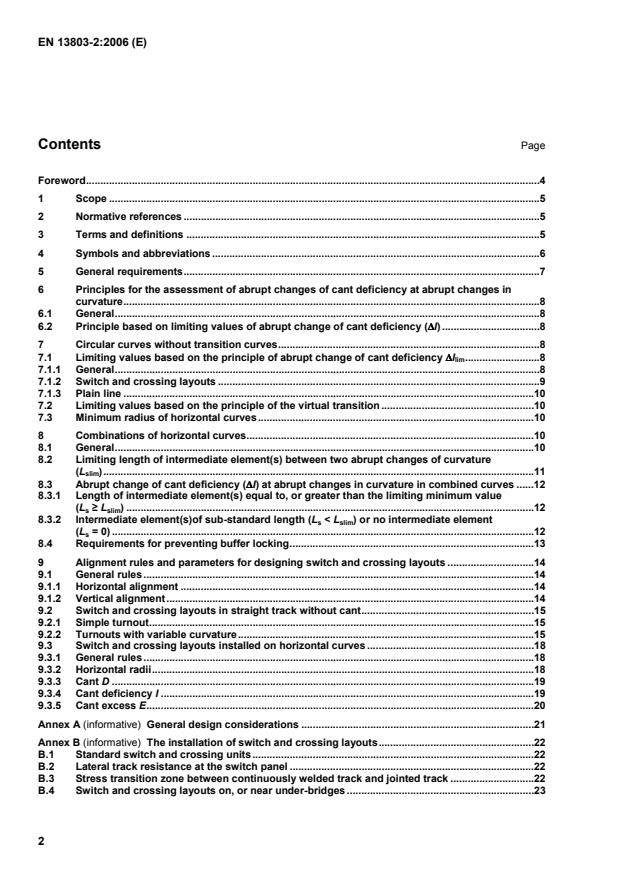
General design considerations.21 Annex B (informative)
The installation of switch and crossing layouts.22 B.1 Standard switch and crossing units.22 B.2 Lateral track resistance at the switch panel.22 B.3 Stress transition zone between continuously welded track and jointed track.22 B.4 Switch and crossing layouts on, or near under-bridges.23
Rules for converting parameter values for track gauges wider than 1435 mm.26 C.1 Scope.26 C.2 Symbols and abbreviations.26 C.3 Basic hypothesis.26 C.4 Conversion rules.27 C.4.1 Application of ∆∆∆∆I limiting values.27 C.4.2 Cant.27 C.4.3 Equilibrium cant.28 C.4.4 Other formulas and values of the standard.28 C.4.5 Annexes.29 Annex D (informative)
Limits of lateral acceleration.30 D.1 Introduction.30 D.2 Wheel-base effect.31 D.3 Limiting values of the non-compensated lateral acceleration.31 D.4 Conclusion.32 Annex E (informative)
The principle of virtual transition.33 E.1 Virtual transition at an abrupt change of curvature.33 E.2 Virtual transition at a short intermediate length between two abrupt changes of curvature.33 E.3 Limiting values based on the principle of the virtual transition.34 E.3.1 General.34 E.3.2 Characteristic vehicle with a distance of 20 m between bogie centres.34 E.3.3 Characteristic vehicle with a distance of 12,2 m and 10,06 m between bogie centres.35 Annex F (informative)
A method for calculating the maximum permissible speed at the toe of a non-tangential switch.36 Annex G (informative)
Constraints and risks associated with the use of maximum (or minimum) limiting values.38 Annex H (informative)
The maximum permissible speed of tilting body trains over switch and crossing layouts.39 H.1 General.39 H.2 The maximum permissible speeds over abrupt changes of curvature.39 H.3 The permissible speeds over switch and crossing layouts on curves.39 Annex ZA (informative)
Relationship between this European Standard and the Essential Requirements of EU Directive 96/48/EC of 23 July 1996 on the interoperability of the trans-European high-speed rail system amended by the EU Directive 2004/50/EC of 29 April 2004.40 Bibliography.42
1 Official Journal of the European Communities N° L 235 of 1996-09-17 2 Official Journal of the European Communities N° L 134 of 2004-04-30 3 Official Journal of the European Communities N° L 237 of 1991-08-24
5 General requirements The track alignment designer is free to specify the most appropriate values for the various parameters at the specified operating speeds, when considering safety, geographical, engineering, historical, and economic constraints. These values and parameters shall be specified in the contract documents. The designer shall endeavour not to exceed the recommended limiting values specified in this European Standard and avoid unnecessary use of the maximum (or minimum) limiting values. Annex G describes the constraints and risks associated with the use of maximum (or minimum) limiting values. Whenever necessary, the track alignment designer shall take into account national standards when these are more restrictive. The most important requirements for the installation of switch and crossing layouts are specified in Annex B. These requirements have an influence on the design of the alignment elements for both tracks in switch and crossing layouts and, consequently, they influence the maximum operating speeds and life cycle costs. The designer should, as far as it is practicable, comply with these requirements. Existing installations, which do not conform to this European Standard, should be modified as soon as possible if safety requirements (for example abrupt change of cant deficiency, length of element(s) between abrupt changes of curvature and the safety related parameters listed in ENV 13803-1) are compromised. Other non-conforming installations should, if possible, be modified during the next track renewal. The railway authority or the manufacturer shall specify the limits (e.g. requirement for the switch entry angle) for non-tangential switches (see also EN 13232-9). Annex F describes a method for calculating the maximum permissible speed at the toe of a non-tangential switch.
[mm] where C = 11,8 mm·m·h2/km2 and i = 1, 2 For curves with cant excess, the equation I = −E shall be used. Between two abutting curves (i.e. two arcs without an intermediate element) the abrupt change in cant deficiency is ∆I = I2 ± I1. For a reverse curve it is ∆I = I2 + I1 and for a compound curve it is ∆I = I2 − I1. The limiting values are specified in 7.1. The limiting lengths of intermediate element(s) between two abrupt changes of curvature are specified in 8.2. The value of abrupt change in cant deficiency to be taken into account when there is no intermediate element between curves, or the intermediate element is of substandard length, is specified in 8.3.2. 7 Circular curves without transition curves 7.1 Limiting values based on the principle of abrupt change of cant deficiency ∆∆∆∆Ilim 7.1.1 General This principle of abrupt change of cant deficiency is described in 6.2. The maximum permissible speed over an abrupt change in curvature between a curve without cant and a straight shall be based on the limiting values for abrupt change of cant deficiency (∆Ilim) specified in 7.1.2 and 7.1.3.
[mm] where C = 11,8 mm·m·h2/km2
Figure 1 — Combination of circular curve and straight without cant NOTE When designs are based on the principle of limiting values for abrupt change of cant deficiency (∆Ilim), in accordance with 6.2, it is not necessary to conform to the limiting values for the rate of change of abrupt change of cant deficiency (∆I/∆t), specified for the principle of the virtual transition as described in the informative Annex E. 7.1.2 Switch and crossing layouts The limiting values for an abrupt change of cant deficiency in the tracks of a switch and crossing layout shall be as specified in Table 2. Table 2a — Limiting values of abrupt change of cant deficiency (∆∆∆∆Ilim) – High-speed lines Speed V (km/h) V ≤ 70 70 < V ≤ 170 170 < V ≤ 230 Recommended limiting values ∆∆∆∆Ilim (mm) 100 80 60 Maximum limiting values ∆∆∆∆Ilim (mm) 120 105 85
Table 2b — Limiting values of abrupt change of cant deficiency (∆∆∆∆Ilim) – Conventional lines Speed V (km/h) V ≤ 100 100 < V ≤ 170 170 < V ≤ 220 220 < V ≤ 230 Recommended limiting values ∆∆∆∆Ilim (mm) 100 133 – 0,33 V 60 Maximum limiting values ∆∆∆∆Ilim (mm) 120 141 – 0,21 V 161 – 0,33 V
The use of higher values of abrupt change of cant deficiency should, if possible, be avoided. If the use of higher values is unavoidable, for example in close conjunction to switch and crossing layouts, the limiting values shall not exceed those specified in 7.1.2. 7.2 Limiting values based on the principle of the virtual transition Some European railway authorities use the principle of the virtual transition (see Annex E). The limits applicable for this principle are given in E.3. 7.3 Minimum radius of horizontal curves On all tracks (including the diverging tracks in switch and crossing layouts) where different railway vehicles operate, the designed minimum radius for any curve shall not be less than 150 m. In the case of a reverse curve, or curves in opposite directions with short intermediate elements, the alignment design shall conform to 8.4. 8 Combinations of horizontal curves 8.1 General Horizontal curves can be combined to form a reverse curve, curves in the opposite directions with an intermediate element, a compound curve, and curves in the same direction with an intermediate element. These types of situations are shown in Figure 2. The track elements may have constant curvature (as in Figure 2), but may also be transition curves (for a turnout placed on a transition curve and/or a turnout with variable curvature). In some cases the intermediate element may be a transition curve of sub-standard length, i.e. a transition curve that does not conform to the requirements of ENV 13803-1. In practice, such situations occur in: the diverging tracks in switch and crossing layouts; plain tracks abutting switch and crossing layouts; plain tracks where it is impractical to provide full transition curves (typically stations and sidings); plain track alignments with large radii curves;
Figure 2 — Combinations of alignment elements Clause 8 specifies: the limiting length of the intermediate element(s) between two abrupt changes of curvature (Lslim); the abrupt change of cant deficiency (∆I) applicable for the each combination of alignment elements; the requirements for preventing buffer locking. 8.2 Limiting length of intermediate element(s) between two abrupt changes of curvature (Lslim) A tangent point with an abrupt change of curvature generates disturbed vehicle dynamics. Therefore, there should be a minimum length to the next tangent point with an abrupt change of curvature. The limiting length of intermediate element(s) between two abrupt changes of curvature is defined as: Lslim = qslim·V
[m] where qslim is a factor (m·h/km) defined in Table 4 V is the maximum train speed (km/h)
NOTE For switches and crossings placed on transition curves, the length between two abrupt changes of cant deficiency may involve more than one intermediate element. If calculations are based on the principle of virtual transitions, the length of intermediate element(s) between two abrupt changes of curvature shall also be assessed according to Annex E. 8.3 Abrupt change of cant deficiency (∆∆∆∆I) at abrupt changes in curvature in combined curves 8.3.1 Length of intermediate element(s) equal to, or greater than the limiting minimum value (Ls ≥ Lslim) If the total length of intermediate element(s) is greater then the limiting length (Ls ≥ Lslim), the tangent points with abrupt changes of curvature shall be considered independently, and the abrupt change of cant deficiency (∆I) for each tangent point shall be as specified in 7.1. 8.3.2 Intermediate element(s)of sub-standard length (Ls < Lslim) or no intermediate element (Ls = 0) Where the total length of the intermediate element(s) does not conform to 8.2, the maximum permissible speed shall be based on the following abrupt changes of cant deficiency (see Figure 2): for a reverse curve: ∆I = I1 + I2; for two curves of the opposite directions and an intermediate straight: ∆I = I1+ I2; Equivalent alignment cases are where two abrupt changes in curvature are separated by a length which is shorter than Lslim, and the second abrupt change of curvature interacts with the first abrupt change of curvature in a way that the total change of curvature over the two tangent points is increased. These cases shall be assessed using the equation ∆I = ∆I1 + ∆I2. for a compound curve: ∆I = I1 − I2; for two curves of the same direction, with an un-canted intermediate straight: ∆I = max {I1 ; I2} Wherever possible, this combination should be avoided and a compound curve with Ls = 0 shall be used. Equivalent alignment cases are where two abrupt changes in curvature are separated by a length which is shorter than Lslim, and the second abrupt change of curvature interacts with the first abrupt change of curvature in a way that the total change of curvature over the two tangent points is decreased. As a general rule, all tangent points i shall be assessed with respect to ∆Ii.
[m] The limiting value for the length of intermediate straight between two circular curves in the opposite directions, based on the basic vehicle, is defined in Table 5 and Figure 3. When free access is required for all types of vehicles, including long coaches with a theoretical recovery of 50 mm on the buffer heads, the recommended limiting values for Ls (based on in-service experiences) shall be used. When there are special conditions, such as multiple short alignment elements, or operating systems with higher longitudinal forces (e.g. push-pull systems), a more detailed theoretical analysis or field assessments shall be carried out. NOTE In the defined cases of curves in the opposite directions only straights are considered as intermediate elements. Table 5 — Limiting values of the length of an intermediate straight (Lslim) Rid (m) 110 105 100 95 90 85 80 75 Recommended limiting value Lslim (m) a 0 4,8 6,0 7,0 8,0 9,0 10,2 11,5 Minimum limiting value Lslim (m) - - 0 3,2 4,3 5,1 6,0 6,8 a recommended value should be considered as the minimum limiting value for tracks for long coaches.
Key 1 Rid in m 2 Lslim in m 3 minimum limiting value 4 recommended limiting value Figure 3 — Limiting values of the length of an intermediate straight (Lslim) as a function of Rid 9 Alignment rules and parameters for designing switch and crossing layouts 9.1 General rules 9.1.1 Horizontal alignment Switch and crossing layouts should, if possible, be installed in straight tracks or in tracks with very large radii. NOTE Switches and crossings placed on curves should be avoided due to higher maintenance cost and/or due to the lack of standardisation (special components). Such layouts may also require speed restrictions due to lower limits for cant and cant deficiency. 9.1.2 Vertical alignment Switch and crossing layouts should be installed where the tracks are level or on a constant gradient. If the installation of switch and crossing layouts on tracks with vertical curves is unavoidable, the radii of the vertical curves shall conform to the values specified in ENV 13803-1, and shall not be less than the limiting values specified in Table 6. For a non-canted switch and crossing unit, the vertical alignment of the tracks shall follow each other up to the last common bearer.
Figure 4 — Standard turnout – Geometric layout and cant deficiency diagram The geometrical layout and the cant deficiency diagram for a simple turnout in a straight track without cant are shown in Figure 4. The diverging track in this type of turnout shall be designed to the requirements specified in Clause 6 and the design parameters specified in Clause 7. Circular curves, or curves that form a combination of curves in the diverging track shall be designed as specified in Clause 8. A cant gradient and cant on the diverging track shall only be applied after the last common bearer behind the crossing, unless the turnout has been designed to build up a cant on the diverging track using special components. 9.2.2 Turnouts with variable curvature 9.2.2.1 General The geometrical layout and the cant deficiency diagram for a typical turnout with curves of variable curvature are shown in Figure 5.
Figure 5 — Standard turnout with curves of variable curvature Possible variations to the geometrical layout and cant deficiency diagram shown in Figure 5 are as follows: the abrupt change of cant deficiency at the crossing side of the turnout (∆lc) could be zero; one or two of the element lengths L1, L2, or L3 could be zero. Figure 6 shows cant deficiency diagrams for a variety of transitioned turnouts with either one, or two, curves of variable curvature in the diverging track.
Figure 6 — Cant deficiency diagrams for various turnouts with curves of variable curvature NOTE Curves of variable curvature usually have a linear rate of change of curvature e.g. a Clothoid curve. The general requirements for the geometrical layout of the diverging track in a turnout with curves of variable curvature are as follows:
Key 1 line speed in km/h 2 parameter of clothoid in m 3 A max (dI/dt = 25 mm/s) 4 A min (dI/dt = 90 mm/s) Figure 7 — Range of parameter of clothoid (A) in relation to speed
[mm/s] where qA = 3,28 mm·m2·h3/(s·km3) 9.2.2.3 Limiting values for abrupt change of cant deficiency at switch side (∆∆∆∆Is) and crossing side (∆∆∆∆Ic) In turnouts with curves of variable curvature the limiting values for abrupt change of cant deficiency at the switch side (∆Is) and at the crossing side (∆Ic) shall be as specified in Table 2. 9.2.2.4 Limiting values for cant deficiency (Imax) in the diverging track The limiting cant deficiency on the diverging tracks of turnouts with curves of variable curvature shall be as specified in 9.3.4. 9.3 Switch and crossing layouts installed on horizontal curves 9.3.1 General rules Switch and crossing layouts, comprising of standard switches and crossings can be installed in curved tracks, which may be either canted or un-canted. The construction of a switch and crossing layout to suit a curved track is achieved by curving standard units to match the curvature of the first designed track. This curving alters the curvature of both tracks within practical limits, but the crossing angle at the end of the crossing remains the same. However, there are limits to which standard units can be curved and, consequently, a switch and crossing layout may have to be constructed from specially designed switches and crossings components. The tracks of switch and crossing layouts on horizontal curves shall be designed to the principles and parameters specified in Clauses 6, 7, and 8. 9.3.2 Horizontal radii When standard switch and crossing units are bent to match the curvature of the firstly designed track (1/RI), the curvature of the second track (1/RII) is affected. The exact value the curvature of the second track (1/RII) depends on the principles for lengthening and shortening the rails on the closure panel. An approximate estimation of the curvature of the second track (1/RII) is based on the superposition of curvatures (the small angle approximation): for an inside curved switch and crossing: 0III111RRR+≈
[m-1] for an outside curved switch and crossing: 0III111RRR−≈
[m-1]
...