

EN 1010-2:2006
(Main)Safety of machinery - Safety requirements for the design and construction of printing and paper converting machines - Part 2: Printing and varnishing machines including pre-press machinery
- Abstract
This document applies to:
- Pre-press machinery (machinery and devices for the production of master copies and printing forms):
- exposure equipment for the production of films and printing forms;
- equipment for developing films and printing forms;
- washing machines for printing forms;
- machines for bending printing forms;
- punching machines for film and printing forms;
- cutting machines for film and printing forms;
- machines for the production of gravure printing forms;
- scanners.
- Printing and varnishing machines:
- proofing presses;
- sheet-fed printing presses and varnishing machines including digital printing presses;
- web-fed rotary presses and varnishing machines including digital printing presses;
- screen printing presses.
- Auxiliary devices:
- cylinder and roller washing devices;
- continuous flow drying devices;
- powder spraying devices;
- auxiliary devices on inking and damping units;
- automatic plate clamping devices;
- washing equipment for printing forms, rollers and scrapers;
- pile turners; reel turners,
- measuring and control devices.
This document shall be used together with prEN 1010-1:2003. Both parts together identify all significant hazards relevant to printing and varnishing machines including pre-press machinery and auxiliary devices, when they are used as intended and under the conditions foreseen by the manufacturer (see clause 4). The specific requirements specified in prEN 1010-2 take precedence over respective requirements in prEN 1010-1:2003.
This document does not deal with risks generated by noise emitted from the machines. These issues are fundamentally covered in prEN 1010-1: 20032
However, this document specifies requirements for noise reduction of corrugated board and flatbed punching machines.
This document does not apply to high-pressure cleaning devices and screen printing presses for textile substrates.
This document is not applicable to bookbinding, paper converting and finishing
- Status
- Withdrawn
- Publication Date
- 14-Mar-2006
- Withdrawal Date
- 03-Aug-2010
- Technical Committee
- CEN/TC 198 - Printing and paper machinery - Safety
- Current Stage
- 9960 - Withdrawal effective - Withdrawal
- Start Date
- 04-Aug-2010
- Completion Date
- 04-Aug-2010
- Directive
- 94/9/EC - Equipment and protective systems intended for use in potentially explosive atmospheres (ATEX)OJ Ref: C, C 97 OJ Date: 16-Apr-2010



Relations
- Effective Date
- 19-Jan-2023
- Effective Date
- 28-Jan-2026
- Effective Date
- 22-Dec-2008
- Effective Date
- 22-Dec-2008
Get Certified
Connect with accredited certification bodies for this standard

Control Union Certifications
Global certification for agriculture and sustainability.

Gozdarski inštitut Slovenije
Slovenian Forestry Institute. Forest management certification support, timber testing.
Sponsored listings
Frequently Asked Questions
EN 1010-2:2006 is a standard published by the European Committee for Standardization (CEN). Its full title is "Safety of machinery - Safety requirements for the design and construction of printing and paper converting machines - Part 2: Printing and varnishing machines including pre-press machinery". This standard covers: This document applies to: - Pre-press machinery (machinery and devices for the production of master copies and printing forms): - exposure equipment for the production of films and printing forms; - equipment for developing films and printing forms; - washing machines for printing forms; - machines for bending printing forms; - punching machines for film and printing forms; - cutting machines for film and printing forms; - machines for the production of gravure printing forms; - scanners. - Printing and varnishing machines: - proofing presses; - sheet-fed printing presses and varnishing machines including digital printing presses; - web-fed rotary presses and varnishing machines including digital printing presses; - screen printing presses. - Auxiliary devices: - cylinder and roller washing devices; - continuous flow drying devices; - powder spraying devices; - auxiliary devices on inking and damping units; - automatic plate clamping devices; - washing equipment for printing forms, rollers and scrapers; - pile turners; reel turners, - measuring and control devices. This document shall be used together with prEN 1010-1:2003. Both parts together identify all significant hazards relevant to printing and varnishing machines including pre-press machinery and auxiliary devices, when they are used as intended and under the conditions foreseen by the manufacturer (see clause 4). The specific requirements specified in prEN 1010-2 take precedence over respective requirements in prEN 1010-1:2003. This document does not deal with risks generated by noise emitted from the machines. These issues are fundamentally covered in prEN 1010-1: 20032 However, this document specifies requirements for noise reduction of corrugated board and flatbed punching machines. This document does not apply to high-pressure cleaning devices and screen printing presses for textile substrates. This document is not applicable to bookbinding, paper converting and finishing
This document applies to: - Pre-press machinery (machinery and devices for the production of master copies and printing forms): - exposure equipment for the production of films and printing forms; - equipment for developing films and printing forms; - washing machines for printing forms; - machines for bending printing forms; - punching machines for film and printing forms; - cutting machines for film and printing forms; - machines for the production of gravure printing forms; - scanners. - Printing and varnishing machines: - proofing presses; - sheet-fed printing presses and varnishing machines including digital printing presses; - web-fed rotary presses and varnishing machines including digital printing presses; - screen printing presses. - Auxiliary devices: - cylinder and roller washing devices; - continuous flow drying devices; - powder spraying devices; - auxiliary devices on inking and damping units; - automatic plate clamping devices; - washing equipment for printing forms, rollers and scrapers; - pile turners; reel turners, - measuring and control devices. This document shall be used together with prEN 1010-1:2003. Both parts together identify all significant hazards relevant to printing and varnishing machines including pre-press machinery and auxiliary devices, when they are used as intended and under the conditions foreseen by the manufacturer (see clause 4). The specific requirements specified in prEN 1010-2 take precedence over respective requirements in prEN 1010-1:2003. This document does not deal with risks generated by noise emitted from the machines. These issues are fundamentally covered in prEN 1010-1: 20032 However, this document specifies requirements for noise reduction of corrugated board and flatbed punching machines. This document does not apply to high-pressure cleaning devices and screen printing presses for textile substrates. This document is not applicable to bookbinding, paper converting and finishing
EN 1010-2:2006 is classified under the following ICS (International Classification for Standards) categories: 37.100.10 - Reproduction equipment; 85.100 - Equipment for the paper industry. The ICS classification helps identify the subject area and facilitates finding related standards.
EN 1010-2:2006 has the following relationships with other standards: It is inter standard links to EN 1010-2:2006+A1:2010, EN 1010-4:2004+A1:2009, EN 1010-2:2006/FprA1; is excused to EN 1010-1:2004. Understanding these relationships helps ensure you are using the most current and applicable version of the standard.
EN 1010-2:2006 is associated with the following European legislation: EU Directives/Regulations: 94/9/EC, 98/37/EC; Standardization Mandates: M/079, M/BC/CEN/92/46. When a standard is cited in the Official Journal of the European Union, products manufactured in conformity with it benefit from a presumption of conformity with the essential requirements of the corresponding EU directive or regulation.
EN 1010-2:2006 is available in PDF format for immediate download after purchase. The document can be added to your cart and obtained through the secure checkout process. Digital delivery ensures instant access to the complete standard document.
Standards Content (Sample)
2003-01.Slovenski inštitut za standardizacijo. Razmnoževanje celote ali delov tega standarda ni dovoljeno.Safety of machinery - Safety requirements for the design and construction of printing and paper converting machines - Part 2: Printing and varnishing machines including pre-press machinerySécurité des machines - Prescriptions de sécurité pour la conception et la construction de machines d'impression et de transformation du papier - Partie 2: Machines d'impression et de vernissage ycompris les équipementsde pré-pressSicherheit von Maschinen - Sicherheitsanforderungen an Konstruktion und Bau von Druck- und Papierverarbeitungsmaschinen - Teil 2: Druck- und Lackiermaschinen einschließlich Maschinen der DruckvorstufeTa slovenski standard je istoveten z:EN 1010-2:2006SIST EN 1010-2:2006en85.10037.100.10ICS:SLOVENSKI
STANDARDSIST EN 1010-2:200601-september-2006
EUROPEAN STANDARDNORME EUROPÉENNEEUROPÄISCHE NORMEN 1010-2March 2006ICS 37.100.10; 85.100 English VersionSafety of machinery - Safety requirements for the design andconstruction of printing and paper converting machines - Part 2:Printing and varnishing machines including pre-press machinerySécurité des machines - Prescriptions de sécurité pour laconception et la construction de machines d'impression etde transformation du papier - Partie 2: Machinesd'impression et de vernissage ycompris les équipementsdepré-pressSicherheit von Maschinen - Sicherheitsanforderungen anKonstruktion und Bau von Druck- undPapierverarbeitungsmaschinen - Teil 2: Druck- undLackiermaschinen einschließlich Maschinen derDruckvorstufeThis European Standard was approved by CEN on 17 January 2005.CEN members are bound to comply with the CEN/CENELEC Internal Regulations which stipulate the conditions for giving this EuropeanStandard the status of a national standard without any alteration. Up-to-date lists and bibliographical references concerning such nationalstandards may be obtained on application to the Central Secretariat or to any CEN member.This European Standard exists in three official versions (English, French, German). A version in any other language made by translationunder the responsibility of a CEN member into its own language and notified to the Central Secretariat has the same status as the officialversions.CEN members are the national standards bodies of Austria, Belgium, Cyprus, Czech Republic, Denmark, Estonia, Finland, France,Germany, Greece, Hungary, Iceland, Ireland, Italy, Latvia, Lithuania, Luxembourg, Malta, Netherlands, Norway, Poland, Portugal, Romania,Slovakia, Slovenia, Spain, Sweden, Switzerland and United Kingdom.EUROPEAN COMMITTEE FOR STANDARDIZATIONCOMITÉ EUROPÉEN DE NORMALISATIONEUROPÄISCHES KOMITEE FÜR NORMUNGManagement Centre: rue de Stassart, 36
B-1050 Brussels© 2006 CENAll rights of exploitation in any form and by any means reservedworldwide for CEN national Members.Ref. No. EN 1010-2:2006: E
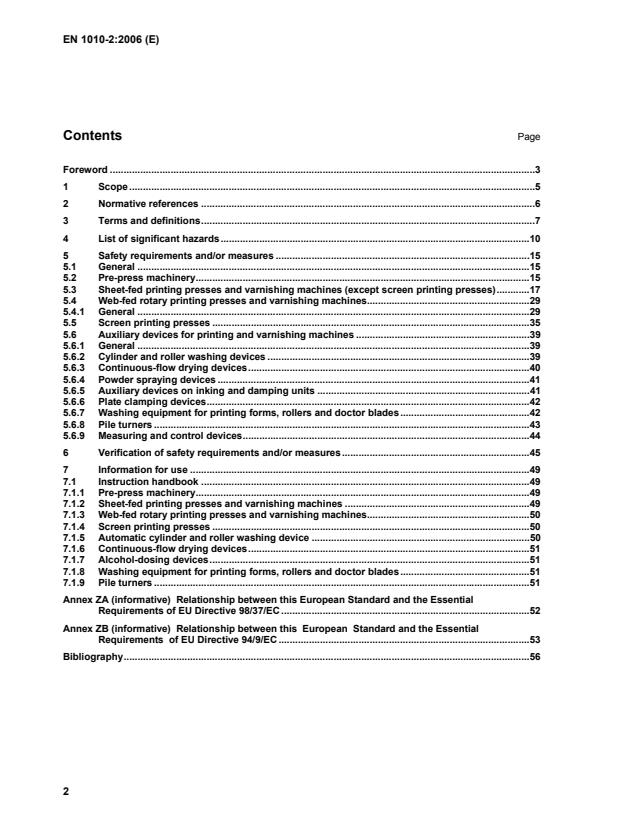
Relationship between this European Standard and the Essential Requirements of EU Directive 98/37/EC.52 Annex ZB (informative)
Relationship between this
European
Standard and the Essential Requirements
of EU Directive 94/9/EC.53 Bibliography.56
Introduction This document is a type C standard as stated in EN ISO 12100-1:2003. It defines additional safety requirements and/or deviations from the stipulations in EN 1010-1:2004. The machinery concerned and the extent to which hazards, hazardous situations and events are covered are indicated in the scope of this document. When provisions of this type C standard are different from those which are stated in type A or B standards, the provisions of this type C standard take precedence over the provisions of the other standards for machines that have been designed and built according to the provisions of this type C standard. The European Committee for Standardization (CEN) draws attention to the fact that it is claimed that compliance with this document may involve the use of one or more patents: - German Patent DE 103 10 236 B3 - PCT patent application CEN takes no position concerning the evidence, validity and scope of this patent right. The holders of this patent right have assured CEN that they are willing to negotiate licences under reasonable and non-discriminatory terms and conditions with applicants throughout the world. In this respect, the statement of the holders of this patent right is registered with CEN: The companies Koenig & Bauer AG, Friedrich-Koenig-Strasse 4, 97080 Würzburg (DE), Heidelberger Druckmaschinen AG, Kurfuersten-Anlage 52-60, 69115 Heidelberg (DE) and MAN Roland Druckmaschinen AG, Mühlheimer Strasse 341, 63075 Offenbach (DE) (“Patent Owners”) as the exclusive owners of the German Patent DE 103 10 236 B3 and the PCT patent application WO 2004/078626 A1 (“Patents”) herewith declare not to enforce any rights resulting from the German Patent DE 103 10 236 B3 and the PCT patent application WO 2004/078626 A1 against third parties that intend to comply with the ISO/TC130, CEN/TC 198, ANSI B65 standards, or any other local or regional standards that use the ISO/TC 130 standards or the relevant parts thereof or any derivative standards thereof. This declaration is legally binding for all current owners of the above-mentioned patent and patent application and their future legal successors.
Information may be obtained from:
Heidelberger Druckmaschinen AG Intellectual Property R3 Kurfürstenanlage 52-60, 69115 Heidelberg Germany Tel: +49-6221/92-3027 Fax: +49-6221/92-3099 Koening & Bauer AG Friedrich-König-Straße 4, 97080 Würzburg, Germany
MAN Roland Druckmaschinen AG Mühlheimer Straße 341, 63075 Offenbach Germany Attention is drawn to the possibility that some of the elements of this document may be the subject of patent rights other than those identified above. CEN shall not be held responsible for identifying any or all such patent rights.
measuring and control devices. This document shall be used together with EN 1010-1:2004. Both parts together identify all significant hazards relevant to printing and varnishing machines including pre-press machinery and auxiliary devices, when they are used as intended and under the conditions foreseen by the manufacturer (see clause 4). The specific requirements specified in prEN 1010-2 take precedence over respective requirements in this standard. This document does not deal with risks generated by noise emitted from the machines. These issues are fundamentally covered in EN 1010-1: 2004
For dated references, only the edition cited applies.
For undated references, the latest edition of the referenced document (including any amendments) applies. EN 294:1992, Safety of machinery — Safety distances to prevent danger zones being reached by the upper limbs. EN 349:1993, Safety of machinery — Minimum gaps to avoid crushing of parts of the human body. EN 378-1:2000, Refrigerating systems and heat pumps — Safety and environmental requirements — Part 1: Basic requirements, definitions, classification and selection criteria. EN 954-1:1996, Safety of machinery — Safety related parts of control systems — Part 1: General principles for design. EN 999:1998, Safety of machinery — The positioning of protective equipment in respect of approach speeds of parts for the human body. EN 1010-1:2004, Safety of machinery — Safety requirements for the design and construction of printing and paper converting machines — Part 1: General requirements. EN 1050 :1996, Safety of machinery — Principles for risk assessment. EN 1127-1:1997, Explosive atmospheres — Explosion prevention and protection — Part 1: Basic concepts and methodology. EN 1539 :2000, Dryers and ovens, in which flammable substances are released — Safety requirements. EN 60204-1:1997, Safety of machinery — Electrical equipment of machines — Part 1: General requirements (IEC 60204-1:1997). EN 60529:1991, Degrees of protection provided by enclosures (IP code) (IEC 60529:1989). EN 60825-1:1994, Safety of laser products — Part 1: Equipment classification, requirements and user's guide (IEC 60825-1:1993). EN 60950-1:2001, Information technology equipment — Safety — Part 1: General requirements
(IEC 60950-1:2001, modified). EN ISO 12100-1:2003, Safety of machinery — Basic concepts, general principles for design —- Part 1: Basic terminology, methodology (ISO 12100-1:2003). EN ISO 12100-2:2003, Safety of machinery — Basic concepts, general principles for design — Part 2: Technical principles (ISO 12100-2:2003).
EN ISO 14122-4:2004, Safety of machinery — Permanent means of access to machinery
— Part 4: Fixed ladders (ISO 1422-4:2004)
printing basis of screen printing presses counterpressure element taking up the substrate for printing. It can be a flat plate (printing table) or a rotating cylinder
3.22 doctor blade unit unit for pressing the screen printing form against the substrate with the blade forcing the printing ink through the open areas of the screen printing form onto the substrate and scraping excessive ink off the screen. It consists of the blade holder and the blade 3.23 printing unit of screen printing presses designation for the screen printing form and the doctor blade unit
3.24 pile turners devices for turning piles of substrate. They are associated with sheet-fed printing presses in order to turn piles of printed paper for further processing, for example, for back printing in a second run
3.25 engraving machines for gravure cylinders machines for cutting images on printing forms used for gravure printing where the engraved parts hold the ink for the printing process 3.26 newspaper printing presses machines which are designed and constructed primarily for printing newspapers 3.27 auxiliary devices for printing presses devices used for the production process which are either built in or attached to the printing press 3.28 enabling devices actuating devices which shall be operated in addition to at least one other actuator or enabling device in order to start a machine under hold-to-run control. The machine movement is stopped as soon as one of the hold-to-run controls or enabling devices respectively is released 3.29 roller/cylinder washing devices devices integrated into the printing press for washing cylinders and rollers, for example, ink rollers, blanket cylinders, printing cylinders, plate cylinders 3.30 cylinder screen printing presses sheet-fed screen printing presses where the substrate (sheet) is guided along the screen by a printing cylinder
fundamentally dealt with in EN 1010-1:2004), as far as they are dealt with in this standard, identified by the risk assessment significant for this type of machinery and which require action to eliminate or reduce the risk. When carrying out the risk assessment, the machine designer shall check whether the list of hazards in Table 1 is complete and applicable with respect to the particular machine. 4.2 It is of great importance that the users of this standard, i. e. the designer or manufacturer, take into account the following principal aspects in accordance with EN 1050:1996: the intended use of the machine including setting-up (make-ready), cleaning and maintenance, including foreseeable misuse; identification of the significant hazards.
Significant hazards
Danger zone
this standard EN ISO 12100-1:2003 EN 1050:1996 Annex A Pre-press machinery
4.2 1 — inrunning nips on rollers and
cylinders 5.2.8
— inrunning nips between engraving tools and form cylinder
5.2.9
— trapping hazards on chuck jaws of engraving machines
5.2.9
— printing forms bending devices
5.2.10, 5.2.11, 7.1.1.2
— printing forms punching devices
5.2.12
Mechanical hazards crushing shearing cutting or severing entanglement drawing-in impacts Sheet-fed printing presses and varnishing machines
— sheet gripping devices, rollers, cylinders, perforating tools, feed openings
5.3.1
— inrunning nips behind interlocking guards during cleaning and make-ready
5.3.2
— damping unit, varnishing unit, inking unit 5.3.4, 5.3.5
— sheet delivery
5.3.8 to 5.3.10, 7.1.2.2
— sheet delivery
5.3.11
— material feeding for board and plate
printing
5.3.12, 7.1.2.4
— sheet stops, suction head on automatic format setting
5.3.13
— pile changing device 5.3.14
— powered movable guards
5.3.16
— upper and lower tool on offset proofing presses 5.3.17
Web-fed rotary printing presses and varnishing machines
— inrunning nips on rollers and cylinders, feed openings
5.4.2, 5.4.3
— inrunning nips behind interlocking guards during cleaning and make-ready
5.4.4
— powered movable guards
5.4.5
— damping unit, varnishing unit, inking unit
5.4.8, 5.4.9
— automatic format setting, area of turner bars 5.4.10, 7.1.3.1
— transport carriages for cylinders
5.4.12, 5.4.13
— folding unit 5.4.14
— material feeding
5.4.15
— material webs 5.4.16
— reel unwinding unit 5.4.17
— forms printing with guards open
5.4.18, 7.1.3.3
— rollers, guide rollers 5.4.19
— digital pronting presses 5.4.21
Screen printing presses
— printing unit, printing basis
5.5.2, 7.1.4.5
— feeding table, gripper systems
5.5.3
— doctor blade/screen frame
5.5.4, 5.5.5
— doctor blade/screen frame
5.5.6
—
feeding unit, delivery 5.5.7
— screen frames on cylinder screen
printing presses
5.5.8
— pressure cylinder 5.5.9
Auxiliary devices for printing and varnishing machines 5.6
Powder spraying devices Auxiliary devices on inking and damping units 5.6.4
— refrigerating devices 5.6.5.3
Plate clamping devices Pile turners
5.6.6
— load lifting device
5.6.8.1
— hydraulic, pneumatic lifting device 5.6.8.2
Measuring and control devices
5.6.8
Sheet-fed printing presses and varnishing machines
4.10 19 Slipping, tripping, falling
— accessible floor plates with low slip resistance
5.3.21
Pre-press machinery
1.1.4 Ejection of parts
— safety screen on exposing equipment
5.2.3
Thermal hazards Burns due to possible contact
Continuous flow drying devices
—
surface temperature
5.6.3.6 4.4 3
4.3 2 Electrical hazards Direct or indirect contact Thermal radiation (burns) — electrical equipment 5.2.1
Hazards generated by radiation UV radiation, laser
Pre-press machinery
4.7 6
— UV exposing equipment 5.2.4
— laser exposing equipment 5.2.5
Sheet-fed printing presses and varnishing machines
— laser exposing equipment
5.3.18
Web-fed rotary printing presses and varnishing machines
— laser exposing eqipment 5.3.15, 5.4.22
Continuous flow drying devices
— UV radiation 5.6.3.7
Pre-press machinery
4.8 7.1 — charging and discharging of liquid substances 5.2.6
— areas with solvents,solvent vapours, dust 5.2.7, 7.1.1.1
Sheet-fed printing presses and varnishing machines
— powdered inks 5.3.19
— ink flyl 5.6.3.9, 7.1.6.3
Web-fed rotary printing presses and varnishing machines
Hazards from substances and material used for processing, machine operation or which are emitted during the process Hazards resulting from contact with or inhalation of harmful fluids, gases, fumes, dusts — paper dust 5.4.20
Cylinder and roller washing devices
— washing device 5.6.2.2, 7.1.5.1
— replenishment openings on containers of washing agents 5.6.2.3
— washing devices 5.6.2.4
Continuous flow drying devices
— UV dryers 5.6.3.8
Auxiliary devices on inking and damping units
— alcohol dosing equipment 5.6.5.1, 5.6.5.2, 7.1.7.2
Washing equipment for printing forms, rollers and doctor blades
5.67.1
Hazards from ignition and explosion
Web-fed rotary printing presses and varnishing machines
4.8 7.2
— exhaust fans for paper dust removal 5.4.20
Screen printing processes 5.5.1, 7.1.4.1
Cylinder and roller washing devices
— washing device 5.6.2.1, 7.1.5.1
Continuous flow drying devices
— continuous flow drying devices in connection with washing devices
5.6.3.1, 5.6.3.2, 5.6.3.4, 7.1.6.1
— integrated continuous flow drying devices 5.6.3.3
— substrates 5.6.3.5
Auxiliary devices on inking and damping units
— alcohol dosing devices 5.6.5.2, 7.1.7.1
Washing equipment for printing forms, rollers and doctor blades
5.6.7.2, 5.6.7.3
Sheet-fed printing presses and varnishing machines
4.9 8 — hold-to-run control 5.3.6
— stairs between units 5.3.7
— installation and removal of heavy machine parts 5.3.15, 7.1.2.1
— catwalks, passageways, stairs, working platforms 5.3.20, 5.3.22
Hazards generated by neglect of ergonomic principles in machine design unhealthy body postures — accessible floor plates 5.3.21
Web-fed rotary printing presses and varnishing machines
— hold-to-run control
5.4.6
— installation and removal of heavy machine parts 5.4.11
— working platforms, catwalks,
passageways, stairs
5.4.22 to 5.4.26
— movable platforms
5.4.27
Web-fed rotary printing presses and varnishing machines
5.5.10
Failure, malfunction of control system
Faults or failures in safety circuits
Screen oprinting presses Auxiliary devices on inking and damping units
— alcohol dosing equipment 5.6.5.1
5 Safety requirements and/or measures 5.1 General Machinery shall comply with the safety requirements and/or protective measures of this clause. In addition, the machine shall be designed according to the principles of EN ISO 12100:2003 for hazards relevant but not significant, which are not dealt with by this document (e. g. sharp edges of machine frame). The common requirements of Part 1 shall also be satisfied. 5.2 Pre-press machinery 5.2.1 The electrical equipment of pre-press machinery shall satisfy the requirements of 5.2.5 of EN 1010-1:2004. As a deviation from this requirement, for machinery which
is used exclusively for the production of master copies, film and printing form exposure may fall within the scope of EN 60950:2001 and it is ensured that they are not
used in areas where printing on paper or paper converting takes place, it is permitted to design the electrical equipment so that electrical hazards (such as burns or shocks) are prevented in accordance with EN 60950-1:2001 and electrical equipment has degree of protection IP 23 according to EN 60529:1991. As a deviation from 5.2.5.2 of EN 1010-1:2004, it is permitted to equip pre-press machinery with supply disconnecting devices according to 5.3.2 d) or e) of EN 60204-1:1997. 5.2.2 Parts of the electric/electronic control system of pre-press machinery shall comply with 5.2.6.1 of
EN 1010-1:2004. Parts of the electric/electronic control system of machines and equipment for the preparation of printing forms may be designed in accordance with category 1 of EN 954-1:1996 as a deviation from 5.2.6.1 of
EN 1010-1:2004. The control systems of interlocking devices for safety devices that prevent access to laser
5.2.12 On printing form punching devices, the movement of the punching tool shall be safeguarded. This may be done by: designing the opening width of fixed punching tools in accordance with EN 294:1992 ("Safe tools") and protecting the drive elements of the punching tools by guards in accordance with 5.2.1.1.a) of
EN 1010-1:2004. 5.3 Sheet-fed printing presses and varnishing machines (except screen printing presses) 5.3.1 This clause applies to sheet-fed printing presses following the principle of offset, digital, gravure, flexo or letter press printing. The basic layout is illustrated in Figure 1. For screen printing presses, see 5.5.
Key 1 Feeder 2 Printing units 3 Varnishing unit (optional) 4 Delivery Figure 1 — Basic layout of a sheet-fed printing press following the principle of offset,
gravure, flexo or letter press printing Inrunning nips on rollers, cylinders, numbering and perforating tools as well as drawing-in, crushing and shearing points on sheet gripping devices, sheet transport systems, exposing devices, measurement and control devices shall be safeguarded in accordance with 5.2.1.1 a) of EN 1010-1:2004. As a deviation, inrunning nips on smooth cylinders and rollers may be guarded in accordance with 5.2.1.1 b) of
EN 1010-1:2004. NOTE For the definition of "smooth" cylinders/rollers, see 3.13 of EN 1010-1:2004. Interlocking with guard locking is required where the action of opening the guard when moving from its safeguarding position up to the position reached when the position detector is actuated (stopping the machine) is not in compliance with Table 2.
sr < 80 mm
e < 30 mm
80 mm ≤ sr < 500 mm
e < 40 mm 500 mm ≤ sr < 850 mm
e < 80 mm
sr > 850 mm
e < 160 mm
Interlocking with guard locking is also required where the hazardous movement cannot be stopped within at least 10 s after actuation of the position detector. 5.3.2 Where inrunning nips on cylinders in the vicinity of points on the machine that are directly accessible after the interlocking guards have been opened and where frequent interventions need to be carried out which cannot be done with the machine at standstill (such as cleaning and setting-up or changing of printing plates), trip devices in accordance with 5.2.10 of EN 1010-1:2004 shall be used as far as possible. For such trip devices, the requirements of category 3 of EN 954-1:1996 shall be satisfied and the interlocking system shall be designed such that the requirements for stopping paths specified in 5.2.10.2 of EN 1010-1:2004 are satisfied. Trip devices and cylinder gaps shall be designed such that cylinder gaps cannot be accessed behind trip devices, thus causing a risk of injury. Use of trip devices is, for example, not possible on small-size offset presses where trip devices would impede access to the cylinder for plate changing, for example. As a deviation, inrunning nips may be guarded according to 5.2.1.1.b) of EN 1010-1:2004 on smooth cylinders and rollers and on cylinders and rollers with cut-outs or elevations in the radial direction of 4 mm maximum and with axial gaps in the circumferential direction of 8 mm maximum, without sharp or cutting edges (see Figure 2). Cylinder gaps shall be as small as possible.
Figure 2 — Cylinders, rollers
EN 1010-1:2004, sheet-fed printing presses and varnishing machines shall only be allowed to be started under hold-to-run control according to 5.2.3.3.a)1) of EN 1010-1:2004 with a limitation of displacement of 25 mm maximum or with a speed limited to 1 m/min maximum. As a deviation, the machines may be started under hold-to-run control according to 5.2.3.3.1.a)2) of EN 1010-1:2004 with a limitation of displacement of 75 mm maximum or with a speed limited to 5 m/min maximum if direct access to unprotected inrunning nips on cylinders or unprotected danger points on the sheet transport system is not possible. Starting for continuous runs shall not be possible.
Cylinders within the meaning of this standard are plate cylinders, blanket cylinders, impression cylinders or transfer cylinders. Ink rollers and damping water rollers, for example, are not considered cylinders within the meaning of this standard. Sheet transport systems are, for example, gripping systems, transport drums. Direct access is, for example, possible where inrunning nips can be reached after falling in or where nips are located in the immediate vicinity of places where setting-up or cleaning operations are to be carried out. On small-size sheet-fed presses, movements can be non-powered.
Continuous run is starting the machine with a self-holding actuating element (other than hold-to-run), for example, for running the machine at a reduced speed or for cylinder positioning where the cylinder stops at a predetermined position. 5.3.3 The machine control system shall comply with 5.2.6.1 of EN 1010-1:2004. 5.3.4 Closing the interlocking guard on damping or varnishing devices may initiate the rotation of damping or varnish ductor rollers or dosing rollers if it is ensured that at this time no danger points can be accessed. This also applies to ink duct rollers on flexo printing presses. Closing the interlocking guard shall not cause the printing press to restart its operation. Restarting the varnish, ink or damping ductor roller may be necessary in order to prevent malfunctions due to dried-up varnish or damping agents or ink on the flexo printing unit. Separate drives may be provided for ductor rollers and dosing rollers. 5.3.5 Emergency stop buttons shall be provided on each printing and varnishing unit where press motion controls are located and in the area of the operating position of feeder and delivery. Actuation of an emergency stop button shall not cause stopping of the ink, damping and varnish ductor roller where this is required for operational reasons and if all danger points are safeguarded, i. e. inrunning nips on the ink ductor roller even with the ink fountain swung down are not accessible or all inrunning nips on the damping and the varnish ductor are safeguarded by interlocking guards, possibly in combination with fixed guards. This shall be mentioned in the instruction handbook. 5.3.6 Actuators shall comply with 5.2.7.1 of EN 1010-1:2004. Hold-to-run controls for forward and backward movement shall be designed such that erroneous actuation is prevented. This can be achieved, for example, by shrouding the "backward" control button or by using different surfaces. 5.3.7 On sheet-fed offset printing presses with a format width of 750 mm maximum, it is acceptable to provide, where required as a deviation from 5.2.12 of EN 1010-1:2004, a single step for access to the platform fitted between units (printing units, varnishing units, delivery units) under the following conditions: the difference in height between floor or catwalk and platform is not more than 750 mm and the depth of the step is at least 250 mm, the width at least 300 mm and the step is fitted half-way between floor or catwalk and platform and
On sheet deliveries, measures are required on all sides with possible access to prevent persons from entering the area of the circulating sheet gripper elements: where the access height h is 800 mm or more (see Figure 3) or where whole-body access is needed more than once a week. The necessity of whole-body access is restricted to cases where make-ready and cleaning can only be done by a person entering the area. 5.3.9.1 Safeguarding whole-body access by ESPDs for machines with a single access level. 5.3.9.1.1 The photoelectric beams of the ESPD shall be arranged as shown in Table 3. NOTE For the arrangement of photoelectric beams on machines with several access levels, see 5.3.9.1.4. The horizontal distance of photoelectric beams from the circulating gripper system elements, according to
EN 999:1998, need not be taken into consideration because the primary safeguarding function is the prevention of an unexpected start-up of the machine. In addition, free access to the danger points is prevented or made difficult by the outline of the machine, by the delivery pile carrier and possibly by the pile itself so that the stopping ti
...