

EN 10208-1:2009
(Main)Steel pipes for pipelines for combustible fluids - Technical delivery conditions - Part 1: Pipes of requirement class A
- Abstract
This European Standard specifies the technical delivery conditions for seamless and welded steel pipes for the on land transport of combustible fluids primarily in gas supply systems but excluding pipeline applications in the petroleum and natural gas exploration and production industries. It includes less stringent quality and testing requirements than those in EN 10208-2.
NOTE 1 Steel pipes for pipeline transportation systems within the petroleum and natural gas exploration and production industries are covered by ISO 3183 [1]. This standard specifies products with the same (and additional) strength levels and partly similar (but not identical) requirements as EN 10208-1 and EN 10208-2 and is with two additional annexes specifying deviating or additional requirements also published as API Spec 5L [4].
NOTE 2 This European Standard does not apply to cast steel pipe.
- Status
- Withdrawn
- Publication Date
- 17-Mar-2009
- Withdrawal Date
- 31-Oct-2012
- Technical Committee
- ECISS/TC 110 - Steel tubes, and iron and steel fittings
- Drafting Committee
- ECISS/TC 29/SC 2 - Line pipe
- Current Stage
- 9960 - Withdrawal effective - Withdrawal
- Start Date
- 01-Nov-2012
- Completion Date
- 01-Nov-2012

Relations
- Effective Date
- 22-Dec-2008
- Effective Date
- 14-Nov-2012
- Effective Date
- 28-Jan-2026
Get Certified
Connect with accredited certification bodies for this standard

Institut za varilstvo d.o.o. (Welding Institute)
Slovenia's leading welding institute since 1952. ISO 3834, EN 1090, pressure equipment certification, NDT personnel, welder qualification. Only IIW Au
Sponsored listings
Frequently Asked Questions
EN 10208-1:2009 is a standard published by the European Committee for Standardization (CEN). Its full title is "Steel pipes for pipelines for combustible fluids - Technical delivery conditions - Part 1: Pipes of requirement class A". This standard covers: This European Standard specifies the technical delivery conditions for seamless and welded steel pipes for the on land transport of combustible fluids primarily in gas supply systems but excluding pipeline applications in the petroleum and natural gas exploration and production industries. It includes less stringent quality and testing requirements than those in EN 10208-2. NOTE 1 Steel pipes for pipeline transportation systems within the petroleum and natural gas exploration and production industries are covered by ISO 3183 [1]. This standard specifies products with the same (and additional) strength levels and partly similar (but not identical) requirements as EN 10208-1 and EN 10208-2 and is with two additional annexes specifying deviating or additional requirements also published as API Spec 5L [4]. NOTE 2 This European Standard does not apply to cast steel pipe.
This European Standard specifies the technical delivery conditions for seamless and welded steel pipes for the on land transport of combustible fluids primarily in gas supply systems but excluding pipeline applications in the petroleum and natural gas exploration and production industries. It includes less stringent quality and testing requirements than those in EN 10208-2. NOTE 1 Steel pipes for pipeline transportation systems within the petroleum and natural gas exploration and production industries are covered by ISO 3183 [1]. This standard specifies products with the same (and additional) strength levels and partly similar (but not identical) requirements as EN 10208-1 and EN 10208-2 and is with two additional annexes specifying deviating or additional requirements also published as API Spec 5L [4]. NOTE 2 This European Standard does not apply to cast steel pipe.
EN 10208-1:2009 is classified under the following ICS (International Classification for Standards) categories: 23.040.10 - Iron and steel pipes. The ICS classification helps identify the subject area and facilitates finding related standards.
EN 10208-1:2009 has the following relationships with other standards: It is inter standard links to EN 10208-1:1997, EN ISO 3183:2012, EN 15001-1:2009. Understanding these relationships helps ensure you are using the most current and applicable version of the standard.
EN 10208-1:2009 is available in PDF format for immediate download after purchase. The document can be added to your cart and obtained through the secure checkout process. Digital delivery ensures instant access to the complete standard document.
Standards Content (Sample)
2003-01.Slovenski inštitut za standardizacijo. Razmnoževanje celote ali delov tega standarda ni dovoljeno.Stahlrohre für Rohrleitungen für brennbare Medien - Technische Lieferbedingungen - Teil 1: Rohre der Anforderungsklasse ATubes en acier pour conduites de fluides combustibles - Conditions techniques de livraison - Partie 1 : Tubes de la classe de préscription ASteel pipes for pipelines for combustible fluids - Technical delivery conditions - Part 1: Pipes of requirement class A77.140.75Jeklene cevi in cevni profili za posebne nameneSteel pipes and tubes for specific use75.200Petroleum products and natural gas handling equipmentICS:Ta slovenski standard je istoveten z:EN 10208-1:2009SIST EN 10208-1:2009en,de01-junij-2009SIST EN 10208-1:2009SLOVENSKI
STANDARDSIST EN 10208-1:19981DGRPHãþD
EUROPEAN STANDARDNORME EUROPÉENNEEUROPÄISCHE NORMEN 10208-1March 2009ICS 23.040.10Supersedes EN 10208-1:1997
English VersionSteel pipes for pipelines for combustible fluids - Technicaldelivery condi-tions - Part 1: Pipes of requirement class ATubes en acier pour conduites de fluides combustibles -Conditions techniques de livraison - Partie 1 : Tubes de laclasse de préscription AStahlrohre für Rohrleitungen für brennbare Medien -Technische Lieferbedingungen - Teil 1: Rohre derAnforderungsklasse AThis European Standard was approved by CEN on 26 January 2009.CEN members are bound to comply with the CEN/CENELEC Internal Regulations which stipulate the conditions for giving this EuropeanStandard the status of a national standard without any alteration. Up-to-date lists and bibliographical references concerning such nationalstandards may be obtained on application to the CEN Management Centre or to any CEN member.This European Standard exists in three official versions (English, French, German). A version in any other language made by translationunder the responsibility of a CEN member into its own language and notified to the CEN Management Centre has the same status as theofficial versions.CEN members are the national standards bodies of Austria, Belgium, Bulgaria, Cyprus, Czech Republic, Denmark, Estonia, Finland,France, Germany, Greece, Hungary, Iceland, Ireland, Italy, Latvia, Lithuania, Luxembourg, Malta, Netherlands, Norway, Poland, Portugal,Romania, Slovakia, Slovenia, Spain, Sweden, Switzerland and United Kingdom.EUROPEAN COMMITTEE FOR STANDARDIZATIONCOMITÉ EUROPÉEN DE NORMALISATIONEUROPÄISCHES KOMITEE FÜR NORMUNGManagement Centre:
Avenue Marnix 17,
B-1000 Brussels© 2009 CENAll rights of exploitation in any form and by any means reservedworldwide for CEN national Members.Ref. No. EN 10208-1:2009: ESIST EN 10208-1:2009
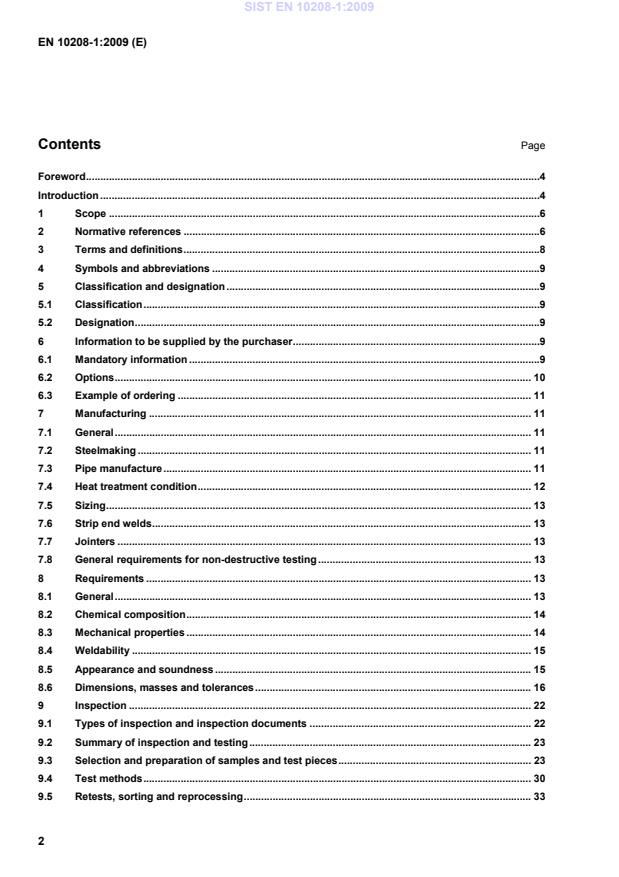
Specification of welded jointers . 36Annex B (normative)
Treatment of imperfections and defects disclosed by visual
examination . 37Annex C (normative)
Non-destructive testing . 38Bibliography . 43SIST EN 10208-1:2009
Foreword This document (EN 10208-1:2009) has been prepared by Technical Committee ECISS/TC 29 “Steel tubes and fittings for steels tubes”, the secretariat of which is held by UNI. This European Standard shall be given the status of a national standard, either by publication of an identical text or by endorsement, at the latest by September 2009, and conflicting national standards shall be with-drawn at the latest by September 2009. Attention is drawn to the possibility that some of the elements of this document may be the subject of patent rights. CEN [and/or CENELEC] shall not be held responsible for identifying any or all such patent rights. This document supersedes EN 10208-1:1997 This European Standard consists of the following parts, under the general title Steel pipes for pipelines for combustible fluids — Technical delivery conditions: Part 1: Pipes of requirement class A Part 2: Pipes of requirement class B According to the CEN/CENELEC Internal Regulations, the national standards organizations of the following countries are bound to implement this European Standard: Austria, Belgium, Bulgaria, Cyprus, Czech Repub-lic, Denmark, Estonia, Finland, France, Germany, Greece, Hungary, Iceland, Ireland, Italy, Latvia, Lithuania, Luxembourg, Malta, Netherlands, Norway, Poland, Portugal, Romania, Slovakia, Slovenia, Spain, Sweden, Switzerland and the United Kingdom. SIST EN 10208-1:2009
It was the intention, when preparing this document, to avoid specifying the quality of line pipe to be used for a particular application. However, it was recognized that there are several quality levels commonly used, and it was decided to reflect these in the standard by the differentiation between two quality levels. Firstly, the need was recognized to provide a basic quality level. This is designated requirement class A and considered in EN 10208-1. Secondly, many purchasers impose requirements additional to the basic standard, for instance concerning toughness and non-destructive inspection. This approach is common, for example, for transmission pipelines. Such enhanced requirements are addressed in requirement class B and considered in EN 10208-2. For offshore applications and other applications outside the scope of EN 10208-1 and EN 10208-2, other standards may be applicable, e.g. ISO 3183 [1]. In this Part 1 of EN 10208, no Charpy impact energy requirements are specified. The corresponding require-ments in EN 10208-2 have been derived from established data in accordance with EPRG recommendations [2], and are intended to prevent the occurrence of long running shear fracture in pipelines transporting lean, dry natural gas. It is the responsibility of the designer to decide whether these energy requirements suffice for the intended application. For example, rich gas or two-phase fluids may require additional testing to be carried out. The selection of the requirement class depends on many factors: the properties of the fluid to be conveyed, the service conditions, design code and any statutory requirements should all be taken into consideration. Therefore this document gives no detailed guidelines. It is the ultimate responsibility of the user to select the appropriate requirement class for the intended application. NOTE This document combines a wide range of product types, dimensions and technical restrictions in accordance with the functional requirements for gas supply systems referred to in EN 1594 [3]. SIST EN 10208-1:2009
tightness SIST EN 10208-1:2009
Location and preparation of samples and test pieces for mechanical testing (ISO 377:1997) EN ISO 2566-1, Steel — Conversion of elongation values — Part 1: Carbon and low alloy steels
(ISO 2566-1:1984) EN ISO 6506-1, Metallic materials — Brinell hardness test — Part 1: Test method (ISO 6506-1:2005) EN ISO 6508-1, Metallic materials — Rockwell hardness test — Part 1: Test method (scales A, B, C, D, E, F, G, H, K, N, T) (ISO 6508-1:2005) EN ISO 8492, Metallic materials — Tube — Flattening test (ISO 8492:1998) EN ISO 14284, Steel and iron — Sampling and preparation of samples for the determination of the chemical composition (ISO 14284:1996) EN ISO 15607, Specification and qualification of welding procedures for metallic materials — General rules (ISO 15607:2003) EN ISO 15609-1, Specification and qualification of welding procedures for metallic materials — Welding procedure specification — Part 1: Arc welding (ISO 15609-1:2004) ISO 19232-1, Non-destructive testing — Image quality of radiographs — Part 1: Image quality indicators (wire type) — Determination of image quality value CEN/TR 10261, Iron and steel — Review of available methods of chemical analysis SIST EN 10208-1:2009
normalizing forming
[deviating from EN 10052:1993] forming process in which the final deformation is carried out in a certain temperature range leading to a mate-rial condition equivalent to that obtained after normalizing so that the specified values of the mechanical pro-perties are retained even after normalizing
NOTE The abbreviated form of this delivery condition is N. 3.2 thermomechanical forming [as in EN 10052:1992, but supplemented]
forming process in which the final deformation is carried out in a certain temperature range leading to a mate-rial condition with certain properties which cannot be achieved or repeated by heat treatment alone NOTE 1 Subsequent heating above 580 °C may lower the strength values. NOTE 2 The abbreviated form of this delivery condition is M (in this document for special marking). NOTE 3 Thermomechanical forming leading to the delivery condition M may include processes of increased cooling rates without or with tempering including self-tempering but excluding definitively direct quenching and quenching and tempering. NOTE 4 As a consequence of lower carbon content and carbon equivalent values, material in the delivery condition M has improved weldability properties. 3.3 quenching and tempering heat treatment comprising of quench hardening followed by tempering, where quench hardening implies aus-tenitization followed by cooling, under conditions such that austenite transforms more or less completely into martensite and possibly into bainite NOTE 1 By tempering to specific temperature (< Ac1) one or more times or holding at these temperatures, followed by cooling at an appropriate rate, the properties are brought to the required level. NOTE 2 The abbreviated form of this delivery condition is Q (in this document for special marking).
3.4 cold forming (in this context) the process by which a flat product is formed into a pipe without heating of the plate or strip 3.5
cold finishing
cold working operation (normally cold drawing) with a permanent strain greater than the maximum strain of 1,5 % which differentiates it from sizing operations specified in 7.5 3.6 pipe body for seamless pipe, the entire pipe; for welded pipes, the entire pipe excluding weld(s) and heat affected zone (HAZ)
3.7 imperfection irregularity in the wall or on the pipe surfaces detectable by methods described in this document SIST EN 10208-1:2009
3.9 jointer two lengths of pipe coupled or welded together by the manufacturer 3.10 by agreement/agreed [as in EN 10266] agreement between manufacturer and purchaser at the time of enquiry and order 4 Symbols and abbreviations For symbols and abbreviations, see EN 10266:2003. NOTE 1 EN 10266 includes definitions of types of pipe and their abbreviations. NOTE 2 Symbols from EN 10266:2003 most frequently used in this document are: D
specified outside diameter; Dmin
(specified) minimum outside diameter; T
specified wall thickness; Tmin
(specified) minimum wall thickness.
5 Classification and designation
5.1 Classification The steel grades specified in this document are non-alloy quality steels in accordance with EN 10020.
5.2 Designation The specified steel grades are designated with steel names in accordance with EN 10027-1. The correspond-ing steel numbers have been allocated in accordance with EN 10027-2. 6 Information to be supplied by the purchaser 6.1 Mandatory information The purchaser shall state in his enquiry and order the following minimum information: a) quantity ordered (e.g. total tonnage or total length of pipe); b) type of pipe (seamless (S) or welded (W)); c) product form (i.e. pipe); SIST EN 10208-1:2009
columns 2 and 3); 3) party to issue the inspection document 3.2 (see 9.1.1). b) Unless otherwise agreed –left to the discretion of the manufacturer: 1) process of manufacture for welded pipe (see 7.3); 2) choice of the heat treatment condition (see 7.4); 3) choice of the welding process for jointers (see A.1); 4) radiographic inspection for the detection of longitudinal imperfections (see C.4.2 a). c) Optional agreement – options which may be agreed: 1) approval of the quality system (see 7.1); 2) manufacture of SAWL pipe with two seams (see 7.3); 3) delivery of jointers (see 7.7); 4) application of the diameter tolerance to the inside diameter (see Table 6, footnote c); 5) application of the diameter tolerance to the outside diameter (see Table 6, footnote d); 6) special bevel configuration (see 8.6.4.2); 7) threaded ends or belled ends (see 8.6.4.3); 8) offset of strip end welds (see Table 10, footnote a); 9) test piece direction (see Table 13, footnote b); 10) use of circular test pieces (see 9.3.2.2, second paragraph); SIST EN 10208-1:2009
19) use of fixed depth notches for equipment calibration (see C.4.1.1 d); 20) use of hole penetrameter instead of ISO wire penetrameter (see C.4.3.1 a); 21) use of fluoroscopic inspection (C.4.3.1 b). 6.3 Example of ordering Orders shall be preferably presented as given in the example. EXAMPLE 1 000 m welded pipe with an outside diameter of 219,1 mm, a wall thickness of 6,3 mm in a length ac-cording to random length group r2 (see Table 8), made of steel grade L235GA, with test report 2.2 in accordance with
EN 10204: 1 000 m W pipe – 219,1 x 6,3 x r2 – EN 10208-2 – L235GA –
test report EN 10204 – 2.2 7 Manufacturing 7.1 General The pipe manufacturer and the stockist, where products are supplied through a stockist, shall operate a qual-ity system. An approval of the quality system may be agreed. 7.2 Steelmaking The steel making process is left to the discretion of the manufacturer. 7.3 Pipe manufacture Acceptable types of pipe are listed together with acceptable manufacturing routes in Table 1. Unless other-wise agreed, the process of manufacture (type of pipe) for welded pipe is left to the discretion of the manufac-turer. For all types of pipe, the choice of the process route in accordance with Table 1 is left to the discretion of the manufacturer.
SAWH pipe shall be manufactured using strip with a width not less than 0,8 or more than 3,0 times the pipe outside diameter. SAWL pipe may be manufactured with two seams by agreement.
otherwise agreed, the choice of the heat treatment condition is left to the discretion of the manufacturer. Table 1 — Type of piping and manufacturing route (starting material, pipe forming
and heat treatment conditions) Type of pipe Starting material Pipe forming a
Heat treatment condition
Seamless (S)
Hot rolling
(as rolled)
Ingot or billet Normalizing or
normalizing formed Quenched and tempered
Hot rolling and cold finishing Normalized
Quenched and tempered
Electric welded (EW) Normalizing rolled strip Cold forming
b Stress relieved (weld area)b Normalized (weld area) Cold forming and cold finishing Normalized (entire pipe) Thermomechanically rolled strip Cold forming Heat treated (weld area)
Hot rolled or norma-lizing rolled strip Cold forming Normalized (entire pipe) Cold forming and hot stretch reducing under controlled tem-perature resulting in a nor-malized condition
Submerged arc-welded (SAW) – longitudinal
seam (SAWL) – helical seam
(SAWH), Combination welded (COW) – longitudinal
seam COWL) – helical seam
(COWH) Normalized or normal-izing rolled plate or strip Cold forming
Thermomechanically rolled plate or strip As rolled plate or strip Normalizing forming
Normalized or normal-izing rolled plate or strip As rolled plate or strip Cold forming
d Continuous wel-ded (BW)c Hot rolled or normali-zing rolled strip Hot forming
(as welded; normalized if necessary) a See 3.4 and 3.5. b
Steel grades L210GA, L235GA, L245GA and L290GA only. c
Steel grades L210GA and L235GA and D ≤ 114,3 mm for distribution pipelines only. d
Steel grades L210GA, L235GA and L245GA only. SIST EN 10208-1:2009
7.5 Sizing The pipes may be sized to their final dimensions by expanding or reducing. This shall not produce excessive permanent strain. Where no further heat treatment or only a heat treatment of the weld area is carried out, the sizing ratio sr
achieved by this cold working shall not exceed 0,015. It shall be calculated according to the for-mula: sr = DDDba− (1) where Da is the outside diameter after sizing; Db is the outside diameter before sizing; D is the specified outside diameter. 7.6 Strip end welds 7.6.1 For helical seam welded pipe, the strip end weld shall be located at least 200 mm from the pipe end.
7.6.2 For welded pipe with a longitudinal seam, strip end welds are not permitted in the pipe. 7.7 Jointers The delivery of jointers is permitted by agreement provided the lengths of pipe used have fulfilled the requirements of this document and the special requirements in Annex A are complied with. 7.8 General requirements for non-destructive testing All NDT activities shall be carried out by qualified and competent level 1, 2 and/or 3 personnel authorized to operate by the employer. The qualification shall be in accordance with EN 10256 or, at least, an equivalent to it. It is recommended that the level 3 personnel be certified in accordance to EN 473 or, at least an equivalent to it. The operating authorization issued by the employer shall be in accordance with a written procedure.
NDT operations shall be authorized by a level 3 NDT individual approved by the employer. NOTE The definition of level 1, 2 and 3 can be found in appropriate standards, e.g. EN 473 and EN 10256. 8 Requirements 8.1 General The requirements specified in this document apply on condition that the relevant specifications for test piece selection, test piece preparation and test methods given in 9.3 and 9.4 are complied with. NOTE Table 12 gives a survey on the tables and clauses containing requirements and specifications for testing.
b L235GA 1.0458 0,16 0,40 1,20 0,030 0,030 L245GA 1.0459 0,20 0,40 1,15 0,030 0,030 L290GA 1.0483 0,20 0,40 1,40 0,030 0,030 c L360GA 1.0499 0,22 0,55 1,45 0,030 0,030 a The steels shall be fully killed with 0,015 % ≤ Altotal < 0,060 %. b Other elements shall not be added intentionally. c V, Nb, Ti and combinations thereof may be added at the discretion of the manufacturer. The sum of these elements shall not exceed 0,15 %.
8.2.2 Product analysis The product analysis shall not deviate from the limiting values for the cast analysis as specified in Table 2 by more than the values given in Table 3. Table 3 — Permissible deviations of the product analysis from the specified limits on cast analysis given in Table 2 Element Limiting value for the cast analysis according to Table 2 % by mass Permissible deviation of the product analysis % by mass C ≤ 0,22 + 0,02 Si ≤ 0,55 + 0,05 Mn ≤ 1,45 + 0,10 P ≤ 0,030 + 0,005 S ≤ 0,030 + 0,005 Al ≥ 0,015
< 0,060 ± 0,005 V + Nb + Ti ≤ 0,15 + 0,02
8.3 Mechanical properties The pipe shall, as applicable (see Table 12, column 2), comply with the requirements given in Table 4.
NOTE In case of hot forming and/or subsequent field heat treatment of pipes delivered in the quenched and tem-pered or thermomechanically rolled condition, an adverse change of mechanical properties can occur (see for example 3.2). Where appropriate, the purchaser should contact the manufacturer for more detailed information. SIST EN 10208-1:2009
COW Yield strength Rt0,5
MPa Tensile strength Rm
MPa min. Elongation aA
% min. Tensile strength Rm
MPa min. Diameter of the mandrel for bend test b
(see 9.4.3) Hydrostatic test
(see 9.4.6) Steel name
Steel
number L210GA 1.0319 210 335 to 475 25 The same values as for the pipe body apply. 2 T Each length of pipe shall withstand the test without showing leak-age or visible deformation L235GA 1.0458 235 370 to 510
23 L245GA 1.0459 245 415 to 555 22 3 T L290GA 1.0483 290 415 to 555 21 L360GA 1.0499 360 460 to 620
20 4 T a These values apply to transverse specimens taken from the pipe body. When longitudinal specimens are tested (see Table 13),
the values of elongation shall be 2 units higher. b
T
specified wall thickness of the pipe.
8.4 Weldability In view of the processes for the manufacture of pipes and of pipe lines, the requirements for the chemical composition of the steels have been selected to insure that the steels delivered in accordance with this docu-ment are weldable.
However, account should be taken of the fact that the behaviour of the steel during and after welding is de-pendent not only on the steel, but also on the welding consumables used and on the conditions of preparing for and carrying out the welding.
8.5 Appearance and soundness 8.5.1 The pipes shall be free from defects in the finished condition. 8.5.2 The internal and external surface finish of the pipes shall be typical of the manufacturing process and the heat treatment employed. The surface condition shall be such that any surface imperfections requiring dress-ing can be identified. 8.5.3 Surface imperfections disclosed by visual inspection shall be investigated, classified and treated as follows: a) imperfections with a depth equal to or less than 12,5 % of the specified wall thickness, and which do not encroach on the specified minimum wall thickness, shall be classified as acceptable imperfections and treated in accordance with B.1; b) imperfections with a depth greater than 12,5 % of the specified wall thickness, but which do not encroach on the specified minimum wall thickness, shall be classified as defects and shall either be dressed-out by grinding in accordance with B.2 or treated in accordance with B.3 as appropriate; c) imperfections which encroach the specified minimum wall thickness shall be classified as defects and treated in accordance with B.3. SIST EN 10208-1:2009
For the measurement of flat spots and peaks, see 9.4.8.3. For dents, the length in any direction shall not ex-ceed one half of the pipe outside diameter. 8.5.5 For undercuts disclosed by visual inspection of SAW and COW pipes, the acceptance criteria given in C.4.3.2 d) to C.4.3.2 f) apply. 8.5.6 Surface imperfections may be removed, but only by grinding or machining. The tube thickness in the dressed area shall not be less than the specified minimum wall thickness. All dressed areas shall blend smoothly into the contour of the tube. 8.5.7 Any hard spot exceeding 50 mm in any direction shall have a hardness value less than 35 HRC (327 HB) (see 9.4.7). 8.5.8 The acceptance criteria for imperfections detected by non-destructive testing, as required by 9.4.10, are specified in Annex C. 8.6 Dimensions, masses and tolerances 8.6.1 Dimensions
8.6.1.1 The pipes shall be delivered to the dimensions specified in the enquiry and order, within the toler-ances given in 8.6.3 to 8.6.6.
8.6.1.2 Where appropriate, the preferred outside diameters D and wall thicknesses T given in Table 5 and selected from those in EN 10220 should be ordered. 8.6.1.3 For the length of pipes, see 8.6.3.3, and for the execution of the pipe ends, see 8.6.4. 8.6.2 Masses The mass per unit length may be calculated by the formula M = (D – T) x T x 0,0246615 kg/m (2) where M is the mass per unit length, D is the specified outside diameter in mm, T is the specified wall thickness in mm. The formula is based on density equal to 7,85 kg/dm3. SIST EN 10208-1:2009
42,4
48,3
60,3
88,9
114,3
168,3
219,1
323,9
355,6
406,4
1 016
1 067
1 118
1 168
1 219
1 321
1 422
1 524
1 626
8.6.3 Tolerances on the pipe 8.6.3.1 Diameter and out-of-roundness The outside diameters and the out-of-roundness of the pipes as defined in 9.4.8.2 shall be within the tolerance limits given in Table 6. SIST EN 10208-1:2009
Tolerance on diameter and out-of-roundness
Outside diameter D mm Diameter tolerance a Out-of-roundness a Pipe except the end Pipe end b
Pipe except the end Pipe end b,e
Seamless pipe Welded pipe Seamless pipe Welded pipe D ≤ 60 ± 0,5 mm or ± 0,75 % D
(whichever is the greater) ± 0,5 mm or ± 0,75 % D (whichever is the greater), but max.
± 3 mm ± 0,5 mm or ± 0,5 % D c
(whichever is the greater), but max. ± 1,6 mm (included in the diameter tolerance) 60 < D ≤ 610 2,0 % 1,5 % 610 < D ≤ 1 430 ± 1 % D ± 0,5 % D but max. ± 4 mm ± 2,0 mm d
± 1,6 mm d 1,5 % (but max. 15 mm) for TD ≤ 75; 2,0 % for TD > 75 1,0 % for TD ≤ 75; 1,5 % for TD > 75 D > 1 430 as agreed as agreed d as agreed d a The pipe end shall be considered to include a length of 100 mm at the pipe extremities. b For seamless pipe, the values apply for wall thicknesses T ≤ 25 mm; for greater thicknesses by agreement. c Subject to agreement, the tolerance may be applied to the inside diameter for outside diameters D > 210 mm. d Unless otherwise agreed, the diameter tolerance applies to the inside diameter. e
When the diameter tolerance is applied to the inside diameter, the inside diameter shall also be the basis for the out-of-roundness
requirements.
8.6.3.2 Wall thickness The wall thickness shall be within the tolerances given in Table 7. Table 7 — Tolerances on wall thickness Wall thickness T mm Permissible tolerance Seamless pipe a
T ≤ 4 + 0,6 mm / – 0,5 mm 4 < T < 25 + 15 % / – 12,5 % T ≥ 25 + 3,75 mm/ – 3,0 mm or ± 10 % (whichever is the greater) Welded pipe T ≤ 10 + 1,0 mm / – 0,5 mm 10 < T < 20 + 10 % / – 5 % T ≥ 20 + 2,0 mm / – 1,0 mm a For outside diameters D ≥ 355,6 mm, it is permitted to exceed the upper wall thickness
locally by further 5 % of the specified wall thickness. However, the mass tolerance in
8.6.6 applies. SIST EN 10208-1:2009
Minimum average length of order item Shortest length of order item r1 6 to 11 8 4 r2 9 to 14 11 6 r3 10 to 16 13 7 r4 11 to 18 15 8 a The upper limit applies as an absolute maximum value for the length of each individual pipe.
8.6.3.4 Straightness The total deviation from a straight line shall be ≤
0,2 % of the whole pipe length. Any local deviation in straightness shall be < 4 mm/m. 8.6.4 Finish of pipe ends 8.6.4.1 Unless otherwise agreed (see 8.6.4.3), the pipe shall be delivered with plain ends. All pipe ends shall be cut square and be free from harmful burrs.
The out-of-squareness (see Figure 1) shall not exceed: a) 1 mm for outside diameters D ≤ 220 mm; b) 0,005 D, but max. 1,6 mm, for outside diameters D > 220 mm. SIST EN 10208-1:2009
Key 1 out-of-squareness Figure 1 — Out-of-squareness 8.6.4.2 The end faces of pipes with a wall thickness greater than 3,2 mm shall be bevelled for welding. The angle of the bevel measured from a line drawn perpendicular to the axis of the pipe shall be 30° with a tolerance of 50+°. The width of the root face of the bevel shall be 1,6 mm with a tolerance of ± 0,8 mm. Other bevel preparations may be agreed. Where internal machining or grinding is carried out, the angle of the internal taper, measured from the longitu-dinal axis, shall be not greater than: a) as given in Table 9 (for seamless pipe); b) 7° (for welded pipe, outside diameter D > 114,3 mm). Table 9 — Maximum angle of internal taper for seamless pipe Specified wall thickness T mm Maximum angle of taper degrees T < 10,5 7 10,5 ≤ T < 14 9,5 14 ≤ T < 17 11 T ≥ 17 14 8.6.4.3
By agreement, the pipe may be delivered with threaded ends or with belled ends. NOTE Threaded and belled end pipes are in general only applicable for distribution pipelines and/or under less criti-cal service conditions. 8.6.5 Tolerances of the weld seam 8.6.5.1 Radial offset of plate or strip edges 8.6.5.1.1 In the case of EW pipe, the radial offset of strip edges shall not cause the remaining wall thick-ness at the weld to be less than the specified minimum wall thickness (see Figure 2a). SIST EN 10208-1:2009
Key 1 remaining wall thickness at the weld a) Radial offset of strip edges (EW pipe)
Key 1, 4
outside/inside radial offset 2, 3
outside/inside height of the weld bead b) Radial offset and height of the weld beads of plate/strip edges (SAW and COW pipe)
Key 1 misalignment c) Misalignment of the weld beads (SAW and COW pipe) Figure 2 — Possible dimensional deviations of the weld seam 8.6.5.1.2
In the case of SAW and COW pipes the maximum radial offset (see Figure 2b) of the strip/plate edges shall be as given in Table 10. Table 10 — Maximum permissible offset of SAW and COW pipes Dimensions in mm Specified wall thickness T Maximum permissible radial offset a
T ≤ 10 1,0 10 < T ≤ 20 0,1 T T > 20 2,0 a For strip and welds other requirements may be agreed. SIST EN 10208-1:2009
Table 11. Table 11 — Maximum permissible weld bead of SAW and COW pipes
Dimensions in mm Specified wall thickness T
Maximum height of the weld bead T ≤ 12,7 3 T > 12,7 4,8
8.6.5.2.3 The weld beads shall blend in smoothly with the parent metal and shall for SAW and COW pipe not come below the contour of the pipe, except that dressing out of undercuts is permitted (see C.4.3.2 d). 8.6.5.3 Misalignment of the weld beads
Any misalignment of the weld beads of SAW and COW pipes (see Figure 2c) shall not be cause for rejection provided complete penetration and complete fusion have been achieved (see C.4.3.2 a). 8.6.6 Mass tolerance The mass of any individual pipe shall not deviate from the nominal mass determined in accordance with 8.6.2 by more than + 10 % or – 3,5 %. 9 Inspection 9.1 Types of inspection and inspection documents 9.1.1 The compliance with the requirements of the order shall be checked for products in accordance with this document either by non-specific or by specific inspection. The purchaser shall specify the required type of inspection and the inspection document in accordance with EN 10204. In the case of non-specific inspection, a test report 2.2 shall be issued. In the case of specific inspection, an inspection certificate (3.1 or 3.2) shall be issued. If an inspection certificate 3.2 is specified, the purchaser shall notify the manufacturer of the name and
address of the organization or person who is to carry out the inspection and produce the inspection document. It shall also be agreed which party shall issue the certificate. SIST EN 10
...