

EN 15503:2009
(Main)Garden equipment - Garden blowers, vacuums and blower/vacuums - Safety
- Abstract
This European Standard specifies the safety requirements and their verification for the design and construction of hand-held combustion engine powered and back-pack combustion engine powered, garden vacuums and garden blower/vacuums with or without shredding means and garden blowers, designed for one operator only. In addition, it specifies the type of information on safe working practices (including residual risks) to be provided by the manufacturer.
Throughout this European Standard the term 'machine' is used to mean all the types of garden blowers and vacuums covered by it.
This European Standard deals, except for vibration of backpack machines, with all hazards, hazardous situations and events relevant to these machines when they are used as intended and under the conditions foreseen by the manufacturer (see Clause 4).
This European Standard is not applicable to:
- walk-behind, hand-guided (support-wheeled) and ride-on machines;
- mains driven and battery powered blowers and vacuums of combinations thereof;
NOTE EN 60335-1 [1] and IEC 60335-2-100 [2] give the safety requirements for mains driven blowers and blower vacuums, vacuum cleaners for household and industrial use.
- structural integrity test for blowers and blower vacuums;
- strength test for harnesses and back-pack supports.
This European Standard is not applicable to machines which are manufactured before the date of its publication as EN.
- Status
- Withdrawn
- Publication Date
- 03-Nov-2009
- Withdrawal Date
- 15-Oct-2013
- Technical Committee
- CEN/TC 144 - Tractors and machinery for agriculture and forestry
- Drafting Committee
- CEN/TC 144/WG 7 - Garden equipment
- Current Stage
- 9960 - Withdrawal effective - Withdrawal
- Start Date
- 16-Oct-2013
- Completion Date
- 16-Oct-2013
- Directive
- 2006/42/EC - Directive 2006/42/EC of the European Parliament and of the Council of 17 May 2006 on machinery, and amending Directive 95/16/EC (recast)OJ Ref: C, C 136 OJ Date: 26-May-2010

Relations
- Merged Into
EN 15503:2009+A1:2013 - Garden equipment - Garden blowers, vacuums and blower/vacuums - Safety - Effective Date
- 21-Aug-2013
- Effective Date
- 25-Aug-2026
- Effective Date
- 09-Feb-2026
- Effective Date
- 28-Jan-2026
- Effective Date
- 28-Jan-2026
- Effective Date
- 28-Jan-2026
- Effective Date
- 28-Jan-2026
- Effective Date
- 28-Jan-2026
- Effective Date
- 28-Jan-2026
- Effective Date
- 28-Jan-2026
- Effective Date
- 28-Jan-2026
- Effective Date
- 28-Jan-2026
- Effective Date
- 28-Jan-2026
- Effective Date
- 28-Jan-2026
- Effective Date
- 28-Jan-2026
Get Certified
Connect with accredited certification bodies for this standard

Control Union Certifications
Global certification for agriculture and sustainability.

ECOCERT
Organic and sustainability certification.

FSC International
Forest Stewardship Council certification.
Sponsored listings
Frequently Asked Questions
EN 15503:2009 is a standard published by the European Committee for Standardization (CEN). Its full title is "Garden equipment - Garden blowers, vacuums and blower/vacuums - Safety". This standard covers: This European Standard specifies the safety requirements and their verification for the design and construction of hand-held combustion engine powered and back-pack combustion engine powered, garden vacuums and garden blower/vacuums with or without shredding means and garden blowers, designed for one operator only. In addition, it specifies the type of information on safe working practices (including residual risks) to be provided by the manufacturer. Throughout this European Standard the term 'machine' is used to mean all the types of garden blowers and vacuums covered by it. This European Standard deals, except for vibration of backpack machines, with all hazards, hazardous situations and events relevant to these machines when they are used as intended and under the conditions foreseen by the manufacturer (see Clause 4). This European Standard is not applicable to: - walk-behind, hand-guided (support-wheeled) and ride-on machines; - mains driven and battery powered blowers and vacuums of combinations thereof; NOTE EN 60335-1 [1] and IEC 60335-2-100 [2] give the safety requirements for mains driven blowers and blower vacuums, vacuum cleaners for household and industrial use. - structural integrity test for blowers and blower vacuums; - strength test for harnesses and back-pack supports. This European Standard is not applicable to machines which are manufactured before the date of its publication as EN.
This European Standard specifies the safety requirements and their verification for the design and construction of hand-held combustion engine powered and back-pack combustion engine powered, garden vacuums and garden blower/vacuums with or without shredding means and garden blowers, designed for one operator only. In addition, it specifies the type of information on safe working practices (including residual risks) to be provided by the manufacturer. Throughout this European Standard the term 'machine' is used to mean all the types of garden blowers and vacuums covered by it. This European Standard deals, except for vibration of backpack machines, with all hazards, hazardous situations and events relevant to these machines when they are used as intended and under the conditions foreseen by the manufacturer (see Clause 4). This European Standard is not applicable to: - walk-behind, hand-guided (support-wheeled) and ride-on machines; - mains driven and battery powered blowers and vacuums of combinations thereof; NOTE EN 60335-1 [1] and IEC 60335-2-100 [2] give the safety requirements for mains driven blowers and blower vacuums, vacuum cleaners for household and industrial use. - structural integrity test for blowers and blower vacuums; - strength test for harnesses and back-pack supports. This European Standard is not applicable to machines which are manufactured before the date of its publication as EN.
EN 15503:2009 is classified under the following ICS (International Classification for Standards) categories: 65.060.70 - Horticultural equipment. The ICS classification helps identify the subject area and facilitates finding related standards.
EN 15503:2009 has the following relationships with other standards: It is inter standard links to EN 15503:2009+A1:2013, IEC 61032:1997, IEC 60068-2-75:1997, EN 14930:2007, EN ISO 3744:2009, EN ISO 13849-1:2008, EN 1088:1995, EN ISO 12100-2:2003, EN ISO 4871:2009, EN 232:2003, EN ISO 11201:2009, EN ISO 22867:2008, EN ISO 13857:2008, EN ISO 12100-1:2003, EN ISO 22868:2008. Understanding these relationships helps ensure you are using the most current and applicable version of the standard.
EN 15503:2009 is associated with the following European legislation: EU Directives/Regulations: 2006/42/EC, 98/37/EC; Standardization Mandates: M/079, M/396. When a standard is cited in the Official Journal of the European Union, products manufactured in conformity with it benefit from a presumption of conformity with the essential requirements of the corresponding EU directive or regulation.
EN 15503:2009 is available in PDF format for immediate download after purchase. The document can be added to your cart and obtained through the secure checkout process. Digital delivery ensures instant access to the complete standard document.
Standards Content (Sample)
2003-01.Slovenski inštitut za standardizacijo. Razmnoževanje celote ali delov tega standarda ni dovoljeno.Oprema za nego vrta - Vrtni pihalniki, vrtni sesalniki in vrtni pihalniki/sesalniki - VarnostGartengeräte - Blasgeräte, Sauggeräte und Blas-/Sauggeräte für den Garten - SicherheitMatériel de jardinage - Souffleurs, aspirateurs et aspirateurs-souffleurs de jardin - SécuritéGarden equipment - Garden blowers, vacuums and blower/vacuums - Safety65.060.70Vrtnarska opremaHorticultural equipmentICS:Ta slovenski standard je istoveten z:EN 15503:2009SIST EN 15503:2010en,fr,de01-julij-2010SIST EN 15503:2010SLOVENSKI
STANDARD
EUROPEAN STANDARD NORME EUROPÉENNE EUROPÄISCHE NORM
EN 15503
November 2009 ICS 65.060.70 English Version
Garden equipment - Garden blowers, vacuums and blower/vacuums - Safety
Matériel de jardinage - Souffleurs, aspirateurs et aspirateurs-souffleurs de jardin - Sécurité
Gartengeräte - Blasgeräte, Sauggeräte und Blas-/Sauggeräte für den Garten - Sicherheit This European Standard was approved by CEN on 22 September 2009.
CEN members are bound to comply with the CEN/CENELEC Internal Regulations which stipulate the conditions for giving this European Standard the status of a national standard without any alteration. Up-to-date lists and bibliographical references concerning such national standards may be obtained on application to the CEN Management Centre or to any CEN member.
This European Standard exists in three official versions (English, French, German). A version in any other language made by translation under the responsibility of a CEN member into its own language and notified to the CEN Management Centre has the same status as the official versions.
CEN members are the national standards bodies of Austria, Belgium, Bulgaria, Cyprus, Czech Republic, Denmark, Estonia, Finland, France, Germany, Greece, Hungary, Iceland, Ireland, Italy, Latvia, Lithuania, Luxembourg, Malta, Netherlands, Norway, Poland, Portugal, Romania, Slovakia, Slovenia, Spain, Sweden, Switzerland and United Kingdom.
EUROPEAN COMMITTEE FOR STANDARDIZATION
COMITÉ EUROPÉEN DE NORMALISATION EUROPÄISCHES KOMITEE FÜR NORMUNG
Management Centre:
Avenue Marnix 17,
B-1000 Brussels © 2009 CEN All rights of exploitation in any form and by any means reserved worldwide for CEN national Members. Ref. No. EN 15503:2009: ESIST EN 15503:2010
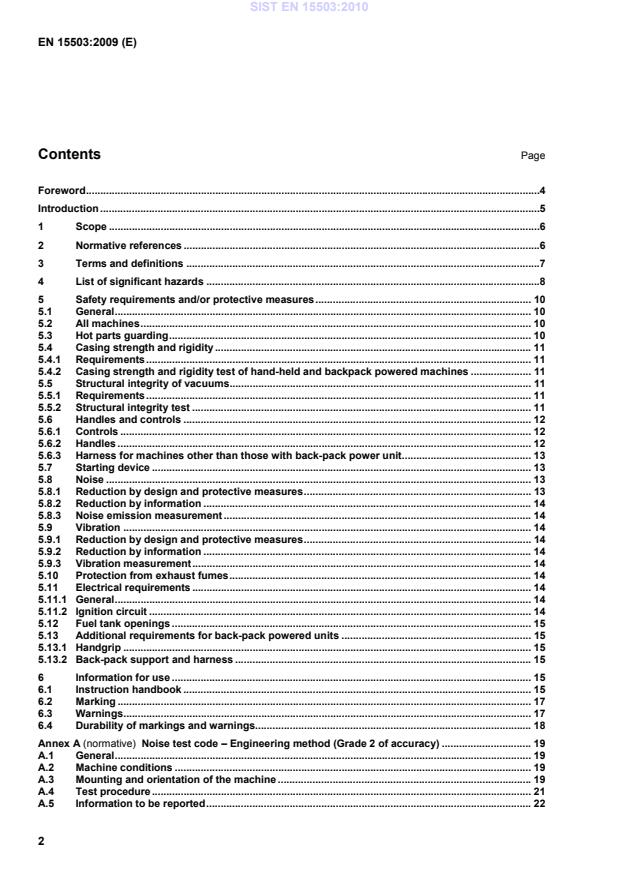
Noise test code – Engineering method (Grade 2 of accuracy) . 19A.1General . 19A.2Machine conditions . 19A.3Mounting and orientation of the machine . 19A.4Test procedure . 21A.5Information to be reported . 22SIST EN 15503:2010
Measurement of vibration values at the handles . 26B.1General . 26B.2Measurement direction and location . 26B.3Adjustment of the machine before test . 26B.4Test procedure . 27B.5Information to be reported. 27B.6Declaration and verification of vibration values . 29Annex C (informative)
Examples of safety signs General . 31Annex ZA (informative)
Relationship between this European Standard and the Essential Requirements of EU Directive 98/37/EC . 32Annex ZB (informative)
Relationship between this European Standard and the Essential Requirements of EU Directive 2006/42/EC . 33Bibliography . 34 SIST EN 15503:2010
This European Standard specifies the safety requirements and their verification for the design and construction of hand-held combustion engine powered and back-pack combustion engine powered, garden vacuums and garden blower/vacuums with or without shredding means and garden blowers, designed for one operator only. In addition, it specifies the type of information on safe working practices (including residual risks) to be provided by the manufacturer. Throughout this European Standard the term 'machine' is used to mean all the types of garden blowers and vacuums covered by it. This European Standard deals, with all hazards, hazardous situations and events relevant to these machines when they are used as intended and under the conditions foreseen by the manufacturer (see Clause 4), except for: - vibration of backpack machines; - structural integrity for blowers and blower vacuums; - strength for harnesses and back-pack supports. This European Standard is not applicable to: walk-behind, hand-guided (support-wheeled) and ride-on machines; mains driven and battery powered blowers and vacuums of combinations thereof;
NOTE EN 60335-1 [1] and IEC 60335-2-100 [2] give the safety requirements for mains driven blowers and blower vacuums, vacuum cleaners for household and industrial use. This European Standard is not applicable to machines which are manufactured before the date of its publication as EN. 2 Normative references
The following referenced documents are indispensable for the application of this European Standard. For dated references, only the edition cited applies. For undated references, the latest edition of the referenced document (including any amendments) applies. EN 1088:1995, Safety of machinery — Interlocking devices associated with guards — Principles for design and selection EN 14930:2007, Agricultural and forestry machinery and gardening equipment — Pedestrian controlled and hand-held machines — Determination of accessibility of hot surfaces EN ISO 3744:2009, Acoustics — Determination of sound power levels of noise sources using sound pressure — Engineering method in an essentially free field over a reflecting plane (ISO 3744:1994) EN ISO 4871:2009, Acoustics — Declaration and verification of noise emission values of machinery and equipment (ISO 4871:1996) EN ISO 11201:2009, Acoustics — Noise emitted by machinery and equipment — Measurement of emission sound pressure levels at a work station and at other specified positions — Engineering method in an essentially free field over a reflecting plane (ISO 11201:1995, including Cor 1:1997) EN ISO 12100-1:2003, Safety of machinery — Basic concepts, general principles for design — Part 1: Basic terminology, methodology (ISO 12100-1:2003) SIST EN 15503:2010
EN ISO 13849-1:2008, Safety of machinery — Safety-related parts of control systems — Part 1: General principles for design (ISO 13849-1:2006) EN ISO 13857:2008, Safety of machinery — Safety distances to prevent hazard zones being reached by upper and lower limbs (ISO 13857:2008) EN ISO 22867:2008, Forestry machinery — Vibration test code for portable hand-held machines with internal combustion engine — Vibration at the handles (ISO 22867:2004, including Cor 1:2006) EN ISO 22868:2008, Forestry machinery — Noise test code for portable hand-held machines with internal combustion engine — Engineering method (Grade 2 accuracy) (ISO 22868:2005) IEC 60068-2-75:1997, Environmental testing — Part 2: Tests — Test Eh: Hammer tests IEC 61032:1997, Protection of persons and equipment by enclosures — Probes for verification 3 Terms and definitions For the purposes of this document, the terms and definitions given in EN ISO 12100-1:2003 and the following apply: 3.1 garden blower machine which moves debris by the force of blasting air
3.2
back-pack powered blower garden blower designed to have the power source carried on the operator's back by means of a supporting device consisting of a frame and harness 3.3 back-pack powered vacuum garden vacuum designed to have the power source and collector carried on the operator's back by means of a supporting device 3.4 debris organic material of vegetable origin such as leaves and grass clippings 3.5 debris collector part or combination of parts of the machine designed to contain the debris 3.6 dirty fan construction construction where the debris being collected passes the air-moving fan 3.7 garden vacuum machine which collects debris into a debris collector by means of air suction 3.8
guard physical barrier, designed as part of the machine, to provide protection SIST EN 15503:2010
handle
part of the machine designed for holding or carrying the machine during normal use
3.10 hand-held garden blower garden blower designed to be held by hand, possibly assisted by a harness 3.11 hand-held garden vacuum garden vacuum held by hand, possibly assisted by a harness 3.12 normal operation use of the machine which is reasonably foreseeable, and which is consistent with operating, i.e. starting, stopping and re-fuelling 3.13 normal use normal operation, plus routine maintenance, servicing, cleaning, transporting, attaching or removing accessories, and making ordinary adjustments as determined by the manufacturer’s instructions 3.14 operator control part of the machine requiring operator actuation 3.15 shredding means means designed to cut debris into smaller pieces 3.16 throttle locking device device for temporarily arresting the throttle in a partially open position, to aid (assist) starting 3.17 throttle setting device
arrest device allowing the throttle to be temporarily fixed in and released from any required position to ease working with the machine over a period of time 4 List of significant hazards For the purposes of this European Standard, Table 1 gives, for defined danger zones, all the significant hazards, the significant hazardous situations and events covered by this European Standard, that have been identified by risk assessment as being significant for this type of machine, and which require specific action to eliminate or to reduce the risk
The attention is drawn to the necessity to verify that the safety requirements specified in this European Standard apply to each significant hazard presented by a given machine and to validate that the risk assessment is complete with particular attention to: the intended use of the machine including maintenance, setting and cleaning and its reasonably foreseeable misuse; the identification of all significant hazards associated with the machine. SIST EN 15503:2010
Ref. Nr.
Hazard Location or event Reference of this European Standard Hazards, hazardous situations and hazardous events 1 Mechanical hazards due to 1.1 Inadequacy of mechanical strength Ejection of sucked up parts or broken parts through casing Weakening casing by overheating of motor compartment 5.4, 5.5,
1. 2 Shearing, cutting, severing, entanglement, drawing-in or trapping hazard Contact with shredding means or fan 5.1, 5.6.1, 6.1, 6.2, 6.3 and Annex C 2
Electrical hazards due to: 2.1 Contact with live parts under high voltage Contact with HT ignition parts 5.11.2 3
Thermal hazards, resulting in: 3.1 Burns, scalds and other injuries by a possible contact of persons with objects or materials with an extreme high or low temperature, by flames or explosions and also by the radiation of heat sources Contact with cylinder or exhaust pipe 5.3 4
Hazards generated by noise, resulting in: 4.1 Hearing loss (deafness), other physiological disorders (e.g. loss of balance, loss of awareness) Noise emitted by the machine
5.8, 6.1, 6.2, 6.3 and Annex A Interference with speech, communication and warning signals. Operator not being aware of surrounding or not noticing important information5
Hazards generated by vibration 5.1 Use of hand-held machines resulting in a variety of neurological and vascular disorders Vibrations transmitted by the machine 5.9, 6.1 and Annex B 6 Hazards generated by materials and substances (and their constituent elements) used by the machinery 6.1 Hazards from contact with or inhalation of harmful fluids, gases, mists, fumes, and dusts Contact with fuel Inhalation of exhaust fumes 5.10 6.2 Fire or explosion hazard Fuel coming into contact with hot parts 5.11 8 7 Hazards requiring application of ergonomic principles in machinery design from: 7.1 Unhealthy postures or excessive effort Heavy and voluminous machines 5.6.3, 5.13.2 and 6.1 7.2 Inadequate consideration of hand-arm or foot-leg anatomy Handling of machine and position of handgrips 5.6.2 7.3 Neglected use of personal protective equipment Ejection of particles from the discharge opening of the machine Hot parts of the machine Noise emitted from the machine 6.1 and Annex C 7.4 Inadequate design, location or identification of manual controls Handgrips and throttle setting device 5.6.1, 6.2 SIST EN 15503:2010
Hazard Location or event Reference of this European Standard 8 Unexpected start-up, unexpected over-run/over-speed from: 8.1 Errors made by the operator (due to mismatch of machinery with human characteristics and abilities) Use of a machine without a harness 6.1 9 Break-up during operation Broken fan and/or shredding means 5.5 10 Ejected objects
Objects ejected from the discharge opening of the machine 5.5 5 Safety requirements and/or protective measures 5.1 General The machine shall comply with the safety requirements and/or protective measures of this Clause.
In addition, the machine shall be designed according to the principles of EN ISO 12100 for relevant but not significant hazards, which are not dealt with by this document (e.g. sharp edges of the machine frame). NOTE For guidance in connection with risk reduction by design, see Clause 4 of EN ISO 12100-2:2003, and for safeguarding measures, see Clause 5 of EN ISO 12100-2:2003
Parts are considered stable when conditioned in the location where testing is carried out for a period of 24 hours and the ambient temperature is maintained at not less than 15°C.
Machines shall also be marked according to 6.2 and carry warnings according to 6.3.The instruction handbook to be provided with the machine shall comply with 6.1. 5.2 All machines The infeed and discharge opening shall be guarded to prevent contact during normal operation taking into account the safety distances conforming to 4.2.4.1 and 4.2.4.3 of EN ISO 13857:2008.
All guards shall be permanently attached to the machine and shall not be detachable without the use of tools. The opening of guards shall require the use of a tool.
If regular access (see 6.1 for user maintenance) to moving parts is needed (e.g. for removing debris), guards shall be equipped with interlocks in compliance with EN 1088, which disable the drive to the relevant moving parts when accessing the moving parts. The safety-related control system of the interlocked guards shall comply with at least category 1 of EN ISO 13849-1:2008. Compliance is checked by inspection and measurement. 5.3 Hot parts guarding Any metallic surface of the machine that has a temperature of over 80 ºC, or plastic part that has a temperature of over 94 ºC, shall be considered as a hot surface. Such surfaces shall be guarded or designed so that the test acceptance in EN 14930 is met. Surface temperature and compliance shall be determined in accordance with EN 14930. The inside and the end of the exhaust pipe are not considered accessible hot parts and therefore do not have to pass the test of EN 14930. SIST EN 15503:2010
5.4.1 Requirements The casing including all detachable guards shall have adequate mechanical strength and be constructed to withstand such rough handling that may be expected in normal use. Compliance shall be checked by the test in 5.4.2. 5.4.2 Casing strength and rigidity test of hand-held and backpack powered machines The machine is rigidly supported and three blows are applied to every point of the casing that is likely to be weak with an impact energy of 1,0 J ± 0,05 J by means of the spring hammer as specified in IEC 60068-2-75:1997. To ensure that the machine is rigidly supported, it may be placed against a solid wall of brick, concrete or similar material. In that case a sheet of polyamide is tightly fixed to the wall, care being taken to ensure that there is no appreciable air gap between the sheet and the wall. The sheet shall have a Rockwell hardness of HR 100, a thickness of at least 8 mm and be sufficiently large to ensure that all parts of the machine are supported.
No parts of the guarding (casing) that are necessary for compliance with the requirements of this European Standard shall have become detached and no visible cracks shall have developed in these parts. It is not necessary for the machine to be operable after the test but, if it is operable, then immediately following this test, it shall be run at its maximum speed for 30 s and again, no parts of the machine that are necessary for safe operation shall become detached and no visible cracks shall have developed in these parts.
If there is doubt as to whether a defect has occurred by the application of the preceding blows, this defect is neglected and the group of three blows is applied to the same place on a new sample which shall then withstand the test.
If an inner cover is protected by a decorative cover, the test shall be done with the decorative cover removed Damage to the finish, small dents and small chips that do not adversely affect the function of the guard are ignored. Cracks not visible to the naked eye are ignored. 5.5 Structural integrity of vacuums
5.5.1 Requirements The machine shall have sufficient structural integrity to withstand the rigours of normal operation and break- up of the fan.
No part of the machine shall have become detached and there shall be no visible holes, tears or cracks in the enclosure surrounding moving parts or in the debris collector. Compliance shall be checked by the test in 5.5.2. 5.5.2 Structural integrity test A structural integrity test shall be carried out on all machines by vacuuming up ceramic prisms with triangular sides and a prism height of 6,5 mm ± 0,8 mm and a mass of 0,4 g ± 0,02 g (see Figure 1).
For machines the vacuum power of which is not capable of sucking up a sample prism the test does not apply. If the machine has a removable facility for shredding, the machine shall be tested with and without this facility. SIST EN 15503:2010
5.8 Noise 5.8.1 Reduction by design and protective measures The machine shall be so designed and constructed that risks resulting from the emission of airborne noise are reduced to the lowest level taking account of technical progress and the availability of means of reducing noise, in particular at source. The main sources causing noise for the machines covered are: air intake system; motor/engine cooling system; fan; vibrating surfaces; shredding means. NOTE EN ISO 11688-1 [5] gives general technical information on widely recognized technical rules and means for the design of machines of low-noise emission.
5.11.2.2 Test method The requirements shall be checked by inspection and using the test probe B of IEC 61032:1997.
Test acceptance: the test probe shall not make contact with high voltage parts of the circuit including spark plug terminals
5.12 Fuel tank openings The fuel tank opening shall be at least 20 mm diameter and the cap shall have a retainer. The design of the cap shall be such that no leakage occurs in all working positions while the machine is running and during transport. The filler opening shall be located in such a way that the filling of the tank with a funnel is not obstructed by other components. Seepage from fuel tank ventilation systems is not regarded as leakage. Compliance shall be checked by inspection and functional test. 5.13 Additional requirements for back-pack powered units 5.13.1 Handgrip The backpack unit shall be equipped with a handgrip surface or structure specifically designed for the operator's hand to allow the operator to grasp the back-pack power unit to place it on his back or take it off.
Compliance shall be checked by inspection and functional test. 5.13.2 Back-pack support and harness The harness shall be designed to prevent slipping and be adjustable so that pressure can be evenly distributed on the operator. Harnesses of backpack units shall be equipped with a quick release mechanism ensuring the unit to be released quickly from the operators in the event of emergency. The quick release mechanism shall only allow separation by deliberate action of the operator. Compliance shall be checked by inspection and by functional test. 6 Information for use 6.1 Instruction handbook Each machine shall be provided with information and instructions for normal use including warnings against particular hazards of use and instructions for operating, servicing and maintenance that comply as appropriate with 6.5 of EN ISO 12100-2:2003. The importance of reading the instruction handbook thoroughly before using the machine shall be stressed on the front of the instruction handbook.
The instructions shall include all operations that are meant to be performed by the user. The instructions shall be simple and clear such that they are suitable for unskilled users. They shall include: SIST EN 15503:2010
a warning not to operate the machine near open windows, etc.;
explanations of any safety signs affixed to the machine and a repeat of all other information except the serial number; for machines with bagging facility, instructions on attaching and detaching the bag from the machine; instruction on low-vibration and low-noise operating modes, and/or limited time of operation to prevent damage from vibration and/or damage to the ears; instruction on the choice and use of personal protection equipment (PPE); a warning indicating that these machines are extremely noisy and require the use of ear protection; the operating method to be followed in the event of accident or breakdown; if a blockage is likely to occur, the operating method to be followed so as to enable the equipment to be safely unblocked; the specifications of the spare parts to be used, when these affect the health and safety of operators; recommendation to operate the machine only at reasonable hours – not early in the morning or late at night when people might be disturbed; recommendation to use rakes and brooms to loosen debris before blowing/vacuuming; recommendation to slightly dampen surfaces in dusty conditions or use mister attachment; recommendation to use the full blower nozzle extension so the air stream can work close to the ground. The instruction handbook and the technical documentation describing the machine shall: give the A-weighted emission sound pressure level at the operator position as measured according to Annex A, where this exceeds A-weighted 70 dB; where this level does not exceed A-weighted 70 dB, this fact shall be indicated; SIST EN 15503:2010
the vibration total value to which the hand-arm system is subjected as determined according to Annex B, if it exceeds 2,5 m/s2; where the value does not exceed 2,5 m/s2, this shall be indicated; the uncertainty of measurement. NOTE 2 B.6 gives information concerning measurement uncertainties
Both for noise and vibration values shall be either those actually measured for the machinery in question or those established on the basis of measurements taken for technically comparable machinery, which is representative of the machinery to be produced. The operating conditions during measurement and the methods used for measurement, and the reference to Annex A and Annex B, respectively, of this European Standard shall be specified. NOTE 3 Information in the sales literature on noise and vibration emissions shall not contradict the information given in the information for use.
Compliance shall be checked by inspection. 6.2 Marking All machines shall be marked legibly and indelibly with the following minimum information: the business name and full address of the manufacturer and, where applicable, his authorised representative; designation of the machinery; the year of construction, that is the year in which the manufacturing process is completed; designation of series or type; serial number, if any. Controls shall have their function, direction and/or method of operation clearly identified. NOTE ISO 3767-1 [8], ISO 3767-3 [9], ISO 3767-4 [10] and ISO 3767-5 [11] give useful information on symbols.
6.3 Warnings All machines shall be marked legibly and indelibly with the following warnings by text and/or pictorials: be in one of the official languages of the country in which the machine is to be sold;
be easily legible and – if applied for warning purposes – located as close as practicable to the relevant hazard. If colours are used they shall be contrasting (i.e. black on yellow, or on red or orange if general background is yellow, but not on green or blue). If the marking is cast, embossed or stamped, colours are not required; SIST EN 15503:2010
Compliance shall be checked by inspection. 6.4 Durability of markings and warnings Marking provided for identification and directional or warning information shall: have a durable bond with the base material surface; be water resistant and designed to be permanently legible; not curl at the edges; not be affected by fuel or lubricant. Compliance shall be checked by inspection and by the following test.
Unless cast, embossed or stamped, all marking required by 6.2 and 6.3 shall be rubbed by hand for 15 s with a piece of cloth soaked in water and again for 15 s with a piece of cloth soaked in petrol.
The petroleum to be used for the test is aliphatic solvent hexane having a maximum aromatics content of 0,1% by volume, a kauri – butanol value of 29, an initial boiling point of approximately 65 ºC, a dry point of approximately 69 ºC and a specific mass of approximately 0,66 kg/l.
...