

CEN/TS 45545-2:2009
(Main)Railway applications - Fire protection on railway vehicles - Part 2: Requirements for fire behaviour of materials and components
- Abstract
This part specifies the reaction to fire performance requirements for materials and products used on railway vehicles as defined in CEN/TS 45545-1.
The operation and design categories defined in CEN/TS 45545-1 are used to establish hazard levels that are used as the basis of a classification system.
For each hazard level, this part specifies the test methods, test conditions and reaction to fire performance requirements.
It is not within the scope of this Technical Specification to describe measures that ensure the preservation of the vehicles in the event of a fire.
- Status
- Withdrawn
- Publication Date
- 27-Jan-2009
- Withdrawal Date
- 05-Mar-2013
- Technical Committee
- CEN/CLC/WG FPR - Fire protection for railway applications
- Drafting Committee
- CEN/CLC/WG FPR - Fire protection for railway applications
- Current Stage
- 9960 - Withdrawal effective - Withdrawal
- Start Date
- 06-Mar-2013
- Completion Date
- 06-Mar-2013

Relations
- Effective Date
- 12-Dec-2009
- Effective Date
- 25-Aug-2026
- Effective Date
- 25-Aug-2026
- Effective Date
- 25-Aug-2026
- Effective Date
- 25-Aug-2026
- Effective Date
- 25-Aug-2026
- Effective Date
- 25-Aug-2026
- Effective Date
- 09-Feb-2026
- Effective Date
- 09-Feb-2026
- Effective Date
- 09-Feb-2026
- Effective Date
- 09-Feb-2026
- Effective Date
- 09-Feb-2026
- Effective Date
- 09-Feb-2026
- Effective Date
- 28-Jan-2026
- Refers
EN ISO 1182:2020 - Reaction to fire tests for products - Non-combustibility test (ISO 1182:2020) - Effective Date
- 28-Jan-2026
Get Certified
Connect with accredited certification bodies for this standard

IRIS Certification (UNIFE)
International Railway Industry Standard certification.

TÜV SÜD Rail GmbH
TÜV SÜD railway certification services.

Bureau Veritas Railway Certification
Railway and transportation certification.
Sponsored listings
Frequently Asked Questions
CEN/TS 45545-2:2009 is a draft published by the European Committee for Standardization (CEN). Its full title is "Railway applications - Fire protection on railway vehicles - Part 2: Requirements for fire behaviour of materials and components". This standard covers: This part specifies the reaction to fire performance requirements for materials and products used on railway vehicles as defined in CEN/TS 45545-1. The operation and design categories defined in CEN/TS 45545-1 are used to establish hazard levels that are used as the basis of a classification system. For each hazard level, this part specifies the test methods, test conditions and reaction to fire performance requirements. It is not within the scope of this Technical Specification to describe measures that ensure the preservation of the vehicles in the event of a fire.
This part specifies the reaction to fire performance requirements for materials and products used on railway vehicles as defined in CEN/TS 45545-1. The operation and design categories defined in CEN/TS 45545-1 are used to establish hazard levels that are used as the basis of a classification system. For each hazard level, this part specifies the test methods, test conditions and reaction to fire performance requirements. It is not within the scope of this Technical Specification to describe measures that ensure the preservation of the vehicles in the event of a fire.
CEN/TS 45545-2:2009 is classified under the following ICS (International Classification for Standards) categories: 45.060.01 - Railway rolling stock in general. The ICS classification helps identify the subject area and facilitates finding related standards.
CEN/TS 45545-2:2009 has the following relationships with other standards: It is inter standard links to EN 45545-2:2013, ISO 5658-2:2006, ISO 5660-1:2002, IEC TS 60695-1-40:2002, ISO/TR 9705-2:2001, ISO 19702:2006, ISO 11054:2006, EN 61034-1:2005, EN IEC 60332-3-24:2018, EN 60332-1-2:2004, EN 50305:2002, EN 61034-2:2005, EN 60584-1:2013, EN ISO 12952-2:1998, EN ISO 1182:2020. Understanding these relationships helps ensure you are using the most current and applicable version of the standard.
CEN/TS 45545-2:2009 is associated with the following European legislation: EU Directives/Regulations: 2008/57/EC, 93/38/EEC, 96/48/EC; Standardization Mandates: M/024, M/275. When a standard is cited in the Official Journal of the European Union, products manufactured in conformity with it benefit from a presumption of conformity with the essential requirements of the corresponding EU directive or regulation.
CEN/TS 45545-2:2009 is available in PDF format for immediate download after purchase. The document can be added to your cart and obtained through the secure checkout process. Digital delivery ensures instant access to the complete standard document.
Standards Content (Sample)
SLOVENSKI OSIST prEN 45545-2:2005
PREDSTANDARD
januar 2005
Železniške naprave – Požarna zaščita na železniških vozilih – 2. del: Zahteve
za obnašanje materialov in sestavnih delov v požaru
(istoveten prEN 45545-2:2004)
Railway applications - Fire protection on railway vehicles - Part 2: Requirements for
fire behaviour of materials and components
ICS 13.220.20; 45.060.01 Referenčna številka
© Standard je založil in izdal Slovenski inštitut za standardizacijo. Razmnoževanje ali kopiranje celote ali delov tega dokumenta ni dovoljeno
DRAFT
EUROPEAN STANDARD
prEN 45545-2
NORME EUROPÉENNE
EUROPÄISCHE NORM
September 2004
ICS
English version
Railway applications - Fire protection on railway vehicles - Part
2: Requirements for fire behaviour of materials and components
Applications ferroviaires - Protection contre les incendies Bahnanwendungen - Brandschutz in Schienenfahrzeugen -
dans les véhicules ferroviaires - Partie 2 : Exigences du Teil 2: Anforderungen an das Brandverhalten
comportement au feu des matériaux et des composants
This draft European Standard is submitted to CEN and CENELEC members for enquiry. It has been drawn up by the Technical Committee
CEN/CLC/WG FPR.
If this draft becomes a European Standard, CEN and CENELEC members are bound to comply with the CEN/CENELEC Internal
Regulations which stipulate the conditions for giving this European Standard the status of a national standard without any alteration.
This draft European Standard was established by CEN and CENELEC in three official versions (English, French, German). A version in
any other language made by translation under the responsibility of a CEN or CENELEC member into its own language and notified to the
CEN Management Centre has the same status as the official versions.
CEN and CENELEC members are the national standards bodies and national electrotechnical committees, respectively, of Austria,
Belgium, Cyprus, Czech Republic, Denmark, Estonia, Finland, France, Germany, Greece, Hungary, Iceland, Ireland, Italy, Latvia,
Lithuania, Luxembourg, Malta, Netherlands, Norway, Poland, Portugal, Slovakia, Slovenia, Spain, Sweden, Switzerland and United
Kingdom.
Warning : This document is not a European Standard. It is distributed for review and comments. It is subject to change without notice and
shall not be referred to as a European Standard.
CEN Management Centre: CENELEC Central Secretariat:
rue de Stassart, 36 B-1050 Brussels rue de Stassart, 35 B-1050 Brussels
© 2004 CEN/CENELEC All rights of exploitation in any form and by any means reserved Ref. No. prEN 45545-2:2004 E
worldwide for CEN national Members and for CENELEC
Members.
prEN 45545-2:2004 (E)
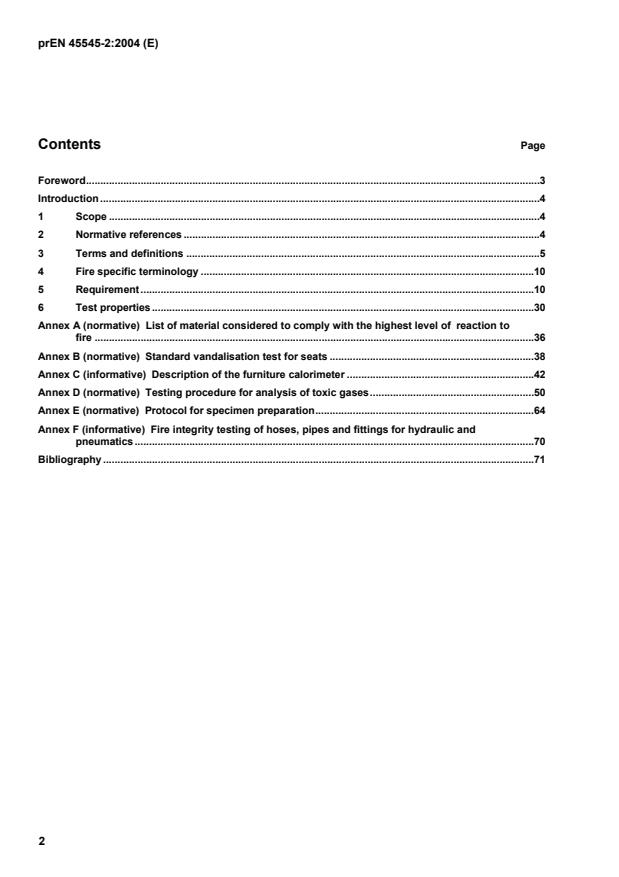
Contents Page
Foreword.3
Introduction .4
1 Scope .4
2 Normative references .4
3 Terms and definitions .5
4 Fire specific terminology .10
5 Requirement.10
6 Test properties.30
Annex A (normative) List of material considered to comply with the highest level of reaction to
fire .36
Annex B (normative) Standard vandalisation test for seats .38
Annex C (informative) Description of the furniture calorimeter .42
Annex D (normative) Testing procedure for analysis of toxic gases.50
Annex E (normative) Protocol for specimen preparation.64
Annex F (informative) Fire integrity testing of hoses, pipes and fittings for hydraulic and
pneumatics .70
Bibliography .71
prEN 45545-2:2004 (E)
Foreword
This document (prEN 45545-2:2004) has been prepared by Technical Committee CEN/TC 256 “Railway
applications”, the Secretariat of which is held by DIN, in cooperation with CENELEC/TC 9X “Electrical and
electronic applications for railways".
This document is currently submitted to the parallel CEN/CENELEC Enquiry.
This document has been prepared under a mandate given to CEN by the European Commission and the
European Free Trade Association, and supports essential requirements of EU Directive(s).
Council Directive 96/48/EC of 23 July 1996 on the Interoperability of the trans-European high-speed rail
1)
system
CEN/TC 256/WG 1 and CENELEC/TC 9X / WG 3 started in 1991 with the elaboration of this European
Standard. The co-ordination with other fire safety standardisation within CEN and CENELEC was carried out
by CEN/BT/WG 50, Fire safety technology.
This series of European Standards EN 45545 “Railway applications — Fire protection on railway vehicles”
consists of the following parts:
Part 1: General
Part 2: Requirements for fire behaviour of materials and components
Part 3: Fire resistance requirements for fire barriers and partitions
Part 4: Fire safety requirements for railway rolling stock design
Part 5: Fire safety requirements for electrical equipment including that of trolley buses, track guided
buses and magnetic levitation vehicles
Part 6: Fire control and management systems
Part 7: Fire safety requirements for flammable liquid and flammable gas installations
1)
Official Journal of the European Communities No L 235/6 of 17.09.96
prEN 45545-2:2004 (E)
Introduction
This European Standard is based on existing fire safety regulations for railway vehicles from the International
Union of Railways (UIC) and different European countries.
In using the operation and design categories defined in prEN 45545-1, the requirements laid down in this part
take into account the current operating conditions for European public rail transport.
1 Scope
This part of EN 45545 specifies the reaction to fire performance requirements for materials and products used
on railway vehicles as defined in prEN 45545-1.
2 Normative references
The following referenced documents are indispensable for the application of this document. For dated
references, only the edition cited applies. For undated references, the latest edition of the referenced
document (including any amendments) applies.
EN 13501-1, Fire classification of construction products and building elements — Part 1: Classification using
test data from reaction to fire tests.
prEN 45545-1, Railway applications — Fire protection of railway vehicles — Part 1: General.
prEN 45545-3:1998, Railway applications — Fire protection of railway vehicles — Part 3: Fire resistance
requirements for fire barriers and partitions.
prEN 45545-5:2003, Railway applications — Fire protection of railway vehicles — Part 5: Fire safety
requirements for electrical equipment including that of trolley buses, track guided buses and magnetic
levitation vehicles.
prEN 45545-6, Railway applications — Fire protection of railway vehicles — Part 6: Fire control and
management systems.
EN 50266-1, Common test methods for cables under fire conditions — Test for vertical flame spread of
vertically-mounted bunched wires or cables — Part 1: Apparatus.
EN 50266-2-4, Common test methods for cables under fire conditions — Test for vertical flame spread of
vertically-mounted bunched wires or cables — Part 2-4: Procedures; Category C.
EN 50268-1, Common test methods for cable under fire conditions — Measurement of smoke density of
cables burning under defined conditions — Part 1: Apparatus.
EN 50268-2, Common test methods for cables under fire conditions — Measurement of smoke density of
cables burning under defined conditions — Part 2: Procedure.
EN 60529, Degrees of protection provided by enclosures (IP code) (IEC 60529:1989).
EN ISO 4589-2, Plastics — Determination of burning behaviour by oxygen index — Part 2: Ambient-
temperature test (ISO 4589-2:1996).
prEN 45545-2:2004 (E)
EN ISO 5659-2, Plastics — Smoke generation — Part 2: Determination of optical density by a single-chamber
test (ISO 5659-2:1994, including Technical Corrigendum 1:1997
EN ISO 9239-1, Reaction to fire tests for floorings — Part 1: Determination of the burning behaviour using a
radiant heat source (ISO 9239-1:2002
EN ISO 11925-2, Reaction to fire tests — Ignitability of building products subjected to direct impingement of
flame — Part 2: Single-flame source test (ISO 11925-2:2002).
EN ISO 12952-3, Textiles — Burning behaviour of bedding items — Part 3: General test methods for the
ignitability by a small open flame (ISO 12952-3:1998).
EN ISO 12952-4, Textiles — Burning behaviour of bedding items — Part 4: Specific test methods for the
ignitability by a small open flame (ISO 12952-4:1998).
EN ISO 13943, Fire safety — Vocabulary (ISO 13943:1999).
ISO 3261, Fire tests; Vocabulary Bilingual edition.
ISO 5660-1, Reaction-to-fire tests — Heat release, smoke production and mass loss rate — Part 1: Heat
release rate (cone calorimeter method).
ISO 5658-2, Reaction to fire tests — Spread of flame — Part 2: Lateral spread on building products in vertical
configuration.
ISO 8421-1, Fire protection; Vocabulary; Part 1: General terms and phenomena of fire Bilingual edition.
ISO 9705, Fire tests; full-scale room test for surface products.
ISO 15540, Ships and marine technology — Fire resistance of hose assemblies — Test methods.
ISO/TR 9705-2, Reaction-to-fire tests — Full-scale room tests for surface products — Part 2: Technical
background and guidance
ISO/DIS 19702, Analysis of fire gases using Fourier infra-red technique (FTIR).
IEC/TS 60695-1-40, Fire hazard testing — Part 1-40 : Guidance for assessing the fire hazard for
electrotechnical materials — Insulating liquids.
NF F 00-201, Railway material in general — Antivandalism protection — Test method of laceration resistance,
with a blade, of vandal-proof covering.
NF X 70-100-1:2001 Fire tests — Analysis of gaseos effluents — Part 1: Methods for analysing gases
stemming from thermal degradation.
3 Terms and definitions
3.1 Definition of parameters
3.1.1
Average Rate of Heat Emission (ARHE) and its Maximum (MARHE)
the Average Rate of Heat Emission at time t, ARHE(t), is defined as the cumulative heat emission in the
period t=0 to t=t divided by t. The maximum value of the ARHE curve in the period t=0 to t=t is defined as
end
the Maximum Average Rate of Heat Emission (MARHE). MARHE can be applied to data in the form of kW vs
-2
time or kWm vs time
ARHE can be generated as follows :
prEN 45545-2:2004 (E)
Given that the rate of heat emission data comprises pairs of data points where the first data point is (t ,p )
1 1
where t is the time and p is the rate of heat emission then ARHE(t ), (using a trapezoidal area assumption), is
n
given by :
n
(p + p )
n n-1
(t − t )×
∑
n n-1
2
ARHE(t ) =
n
t − t
n 1
(Generally t =0 and p =0, or at least t can be rescaled to meet this condition and the expression can be further
1 1
simplified).
This formula is derived from expressions for the heat for each time element and the summation of these
elements as follows:
The heat for each time element, (h ), is calculated (the first heat element is derived from data points 1 and 2
n
and is assigned to data point 2; its designation is therefore h )
(p + p )
n n-1
h = (t − t ) ×
n n n −1
Summing these elements from n=2 to n=n and dividing by the interval from t to t generates ARHE(t ).
1 n n
n
h
∑ n
ARHE(t ) =
n
t − t
n 1
3.1.2
Specific optical density – D (n)
s
this term is defined in EN ISO 5659-2. D is the specific optical density,
s
(n indicates “at time n min into the test”)
The physical meaning of D is the optical density developed across opposite faces of a 1m cube when the
s
smoke from 1m of material is dispersed within the 1m cube. D is dimensionless.
s
3.1.3
VOF4 (Valeur obscurcissement fumée in 4 min)
VOF4 is the area under the Ds vs. time curve during the test period t=0 to t=4, using a trapezoidal area
assumption and a finite element (t) of 1 min
n=3
t(D (n) + D (n +1))
s s
VOF4 =
∑
n=0
With D (0)=0 and t=1 this simplifies to:
s
VOF4 = D (1) + D (2) + D (3) + D (4)/2
s s s s
VOF4 has dimensions of min.
3.1.4
Toxic measurement
Toxic fume requirements are defined in term of the Conventional Index of Toxicity (CIT). CIT has a specific
meaning for specific materials/items but in all cases CIT comprises two terms:
CIT = [Precursor Term] x [Summation Term]
prEN 45545-2:2004 (E)
CIT is always dimensionless and the Summation Term is generally produced from ratios of the emission level
to the reference level of the gas components. For the scope of this European Standard the following 8 gas
)
components shall be analysed : CO ; CO; HF; HCL; HBr; HCN; S O ;NO .
2 2
It may be assumed that the units of the Precursor Term are such as to generate a dimensionless CIT.
CIT – General (CIT)
The CIT is defined as follows:
i=8
c
i
CIT = 0.0805 ×
∑
Ci
i=1
th -3
c = concentration of the I gas in the chamber (mgm ).
i
th -3
C = reference concentration 2 of the I gas (mgm ).
i
CIT – Non-Listed Items (CIT )
NLI
For non listed items there are two options for the determination.
Option 1 utilises the EN ISO 5659-2 chamber, option 2 utilises the NF X70-100-1 tube furnace
Option 1
The CIT measured with the smoke box is defined as follows:
NLI
i=8
362 c
i
CIT = ×
NLI ∑
W C
i=1
i
th -3
c = concentration of the I gas in the chamber (mgm ).
i
th -3
C = reference concentration 2 of the I gas (mgm ).
i
W = mass of 1m of the material at 3mm thickness (g)
Option 2
The CIT measured with the tube furnace according to NF X70-100-1 with 8 gases is defined as follows :
NLI
i=8
c
i
CIT = 3×
NLI ∑
C
i=1
i
th -1
c = measured emission of the I gas for (mgg ).
i
th -3
C = reference concentration of the I gas (mgm ).
i
CIT – Cable (CIT )
C
For a single combustible component within a cable, i.e. material (j) the contribution to CIT shall be calculated
C
as follows. The calculation shall be carried out for each combustible component and the individual
contributions summed to give the final CIT .
C
)
NO includes both NO and NO quoted as NO
2 2 2
prEN 45545-2:2004 (E)
For material 1:
i=8
0.75 × w(j) c (j)
i
CIT (j) = ×
C ∑
d C
i=1
i
th -1
ci (j) = measured emission of the I gas for combustible material 1 (mgg ).
th -3
C = reference concentration of the I gas (mgm ).
i
W(j) = mass of combustible material (j) per metre of cable (g)
d = cable diameter (mm)
The calculation shall be carried out for each combustible component (materials j = 1 to N) the invidual
contributions summed to give the final CIT
C
j=N
CIT = CIT (j)
C ∑ C
j=1
The reference concentrations C of the gas components in Table 1 shall be used.
i
Table 1 — Reference concentration of the gas components
Gas Reference
components concentration
-3
mgm
CO 72000
CO 1380
HF 25
HCl 75
HBr 99
HCN 55
NO 38
SO 262
NO includes both NO and NO quoted as NO
2 2 2
-3
Both NO and NO shall be measured. The mgm of NO shall be multiplied by 46/30 to produce the equivalent
-3
mgm of NO . The total NO is given by the sum of the two values.
2 2
3.2 Explanation of expressions
Expressions used in this European Standard are explained on Table 2.
For fire terms and definitions used in this European Standard, see EN ISO 13943.
The numbers indicated in column “references” refer to clauses within this European Standard.
prEN 45545-2:2004 (E)
Table 2 — Table of expressions
Expressions Explanation References
Armrest An element which may function as a support for a seated person’s 5.3.4
arm but which may also be part of a seat which defines the width
of a seat place. For testing purposes an armrest shall be
considered to be formed from four surfaces including their
substrates. Not all surfaces will be present for all types of armrest.
Coating Product applied as liquid or powder to a substrate which will cure or
dry into a continuous surface to the substrate.
Composite A combination of materials which are recognised in building
construction as discrete entities, for example, coated, faced or
laminated materials.
Exterior of the body shell If the path taken by the fire effluent to reach a passenger or staff
area uses only space outside of the physical envelope of the
vehicle, then the item or surface is exterior else the item or surface
is interior.
A gangway area between fire resisting vehicle ends is defined as
an exterior area
Homogeneous product a product, consisting of a single material, having uniform density
and composition throughout the product
Listed item Product included in the Table 3 4.2.2
Non listed item Any item which is not listed in Table 3 4.2.3
Material Single basic substance or uniformly dispersed mixture e.g. metal,
stone, timber, concrete, mineral wool with uniformly dispersed
binder, polymers.
Non-homogeneous A product that does not satisfy the requirements of a homogeneous
product product.
Product The material, composite or assembly about which information is
required.
Limited Surfaces For a listed item which is permitted to be a limited surface to be
classified as a limited surface:
The area shall be less than 0,25 m
and : On a ceiling:
- the maximum dimension in any direction on the surface shall be
less than 1m
and
- the separation from another limited surface shall be greater than
the maximum extent of the surface (measured horizontally in any
direction on the surface)
Or : On a wall:
- the maximum dimension in a vertical direction shall be less
than 1 m
and
- the separation from another limited surface shall be greater than
the maximum extent of the surface (measured vertically)
The total area of all limited surfaces on walls and ceilings
(including windows and transverse partitions) within each
passenger or staff compartment and each passenger or staff area,
shall be less than 15 % of the total surface area of these walls and
ceilings.
prEN 45545-2:2004 (E)
Table 2 (continued)
Expressions Explanation References
Specimen A specimen is a representative sample of the thing which is tested.
Substrate A material or materials which are used immediately beneath the
product.
Cable containment Cable containment placed in assemblies or equipment rooms.
(linear products), limited (considered to be a Non Listed item)
4 Fire specific terminology
For the purposes of this European Standard, the following terms and definitions given in EN ISO 13943,
ISO 3261 and ISO 8421-1 apply.
5 Requirement
5.1 Essential
The design of rolling stock and the materials used shall be aimed at limiting fire development should an
ignition event occur.
According to different operation conditions, sizes of passenger areas and probable ignition sources, it shall be
possible for passengers and staff to leave any area impacted by the products of fire unaided and to reach a
place safety.
If it can be shown in agreement with the responsible certification body that any of the requirements specified
are not technically achievable with functionally suitable materials, then it is acceptable to use "best available"
products until and unless a suitable compliant material is developed.
5.2 Items requiring testing
5.2.1 General
There are two kinds of items defined:
The "listed items" (requirements on 5.2.2)
The "non-listed items" . (requirements on 5.2.3)
Both kinds of items shall be tested for their reaction to fire performance.
The principles on 5.2.3 apply to non listed items
The following principles applies to both kinds of items :
The materials listed in Annex A are considered to comply with the highest level of reaction to fire
performance within this part by definition.
Items placed in technical cabinets, which are fitted with an automatic fire detection and fire extinguishing
system, as defined in prEN 45545-6, may fulfil only the HL1 requirements, irrespectively of the hazard
level of the vehicle / train.
The failure rate of the Automatic detection and extinguishing system to detect and respond to fire shall
-6
not be less or equal than 10 .
prEN 45545-2:2004 (E)
Machine compartments of vehicles, and any installations and equipment in this machine compartment,
which are separated by at least a A1-15 fire barrier according to prEN 45545-3 from the cab or passenger
areas, shall be treated as exterior applications.
Mechanical or electric items, which are contained in an sealed, fire resisting enclosure may fulfil reduced
requirements due to oxygen consumption or restriction according to the following rules:
No requirements with a defined sealing quality of IP 54 according to EN 60529.
and
if the enclosure is made by a A2-5 fire barrier and the enclosed volume is ≤ 1 m
or
if the enclosure is made by a A2-10 fire barrier and the enclosed volume is ≤ 2 m
or if the enclosure is made by a A1-30 fire barrier
NOTE Fire barriers A1 and A2 according to prEN 45545-3, but with 5, 10 or 30 min of fire resistance.
For new build products the paints interior and exterior shall be tested in end use condition.
To reduce testing effort, qualifying one colour is sufficient.
Other colours of this paint system are qualified, without further testing
5.2.2 Requirement of listed items
The set of material requirements are listed in 5.3 and the short name of the set of material requirements is
visible on the column "Requirement" on each listed item.
The column "Remarks" shows relationships to special requirements e.g. sample preparation , fire resistance.
Table 3 — Requirements of listed items
Item No Name Description Require- Remark
ment
IN Interiors
IN1 Interior components – horizontal Interior components (structure and R1
downward facing surface; coverings) such as ceiling panelling as also
horizontal upwards facing; flaps, boxes, hoods, louvers, and the body
surfaces within cavities, shell in this area.
walls – vertical surfaces
Interior components (structure and
covering) such as side walls, front walls /
end-walls, partitions, room dividers, as also
flaps, boxes, hoods, louvers, in this area,
interior doors, interior lining of the front-
/end-wall doors and external doors, luggage
area, windows (plastics, glazing with foils)
also body shell in this area; kitchen interiors
surfaces (except those of kitchen
equipment)
IN2 Limited Surface All listed items, which meet the R2
requirements according to Table 2 column
“limited surface “
Exception :
A limited surface with an area less
than 0,1 m may optionally be tested
against R25 alternatively
prEN 45545-2:2004 (E)
Table 3 (continued)
Item No Name Description Require- Remark
ment
IN Interiors
IN3 Interior lighting Lighting diffuser, light covering, covering for R1
lamps (lamps itself and signal lamps are not
within the scope)
IN4 Luggage rack Overhead luggage racks, vertical luggage R1
racks, luggage lockers
IN5 Driver’s desk Panelling and surfaces of the driver’s desk. R1
IN6A Interior surfaces of gangways Interior side of gangway membrane(below), R1
interior lining of the gangway, (except
flooring of the gangway) if there is no fire
Type A
barrier at both bulk-head sides of the
gangway
IN6B Interior surfaces of gangways Interior side of gangway membrane(below), R6
interior lining of the gangway,(except
flooring of the gangway), if there is a fire
Type B
barrier at both bulk-head sides of the
gangway
IN 7 Window frame Window frame R1
IN 8 Curtains and sunblind in Curtains and sunblind except where R3
passenger and enclosed within a double glassed window
staff areas, staff compartments
IN10 A Tables, folding tables top, Upward surface of the tables or toilet wash R2
including toilet wash basins basins and surrounds .
IN10 B Tables, folding tables downward Bottom surface of a table, the exposed R1
facing surface vertical sides of drop down tables or any
surface of a folding table that may become a
bottom surface
IN 11 Container interior Water container, air container. R2
IN12 A Sound and thermal insulation R1
material in wall and ceiling
areas.
IN12 B Sound and thermal insulation R2
material in floor areas.
IN13 A Interior surface of air ducts Which are connected to the interior of the R1
vehicle.
IN14 B Exterior surface of air ducts Which are interior installed to the vehicle R1
IN15 Air filter materials Air filter materials for equipment ventilation R4
heating and air conditioning
prEN 45545-2:2004 (E)
Table 3 (continued)
Item No Name Description Require- Remark
ment
IN Interiors
IN16 Devices for passenger info Devices for passenger info R1
This item can be a IN 2 requirements
IN17 Floor composite Includes the floor substrate and floor R9
covering in end use condition
EX Exterior located
EX 1 External body shell, walls Vertical parts of external structure of body R6
shell, cab housing and door leafs
(including paint/coating systems, films)
EX 2 External body shell, roof External roof structure of the car body R7
(including paint/coating systems, films)
EX 3 External body shell, underframe External surfaces of underframe structure of R6
the body shell (floor) including paint and
coating systems (thermal, design and
acoustic coating) and protective floor
panelling
EX 4 Exterior ducts Exterior surface and interior surface of ducts R6
which are not connected to the interior of
the vehicle
EX 5 External design features External design features (e.g. streamlining R6
parts, ventilation grills, flaps, skirts,
coverings for HVAC systems, enclosures,
etc.)
EX 6A Container exterior Water container, air container placed in the R6
underframe.
EX 6B Container exterior Water container, air container placed on the R7
roof.
EX 7 Outer membrane of R6
intercommunication gangways
EX 8 Bogie parts , structural Bogie frames; spring leaf guide R6
EX 9 Air bags for pneumatic Air bags for pneumatic suspension R8
suspension
EX 11 Parts of the drive Wheel sets , brake disc R8
EX12 Tyres R6
prEN 45545-2:2004 (E)
Table 3 (continued)
Item No Name Description Require- Remark
ment
F Furniture
F1 Complete passenger seat Complete passenger seat including arm R17 Extent of
and head rests, separate pillows, tip up vandalisatio
seats and driver seat accessible to the n
passenger see Annex
B
F2A Driver’s seat Driver’s seat upholstery R18
F2B Driver’s seat Driver’s seat Back and Base shell R19 Fire
integrity
5.2.1
F3 Mattresses Mattresses R21
F4 Upholstery for seats and head Upholstery for seats and head rest R21
rest
F5 Bed clothes for couchettes and Bed clothes for couchettes and beds R20
beds (blanket, duvets, pillows, (blanket, duvets, pillows)
sleeping bags and sheets)
F6A Armrest – Upwards Facing Armrest – Surface on which the arm rests R22
Surface
F6B Armrest – Vertical Surface Armrest – Inside surface (or outside surface R23 Fire
on transverse seating) which is against the integrity
body of the seat occupant 5.2.1
F6C Armrest – Downwards Facing Armrest – Underside surface of the arm rest R23 Fire
Surface integrity
5.2.1
F7A Back shell; base shell of Back shell; base shell of passenger seats R19 Fire
passenger seats integrity
5.2.1
F7B Underside surface of couchettes Underside surface of couchettes and beds R1 Fire
and beds integrity
5.2.1
E Electrotechnical Equipment
E1A Cables for interior R14
E1B Cables for exterior R15
E2A Cable containment Cable containment surface related (cable R1
(linear product) for interior duct, cable conduit)
E2B Cable containment Cable containment surface related (cable R6
(linear product) for exterior duct, cable conduit)
prEN 45545-2:2004 (E)
Table 3 (continued)
Item No Name Description Require- Remark
ment
E3 Enclosures Enclosure for electrical equipment R1
E4A Arc resistant insulation materials Arc resistant insulation material ; R10
Type A Arc barrier type A
see definition prEN 45545- 5, 3.1.1
E4B Arc resistant insulation materials Arc resistant insulation material; R11
Type B Arc barrier type B
see definition prEN 45545-5, 3.1.2
E4C Arc splash barrier materials Arc splash barrier R6
see definition prEN 45545-5, 3.2
E5 Flammable insulation liquid Flammable insulation liquid R13
E6 Supply line system devices Surge arrester; Isolators; switches; R26
exterior Main circuit breakers.
E7A Supply line system and high Isolators; current and voltage transformers, R25
power devices. Main circuit breakers;
supposed as interior Contactors
E7B Supply line system and high Isolators; current and voltage transformers, R26
power devices. Main circuit breakers;
supposed as exterior Contactors
E8A Choke and coils Chokes for supply line filtering, coils for air R25
supposed as interior cooled transformers, including spacers and
air guiding plates
E8B Choke and coils Chokes for supply line filtering, coils for air R26
supposed as exterior cooled transformers, including spacers and
air guiding plates and traction motor
winding insulation
E9 Brake resistors Brake resistor air cooled R12
M Mechanical Equipment
M2 Flexible metal/rubber units Flexible metal/rubber units including R8
elements in bogies
5.2.3 Requirement of “Non listed” items
5.2.3.1 Principle of non listed item
All items not listed in column “listed items” in Table 3 are intended having the requirement according to the
“non listed items”.
There are several possibilities to comply for non listed items:
The principles on 5.2.1.
prEN 45545-2:2004 (E)
The exposed area presented by the non listed item shall be less than 0,25 m , if non compliant to this
area restriction higher requirements are requested.
Table 4 — Requirements of non listed items according to the exposed area and location in the vehicle
Exposed Area Location Requirement
> 0,25 m² interior R 1
> 0,25 m² exterior R 6
≤ 0,25 m² interior R 25
exterior R 26
≤ 0,25 m²
The set of requirements R1, R6, R25, R26 are according to Table 6.
Is the exposed area of a non listed item less than 0,25 m and the non listed items have no compliance
according to 5.2.1, then the non listed item is compliant if:
they stay within the mass and area limits according to 5.2.3.2;
the stay with the allowable mass scheme according to 5.2.3.3.
The Figure 1 shows the process flow for compliance for non listed items.
prEN 45545-2:2004 (E)
Figure 1 — Process flow for compliance principles for non listed items
5.2.3.2 Non compliance to LOI requirements, mass and area limits
5.2.3.2.1 Interior located non listed items
An interior non listed item which fails to meet the LOI requirement shall be compliant if, after application of the
Flammability Grouping Rules, it meets either the mass or area requirement (or both).
prEN 45545-2:2004 (E)
Mass requirement:
The mass shall be < 100 g.
Area requirement:
The total exposed surface area of the grouped non listed items shall be less than < 0,1 m and for downward
facing or vertical surfaces, the exposed area per metre shall be < 0,05 m measured in any direction on a
downward facing surface and vertically on a vertical surface.
5.2.3.2.2 Exterior located non listed items
An exterior non listed item which fails to meet the LOI requirement shall be compliant if, after application of the
Flammability Grouping Rules it meets either the mass or area requirement (or both).
Mass requirement:
The mass shall be < 400 g.
Area requirement
The total exposed surface area of the grouped non listed items shall be less than < 0,2 m and for downward
facing or vertical surfaces the exposed area per metre shall be < 0,1 m measured in any direction on a
downward facing surface and vertically on a vertical surface.
5.2.3.2.3 Interior flammability grouping rules
Only non listed items which have shown failure to LOI requirement shall be considered for grouping.
The following grouping rules apply to interior non listed items which have failed the LOI requirement.
Grouping shall be carried across the boundary between surfaces of different orientation.
For non listed items fixed on, forming, or part of a downward facing surface e.g. orientated like ceiling, the
grouping consideration shall be extended to a maximum distance of 4 m, where 4 m is the total distance
on both vertical and downward facing surfaces.
For non listed items fixed on, forming, or part of a vertical surface e.g. orientated like wall, the grouping
consideration shall be extended to a maximum distance of 4 m, where 4 m is the total distance on both
vertical and downward facing surfaces.
For non listed items fixed on, forming, or part of a upward facing surface e.g. orientated like floor, the
grouping consideration shall be extended to a maximum distance of 1 m.
NOTE The maximum distance rules are useful when applied to LOI non-compliant continuous non listed items,
commonly in the form of strips.
To avoid being grouped with the first non listed item, (for the purposes of continuing the grouping analysis),
the second non listed item shall lie outside of the exclusion zones around the first non listed item.
There are two exclusion zones; Standard and Special.
Interior standard exclusion zone (Figures 2.1 and 3.1 )
The Standard exclusion zone is applicable to all items.
Horizontal planes are drawn at the highest and lowest point of the first non listed item. The first non listed item
is projected onto the lower plane. A perimeter is drawn around the projection of the first non listed item so that
the perimeter is not less than 20 mm from the projection. The perimeter is then projected onto the upper plane
and then a further 200 mm vertically upwards from the higher plane. The exclusion zone comprises the full
projected volume; i.e the volume between the planes plus the 200 mm upward projection.
prEN 45545-2:2004 (E)
Interior special exclusion zone (Figures 2.2 and 3.2 )
The special exclusion zone takes in account of fire plumes underneath a surface.
The special exclusion zone shall be applied where any part of the second non listed item is within 20 mm of a
downward facing surface and the vertical projection of the first non listed item intersects this surface. The
exclusion zone is 200 mm linear distance from the first non listed item. (The distance between first non listed
item and the downward facing surface is variable)
Dimensions in millimetres Dimensions in millimetres
Key Key
8 = not grouped 8 = not grouped
9 = grouped 9 = grouped
1 = first non listed item 1 = first non listed item
z = second non listed item [NOT TO SCALE]
= Projection of first non listed item
z = second non listed item [NOT TO SCALE]
Figure 2.1 —— Standard exlusion zone Figure 2.2 —— Special exclusion zone
—— ——
(The second (lower plane) is not shown.)
If a second non listed item is grouped under either or both of the above rules it may be ungrouped by barriers
placed within the exclusion zone. To qualify as a barrier the barrier material used shall meet one of the
following requirements:
A A2-10 fire barrier: i.e. a A2 barrier according to prEN 45545-3, but tested for 10 min only.
Testing shall be done on a sheet of at least 500 mm x 500 mm size.
prEN 45545-2:2004 (E)
B Meet the fire penetration requirement as the shell of a passenger seat according to 5.2.1.
The fire barrier shall be placed such, that :
For the Standard Exclusion Zone;
It fully occludes the vertical projection of the 20 mm spaced perimeter of the first non listed item
For the Special Exclusion Zone;
It fully occludes the lateral projection of the vertical projection of the 20 mm spaced perimeter of the first
non listed item and is not less than 20 mm depth.
Dimensions in millimetres Dimensions in millimetres
Key Key
8 = not grouped 8 = not grouped
9 = grouped 9 = grouped
1 = first non listed item 1 = first non listed item
z = second non listed item [NOT TO SCALE]
= Projection of first mass
z = second non listed item [NOT TO SCALE]
Figure 3.1 — Standard Exlusion Zone Figure 3.2 — Special Exclusion Zone
(The second (lower plane) is not shown.)
5.2.3.2.4 Exterior flammability grouping rules
For exterior non listed items either the interior scheme of flammability grouping rules shall be applied or the
exterior scheme of flammability grouping rules shall be applied.
prEN 45545-2:2004 (E)
For the exterior scheme the numerical value of the interior scheme shall be changed as follows :
All occurrences of 20 mm become 40 mm.
All occurrences of 200 mm become 400 mm.
5.2.3.3 Failure to meet smoke and/or toxic fume emission requirements
A group of N individual piece of material of these non listed items, which have individually failed to meet the
smoke and/or toxic fume requirements shall be compliant if, after application of the smoke and toxic fume
grouping rules, the requirements below are met.
i=N
m (i)
Smoke requirement: <1
∑
w (i)
i=1 smoke
and
i=N
m (i)
toxic fumes requirement : <1
∑
w (i)
i=1
toxic
where m(i) is the mass (g) of each individual material (i) non listed item within the group and
Required D (max)× 450
s
w (i) = (g)
smoke
Actual D (max)(i)
s
Required CIT × 450
w(i) = (g)
toxic
Actual CIT (i)
The "Required Ds(max)" – or " Required CIT"-values are those Ds(max) or CIT- requirements quoted
R 25(interior application) or R26 (exterior application) on Table 6.
The "Actual Ds(max) (i) " – or "Actual CIT (i) " values are those measured for one individual material (i).
5.2.3.3.1 Smoke and toxic fume grouping rules
The masses of all failed non listed items (m) shall be the maximum masses that can be bounded
by a 0,2 m x 0,2 m x 0,2 m cubical volume; the volume being applied to the as-installed condition.
5.2.4 Refurbishment and maintenance requirements
The following verification rules apply for exchange of non listed items and components during refurbishment
(see prEN 45545-1 clause 10). The train operator shall ensure that components introduced during regular
maintenance are able to comply with the relevant material requirements as described below.
prEN 45545-2:2004 (E)
5.2.4.1 General
After refurbishment it shall be demonstrated, that any new surface generated by any over-coating or over-
laminating process is not of a worse classification than original surface.
At the time of refurbishment process of a railway vehicle, it could be difficult to obtain the original substrate.
Therefore it is recommended to identify the equivalent substrates that can represent the performance of the
original substrate.
On trains built and approved according to this European Standard any new components introduced during
refurbishment shall be verified to the requirements on clause 4 (listed and non listed items).
For trains built and already approved to previous standards and regulations, e.g. National standards or
UIC-leaflets, the following applies:
Minor adjustments during maintenance as a consequence of product- and market development on
components may be performed to the already approved set of standards and regulations for the relevant
train at the time of its approval.
Refurbishment projects shall take into account the guidelines of this European Standard, and the new
components introduced shall be documented against the relevant acceptance criteria in 5.2.
5.2.4.2 Requirements for refurbishment of passenger seats
Parameters which may influence fire behaviour are :
composition nature;
shape;
mass , thickness, density;
supplier.
For minor changes in these parameters on cushions of passenger seats the Table 5 specifies test requirements
in relevant cases with reference to the Table 6.
Refurbished passenger seats having more than one of the listed parameters changed according to Table 5
shall be tested against the full set of requirement according to Table 3 item No F1.
prEN 45545-2:2004 (E)
Table 5 — Test requirement for refurbishment of the passenger seats
Parts Parameters Requirements
changed
R17 R21
Cover Colour only
- -
(the material shall
be the same)
Supplier only
- X
Interlayer Supplier only
- X
(fire barrier)
Glue Composition nature,
- X
Supplier
Foam Certified thickness
- -
less than ± 15 %
Certified thickness
X -
more than ± 15 %
5.3 Set of material requirements
In the following Table 6 the parameters used to define requirements and their characteristics, are listed.
A reported result equal to the requirement is compliant.
The column "Test method ref." Refers to the corresponding number in Table 7, where the test methods are
described more detailed with short explanation of the test-method, parameter, unit and requirement definition
including whether the numerical value in the tables of requirements represents a maximum or minimum for
compliance.
Where no requirement is specified in the Tables of requirements the symbol “-“ is inserted.
Table 6 — Set of material requirements
Short name of Test Method : Conditions HL1 HL2 HL3 HL4
requirement set method Parameter
ref.
R1 T02 ISO 5658-2 23,9 23,9 30,9 37,8
-2
CHF (kWm )
-2
T03.01 ISO 5660-1 : 50kWm - 90 90 60
MARHE
-2
T10.01 EN ISO 5659-2 : 50kWm 600 300 300 150
D (4)
s
-2
T10.02 EN ISO 5659-2 : 50kWm 1200 600 600 300
VOF4
-2
T11.01 EN ISO 5659-2 : 50kWm 1,2 0,9 0,9 0,75
CIT at 8 min
prEN 45545-2:2004 (E)
Table 6 (continued)
Short name of Test Method : Conditions HL1 HL2 HL3 HL4
requirement set method Parameter
ref.
R2 T02 ISO 5658-2 13,2 13,2 18,2 23,9
-2
CHF (kWm )
-2
T03.01 ISO 5660-1 : 50kWm - - - 90
MARHE
-2
T10.01 EN ISO 5659-2 : 50kWm 600 300 300 150
D (4)
s
-2
T10.02
...