

EN 15220:2025
(Main)Railway applications - Brake indicators
- Abstract
This document specifies the requirements for the function, design, performance and testing of brake indicators. It applies to brake indicators visible from the outside of the rail vehicle.
- Status
- Published
- Publication Date
- 01-Jul-2025
- Technical Committee
- CEN/TC 256 - Railway applications
- Drafting Committee
- CEN/TC 256/SC 3/WG 47 - Braking
- Current Stage
- 6060 - Definitive text made available (DAV) - Publishing
- Start Date
- 02-Jul-2025
- Due Date
- 07-Mar-2025
- Completion Date
- 02-Jul-2025

Overview - EN 15220:2025 (Railway applications - Brake indicators)
EN 15220:2025 is a CEN European standard that specifies function, design, performance and testing requirements for brake indicators that are visible from the outside of a rail vehicle. Approved in July 2025, it supersedes EN 15220:2016 and applies to both pneumatic and electrical brake-indicator systems used on rolling stock. The document sets out test methods, operating conditions and in‑service assessment requirements to ensure reliable brake status indication across European rail networks.
Key topics and technical requirements
- Scope and visibility: Applies to brake indicators visible externally on rail vehicles.
- Functional behaviour: Indicators must show application (red) and release (green) statuses. Thresholds for pneumatic inputs are defined: switch-to-application at ≤ 0.8 bar; switch-to-release at ≤ 0.3 bar but ≥ 0.1 bar.
- Pneumatic requirements: Operation without additional lubrication between overhauls; leakage limits and tightness testing (see clause 6.3.7).
- Electrical requirements: Insulation test of at least 500 V DC and dielectric (flash) tests per EN 50155:2021 for pneumatic indicators with electrical circuits.
- Environmental & mechanical: Defines resistance to shock and vibration (EN 61373), temperature, humidity, rain, snow/ice, solar radiation and pollution; exterior protection (IP rating per EN 60529) and corrosion resistance (EN ISO 9227).
- Design & safety: External appearance, indicator window, pneumatic/electrical connections, fire/smoke behaviour (EN 45545-2) and space envelope constraints.
- Type testing and in‑service assessment: Detailed type test methods (clause 6), sampling, endurance, insulation, dielectric strength, tightness tests and an informative Annex B on in-service trials and assessment.
- Marking and documentation: Requirements for marking and information required for installation and maintenance.
Applications and who uses this standard
- Rolling stock manufacturers specifying and integrating external brake indicators.
- Component suppliers designing pneumatic and electrical brake-indicator units.
- Rail operators & maintainers for procurement, installation, routine inspection and in-service assessment.
- Test laboratories and certification bodies performing type tests, shock/vibration, IP and electrical tests.
- Regulators and vehicle acceptance teams ensuring compliance with European technical specifications.
Related standards (normative references)
EN 45545-2, EN 50125-1, EN 50155, EN 60529, EN 61373, EN ISO 24478, EN ISO 9227 and ISO 4975 are among the referenced standards governing fire behaviour, environmental conditions, EMC, IP ratings, shock/vibration, braking vocabulary, corrosion and compressed air quality.
For full compliance requirements and test procedures consult the complete EN 15220:2025 text via your national standards body or CEN.
Relations
- Effective Date
- 18-Jan-2023
- Refers
EN IEC 61373:2026 - Railway applications - Rolling stock equipment - Shock and vibration tests - Effective Date
- 15-Sep-2026
- Effective Date
- 25-Aug-2026
- Effective Date
- 03-Mar-2026
- Effective Date
- 09-Feb-2026
- Effective Date
- 09-Feb-2026
- Effective Date
- 09-Feb-2026
- Effective Date
- 09-Feb-2026
- Effective Date
- 09-Feb-2026
- Effective Date
- 09-Feb-2026
- Effective Date
- 09-Feb-2026
- Effective Date
- 09-Feb-2026
- Effective Date
- 09-Feb-2026
- Effective Date
- 09-Feb-2026
- Refers
EN ISO 9227:2022 - Corrosion tests in artificial atmospheres - Salt spray tests (ISO 9227:2022) - Effective Date
- 28-Jan-2026
Get Certified
Connect with accredited certification bodies for this standard

IRIS Certification (UNIFE)
International Railway Industry Standard certification.

TÜV SÜD Rail GmbH
TÜV SÜD railway certification services.

Bureau Veritas Railway Certification
Railway and transportation certification.
Sponsored listings
Frequently Asked Questions
EN 15220:2025 is a standard published by the European Committee for Standardization (CEN). Its full title is "Railway applications - Brake indicators". This standard covers: This document specifies the requirements for the function, design, performance and testing of brake indicators. It applies to brake indicators visible from the outside of the rail vehicle.
This document specifies the requirements for the function, design, performance and testing of brake indicators. It applies to brake indicators visible from the outside of the rail vehicle.
EN 15220:2025 is classified under the following ICS (International Classification for Standards) categories: 45.060.01 - Railway rolling stock in general. The ICS classification helps identify the subject area and facilitates finding related standards.
EN 15220:2025 has the following relationships with other standards: It is inter standard links to EN 15220:2016, EN IEC 61373:2026, ISO 5208:2015, EN IEC 60721-3-5:2026, EN 60529:1991/A1:2000, ISO 4975:2022, EN 50121-3-2:2016, EN 60529:1991/A2:2013, EN 60721-3-5:1997, EN 61373:2010, EN 50125-1:2014, EN 60529:1991, EN 50155:2021, EN 60423:2007, EN ISO 9227:2022. Understanding these relationships helps ensure you are using the most current and applicable version of the standard.
EN 15220:2025 is associated with the following European legislation: EU Directives/Regulations: 2016/797/EU, 2016/797/EU, 2016/797/EU, 2016/797/EU, 2016/797/EU, 2016/797/EU, 2016/797/EU, 2016/797/EU, 2016/797/EU, 2016/797/EU, 2016/797/EU, 2016/797/EU, 2016/797/EU; Standardization Mandates: M/483. When a standard is cited in the Official Journal of the European Union, products manufactured in conformity with it benefit from a presumption of conformity with the essential requirements of the corresponding EU directive or regulation.
EN 15220:2025 is available in PDF format for immediate download after purchase. The document can be added to your cart and obtained through the secure checkout process. Digital delivery ensures instant access to the complete standard document.
Standards Content (Sample)
SLOVENSKI STANDARD
01-september-2025
Nadomešča:
SIST EN 15220:2016
Železniške naprave - Kazalniki zavor
Railway applications - Brake indicators
Bahnanwendungen - Bremsanzeigevorrichtungen
Applications ferroviaires - Indicateurs de freins
Ta slovenski standard je istoveten z: EN 15220:2025
ICS:
45.040 Materiali in deli za železniško Materials and components
tehniko for railway engineering
2003-01.Slovenski inštitut za standardizacijo. Razmnoževanje celote ali delov tega standarda ni dovoljeno.
EN 15220
EUROPEAN STANDARD
NORME EUROPÉENNE
July 2025
EUROPÄISCHE NORM
ICS 45.060.01 Supersedes EN 15220:2016
English Version
Railway applications - Brake indicators
Applications ferroviaires - Indicateurs de freins Bahnanwendungen - Bremsanzeigevorrichtungen
This European Standard was approved by CEN on 25 May 2025.
CEN members are bound to comply with the CEN/CENELEC Internal Regulations which stipulate the conditions for giving this
European Standard the status of a national standard without any alteration. Up-to-date lists and bibliographical references
concerning such national standards may be obtained on application to the CEN-CENELEC Management Centre or to any CEN
member.
This European Standard exists in three official versions (English, French, German). A version in any other language made by
translation under the responsibility of a CEN member into its own language and notified to the CEN-CENELEC Management
Centre has the same status as the official versions.
CEN members are the national standards bodies of Austria, Belgium, Bulgaria, Croatia, Cyprus, Czech Republic, Denmark, Estonia,
Finland, France, Germany, Greece, Hungary, Iceland, Ireland, Italy, Latvia, Lithuania, Luxembourg, Malta, Netherlands, Norway,
Poland, Portugal, Republic of North Macedonia, Romania, Serbia, Slovakia, Slovenia, Spain, Sweden, Switzerland, Türkiye and
United Kingdom.
EUROPEAN COMMITTEE FOR STANDARDIZATION
COMITÉ EUROPÉEN DE NORMALISATION
EUROPÄISCHES KOMITEE FÜR NORMUNG
CEN-CENELEC Management Centre: Rue de la Science 23, B-1040 Brussels
© 2025 CEN All rights of exploitation in any form and by any means reserved Ref. No. EN 15220:2025 E
worldwide for CEN national Members.
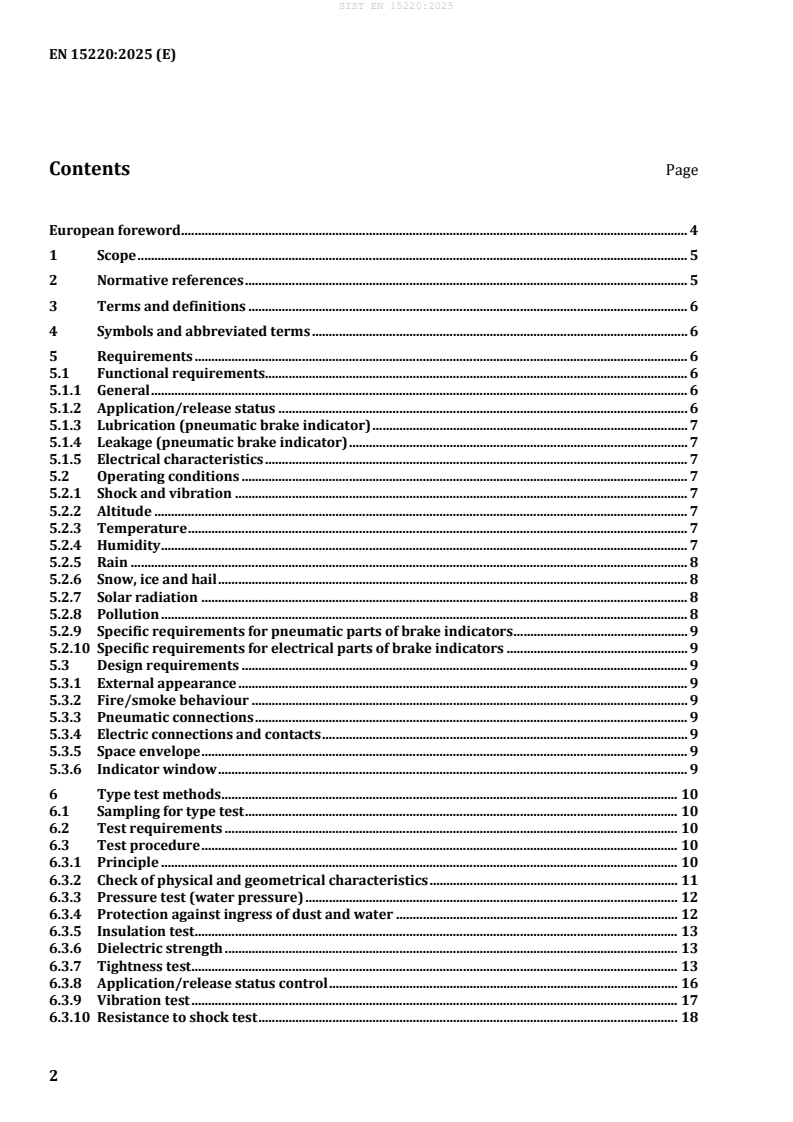
Contents Page
European foreword . 4
1 Scope . 5
2 Normative references . 5
3 Terms and definitions . 6
4 Symbols and abbreviated terms . 6
5 Requirements . 6
5.1 Functional requirements. 6
5.1.1 General . 6
5.1.2 Application/release status . 6
5.1.3 Lubrication (pneumatic brake indicator) . 7
5.1.4 Leakage (pneumatic brake indicator) . 7
5.1.5 Electrical characteristics . 7
5.2 Operating conditions . 7
5.2.1 Shock and vibration . 7
5.2.2 Altitude . 7
5.2.3 Temperature . 7
5.2.4 Humidity . 7
5.2.5 Rain . 8
5.2.6 Snow, ice and hail . 8
5.2.7 Solar radiation . 8
5.2.8 Pollution . 8
5.2.9 Specific requirements for pneumatic parts of brake indicators . 9
5.2.10 Specific requirements for electrical parts of brake indicators . 9
5.3 Design requirements . 9
5.3.1 External appearance . 9
5.3.2 Fire/smoke behaviour . 9
5.3.3 Pneumatic connections . 9
5.3.4 Electric connections and contacts . 9
5.3.5 Space envelope . 9
5.3.6 Indicator window . 9
6 Type test methods . 10
6.1 Sampling for type test . 10
6.2 Test requirements . 10
6.3 Test procedure . 10
6.3.1 Principle . 10
6.3.2 Check of physical and geometrical characteristics . 11
6.3.3 Pressure test (water pressure) . 12
6.3.4 Protection against ingress of dust and water . 12
6.3.5 Insulation test . 13
6.3.6 Dielectric strength . 13
6.3.7 Tightness test . 13
6.3.8 Application/release status control . 16
6.3.9 Vibration test . 17
6.3.10 Resistance to shock test . 18
6.3.11 Endurance at ambient temperature test . 18
6.3.12 Corrosion test . 19
6.3.13 Fire/smoke behaviour . 19
6.3.14 Examination . 19
7 In-service assessment . 20
8 Marking . 20
Annex A (informative) Brake indicator and parking brake indicator overall dimensions . 21
Annex B (informative) In-service assessment . 26
B.1 General . 26
B.2 Service trial . 26
B.3 Sample . 26
B.4 Initial tests (before start of the service trial) . 26
B.5 Intermediate test . 26
B.6 Final tests . 26
European foreword
This document (EN 15220:2025) has been prepared by Technical Committee CEN/TC 256 “Railway
applications”, the secretariat of which is held by DIN.
This European Standard shall be given the status of a national standard, either by publication of an
identical text or by endorsement, at the latest by January 2026, and conflicting national standards shall
be withdrawn at the latest by January 2026.
Attention is drawn to the possibility that some of the elements of this document may be the subject of
patent rights. CEN shall not be held responsible for identifying any or all such patent rights.
This document supersedes EN 15220:2016.
— Scope has been modified;
— Normative references have been updated;
— Clause 5 “Requirements” has been revised and restructured;
— Clause 6 “Type test methods” has been revised;
— Clause 7 “In Service assessment” has been revised and restructured (new informative Annex B
added);
— Clause 8 “Routine tests” has been deleted;
— Clause 9 “Designation” has been deleted;
— Annex ZA has been deleted.
Any feedback and questions on this document should be directed to the users’ national standards body.
A complete listing of these bodies can be found on the CEN website.
According to the CEN-CENELEC Internal Regulations, the national standards organisations of the
following countries are bound to implement this European Standard: Austria, Belgium, Bulgaria,
Croatia, Cyprus, Czech Republic, Denmark, Estonia, Finland, France, Germany, Greece, Hungary, Iceland,
Ireland, Italy, Latvia, Lithuania, Luxembourg, Malta, Netherlands, Norway, Poland, Portugal, Republic of
North Macedonia, Romania, Serbia, Slovakia, Slovenia, Spain, Sweden, Switzerland, Türkiye and the
United Kingdom.
1 Scope
This document specifies the requirements for the function, design, performance and testing of brake
indicators. It applies to brake indicators visible from the outside of the rail vehicle.
2 Normative references
The following documents are referred to in the text in such a way that some or all of their content
constitutes requirements of this document. For dated references, only the edition cited applies. For
undated references, the latest edition of the referenced document (including any amendments) applies.
EN 45545-2, Railway applications — Fire protection on railway vehicles — Part 2: Requirements for fire
behaviour of materials and components
EN 50121-3-2, Railway applications - Electromagnetic compatibility - Part 3-2: Rolling stock - Apparatus
EN 50125-1:2014, Railway applications - Environmental conditions for equipment - Part 1: Rolling stock
and on-board equipment
EN 50155:2021, Railway applications - Rolling stock - Electronic equipment
EN 60423, Conduit systems for cable management - Outside diameters of conduits for electrical
installations and threads for conduits and fittings
EN 60529:1991 , Degrees of protection provided by enclosures (IP Code)
EN 60721-3-5, Classification of environmental conditions - Part 3: Classification of groups of
environmental parameters and their severities - Section 5: Ground vehicle installations
EN 61373, Railway applications - Rolling stock equipment - Shock and vibration tests
EN ISO 228-2, Pipe threads where pressure-tight joints are not made on the threads - Part 2: Verification
by means of limit gauges (ISO 228-2:1987)
EN ISO 6270-2, Paints and varnishes - Determination of resistance to humidity - Part 2: Condensation (in-
cabinet exposure with heated water reservoir) (ISO 6270-2:2017)
EN ISO 9227, Corrosion tests in artificial atmospheres - Salt spray tests (ISO 9227:2022)
EN ISO 24478:2024, Railway applications - Braking - General vocabulary (ISO 24478:2023, including
corrected version 2024-04)
ISO 5208, Industrial valves — Pressure testing of metallic valves
ISO 4975, Railway applications — Braking system — Quality of compressed air for pneumatic apparatus
and systems
As impacted by EN 60529:1991/corrigendum May 1993, EN 60529:1991/A1:2000, EN 60529:1991/A2:2013,
EN 60529:1991/AC:2016-12-02 and EN 60529:1991/A2:2013/AC:2019-02
3 Terms and definitions
For the purposes of this document, the terms and definitions given in EN ISO 24478:2024 and the
following apply.
ISO and IEC maintain terminology databases for use in standardization at the following addresses:
— ISO Online browsing platform: available at https://www.iso.org/obp
— IEC Electropedia: available at https://www.electropedia.org
3.1
uncertain braking status of a parking brake
condition where the parking brake indication becomes uncertain in case of isolated parking brake with
possibility of manual release or, e.g. lack of air pressure in a pneumatic brake system
3.2
application status of the brake unit
condition which indicates that the brake is applied or not completely released
3.3
release status of the brake unit
condition which indicates that the brake is released
4 Symbols and abbreviated terms
U nominal voltage
n
UV ultraviolet (UV irradiation)
“ inch
IP
International Protection Marking as defined in EN 60529:1991
RAL colour standardization system of the German Institute for Quality Assurance and
Certification e.V.
NOTE IP is a coding system to indicate the degrees of protection provided by an enclosure against access to
hazardous particles, ingress of solid foreign objects, ingress of water and to give additional information in
connection with such protection.
5 Requirements
5.1 Functional requirements
5.1.1 General
Brake indicators shall be able to display the status of the brake unit. Different forms of energy may be
used, e.g. air pressure or electricity.
5.1.2 Application/release status
In normal operation the application status of the brake unit shall be displayed with red colour and the
release status of the brake unit shall be displayed with green colour.
When the input signal follows an increase of the braking force, the brake indicator shall be designed to
switch from “release status” to “application status” at the latest for defined value of input signal. In case
of pneumatic input signal this value shall be not more than 0,8 bar.
When the input signal follows a decrease of the braking force, the brake indicator shall be designed to
switch from “application status” to “release status” at the latest for defined value of input signal. In case
of pneumatic input signal this value shall be lower or equal to 0,3 bar but higher or equal to 0,1 bar.
The operating conditions of the application/release flag and its change in status shall be tested in
accordance with 6.3.8.
5.1.3 Lubrication (pneumatic brake indicator)
The brake indicator shall operate at the air pressure range defined by this document without additional
lubrication between overhauls.
5.1.4 Leakage (pneumatic brake indicator)
The sealing arrangement within the brake indicator shall prevent any unacceptable loss of air. The
allowable loss of air shall be less than the leakage values when tested in accordance with 6.3.7.1.
5.1.5 Electrical characteristics
For pneumatic brake indicators, the electrical circuits within the brake indicator shall withstand an
insulation test of at least 500 V DC and a dielectric test (flash test) in accordance with EN 50155:2021.
This requirement shall be tested in accordance with 6.3.5 and 6.3.6.
For electrical brake indicators the requirements of EN 50155:2021 and EN 50121-3-2 shall apply.
5.2 Operating conditions
5.2.1 Shock and vibration
The brake indicator shall be able to operate without restriction under shock and vibration conditions as
specified in EN 61373, category 1, class B, body mounted or category 2, bogie mounted. This shall be
tested in accordance with 6.3.9.
The brake indicator shall be able to withstand shocks and shall be tested in accordance with 6.3.10.
5.2.2 Altitude
The brake indicator shall be able to operate without restrictions up to an altitude of 2 000 m above sea
level.
5.2.3 Temperature
Brake component shall be able to operate within the temperature class TX as specified by
EN 50125-1:2014, where the upper limit for TX is +70 °C external air temperature. This requirement
shall be tested in accordance with 6.3.7 and 6.3.8.
5.2.4 Humidity
The following external humidity levels shall be considered:
— yearly average: ≤ 75 % relative humidity;
— on 30 days in the year continuously: between 75 % and 95 % relative humidity;
— on the other days occasionally: between 95 % and 100 % relative humidity;
— maximum absolute humidity: 30 g/m occurring in tunnels.
An operationally caused infrequent and slight moisture condensation shall not lead to any malfunction
or failure.
At cooled surfaces, 100 % relative humidity can occur, causing condensation on parts of equipment; this
shall not lead to any malfunction or failure.
Sudden lowering of the air temperature local to the vehicle can cause condensation of water on parts of
equipment with rate of 3 K/s and maximum fall in temperature of 40 K.
These conditions particularly occurring when entering or leaving a tunnel shall not lead to any
malfunction or failure of the equipment.
5.2.5 Rain
Rain rate of 6 mm/min shall be taken into account. The effect of rain shall be considered depending on
the possible equipment installation together with wind and vehicle movement.
5.2.6 Snow, ice and hail
Consideration shall be given to the effect of all kinds of snow, ice and/or hail. The maximum diameter of
hailstones shall be taken as 15 mm, larger diameter can occur exceptionally. The effect of snow, ice and
hail shall be considered depending on the equipment installation together with wind and vehicle
movement.
5.2.7 Solar radiation
Equipment design shall allow for direct exposure to solar radiation at the rate of 1 120 W/m for a
maximum duration of 8 h.
5.2.8 Pollution
The effects of pollution shall be considered in the design of equipment and components. Means may be
provided to reduce pollution by the effective use of protection of the braking indicator. The severity of
pollution can depend upon the location of the equipment therefore the effects of the kinds of pollution
indicated in Table 1 shall be considered as a minimum.
Table 1 — Pollution
Pollution Requirements
Chemically active Class 5C2 of EN 60721-3-5
substances
Contaminating fluids Class 5F2 (electrical engine) of EN 60721-3-5
Class 5F3 (thermal engine) of EN 60721-3-5
Biologically active Class 5B2 of EN 60721-3-5
substances
Dust Class 5S2 of EN 60721-3-5
Stones and other Ballast and other objects of maximum 15 mm diameter
objects
Sand Class 5S2 of EN 60721-3-5
Sea spray Class 5C2 of EN 60721-3-5
Compatibility of a cleaning product should be considered in the design of equipment.
To withstand the external ingress of dust and water as specified in EN 60529, (code IP 55 for indicators
with only pneumatic parts, IP 65 for indicators with electrical parts), the brake indicator shall be tested
in accordance with 6.3.4.
5.2.9 Specific requirements for pneumatic parts of brake indicators
To respect the upper pressure limit of the compressed air supply of 10 bar, it shall be able to withstand
a hydraulic test with a pressure of 15 bar in accordance with 6.3.3.
It shall be possible to operate the pneumatic parts of brake indicators without restrictions with at least
the compressed air purity 3-3-4 [−25 °C; 50 °C] in accordance with ISO 4975.
5.2.10 Specific requirements for electrical parts of brake indicators
The electrical parts of brake indicators shall be in accordance with the requirements of EN 501
...