

EN 45545-2:2013
(Main)Railway applications - Fire protection on railway vehicles - Part 2: Requirements for fire behavior of materials and components
- Abstract
This part specifies the reaction to fire performance requirements for materials and products used on railway vehicles as defined in FprEN 45545-1.
The operation and design categories defined in FprEN 45545-1 are used to establish hazard levels that are used as the basis of a classification system.
For each hazard level, this part specifies the test methods, test conditions and reaction to fire performance requirements.
It is not within the scope of this European Standard to describe measures that ensure the preservation of the vehicles in the event of a fire.
- Status
- Withdrawn
- Publication Date
- 05-Mar-2013
- Withdrawal Date
- 06-Oct-2026
- Technical Committee
- CEN/TC 256 - Railway applications
- Drafting Committee
- CEN/TC 256/WG 1 - Fire safety
- Current Stage
- 9960 - Withdrawal effective - Withdrawal
- Start Date
- 21-Oct-2015
- Completion Date
- 07-Oct-2026
- Directive
- 2008/57/EC - DIRECTIVE 2008/57/EC OF THE EUROPEAN PARLIAMENT AND OF THE COUNCIL of 17 June 2008 on the interoperability of the rail system within the Community (Recast)OJ Ref: C, C 345 OJ Date: 26-Nov-2013

Relations
- Effective Date
- 10-Feb-2026
- Effective Date
- 12-Dec-2009
- Effective Date
- 08-Jun-2022
- Effective Date
- 25-Aug-2026
- Effective Date
- 25-Aug-2026
- Effective Date
- 25-Aug-2026
- Effective Date
- 25-Aug-2026
- Effective Date
- 25-Aug-2026
- Effective Date
- 25-Aug-2026
- Effective Date
- 09-Feb-2026
- Effective Date
- 09-Feb-2026
- Effective Date
- 09-Feb-2026
- Effective Date
- 09-Feb-2026
- Effective Date
- 09-Feb-2026
- Effective Date
- 09-Feb-2026
Get Certified
Connect with accredited certification bodies for this standard

IRIS Certification (UNIFE)
International Railway Industry Standard certification.

TÜV SÜD Rail GmbH
TÜV SÜD railway certification services.

Bureau Veritas Railway Certification
Railway and transportation certification.
Sponsored listings
Frequently Asked Questions
EN 45545-2:2013 is a standard published by the European Committee for Standardization (CEN). Its full title is "Railway applications - Fire protection on railway vehicles - Part 2: Requirements for fire behavior of materials and components". This standard covers: This part specifies the reaction to fire performance requirements for materials and products used on railway vehicles as defined in FprEN 45545-1. The operation and design categories defined in FprEN 45545-1 are used to establish hazard levels that are used as the basis of a classification system. For each hazard level, this part specifies the test methods, test conditions and reaction to fire performance requirements. It is not within the scope of this European Standard to describe measures that ensure the preservation of the vehicles in the event of a fire.
This part specifies the reaction to fire performance requirements for materials and products used on railway vehicles as defined in FprEN 45545-1. The operation and design categories defined in FprEN 45545-1 are used to establish hazard levels that are used as the basis of a classification system. For each hazard level, this part specifies the test methods, test conditions and reaction to fire performance requirements. It is not within the scope of this European Standard to describe measures that ensure the preservation of the vehicles in the event of a fire.
EN 45545-2:2013 is classified under the following ICS (International Classification for Standards) categories: 13.220.20 - Fire protection; 45.060.01 - Railway rolling stock in general. The ICS classification helps identify the subject area and facilitates finding related standards.
EN 45545-2:2013 has the following relationships with other standards: It is inter standard links to CEN/TS 45545-2:2009, CEN/TS 45545-2:2009, EN 45545-2:2013+A1:2015, ISO 5660-1:2002, ISO 2719:2002, ISO 5658-2:2006, ISO 2592:2000, ISO 19702:2006, ISO/TR 9705-2:2001, EN 50306-1:2020, EN 50264-2-1:2008, EN 50382-1:2008, EN 61034-2:2005, EN 50306-4:2020, EN IEC 60332-3-24:2018. Understanding these relationships helps ensure you are using the most current and applicable version of the standard.
EN 45545-2:2013 is associated with the following European legislation: EU Directives/Regulations: 2008/57/EC; Standardization Mandates: M/275, M/334, M/483. When a standard is cited in the Official Journal of the European Union, products manufactured in conformity with it benefit from a presumption of conformity with the essential requirements of the corresponding EU directive or regulation.
EN 45545-2:2013 is available in PDF format for immediate download after purchase. The document can be added to your cart and obtained through the secure checkout process. Digital delivery ensures instant access to the complete standard document.
Standards Content (Sample)
2003-01.Slovenski inštitut za standardizacijo. Razmnoževanje celote ali delov tega standarda ni dovoljeno.Bahnanwendungen - Brandschutz in Schienenfahrzeugen - Teil 2: Anforderungen an das Brandverhalten von Materialien und KomponentenApplications ferroviaires - Protection contre les incendies dans les véhicules ferroviaires - Partie 2: Exigences du comportement au feu des matériaux et des composantsRailway applications - Fire protection on railway vehicles - Part 2: Requirements for fire behavior of materials and components45.060.01Železniška vozila na splošnoRailway rolling stock in general13.220.20Fire protectionICS:Ta slovenski standard je istoveten z:EN 45545-2:2013SIST EN 45545-2:2013en,fr01-maj-2013SIST EN 45545-2:2013SLOVENSKI
STANDARDOSIST prEN 45545-2:20051DGRPHãþD
EUROPEAN STANDARD NORME EUROPÉENNE EUROPÄISCHE NORM
EN 45545-2
March 2013 ICS 45.060.01; 13.220.20 Supersedes CEN/TS 45545-2:2009
English Version
Railway applications - Fire protection on railway vehicles - Part 2: Requirements for fire behavior of materials and components
Applications ferroviaires - Protection contre les incendies dans les véhicules ferroviaires - Partie 2: Exigences du comportement au feu des matériaux et des composants
Bahnanwendungen - Brandschutz in Schienenfahrzeugen - Teil 2: Anforderungen an das Brandverhalten von Materialien und Komponenten This European Standard was approved by CEN on 7 December 2012.
CEN and CENELEC members are bound to comply with the CEN/CENELEC Internal Regulations which stipulate the conditions for giving this European Standard the status of a national standard without any alteration. Up-to-date lists and bibliographical references concerning such national standards may be obtained on application to the CEN-CENELEC Management Centre or to any CEN and CENELEC member.
This European Standard exists in three official versions (English, French, German). A version in any other language made by translation under the responsibility of a CEN and CENELEC member into its own language and notified to the CEN-CENELEC Management Centre has the same status as the official versions.
CEN and CENELEC members are the national standards bodies and national electrotechnical committees of Austria, Belgium, Bulgaria, Croatia, Cyprus, Czech Republic, Denmark, Estonia, Finland, Former Yugoslav Republic of Macedonia, France, Germany, Greece, Hungary, Iceland, Ireland, Italy, Latvia, Lithuania, Luxembourg, Malta, Netherlands, Norway, Poland, Portugal, Romania, Slovakia, Slovenia, Spain, Sweden, Switzerland, Turkey and United Kingdom.
CEN-CENELEC Management Centre: Avenue Marnix 17, B-1000 Brussels © 2013 CEN/CENELEC All rights of exploitation in any form and by any means reserved worldwide for CEN national Members and for CENELEC Members. Ref. No. EN 45545-2:2013 E SIST EN 45545-2:2013
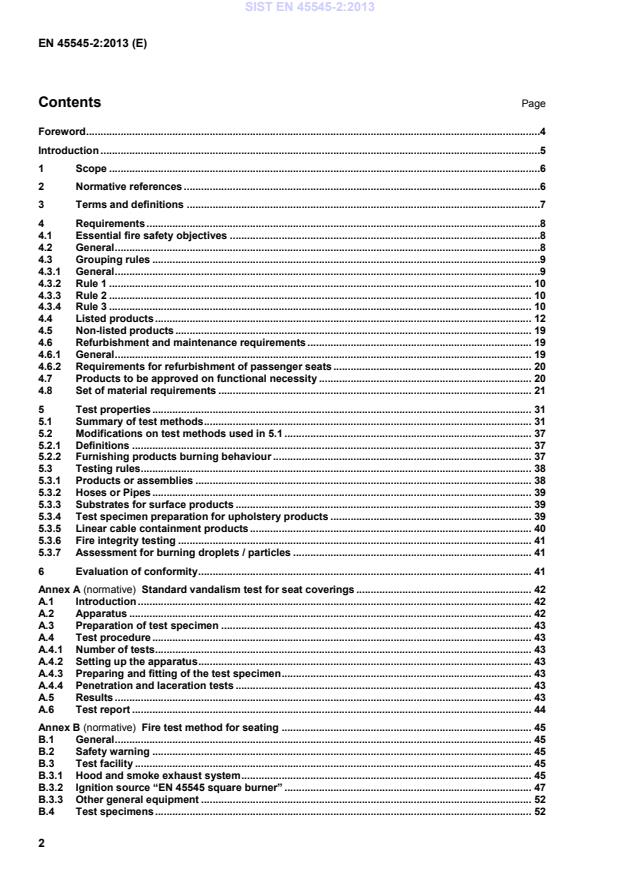
Standard vandalism test for seat coverings . 42 A.1 Introduction . 42 A.2 Apparatus . 42 A.3 Preparation of test specimen . 43 A.4 Test procedure . 43 A.4.1 Number of tests . 43 A.4.2 Setting up the apparatus . 43 A.4.3 Preparing and fitting of the test specimen . 43 A.4.4 Penetration and laceration tests . 43 A.5 Results . 43 A.6 Test report . 44 Annex B (normative)
Fire test method for seating . 45 B.1 General . 45 B.2 Safety warning . 45 B.3 Test facility . 45 B.3.1 Hood and smoke exhaust system . 45 B.3.2 Ignition source “EN 45545 square burner” . 47 B.3.3 Other general equipment . 52 B.4 Test specimens . 52 SIST EN 45545-2:2013
B.4.1 General . 52 B.4.2 Number of tests . 53 B.4.3 Preparation of the test specimen . 53 B.4.4 Conditioning of test specimen . 54 B.5 Test procedure and application of the burner . 54 B.6 Early termination of test . 56 B.7 Test results . 56 B.8 Test report . 56 Annex C (normative)
Testing methods for determination of toxic gases from railway products . 58 C.1 Introduction . 58 C.2 Method 1 – Test apparatus . 60 C.2.1 General . 60 C.2.2 Calibration of the radiating cone . 60 C.2.3 Smoke chamber – Smoke density . 60 C.3 Analysis of fire effluents for Method 1 . 60 C.3.1 Principles of FTIR gas analysis used in a discontinuous way . 60 C.3.2 Probe for sampling of effluents . 61 C.3.3 FTIR gas cell . 61 C.3.4 FTIR spectrometer . 61 C.4 Test environment . 62 C.5 Conditioning . 62 C.6 Pre-test conditions for the apparatus for Method 1 . 62 C.7 Warnings . 62 C.8 Smoke and gas testing using Method 1 . 63 C.8.1 Beginning of the test . 63 C.8.2 Test procedure . 63 C.8.3 End of test . 64 C.8.4 Data acquisition . 64 C.9 Data treatment . 64 C.10 Test report for Method 1 . 65 C.11 Use of alternative gas analysis techniques to FTIR . 67 C.12 Method 2 – Test apparatus . 68 C.13 Test environment (Method 2) . 68 C.14 Conditioning of samples. 68 C.15 Test for gases using Method 2 . 68 C.16 Calculations of CIT . 69 C.16.1 Introduction . 69 C.16.2 General products (CITG) . 69 C.16.3 Non-listed products (CITNLP) . 70 Annex D (normative)
Protocol for test specimen preparation in standard tests . 71 D.1 Protocol for specimen preparation for tests according to EN ISO 5659-2 and ISO 5660-1 . 71 D.2 Protocol for specimen preparation of upholstered furniture assembled products for tests according to EN ISO 5659-2 and ISO 5660-1 . 71 D.2.1 Scope and field of application . 71 D.2.2 Preparation of test specimens . 71 D.3 Protocol for test specimen preparation for flame spread testing . 72 D.3.1 Scope and field of application . 72 D.3.2 Test specimen preparation . 72 Annex ZA (informative)
Relationship between this European Standard and the Essential Requirements of EU Directive 2008/57/EC . 73 Bibliography . 75
Foreword This document (EN 45545-2:2013) has been prepared by Technical Committee CEN/TC 256 “Railway applications”, the secretariat of which is held by DIN. This European Standard shall be given the status of a national standard, either by publication of an identical text or by endorsement, at the latest by September 2013, and conflicting national standards shall be withdrawn at the latest by March 2016. Attention is drawn to the possibility that some of the elements of this document may be the subject of patent rights. CEN [and/or CENELEC] shall not be held responsible for identifying any or all such patent rights. This document supersedes CEN/TS 45545-2:2009. This document has been prepared under a mandate given to CEN by the European Commission and the European Free Trade Association, and supports essential requirements of EU Directive 2008/57/EC. For relationship with EU Directive 2008/57/EC, see informative Annex ZA, which is an integral part of this document. This series of European standards Railway applications — Fire protection on railway vehicles consists of: Part 1: General; Part 2: Requirements for fire behaviour of materials and components; Part 3: Fire resistance requirements for fire barriers; Part 4: Fire safety requirements for railway rolling stock design; Part 5: Fire safety requirements for electrical equipment including that of trolley buses, track guided buses and magnetic levitation vehicles; Part 6: Fire control and management systems; Part 7: Fire safety requirements for flammable liquid and flammable gas installations. According to the CEN/CENELEC Internal Regulations, the national standards organisations of the following countries are bound to implement this European Standard: Austria, Belgium, Bulgaria, Croatia, Cyprus, Czech Republic, Denmark, Estonia, Finland, Former Yugoslav Republic of Macedonia, France, Germany, Greece, Hungary, Iceland, Ireland, Italy, Latvia, Lithuania, Luxembourg, Malta, Netherlands, Norway, Poland, Portugal, Romania, Slovakia, Slovenia, Spain, Sweden, Switzerland, Turkey and the United Kingdom. SIST EN 45545-2:2013
Introduction EN 45545-2 has been developed from existing fire safety regulations for railway vehicles from the International Union of Railways (UIC) and different European countries. In using the operation and design categories defined in EN 45545-1, the requirements laid down in this part take into account the current operating conditions for European public rail transport. SIST EN 45545-2:2013
1 Scope This part of EN 45545 specifies the reaction to fire performance requirements for materials and products used on railway vehicles as defined in EN 45545-1. The operation and design categories defined in EN 45545-1 are used to establish hazard levels that are used as the basis of a classification system. For each hazard level, this part specifies the test methods, test conditions and reaction to fire performance requirements. It is not within the scope of this European Standard to describe measures that ensure the preservation of the vehicles in the event of a fire. 2 Normative references The following documents, in whole or in part, are normatively referenced in this document and are indispensable for its application. For dated references, only the edition cited applies. For undated references, the latest edition of the referenced document (including any amendments) applies. EN 13238, Reaction to fire tests for building products — Conditioning procedures and general rules for selection of substrates EN 13501-1, Fire classification of construction products and building elements — Part 1: Classification using data from reaction to fire tests EN 45545-1:2013, Railway applications — Fire protection on railway vehicles — Part 1: General EN 45545-3, Railway applications — Fire protection on railway vehicles — Part 3: Fire resistance requirements for fire barriers EN 45545-5:2013, Railway applications — Fire protection on railway vehicles — Part 5: Fire safety requirements for electrical equipment including that of trolley buses, track guided buses and magnetic levitation vehicles EN 50305:2002, Railway applications — Railway rolling stock cables having special fire performance — Test methods EN 50306, Railway applications — Railway rolling stock cables having special fire performance EN 50264, Railway applications — Railway rolling stock power and control cables having special fire performance EN 50382, Railway applications — Railway rolling stock high temperature power cables having special fire performance EN 60332-1-2, Tests on electric and optical fibre cables under fire conditions — Part 1-2: Test for vertical flame propagation for a single insulated wire or cable — Procedure for 1 kW pre-mixed flame
EN 60332-3-24, Tests on electric and optical fibre cables under fire conditions — Part 3-24: Test for vertical flame spread of vertically-mounted bunched wires or cables — Category C EN 60584-1, Thermocouples — Part 1: Reference tables
EN 60695-2-11, Fire hazard testing — Part 2-11: Glowing/hot-wire based test methods — Glow-wire flammability test method for end-products SIST EN 45545-2:2013
EN 60695-11-10, Fire hazard testing — Part 11-10: Test flames — 50 W horizontal and vertical flame test methods
EN 61034-1, Measurement of smoke density of cables burning under defined conditions — Part 1: Test apparatus EN 61034-2, Measurement of smoke density of cables burning under defined conditions — Part 2: Test procedure and requirements
EN ISO 1182, Reaction to fire tests for products - Non-combustibility test (ISO 1182)
EN ISO 1716:2010, Reaction to fire tests for products — Determination of the gross heat of combustion (calorific value) (ISO 1716:2010) EN ISO 4589-2, Plastics — Determination of burning behaviour by oxygen index — Part 2: Ambient-temperature test (ISO 4589-2) EN ISO 5659-2, Plastics — Smoke generation — Part 2: Determination of optical density by a single-chamber test (ISO 5659-2) EN ISO 6507-3, Metallic materials — Vickers hardness test — Part 3: Calibration of reference blocks
(ISO 6507-3) EN ISO 9239-1, Reaction to fire tests for floorings — Part 1: Determination of the burning behaviour using a radiant heat source (ISO 9239-1) EN ISO 11925-2, Reaction to fire tests — Ignitability of products subjected to direct impingement of flame — Part 2: Single-flame source test (ISO 11925-2) EN ISO 12952-2, Textiles — Assessment of the ignitability of bedding items — Part 2: Ignition source: match-flame equivalent (ISO 12952-2) ISO 5658-2:2006, Reaction to fire tests — Spread of flame — Part 2: Lateral spread on building and transport products in vertical configuration ISO 5660-1, Reaction-to-fire tests — Heat release, smoke production and mass loss rate — Part 1: Heat release rate (cone calorimeter method) ISO/TR 9705-2, Reaction-to-fire tests — Full-scale room tests for surface products — Part 2: Technical background and guidanceISO 11054, Cutting tools — Designation of high-speed steel groups ISO 19702, Toxicity testing of fire effluents — Guidance for analysis of gases and vapours in fire effluents using FTIR gas analysis ISO 2592, Determination of flash and fire points — Cleveland open cup method ISO 2719, Determination of flash point — Pensky-Martens closed cup method NF X70-100-1, Fire tests — Analysis of gaseous effluents — Part 1: methods for analysing gases stemming from thermal degradation NF X70-100-2, Fire tests — Analysis of gaseous effluents — Part 2: tubular furnace thermal degradation method. 3 Terms and definitions For the purposes of this document, the terms and definitions given in EN 45545-1:2013 apply.
4 Requirements 4.1 Essential fire safety objectives The design of rolling stock and the products used shall incorporate the aim of limiting fire development should an ignition event occur so that an acceptable level of safety is achieved. If the objectives defined in Clause 4 of EN 45545-1:2013 are met, then there should be a high probability that in the event of a fire, passengers and staff will be able to escape from the fire unaided and be able to reach a place of safety. Hazard levels (HL 1 to HL 3) have been determined using a product of the relation between operation categories and design categories defined in EN 45545-1, as described in Table 1. Hazard levels are used in Table 5 for Material Fire Safety requirement classification. Table 1 — Hazard level classification Operation
category Design category N: Standard vehicles A: Vehicles forming part of an automatic train having no emergency trained staff on board D: Double decked vehicle
S: Sleeping and couchette vehicles
1 HL1 HL1 HL1 HL2 2 HL2 HL2 HL2 HL2 3 HL2 HL2 HL2 HL3 4 HL3 HL3 HL3 HL3
4.2 General The following principles are applicable to all products: a) products which comply with the highest level of reaction to fire performance and therefore need no further testing are: products classified as A1 according to EN 13501-1; all products described in commission decision 96/603/EC (as amended); b) products classified as A2 – s1, d0 according to EN 13501-1 are considered compliant with regard to flame spread, heat release and smoke emission requirements only. The toxic emissions limit shall satisfy the requirements of R1 HL3 (CIT<0,75); c) electrical cables which satisfy the fire safety requirements of EN 50306, EN 50264 or EN 50382 are considered to satisfy the requirements of R15 and R16 for the corresponding hazard level (no further testing required); d) where a product has a continuous aluminium or steel substrate and where the thickness of the substrate metal is equal to or greater than defined in Table 7, it is sufficient to test the product with the thickness given in Table 7; e) a product, other than an electric cable, meeting a requirement at two different thicknesses with identical formulations shall be considered to comply with the requirement at all intermediate thicknesses. Electric SIST EN 45545-2:2013
cables meeting a requirement at two different diameters with identical formulations shall be considered to comply with the requirement at all intermediate diameters; f) a test which qualifies any product or surface shall also qualify any product or surface which differs in colour and/ or pattern; g) multi layer products shall be tested in the end use condition; h) mechanical or electrical products contained in a technical cabinet may be considered as unclassified products if: the technical cabinet satisfies the requirements of integrity criterion E10, based on the definitions described in EN 45545-1 and EN 45545-3 and the enclosed volume is ≤ 2 m3;
or the technical cabinet satisfies the requirements of integrity criterion E15 and insulation criterion I15 to surfaces adjacent to passenger area and staff area and integrity criterion E15 to other surfaces, based on the definitions described in EN 45545-1 with no volume limitations;
or the technical cabinet is protected by an automatic fire detection and fire extinguishing system; i) all coating systems shall be tested in end use condition. This means inclusion of levelling fillers at a thickness estimated at mean end use application, primers and finish coatings with specified coating thickness and number of layers; j) where a coating (including vinyls, films and their adhesives) is applied to aluminium or steel in the end use condition and where the thickness of the metal is greater than those defined in Table 7 it is sufficient to test the coating on the reference substrate defined in Table 7; k) for coatings applied to non metallic surfaces, the full specified test requirements are mandatory; l) for products which are classified in Table 2 as IN2, IN3A, IN3B, IN10, IN11, EX1C, EX5, EX6A, EX6B, EX8, EX11, or EL2, where surfaces have organic coatings applied on metal or glass surfaces, ISO 5658-2 or EN ISO 9239-1 flame spread tests shall be carried out, but other test requirements such as heat release, smoke emission and toxic gas emission tests are not required if the nominal coating thickness, including any surfacing filler for exterior products is < 0,3 mm, or for interior products the nominal thickness of organic coating is < 0,15 mm; m) if ISO 5658-2 is required as part of a requirement set, but the end use condition of a product does not allow preparation of test specimens to the size defined in ISO 5658-2, then in the case of interior use, R6 is applicable instead of the designated requirement set, and in the case of exterior use, R9 is applicable instead of the designated requirement set; n) if listed products are used in an application below the mass and area thresholds given in 4.3, they may be treated as non-listed products. 4.3 Grouping rules 4.3.1 General No requirements apply to products with a combustible mass of < 10 g not in touching contact with another unclassified product. To assess products the following parameters have to be considered. Products shall be considered as grouped if: the exposed area of each product is < 0,2 m2; and they are not compliant to the applicable requirements of Table 2; and the combustible mass of each product is > 10 g or they are in touching contact to another combustible product; and SIST EN 45545-2:2013
the horizontal distance to a product non compliant to Table 2 is < 20 mm or the vertical distance to a product non compliant to Table 2 is < 200 mm; and they are not fully separated by a product compliant with the fire integrity requirement of 5.3.6.
The combustible masses of the products in this group shall be summed. The assessment process described in 4.3.2 to 4.3.4 is visualized in the flow chart in Figure 1. 4.3.2 Rule 1 If the total combustible mass of the grouped products is
< 100 g for interior grouped products;
or < 400 g for exterior grouped products; no requirements apply to the products of this group. 4.3.3 Rule 2 If the combustible mass of the grouped products exceeds the limits stated in Rule 1, but is
< 500 g for interior grouped products;
or < 2 000 g for exterior grouped products; one combustible product of this group has to be tested according to R24. If this product is compliant to R24 it shall not be considered for further assessment of this group. The remaining products in this group shall be assessed starting with Rule 1, 4.3.2, again. 4.3.4 Rule 3 If the combustible mass of the grouped products exceeds the limits stated in Rule 2, one product of the group shall be tested according to the requirements of non-listed products given in 4.5, Table 3. If this product is compliant to the requirements of Table 3 it shall not be considered for further assessment of this group. The remaining products in this group shall be assessed starting with Rule 1, 4.3.2, again. SIST EN 45545-2:2013
Figure 1 — Assessment process – Grouping rules SIST EN 45545-2:2013
4.4 Listed products The reaction to fire performance requirements of materials and components depend on their intrinsic nature but also: on the location of the materials or components within the design; on the shape and the layout of the materials; on the surface exposed and the relative mass and the thickness of the materials. It is on this basis that the listed products have been classified and further differentiated into subgroups as follows: their general location (interiors or exteriors); their specific use (furniture, electrotechnical equipment or mechanical equipment). Within the sub groupings, for each of the listed products, a set of requirements has been given which defines the ability of products to contain fire development to an appropriate degree considering the location, the exposed surfaces, their geometry and general disposition. Examples of different products are: ceiling panelling, floor composites, interior lighting, curtains, external body shell walls and underside and parts of the drive and suspension system. The requirement sets for listed products are given in Table 2 and are designated R1 to R26. The content of each requirement set is listed in Table 5. The column “Details” shows relationships to special requirements e. g. sample preparation and/or fire resistance. SIST EN 45545-2:2013
Table 2 — Requirements of listed products (1 of 7) Product No Name Details Require-ment IN Interiors
IN1A Interior vertical surfaces Interior components (structure and covering) such as side walls, front walls / end-walls, partitions, room dividers, flaps, boxes, hoods, louvres. Interior doors, interior lining of the front-/end-wall doors and external doors. Windows (including plastics and glazing)
Insulation material and interior surface of body shell. Kitchen interior surfaces (except those of kitchen equipment).
R1 IN1B Interior horizontal downward- facing surfaces Interior components (structure and coverings) such as ceiling panelling, flaps, boxes, hoods, louvres. Insulation material and interior surface of body shell.
R1 IN1C Interior horizontal upwards-facing surfaces Interior components (structure and coverings) such as flaps, boxes, hoods, louvres. Insulation material and interior surface of body shell.
Compliance with the requirements of R1 is also considered to be compliant for this requirement.
R10 IN1D Interior surfaces within cavities The surfaces may be horizontal or vertical. R1 IN1E External surfaces of enclosures containing technical equipment Enclosures which are located inside the body shell NOTE Fire resistance requirements may apply to enclosures containing technical equipment – see 4.2 and EN 45545-3. R1 IN2 Limited surfaces
they shall have an area ≤ 0,20 m2; they shall have a maximum dimension in any direction on the surface ≤ 1 m; they shall be separated from any other limited surface or strip by a distance of R1 compliant material greater than the dimension of the limited surface, measured in the same horizontal direction as the separation direction. R2
Table 2 (2 of 7) Product No Name Details Require-ment IN Interiors
IN3A Strips they shall have a width < 200 mm and be separated from another limited surface or strip by > 200 mm of R1 compliant material; they shall not have length limitation.
For example, vertical cover strips on walls.
R3 IN3B Light diffusers For example, polycarbonate diffusers, light coverings for lamps. Light units themselves and indicators are not within the scope of IN3B. R4 IN4 Luggage storage areas Overhead luggage racks, vertical luggage racks, luggage stacks, luggage containers and luggage compartments. R1 IN5 Driver’s desk Panelling and surfaces of the driver’s desk (excluding electrical components/ equipment). a R1 IN6A Interior surfaces of gangways Type A – For railway vehicles in which there are no fire barriers at both bulk head ends of the gangway. Interior side of gangway membrane (bellow), interior lining of the gangway, (except flooring).
R1 IN6B Interior surfaces of gangways Type B – For railway vehicles in which there are fire barriers at both bulk head ends of the gangway. Interior side of gangway membrane (bellow), interior lining of the gangway, (except flooring). R7 IN7 Window frames Window surround (including sealants and gaskets). R1 IN8 Curtains and sunblind in passenger area and staff area, staff compartments Curtains and sunblind except where they are enclosed within a double glazed window.
R1 IN9A Tables, folding table tops, and toilet wash basins. Type A – Upper surfaces All tables and toilet wash basins (including surrounds).
R2 IN9B Tables, folding tables downward facing surface b Type B – Downward-surfaces Bottom surface of a table, the exposed vertical sides of drop down tables or any surface of a folding table that may become a bottom surface. R1 IN10 Containers Outer surface of water containers and air containers. R2 IN11 Litter bins and ashtrays Inner and outer surfaces of litter bins and ashtrays. R1 IN12A Air ducts - Interior surfaces
Interior surfaces of ducts which are installed on the interior of the vehicle and from which air flows into the vehicle interior. R1
Table 2 (3 of 7) Product No Name Details Require-ment IN Interiors
IN12B Air ducts – Exterior surfaces Exterior surfaces of ducts which are installed in the interior of the vehicle, but from which air flows into the vehicle interior. R1 IN12C Air ducts on locomotives
Exterior and interior surfaces of ducts, which are located in technical areas and from which no air flows to the passenger area and staff area of a vehicle.
R7 IN13 Air filters
Materials for air filters used for equipment ventilation, heating and air conditioning. R5 IN14 Devices for passenger information Information display screens in passenger areas, not those in staff areas.
Products such as speakers, handsets and their holders shall be considered as non-listed products R1 IN15 Floor composites The floor composites include the floor substrate (together with any thermal insulation) and floor covering (together with any fixings or adhesives applied in end use conditions). R10 IN16 Interior seals
Longitudinal seals such as window seals, door joints and panel connections.
R22 EX Exterior located products
EX1A Walls of external body shell Vertical parts of external structure of body shell and door leafs (including paint/coating systems, films and windows). R7 EX1B Cab housing – External surfaces Front of the train up to the cab partition
(including paint/coating systems, films). R17 EX1C External surfaces of enclosures containing technical equipment Enclosures which are located outside the body shell R7 EX2 Roof of external body shell External roof structure of the car body
(including paint/coating systems, films). Compliance with the requirements of R7 is also considered to be compliant for this requirement. R8 EX3 Under frame of external body shell
External surfaces of under frame structure of the body shell (floor) including paint and coating systems (thermal, design and acoustic coating) and protective floor panelling. R7 EX4 Exterior ducts
Exterior and interior surfaces of ducts which are not connected to the interior of the vehicle R7
Table 2 (4 of 7) Product No Name Details Require-ment EX Exterior located products
EX5 External design features External design features (e. g. streamlining parts, ventilation grills, flaps, skirts, coverings for HVAC systems, enclosures, etc.)
R7 EX6A Containers mounted in under frame Outer surfaces of water containers and air containers which are positioned in the under frame. R7 EX6B Containers mounted on roof Outer surfaces of water containers and air containers which are positioned on the roof. Compliance with the requirements of R7 are also considered to be compliant to this requirement. R8 EX7 Exterior surfaces of gangways Outer membrane of intercommunication gangways. R7 EX8 Bogie structure and parts The bogie structure shall include frames, spring leaf guides and bolster.
R7 EX9 Air bags for pneumatic suspension
R9 EX10 Parts of the drive Wheel sets and brake discs. R9 EX11 Tyres
R9 EX12 Exterior seals
Longitudinal seals such as window seals, door joints and panel connections R23 F Furniture
F1 c Complete passenger seats Complete passenger seat, including seat shell, upholstery, arm and head rests. Tip-up seats and driver’s seat (if it is accessible to passengers) are also included.
Details of seat tests (including the conditions for vandalism testing) are given in Annex A and Annex B.
R18 F1A Upholstery for passenger seats and head rest Upholstery includes the trimming (e. g. suspension system), flexible foam core, intermediate layers (e. g. fire barrier, anti-vandal layer), seat covers (e. g. base, back, side cover) and head rest upholstery. Details of test specimen preparation are given in Annex D. R21
Table 2 (5 of 7) Product No Name Details Require-ment F Furniture
F1B Armrests for passenger seats The surface on which the arm rests shall be tested. In addition, the downwards facing and vertical surfaces in the normal operating position shall comply with the requirements of 5.2.2.2 Fire integrity.
Details of test specimen preparation are given in Annex D. R21 F1C Passenger seat shell - Base The external surface of the base shell (including all coatings or coverings) shall be tested. Compliance with 5.2.2.2 Fire Integrity is also required. R6 F1D Passenger seat shell - Back The external surface of the back shell (including all coatings or coverings) shall be tested. Compliance with 5.2.2.2 Fire Integrity is also required. R6 F1E Removable head rest Removable head rests shall be tested as if they were loose cushions. R21 F2 Seats in staff areas Staff seat upholstery and supporting structure (including the back/base shell) shall be tested according to the following conditions:
top surface of seat;
back shell from external surface; external surface of base shell.
Test in the end use conditions referring to guidance in Annex D.
If the fire integrity condition of 5.2.2.2 is additionally met, then it is not necessary to test the shell/upholstery composite from the shell face. Whole seat is qualified if the requirement set R19 is met. No further tests required. R19 F3 Mattresses Details of test specimen preparation are given in Annex D. R21 F4 Loose upholstery items for seats, couchettes and beds
Bed clothes for couchettes and beds (cushions, blankets, duvets, pillows, sleeping bags and sheets, etc).
Antimaccassars shall be considered as non- listed products. R20 F5 Underside surface of couchettes and beds Compliance with 5.2.2.2 Fire integrity is also required.
R1
Table 2 (6 of 7) Product No Name Details Require-ment E Electrotechnical equipment
EL1A Cables for interior Cables not compliant with one of the standards referenced in 4.2c R15 EL1B Cables for exterior Cables not compliant with one of the standards referenced in 4.2c R16 EL2 Cable containment (linear product) Cable containment surface related (cable duct, cable conduit). See 5.3.5 See Table 8 and Table 9 EL3A Arc resistant insulation materials Type A See 5.3.2 in EN 45545-5:2013. R11 EL3B Arc resistant insulation materials Type B See 5.3.3 in EN 45545-5:2013. R12 EL3C Arc splash barrier materials See 5.3.1 in EN 45545-5:2013. R7 EL4 Flammable insulation liquid
R14 EL5 Sup
...