

EN 14615:2017
(Main)Postal services - Digital postage marks - Applications, security and design
- Abstract
This European Standard specifies a recommended procedure for the development of specifications for applications of digital postage marks (DPMs) – i.e. applications linked to the use of digital printing and image data capture technologies in the postal industry, most particularly for the evidencing of postage accounting and/or payment. It is not intended to prescribe or to recommend any particular architecture or design for such applications, only to specify the process through which such an architecture or design should be developed.
The document covers only requirements and considerations relating to applications that use digital postage marks, on individual postal items, as a means of communicating data (messages). The clause on design covers only the design of the digital postage marks themselves. It does not cover other aspects of design, including the possible use of other messages, transported by other means (e.g. statements of mailing), to provide for the communication of additional data, even though these might be just as important.
- Status
- Published
- Publication Date
- 19-Sep-2017
- Withdrawal Date
- 30-Mar-2018
- Technical Committee
- CEN/TC 320 - Transport - Logistics and services
- Drafting Committee
- CEN/TC 331/WG 3 - Automatic identification of items - Addresses
- Current Stage
- 9060 - Closure of 2 Year Review Enquiry - Review Enquiry
- Start Date
- 04-Mar-2023
- Completion Date
- 04-Mar-2023
- Directive
- 97/67/EC - Common rules for the development of the internal market of Community postal services and the improvement of quality of serviceOJ Ref: L, L 369 OJ Date: 19-Oct-2021



Overview
EN 14615:2017 - Postal services: Digital postage marks (DPMs) - Applications, security and design (SIST / CEN, developed with UPU) defines a recommended procedure for developing specifications for applications that use digital postage marks. The standard focuses on using digital printing and image capture technologies on individual postal items to communicate data for postage evidencing, accounting and payment. It does not prescribe a single architecture or force specific design choices; instead it specifies the process to be followed when creating DPM applications and the design of the marks themselves.
Key topics and technical requirements
The standard structures the DPM design process and provides guidance and normative checklists. Major technical topics include:
- DPM applications and design process - business planning, systems analysis, security analysis and DPM design (Clause 5 and subclauses 5.1–5.5).
- Specification checklists - application, system, security and DPM specification templates (Annex A).
- Business planning and market selection - possible applications, segmentation and selection guidance (Annex B).
- Security analysis - threat models, security objectives, message-level and application-level countermeasures (Annex C).
- Systems analysis and architecture - requirements analysis, function allocation and architecture design considerations (Annex D).
- DPM design considerations - data content, symbology, human-readable information, layout and test criteria (Annex E).
- Verification and statistical analysis - detection of invalid or duplicate DPMs and verification performance (Annex F).
- Message security algorithms and CVC generation - hash functions, asymmetric cryptography, MACs and exchange validation code considerations (Annex G–H).
- Examples and IPR - architecture examples (e.g., REMPI, USPS IBIP), sample DPMs, and relevant intellectual property notes (Annex I–K).
Practical applications and users
EN 14615:2017 is intended for practical adoption by:
- Postal operators planning digital franking and postage-evidence systems
- System architects and integrators designing DPM-enabled workflows
- Security analysts defining message-level and system-level countermeasures
- Meter and printer vendors implementing DPM symbologies and verification
- Standards bodies and regulators aligning national DPM specifications
Practical value: use the standard to structure DPM project planning, produce robust security and verification requirements, select appropriate cryptographic options, and create interoperable DPM designs that meet postal business needs.
Related standards
- Supersedes EN 14615:2005 and is aligned with UPU standard S36 (S36-4).
- Developed by CEN/TC 331 in collaboration with the Universal Postal Union (UPU).
Keywords: EN 14615:2017, digital postage marks, DPM, postal services, DPM security, DPM design, postage verification, message security, postal standards.
Relations
- Effective Date
- 27-Sep-2017
- Referred By
CEN/TS 17217:2018 - Postal services - Reverse envelope - Design and printing requirements - Effective Date
- 28-Jan-2026
Get Certified
Connect with accredited certification bodies for this standard

Great Wall Tianjin Quality Assurance Center
Established 1993, first batch to receive national accreditation with IAF recognition.
Hong Kong Quality Assurance Agency (HKQAA)
Hong Kong's leading certification body.

Innovative Quality Certifications Pvt. Ltd. (IQCPL)
Known for integrity, providing ethical & impartial Assessment & Certification. CMMI Institute Partner.
Sponsored listings
Frequently Asked Questions
EN 14615:2017 is a standard published by the European Committee for Standardization (CEN). Its full title is "Postal services - Digital postage marks - Applications, security and design". This standard covers: This European Standard specifies a recommended procedure for the development of specifications for applications of digital postage marks (DPMs) – i.e. applications linked to the use of digital printing and image data capture technologies in the postal industry, most particularly for the evidencing of postage accounting and/or payment. It is not intended to prescribe or to recommend any particular architecture or design for such applications, only to specify the process through which such an architecture or design should be developed. The document covers only requirements and considerations relating to applications that use digital postage marks, on individual postal items, as a means of communicating data (messages). The clause on design covers only the design of the digital postage marks themselves. It does not cover other aspects of design, including the possible use of other messages, transported by other means (e.g. statements of mailing), to provide for the communication of additional data, even though these might be just as important.
This European Standard specifies a recommended procedure for the development of specifications for applications of digital postage marks (DPMs) – i.e. applications linked to the use of digital printing and image data capture technologies in the postal industry, most particularly for the evidencing of postage accounting and/or payment. It is not intended to prescribe or to recommend any particular architecture or design for such applications, only to specify the process through which such an architecture or design should be developed. The document covers only requirements and considerations relating to applications that use digital postage marks, on individual postal items, as a means of communicating data (messages). The clause on design covers only the design of the digital postage marks themselves. It does not cover other aspects of design, including the possible use of other messages, transported by other means (e.g. statements of mailing), to provide for the communication of additional data, even though these might be just as important.
EN 14615:2017 is classified under the following ICS (International Classification for Standards) categories: 03.240 - Postal services. The ICS classification helps identify the subject area and facilitates finding related standards.
EN 14615:2017 has the following relationships with other standards: It is inter standard links to EN 14615:2005, CEN/TS 17217:2018. Understanding these relationships helps ensure you are using the most current and applicable version of the standard.
EN 14615:2017 is associated with the following European legislation: EU Directives/Regulations: 97/67/EC; Standardization Mandates: M/240. When a standard is cited in the Official Journal of the European Union, products manufactured in conformity with it benefit from a presumption of conformity with the essential requirements of the corresponding EU directive or regulation.
EN 14615:2017 is available in PDF format for immediate download after purchase. The document can be added to your cart and obtained through the secure checkout process. Digital delivery ensures instant access to the complete standard document.
Standards Content (Sample)
2003-01.Slovenski inštitut za standardizacijo. Razmnoževanje celote ali delov tega standarda ni dovoljeno.REOLNRYDQMHPostalische Dienstleistungen - Digitale Freimachungsvermerke - Anwendungen, Sicherheit und GestaltungServices postaux - Marques d'affranchissement digitales - Applications, sécurité et designPostal services - Digital postage marks - Applications, security and design03.240Poštne storitvePostal servicesICS:Ta slovenski standard je istoveten z:EN 14615:2017SIST EN 14615:2017en,fr,de01-november-2017SIST EN 14615:2017SLOVENSKI
STANDARDSIST EN 14615:20051DGRPHãþD
EUROPEAN STANDARD NORME EUROPÉENNE EUROPÄISCHE NORM
EN 14615
September
t r s y ICS
r uä t v r Supersedes EN
s v x s wã t r r wEnglish Version
Postal services æ Digital postage marks æ Applicationsá security and design Services postaux æ Marques d 5affranchissement digitales æ Applicationsá sécurité et design
Postalische Dienstleistungen æ Digitale Freimachungsvermerke æ Anwendungená Sicherheit und Gestaltung This European Standard was approved by CEN on
t December
t r s xä
egulations which stipulate the conditions for giving this European Standard the status of a national standard without any alterationä Upætoædate lists and bibliographical references concerning such national standards may be obtained on application to the CENæCENELEC Management Centre or to any CEN memberä
translation under the responsibility of a CEN member into its own language and notified to the CENæCENELEC Management Centre has the same status as the official versionsä
CEN members are the national standards bodies of Austriaá Belgiumá Bulgariaá Croatiaá Cyprusá Czech Republicá Denmarká Estoniaá Finlandá Former Yugoslav Republic of Macedoniaá Franceá Germanyá Greeceá Hungaryá Icelandá Irelandá Italyá Latviaá Lithuaniaá Luxembourgá Maltaá Netherlandsá Norwayá Polandá Portugalá Romaniaá Serbiaá Slovakiaá Sloveniaá Spainá Swedená Switzerlandá Turkey and United Kingdomä
EUROPEAN COMMITTEE FOR STANDARDIZATION COMITÉ EUROPÉEN DE NORMALISATION EUROPÄISCHES KOMITEE FÜR NORMUNG
CEN-CENELEC Management Centre:
Avenue Marnix 17,
B-1000 Brussels
t r s y CEN All rights of exploitation in any form and by any means reserved worldwide for CEN national Membersä Refä Noä EN
s v x s wã t r s y ESIST EN 14615:2017
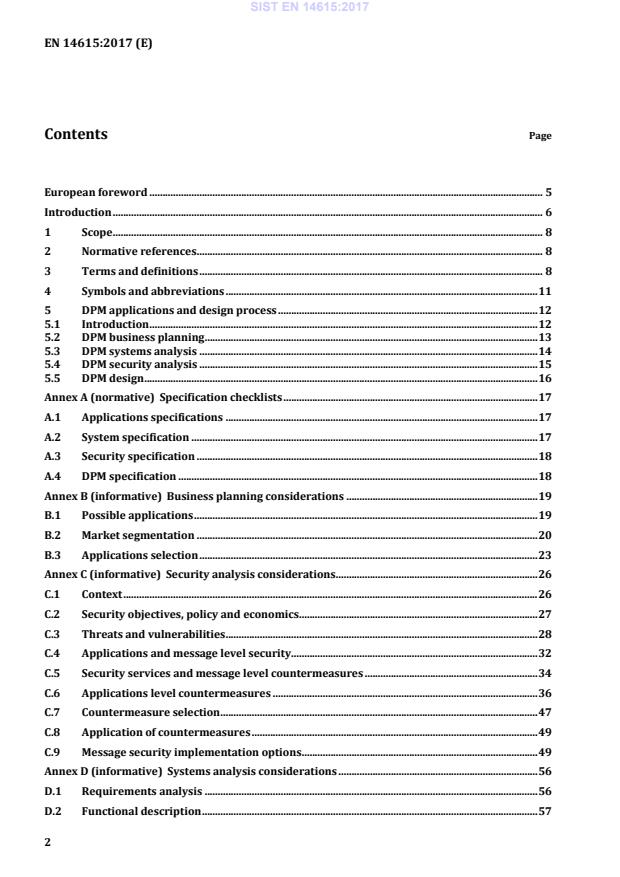
European foreword . 5 Introduction . 6 1 Scope . 8 2 Normative references . 8 3 Terms and definitions . 8 4 Symbols and abbreviations . 11 5 DPM applications and design process . 12 5.1 Introduction . 12 5.2 DPM business planning . 13 5.3 DPM systems analysis . 14 5.4 DPM security analysis . 15 5.5 DPM design . 16 Annex A (normative)
Specification checklists . 17 A.1 Applications specifications . 17 A.2 System specification . 17 A.3 Security specification . 18 A.4 DPM specification . 18 Annex B (informative)
Business planning considerations . 19 B.1 Possible applications . 19 B.2 Market segmentation . 20 B.3 Applications selection . 23 Annex C (informative)
Security analysis considerations . 26 C.1 Context . 26 C.2 Security objectives, policy and economics . 27 C.3 Threats and vulnerabilities . 28 C.4 Applications and message level security . 32 C.5 Security services and message level countermeasures . 34 C.6 Applications level countermeasures . 36 C.7 Countermeasure selection . 47 C.8 Application of countermeasures . 49 C.9 Message security implementation options . 49 Annex D (informative)
Systems analysis considerations . 56 D.1 Requirements analysis . 56 D.2 Functional description . 57 SIST EN 14615:2017
DPM design considerations . 67 E.1 Data content . 67 E.2 Data entry . 68 E.3 Data construct mapping . 69 E.4 Symbology . 70 E.5 Human readable information . 71 E.6 Layout, facing and aesthetics . 72 E.7 Performance and test criteria . 73 Annex F (informative)
Statistical analysis of DPM verification . 74 F.1 Introduction . 74 F.2 Purpose and scope of postal item verification . 74 F.3 Detection of DPMs with invalid validation code . 75 F.4 Influence of CVC length on fraud detection . 80 F.5 Detection of duplicate DPMs . 81 Annex G (informative)
Message security algorithms . 82 G.1 Introduction . 82 G.2 Hash functions used in message security services . 82 G.3 Asymmetric (public key) cryptographic algorithms . 83 G.4 Message authentication code (MAC) algorithms . 86 G.5 Exchange validation code generation . 90 G.6 Selection of algorithms for CVC implementation . 90 Annex H (informative)
CVC generation and verification data . 96 H.1 Introduction . 96 H.2 Sources of data for verification. 96 H.3 Selection of data used in the verification process . 97 Annex I (informative)
Architecture examples . 103 I.1 Introduction . 103 I.2 The REMPI architecture . 103 I.3 USPS IBIP configurations . 107 Annex J (informative)
Examples of digital postage marks (not to scale) . 112 J.1 Australia Post . 112 J.2 Canada Post . 112 J.3 Deutsche Post . 112 J.4 Die Post, Switzerland . 114 J.5 Royal Mail . 115 J.6 United States Postal Service (USPS) . 116 SIST EN 14615:2017
Relevant intellectual property rights (IPR) . 118 K.1 Introduction . 118 K.2 Massachusetts Institute of Technology . 118 K.3 Neopost . 118 K.4 Pitney Bowes Inc . 119 K.5 Pitney Bowes Inc, together with Certicom Corp . 119 K.6 United States Department of Commerce . 120 K.7 United States Postal Service . 120 Annex L (informative)
DPM design charts . 121 L.1 Applicability of countermeasures against identified threats . 121 L.2 Data elements used by typical applications and countermeasures . 125 L.3 Mapping data elements onto data source and DPM data constructs . 129 Bibliography . 131
1) The Universal Postal Union (UPU) is the specialised institution of the United Nations that regulates the universal postal service. The postal services of its 192 member countries form the largest physical distribution network in the world. Some 5 million postal employees working in over 660 000 post offices all over the world handle an annual total of 425 billion letters-post items in the domestic service and almost 6,7 billion in the international service. Some 4,5 billion parcels are sent by post annually. Keeping pace with the changing communications market, posts are increasingly using new communication and information technologies to move beyond what is traditionally regarded as their core postal business. They are meeting higher customer expectations with an expanded range of products and value-added services. 2) The UPU's Standards Board develops and maintains a growing number of standards to improve the exchange of postal-related information between posts, and promotes the compatibility of UPU and international postal initiatives. It works closely with posts, customers, suppliers and other partners, including various international organisations. The Standards Board ensures that coherent standards are developed in areas such as electronic data interchange (EDI), mail encoding, postal forms and meters. UPU standards are published in accordance with the rules given in Part VII of the General information on UPU standards, which can be freely downloaded from the UPU world-wide web site (www.upu.int). SIST EN 14615:2017
3) Mail service contractors are advised to ensure that reliance on patented approaches does not inadvertently lead to the creation of an effective monopoly. This could occur, even if usage of the approaches concerned is licensed by the mail service contractor, unless the terms of the licensing agreement commit the patent holder to making licences available, on appropriate terms, to the mail service contractors customers and suppliers, including competitors of the patent holder. SIST EN 14615:2017
4) UPU Standards are obtainable from the UPU International Bureau, whose contact details are given in the Bibliography; the UPU Standards glossary is freely accessible on URL http://www.upu.int SIST EN 14615:2017
See C.9.2. The use of digital signatures protects:
the sender against forgery by third parties or the recipient, and
the recipient against forgery by third parties and repudiation by the sender. 3.13 exchange validation code EVC code, known to or agreed between a mailer and a licensing post, which when applied to a postal item by the mailer, can be used by the licensing post to authenticate the origin of the item and, under appropriate circumstances, to verify the integrity of agreed upon DPM data Note 1 to entry: See also cryptographic validation code (CVC) and C.9.4. SIST EN 14615:2017
to the checklist in A.3.
Figure 1 — DPM Applications and Design Process SIST EN 14615:2017
This should cover: SIST EN 14615:2017
and Cost Justification: an analysis of the quantitative and qualitative benefits that are expected to result; how these are related to costs and the expected return, both for the mail service contractor and for the other affected parties. Consideration should be given to whether all parties are properly incentivized; i) Critical Success Factors: a description of the key factors which will influence the success of the implementation and subsequent operation and of the measures that need to be taken to control these factors; j) Management Control and Evaluation: a specification of how the implementation and subsequent operations will be managed and controlled. In particular, this should address the key decision points and what quantitative measures need to be available to support management decision processes. 5.3 DPM systems analysis The second stage in the DPM applications and design process is that of Systems Analysis. This should be undertaken in parallel with development of the Security Specification (see 5.4) since the two topics are closely interrelated: at least in payment related applications, many applications functions correspond to security countermeasures. Normal systems analysis and design processes should be followed, but there might be a need to pay particular attention to the phasing of development and introduction. It could well be that longer term objectives cannot be economically realized in the context of the existing postal system infrastructure and designs and plans for implementation should take into account the phasing in of infrastructure developments. The output of this stage shall be a control document, the System Specification, that describes the architecture for the system required to support the selected DPM applications and presents the system design in sufficient detail to give a boundary condition within which the detailed design of DPM applications can be prepared. The System Specification shall cover all systems requirements which need to be met in order to satisfy business objectives. At least the following topics, most of which are discussed at more length in informative Annex D, shall be addressed: SIST EN 14615:2017
...