

EN ISO 15156-2:2003
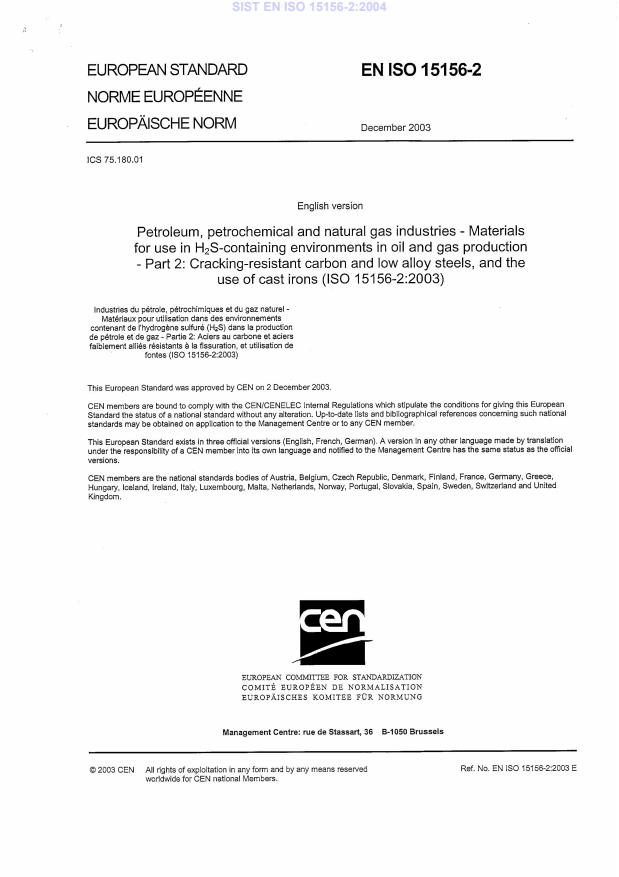
(Main)Petroleum, petrochemical and natural gas industries - Materials for use in H2S-containing environments in oil and gas production - Part 2: Cracking-resistant carbon and low alloy steels, and the use of cast irons (ISO 15156-2:2003)
- Status
- Withdrawn
- Publication Date
- 14-Dec-2003
- Withdrawal Date
- 14-Oct-2009
- Current Stage
- 9960 - Withdrawal effective - Withdrawal
- Start Date
- 15-Oct-2009
- Completion Date
- 15-Oct-2009

Relations
- Effective Date
- 24-Oct-2009
- Effective Date
- 28-Jan-2026
- Effective Date
- 12-Feb-2026
- Effective Date
- 08-Jun-2022
Get Certified
Connect with accredited certification bodies for this standard

Element Materials Technology
Materials testing and product certification.

ABS Group Brazil
ABS Group certification services in Brazil.

ABS Quality Evaluations Inc.
American Bureau of Shipping quality certification.
Sponsored listings
Frequently Asked Questions
EN ISO 15156-2:2003 is a standard published by the European Committee for Standardization (CEN). Its full title is "Petroleum, petrochemical and natural gas industries - Materials for use in H2S-containing environments in oil and gas production - Part 2: Cracking-resistant carbon and low alloy steels, and the use of cast irons (ISO 15156-2:2003)". This standard covers: Dieser Teil von ISO 15156 nennt Anforderungen und gibt Empfehlungen für die Auswahl und Qualifizierung von unlegierten und niedriglegierten Stählen für den Einsatz in Einrichtungen der Öl- und Gasgewinnung und in Erdgasaufbereitungsanlagen im Bereich H2S-haltiger Umgebungen, deren Versagen ein mögliches Gesundheits- und Sicherheitsrisiko für die Allgemeinheit und das Personal oder für die Umwelt darstellt. Er kann angewendet werden zur Vermeidung kostspieliger Beschädigungen infolge von Korrosion der Anlage selbst. Er ergänzt, ersetzt aber nicht die in einschlägigen Berechnungscodes, Normen oder Regelwerken vorgegebenen Anforderungen an Werkstoffe. Dieser Teil von ISO 15156 behandelt die Beständigkeit dieser Stähle gegen Schäden, die durch schwefelwasserstoffinduzierte Spannungsrisskorrosion (SSC) sowie die damit zusammenhängende spannungsorientierte wasserstoffinduzierte Rissbildung (SOHIC) und Weichzonenrissbildung (SZC) verursacht werden können. Dieser Teil von ISO 15156 behandelt auch die Beständigkeit dieser Stähle gegen wasserstoffinduzierte Rissbildung (HIC) und die daraus entstehende mögliche Stufenrissbildung (SWC). Dieser Teil von ISO 15156 bezieht sich nur auf die Rissbildung. Materialschwund auf Grund allgemeiner (Gewichtsschwund) oder örtlicher Korrosion wird nicht angesprochen. Tabelle 1 enthält als nicht erschöpfende Liste eine Übersicht von Ausrüstungen, die in den Anwendungsbereich von ISO 15156 fallen. Tabelle 1 enthält auch eine Liste der Ausrüstungen, die unter den vorgegebenen Umständen vom Anwendungsbereich von ISO 15156 ausgenommen sein können. Dieser Teil von ISO 15156 gilt für die Qualifizierung und Auswahl von Werkstoffen für Ausrüstungen, die unter Verwendung konventioneller Kriterien für die elastische Auslegung bemessen und gebaut wurden. Für Auslegungen, die auf Plastizitätskriterien (z. B. Verformung und Grenzzustände) beruhen, siehe ISO 15156-1, Abschnitt 5. WARNHINWEIS: Nach diesem Teil von ISO 15156 ausgewählte unlegiert
Dieser Teil von ISO 15156 nennt Anforderungen und gibt Empfehlungen für die Auswahl und Qualifizierung von unlegierten und niedriglegierten Stählen für den Einsatz in Einrichtungen der Öl- und Gasgewinnung und in Erdgasaufbereitungsanlagen im Bereich H2S-haltiger Umgebungen, deren Versagen ein mögliches Gesundheits- und Sicherheitsrisiko für die Allgemeinheit und das Personal oder für die Umwelt darstellt. Er kann angewendet werden zur Vermeidung kostspieliger Beschädigungen infolge von Korrosion der Anlage selbst. Er ergänzt, ersetzt aber nicht die in einschlägigen Berechnungscodes, Normen oder Regelwerken vorgegebenen Anforderungen an Werkstoffe. Dieser Teil von ISO 15156 behandelt die Beständigkeit dieser Stähle gegen Schäden, die durch schwefelwasserstoffinduzierte Spannungsrisskorrosion (SSC) sowie die damit zusammenhängende spannungsorientierte wasserstoffinduzierte Rissbildung (SOHIC) und Weichzonenrissbildung (SZC) verursacht werden können. Dieser Teil von ISO 15156 behandelt auch die Beständigkeit dieser Stähle gegen wasserstoffinduzierte Rissbildung (HIC) und die daraus entstehende mögliche Stufenrissbildung (SWC). Dieser Teil von ISO 15156 bezieht sich nur auf die Rissbildung. Materialschwund auf Grund allgemeiner (Gewichtsschwund) oder örtlicher Korrosion wird nicht angesprochen. Tabelle 1 enthält als nicht erschöpfende Liste eine Übersicht von Ausrüstungen, die in den Anwendungsbereich von ISO 15156 fallen. Tabelle 1 enthält auch eine Liste der Ausrüstungen, die unter den vorgegebenen Umständen vom Anwendungsbereich von ISO 15156 ausgenommen sein können. Dieser Teil von ISO 15156 gilt für die Qualifizierung und Auswahl von Werkstoffen für Ausrüstungen, die unter Verwendung konventioneller Kriterien für die elastische Auslegung bemessen und gebaut wurden. Für Auslegungen, die auf Plastizitätskriterien (z. B. Verformung und Grenzzustände) beruhen, siehe ISO 15156-1, Abschnitt 5. WARNHINWEIS: Nach diesem Teil von ISO 15156 ausgewählte unlegiert
EN ISO 15156-2:2003 is classified under the following ICS (International Classification for Standards) categories: 75.180.10 - Exploratory, drilling and extraction equipment; 77.060 - Corrosion of metals. The ICS classification helps identify the subject area and facilitates finding related standards.
EN ISO 15156-2:2003 has the following relationships with other standards: It is inter standard links to EN ISO 15156-2:2009, EN 14870-2:2004, ISO 15156-2:2003, EN ISO 15156-2:2003/AC:2006. Understanding these relationships helps ensure you are using the most current and applicable version of the standard.
EN ISO 15156-2:2003 is available in PDF format for immediate download after purchase. The document can be added to your cart and obtained through the secure checkout process. Digital delivery ensures instant access to the complete standard document.
Standards Content (Sample)
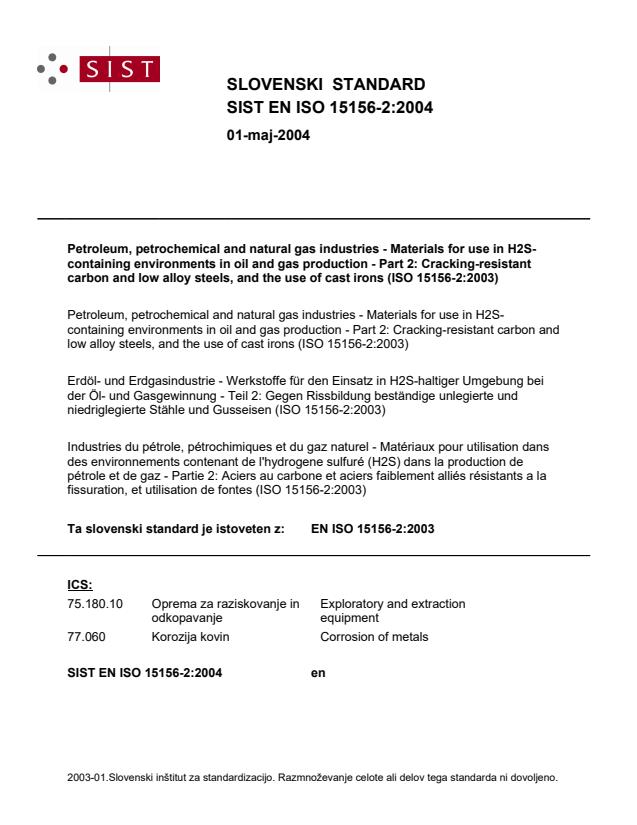
SLOVENSKI STANDARD
01-maj-2004
Petroleum, petrochemical and natural gas industries - Materials for use in H2S-
containing environments in oil and gas production - Part 2: Cracking-resistant
carbon and low alloy steels, and the use of cast irons (ISO 15156-2:2003)
Petroleum, petrochemical and natural gas industries - Materials for use in H2S-
containing environments in oil and gas production - Part 2: Cracking-resistant carbon and
low alloy steels, and the use of cast irons (ISO 15156-2:2003)
Erdöl- und Erdgasindustrie - Werkstoffe für den Einsatz in H2S-haltiger Umgebung bei
der Öl- und Gasgewinnung - Teil 2: Gegen Rissbildung beständige unlegierte und
niedriglegierte Stähle und Gusseisen (ISO 15156-2:2003)
Industries du pétrole, pétrochimiques et du gaz naturel - Matériaux pour utilisation dans
des environnements contenant de l'hydrogene sulfuré (H2S) dans la production de
pétrole et de gaz - Partie 2: Aciers au carbone et aciers faiblement alliés résistants a la
fissuration, et utilisation de fontes (ISO 15156-2:2003)
Ta slovenski standard je istoveten z: EN ISO 15156-2:2003
ICS:
75.180.10 Oprema za raziskovanje in Exploratory and extraction
odkopavanje equipment
77.060 Korozija kovin Corrosion of metals
2003-01.Slovenski inštitut za standardizacijo. Razmnoževanje celote ali delov tega standarda ni dovoljeno.
INTERNATIONAL ISO
STANDARD 15156-2
First edition
2003-12-15
Petroleum and natural gas industries —
Materials for use in H S-containing
environments in oil and gas
production —
Part 2:
Cracking-resistant carbon and low alloy
steels, and the use of cast irons
Industries du pétrole et du gaz naturel — Matériaux pour utilisation
dans des environnements contenant de l'hydrogène sulfuré (H S) dans
la production de pétrole et de gaz —
Partie 2: Aciers au carbone et aciers faiblement alliés résistants à
la fissuration, et utilisation de fontes
Reference number
ISO 15156-2:2003(E)
©
ISO 2003
ISO 15156-2:2003(E)
PDF disclaimer
This PDF file may contain embedded typefaces. In accordance with Adobe's licensing policy, this file may be printed or viewed but
shall not be edited unless the typefaces which are embedded are licensed to and installed on the computer performing the editing. In
downloading this file, parties accept therein the responsibility of not infringing Adobe's licensing policy. The ISO Central Secretariat
accepts no liability in this area.
Adobe is a trademark of Adobe Systems Incorporated.
Details of the software products used to create this PDF file can be found in the General Info relative to the file; the PDF-creation
parameters were optimized for printing. Every care has been taken to ensure that the file is suitable for use by ISO member bodies. In
the unlikely event that a problem relating to it is found, please inform the Central Secretariat at the address given below.
© ISO 2003
All rights reserved. Unless otherwise specified, no part of this publication may be reproduced or utilized in any form or by any means,
electronic or mechanical, including photocopying and microfilm, without permission in writing from either ISO at the address below or
ISO's member body in the country of the requester.
ISO copyright office
Case postale 56 • CH-1211 Geneva 20
Tel. + 41 22 749 01 11
Fax + 41 22 749 09 47
E-mail copyright@iso.org
Web www.iso.org
Published in Switzerland
ii © ISO 2003 — All rights reserved
ISO 15156-2:2003(E)
Contents Page
Foreword. iv
Introduction . v
1 Scope. 1
2 Normative references . 2
3 Terms and definitions. 3
4 Symbols and abbreviated terms. 6
5 Purchasing information. 7
6 Factors affecting the behaviour of carbon and low alloy steels in H S-containing
environments. 7
7 Qualification and selection of carbon and low alloy steels with resistance to SSC, SOHIC
and SZC. 8
7.1 Option 1: Selection of SSC-resistant steels (and cast irons) using A.2. 8
7.2 Option 2: Selection of steels for specific sour service applications or for ranges of sour
service. 8
7.3 Hardness requirements. 10
7.4 Other fabrication methods . 16
8 Evaluation of carbon and low alloy steels for their resistance to HIC/SWC. 16
9 Marking. 16
Annex A (normative) SSC-resistant carbon and low alloy steels (and requirements and
recommendations for the use of cast irons). 17
Annex B (normative) Qualification of carbon and low alloy steels for H S service by laboratory
testing. 26
Annex C (informative) Determination of H S partial pressure . 34
Annex D (informative) Recommendations for determining pH. 36
Annex E (informative) Information to be supplied for material purchasing . 41
Bibliography . 43
ISO 15156-2:2003(E)
Foreword
ISO (the International Organization for Standardization) is a worldwide federation of national standards bodies
(ISO member bodies). The work of preparing International Standards is normally carried out through ISO
technical committees. Each member body interested in a subject for which a technical committee has been
established has the right to be represented on that committee. International organizations, governmental and
non-governmental, in liaison with ISO, also take part in the work. ISO collaborates closely with the
International Electrotechnical Commission (IEC) on all matters of electrotechnical standardization.
International Standards are drafted in accordance with the rules given in the ISO/IEC Directives, Part 2.
The main task of technical committees is to prepare International Standards. Draft International Standards
adopted by the technical committees are circulated to the member bodies for voting. Publication as an
International Standard requires approval by at least 75 % of the member bodies casting a vote.
Attention is drawn to the possibility that some of the elements of this document may be the subject of patent
rights. ISO shall not be held responsible for identifying any or all such patent rights.
ISO 15156-2 was prepared by Technical Committee ISO/TC 67, Materials, equipment and offshore strcutures
for petroleum and natural gas industries.
ISO 15156 consists of the following parts, under the general title Petroleum and natural gas industries —
Materials for use in H S-containing environments in oil and gas production:
Part 1: General principles for selection of cracking-resistant materials
Part 2: Cracking-resistant carbon and low alloy steels, and the use of cast irons
Part 3: Cracking-resistant CRAs (corrosion-resistant alloys) and other alloys
iv © ISO 2003 — All rights reserved
ISO 15156-2:2003(E)
Introduction
The consequences of sudden failures of metallic oil and gas field components, associated with their exposure
to H S-containing production fluids, led to the preparation of the first edition of NACE MR0175, which was
published in 1975 by the National Association of Corrosion Engineers, now known as NACE International.
The original and subsequent editions of NACE MR0175 established limits of H S partial pressure above which
precautions against sulfide stress-cracking (SSC) were always considered necessary. They also provided
guidance for the selection and specification of SSC-resistant materials when the H S thresholds were
exceeded. In more recent editions, NACE MR0175 has also provided application limits for some
corrosion-resistant alloys, in terms of environmental composition and pH, temperature and H S partial
pressures. NACE MR0175 is complemented by NACE TM0177-96 and NACE TM0284 test methods.
In separate developments, the European Federation of Corrosion issued EFC Publication 16 in 1995 and EFC
Publication 17 in 1996. These documents are generally complementary to those of NACE though they differ in
scope and detail.
This part of ISO 15156 utilizes the above sources to provide requirements and recommendations for materials
qualification and selection for application in environments containing wet H S in oil and gas production
systems.
Changes will be incorporated into this part of ISO 15156 by amendment or revision in accordance with
Interpretation and maintenance of ISO 15156 by ISO/TC 67/WG 7, copies of which can be obtained from the
ISO/TC 67 Secretariat. Experts from both NACE and EFC are members of ISO/TC 67/WG 7.
INTERNATIONAL STANDARD ISO 15156-2:2003(E)
Petroleum and natural gas industries — Materials for use in
H S-containing environments in oil and gas production —
Part 2:
Cracking-resistant carbon and low alloy steels, and the use of
cast irons
WARNING — Carbon and low alloy steels and cast irons selected using this part of ISO 15156 are
resistant to cracking in defined H S-containing environments in oil and gas production but not
necessarily immune to cracking under all service conditions. It is the equipment user's responsibility
to select the carbon and low alloy steels and cast irons suitable for the intended service.
1 Scope
This part of ISO 15156 gives requirements and recommendations for the selection and qualification of carbon
and low alloy steels for service in equipment, used in oil and natural gas production and natural gas treatment
plants in H S-containing environments, whose failure could pose a risk to the health and safety of the public
and personnel or to the environment. It can be applied to help to avoid costly corrosion damage to the
equipment itself. It supplements, but does not replace, the materials’ requirements of the appropriate design
codes, standards or regulations.
This part of ISO 15156 addresses the resistance of these steels to damage that may be caused by sulfide
stress-cracking (SSC) and the related phenomena of stress-oriented hydrogen-induced cracking (SOHIC) and
soft-zone cracking (SZC).
This part of ISO 15156 also addresses the resistance of these steels to hydrogen-induced cracking (HIC) and
its possible development into stepwise cracking (SWC).
This part of ISO 15156 is only concerned with cracking. Loss of material by general (mass loss) or localized
corrosion is not addressed.
Table 1 provides a non-exhaustive list of equipment to which this part of ISO 15156 is applicable, including
permitted exclusions.
This part of ISO 15156 applies to the qualification and selection of materials for equipment designed and
constructed using conventional elastic design criteria. For designs utilizing plastic criteria (e.g. strain-based
and limit-state designs), see ISO 15156-1:2001, Clause 5.
Annex A lists SSC-resistant carbon and low alloy steels, and A.2.4 includes requirements for the use of cast
irons.
This part of ISO 15156 is not necessarily suitable for application to equipment used in refining or downstream
processes and equipment.
ISO 15156-2:2003(E)
Table 1 — List of equipment
ISO 15156 is applicable to materials used
Permitted exclusions
for the following equipment
a
Drilling, well construction and well-servicing Equipment only exposed to drilling fluids of controlled composition
equipment
Drill bits
b
Blowout Preventer (BOP) shear blades
Drilling riser systems
Work strings
c
Wireline and wireline equipment
Surface and intermediate casing
d
Wells, including subsurface equipment, gas lift Sucker rod pumps and sucker rods
equipment, wellheads and christmas trees
Electric submersible pumps
Other artificial lift equipment
Slips
Flow-lines, gathering lines, field facilities and Crude oil storage and handling facilities operating at a total absolute
field processing plants pressure below 0,45 MPa (65 psi)
Water-handling equipment Water-handling facilities operating at a total absolute pressure below
0,45 MPa (65 psi)
Natural gas treatment plants
Transportation pipelines for liquids, gases and Lines handling gas prepared for general commercial and domestic use
multiphase fluids
For all equipment above Components loaded only in compression
a
See A.2.3.2.3 for more information.
b
See A.2.3.2.1 for more information.
c
Wireline lubricators and lubricator connecting devices are not permitted exclusions.
d
For sucker rod pumps and sucker rods, reference can be made to NACE MR0176.
2 Normative references
The following referenced documents are indispensable for the application of this document. For dated
references, only the edition cited applies. For undated references, the latest edition of the referenced
document (including any amendments) applies.
ISO 6506-1, Metallic materials — Brinell hardness test — Part 1: Test method
ISO 6507-1, Metallic materials — Vickers hardness test — Part 1: Test method
ISO 6508-1, Metallic materials — Rockwell hardness test — Part 1: Test method (scales A, B, C, D, E, F, G,
H, K, N, T)
ISO 6892, Metallic materials — Tensile testing at ambient temperature
ISO 10423, Petroleum and natural gas industries — Drilling and production equipment — Wellhead and
christmas tree equipment
ISO 15156-1:2001, Petroleum and natural gas industries — Materials for use in H S-containing environments
in oil and gas production — Part 1: General principles for selection of cracking-resistant materials
2 © ISO 2003 — All rights reserved
ISO 15156-2:2003(E)
1)
NACE TM0177-96 , Laboratory testing of metals for resistance to sulfide stress cracking and stress corrosion
cracking in H S environments
NACE TM0284, Evaluation of pipeline and pressure vessel steels for resistance to hydrogen-induced cracking
2)
EFC Publications Number 16 , Guidelines on materials requirements for carbon and low alloy steels for H S-
containing environments in oil and gas production
3)
SAE AMS-S-13165 , Shot peening of metal parts
3 Terms and definitions
For the purposes of this document, the terms and definitions given in ISO 15156-1 and the following apply.
3.1
Brinell hardness
HBW
hardness value, measured in accordance with ISO 6506-1, normally using a 10-mm diameter tungsten ball
and a force of 29,42 kN
3.2
bubble-point pressure
p
B
pressure under which gas bubbles will form in a liquid at a particular operating temperature
NOTE See C.2.
3.3
burnish
process of smoothing surfaces using frictional contact between the material and some other hard pieces of
material, such as hardened steel balls
3.4
casting
metal that is obtained at or near its finished shape by the solidification of molten metal in a mould
3.5
cast iron
iron-carbon alloy containing approximately 2 % to 4 % carbon
3.5.1
grey cast iron
cast iron that displays a grey fracture surface due to the presence of flake graphite
3.5.2
white cast iron
cast iron that displays a white fracture surface due to the presence of cementite
1) NACE International, P.O. Box 2183140, Houston, Texas 77218-8340, USA
2) European Federation of Corrosion, available from The Institute of Materials, 1 Carlton House Terrace, London SW1Y
5DB, UK [ISBN 0-901716-95-2]
3) Society of Automotive Engineers (SAE), 400 Commonwealth Drive, Warrendale, PA 15096-0001 USA
ISO 15156-2:2003(E)
3.5.3
malleable cast iron
white cast iron that is thermally treated to convert most or all of the cementite to graphite (temper carbon)
3.5.4
ductile cast iron
nodular cast iron
cast iron that has been treated while molten with an element (usually magnesium or cerium) that spheroidizes
the graphite
3.6
cementite
microstructural constituent of steels composed principally of iron carbide (Fe C)
3.7
cold working
cold deforming
cold forging
cold forming
deforming metal plastically under conditions of temperature and strain rate that induce strain-hardening,
usually, but not necessarily, conducted at room temperature
3.8
fitness-for-purpose
suitability for use under the expected service conditions
3.9
free-machining steel
steel to which elements such as sulfur, selenium and lead have been added intentionally to improve
machineability
3.10
lower critical temperature
temperature of a ferrous metal at which austenite begins to form during heating or at which the transformation
of austenite is completed during cooling
3.11
nitriding
case-hardening process in which nitrogen is introduced into the surface of metallic materials (most commonly
ferrous alloys)
EXAMPLES Liquid nitriding, gas nitriding, ion nitriding and plasma nitriding.
3.12
normalizing
heating a ferrous metal to a suitable temperature above the transformation range (austenitizing), holding at
temperature for a suitable time and then cooling in still air (or protective atmosphere) to a temperature
substantially below the transformation range
3.13
plastically deformed
permanently deformed by stressing beyond the limit of elasticity, i.e. the limit of proportionality of stress to
strain
3.14
pressure-containing parts
those parts whose failure to function as intended would result in a release of retained fluid to the atmosphere
NOTE Examples are valve bodies, bonnets and stems.
4 © ISO 2003 — All rights reserved
ISO 15156-2:2003(E)
3.15
quenched and tempered
quench hardened and then tempered
3.16
Rockwell C hardness
HRC
hardness value, measured in accordance with ISO 6508, obtained using a diamond cone indenter and a force
of 1 471 N
3.17
shot peening
inducing compressive stresses in the surface layer of a material by bombarding it with a selected medium
(usually round steel shot) under controlled conditions
3.18
stress relieving
heating a metal to a suitable temperature, holding at that temperature long enough to reduce residual stresses,
and then cooling slowly enough to minimize the development of new residual stresses
3.19
tempering
heat treatment by heating to a temperature below the lower critical temperature, for the purpose of decreasing
the hardness and increasing the toughness of hardened steel, hardened cast iron and, sometimes, normalized
steel
3.20
tensile strength
ultimate strength
ratio of maximum load to original cross-sectional area
NOTE See ISO 6892.
3.21
test batch
group of items representing a production batch whose conformity with a specified requirement can be
determined by testing representative samples in accordance with a defined procedure
3.22
tubular component
cylindrical component (pipe) having a longitudinal hole, used in drilling/production operations for conveying
fluids
3.23
Vickers hardness
HV
hardness value, measured in accordance with ISO 6507-1, obtained using a diamond pyramid indenter and
one of a variety of possible applied loads
3.24
weldment
that portion of a component on which welding has been performed, including the weld metal, the heat-affected
zone (HAZ), and the adjacent parent metal
3.25
weld metal
that portion of a weldment that has been molten during welding
ISO 15156-2:2003(E)
3.26
wrought metal
metal in the solid condition that is formed to a desired shape by working (rolling, extruding, forging, etc.),
usually at an elevated temperature
4 Symbols and abbreviated terms
For the purposes of this document, the abbreviated terms given in ISO 15156-1 and the following apply.
AYS actual yield strength
CLR crack length ratio
CR c-ring (test)
CSR crack surface ratio
CTR crack thickness ratio
DCB double cantilever beam (test)
FPB four point bend (test)
HBW Brinell hardness
HIC hydrogen-induced cracking
HRC Rockwell hardness (scale C)
HSC hydrogen stress cracking
HV Vickers hardness
OCTG oil country tubular goods, i.e. casing, tubing and drill pipe
p partial pressure of H S
H S 2
R 0,2 % proof stress in accordance with ISO 6892
p0,2
SMYS specified minimum yield strength
SOHIC stress-oriented hydrogen-induced cracking
SSC sulfide stress-cracking
SWC stepwise cracking
SZC soft-zone cracking
UNS Unified Numbering System (from SAE-ASTM, Metals and alloys in the Unified Numbering System)
UT uniaxial tensile (test)
6 © ISO 2003 — All rights reserved
ISO 15156-2:2003(E)
5 Purchasing information
5.1 The preparation of material purchasing specifications might require co-operation and exchange of data
between the equipment user, the equipment supplier and the material manufacturer to ensure that the
material purchased complies with ISO 15156-1 and this part of ISO 15156.
5.2 The following information shall be provided:
preferred material types and/or grades (if known);
equipment type (if known);
reference to this part of ISO 15156;
acceptable bases for selection of materials for SSC resistance (see Clause 7);
requirements for HIC resistance (see Clause 8).
5.3 The equipment user and the equipment supplier/material manufacturer may agree that carbon or low
alloy steels other than those described and/or listed in Annex A may be selected subject to suitable
qualification testing in accordance with Annex B and ISO 15156-1. The qualification requirements may be
extended to include resistance to SOHIC and SZC.
If the purchaser intends to make use of such agreements, extensions and qualifications, the appropriate
additional information shall be clearly indicated in the materials purchasing specification. This information may
include
requirements for SSC testing (see 7.1, 7.2),
service conditions for specific sour service application, and
other special requirements.
5.4 Annex C describes how to calculate the H S partial pressure and Annex D gives guidance on how to
determine the pH-value of a fluid.
5.5 The information required for material purchasing shall be entered on suitable data sheets. Suggested
formats are given in Annex E.
6 Factors affecting the behaviour of carbon and low alloy steels in H S-containing
environments
The behaviour of carbon and low alloy steels in H S-containing environments is affected by complex
interactions of parameters, including the following:
a) chemical composition, method of manufacture, product form, strength, hardness of the material and its
local variations, amount of cold work, heat treatment condition, microstructure, microstructural uniformity,
grain size and cleanliness of the material;
b) H S partial pressure or equivalent concentration in the water phase;
c) chloride ion concentration in the water phase;
d) acidity (pH) of the water phase;
e) presence of sulfur or other oxidants;
f) exposure to non-production fluids;
ISO 15156-2:2003(E)
g) exposure temperature;
h) total tensile stress (applied plus residual);
i) exposure time.
These factors shall be considered when using this part of ISO 15156 for the selection of materials suitable for
environments containing H S in oil and gas production systems.
7 Qualification and selection of carbon and low alloy steels with resistance to SSC,
SOHIC and SZC
7.1 Option 1: Selection of SSC-resistant steels (and cast irons) using A.2
7.1.1 For p < 0,3 kPa (0,05 psi)
H S
The selection of materials for SSC resistance for p below 0,3 kPa (0,05 psi) is not considered in detail in
H S
this part of ISO 15156. Normally, no special precautions are required for the selection of steels for use under
these conditions, nevertheless, highly susceptible steels can crack. Further information on factors affecting
susceptibility of steels and attack by cracking mechanisms other than SSC is given in 7.2.1.
7.1.2 For p W 0,3 kPa (0,05 psi)
H S
If the partial pressure of H S in the gas is equal to or greater than 0,3 kPa (0,05 psi), SSC-resistant steels
shall be selected using A.2.
NOTE 1 The steels described or listed in A.2 are considered resistant to SSC in oil and natural gas production and
natural gas treatment plants.
NOTE 2 Users concerned with the occurrence of SOHIC and/or SZC can refer to Option 2 (see 7.2.2).
NOTE 3 For HIC and SWC, refer to Clause 8.
7.2 Option 2: Selection of steels for specific sour service applications or for ranges of sour
service
7.2.1 Sulfide stress-cracking (SSC)
7.2.1.1 General
Option 2 allows the user to qualify and select materials for SSC resistance for specific sour service
applications or for ranges of sour service.
The use of Option 2 may require knowledge of both the in situ pH and the H S partial pressure and their
variations with time (see ISO 15156-1).
Option 2 facilitates the purchase of bulk materials, such as OCTG or line pipe, where the economic incentive
to use materials not described nor listed in Annex A outweighs the additional qualification and other costs that
might be incurred. Steels for other equipment may also be qualified. In some cases this will require agreement
between the supplier and the equipment user with respect to test and acceptance requirements. Such
agreements shall be documented.
Option 2 can also facilitate fitness-for-purpose evaluations of existing carbon or low alloy steel equipment
exposed to sour service conditions more severe than assumed in the current design.
8 © ISO 2003 — All rights reserved
ISO 15156-2:2003(E)
7.2.1.2 SSC Regions of environmental severity
The severity of the sour environment, determined in accordance with ISO 15156-1, with respect to SSC of a
carbon or low alloy steel shall be assessed using Figure 1.
Key
X H S partial pressure, kPa
Y in situ pH
0 Region 0
1 SSC Region 1
2 SSC Region 2
3 SSC Region 3
In defining the severity of the H S-containing environment, the possibility of exposure to unbuffered condensed aqueous
phases of low pH during upset operating conditions or downtime, or to acids used for well stimulation and/or the backflow
of stimulation acid, after reaction should be considered.
NOTE 1 The discontinuities in the figure below 0,3 kPa (0,05 psi) and above 1 MPa (150 psi) partial pressure H S
reflect uncertainty with respect to the measurement of H S partial pressure (low H S) and steel’s performance outside
2 2
these limits (both low and high H S).
NOTE 2 Guidance on the calculation of H S partial pressure is given in Annex C.
NOTE 3 Guidance on the calculation of pH is given in Annex D.
Figure 1 — Regions of environmental severity with respect to SSC of carbon and low alloy steels
7.2.1.3 Region 0, p < 0,3 kPa (0,05 psi)
H S
Normally, no precautions are required for the selection of steels for use under these conditions. Nevertheless,
a number of factors that can affect a steel's performance in this region should be considered, as follows.
Steels that are highly susceptible to SSC and HSC may crack.
ISO 15156-2:2003(E)
A steel's physical and metallurgical properties affect its inherent resistance to SSC and HSC, see
Clause 6.
Very high strength steels can suffer HSC in aqueous environments without H S. Above about 965 MPa
(140 ksi) yield strength, attention may be required to steel composition and processing to ensure that
these steels do not exhibit SSC or HSC in Region 0 environments.
Stress concentrations increase the risk of cracking.
7.2.1.4 SSC Regions 1, 2 and 3
Referring to the Regions of severity of the exposure as defined in Figure 1, steels for Region 1 may be
selected using A.2, A.3 or A.4, steels for Region 2 may be selected using A.2 or A.3 and steels for Region 3
may be selected using A.2.
In the absence of suitable choices from Annex A, carbon and low alloy steels may be tested and qualified for
use under specific sour service conditions or for use throughout a given SSC Region. Testing and qualification
shall be in accordance with ISO 15156-1 and Annex B.
Documented field experience may also be used as the basis for material selection for a specific sour service
application (see ISO 15156-1).
7.2.2 SOHIC and SZC
The user should consider SOHIC and SZC, as defined in ISO 15156-1, when evaluating carbon steels in plate
form and their welded products for sour service in H S-containing environments.
B.4 provides guidance on test methods and acceptance criteria to evaluate resistance to SOHIC and SZC.
NOTE The occurrence of these phenomena is rare and they are not well understood. They have caused sudden
failures in parent steels (SOHIC) and in the HAZ of welds (SOHIC and SZC). Their occurrence is thought to be restricted
to carbon steels. The presence of sulfur or oxygen in the service environment is thought to increase the probability of
damage by these mechanisms.
7.3 Hardness requirements
7.3.1 General
The hardness of parent materials and of welds and their heat-affected zones play important roles in
determining the SSC resistance of carbon and low alloy steels. Hardness control can be an acceptable means
of obtaining SSC resistance.
7.3.2 Parent metals
If hardness measurements on parent metal are specified, sufficient hardness tests shall be made to establish
the actual hardness of the steel being examined. Individual HRC readings exceeding the value permitted by
this part of ISO 15156 may be considered acceptable if the average of several readings taken within close
proximity does not exceed the value permitted by this part of ISO 15156 and no individual reading is greater
than 2 HRC above the specified value. Equivalent requirements shall apply to other methods of hardness
measurement when specified in this part of ISO 15156 or referenced in a manufacturing specification.
NOTE The number and location of hardness tests on parent metal are not specified in ISO 15156.
For ferritic steels, EFC Publication 16 shows graphs for the conversion of hardness readings, from Vickers
(HV) to Rockwell (HRC) and from Vickers (HV) to Brinell (HBW), derived from the tables of ASTM E 140 and
BS 860. Other conversion tables also exist. Users may establish correlations for individual materials.
10 © ISO 2003 — All rights reserved
ISO 15156-2:2003(E)
7.3.3 Welds
7.3.3.1 General
The metallurgical changes that occur on welding carbon and low alloy steels affect their susceptibility to SSC,
SOHIC and SZC.
Processes and consumables should be selected in accordance with good practice and to achieve the required
cracking resistance.
Welding shall be carried out in compliance with appropriate codes and standards as agreed between the
supplier and the purchaser. Welding procedure specifications (WPSs) and procedure qualification records
(PQRs) shall be available for inspection by the equipment user.
The qualification of welding procedures for sour service shall include hardness testing in accordance with
7.3.3.2, 7.3.3.3 and 7.3.3.4.
7.3.3.2 Hardness testing methods for welding procedure qualification
Hardness testing for welding procedure qualification shall normally be carried out using the Vickers HV 10 or
HV 5 method in accordance with ISO 6507-1, or the Rockwell method in accordance with ISO 6508-1 using
the 15N scale.
The HRC method may be used for welding procedure qualification if the design stress does not exceed two-
thirds of SMYS and the welding procedure specification includes post weld heat treatment. The use of the
HRC method for welding procedure qualification in all other cases shall require the agreement of the
equipment user.
NOTE Hardness surveys using the Vickers or Rockwell 15N testing method produce a more detailed picture of weld
hardness and its variations. Hardness surveys using the HRC testing method might not detect small zones in welds or
HAZs where the hardness exceeds the acceptance criteria for the Vickers or Rockwell 15N testing method. The
significance of such small hard zones is not well understood.
The use of other hardness testing methods shall require the agreement of the equipment user.
The Vickers or Rockwell 15N hardness testing method shall be used for the qualification of alternative weld
hardness acceptance criteria as permitted in 7.3.3.4.
7.3.3.3 Hardness surveys for welding procedure qualification
Vickers hardness surveys shall be in accordance with Figure 2 for butt welds, Figure 3 for fillet welds and
Figure 4 for repair and partial penetration welds. HRC surveys of butt welds shall be in accordance with
Figure 5. Survey requirements for other joint configurations shall be developed from these figures.
ISO 15156-2:2003(E)
Dimensions in millimetres
Key
A weld heat-affected zone (visible after etching)
B lines of survey
Hardness impressions 2, 3, 6, 7, 10, 11, 14, 15, 17 and 19 should be entirely within the heat-affected zone and located as
close as possible to the fusion boundary between the weld metal and the heat-affected zone.
The top line of survey should be positioned so that impressions 2 and 6 coincide with the heat-affected zone of the final
run or change of profile of the fusion line associated with the final run.
Figure 2 — Butt weld survey method for Vickers hardness measurement
12 © ISO 2003 — All rights reserved
ISO 15156-2:2003(E)
Dimensions in millimetres
Key
A weld heat-affected zone (visible after etching)
B line of survey
C line of survey, parallel to line B and passing through the fusion boundary between the weld metal and the
heat-affected zone at the throat
Hardness impressions 3, 6, 10 and 12 should be entirely within the heat-affected zone and located as close as possible to
the fusion boundary between the weld metal and the heat-affected zone.
Figure 3 — Fillet weld
ISO 15156-2:2003(E)
Dimensions in millimetres
Key
A original weld heat-affected zone
B repair weld heat-affected zone
C parallel lines of survey
Hardness impressions in the heat-affected zone should be located as close as possible to the fusion boundary.
The top line of survey should be positioned so that the heat-affected zone impressions coincide with the heat-affected
zone of the final run or change in profile of the cap of fusion line associated with the final run.
Figure 4 — Repair and partial penetration welds
14 © ISO 2003 — All rights reserved
ISO 15156-2:2003(E)
Dimensions in millimetres
Key
A weld
B weld heat-affected zone (visible after etching)
C parent metal
D lines of survey
Hardness impressions in the weld heat-affected zone should be located within 2 mm of the fusion boundary.
Figure 5 — Butt weld (survey method for Rockwell hardness measurements)
7.3.3.4 Hardness acceptance criteria for welds
Weld hardness acceptance criteria for steels selected using option 1 (see 7.1) shall be as specified in A.2.1.4.
Alternative weld hardness acceptance criteria may be established from successful SSC testing of welded
samples. SSC testing shall be in accordance with Annex B.
Weld hardness acceptance criteria for steels qualified and/or selected using option 2 (see 7.2) may be
established from successful SSC testing of welded samples. SSC testing shall be in accordance with Annex B.
ISO 15156-2:2003(E)
7.4 Other fabrication methods
For steels that are subject to hardness change caused by fabrication methods other than welding, hardness
testing shall be specified as part of the qualification of the fabrication process. Hardness testing shall be
specified as part of the qualification of burning/cutting processes if any HAZ remains in the final product. The
requirements, interpreted for the fabrication method, and hardness acceptance criteria of 7.3 shall apply.
The form and location of the samples for evaluation and testing shall be acceptable to the equipment user.
8 Evaluation of carbon and low alloy steels for their resistance to HIC/SWC
The equipment user shall consider HIC/SWC as defined in ISO 15156-1 when evaluating flat-rolled carbon
steel products for sour service environments containing even trace amounts of H S and shall consider
HIC/SWC testing of these products. Annex B provides guidance on test methods and acceptance criteria to
evaluate resistance to HIC/SWC.
The probability of HIC/SWC is influenced by steel chemistry and manufacturing route. The level of sulfur in the
steel is of particular importance, typical maximum acceptable levels for flat-rolled and seamless products are
0,003 % and 0,01 %, respectively. Conventional forgings with sulfur levels less than 0,025 %, and castings,
are not normally considered sensitive to HIC or SOHIC.
NOTE 1 HIC/SWC leading to loss of containment has occurred only rarely in seamless pipe and other products that are
not flat-rolled. Furthermore, seamless pipe manufactured using modern technology is much less sensitive to HIC/SWC
than older products. Hence there could be benefits in evaluating seamless pipe for HIC/SWC resistance for applications
where the potential consequences of failure make this justifiable.
NOTE 2 The presence of rust, sulfur or oxygen, particularly together with chloride, in the service environment is
thought to increase the probability of damage.
9 Marking
Materials complying with this part of ISO 15156 shall be made traceable, preferably by marking, before
delivery. Suitable labelling or documentation is also acceptable.
The tables in Annex E provide designations that may be used to identify materials.
16 © ISO 2003 — All rights reserved
ISO 15156-2:2003(E)
Annex A
(normative)
SSC-resistant carbon and low alloy steels (and requirements and
recommendations for the use of cast irons)
A.1 General
This annex describes and lists SSC-resistant carbon and low alloy steels. Requirements for the use of cast
irons are given in A.2.4.
Steels complying with this annex might not resist SOHIC, SZC, HIC or SWC without the specification of
additional requirements (see 7.2.2 and/or Clause 8).
NOTE A.2 is consistent with the previously established requirements of NACE MR0175.
At the time of publication of this part of ISO 15156, there are no listings of steels approved for SSC Region 2
(A.3) or SSC Region 1 (A.4). Therefore A.3 and A.4 only indicate properties typical of steels that are expected
to be suitable for use under the defined conditions.
A.2 SSC-resistant carbon and low alloy steels and the use of cast irons
A.2.1 General requirements for carbon and low alloy steels
A.2.1.1 General
Carbon and low alloy steels shall comply with A.2.1.2 through A.2.1.9.
Carbon and low alloy steels, products and components that comply with A.2 are, with stated exceptions,
qualified in accordance with this part of ISO 15156 without further SSC testing. Nevertheless, any SSC testing
that forms part of a materials manufacturing specification shall be carried out successfully and the results
reported.
The majority of steels that comply with the general requirements of A.2 are not individually listed; however, for
convenience, some examples of such steels are listed in Table A.2, Table A.3 and Table A.4.
NOTE The carbon and low alloy steels described/listed previously in NACE MR0175 (all revisions) were identified by
extensive correlations of field failures/successes and laboratory data. The hardness limit of HRC 22 applied to most
carbon and low alloy steels was based upon correlations of heat treatment, chemical composition, hardness and failure
experience. The higher hardness limits for the chromium-molybdenum steels were based upon similar considerations.
A.2.1.2 Parent metal composition, heat treatment and hardness
Carbon and low alloy steels are acceptable at 22 HRC maximum hardness provided they contain less than
1 % nickel, are not free-machining steels and are used in one of the following heat-treatment conditions:
a) hot-rolled (carbon steels only);
b) annealed;
c) normalized;
ISO 15156-2:2003(E)
d) normalized and tempered;
e) normalized, austenitized, quenched, and tempered;
f) austenitized, quenched, and tempered.
A.2.1.3 Carbon steels acceptable with revised or additional restrictions
In addition to the restrictions of A.2.1.2, some carbon steels are acceptable subject to the revised or additional
restrictions as follows.
a) Forgings produced in accordance with ASTM A 105 are acceptable if the hardness does not exceed
187 HBW.
b) Wrought pipe fittings to ASTM A 234 grades WPB and WPC are acceptable if the hardness does not
...