

CEN/TS 16181:2013
(Main)Sludge, treated biowaste and soil - Determination of polycyclic aromatic hydrocarbons (PAH) by gas chromatography (GC) and high performance liquid chromatography (HPLC)
- Abstract
This Technical Specification specifies the quantitative determination of 16 polycyclic aromatic hydrocarbons (PAH) (see Table 2) in sludge, soil and treated biowaste using GC-MS and HPLC-UV-DAD/FLD covering a wide range of PAH contamination levels (see also Annex B).
When using fluorescence detection, acenaphthylene cannot be measured.
The limit of detection depends on the determinants, the equipment used, the quality of chemicals used for the extraction of the sample and the clean-up of the extract.
Typically, a lower limit of application of 0,01 mg/kg (expressed as dry matter) may be ensured for each individual PAH. This depends on instrument and sample.
Sludge, soil and treated biowaste may differ in properties and also in the expected contamination levels of PAHs and presence of interfering substances. These differences make it impossible to describe one general procedure. This Technical Specification contains decision tables based on the properties of the sample and the extraction and clean-up procedure to be used. Two general lines are followed, an agitation procedure (shaking) or use of soxhlet/pressurised liquid extraction.
NOTE Other PAH compounds can also be analysed with this method, provided suitability has been proven.
- Status
- Withdrawn
- Publication Date
- 01-Oct-2013
- Withdrawal Date
- 06-Oct-2026
- Technical Committee
- CEN/TC 444 - Environmental characterization
- Drafting Committee
- CEN/TC 444/WG 2 - Organic analysis
- Current Stage
- 9960 - Withdrawal effective - Withdrawal
- Start Date
- 06-Jun-2018
- Completion Date
- 07-Oct-2026
Buy Documents
TS CEN/TS 16181:2013
Relations
- Effective Date
- 13-Jun-2018
- Effective Date
- 25-Aug-2026
- Effective Date
- 17-Jun-2026
- Effective Date
- 09-Feb-2026
- Effective Date
- 28-Jan-2026
- Effective Date
- 28-Jan-2026
- Effective Date
- 28-Jan-2026
- Effective Date
- 28-Jan-2026
- Effective Date
- 28-Jan-2026
- Effective Date
- 28-Jan-2026
Buy Documents
TS CEN/TS 16181:2013
Get Certified
Connect with accredited certification bodies for this standard

CIS Institut d.o.o.
Personal Protective Equipment (PPE) certification body. Notified Body NB-2890 for EU Regulation 2016/425 PPE.

Kiwa BDA Testing
Building and construction product certification.
Kmetijski inštitut Slovenije
Agricultural Institute of Slovenia. Soil testing, plant health, agricultural product analysis.
Sponsored listings
Frequently Asked Questions
CEN/TS 16181:2013 is a standard + national annex and/or foreword published by the European Committee for Standardization (CEN). Its full title is "Sludge, treated biowaste and soil - Determination of polycyclic aromatic hydrocarbons (PAH) by gas chromatography (GC) and high performance liquid chromatography (HPLC)". This standard covers: This Technical Specification specifies the quantitative determination of 16 polycyclic aromatic hydrocarbons (PAH) (see Table 2) in sludge, soil and treated biowaste using GC-MS and HPLC-UV-DAD/FLD covering a wide range of PAH contamination levels (see also Annex B). When using fluorescence detection, acenaphthylene cannot be measured. The limit of detection depends on the determinants, the equipment used, the quality of chemicals used for the extraction of the sample and the clean-up of the extract. Typically, a lower limit of application of 0,01 mg/kg (expressed as dry matter) may be ensured for each individual PAH. This depends on instrument and sample. Sludge, soil and treated biowaste may differ in properties and also in the expected contamination levels of PAHs and presence of interfering substances. These differences make it impossible to describe one general procedure. This Technical Specification contains decision tables based on the properties of the sample and the extraction and clean-up procedure to be used. Two general lines are followed, an agitation procedure (shaking) or use of soxhlet/pressurised liquid extraction. NOTE Other PAH compounds can also be analysed with this method, provided suitability has been proven.
This Technical Specification specifies the quantitative determination of 16 polycyclic aromatic hydrocarbons (PAH) (see Table 2) in sludge, soil and treated biowaste using GC-MS and HPLC-UV-DAD/FLD covering a wide range of PAH contamination levels (see also Annex B). When using fluorescence detection, acenaphthylene cannot be measured. The limit of detection depends on the determinants, the equipment used, the quality of chemicals used for the extraction of the sample and the clean-up of the extract. Typically, a lower limit of application of 0,01 mg/kg (expressed as dry matter) may be ensured for each individual PAH. This depends on instrument and sample. Sludge, soil and treated biowaste may differ in properties and also in the expected contamination levels of PAHs and presence of interfering substances. These differences make it impossible to describe one general procedure. This Technical Specification contains decision tables based on the properties of the sample and the extraction and clean-up procedure to be used. Two general lines are followed, an agitation procedure (shaking) or use of soxhlet/pressurised liquid extraction. NOTE Other PAH compounds can also be analysed with this method, provided suitability has been proven.
CEN/TS 16181:2013 is classified under the following ICS (International Classification for Standards) categories: 13.030.20 - Liquid wastes. Sludge. The ICS classification helps identify the subject area and facilitates finding related standards.
CEN/TS 16181:2013 has the following relationships with other standards: It is inter standard links to EN 16181:2018, ISO 18512:2007, EN ISO 5667-15:2026, ISO 8466-1:1990, EN 16495:2014, EN ISO 11465:2025, EN 16179:2012, EN ISO 16720:2007, EN ISO 5667-15:2009, EN ISO 22892:2011. Understanding these relationships helps ensure you are using the most current and applicable version of the standard.
CEN/TS 16181:2013 is associated with the following European legislation: EU Directives/Regulations: 86/278/EEC; Standardization Mandates: M/330. When a standard is cited in the Official Journal of the European Union, products manufactured in conformity with it benefit from a presumption of conformity with the essential requirements of the corresponding EU directive or regulation.
CEN/TS 16181:2013 is available in PDF format for immediate download after purchase. The document can be added to your cart and obtained through the secure checkout process. Digital delivery ensures instant access to the complete standard document.
Standards Content (Sample)
SIST-TS CEN/TS 16181
SLOVENSKA
TEHNIČNA
december 2013
SPECIFIKACIJA
Blato, obdelani biološki odpadki in tla – Določevanje policikličnih
aromatskih ogljikovodikov (PAO) s plinsko kromatografijo (GC) in s
tekočinsko kromatografijo visoke ločljivosti (HPLC)
Sludge, treated biowaste and soil – Determination of polycyclic aromatic
hydrocarbons (PAH) by gas chromatography (GC) and high performance liquid
chromatography (HPLC)
Boue, biodéchet traité et sol – Dosage des hydrocarbures aromatiques
polycycliques (HAP) par chromatographie en phase gazeuse et chromatographie
liquide à haute performance
Schlamm, behandelter Bioabfall und Boden – Bestimmung von polycyclischen
aromatischen Kohlenwasserstoffen (PAK) mittels Gaschromatographie (GC) und
Hochleistungs-Flüssigkeitschromatographie (HPLC)
Referenčna oznaka
ICS 13.030.20; 13.080.10 SIST-TS CEN TS 16181:2013 ((sl),en)
Nadaljevanje na straneh II do IV in od 1 do 42
© 2013-12. Slovenski inštitut za standardizacijo. Razmnoževanje celote ali delov tega standarda ni dovoljeno.
SIST-TS CEN/TS 16181 : 2013
NACIONALNI UVOD
Tehnična specifikacija SIST-TS CEN/TS 16181 ((sl),en), Blato, obdelani biološki odpadki in tla –
Določevanje policikličnih aromatskih ogljikovodikov (PAO) s plinsko kromatografijo (GC) in s
tekočinsko kromatografijo visoke ločljivosti (HPLC), 2013, ima status slovenske tehnične specifikacije
in je istovetna z evropsko tehnično specifikacijo CEN/TS 16181, Sludge, treated biowaste and soil –
Determination of polycyclic aromatic hydrocarbons (PAH) by gas chromatography (GC) and high
performance liquid chromatography (HPLC), 2013.
NACIONALNI PREDGOVOR
Evropsko tehnično specifikacijo CEN/TS 16181:2013 je pripravil tehnični odbor Evropskega komiteja
za standardizacijo CEN/TC 400 Horizontalni standardi na področju blata, obdelanih bioloških
odpadkov in tal, katerega sekretariat vodi DIN.
CEN je pripravil ta dokument na podlagi mandata M/330 Evropske komisije in Evropskega združenja
za prosto trgovino, ki narekuje pripravo standardov za vzorčenje in analizne metode za higienske in
biološke kakor tudi za anorganske in organske parametre, ki bi bili primerni za blata, obdelane
biološke odpadke in tla, kolikor je to tehnično izvedljivo.
Odločitev za privzem te tehnične specifikacije je dne 25. septembra 2013 sprejel tehnični odbor
SIST/TC KAT Kakovost tal.
ZVEZE S STANDARDI
S privzemom te evropske tehnične specifikacije veljajo za omenjeni namen referenčnih standardov vsi
standardi, navedeni v izvirniku, razen tistih, ki so že sprejeti v nacionalno standardizacijo:
SIST EN 15934 (en) Blato, obdelani biološki odpadki, tla in odpadki – Izračun suhe snovi z
določevanjem suhega ostanka ali vsebnosti vode
SIST EN 16179 (en) Blato, obdelani biološki odpadki in tla – Navodilo za pripravo vzorcev
SIST EN ISO 5667-15 (en) Kakovost vode – Vzorčenje – 15. del: Navodilo za konzerviranje in
ravnanje z blatom in vzorci sedimenta (ISO 5667-15)
SIST EN ISO 16720 (en) Kakovost tal – Priprava vzorcev za analizo z liofilizacijo (ISO 16720)
SIST EN ISO 22892 (en) Kakovost tal – Smernice za identifikacijo ciljnih spojin s plinsko
kromatografijo in masno spektrometrijo (ISO 22892)
SIST ISO 8466-1 (en) Kakovost vode – Umerjanje in vrednotenje analitskih metod in določitev
delovnih karakteristik – 1. del: Statistično vrednotenje linearne umerjalne
funkcije
IZRAZI IN DEFINICIJE
V tem dokumentu se uporabljajo naslednji izrazi in definicije:
3.1
kritični par
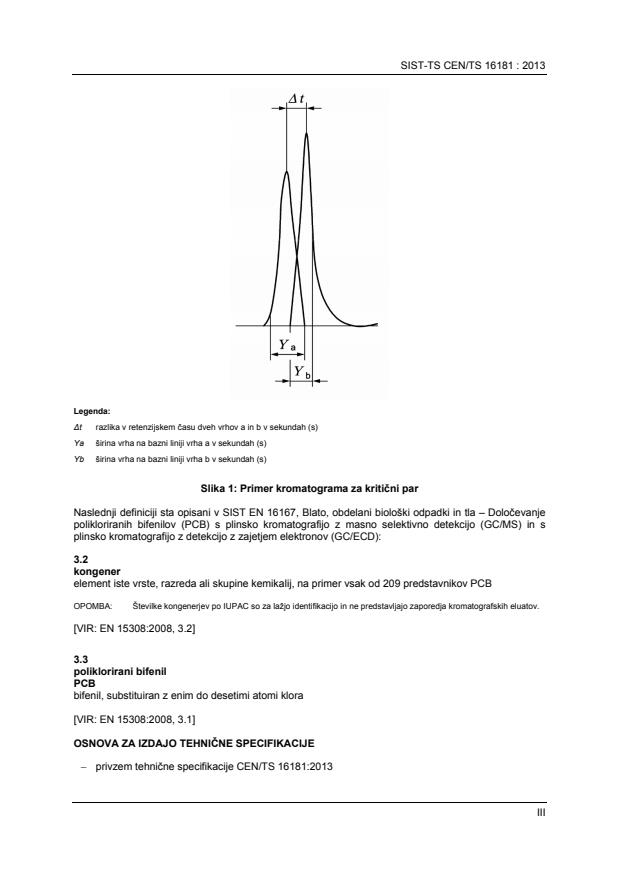
par kongenerjev, ki bodo ločeni po vnaprej določeni stopnji (npr. R = 0,5), s čimer se zagotovi, da
kromatografsko ločevanje izpolnjuje minimalna merila kakovosti
[VIR: EN 15308:2008, 3.6]
OPOMBA 1: Glej sliko 1.
II
SIST-TS CEN/TS 16181 : 2013
Legenda:
∆t razlika v retenzijskem času dveh vrhov a in b v sekundah (s)
Ya širina vrha na bazni liniji vrha a v sekundah (s)
Yb širina vrha na bazni liniji vrha b v sekundah (s)
Slika 1: Primer kromatograma za kritični par
Naslednji definiciji sta opisani v SIST EN 16167, Blato, obdelani biološki odpadki in tla – Določevanje
polikloriranih bifenilov (PCB) s plinsko kromatografijo z masno selektivno detekcijo (GC/MS) in s
plinsko kromatografijo z detekcijo z zajetjem elektronov (GC/ECD):
3.2
kongener
element iste vrste, razreda ali skupine kemikalij, na primer vsak od 209 predstavnikov PCB
OPOMBA: Številke kongenerjev po IUPAC so za lažjo identifikacijo in ne predstavljajo zaporedja kromatografskih eluatov.
[VIR: EN 15308:2008, 3.2]
3.3
poliklorirani bifenil
PCB
bifenil, substituiran z enim do desetimi atomi klora
[VIR: EN 15308:2008, 3.1]
OSNOVA ZA IZDAJO TEHNIČNE SPECIFIKACIJE
– privzem tehnične specifikacije CEN/TS 16181:2013
III
SIST-TS CEN/TS 16181 : 2013
OPOMBE
– Povsod, kjer se v besedilu tehnične specifikacije uporablja izraz “evropska tehnična
specifikacija”, v SIST-TS CEN/TS 16181:2013 to pomeni “slovenska tehnična specifikacija”.
– Nacionalni uvod in nacionalni predgovor nista sestavni del te tehnične specifikacije.
– Ta nacionalni dokument je istoveten s CEN/TS 16181:2013 in je objavljen z dovoljenjem
CEN
Management Centre
Avenue Marnix 17
B-1000 Brussels
This national document is identical with CEN/TS 16181:2013 and is published with the permission of
CEN
Management Centre
Avenue Marnix 17
B-1000 Brussels
IV
TECHNICAL SPECIFICATION
CEN/TS 16181
SPÉCIFICATION TECHNIQUE
TECHNISCHE SPEZIFIKATION
October 2013
ICS 13.030.20
English Version
Sludge, treated biowaste and soil - Determination of polycyclic
aromatic hydrocarbons (PAH) by gas chromatography (GC) and
high performance liquid chromatography (HPLC)
Boues, bio-déchets traités et sols - Dosage des Schlamm, behandelter Bioabfall und Boden - Bestimmung
hydrocarbures aromatiques polycycliques (HAP) par von polycyclischen aromatischen Kohlenwasserstoffen
chromatographie en phase gazeuse et chromatographie (PAK) mittels Gaschromatographie (GC) und
liquide à haute performance Hochleistungs-Flüssigkeitschromatographie (HPLC)
This Technical Specification (CEN/TS) was approved by CEN on 16 July 2012 for provisional application.
The period of validity of this CEN/TS is limited initially to three years. After two years the members of CEN will be requested to submit their
comments, particularly on the question whether the CEN/TS can be converted into a European Standard.
CEN members are required to announce the existence of this CEN/TS in the same way as for an EN and to make the CEN/TS available
promptly at national level in an appropriate form. It is permissible to keep conflicting national standards in force (in parallel to the CEN/TS)
until the final decision about the possible conversion of the CEN/TS into an EN is reached.
CEN members are the national standards bodies of Austria, Belgium, Bulgaria, Croatia, Cyprus, Czech Republic, Denmark, Estonia,
Finland, Former Yugoslav Republic of Macedonia, France, Germany, Greece, Hungary, Iceland, Ireland, Italy, Latvia, Lithuania,
Luxembourg, Malta, Netherlands, Norway, Poland, Portugal, Romania, Slovakia, Slovenia, Spain, Sweden, Switzerland, Turkey and United
Kingdom.
EUROPEAN COMMITTEE FOR STANDARDIZATION
COMITÉ EUROPÉEN DE NORMALISATION
EUROPÄISCHES KOMITEE FÜR NORMUNG
CEN-CENELEC Management Centre: Avenue Marnix 17, B-1000 Brussels
© 2013 CEN All rights of exploitation in any form and by any means reserved Ref. No. CEN/TS 16181:2013: E
worldwide for CEN national Members.
Contents Page
Foreword .4
Introduction.5
1 Scope .6
2 Normative references . 7
3 Terms and definitions . 7
4 Principle .8
5 Interferences .8
5.1 Interference with sampling and extraction . 8
5.2 Interference with GC-MS . 9
5.3 Interferences with the HPLC . 9
6 Safety remarks . 9
7 Reagents . 10
7.1 General . 10
7.2 Reagents for extraction. 10
7.3 Reagents for clean-up . 10
7.3.1 Clean-up using aluminium oxide . 10
7.3.2 Clean-up using silica gel 60 for column chromatography . 10
7.3.3 Clean-up using gel permeation chromatography (GPC) . 11
7.3.4 Clean-up using liquid-liquid partition/DMF/cyclohexane . 11
7.4 Reagents for chromatographic analysis . 11
7.4.1 GC-Analysis . 11
7.4.2 HPLC-analysis . 11
7.5 Standards . 11
7.5.1 Reference substances, internal standards . 11
7.5.2 Injection standard . 12
7.6 Preparation of standard solutions . 12
7.6.1 General . 12
7.6.2 Standard solutions for HPLC-Analysis . 13
7.6.3 Standard solutions for GC-MS analysis . 13
7.6.4 Calibration standard solutions . 13
7.7 Preparation of internal standard solutions . 14
7.8 Preparation of injection standard solution . 14
8 Apparatus . 14
8.1 Extraction and clean-up procedures . 14
8.2 Gas chromatograph . 15
8.2.1 General . 15
8.3 High-performance liquid chromatograph . 15
9 Sample storage and preservation . 15
9.1 Sample storage . 15
9.2 Sample pretreatment . 16
10 Procedure . 16
10.1 Blank test . 16
10.2 Extraction . 16
10.2.1 General . 16
10.2.2 Extraction procedure 1: acetone/petroleum ether and agitation . 17
10.2.3 Extraction procedure 2: Soxhlet extraction (dry samples) . 18
10.2.4 Extraction procedure 3: acetone/petroleum ether/sodium chloride and agitation . 18
10.3 Concentration or dilution . 19
10.3.1 General .1 9
10.3.2 For HPLC analysis .1 9
10.4 Clean-up of the extract .1 9
10.4.1 General .1 9
10.4.2 Clean-up A – Aluminium oxide .2 0
10.4.3 Clean-up B – Silica gel .2 0
10.4.4 Clean-up C – Gel permeation chromatography (styrene divinylbenzene resin) . 21
10.4.5 Clean-up D – DMF/cyclohexane partitioning for aliphatic hydrocarbons removal . 21
10.5 Addition of the injection standard . 21
10.6 Gas chromatographic analysis (GC) .2 1
10.6.1 Gas chromatographic analysis with mass spectrometric detection . 21
10.6.2 Calibration of the method using an internal standard .2 2
10.6.3 Measurement .2 4
10.6.4 Identification .2 4
10.6.5 Check on method performance .2 4
10.6.6 Calculation .2 5
10.7 High-performance liquid chromatographic analysis (HPLC). 25
10.7.1 General .2 5
10.7.2 Chromatographic separation .2 5
10.7.3 Detection .2 6
10.7.4 Calibration .2 7
10.7.5 Measurement of samples .2 7
10.7.6 Calculation .2 7
11 Performance characteristics .2 8
12 Precision .2 8
13 Test report .2 8
Annex A (informative) Repeatability and reproducibility data .2 9
A.1 Materials used in the interlaboratory comparison study . 29
A.2 Interlaboratory comparison results .3 0
Annex B (informative) Examples of instrumental conditions and chromatograms. 32
B.1 Measurement of PAH with GC-MS . 32
B.2 Measurement of PAH with HPLC fluorescence .3 8
Bibliography .4 2
Foreword
This document (CEN/TS 16181:2013) has been prepared by Technical Committee CEN/TC 400 “Project
Committee - Horizontal standards in the fields of sludge, biowaste and soil”, the secretariat of which is held by
DIN.
Attention is drawn to the possibility that some of the elements of this document may be the subject of patent
rights. CEN [and/or CENELEC] shall not be held responsible for identifying any or all such patent rights.
This document has been prepared under a mandate given to CEN by the European Commission and the
European Free Trade Association.
The preparation of this document by CEN is based on a mandate by the European Commission (Mandate
M/330), which assigned the development of standards on sampling and analytical methods for hygienic and
biological parameters as well as inorganic and organic determinants, aiming to make these standards
applicable to sludge, treated biowaste and soil as far as this is technically feasible.
According to the CEN-CENELEC Internal Regulations, the national standards organisations of the following
countries are bound to announce this Technical Specification: Austria, Belgium, Bulgaria, Croatia, Cyprus,
Czech Republic, Denmark, Estonia, Finland, Former Yugoslav Republic of Macedonia, France, Germany,
Greece, Hungary, Iceland, Ireland, Italy, Latvia, Lithuania, Luxembourg, Malta, Netherlands, Norway, Poland,
Portugal, Romania, Slovakia, Slovenia, Spain, Sweden, Switzerland, Turkey and the United Kingdom.
Introduction
Polycyclic aromatic hydrocarbons (PAH) are ubiquitous because they are released in appreciable quantities
every year into the environment through the combustion of organic matters such as coal, fuel oils, petrol,
wood, refuse and plant materials. Since some of these PAH compounds are carcinogenic or mutagenic, their
presence in the environment (air, water, soil, sediment and waste) is regularly monitored and controlled. At
present determination of PAH is carried out in these matrices in most of the routine laboratories following the
preceding steps for sampling, pretreatment, extraction, clean-up by measurement of specific PAH by means
of gas chromatography in combination with mass spectrometric detection (GC-MS) or by high performance
liquid chromatography (HPLC) in combination with UV-DAD- or fluorescence-detection (HPLC-UV-DAD/FLD).
Both the GC-MS and the HPLC methods are included in this horizontal standard.
It is to be underlined that the target contamination level of PAH can lie in the range of about 0,01 mg/kg per
individual PAH (agricultural soil and sediment) to about 200 mg/kg and higher (e.g. contaminated soil at
coking plant sites or waste). The use of internal and injection standards is described in order to have an
internal check on execution of the extraction and clean-up procedure. The method is as far as possible in
agreement with the method described for PCBs (see EN 16167).
This document is the result of a desk study "Horizontal Technical Specification for determination of PAH in
sludge, soil and biowaste" in the project "Horizontal" and aims at evaluating the latest developments in
assessing PAH in sludge, soil, treated biowaste and neighbouring fields. After an evaluation study, in which
the ruggedness of the method was studied, a European-wide validation of the draft standard has taken place.
The results of the desk studies as well as the evaluation and validation studies have been subject to
discussions with all parties concerned in CEN.
This Technical Specification is applicable and validated for several types of matrices as indicated in Table 1
(see also Annex A for the results of the validation).
Table 1 — Matrices for which this Technical Specification is applicable and validated
Matrix Materials used for validation
Sludge Municipal sludge
Biowaste Fresh compost
WARNING — Persons using this Technical Specification should be familiar with usual laboratory
practice. This Technical Specification does not purport to address all of the safety problems, if any,
associated with its use. It is the responsibility of the user to establish appropriate safety and health
practices and to ensure compliance with any national regulatory conditions.
IMPORTANT — It is absolutely essential that tests conducted according to this Technical
Specification be carried out by suitably trained staff.
1 Scope
This Technical Specification specifies the quantitative determination of 16 polycyclic aromatic hydrocarbons
(PAH) (see Table 2) in sludge, soil and treated biowaste using GC-MS and HPLC-UV-DAD/FLD covering a
wide range of PAH contamination levels (see also Annex B).
When using fluorescence detection, acenaphthylene cannot be measured.
Table 2 — Polycyclic aromatic hydrocarbons
which can be analysed using this Technical Specification
a
Target analyte
CAS-RN
Naphthalene 91-20-3
Acenaphthene 83-32-9
Acenaphthylene 208-96-8
Fluorene 86-73-7
Anthracene 120-12-7
Phenanthrene 85-01-8
Fluoranthene 206-44-0
Pyrene 129-00-0
Benz(a)anthracene 56-55-3
Chrysene 218-01-9
Benzo(b)fluoranthene 205-99-2
Benzo(k)fluoranthene 207-08-9
Benzo(a)pyrene 50-32-8
Indeno(1,2,3-cd)pyrene 193-39-5
Dibenz(a,h)anthracene 53-70-3
Benzo(ghi)perylene 191-24-2
a
CAS-RN Chemical Abstracts Service Registry Number.
The limit of detection depends on the determinants, the equipment used, the quality of chemicals used for the
extraction of the sample and the clean-up of the extract.
Typically, a lower limit of application of 0,01 mg/kg (expressed as dry matter) may be ensured for each
individual PAH. This depends on instrument and sample.
Sludge, soil and treated biowaste may differ in properties and also in the expected contamination levels of
PAHs and presence of interfering substances. These differences make it impossible to describe one general
procedure. This Technical Specification contains decision tables based on the properties of the sample and
the extraction and clean-up procedure to be used. Two general lines are followed, an agitation procedure
(shaking) or use of soxhlet/pressurised liquid extraction.
NOTE Other PAH compounds can also be analysed with this method, provided suitability has been proven.
2 Normative references
The following documents, in whole or in part, are normatively referenced in this document and are
indispensable for its application. For dated references, only the edition cited applies. For undated references,
the latest edition of the referenced document (including any amendments) applies.
EN 15934, Sludge, treated biowaste, soil and waste — Calculation of dry matter fraction after determination of
dry residue or water content
EN 16179, Sludge, treated biowaste and soil — Guidance for sample pretreatment
EN ISO 5667-15, Water quality — Sampling — Part 15: Guidance on the preservation and handling of sludge
and sediment samples (ISO 5667-15)
EN ISO 16720, Soil quality — Pretreatment of samples by freeze-drying for subsequent analysis (ISO 16720)
EN ISO 22892, Soil quality — Guidelines for the identification of target compounds by gas chromatography
and mass spectrometry (ISO 22892)
ISO 8466-1, Water quality — Calibration and evaluation of analytical methods and estimation of performance
characteristics — Part 1: Statistical evaluation of the linear calibration function
ISO 18512, Soil quality — Guidance on long and short term storage of soil samples
3 Terms and definitions
For the purposes of this document, the following terms and definitions apply.
3.1
critical pair
pair of congeners that will be separated to a predefined degree (e.g. R = 0,5) to ensure chromatographic
separation meets minimum quality criteria
[SOURCE: EN 15308:2008, 3.6]
Note 1 to entry: See Figure 1.
Key
∆t difference in retention times of the two peaks a and b in seconds (s)
Y peak width at the base of peak a in seconds (s)
a
Y peak width at the base of peak b in seconds (s)
b
Figure 1 — Example of a chromatogram of a critical pair
4 Principle
After pretreatment to reduce the moisture content and to increase the homogeneity (see 9.2), the test sample
is extracted with a solvent.
The extract is concentrated and interfering compounds are removed by a clean-up method suitable for the
specific matrix. The eluate is concentrated. For HPLC analysis, the concentrated eluate is taken up in an
appropriate less volatile water miscible polar solvent and the non-polar eluate residue is removed.
The extract is analysed by GC-MS using a capillary column with a stationary phase of low polarity or by
HPLC-UV-DAD/FLD with an appropriate reversed phase column.
PAH are identified and quantified with GC-MS by comparison of relative retention times and relative peak
heights (or peak areas) with respect to internal standards added, and with HPLC by using the corresponding
variables of the external standard solutions. The efficiency of the procedure depends on the composition of
the matrix that is investigated.
5 Interferences
5.1 Interference with sampling and extraction
Use sampling containers of materials (preferably of steel, aluminium or glass) that do not change the sample
during the contact time. Avoid plastics and other organic materials during sampling, sample storage or
extraction. Keep the samples from direct sunlight and prolonged exposure to light.
During storage of the samples, losses of PAH may occur due to adsorption on the walls of the containers. The
extent of the losses depends on the storage time.
5.2 Interference with GC-MS
Substances that co-elute with the target PAH may interfere with the determination. These interferences may
lead to incomplete resolved signals and may, depending on their magnitude, affect accuracy and precision of
the analytical results. Peak overlap does not allow an interpretation of the result. Unsymmetrical peaks and
peaks broader than the corresponding peaks of the reference substance suggest interferences.
Chromatographic separation between dibenz(a,h)anthracene and indeno(1,2,3-cd)pyrene are mostly critical.
Due to their molecular mass differences, quantification can be made by mass selective detection. When
incomplete resolution is encountered, peak integration shall be checked and, if necessary, corrected.
Sufficient resolution (e.g. 0,8) between the peaks of benzo(b)fluoranthene and benzo(k)fluoranthene as well
as of benzo(a)pyrene and benzo(e)pyrene shall be set as quality criteria for the capillary column.
Benzo(b)fluoranthene and benzo(j)fluoranthene cannot be separated. Triphenylene may not be completely
separated from benz(a)anthracene and chrysene. In this case it shall be stated in the report.
5.3 Interferences with the HPLC
Substances that show either fluorescence or quenching and co-elute with the PAHs to be determined may
interfere with the determination. These interferences may lead to incompletely resolved signals and may,
depending on their magnitude, affect accuracy and precision of the analytical results. Peak overlap does not
allow an interpretation of the result. Asymmetrical peaks and peaks being broader than the corresponding
peaks of the reference substance suggest interferences. This problem may arise for naphthalene and
phenanthrene depending on the selectivity of the phases used.
Incomplete removal of the solvents used for sample extraction and clean-up may lead to poor reproducibility
of the retention times and wider peaks or double peaks especially for the 2- and 3-ring PAHs. Extracts shall be
diluted sufficiently with acetonitrile for the HPLC-analysis, otherwise the detection of naphthalene and 3-ring
PAH can be interfered with by a broad toluene peak.
Separation between dibenz(a,h)anthracene and indeno(1,2,3-cd)pyrene can be critical. When incomplete
resolution is encountered, peak integration shall be checked and, when necessary, corrected.
Usually perylene is incompletely resolved from benzo(b)fluoranthene, but by choosing a selective wavelength,
the perylene peak can be suppressed.
6 Safety remarks
Certain PAH are highly carcinogenic and shall be handled with extreme care. Avoid contact with solid
materials, solvent extracts and solutions of standard PAH.
PAH may co-distil with solvent and become deposited outside of stoppered bottles. All containers containing
solutions of PAH in solvent shall therefore always be handled using gloves which are solvent resistant and
preferably disposable.
PAH contamination of vessels may be detected by irradiation with 366 nm UV-light.
Vessels containing PAH solutions should be stored standing in beakers to contain any spillage in the case of
breakage.
Solid PAH are the most dangerous and give rise to a dust hazard due to their crystals becoming
electrostatically charged. These materials shall only be handled where proper facilities are available (e.g.
adequate fume hoods, protective clothing, dust masks). It is strongly advised that standard solutions are
prepared centrally in suitably equipped laboratories or are purchased from suppliers specialised in their
preparation.
Solvent solutions containing PAH shall be disposed of in a manner approved for disposal of toxic wastes.
National regulations shall be followed with respect to all hazards associated with this method.
7 Reagents
7.1 General
All reagents shall be of recognised analytical grade. The purity of the reagents used shall be checked by
running a blank test as described in 10.1. The blank shall be less than 50 % of the lowest reporting limit.
7.2 Reagents for extraction
7.2.1 Acetone (2-propanone), C H O.
3 6
7.2.2 Petroleum ether, boiling range 40 °C to 60 °C.
NOTE Hexane-like solvents with a boiling range between 30 °C and 69 °C are allowed.
7.2.3 Toluene, C H .
7 8
7.2.4 Anhydrous sodium sulfate, Na SO . The anhydrous sodium sulfate shall be kept carefully sealed.
2 4
7.2.5 Distilled water or water of equivalent quality, H O.
7.2.6 Sodium chloride, NaCl, anhydrous.
7.3 Reagents for clean-up
7.3.1 Clean-up using aluminium oxide
7.3.1.1 Aluminium oxide, Al O .
2 3
Basic or neutral, specific surface 200 m /g, activity Super I according to Brockmann.
NOTE 1 Hexane-like solvents with a boiling range between 30 °C and 69 °C are allowed.
NOTE 2 Brockman Activity Scale is a measure of the percentage of water added to the adsorbent based upon
weight/weight relationships between water and the adsorbent. Grade I corresponds to 0 % water added. See [14], [15].
7.3.1.2 Deactivated aluminium oxide
Deactivated with approximately 10 % water.
Add approximately 10 g of water (7.2.5) to 90 g of aluminium oxide (7.3.1.1). Shake until all lumps have
disappeared. Allow the aluminium oxide to condition before use for some 16 h, sealed from the air, use it for
maximum of two weeks.
NOTE The activity depends on the water content. It might be necessary to adjust the water content.
7.3.2 Clean-up using silica gel 60 for column chromatography
7.3.2.1 Silica gel 60, particle size 63 µm to 200 µm.
7.3.2.2 Silica gel 60, water content: mass fraction w(H O) = 10 %.
Silica gel 60, heated for at least 3 h at 450 °C, cooled down in a desiccator and stored containing magnesium
perchlorate or a suitable drying agent. Before use, heat at least for 5 h at 130 °C in a drying oven. Then allow
cooling in a desiccator and add 10 % water (mass fraction) in a flask. Shake for 5 min intensively until all
lumps have disappeared and then for 2 h in a shaking device (8.1.2). Store the deactivated silica gel in the
absence of air; use it for a maximum of two weeks.
Silica gel 60 is stable for at most 2 weeks.
7.3.3 Clean-up using gel permeation chromatography (GPC)
1)
7.3.3.1 Bio-Beads S-X3.
7.3.3.2 Ethyl acetate, C H O .
4 8 2
7.3.3.3 Cyclohexane, C H .
6 12
7.3.3.4 Spherical, porous styrene divinylbenzene resin
Preparation of GPC, for example: Put 50 g Bio-Beads S-X3 (7.3.3.1) into a 500 ml Erlenmeyer flask and add
300 ml elution mixture made up of cyclohexane (7.3.3.3) and ethyl acetate (7.3.3.2) 1:1 (volume) in order to
allow the beads to swell. After swirling for a short time until no lumps are left, maintain the flask closed for
24 h. Drain the slurry into the chromatography tube for GPC. After approximately three days, push in the
plungers of the column so that a filling level of approximately 35 cm is obtained. To further compress the gel,
-1
pump approximately 2 l of elution mixture through the column at a flow rate of 5 ml · min and push in the
plungers to obtain a filling level of approximately 33 cm.
7.3.4 Clean-up using liquid-liquid partition/DMF/cyclohexane
7.3.4.1 Dimethylformamide (DMF), C H NO.
3 7
7.3.4.2 Dimethylformamide:water, 9:1.
7.4 Reagents for chromatographic analysis
7.4.1 GC-Analysis
Carrier gas for GC-MS: helium or hydrogen of high purity and in accordance with the manufacturer’s
specifications.
7.4.2 HPLC-analysis
7.4.2.1 Mobile phase
7.4.2.2 Acetonitrile, CH CN or methanol, CH OH, HPLC purity grade.
3 3
7.4.2.3 Ultra-pure water, HPLC purity grade.
7.4.2.4 Helium, He, of suitable purity for degasification of solvents.
7.5 Standards
7.5.1 Reference substances, internal standards
Choose the internal standards substances whose physical and chemical properties (such as extraction
behaviour, retention time) are similar to those of the compounds to be analysed. A minimum of five labelled
internal standards shall be used as internal standards for the GC-MS method for evaluation of results. Verify
the stability of the internal standards regularly. Table 3 contains native and deuterated PAH to be used for
calibration of specific analytes.
1) Bio-Beads© is an example of a suitable product available commercially. This information is given for the convenience
of this Technical Specification and does not constitute an endorsement by CEN of this product. Equivalent products may
be used if they can be shown to lead to the same results.
Table 3 — Native PAH and deuterated PAH
PAH reference substances Internal standard substances deuterated PAHs
Naphthalene (CAS-RN 91-20-3) Naphthalene-d8
Acenaphthene (CAS-RN 83-32-9) Acenaphthene-d10
Acenaphthylene (CAS-RN 208-96-8) Acenaphthylene-d8
Fluorene (CAS-RN 86-73-7) Fluorene-d10
Anthracene (CAS-RN 120-12-7) Anthracene-d10
Phenanthrene (CAS-RN 85-01-8) Phenanthrene-d10
Fluoranthene (CAS-RN 206-44-0) Fluoranthene-d10
Pyrene (CAS-RN 129-00-0) Pyrene-d10
Benz(a)anthracene (CAS-RN 56-55-3) Benz(a)anthracene-d12
Chrysene (CAS-RN 218-01-9) Chrysene-d12
Benzo(b)fluoranthene (CAS-RN 205-99-2) Benzo(b)fluoranthene-d12
Benzo(k)fluoranthene (CAS-RN 207-08-9) Benzo(k)fluoranthene-d12
Benzo(a)pyrene (CAS-RN 50-32-8) Benzo(a)pyrene-d12
a
Benzo(e)pyrene (CAS-RN 192-97-2)
Indeno(1,2,3-cd)pyrene (CAS-RN 193-39-5) Indeno(1,2,3-cd)pyrene-d12
Dibenz(a,h)anthracene (CAS-RN 53-70-3) Dibenz(a,h)anthracene-d14
Benzo(ghi)perylene (CAS-RN 191-24-2) Benzo(ghi)perylene-d12
a
Not part of 16 target analytes, but applicable for resolution check for the separation with benzo(a)pyrene for GC
measurements.
NOTE 1 C -labelled PAH standards can also be used as internal standards.
NOTE 2 Certified solutions of PAH, and single solid PAH substances with certified purity are available from a limited
number of suppliers e.g. Institute for Reference Materials and Measurements (IRMM) B-2440 Geel, Belgium, National
Institute of Science and Technology. Office of Standard Ref. Data, Washington D.C. 20 234 U.S.A, or from other
commercial providers.
When highly contaminated samples are analysed, an aliquot of the extract is often used for a further clean-up.
7.5.2 Injection standard
7.5.2.1 GC-MS
A deuterated PAH such as 1-Methylnaphthalene-d10, Triphenylene-d12 and Perylene-d12 shall be added to
the final extract before GC-MS injection to check the recovery of the deuterated internal standards.
7.5.2.2 HPLC
For this method a recovery control shall be made by addition, and which is not interfering with the target
analytes, of a suitable native PAH not mentioned in the scope, e.g. 6-methylchrysene, to the sample before
extraction. The recovery range for this control should be between 70 % and 110 %.
7.6 Preparation of standard solutions
7.6.1 General
Commercially available, preferably certified, standard solutions should be used, due to the dangerous nature
of the substances. Avoid skin contact.
7.6.2 Standard solutions for HPLC-Analysis
7.6.2.1 Single substance stock solutions
Prepare solutions of the single substances (see Table 3) in acetonitrile (7.4.2.2) to achieve a mass
concentration of 10 µg/ml. These solutions are used for confirmation and identification of single PAHs in the
chromatogram.
7.6.2.2 Multiple substance stock solution
Prepare solutions of the reference substances (see Table 3) in acetonitrile (7.4.2.2) to achieve a mass
concentration of the respective individual substance of 10 µg/ml.
Solutions according to 7.6.2.1 and 7.6.2.2 are stable for at least one year when stored in the dark at room
temperature and protected from evaporation.
7.6.2.3 Calibration solutions
Prepare at least five calibration solutions by appropriate dilution of the stock solution (7.6.2.1 or 7.6.2.2), using
acetonitrile (7.4.2.2) or methanol (7.4.2.2) as solvent. The choice of solvent depends on the composition of the
mobile phase.
Transfer 50 µl of the stock solution into a graduated 5 ml flask and fill up to the mark with acetonitrile. 1 µl of
this reference solution contains 100 pg of the respective individual substances.
Check the stability of the reference solutions regularly.
Check the mass concentration of the PAH in the stock solution by comparison with an independent, preferably
certified, standard solution.
7.6.3 Standard solutions for GC-MS analysis
7.6.3.1 Single substance stock solution
Prepare solutions of the single substances of native and deuterated PAH (see Table 3) in toluene (7.2.3) or
cyclohexane (7.3.3.3) to achieve a mass concentration of 10 µg/ml. These solutions are used for confirmation
and identification of single PAHs in the chromatogram.
The single substance stock solutions shall be stored in a dark place at about –15 °C to –18 °C. Store the
diluted standard solutions at (5 ± 3) °C protected from light and evaporation. The solutions are stable for about
one year.
7.6.3.2 Multiple substance stock solution of native PAH
Dilute the solution of the reference substances, i.e. native PAH (see Table 3) in toluene (7.2.3) or cyclohexane
(7.3.3.3), to achieve a mass concentration of the respective individual substance, i.e. 10 µg/ml.
7.6.3.3 Multiple substance stock solution of deuterated or labelled PAH (internal standard)
Multiple deuterated or labelled PAH standards for use as internal standard, also available as mixtures in
suitable solvent, can be diluted to the same mass concentration, i.e. 10 µg/ml for each individual deuterated
standard.
7.6.4 Calibration standard solutions
Prepare a series of calibration standard solutions (at least five) over a suitable range by transferring different
volumes of the multiple substance stock solution of native PAH standards (7.6.3.2) and a constant volume of
the internal standard solution (7.6.3.3) into a volumetric flask and fill up with cyclohexane (7.3.3.3).
7.7 Preparation of internal standard solutions
Multiple substance stock solution of deuterated or labelled PAH (7.6.3.3) can be used for spiking of the
sample before extraction. The use of the spiked internal standards shall be adjusted so that their
concentration in the final extract for GC-MS determination is the same as in the calibration solutions (e.g.
100 pg/µl). For HPLC analysis, where external calibration is applied, a PAH which is not interfering with the
target PAH, e.g. 6-methylchrysene, is added to the sample before extraction to check for the recovery of this
substance throughout the whole procedure.
7.8 Preparation of injection standard solution
This is needed to check the recovery of the deuterated internal standards.
A single substance stock solution (7.6.3.1), e.g. deuterated benzo(e)pyrene, which is not interfering with the
target analyte, can be used.
NOTE A deuterated
...