

EN 484:2019
(Main)Specification for dedicated liquefied petroleum gas appliances - Independent stoves, including those incorporating a grill for outdoor use
- Abstract
This document specifies constructional and performance characteristics, safety specifications and rational use of energy, relevant test methods and marking of independent stoves, side burners, covered burners, open burners, griddles, radiant grills, burning liquefied petroleum gas, referred to in the body of the text as "appliances".
This document covers appliances, used outdoors and operating with the gases of the third family according to EN 437:2018.
Appliances used in leisure vehicles and boats are outside the field of application of this standard.
Independent stove burners, whose nominal heat input is below 1,16 kW, griddles and radiant grills, are not subject to any special requirement concerning the rational use of energy due to their low rate and their use for short periods of time.
This document does not state all requirements for appliances of other nature incorporating a stove (for example barbecues are not covered by this standard but a side burner of a barbecue is covered by this standard).
This document does not cover regulators that are used with those appliances.
- Status
- Published
- Publication Date
- 02-Apr-2019
- Withdrawal Date
- 30-Oct-2019
- Technical Committee
- CEN/TC 181 - Dedicated liquified petroleum gas appliances
- Drafting Committee
- CEN/TC 181/WG 1 - Flueless space heaters
- Current Stage
- 6060 - Definitive text made available (DAV) - Publishing
- Start Date
- 03-Apr-2019
- Due Date
- 21-May-2017
- Completion Date
- 03-Apr-2019



Overview
EN 484:2019 is a CEN European Standard that specifies constructional and performance requirements, safety specifications, test methods and marking for dedicated liquefied petroleum gas (LPG) appliances - specifically independent stoves (including those incorporating a grill) intended for outdoor use. The standard applies to appliances operating with gases of the third family per EN 437:2018 and supersedes EN 484:1997. It excludes appliances for leisure vehicles and boats, and it does not cover regulators. Low‑input burners (below 1.16 kW), griddles and radiant grills are exempt from special energy‑use requirements because of their low duty cycles.
Key Topics
- Scope & classification
- Defines appliance categories (open/covered burners, side burners, griddles, radiant grills) and gas family classification per EN 437:2018.
- Constructional characteristics
- Requirements for materials, gas circuit assembly, connections, taps, control handles, injectors, burners and mechanical strength, stability and resistance to liquid spillage.
- Safety features
- Flame supervision devices, ignition systems, overheating protection (including gas container overheating), flame stability and resistance to draught.
- Performance & testing
- Verification of nominal heat input, soundness (leak tightness), combustion and sooting behavior, temperature limits and rational use of energy for burners.
- Marking & documentation
- Mandatory appliance and packaging markings, plus instructions for assembly, use and maintenance.
- Normative annexes
- National situations (pressures, connections), calculation method for nominal heat input, and composition of test gases.
Applications
EN 484:2019 is used to design, manufacture, test and certify outdoor LPG cooking appliances such as freestanding stoves, barbecue side burners, open and covered burners, griddles and radiant grills. It provides the technical baseline for:
- Product design and material selection to meet safety and durability requirements.
- Laboratory type‑testing and conformity assessment (soundness, heat input, combustion).
- Preparing user manuals, assembly instructions and mandatory markings for market compliance.
- Regulatory compliance and pre‑market verification within European markets where CEN standards are adopted.
Who uses this standard
- Manufacturers and product designers of LPG outdoor cooking appliances
- Test laboratories and conformity assessors performing safety and performance tests
- Certification bodies and national standards organizations
- Safety engineers, distributors and technical authors preparing instructions and markings
Related Standards
- EN 437:2018 - referenced for gas family classification and test gas composition.
- EN 484:2019 replaces EN 484:1997 (previous edition).
Keywords: EN 484:2019, LPG appliances, liquefied petroleum gas, independent stoves, outdoor grills, safety specifications, test methods, marking, rational use of energy, EN 437:2018.
Relations
- Effective Date
- 10-Apr-2019
- Effective Date
- 09-Feb-2026
- Effective Date
- 28-Jan-2026
- Effective Date
- 28-Jan-2026
- Effective Date
- 28-Jan-2026
- Effective Date
- 28-Jan-2026
- Effective Date
- 28-Jan-2026
- Effective Date
- 28-Jan-2026
- Effective Date
- 28-Jan-2026
- Effective Date
- 28-Jan-2026
- Effective Date
- 28-Jan-2026
- Effective Date
- 19-Feb-2020
- Effective Date
- 08-Dec-2021
Frequently Asked Questions
EN 484:2019 is a standard published by the European Committee for Standardization (CEN). Its full title is "Specification for dedicated liquefied petroleum gas appliances - Independent stoves, including those incorporating a grill for outdoor use". This standard covers: This document specifies constructional and performance characteristics, safety specifications and rational use of energy, relevant test methods and marking of independent stoves, side burners, covered burners, open burners, griddles, radiant grills, burning liquefied petroleum gas, referred to in the body of the text as "appliances". This document covers appliances, used outdoors and operating with the gases of the third family according to EN 437:2018. Appliances used in leisure vehicles and boats are outside the field of application of this standard. Independent stove burners, whose nominal heat input is below 1,16 kW, griddles and radiant grills, are not subject to any special requirement concerning the rational use of energy due to their low rate and their use for short periods of time. This document does not state all requirements for appliances of other nature incorporating a stove (for example barbecues are not covered by this standard but a side burner of a barbecue is covered by this standard). This document does not cover regulators that are used with those appliances.
This document specifies constructional and performance characteristics, safety specifications and rational use of energy, relevant test methods and marking of independent stoves, side burners, covered burners, open burners, griddles, radiant grills, burning liquefied petroleum gas, referred to in the body of the text as "appliances". This document covers appliances, used outdoors and operating with the gases of the third family according to EN 437:2018. Appliances used in leisure vehicles and boats are outside the field of application of this standard. Independent stove burners, whose nominal heat input is below 1,16 kW, griddles and radiant grills, are not subject to any special requirement concerning the rational use of energy due to their low rate and their use for short periods of time. This document does not state all requirements for appliances of other nature incorporating a stove (for example barbecues are not covered by this standard but a side burner of a barbecue is covered by this standard). This document does not cover regulators that are used with those appliances.
EN 484:2019 is classified under the following ICS (International Classification for Standards) categories: 97.040.20 - Cooking ranges, working tables, ovens and similar appliances. The ICS classification helps identify the subject area and facilitates finding related standards.
EN 484:2019 has the following relationships with other standards: It is inter standard links to EN 484:1997, EN 60335-2-102:2016, EN 161:2011+A3:2013, EN 549:1994, EN 298:2012, EN ISO 228-1:2003, EN 10226-1:2004, EN 10226-2:2005, EN 1106:2010, EN 125:2010+A1:2015, EN 126:2012, EN 484:2019/AC:2020, FprEN 484. Understanding these relationships helps ensure you are using the most current and applicable version of the standard.
EN 484:2019 is associated with the following European legislation: EU Directives/Regulations: 2009/142/EC, 2016/426; Standardization Mandates: M/BC/CEN/89/6. When a standard is cited in the Official Journal of the European Union, products manufactured in conformity with it benefit from a presumption of conformity with the essential requirements of the corresponding EU directive or regulation.
EN 484:2019 is available in PDF format for immediate download after purchase. The document can be added to your cart and obtained through the secure checkout process. Digital delivery ensures instant access to the complete standard document.
Standards Content (Sample)
SLOVENSKI STANDARD
01-junij-2019
Nadomešča:
SIST EN 484:1997
Specifikacija za plinske aparate na utekočinjeni naftni plin - Prostostoječi
kuhalniki, vključno z žarom za zunanjo uporabo
Specification for dedicated liquefied petroleum gas appliances - Independent stoves,
including those incorporating a grill for outdoor use
Festlegungen für Flüssiggasgeräte - Flüssiggasbetriebene Kochgeräte einschließlich
solcher mit Grillteilen zur Verwendung im Freien
Spécifications pour les appareils fonctionnant exclusivement aux gaz de pétrole liquéfiés
- Réchauds indépendants, équipés ou non d'un grilloir, utilisés en plein air
Ta slovenski standard je istoveten z: EN 484:2019
ICS:
97.040.20 Štedilniki, delovni pulti, Cooking ranges, working
pečice in podobni aparati tables, ovens and similar
appliances
2003-01.Slovenski inštitut za standardizacijo. Razmnoževanje celote ali delov tega standarda ni dovoljeno.
EN 484
EUROPEAN STANDARD
NORME EUROPÉENNE
April 2019
EUROPÄISCHE NORM
ICS 97.040.20 Supersedes EN 484:1997
English Version
Specification for dedicated liquefied petroleum gas
appliances - Independent stoves, including those
incorporating a grill for outdoor use
Spécifications pour les appareils fonctionnant Festlegungen für Flüssiggasgeräte -
exclusivement aux gaz de pétrole liquéfiés - Réchauds Flüssiggasbetriebene Kochgeräte einschließlich solcher
indépendants, équipés ou non d'un grilloir, utilisés en mit Grillteilen zur Verwendung im Freien
plein air
This European Standard was approved by CEN on 15 February 2019.
CEN members are bound to comply with the CEN/CENELEC Internal Regulations which stipulate the conditions for giving this
European Standard the status of a national standard without any alteration. Up-to-date lists and bibliographical references
concerning such national standards may be obtained on application to the CEN-CENELEC Management Centre or to any CEN
member.
This European Standard exists in three official versions (English, French, German). A version in any other language made by
translation under the responsibility of a CEN member into its own language and notified to the CEN-CENELEC Management
Centre has the same status as the official versions.
CEN members are the national standards bodies of Austria, Belgium, Bulgaria, Croatia, Cyprus, Czech Republic, Denmark, Estonia,
Finland, Former Yugoslav Republic of Macedonia, France, Germany, Greece, Hungary, Iceland, Ireland, Italy, Latvia, Lithuania,
Luxembourg, Malta, Netherlands, Norway, Poland, Portugal, Romania, Serbia, Slovakia, Slovenia, Spain, Sweden, Switzerland,
Turkey and United Kingdom.
EUROPEAN COMMITTEE FOR STANDARDIZATION
COMITÉ EUROPÉEN DE NORMALISATION
EUROPÄISCHES KOMITEE FÜR NORMUNG
CEN-CENELEC Management Centre: Rue de la Science 23, B-1040 Brussels
© 2019 CEN All rights of exploitation in any form and by any means reserved Ref. No. EN 484:2019 E
worldwide for CEN national Members.
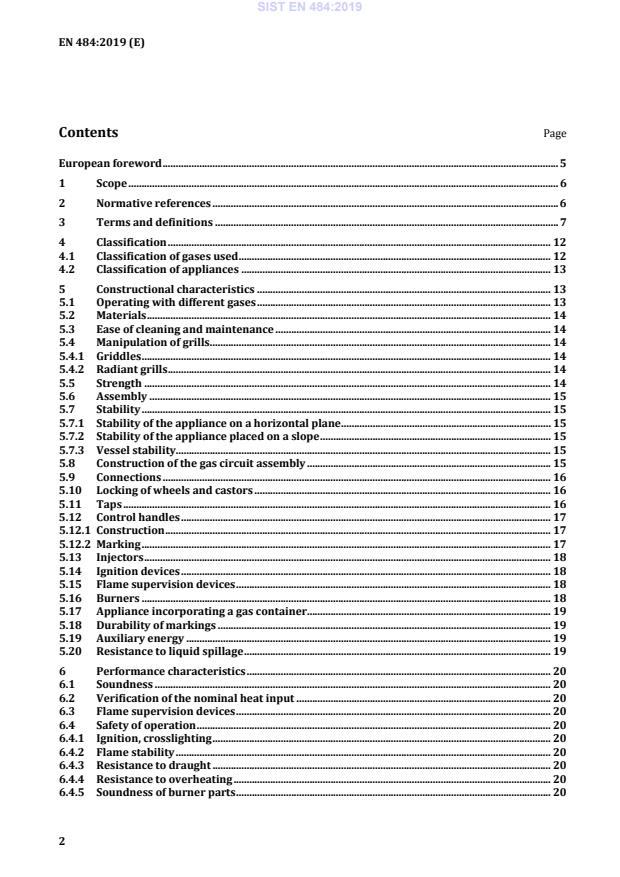
Contents Page
European foreword . 5
1 Scope . 6
2 Normative references . 6
3 Terms and definitions . 7
4 Classification . 12
4.1 Classification of gases used . 12
4.2 Classification of appliances . 13
5 Constructional characteristics . 13
5.1 Operating with different gases . 13
5.2 Materials . 14
5.3 Ease of cleaning and maintenance . 14
5.4 Manipulation of grills . 14
5.4.1 Griddles . 14
5.4.2 Radiant grills . 14
5.5 Strength . 14
5.6 Assembly . 15
5.7 Stability . 15
5.7.1 Stability of the appliance on a horizontal plane . 15
5.7.2 Stability of the appliance placed on a slope . 15
5.7.3 Vessel stability. 15
5.8 Construction of the gas circuit assembly . 15
5.9 Connections . 16
5.10 Locking of wheels and castors . 16
5.11 Taps . 16
5.12 Control handles . 17
5.12.1 Construction . 17
5.12.2 Marking . 17
5.13 Injectors . 18
5.14 Ignition devices . 18
5.15 Flame supervision devices . 18
5.16 Burners . 18
5.17 Appliance incorporating a gas container . 19
5.18 Durability of markings . 19
5.19 Auxiliary energy . 19
5.20 Resistance to liquid spillage . 19
6 Performance characteristics . 20
6.1 Soundness . 20
6.2 Verification of the nominal heat input . 20
6.3 Flame supervision devices . 20
6.4 Safety of operation . 20
6.4.1 Ignition, crosslighting . 20
6.4.2 Flame stability . 20
6.4.3 Resistance to draught . 20
6.4.4 Resistance to overheating . 20
6.4.5 Soundness of burner parts . 20
6.5 Temperatures . 20
6.6 Overheating of the gas container . 22
6.7 Combustion . 22
6.8 Sooting . 22
6.9 Rational use of energy: Performance of the burners . 22
6.9.1 Open burners . 22
6.9.2 Covered burners . 22
6.10 Resistance to liquid spillage . 22
7 Test methods . 23
7.1 General . 23
7.1.1 Test gases . 23
7.1.2 Test pressures . 24
7.1.3 Test procedures . 24
7.2 Verification of the constructional characteristics . 24
7.2.1 Conversion to different gases . 24
7.2.2 Materials . 24
7.2.3 Ease of cleaning and maintenance . 24
7.2.4 Manipulation of grills . 24
7.2.5 Strength . 25
7.2.6 Assembly . 25
7.2.7 Stability of the appliance . 25
7.2.8 Soundness of the gas circuit assembly . 26
7.2.9 Connections . 26
7.2.10 Locking of wheels and castors . 26
7.2.11 Taps . 26
7.2.12 Control handles . 26
7.2.13 Injectors. 26
7.2.14 Ignition devices . 26
7.2.15 Flame supervision devices. 26
7.2.16 Burners . 26
7.2.17 Appliances incorporating a gas container . 26
7.3 Verification of the performance characteristics . 26
7.3.1 Soundness . 26
7.3.2 Verification of the nominal heat input . 27
7.3.3 Flame supervision device. 27
7.3.4 Safety of operation . 27
7.3.5 Temperatures . 29
7.3.6 Overheating of the gas container . 30
7.3.7 Combustion . 30
7.3.8 Sooting . 31
7.3.9 Rational use of energy . 31
7.3.10 Durability of the marking . 34
8 Marking . 34
8.1 Appliance marking . 34
8.2 Packaging marking . 34
8.3 Instructions for assembly, use and maintenance . 35
Annex A (normative) National situations . 41
A.1 General . 41
A.2 Categories marketed in the various countries and corresponding pressures . 41
A.3 Types of connection used in various countries . 43
A.4 Connection of appliances . 44
Annex B (normative) Method of calculation of the nominal heat input . 48
B.1 Nominal heat input . 48
B.2 Corrected mass rate . 48
B.3 Use of a wet meter . 49
B.4 Correction of the measured volume . 50
Annex C (normative) Composition of test gases . 51
C.1 General . 51
C.2 Wobbe index . 51
C.3 Purity . 51
Annex D (normative) Surface temperature probe . 52
D.1 Design . 52
D.2 Validation test . 52
D.2.1 Principle . 52
D.2.2 Procedure . 52
D.2.3 Validation . 52
Bibliography . 54
European foreword
This document (EN 484:2019) has been prepared by Technical Committee CEN/TC 181 “Appliances
and leisure vehicle installations using liquefied petroleum gas and appliances using natural gas for
outdoor use”, the secretariat of which is held by AFNOR.
This European Standard shall be given the status of a national standard, either by publication of an
identical text or by endorsement, at the latest by October 2019, and conflicting national standards
shall be withdrawn at the latest by October 2019.
Attention is drawn to the possibility that some of the elements of this document may be the subject of
patent rights. CEN shall not be held responsible for identifying any or all such patent rights.
This document supersedes EN 484:1997.
The following main technical changes have been made compared to EN 484:1997:
— inconsistencies raised by the European Commission against gas appliance Regulation have been
addressed;
— differences on test pressures between French and English versions have been addressed;
— the scope has been specified to indicate that regulators are not covered by this standard;
— the wording “hotplate” (not adapted for appliances covered by EN 484) has been replaced by
“stove”;
— the definition 3.9 “auxiliary equipment” has been replaced by “fitting” in the sense of the gas
appliance Directive;
— compliance to EN 1106 or EN 126 for the taps has been added;
— paragraphs 7.2.X regarding to the type of examination (visual and/or mechanical) have been
reworded;
— a 300 mm diameter pan and the corresponding sampling of product of combustion has been
added.
According to the CEN-CENELEC Internal Regulations, the national standards organisations of the
following countries are bound to implement this European Standard: Austria, Belgium, Bulgaria,
Croatia, Cyprus, Czech Republic, Denmark, Estonia, Finland, Former Yugoslav Republic of Macedonia,
France, Germany, Greece, Hungary, Iceland, Ireland, Italy, Latvia, Lithuania, Luxembourg, Malta,
Netherlands, Norway, Poland, Portugal, Romania, Serbia, Slovakia, Slovenia, Spain, Sweden,
Switzerland, Turkey and the United Kingdom.
1 Scope
This document specifies constructional and performance characteristics, safety specifications and
rational use of energy, relevant test methods and marking of independent stoves, side burners,
covered burners, open burners, griddles, radiant grills, burning liquefied petroleum gas, referred to in
the body of the text as “appliances”.
This document covers appliances, used outdoors and operating with the gases of the third family
according to EN 437:2018.
Appliances used in leisure vehicles and boats are outside the field of application of this standard.
Independent stove burners, whose nominal heat input is below 1,16 kW, griddles and radiant grills,
are not subject to any special requirement concerning the rational use of energy due to their low rate
and their use for short periods of time.
This document does not state all requirements for appliances of other nature incorporating a stove
(for example barbecues are not covered by this standard but a side burner of a barbecue is covered by
this standard).
This document does not cover regulators that are used with those appliances.
2 Normative references
The following documents are referred to in the text in such a way that some or all of their content
constitutes requirements of this document. For dated references, only the edition cited applies. For
undated references, the latest edition of the referenced document (including any amendments)
applies.
EN 125:2010+A1:2015, Flame supervision devices for gas burning appliances — Thermoelectric flame
supervision devices
EN 126:2012, Multifunctional controls for gas burning appliances
EN 161:2011+A3:2013, Automatic shut-off valves for gas burners and gas appliances
EN 298:2012, Automatic burner control systems for burners and appliances burning gaseous or liquid
fuels
EN 549:1994, Rubber materials for seals and diaphragms for gas appliances and gas equipment
EN 1106:2010, Manually operated taps for gas burning appliances
EN 10226-1:2004, Pipe threads where pressure tight joints are made on the threads — Part 1: Taper
external threads and parallel internal threads — Dimensions, tolerances and designation
EN 10226-2:2005, Pipe threads where pressure tight joints are made on the threads — Part 2: Taper
external threads and taper internal threads — Dimensions, tolerances and designation
EN 60335-2-102:2016, Household and similar electrical appliances — Safety — Part 2-102: Particular
requirements for gas, oil and solid-fuel burning appliances having electrical connections (IEC
60335-2-102:2004)
EN ISO 228-1:2003, Pipe threads where pressure-tight joints are not made on the threads — Part 1:
Dimensions, tolerances and designation (ISO 228-1:2000)
3 Terms and definitions
For the purposes of this standard, the following terms and definitions apply.
ISO and IEC maintain terminological databases for use in standardization at the following addresses:
• IEC Electropedia: available at http://www.electropedia.org/
• ISO Online browsing platform: available at http://www.iso.org/obp
3.1
independent stove
cooking appliance incorporating one or several covered or open burners and, if applicable, one or
several contact or radiant grills
3.2
side burner
part of a cooking appliance incorporating one or several covered or open burners
Note 1 to entry: It is designed in such a way that it can support the pans containing the food.
3.3
griddle
part of an appliance consisting of a plate placed above a burner, allowing for the cooking of food by
direct contact with the surface of this plate which is brought to a high temperature
Note 1 to entry: It may be:
— permanent, that is designed to be used only in the above conditions;
— with two functions: that is designed to be capable of being also used as covered or open burner after
removal or change of the detachable plate.
3.4
radiant grill
appliance or part of an appliance allowing for cooking by radiation from a surface brought to a high
temperature
3.5
cooking device
component part of the appliance designed to hold or receive the food to be cooked
3.6
appliance incorporating a gas container
appliance whose body or support includes a compartment for a liquefied petroleum gas container, or a
fixing or support device for this container
3.7
detachable
can be dismantled without using a tool
3.8
removable
can only be removed with a tool
3.9
fittings
safety devices, controlling devices or regulating devices and sub-assemblies, incorporated into the
appliance
Note 1 to entry: For example: tap, flame supervision device, ignition device.
3.10
burner
component that allow the gas to burn
Note 1 to entry: It may be:
— non-aerated burner, in which the air for combustion is entrained entirely at the burner outlet;
— aerated burner, in which part of the air for combustion, termed primary air, is entrained by the gas flow and
mixed before the burner outlet. The remainder of the air, termed secondary air, is drawn in after the burner
outlet.
3.11
ignition burner (pilot)
small burner whose flame is designed to light another burner
3.12
covered burner
burner where the pans being heated are screened from direct flame contact by the interposition of a
surface on which they rest
Note 1 to entry: A covered burner may be:
— permanent, that is designed to be used only with the plate in position;
— with two functions: that is designed to be capable of being used as uncovered burner after removal of a
detachable plate.
3.13
open burner
burner where the pans being heated are in direct contact with the flames
3.14
pan support
support placed above an open burner, and designed to support the pan being heated
3.15
injector
component part that admits the gas into an aerated burner
Note 1 to entry: There are two types of injectors:
— calibrated injectors where the section of the outlet orifice is fixed;
— adjustable injectors where the section of the outlet orifice is variable.
3.16
tap
device designed to isolate a burner from the gas supply pipework and to adjust its rate during use
Note 1 to entry: There are two types of taps:
— Taps with marked positions: taps for which specific positions are preset (lighting, reduced rate, closed
position)
— Taps with variable positions: taps with a continuous setting without specific position
3.17
ignition device
device to ignite one or more burners directly or indirectly, for instance through a flash tube
Note 1 to entry: It may be:
— either electric (resistance, spark, etc.)
— or thermal (flame, pilot, etc.).
3.18
flame supervision device
device which, due to the presence of a flame on the sensing element, keeps open the gas flow to the
burner and pilot and which cuts off the gas supply to the burner and pilot in the case of extinction of
the supervised flame
3.19
ignition delay time
time between the ignition of the flame supervised, the appliance being at room temperature, and the
moment when the effect of this flame is sufficient to keep the closing member open
3.20
extinction delay time
time between the extinction of the flame supervised and the closure of the gas supply to the burner
and to the pilot
3.21
control handle
component designed to be operated manually so as to control the movement of a control of the
appliance, such as a tap, etc.
3.22
gripping area
area of the appliance designed to be manipulated during normal use
3.23
means of sealing
static or dynamic device designed to ensure soundness, for example: flat-faced joints, O-ring joints,
conical joints, diaphragms, grease, pastes, putties.
3.24
primary air adjuster
device allowing the aeration rate of a burner to be set at a predetermined value according to the
supply conditions
Note 1 to entry: The action consisting in operating this device is termed “primary air adjustment”.
3.25
gas rate adjuster
device allowing the gas rate to a burner to be set at a predetermined value according to the supply
conditions
Note 1 to entry: The adjustment can be continuous (adjustment screw) or discontinuous (changing the calibrated
orifices).
Note 2 to entry: The operation of changing the setting of this device is termed the “adjustment of the gas rate”.
3.26
useful part of a cooking device
part of the device in contact with the food during cooking
3.27
locking
means of locking an adjuster, such that any attempt to change the adjustment causes the breaking of
the sealing device or sealing material and makes the interference with the adjuster apparent
Note 1 to entry: The adjuster is said to be sealed in the adjusted position. An adjuster sealed at the factory is
considered as non existent.
3.28
soft solder
solder for which the lowest temperature of the melting range, after application, is less than 450 °C
3.29
pressure couple
set of two separate supply gas pressures applied because of the large difference between the Wobbe
indexes within a gas family or a gas group:
— the highest pressure applies only with gases of low Wobbe index;
— the lowest pressure applies only with gases of high Wobbe index.
[SOURCE: EN 437:2018]
3.30
heat input
quantity of energy used in unit time corresponding to the volumetric or mass flow rates, the calorific
value used being either the net or gross calorific value
Note 1 to entry: The heat input is expressed in kilowatts (kW).
[SOURCE: EN 437:2018]
3.31
nominal heat input
Q
n
value of the heat input of a burner declared in the instructions
3.32
mass flow rate
M
mass of gas consumed by the appliance in unit time during continuous operation
Note 1 to entry: The mass flow rate is expressed in kilograms per hour (kg/h) or grams per hour (g/h).
[SOURCE: EN 437:2018]
3.33
volume rate
V
volume of gas consumed by the appliance in unit time during continuous operation
Note 1 to entry: The volume flow rate is expressed in cubic metres per hour (m /h), litres per minute (l/min),
3 3
cubic decimetres per hour (dm /h) or cubic decimetres per second (dm /s).
[SOURCE: EN 437:2018]
3.34
sooting
phenomenon appearing during incomplete combustion and characterized by a deposit of carbon on
surfaces in contact with the flame or the products of combustion
3.35
stability of flames
condition of flames when the phenomenon of flame lift or light back do not occur
3.36
light back
phenomenon characterized by the return of the flame inside the body of the burner
3.37
flame lift
phenomenon characterized by the partial or total movement of the base of the flame away from the
burner port
3.38
relative density
d
ratio of the masses of equal volumes of dry gas and dry air under the same conditions of temperature
and pressure: 15 °C or 0 °C and 1 013,25 mbar
[SOURCE: EN 437:2018]
3.39
wobbe index
gross Wobbe index W ;
s
net Wobbe index W
i
ratio of the calorific value of a gas per unit volume and the square root of its relative density under the
same reference conditions
Note 1 to entry: The Wobbe index is said to be gross or net according to whether the calorific value used is the
gross or net calorific value.
Note 2 to entry: The Wobbe index is expressed:
— either in megajoules per cubic metre (MJ/m ) of dry gas under the reference conditions;
— or in megajoules per kilogram (MJ/kg) of dry gas.
Note 3 to entry: Adapted from EN 437:2018.
3.40
calorific value
quantity of heat produced by the complete combustion, at a constant pressure equal to 1 013,25 mbar,
of a unit volume or mass of gas, the constituents of the combustible mixture being taken at reference
conditions and the products of combustion being brought back to the same conditions
Note 1 to entry: A distinction is made between:
— the gross calorific value Hs: the water produced by combustion is assumed to be condensed;
— the net calorific value Hi: the water produced by combustion is assumed to be in the vapour state.
Note 2 to entry: The calorific value is expressed:
— either in megajoules per cubic metre (MJ/m ) of dry gas under the reference conditions;
— or in megajoules per kilogram (MJ/kg) of dry gas.
Note 3 to entry: For the purposes of this European Standard only the gross calorific value is used. The calorific
values are expressed in units of energy referred:
— either to the unit volume of dry gas measured under normal reference conditions: 15 °C, 1 013,25 mbar; it is
expressed in megajoules per cubic metre (MJ/m );
— or to the unit mass of dry gas. It is then expressed in megajoules per kilogramme (MJ/kg).
Note 4 to entry: Adapted from EN 437:2018.
3.41
supply pressure
difference between the static pressure measured at the gas inlet connection of the appliance and the
atmospheric pressure
Note 1 to entry: It is expressed in millibars (mbar).
3.42
reference conditions
15 °C, 1 013, 25 mbar, unless otherwise specified
4 Classification
4.1 Classification of gases used
Gases used are classified in families and groups according to their Wobbe number.
According to EN 437:2018, the third family, grouping liquefied petroleum gases, covers Wobbe
3 3
indexes between 72,9 MJ/m and 87,3 MJ/m (W ). It is subdivided into two groups, group P which
s
3 3
covers the range of Wobbe indexes between 72,9 MJ/m and 76,8 MJ/m and group B which covers the
3 3
range of Wobbe indexes between 81,8 MJ/m and 87,3 MJ/m .
4.2 Classification of appliances
Appliances are classified into categories according to the gases that they use. However, for each
country, only some of the categories mentioned below are applicable, on account of local gas supply
conditions (types of gas and supply pressures). For these categories, no requirement different from
those defined in this standard shall be applied.
The gas supply conditions and types of connection applicable to each country are given in Annex A.
Appliances within the field of application of this standard belong to the following categories and
pressure values:
Category I
a) 3B/P(30)
Appliance capable of using third family gases (propane, butane or their mixtures), without adjustment
at nominal operating pressures of 30 mbar;
b) Category I
(B/P)(37)
3P
Appliances capable of using third family gases of group P and B/P. The gases of group P are used under
the same conditions as for category I3P. The gases of group B/P are used under the same conditions as
for category I with the test pressure of 37 mbar;
3B/P
c) Category I
3B/P(50)
Appliance capable of using third family gases (propane, butane or their mixtures), without adjustment
at nominal operating pressure of 50 mbar;
d) Category I (28-30/37)
3+
Appliance capable of burning third family gases (butane and propane), and operating without
adjustment on the appliance using a pressure couple. For butane, appliances in this category may be
used without adjustment at nominal operating pressures from 28 mbar to 30 mbar, for propane they
are used at a nominal operating pressure of 37 mbar;
e) Category I
3P(37)
Appliances capable of using third family gases in group P (propane), without adjustment at a nominal
operating pressure of 37 mbar;
f) Category I
3P(50)
Appliances capable of using third family gases in group P (propane), without adjustment at a nominal
operating pressure of 50 mbar.
5 Constructional characteristics
5.1 Operating with different gases
The appliance shall operate under normal supply conditions (type of gas and corresponding supply
pressure) specified in the instructions for use, without requiring any intervention on the internal gas
circuit or the adjusters of the appliance.
Adjusters shall be locked and sealed.
5.2 Materials
The quality and thickness of the materials used for the construction of an appliance shall be such that
the performances are not impaired during use.
At the end of the tests of this standard the appliance and its components shall not present any
alteration caused by mechanical, chemical and thermal effects. Metal parts shall be effectively
protected against corrosion.
Elastomeric material shall comply with EN 549:1994 class A2 minimum.
The accessible parts during use or service of the appliance, the outer profile and the parts of the
appliance with which the flexible hose may be in contact shall be free of sharp corners or edges.
Materials containing asbestos shall not be used.
5.3 Ease of cleaning and maintenance
All the parts of the appliance requiring frequent cleaning by the user (for example: cooking devices)
shall be easily accessible without having to use a tool for dismantling. It shall be possible to put these
parts back correctly and without difficulty by following the instructions for use.
Sharp corners and edges which could give rise to injury, for example during the cleaning of appliances,
shall be avoided.
It shall not be possible for the gas container, the connection tube and the parts of the gas circuit to be
soiled by the spillage of cooking juices.
Spillage from vessels shall not impair the operation of the burners on which they are placed and these
shall be accessible for cleaning.
Grills shall be designed in such a way that cooking juices are collected in an area provided for this
purpose.
Any part of the appliance installed or adjusted at the factory and which does not need to be
manipulated by the user shall be protected in appropriate fashion. To this end paint may be used
provided that it withstands the heat to which it is exposed during the normal operation of the
appliance.
5.4 Manipulation of grills
5.4.1 Griddles
For movable plate, the plate handle, if any, shall allow manipulation of the plate without accidental
detachment. Flexing of the handle is allowed if its function is maintained.
5.4.2 Radiant grills
When the grill pan is fitted with a handle, it shall be designed in such a way that when it is held to
carry the grill pan or to pour out the liquid content, it shall not come loose under the conditions given
in 7.2.4.2. Flexing of the handle is allowed if its function is maintained.
5.5 Strength
The materials used, the construction and the assembly of the body of the appliance shall be such that
the application of a load on the grid of the appliance under the test conditions described in 7.2.5 shall
not cause any fracture or any permanent distortion greater than 1 mm at any point in the components
of the appliance.
5.6 Assembly
The appliances gas circuit assembly from the supplying pipe connection(s) to any injector shall be
factory assembled (i.e no intervention of the user needed). This requirement shall not apply if a quick
self-closing connection is used for an auxiliary burner.
All components which require assembly by the user shall be designed in such a way that their
incorrect mounting is not possible if the instructions are followed.
5.7 Stability
5.7.1 Stability of the appliance on a horizontal plane
The appliance being placed on a horizontal surface, the tests described in 7.2.7.2 shall be carried out
without:
— the appliance falling over;
— any of its component parts becoming loose or moving in such a way that its operation is impaired;
— lids falling accidentally from their raised position.
If the appliance is fitted with a foldable support, it shall be possible to lock it in the position of use (for
example: stop, locking device).
5.7.2 Stability of the appliance placed on a slope
Under the test conditions of 7.2.7.3, the appliance when placed on a slope shall not fall over and the lid
shall not fall accidentally.
None of the gas containers indicated in the instructions shall fall during this test, whatever its gas
content, when placed as recommended in the instructions.
5.7.3 Vessel stability
There shall be adequate points of support for vessels to rest level in a stable fashion on the supports of
each open burners.
When tested according to 7.2.7.4 the vessel shall remain stable, and the appliance shall not fall over.
5.8 Construction of the gas circuit assembly
Holes for screws, pins, etc. intended for the assembly of components shall not open into the space
reserved for the gas ways leading to the in
...