

EN 16715:2015
(Main)Liquid petroleum products - Determination of ignition delay and derived cetane number (DCN) of middle distillate fuels - Ignition delay and combustion delay determination using a constant volume combustion chamber with direct fuel injection
- Abstract
WARNING The use of this standard may involve hazardous materials, operations and equipment. This standard does not purport to address all of the safety problems associated with its use. It is the responsibility of the user of this standard to establish appropriate safety and health practices and determine the applicability of regulatory limitations prior to use.
This European Standard specifies a test method for the quantitative determination of ignition and combustion delays of middle distillate fuels intended for use in compression ignition engines. The method utilizes a constant volume combustion chamber with direct fuel injection into heated, compressed synthetic air. A dynamic pressure wave is produced from the combustion of the product under test. An equation is given to calculate the derived cetane number (DCN) from the ignition and combustion delays determined from the dynamic pressure curve.
This standard is applicable to middle distillate fuels, fatty acid methyl esters (FAME) and blends of diesel fuels and FAME .The method is also applicable to middle distillate fuels of non-petroleum origin, oil-sands based fuels, blends of fuel containing biodiesel material, diesel fuel oils containing cetane number improver additives and low-sulfur diesel fuel oils. However, users applying this standard especially to unconventional distillate fuels are warned that the relationship between derived cetane number and combustion behaviour in real engines is not yet fully understood.
This standard covers the ignition delay range from 2,47 ms to 4,09 ms and combustion delay from 3,71 ms to 6,74 ms (67 DCN to 39 DCN).
NOTE 1 The combustion analyser can measure shorter or longer ignition and combustion delays, but precision is not known.
NOTE 2 There is no information about how DCNs outside the 67 to 39 range compares to EN ISO 5165.
NOTE 3 For the purpose of this European Standard, the expression (% (V/V)) is used to represent the volume fraction (φ), and (% (m/m)) the mass fraction (ω).
- Status
- Withdrawn
- Publication Date
- 04-Aug-2015
- Withdrawal Date
- 06-Oct-2026
- Technical Committee
- CEN/TC 19 - Petroleum products, lubricants and related products
- Drafting Committee
- CEN/TC 19/WG 35 - Ignition quality testing and correlation
- Current Stage
- 9960 - Withdrawal effective - Withdrawal
- Start Date
- 04-Mar-2026
- Completion Date
- 07-Oct-2026

Overview
EN 16715:2015 is a CEN European Standard that specifies a laboratory test method to determine ignition delay (ID), combustion delay (CD) and the derived cetane number (DCN) of middle distillate fuels. The method uses a constant volume combustion chamber with direct fuel injection into heated, compressed synthetic air and records the dynamic pressure wave produced during combustion. The standard covers conventional diesel fuels, FAME (fatty acid methyl esters), blends of diesel and biodiesel, non‑petroleum middle distillates and other unconventional distillates, while noting limitations in how DCN relates to real engine behaviour for some fuel types.
Key topics and requirements
- Test principle: Inject a test portion into a constant volume combustion chamber; measure dynamic pressure to determine ID and CD from the injector electronic signal and the pressure trace.
- Measurement definitions:
- Ignition delay (ID) - time from injector signal rise to start of combustion.
- Combustion delay (CD) - time from injector signal rise to the pressure‑curve midpoint.
- Test sequence: 5 preliminary injection cycles followed by 15 analysed cycles; outliers are removed using Peirce’s Criterion and remaining results are averaged.
- Calibration & verification: Uses a calibration reference fluid (40:60 mass mix of hexadecane and 2,2,4,4,6,8,8‑heptamethylnonane). Assigned ARV values for peroxide‑free material: ID = 2.96 ms, CD = 4.90 ms.
- Applicable range & precision: ID range 2.47 ms to 4.09 ms and CD range 3.71 ms to 6.74 ms (corresponding approx. to DCN 67 to 39). The standard notes that the combustion analyser may measure outside this range but precision is unknown and there is limited information on comparison with EN ISO 5165 for DCNs outside 39–67.
- Safety: WARNING - the standard involves hazardous materials and equipment. Users must establish appropriate safety and regulatory practices.
Applications and who uses it
- Engine manufacturers - fuel matching, combustion research, and design validation for compression‑ignition engines.
- Petroleum refiners and fuel marketers - quality control, product development and specification compliance.
- Test laboratories and research institutes - routine DCN/ID/CD measurement, validation of alternative fuels (FAME, bio‑derived distillates), and correlation studies with engine performance.
- Regulatory and standards bodies - interchangeability and fuel quality assessment programs.
Related standards
- EN ISO 5165 - conventional large‑scale cetane number engine test (used for correlation).
- EN ISO 3170 / 3171 - sampling standards referenced for fuel sampling.
- IP 537 - related to purity determination of DCN reference materials.
Keywords: EN 16715:2015, derived cetane number, DCN, ignition delay, combustion delay, constant volume combustion chamber, FAME, middle distillate fuels, diesel, cetane number, combustion analyser.
Relations
- Effective Date
- 06-May-2024
- Effective Date
- 11-Mar-2026
- Effective Date
- 28-Jan-2026
- Effective Date
- 28-Jan-2026
- Effective Date
- 28-Jan-2026
- Effective Date
- 28-Jan-2026
- Effective Date
- 28-Jan-2026
- Effective Date
- 28-Jan-2026
- Effective Date
- 28-Jan-2026
- Referred By
EN 16734:2016 - Automotive fuels - Automotive B10 diesel fuel - Requirements and test methods - Effective Date
- 28-Jan-2026
- Effective Date
- 28-Jan-2026
- Effective Date
- 28-Jan-2026
- Effective Date
- 28-Jan-2026
- Referred By
EN 16734:2022 - Automotive fuels - Automotive B10 diesel fuel - Requirements and test methods - Effective Date
- 28-Jan-2026
- Effective Date
- 28-Jan-2026
Get Certified
Connect with accredited certification bodies for this standard

Element Materials Technology
Materials testing and product certification.

ABS Group Brazil
ABS Group certification services in Brazil.

ABS Quality Evaluations Inc.
American Bureau of Shipping quality certification.
Sponsored listings
Frequently Asked Questions
EN 16715:2015 is a standard published by the European Committee for Standardization (CEN). Its full title is "Liquid petroleum products - Determination of ignition delay and derived cetane number (DCN) of middle distillate fuels - Ignition delay and combustion delay determination using a constant volume combustion chamber with direct fuel injection". This standard covers: WARNING The use of this standard may involve hazardous materials, operations and equipment. This standard does not purport to address all of the safety problems associated with its use. It is the responsibility of the user of this standard to establish appropriate safety and health practices and determine the applicability of regulatory limitations prior to use. This European Standard specifies a test method for the quantitative determination of ignition and combustion delays of middle distillate fuels intended for use in compression ignition engines. The method utilizes a constant volume combustion chamber with direct fuel injection into heated, compressed synthetic air. A dynamic pressure wave is produced from the combustion of the product under test. An equation is given to calculate the derived cetane number (DCN) from the ignition and combustion delays determined from the dynamic pressure curve. This standard is applicable to middle distillate fuels, fatty acid methyl esters (FAME) and blends of diesel fuels and FAME .The method is also applicable to middle distillate fuels of non-petroleum origin, oil-sands based fuels, blends of fuel containing biodiesel material, diesel fuel oils containing cetane number improver additives and low-sulfur diesel fuel oils. However, users applying this standard especially to unconventional distillate fuels are warned that the relationship between derived cetane number and combustion behaviour in real engines is not yet fully understood. This standard covers the ignition delay range from 2,47 ms to 4,09 ms and combustion delay from 3,71 ms to 6,74 ms (67 DCN to 39 DCN). NOTE 1 The combustion analyser can measure shorter or longer ignition and combustion delays, but precision is not known. NOTE 2 There is no information about how DCNs outside the 67 to 39 range compares to EN ISO 5165. NOTE 3 For the purpose of this European Standard, the expression (% (V/V)) is used to represent the volume fraction (φ), and (% (m/m)) the mass fraction (ω).
WARNING The use of this standard may involve hazardous materials, operations and equipment. This standard does not purport to address all of the safety problems associated with its use. It is the responsibility of the user of this standard to establish appropriate safety and health practices and determine the applicability of regulatory limitations prior to use. This European Standard specifies a test method for the quantitative determination of ignition and combustion delays of middle distillate fuels intended for use in compression ignition engines. The method utilizes a constant volume combustion chamber with direct fuel injection into heated, compressed synthetic air. A dynamic pressure wave is produced from the combustion of the product under test. An equation is given to calculate the derived cetane number (DCN) from the ignition and combustion delays determined from the dynamic pressure curve. This standard is applicable to middle distillate fuels, fatty acid methyl esters (FAME) and blends of diesel fuels and FAME .The method is also applicable to middle distillate fuels of non-petroleum origin, oil-sands based fuels, blends of fuel containing biodiesel material, diesel fuel oils containing cetane number improver additives and low-sulfur diesel fuel oils. However, users applying this standard especially to unconventional distillate fuels are warned that the relationship between derived cetane number and combustion behaviour in real engines is not yet fully understood. This standard covers the ignition delay range from 2,47 ms to 4,09 ms and combustion delay from 3,71 ms to 6,74 ms (67 DCN to 39 DCN). NOTE 1 The combustion analyser can measure shorter or longer ignition and combustion delays, but precision is not known. NOTE 2 There is no information about how DCNs outside the 67 to 39 range compares to EN ISO 5165. NOTE 3 For the purpose of this European Standard, the expression (% (V/V)) is used to represent the volume fraction (φ), and (% (m/m)) the mass fraction (ω).
EN 16715:2015 is classified under the following ICS (International Classification for Standards) categories: 75.160.20 - Liquid fuels. The ICS classification helps identify the subject area and facilitates finding related standards.
EN 16715:2015 has the following relationships with other standards: It is inter standard links to EN 16715:2026, ISO 1998-2:1998, EN ISO 3696:1995, EN ISO 3170:2025, EN 13146-8:2002/A1:2006, EN ISO 3171:1999, EN 14214:2012+A2:2019, EN 590:2022, EN 16709:2015+A1:2018, EN 16734:2016, EN 16734:2016+A1:2018, EN 16709:2024, EN 590:2013+A1:2017, EN 16734:2022, EN 590:2025. Understanding these relationships helps ensure you are using the most current and applicable version of the standard.
EN 16715:2015 is available in PDF format for immediate download after purchase. The document can be added to your cart and obtained through the secure checkout process. Digital delivery ensures instant access to the complete standard document.
Standards Content (Sample)
2003-01.Slovenski inštitut za standardizacijo. Razmnoževanje celote ali delov tega standarda ni dovoljeno.Flüssige Mineralölerzeugnisse - Bestimmung des Zündverzugs und der abgeleiteten Cetanzahl (ACZ) von Kraftstoffen aus Mitteldestillaten - Bestimmung des Zündverzugs und des Verbrennungsverzugs in einer Verbrennungskammer mit konstantem Volumen und direkter KraftstoffeinspritzungProduits pétroliers liquides - Détermination due délai d'inflammation et de l'indice de cétane dérivé (ICD) des distillatsmoyens - Détermination due délai d'inflammation et de combustion par utiliser in une une chambre à volume constant avec injection direct de gazoleLiquid petroleum products - Determination of ignition delay and derived cetane number (DCN) of middle distillate fuels - Ignition delay and combustion delay determination using a constant volume combustion chamber with direct fuel injection75.160.20Liquid fuelsICS:Ta slovenski standard je istoveten z:EN 16715:2015SIST EN 16715:2015en,de01-oktober-2015SIST EN 16715:2015SLOVENSKI
STANDARD
EUROPEAN STANDARD NORME EUROPÉENNE EUROPÄISCHE NORM
EN 16715
August 2015 ICS 75.160.20 English Version
Liquid petroleum products - Determination of ignition delay and derived cetane number (DCN) of middle distillate fuels - Ignition delay and combustion delay determination using a constant volume combustion chamber with direct fuel injection
Produits pétroliers liquides - Détermination du délai d'inflammation et de l'indice de cétane dérivé (ICD) des distillats moyens - Détermination du délai d'inflammation et de combustion en utilisant une chambre à volume constant avec injection directe de gazole
Flüssige Mineralölerzeugnisse - Bestimmung des Zündverzugs und der abgeleiteten Cetanzahl (ACZ) von Kraftstoffen aus Mitteldestillaten - Bestimmung des Zündverzugs und des Verbrennungsverzugs in einer Verbrennungskammer mit konstantem Volumen und direkter Kraftstoffeinspritzung This European Standard was approved by CEN on 20 June 2015.
CEN members are bound to comply with the CEN/CENELEC Internal Regulations which stipulate the conditions for giving this European Standard the status of a national standard without any alteration. Up-to-date lists and bibliographical references concerning such national standards may be obtained on application to the CEN-CENELEC Management Centre or to any CEN member.
This European Standard exists in three official versions (English, French, German). A version in any other language made by translation under the responsibility of a CEN member into its own language and notified to the CEN-CENELEC Management Centre has the same status as the official versions.
CEN members are the national standards bodies of Austria, Belgium, Bulgaria, Croatia, Cyprus, Czech Republic, Denmark, Estonia, Finland, Former Yugoslav Republic of Macedonia, France, Germany, Greece, Hungary, Iceland, Ireland, Italy, Latvia, Lithuania, Luxembourg, Malta, Netherlands, Norway, Poland, Portugal, Romania, Slovakia, Slovenia, Spain, Sweden, Switzerland, Turkey and United Kingdom.
EUROPEAN COMMITTEE FOR STANDARDIZATION
COMITÉ EUROPÉEN DE NORMALISATION EUROPÄISCHES KOMITEE FÜR NORMUNG
CEN-CENELEC Management Centre:
Avenue Marnix 17,
B-1000 Brussels © 2015 CEN All rights of exploitation in any form and by any means reserved worldwide for CEN national Members. Ref. No. EN 16715:2015 ESIST EN 16715:2015
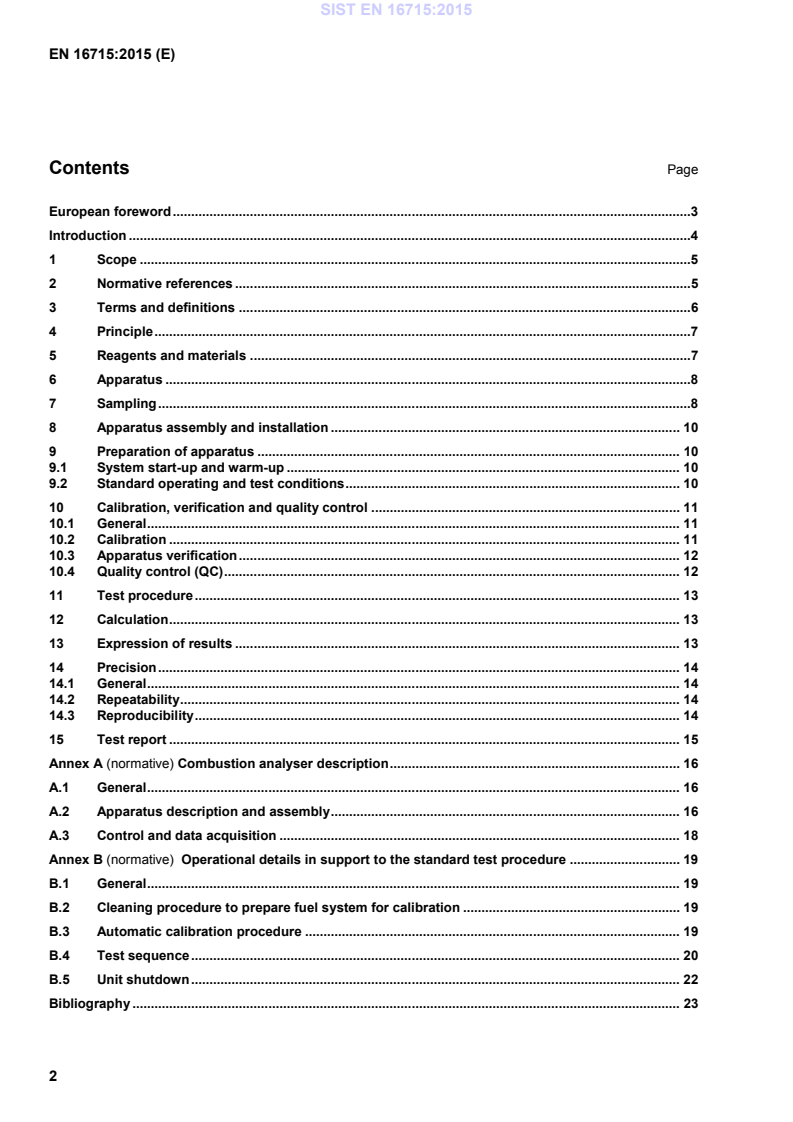
Operational details in support to the standard test procedure . 19 B.1 General . 19 B.2 Cleaning procedure to prepare fuel system for calibration . 19 B.3 Automatic calibration procedure . 19 B.4 Test sequence . 20 B.5 Unit shutdown . 22 Bibliography . 23
Key Digital signals Analogue signals L1: upper level sensor T1: coolant temperature L2: lower level sensor T2: inner wall temperature TF: thermal fuse P1: fuel pressure M1: hydraulic pump P2: chamber dynamic pressure N1: injector P3: chamber static pressure V1: flush valve P4: nitrogen pressure V2: air inlet valve FR1: coolant flow rate V3: exhaust valve
Vx: nitrogen circuit valves
Analyser lines Analyser parts (no signal registration) AI: Air inlet CC: Combustion chamber CI: Coolant input F1, F2, F3: Filter CO: Coolant output M2: Multiplier EX: Air exhaust RD: Rupture disk NI: Nitrogen input S1: Safety valve SI: Sample inlet SV: Sample vessel
WB: Sample waste drain
H1: Clam shell heater Figure 1 — Schematic overview of combustion analyser SIST EN 16715:2015
...