

EN 2243-1:2005
(Main)Aerospace series - Non-metallic materials - Structural adhesives - Test method - Part 1: Single lap shear
General Information
- Abstract
The objective of this standard is to establish the test methods for defining the strength of suitable structural adhesives in metal to metal single lap shear, at ambient and other temperatures.
- Status
- Published
- Publication Date
- 15-Nov-2005
- Withdrawal Date
- 30-May-2006
- Technical Committee
- ASD-STAN - Aerospace
- Drafting Committee
- ASD-STAN/D 4 - Metallic
- Current Stage
- 6060 - Definitive text made available (DAV) - Publishing
- Start Date
- 16-Nov-2005
- Completion Date
- 16-Nov-2005

Overview
EN 2243-1:2005 - "Aerospace series - Non‑metallic materials - Structural adhesives - Test method - Part 1: Single lap shear" is a CEN (AECMA) test standard for measuring the shear strength of structural adhesives in metal‑to‑metal single lap shear specimens. It specifies specimen geometry, surface preparation, bonding and storage, test conditions (ambient and elevated temperatures), test machine requirements and the data to report. This standard is used to generate repeatable, comparable shear strength data for aerospace adhesive qualification and material selection.
Key topics and requirements
- Specimen design and materials
- Defined panel and test piece dimensions; rolling direction parallel to specimen axis.
- Acceptable metal substrates include aluminium alloys (per EN 2087/2088/2090/2092), corrosion‑resisting steel (EN 2540) and titanium alloys (EN 2517/EN 3456/EN 3464) depending on test temperature and adhesive strength.
- Surface preparation
- Pre‑bond treatments reference EN 2334 (chromic‑sulphuric acid pickle) and EN 2497 (dry abrasive blasting for titanium).
- Bonding and storage
- Adhesive application, primers and cure follow the adhesive manufacturer’s instructions or material standard.
- Post‑cure storage: (23 ± 2) °C and (50 ± 5) % RH for 16 h unless otherwise specified.
- Test conditioning and temperature control
- Tests may be at ambient or elevated temperatures; heating rate 6–10 °C/min. For non‑ambient tests, hold the specimen at temperature for 10 min before loading.
- Thermocouple placement is specified (junction on metal within a 6 × 7 mm area inside the bonded zone) for accurate temperature control.
- Mechanical test parameters
- Specimens gripped 50 ± 5 mm from each edge of the lap.
- Loading rate: 2 800 N/min to 5 000 N/min.
- Tensile machine accuracy: load recorded to ±1 %; failing load should be within 10–90 % of machine range.
- Result calculation and reporting
- Shear strength R = F / (L × W) where F = failing load (N), L = loaded length (mm), W = overlap width (mm).
- Test report must include adhesive identification, substrate details, surface prep, cure/bonding parameters, test conditions, individual results, failure mode distribution and any deviations.
Applications and users
- Primary users: adhesive manufacturers, aerospace OEMs, material qualification labs, test houses and certification bodies.
- Practical uses:
- Qualifying structural adhesive systems for aircraft assemblies.
- Comparing adhesive performance across temperatures and substrates.
- Supporting material selection, design validation and procurement specifications in aerospace programs.
Related standards
- EN 2087, EN 2088, EN 2090, EN 2092 (aluminium alloys)
- EN 2334 (acid pickle)
- EN 2497 (dry abrasive blasting for titanium)
- EN 2540 (corrosion‑resisting steel)
- EN 2517, EN 3456, EN 3464 (titanium alloys)
Keywords: EN 2243-1:2005, single lap shear, structural adhesives, aerospace test method, shear strength, metal‑to‑metal bonding, tensile testing, surface preparation.
Relations
- Effective Date
- 28-Jan-2026
- Effective Date
- 28-Jan-2026
- Refers
EN 3464:2012 - Aerospace series - Titanium alloy Ti-6Al-4V - Annealed - Plate - 6 mm < a ≤ 100 mm - Effective Date
- 28-Jan-2026
- Effective Date
- 28-Jan-2026
- Refers
EN 2334:1997 - Aerospace series - Chromic-sulphuric acid pickle of aluminium and aluminium alloys - Effective Date
- 28-Jan-2026
- Effective Date
- 28-Jan-2026
- Refers
EN 2090:2005 - Aerospace series - Aluminium alloy AL-P2024-T3 - Clad sheet and strip 0,3 mm <a <6 mm - Effective Date
- 28-Jan-2026
- Effective Date
- 28-Jan-2026
- Effective Date
- 28-Jan-2026
- Effective Date
- 28-Jan-2026
- Effective Date
- 28-Jan-2026
Get Certified
Connect with accredited certification bodies for this standard

BUREAU VERITAS Certification Germany
Bureau Veritas certification in Germany.

Element Materials Technology
Materials testing and product certification.

AQMS Ltd.
AQMS provides ISO certification to SMEs across the UK.
Sponsored listings
Frequently Asked Questions
EN 2243-1:2005 is a standard published by the European Committee for Standardization (CEN). Its full title is "Aerospace series - Non-metallic materials - Structural adhesives - Test method - Part 1: Single lap shear". This standard covers: The objective of this standard is to establish the test methods for defining the strength of suitable structural adhesives in metal to metal single lap shear, at ambient and other temperatures.
The objective of this standard is to establish the test methods for defining the strength of suitable structural adhesives in metal to metal single lap shear, at ambient and other temperatures.
EN 2243-1:2005 is classified under the following ICS (International Classification for Standards) categories: 49.025.50 - Adhesives. The ICS classification helps identify the subject area and facilitates finding related standards.
EN 2243-1:2005 has the following relationships with other standards: It is inter standard links to EN 2087:2025, EN 2088:2005, EN 3464:2012, EN 3456:2012, EN 2334:1997, EN 2092:2005, EN 2090:2005, EN 2497:1989, EN 2243-6:2005, EN 2243-5:2005, EN 4106:2013. Understanding these relationships helps ensure you are using the most current and applicable version of the standard.
EN 2243-1:2005 is available in PDF format for immediate download after purchase. The document can be added to your cart and obtained through the secure checkout process. Digital delivery ensures instant access to the complete standard document.
Standards Content (Sample)
2003-01.Slovenski inštitut za standardizacijo. Razmnoževanje celote ali delov tega standarda ni dovoljeno.Aerospace series - Non-metallic materials - Structural adhesives - Test method - Part 1: Single lap shearAeronavtika – Nekovinski materiali – Konstrukcijska lepila – Preskusna metoda – 1. del: Strig
enojnega prekritjaSérie aérospatiale - Matériaux non-métalliques - Systeme d'adhésifs structuraux - Méthodes d'essai - Partie 1 : Essais de cisaillement d'un joint a recouvrement simpleLuft- und Raumfahrt - Nichtmetallische Werkstoffe - Strukturelle Klebstoffe - Prüfverfahren - Teil 1: Bestimmung der Bindefestigkeit von einschnittig überlappten Klebungen im ZugversuchTa slovenski standard je istoveten z:EN 2243-1:2005SIST EN 2243-1:2006en49.025.50ICS:SLOVENSKI
STANDARDSIST EN 2243-1:200601-julij-2006
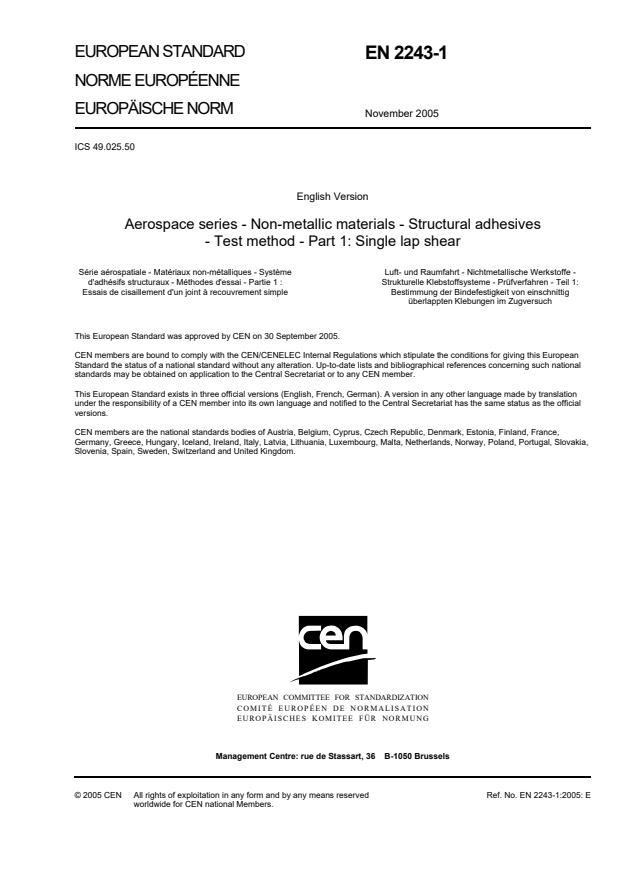
EUROPEAN STANDARDNORME EUROPÉENNEEUROPÄISCHE NORMEN 2243-1November 2005ICS 49.025.50 English VersionAerospace series - Non-metallic materials - Structural adhesives- Test method - Part 1: Single lap shearSérie aérospatiale - Matériaux non-métalliques - Systèmed'adhésifs structuraux - Méthodes d'essai - Partie 1 :Essais de cisaillement d'un joint à recouvrement simpleLuft- und Raumfahrt - Nichtmetallische Werkstoffe -Strukturelle Klebstoffsysteme - Prüfverfahren - Teil 1:Bestimmung der Bindefestigkeit von einschnittigüberlappten Klebungen im ZugversuchThis European Standard was approved by CEN on 30 September 2005.CEN members are bound to comply with the CEN/CENELEC Internal Regulations which stipulate the conditions for giving this EuropeanStandard the status of a national standard without any alteration. Up-to-date lists and bibliographical references concerning such nationalstandards may be obtained on application to the Central Secretariat or to any CEN member.This European Standard exists in three official versions (English, French, German). A version in any other language made by translationunder the responsibility of a CEN member into its own language and notified to the Central Secretariat has the same status as the officialversions.CEN members are the national standards bodies of Austria, Belgium, Cyprus, Czech Republic, Denmark, Estonia, Finland, France,Germany, Greece, Hungary, Iceland, Ireland, Italy, Latvia, Lithuania, Luxembourg, Malta, Netherlands, Norway, Poland, Portugal, Slovakia,Slovenia, Spain, Sweden, Switzerland and United Kingdom.EUROPEAN COMMITTEE FOR STANDARDIZATIONCOMITÉ EUROPÉEN DE NORMALISATIONEUROPÄISCHES KOMITEE FÜR NORMUNGManagement Centre: rue de Stassart, 36
B-1050 Brussels© 2005 CENAll rights of exploitation in any form and by any means reservedworldwide for CEN national Members.Ref. No. EN 2243-1:2005: E
EN 2088, Aerospace series – Aluminium alloy AL-P2014A – T4 or T42 – Clad sheet and strip – 0,4 mm ≤ a ≤ 6 mm. 1) EN 2090, Aerospace series – Aluminium alloy AL-P2024- – T3 – Clad sheet and strip – 0,3 mm ≤ a ≤ 6 mm. 1) EN 2092, Aerospace series – Aluminium alloy AL-P7075- – T6 or T62 – Clad sheet and strip – 0,4 mm ≤ a ≤ 6 mm. EN 2334, Aerospace series – Chromic-sulphuric acid pickle of aluminium and aluminium alloys. EN 2497, Aerospace series – Dry abrasive blasting of titanium and titanium alloys. EN 2
...