

EN 2497:1989
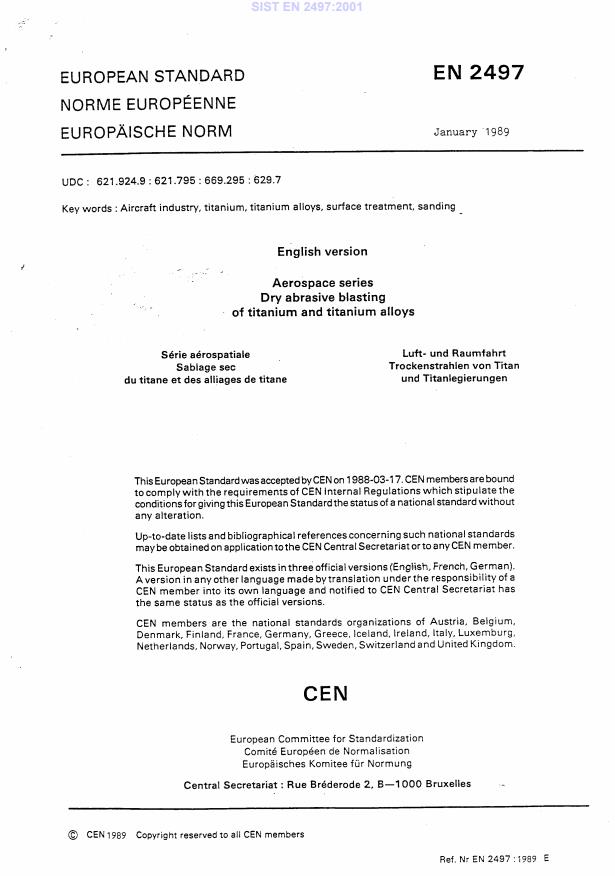
(Main)Aerospace series - Dry abrasive blasting of titanium and titanium alloys
- Abstract
This standard specifies the process schedule and requirements for dry abrasive blasting of titanium and titanium alloys used in aerospace constructions.
The method specified is applicable to the pretreatment of titanium and titanium alloys and to qualification tests of adhesives on these materials.
- Status
- Published
- Publication Date
- 14-Jan-1989
- Withdrawal Date
- 14-Jul-1989
- Technical Committee
- ASD-STAN - Aerospace
- Drafting Committee
- ASD-STAN/D 4 - Metallic
- Current Stage
- 9093 - Decision to confirm - Review Enquiry
- Start Date
- 21-Jan-2025
- Completion Date
- 07-Oct-2026

Overview
EN 2497:1989 is a CEN standard specifically developed for the aerospace industry and addresses the requirements and process schedules for dry abrasive blasting of titanium and titanium alloys. This process is crucial for the preparation of titanium materials, ensuring the correct surface quality before further operations such as adhesive bonding. EN 2497:1989 details the methods for both the pretreatment of titanium and titanium alloy surfaces and the qualification testing of adhesives on these materials, providing an essential reference for aerospace manufacturers and suppliers.
Key Topics
Process Requirements: The standard specifies the necessary steps and controls for performing dry abrasive blasting on titanium and titanium alloys, including equipment setup, media selection, and maintenance procedures.
Pretreatment of Titanium and Alloys: Guidelines are given for preparing the surface of titanium components through dry abrasive blasting, which enhances the adhesion of coatings and adhesives used in aerospace construction.
Adhesive Qualification: EN 2497:1989 includes requirements for testing adhesives on pretreated titanium surfaces to ensure compatibility and durability within aerospace applications.
Quality Assurance: The document emphasizes process control and validation to meet the stringent quality standards of the aerospace sector.
Applications
EN 2497:1989 is widely applied within the aerospace industry for:
Surface Preparation: Creating optimal surface conditions on titanium and titanium alloy parts for subsequent coating or adhesive bonding. Proper surface preparation is vital for ensuring long-term performance and safety in aerospace assemblies.
Manufacturing and Maintenance: Used both in original part manufacturing and in maintenance, repair, and overhaul (MRO) of aerospace components involving titanium alloys.
Adhesive Bonding: Supporting the qualification and performance verification of adhesives used in critical aerospace joints, which rely on properly blasted surfaces for maximum strength and reliability.
Compliance: Ensuring that aerospace manufacturers and suppliers meet international standards and regulatory requirements related to surface treatments for titanium-based materials.
Related Standards
For comprehensive compliance and best practices, EN 2497:1989 works in conjunction with several other standards, including:
- EN 2334 - Aerospace - Adhesives - Determination of the resistance to flow (Adhesives bond strength)
- EN 1669 - Aerospace series - Titanium and titanium alloys - Test methods
- ISO 11073 - Surface preparation and corrosion protection standards for metallic materials
- ISO 9001 - Quality management systems applicable to aerospace manufacturing processes
Industry professionals should consult these related standards to ensure holistic adherence to quality, performance, and safety requirements in aerospace applications.
By following EN 2497:1989, organizations ensure high-standard surface preparation of titanium and titanium alloys, achieving consistent performance and reliability in aerospace constructions through optimized pretreatment and adhesive qualification practices.
Relations
- Referred By
EN 4031:2001 - Aerospace series - Pipe coupling 8°30' in titanium alloy - Nut for welded ferrule - Effective Date
- 28-Jan-2026
- Effective Date
- 28-Jan-2026
- Effective Date
- 28-Jan-2026
- Effective Date
- 28-Jan-2026
Get Certified
Connect with accredited certification bodies for this standard

BUREAU VERITAS Certification Germany
Bureau Veritas certification in Germany.

Element Materials Technology
Materials testing and product certification.

AQMS Ltd.
AQMS provides ISO certification to SMEs across the UK.
Sponsored listings
Frequently Asked Questions
EN 2497:1989 is a standard published by the European Committee for Standardization (CEN). Its full title is "Aerospace series - Dry abrasive blasting of titanium and titanium alloys". This standard covers: This standard specifies the process schedule and requirements for dry abrasive blasting of titanium and titanium alloys used in aerospace constructions. The method specified is applicable to the pretreatment of titanium and titanium alloys and to qualification tests of adhesives on these materials.
This standard specifies the process schedule and requirements for dry abrasive blasting of titanium and titanium alloys used in aerospace constructions. The method specified is applicable to the pretreatment of titanium and titanium alloys and to qualification tests of adhesives on these materials.
EN 2497:1989 is classified under the following ICS (International Classification for Standards) categories: 49.040 - Coatings and related processes used in aerospace industry. The ICS classification helps identify the subject area and facilitates finding related standards.
EN 2497:1989 has the following relationships with other standards: It is inter standard links to EN 4031:2001, EN 2243-4:2005, EN 2243-1:2005, EN 3021:2017. Understanding these relationships helps ensure you are using the most current and applicable version of the standard.
EN 2497:1989 is available in PDF format for immediate download after purchase. The document can be added to your cart and obtained through the secure checkout process. Digital delivery ensures instant access to the complete standard document.
Standards Content (Sample)
2003-01.Slovenski inštitut za standardizacijo. Razmnoževanje celote ali delov tega standarda ni dovoljeno.Aerospace series - Dry abrasive blasting of titanium and titanium alloysLuft- und Raumfahrt - Trockenstrahlen von Titan und TitanlegierungenSérie aérospatiale - Sablage sec du titane et des alliages de titaneAerospace series - Dry abrasive blasting of titanium and titanium a
...