

EN 14960:2006
(Main)Inflatable play equipment - Safety requirements and test methods
- Abstract
This standard is applicable to inflatable play equipment intended for use by children fourteen years and under both individually and collectively.
This standard specifies safety requirements for inflatable play equipment for which the primary activities are bouncing and sliding. It sets measures to address risks and also minimize accidents to users for those involved in the design, manufacture and supply of inflatable play equipment. It specifies information to be supplied with the equipment. The requirements have been laid down bearing in mind the risk factor based on available data.
This standard specifies the requirements that will protect a child from hazards that he or she may be unable to foresee when using the equipment as intended, or in a manner that can be reasonably anticipated.
This Standard is not applicable to inflatable water-borne play and leisure equipment, domestic inflatable toys, air-supported buildings, inflatables used solely for protection, inflatables used for rescue, or other types of inflatable toys where the primary activity is not bouncing or sliding.
- Status
- Withdrawn
- Publication Date
- 14-Nov-2006
- Withdrawal Date
- 03-Sep-2013
- Technical Committee
- CEN/TC 136 - Sports, playground and other recreational equipment
- Drafting Committee
- CEN/TC 136/SC 1 - Playground equipment for children
- Current Stage
- 9960 - Withdrawal effective - Withdrawal
- Start Date
- 04-Sep-2013
- Completion Date
- 04-Sep-2013

Relations
- Effective Date
- 11-Sep-2013
- Effective Date
- 09-Feb-2026
- Effective Date
- 28-Jan-2026
- Effective Date
- 28-Jan-2026
- Effective Date
- 28-Jan-2026
- Effective Date
- 28-Jan-2026
- Effective Date
- 28-Jan-2026
- Effective Date
- 28-Jan-2026
- Referred By
EN 50242:2008 - Electric dishwashers for household use - Methods for measuring the performance - Effective Date
- 09-Feb-2026
- Effective Date
- 09-Feb-2026
- Referred By
EN IEC 60436:2025 - Electric dishwashers for household use - Methods for measuring the performance - Effective Date
- 09-Feb-2026
- Referred By
EN 50242:2016 - Electric dishwashers for household use - Methods for measuring the performance - Effective Date
- 09-Feb-2026
- Effective Date
- 28-Jan-2026
- Effective Date
- 28-Jan-2026
- Effective Date
- 28-Jan-2026
Frequently Asked Questions
EN 14960:2006 is a standard published by the European Committee for Standardization (CEN). Its full title is "Inflatable play equipment - Safety requirements and test methods". This standard covers: This standard is applicable to inflatable play equipment intended for use by children fourteen years and under both individually and collectively. This standard specifies safety requirements for inflatable play equipment for which the primary activities are bouncing and sliding. It sets measures to address risks and also minimize accidents to users for those involved in the design, manufacture and supply of inflatable play equipment. It specifies information to be supplied with the equipment. The requirements have been laid down bearing in mind the risk factor based on available data. This standard specifies the requirements that will protect a child from hazards that he or she may be unable to foresee when using the equipment as intended, or in a manner that can be reasonably anticipated. This Standard is not applicable to inflatable water-borne play and leisure equipment, domestic inflatable toys, air-supported buildings, inflatables used solely for protection, inflatables used for rescue, or other types of inflatable toys where the primary activity is not bouncing or sliding.
This standard is applicable to inflatable play equipment intended for use by children fourteen years and under both individually and collectively. This standard specifies safety requirements for inflatable play equipment for which the primary activities are bouncing and sliding. It sets measures to address risks and also minimize accidents to users for those involved in the design, manufacture and supply of inflatable play equipment. It specifies information to be supplied with the equipment. The requirements have been laid down bearing in mind the risk factor based on available data. This standard specifies the requirements that will protect a child from hazards that he or she may be unable to foresee when using the equipment as intended, or in a manner that can be reasonably anticipated. This Standard is not applicable to inflatable water-borne play and leisure equipment, domestic inflatable toys, air-supported buildings, inflatables used solely for protection, inflatables used for rescue, or other types of inflatable toys where the primary activity is not bouncing or sliding.
EN 14960:2006 is classified under the following ICS (International Classification for Standards) categories: 97.190 - Equipment for children; 97.200.50 - Toys. The ICS classification helps identify the subject area and facilitates finding related standards.
EN 14960:2006 has the following relationships with other standards: It is inter standard links to EN 14960:2013, EN 60529:1991, EN 1177:2018+A1:2023, EN ISO 1421:1998, EN ISO 2307:2019, EN ISO 2411:2000, EN 71-3:2019+A2:2024, EN ISO 9554:2019, EN 50242:2008, EN 60436:2020/A12:2022, EN IEC 60436:2025, EN 50242:2016, EN 15168:2006, EN 14668:2005, EN 12139:1999. Understanding these relationships helps ensure you are using the most current and applicable version of the standard.
EN 14960:2006 is available in PDF format for immediate download after purchase. The document can be added to your cart and obtained through the secure checkout process. Digital delivery ensures instant access to the complete standard document.
Standards Content (Sample)
2003-01.Slovenski inštitut za standardizacijo. Razmnoževanje celote ali delov tega standarda ni dovoljeno.Inflatable play equipment - Safety requirements and test methodsNapihljiva igralna oprema – Varnostne zahteve in preskusne metodeÉquipements de jeu gonflables - Exigences de sécurité et méthodes d'essaiAufblasbare Spielgeräte - Sicherheitstechnische Anforderungen und PrüfverfahrenTa slovenski standard je istoveten z:EN 14960:2006SIST EN 14960:2007en;fr;de97.200.50,JUDþHToys97.190Otroška opremaEquipment for childrenICS:SLOVENSKI
STANDARDSIST EN 14960:200701-marec-2007
EUROPEAN STANDARDNORME EUROPÉENNEEUROPÄISCHE NORMEN 14960November 2006ICS 97.190; 97.200.50 English VersionInflatable play equipment - Safety requirements and testmethodsÉquipements de jeux gonflables - Exigences de sécurité etméthodes d'essaiAufblasbare Spielgeräte - SicherheitstechnischeAnforderungen und PrüfverfahrenThis European Standard was approved by CEN on 6 October 2006.CEN members are bound to comply with the CEN/CENELEC Internal Regulations which stipulate the conditions for giving this EuropeanStandard the status of a national standard without any alteration. Up-to-date lists and bibliographical references concerning such nationalstandards may be obtained on application to the Central Secretariat or to any CEN member.This European Standard exists in three official versions (English, French, German). A version in any other language made by translationunder the responsibility of a CEN member into its own language and notified to the Central Secretariat has the same status as the officialversions.CEN members are the national standards bodies of Austria, Belgium, Cyprus, Czech Republic, Denmark, Estonia, Finland, France,Germany, Greece, Hungary, Iceland, Ireland, Italy, Latvia, Lithuania, Luxembourg, Malta, Netherlands, Norway, Poland, Portugal, Romania,Slovakia, Slovenia, Spain, Sweden, Switzerland and United Kingdom.EUROPEAN COMMITTEE FOR STANDARDIZATIONCOMITÉ EUROPÉEN DE NORMALISATIONEUROPÄISCHES KOMITEE FÜR NORMUNGManagement Centre: rue de Stassart, 36
B-1050 Brussels© 2006 CENAll rights of exploitation in any form and by any means reservedworldwide for CEN national Members.Ref. No. EN 14960:2006: E
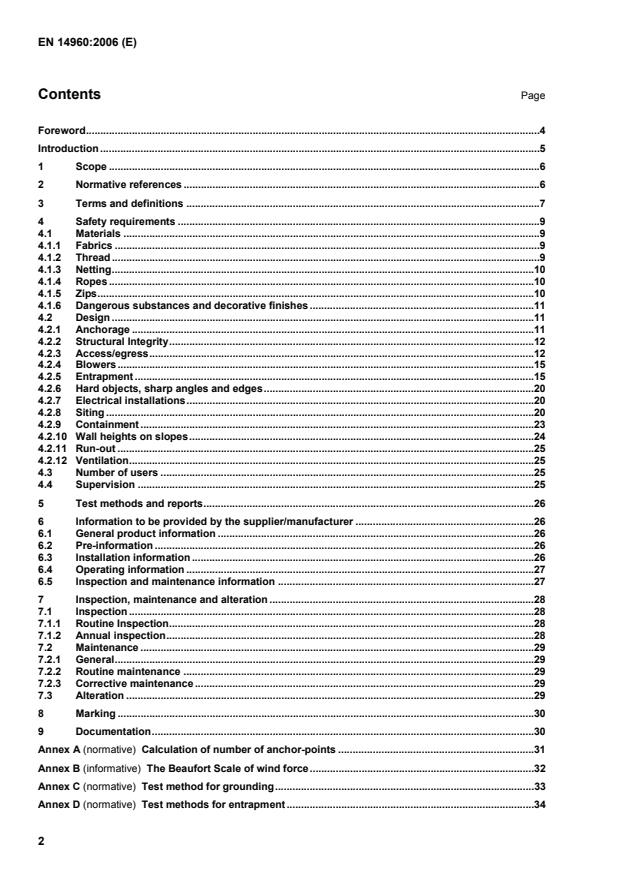
Calculation of number of anchor-points.31 Annex B (informative)
The Beaufort Scale of wind force.32 Annex C (normative)
Test method for grounding.33 Annex D (normative)
Test methods for entrapment.34
Test method for tear strength.42 E.1 Maximum value tongue tear, apparatus.42 E.2 Preparation of test specimens.42 E.3 Conditioning.43 E.4 Preconditioning.43 E.5 Characteristics of test atmospheres.43 E.6 Methods of conditioning.43 E.7 Procedure.44 E.8 Calculation and expression of results.45 E.9 Test report.46 Bibliography.47
This standard specifies safety requirements for inflatable play equipment for which the primary activities are bouncing and sliding. It sets measures to address risks and also minimize accidents to users for those in-volved in the design, manufacture and supply of inflatable play equipment. It specifies information to be sup-plied with the equipment. The requirements have been laid down bearing in mind the risk factor based on available data.
This standard specifies the requirements that will protect a child from hazards that he or she may be unable to foresee when using the equipment as intended, or in a manner that can be reasonably anticipated. This Standard is not applicable to inflatable water-borne play and leisure equipment, domestic inflatable toys, air-supported buildings, inflatables used solely for protection, inflatables used for rescue, or other types of in-flatable toys where the primary activity is not bouncing or sliding. 2 Normative references The following referenced documents are indispensable for the application of this document. For dated refer-ences, only the edition cited applies. For undated references, the latest edition of the referenced document (including any amendments) applies. EN 71-3, Safety of toys - Part 3: Migration of certain elements EN 1177, Impact absorbing playground surfacing — Safety requirements and test methods EN 60529, Degrees of protection provided by enclosures (IP code) (IEC 60529:1989) EN ISO 1421:1998, Rubber- or plastics-coated fabrics - Determination of tensile strength and elongation at break (ISO 1421:1998) EN ISO 2307, Fibre ropes - Determination of certain physical and mechanical properties (ISO 2307:2005) EN ISO 2411:2000, Rubber- or plastics-coated fabrics — Determination of coating adhesion (ISO 2411:2000) EN ISO 9554, Fibre ropes - General specifications (ISO 9554:2005) EN ISO/IEC 17025, General requirements for the competence of testing and calibration laboratories (ISO/IEC 17025:2005)
a) Flat-bed (4 open sides) b) Castle (3 walled sides, 1 open side) c) A-Frame inflatable (3 walled sides, 1 open side)
d) A-Frame inflatable with
raincover e) Multi-Play Centre f) Obstacle course
g) Inflatable slide h) Enclosed inflatable i) Soft mountain Figure 1 — Examples of inflatable play equipment
3.3 connection tube part of the inflatable structure to which the blower is connected 3.4 controller person, company or hirer (those who hire to others), having responsibility for the overall control, inspection and maintenance of the equipment 3.5 operator person appointed by a controller to be in charge of the operation of the equipment at any time when it is avail-able for use by the public 3.6 attendant person working under a control and direction of an operator to assist in the operation of the equipment 3.7 inspection body organization, part of an organization or individual with the appropriate competence to carry out one or more of the following inspections: design review; assessment of conformity to design; initial testing; annual main inspection 3.8 free height of fall greatest vertical distance from the clearly intended body support to an impact area below
[EN 1176-1:1998] 3.9 critical fall height upper limit of all free heights of fall, for which the surfacing provides an acceptable level of impact attenuation 3.10 open side any external side of an inflatable with no containing wall 3.11 step step to aid the access/egress of users into and out of the playing area of the inflatable, making the transition between the height of the playing area and the ground 3.12 ramp ramp to aid the access/egress of users into and out of the playing area of the inflatable, making the transition between the height of the playing area and the ground 3.13 platform any surface on which a user may stand
3.21 user height maximum height of persons allowed to use the inflatable 4 Safety requirements 4.1 Materials 4.1.1 Fabrics Fabrics shall be flame retardant. Fabrics, and joins in fabrics, shall be of adequate tear and tensile strength for the weight of the intended user and have sufficient air retention to enable the inflatable, when pressurized to the level specified in the opera-tions manual, to resume its shape after distortion under load. Fabrics of: a) minimum tear strength 350 N (test method Annex E); b) minimum tensile strength 1 850 N (EN ISO 1421); c) and minimum coating adhesion 100 N (EN ISO 2411); shall be used in those structural parts of the inflatable where force or stress is applied by the user. 4.1.2 Thread Threads shall be non-rotting yarn and at least 88 N tensile strength. Stitching shall be lock-stitch. The length of individual stitches shall be a minimum of 3 mm and a maximum of 8 mm.
Figure 2 — 8 mm finger rod Clamber netting (commonly laid on slopes to form foot and hand holds) shall be securely fixed to prevent lift-ing by the user. The rope from which it is made shall be at least 12 mm in diameter and shall be securely knot-ted. Strand ends shall be treated to prevent fraying. Care shall be taken when heat sealing so as not to form hard or sharp edges. 4.1.4 Ropes Ropes shall be fixed at both ends and the total amplitude of swing shall not exceed 20 % of the distance be-tween the fixing points. NOTE This requirement is intended to remove the risk of strangulation. The rope diameter shall be between 18 mm and 45 mm. Fibre ropes (textile type) shall conform to EN ISO 9554 or EN ISO 2307. Alternatively, the manufacturer shall supply a works certificate stating the material used and the safe working load. Monofilament plastics ropes shall not be used. 4.1.5 Zips Zips shall withstand air pressures and tension generated within the structure. Zips used for entrances and ex-its shall be reliable, easy to use, able to open from both sides and shall allow access and egress by adults. Zips used for deflation purposes shall have the puller hidden from view (e.g. by a flap or pocket).
Key 1 Direction of force 2 Rounded tops 3 Ground level Figure 3 — Examples of ground stakes On hard standing where ground stakes cannot be used, the inflatable shall be secured to the ground by
equally effective method e.g. attaching each of the anchorage points to fittings already in the ground, or to sandbags or other weights, if these are capable of supporting the 1 600 N load. If the inflatable is secured to a vehicle or other movable machinery, such vehicles or machinery shall be immobilized and be under the con-trol of an operator.
Key 1 Surrounding safety apron 2 Tread depth 3 Playing area Figure 4 — Section through a soft mountain
Key a Depth of trough — measured when inflated b Width of adjacent panel Figure 5 — Trough depth 4.2.3 Access/egress A step or ramp shall be wide enough to cover the entire access/egress aperture with overlap, according to Figure 6. A step or ramp shall have a tread depth of a minimum of 1,5 times the height of the adjacent playing area plat-form to which it is attached (see Figure 6).
a)
b) Key 1 Overlap 2 Open side 3 Height of adjacent playing area platform
4 Tread depth 5 Step 6 Ramp Figure 6 — Step or ramp detail
c) Up and over slide Key 1 Walled side 2 At least 1,2 m 3 Open side
4 Impact area 5 Exit 6 Entrance Figure 7 — Impact area
Key 1 Side of inflatable 2 Impact area 3 Anchorage stake as close as practicable to the side of the inflatable 4 Ground level Figure 8 — Anchorage in an impact area Totally enclosed inflatables shall have signs indicating exits, which shall be visible in all circumstances. When designed for more than 15 users, there shall be more than one exit, and users shall never be more than 5 m from an exit. 4.2.4 Blowers Blowers shall be protected to a minimum of IP23B as defined in EN 60529, except that the 8 mm finger rod, as illustrated in Figure 2, shall be used instead of the jointed 12 mm test finger. The blower shall be positioned at least 1,2 m from a walled side and 2,5 m from an open side. The connection tube shall be long enough to allow this. If a blower is sited inside the inflatable structure, it shall be at least 2,5 m from the playing area, safety apron, step and/or ramp. The blower, including cabling and controls, shall not be readily accessible to the public. NOTE See also electrical installations 4.2.7. 4.2.5 Entrapment 4.2.5.1 Entrapment of the head and neck Inflatables shall be constructed so that any openings do not create head and neck entrapment hazards by
either head first or feet first passage.
are not created. Slides shall be constructed so that openings located within the free space (see Figure 9) do not trap the toggle when tested in accordance with D.4. Free space is defined as a series of cylindrical spaces that represent the user, originating from and perpen-dicular to the bearing surface along the f
...