

prEN 1127-2
(Main)Explosive atmospheres - Explosion prevention and protection - Part 2: Basic concepts and methodology for mining
- Abstract
This document specifies methods for explosion prevention and protection in mining by outlining the basic concepts and methodology for the design and construction of equipment, protective systems and components.
This document applies to Group I equipment, protective systems and components intended for use in underground parts of mines and those parts of their surface installations at risk from firedamp and/or combustible dust.
NOTE Detailed information on specific equipment, protective systems and components is contained in the relevant individual standards. Safety-relevant data regarding flammable materials and explosive atmospheres are required for the design and construction of the explosion protection measures.
This document specifies methods for the identification and assessment of hazardous situations that may lead to explosions and describes the design and construction measures appropriate for the required safety. This is achieved by:
— risk assessment;
— risk reduction.
The safety of equipment, protective systems, and components can be achieved by eliminating hazards and/or limiting the risk, i.e.:
a) by appropriate design (without using safeguarding);
b) by safeguarding;
c) by information for use;
d) by any other preventive measures.
Measures in accordance with a) (prevention) and b) (protection) against explosions are dealt with in Clause 6 of this document; measures according to c) against explosions are dealt with in Clause 7 of this document. Measures in accordance with d) are not described in this document. They are dealt with in EN ISO 12100:2010, Clause 6.
The preventive and protective measures described in this document will not provide the required level of protection unless the equipment, protective systems and components are operated in line with their intended use and are installed and maintained according to the relevant codes of practice or requirements.
This document is applicable to any equipment, protective systems and components intended to be used in potentially explosive atmospheres. These atmospheres can arise from flammable materials processed, used or released by the equipment, protective systems and components or from materials in the vicinity of the equipment, protective systems and components and/or from the materials of construction of the equipment, protective systems and components.
As shot firing can release potentially explosive atmospheres, this document is also applicable to the equipment used for shot firing, apart from the explosives and detonators.
This document is applicable to equipment, protective systems and components at all stages of use.
This document is not applicable to:
— medical devices intended for use in a medical environment;
— equipment, protective systems and components where the explosion hazard results exclusively from the presence of explosives or unstable chemical substances;
— equipment, protective systems and components where the explosion can result from reaction of substances with oxidising agents other than atmospheric oxygen or by other hazardous reactions or conditions other than atmospheric conditions;
— equipment intended for use in domestic and non-commercial environments where explosive atmospheres may only rarely be created and solely as a result of the accidental leakage of fuel gas;
— personal protective equipment covered by Regulation (EU) 2016/425; the design and construction of systems containing desired, controlled combustion processes, unless they can act as ignition sources in potentially explosive atmospheres;
— mines where firedamp and/or combustible dust are not naturally present and surface installations such as coal preparation plants, power plants, coke oven plants etc. in which an explosive atmosphere can be present, but which are not part of a coal mine. These are covered by EN 1127-1:2019.
- Status
- Not Published
- Publication Date
- 14-Apr-2027
- Current Stage
- 4020 - Submission to enquiry - Enquiry
- Start Date
- 24-Sep-2026
- Due Date
- 01-Jan-2026
- Completion Date
- 01-Jan-2026

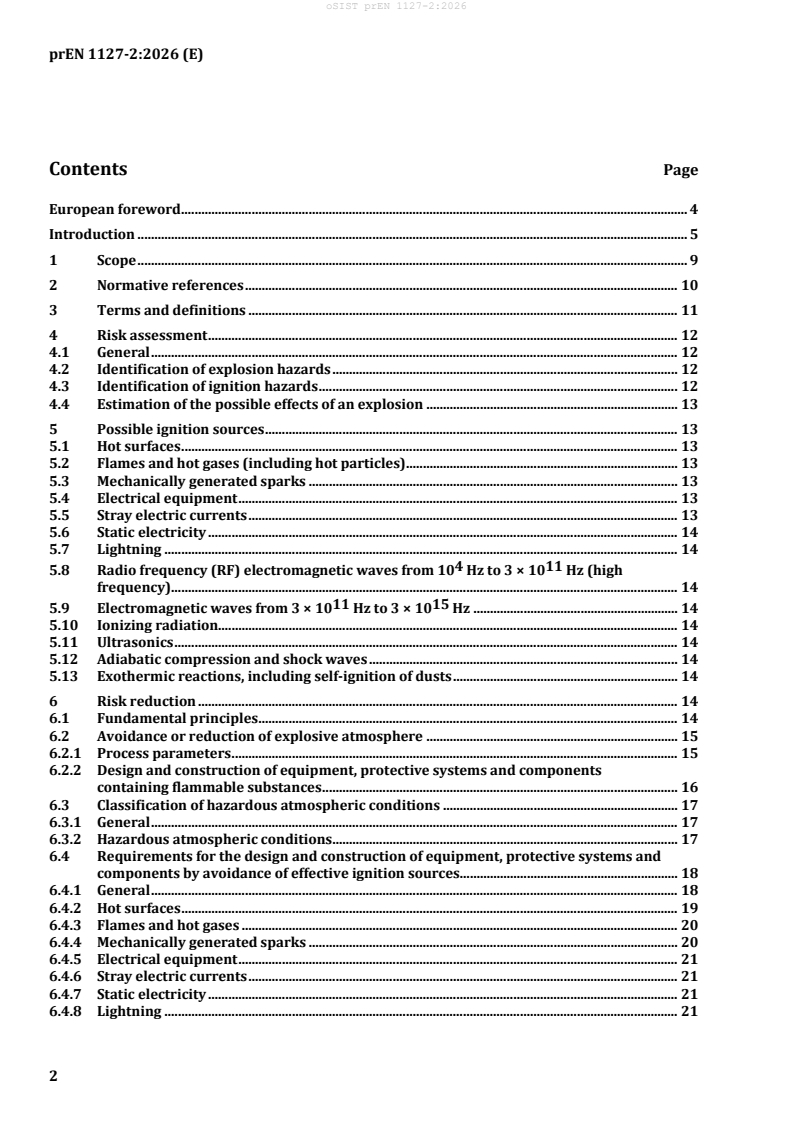
prEN 1127-2 is a CEN draft European Standard on explosion prevention and protection in mining. It specifies the basic concepts and methodology for the design and construction of Group I equipment, protective systems and components used in underground parts of mines and associated surface installations where firedamp and/or combustible dust can create explosive atmospheres. It is written for designers, manufacturers, mine operators and others who need to assess explosion risk and choose suitable protective measures.
What does prEN 1127-2 specify?
prEN 1127-2 specifies how to identify explosion hazards in mining and how to reduce the risk by design, safeguarding and information for use. It focuses on equipment, protective systems and components for underground mines and the parts of surface installations that are exposed to firedamp and/or combustible dust.
The document is organized into:
- Clause 1 - Scope
- Clause 2 - Normative references
- Clause 3 - Terms and definitions
- Clause 4 - Risk assessment
- Clause 5 - Possible ignition sources
- Clause 6 - Risk reduction
- Clause 7 - Information for use
- Annexes A, B, C, ZA and ZB
Annexes are used as follows:
| Annex | What it covers |
|---|---|
| Annex A | Relation between Equipment categories and hazardous atmospheric conditions |
| Annex B | Tools for use in potentially explosive atmospheres |
| Annex C | Significant technical changes from the previous edition |
| Annex ZA | Relationship with Directive 2014/34/EU |
| Annex ZB | Relationship with Regulation (EU) 2023/1230 |
The scope includes equipment used for shot firing, except explosives and detonators. It also covers equipment at all stages of use, so the document is relevant from design through operation, maintenance and repair.
What are the key requirements of prEN 1127-2?
prEN 1127-2 requires a mine-specific explosion safety approach. In practice, the standard asks the manufacturer or integrator to assess the atmosphere, identify ignition sources, choose prevention measures first, and add protection measures where needed.
Clause 4 - risk assessment
Clause 4 requires assessment of the likelihood of hazardous explosive atmospheres in mines based on the mineral being worked, the working method, firedamp in the surrounding strata, human effects on the strata and the dilution effect of ventilation. This matters because the same design can be acceptable in one mine and unsafe in another.
Clause 5 - identify ignition sources
Clause 5 lists the main ignition sources to check: hot surfaces, flames and hot gases, mechanically generated sparks, electrical equipment, stray electric currents, static electricity, lightning, radio frequency (RF) electromagnetic waves, other electromagnetic waves, ionizing radiation, ultrasonics, adiabatic compression and shock waves, and exothermic reactions including self-ignition of dusts. The practical point is that the design review must cover both electrical and non-electrical ignition risks, not only obvious sparks.
Clause 6.1 - prevention first, then protection
Clause 6.1 sets the order of measures: avoid or reduce explosive atmospheres, avoid effective ignition sources, then limit explosion effects. It also requires an explosion safety concept for each case and says normal operation, start-up, shutdown, malfunctions and foreseeable misuse must be considered. That means safety cannot rely only on ideal operating conditions.
Clause 6.2 - reduce the explosive atmosphere
Clause 6.2 calls for substitution of flammable substances where possible, minimum use of flammables where reduction is reasonably practicable, concentration control, inerting or pressurizing, leak limitation and ventilation. It also notes that monitoring such as gas or flow detection may need to be linked to alarms or automatic emergency functions. In practice, this is the section that drives process choices, ventilation design and leak control.
Clause 6.3 and Annex A - classify the hazardous atmosphere
Clause 6.3 distinguishes between explosive atmosphere and potentially explosive atmosphere for mines endangered by firedamp and/or combustible dust. Annex A links those atmospheric conditions to Equipment categories M 1 and M 2. This matters because equipment selection depends on whether the atmosphere is expected to be explosive now, or may become so under abnormal conditions.
Clause 6.4 - design against ignition
Clause 6.4 gives detailed measures for M 1 and M 2 equipment. It covers temperature limits for hot surfaces, restrictions on flames and hot gases, rules for sparks, electrical equipment, bonding against stray currents, static control, lightning protection, radio-frequency and other electromagnetic radiation, ionizing radiation, ultrasonics, compression and shock waves, and exothermic reactions. For users, this clause is the core design checklist for making sure a potential ignition source cannot become effective.
Clause 6.5 to 6.7 - limit explosion effects and manage control systems
Clause 6.5 provides the fallback measures when prevention is not enough: explosion-resistant design, explosion relief, explosion suppression and flame or explosion propagation prevention. Clause 6.6 adds emergency measures such as shutdown, emptying, interrupting material flow and flooding. Clause 6.7 requires measuring and control systems to follow the general principles of EN ISO 13849-1 and to be matched to the risk assessment. In practice, this is where detection, interlocking and automatic response are tied to the safety concept.
Clause 7 and Annex B - operating information
Clause 7 requires clear instructions for commissioning, maintenance, repair, cleaning, fault handling and testing after an explosion. Annex B adds rules for hand-held tools in potentially explosive atmospheres. This is important because correct use, maintenance and repair are part of the explosion protection strategy.
What terms does prEN 1127-2 define?
- Firedamp - any potentially explosive mixture of gases or any flammable gas naturally occurring in a mine, usually mainly methane.
- Component - an item essential to the safe functioning of equipment and protective systems but with no autonomous function.
- Equipment - machines, apparatus, fixed or mobile devices, control components, instrumentation, and detection and prevention systems capable of causing an explosion through their own ignition sources.
- Machinery - an assembly with a drive system made up of linked parts or components, at least one of which moves, and arranged for a specific application.
- Protective system - a device intended to stop an incipient explosion immediately and/or limit its effective range.
- Self-ignition of dust in bulk - dust ignition caused when heat generation from oxidation and/or decomposition is greater than heat loss to the surroundings.
Who uses prEN 1127-2?
prEN 1127-2 is used by machine manufacturers, equipment designers, mine operators, maintenance providers, safety bodies and market surveillance authorities. It is also intended for bodies preparing type-C standards, because those standards may supplement or modify the requirements here.
In practice, it supports:
- design of mining equipment and protective systems
- selection of Group I equipment for mines with firedamp and/or combustible dust
- explosion risk assessment in mine workings and related surface installations
- commissioning, maintenance and repair planning
- preparation of operating instructions and training needs
What changed in prEN 1127-2 from the previous edition?
prEN 1127-2 supersedes EN 1127-2:2014. The document states three significant changes:
- the classification was corrected from type-A standard to type-B standard
- references were updated
- Annex ZA and Annex ZB were updated
Annex C also records the technical changes against the previous edition.
Which standards are used with prEN 1127-2?
The document relies on several normative references that supply general concepts or detailed protection methods:
- EN 1127-1:2019 - general explosion prevention and protection concepts used where the mining part refers back to base methods and ignition sources
- EN 13237:2024 - terms and definitions for explosive atmospheres and related equipment
- EN 14373:2021+A1:2025 - explosion suppression systems
- EN 14460:2018 - explosion resistant equipment
- EN 14797:2006 - explosion venting devices
- EN 15089:2009 - explosion isolation systems
- EN 50303:2000 - Group I, category M1 equipment for firedamp and coal dust
- EN IEC 60079-0:2018 - general requirements for explosive-atmosphere equipment
- EN 60079-2:2014 - pressurized enclosure protection
- EN ISO 12100:2010 - general machinery risk assessment and risk reduction
- EN ISO 13849-1:2023 - safety-related control systems
- EN ISO 80079-36:2016 - non-electrical equipment for explosive atmospheres
- EN ISO/IEC 80079-38:2016 - equipment and components for underground mines
What does the prEN 1127-2 document contain?
prEN 1127-2 contains a structured method for mine explosion safety, from risk assessment through design measures and operating information. It gives long lists of ignition sources, detailed requirements for M 1 and M 2 equipment, and special provisions for underground mining such as explosion suppression systems, explosion barriers and explosion-proof ventilation structures. It also includes a table linking equipment categories to atmospheric conditions and a separate annex for hand tools in potentially explosive atmospheres.
Relations
- Effective Date
- 28-Jan-2026
- Effective Date
- 28-Jan-2026
- Effective Date
- 06-Mar-2024
Get Certified
Connect with accredited certification bodies for this standard

Bureau Veritas Chile
Bureau Veritas certification services in Chile.
Bureau Veritas Peru
Bureau Veritas certification services in Peru.
BVQI Peru
Bureau Veritas certification in Peru.
Sponsored listings
Frequently Asked Questions
prEN 1127-2 is a draft published by the European Committee for Standardization (CEN). Its full title is "Explosive atmospheres - Explosion prevention and protection - Part 2: Basic concepts and methodology for mining". This standard covers: This document specifies methods for explosion prevention and protection in mining by outlining the basic concepts and methodology for the design and construction of equipment, protective systems and components. This document applies to Group I equipment, protective systems and components intended for use in underground parts of mines and those parts of their surface installations at risk from firedamp and/or combustible dust. NOTE Detailed information on specific equipment, protective systems and components is contained in the relevant individual standards. Safety-relevant data regarding flammable materials and explosive atmospheres are required for the design and construction of the explosion protection measures. This document specifies methods for the identification and assessment of hazardous situations that may lead to explosions and describes the design and construction measures appropriate for the required safety. This is achieved by: — risk assessment; — risk reduction. The safety of equipment, protective systems, and components can be achieved by eliminating hazards and/or limiting the risk, i.e.: a) by appropriate design (without using safeguarding); b) by safeguarding; c) by information for use; d) by any other preventive measures. Measures in accordance with a) (prevention) and b) (protection) against explosions are dealt with in Clause 6 of this document; measures according to c) against explosions are dealt with in Clause 7 of this document. Measures in accordance with d) are not described in this document. They are dealt with in EN ISO 12100:2010, Clause 6. The preventive and protective measures described in this document will not provide the required level of protection unless the equipment, protective systems and components are operated in line with their intended use and are installed and maintained according to the relevant codes of practice or requirements. This document is applicable to any equipment, protective systems and components intended to be used in potentially explosive atmospheres. These atmospheres can arise from flammable materials processed, used or released by the equipment, protective systems and components or from materials in the vicinity of the equipment, protective systems and components and/or from the materials of construction of the equipment, protective systems and components. As shot firing can release potentially explosive atmospheres, this document is also applicable to the equipment used for shot firing, apart from the explosives and detonators. This document is applicable to equipment, protective systems and components at all stages of use. This document is not applicable to: — medical devices intended for use in a medical environment; — equipment, protective systems and components where the explosion hazard results exclusively from the presence of explosives or unstable chemical substances; — equipment, protective systems and components where the explosion can result from reaction of substances with oxidising agents other than atmospheric oxygen or by other hazardous reactions or conditions other than atmospheric conditions; — equipment intended for use in domestic and non-commercial environments where explosive atmospheres may only rarely be created and solely as a result of the accidental leakage of fuel gas; — personal protective equipment covered by Regulation (EU) 2016/425; the design and construction of systems containing desired, controlled combustion processes, unless they can act as ignition sources in potentially explosive atmospheres; — mines where firedamp and/or combustible dust are not naturally present and surface installations such as coal preparation plants, power plants, coke oven plants etc. in which an explosive atmosphere can be present, but which are not part of a coal mine. These are covered by EN 1127-1:2019.
This document specifies methods for explosion prevention and protection in mining by outlining the basic concepts and methodology for the design and construction of equipment, protective systems and components. This document applies to Group I equipment, protective systems and components intended for use in underground parts of mines and those parts of their surface installations at risk from firedamp and/or combustible dust. NOTE Detailed information on specific equipment, protective systems and components is contained in the relevant individual standards. Safety-relevant data regarding flammable materials and explosive atmospheres are required for the design and construction of the explosion protection measures. This document specifies methods for the identification and assessment of hazardous situations that may lead to explosions and describes the design and construction measures appropriate for the required safety. This is achieved by: — risk assessment; — risk reduction. The safety of equipment, protective systems, and components can be achieved by eliminating hazards and/or limiting the risk, i.e.: a) by appropriate design (without using safeguarding); b) by safeguarding; c) by information for use; d) by any other preventive measures. Measures in accordance with a) (prevention) and b) (protection) against explosions are dealt with in Clause 6 of this document; measures according to c) against explosions are dealt with in Clause 7 of this document. Measures in accordance with d) are not described in this document. They are dealt with in EN ISO 12100:2010, Clause 6. The preventive and protective measures described in this document will not provide the required level of protection unless the equipment, protective systems and components are operated in line with their intended use and are installed and maintained according to the relevant codes of practice or requirements. This document is applicable to any equipment, protective systems and components intended to be used in potentially explosive atmospheres. These atmospheres can arise from flammable materials processed, used or released by the equipment, protective systems and components or from materials in the vicinity of the equipment, protective systems and components and/or from the materials of construction of the equipment, protective systems and components. As shot firing can release potentially explosive atmospheres, this document is also applicable to the equipment used for shot firing, apart from the explosives and detonators. This document is applicable to equipment, protective systems and components at all stages of use. This document is not applicable to: — medical devices intended for use in a medical environment; — equipment, protective systems and components where the explosion hazard results exclusively from the presence of explosives or unstable chemical substances; — equipment, protective systems and components where the explosion can result from reaction of substances with oxidising agents other than atmospheric oxygen or by other hazardous reactions or conditions other than atmospheric conditions; — equipment intended for use in domestic and non-commercial environments where explosive atmospheres may only rarely be created and solely as a result of the accidental leakage of fuel gas; — personal protective equipment covered by Regulation (EU) 2016/425; the design and construction of systems containing desired, controlled combustion processes, unless they can act as ignition sources in potentially explosive atmospheres; — mines where firedamp and/or combustible dust are not naturally present and surface installations such as coal preparation plants, power plants, coke oven plants etc. in which an explosive atmosphere can be present, but which are not part of a coal mine. These are covered by EN 1127-1:2019.
prEN 1127-2 is classified under the following ICS (International Classification for Standards) categories: 13.230 - Explosion protection; 73.100.01 - Mining equipment in general. The ICS classification helps identify the subject area and facilitates finding related standards.
prEN 1127-2 has the following relationships with other standards: It is inter standard links to EN ISO 12736-3:2023, EN ISO 12736-2:2023, EN 1127-2:2014. Understanding these relationships helps ensure you are using the most current and applicable version of the standard.
prEN 1127-2 is associated with the following European legislation: EU Directives/Regulations: 2014/34/EU, 2023/1230; Standardization Mandates: M/396, M/596, M/605. When a standard is cited in the Official Journal of the European Union, products manufactured in conformity with it benefit from a presumption of conformity with the essential requirements of the corresponding EU directive or regulation.
prEN 1127-2 is available in PDF format for immediate download after purchase. The document can be added to your cart and obtained through the secure checkout process. Digital delivery ensures instant access to the complete standard document.
Standards Content (Sample)
Contents
- Introduction
- 1 Scope
- 2 Normative references
- 3 Terms and definitions
- 3.1 firedamp
- 3.3 component
- 3.4 equipment
- 3.5 machinery
- 3.7 protective system
- 3.8 self-ignition of dust in bulk
- 4 Risk assessment
- 4.1 General
- 4.2 Identification of explosion hazards
- 4.3 Identification of ignition hazards
- 4.4 Estimation of the possible effects of an explosion
- 5 Possible ignition sources
- 5.1 Hot surfaces
- 5.2 Flames and hot gases (including hot particles)
- 5.3 Mechanically generated sparks
- 5.4 Electrical equipment
- 5.5 Stray electric currents
- 5.6 Static electricity
- 5.7 Lightning
- 5.8 Radio frequency (RF) electromagnetic waves from 10 Hz to 3 × 10 Hz (high
- 5.9 Electromagnetic waves from 3 × 10 Hz to 3 × 10 Hz
- 5.10 Ionizing radiation
- 5.11 Ultrasonics
- 5.12 Adiabatic compression and shock waves
- 5.13 Exothermic reactions, including self-ignition of dusts
- 6 Risk reduction
- 6.1 Fundamental principles
- 6.2 Avoidance or reduction of explosive atmosphere
- 6.3 Classification of hazardous atmospheric conditions
- 6.4 Requirements for the design and construction of equipment, protective systems and
- 6.5 Requirements for design and construction of equipment, protective systems and
- 6.6 Provisions for emergency measures
- 6.7 Principles for measuring and control systems for explosion prevention and
- 7 Information for use
- 7.1 General
- 7.2 Information for commissioning, maintenance and repair to prevent explosion
- 7.3 Qualifications and training
- Annex A
- Annex B
- Annex C
- Annex ZA
- Annex II of Directive 2014/34/EU [L 96/309]
- Annex ZB
- 1.4 REQUIRED 6.1 a2 This is achieved by a suitable
- 6.2.2.1 6.2.2.3
- 1.5 RISKS DUE TO OTHER 6.2.1.2 6.2.1.2 Limitation of
- 6.5 6.5.1 6.5.1 General
- 1.6 MAINTENANCE 7.1 7.1 General
- 1.7 INFORMATION 7.1 7.1 General
- 3.3 CONTROL SYSTEMS 6.7 6.7 Principles for measuring and
- 4.4 INSTRUCTIONS 7.1 7.1 General
- 6.1 In the planning of explosion
- 5.6 EXHAUST EMISSIONS Not covered
- Bibliography
Introduction
General CEN and CENELEC are producing a series of standards to assist designers, manufacturers and other interested bodies to interpret the essential safety requirements in order to achieve conformity with European legislation. Within this series of standards, CEN has undertaken to draw up a standard to give guidance in the field of explosion prevention and protection, as hazards from explosions are to be considered in accordance with EN ISO 12100:2010.
This document is a type-B standard as stated in EN ISO 12100.
This document is of relevance, in particular, for the following stakeholder groups representing the market players with regard to machinery safety:
- machine manufacturers (small, medium and large enterprises);
- health and safety bodies (regulators, accident prevention organizations, market surveillance etc.); Others can be affected by the level of machinery safety achieved with the means of the document by the above-mentioned stakeholder groups:
- machine users/employers (small, medium and large enterprises);
- machine users/employees (e.g. trade unions, organizations for people with special needs);
- service providers, e.g. for maintenance (small, medium and large enterprises);
- consumers (in case of machinery intended for use by consumers). The above-mentioned stakeholder groups have been given the possibility to participate at the drafting process of this document.
In addition, this document is intended for standardization bodies elaborating type-C standards. The requirements of this document can be supplemented or modified by a type-C standard. For machines that are covered by the scope of a type-C standard and have been designed and built according to the requirements of that standard, the requirements of that type-C standard take precedence.
Special considerations for mining Explosions can result from:
- materials processed or used by the equipment and components, e.g. minerals obtained as part of the winning process;
- materials released by the equipment and components;
- materials in the vicinity of the equipment, protective systems and components;
- materials of which the equipment, protective systems and components are constructed. As the explosion protection of equipment, protective systems and components depends on:
- the design and construction of the equipment, protective systems and components;
- the intended use;
oSIST prEN 1127-2:2026 prEN 1127-2:2026 (E) - the foreseeable misuse; - the ambient conditions; - the materials extracted and handled.
This document also includes safety aspects related to these factors, i.e. it is imperative that the manufacturer consider how and for what the equipment, protective systems and components will be used and take this into account during their design and construction. Only in this way can hazards inherent in equipment, protective systems and components be reduced.
NOTE 1 This document can also serve as a guide for users of equipment, protective systems and components when assessing the risk of explosion in the workplace and selecting the appropriate equipment, protective systems and components.
Mines can be either gassy or non-gassy depending upon the mineral/material being extracted and whether or not firedamp can occur in the workings. It is usual practice to consider all coal mines as gassy mines. Non-coal mines can, however, also be susceptible to the occurrence of firedamp, e.g. if minerals/materials are being extracted in the vicinity of oil-bearing strata or unworked coal seams which are disturbed by the extraction process or mines susceptible to outbursts of flammable gas. In mines where flammable minerals/materials are extracted, there can also be a risk of explosions because small particles of the extracted product can be blown into the air to form dust/air mixtures able to support rapid combustion. Combustible dust can either be an explosion risk on its own (when in the form of an explosive dust/air mixture), or it can settle in layers which can be blown from the floor and sides of the roadways by a firedamp explosion. In the latter case, the explosive violence can increase many times as more and more fuel in the form of combustible dust is raised by a blast wave and added to the flame as it travels along the roadways.
The risk of an explosive atmosphere occurring and its consequences will therefore vary from mine to mine, depending on the type of mine, its layout, the mineral being extracted and the likelihood of firedamp and/or combustible dust occurring.
In coal mining, firedamp and coal dust naturally associated with the coal is released by the activity of the miners. Therefore, the potential explosion risk is greater as a result of explosive air/gas or air/dust mixtures forming that cannot be totally excluded by the preventive measures taken. Firedamp/air mixtures are usually diluted by the ventilation and evacuated to the surface via the mine workings so that the gas content in normal operation is kept far below the lower explosion limit. However, as a result of system malfunction (e.g. fan failure), sudden release of large gas quantities (gas outbursts) or intensified gas release caused by decreasing air pressure or by increased coal production, the permissible gas concentration thresholds may be exceeded. The explosive atmosphere caused in this way, even though limited in space and/or time, can cause a hazard not just at its point of origin but also in the escape roads, waste air paths and other connected mine structures in the mine layout. Coal dust/air mixtures are usually neutralized at the dust source by water sprays, dust removal systems on heading machines and/or treating with inert dust in order to reduce the explosive potential. However, an explosion hazard can exist if explosive dust can become airborne, e.g. at transfer points, in bunkers and other conveying systems.
In contrast to surface industries, in gassy mines electrical and non-electrical equipment and mining personnel are in permanent contact with gas and/or dust/air mixtures which, under unfavourable conditions, can constitute explosive atmospheres. Accordingly, particularly stringent safety requirements are in force for explosion protection and escape possibilities in the event of a hazard. Due to the possibly devastating effects of underground gas/dust explosions, underground mining is permitted only well outside the explosion range.
oSIST prEN 1127-2:2026 prEN 1127-2:2026 (E) In gassy mines, the decision as to whether or not mine workers can operate in a particular workplace depends upon the atmospheric conditions prevailing at the time. Traditionally, a factor of safety is also introduced so that it is common practice throughout the European member states for equipment to be de-energized or made safe and for miners to be withdrawn from their workplace if the atmospheric conditions attain a specific percentage of the lower explosion limit (LEL) of methane (firedamp) in air as defined by the relevant national legislation of the member states. NOTE 2 The current limit values for disconnecting equipment and withdrawing personnel are different in each member state.
Two different ranges of explosive atmospheres originating from the intended installation and use of the equipment are taken into account when dealing with requirements for Equipment categories M 2 and M 1:
- potentially explosive atmosphere — range between 0 % and below LEL or above UEL up to 100 % of firedamp in air;
- explosive atmosphere — range between LEL and UEL of firedamp in air. In mine workings with explosive atmospheres, only Equipment category M 1 equipment is acceptable as it has a very high level of protection. Equipment category M 1 equipment, e.g. telephones or gas measuring equipment can continue to be operated in explosive atmospheres, because they are safe even in the event of rare equipment faults. This is ensured by the existence of two independent protective measures or double fail-safe systems.
In mine workings with potentially explosive atmospheres, both Equipment categories M 1 and M 2 equipment may be used. Equipment category M 2 equipment may be used as it has a high level of protection and is suitable for the severe conditions in mining. In an explosive atmospheres, Equipment category M 2 equipment needs to be capable of being disconnected or made safe. NOTE 3 Under special conditions, it might be necessary to operate Equipment category M 2 equipment in an explosive atmosphere for a short time, e.g. when personnel are escaping from mine workings with high firedamp readings with their Equipment category M 2 caplights switched on, when personnel are being recovered by the mine rescue service or the firedamp extraction system has been started up. Equipment category M 1 and M 2 equipment can only be operated with the characteristics specified by the manufacturer as only then do they ensure the relevant level of protection. The manufacturer specifies the operating characteristics for the equipment.
In practice, national regulations require that gas measurements be taken at certain points and at specific intervals and suitable measures are taken to de-energize the equipment either manually or automatically if the firedamp concentration reaches a certain value. A subdivision into hazards caused by an explosive gas atmosphere and those caused by an explosive dust atmosphere is, in contrast to EN 1127-1:2019, not advisable in underground mining as the hazard to the mine workings can be caused simultaneously by firedamp and by clouds of combustible dust. Therefore, the explosion protection measures will always cover both, i.e. the hazard caused by firedamp and the one caused by combustible dust. The definition of potentially explosive atmospheres in coal mines susceptible to firedamp based on Directive 2014/34/EU extends the definition of potentially explosive atmosphere to include combustible dust as well as firedamp. Extensive research has shown that the minimum ignition energy (MIE) of coal dust/air mixtures is several hundred times that of firedamp/air mixtures and that the maximum experimental safe gap (MESG) of coal dust particles is more than double that for firedamp. It is therefore reasonable to assume that the equipment, protective systems and components which are designed and constructed for use in firedamp/air mixtures are also suitable for use in coal dust/air mixtures. The comparison of methane and coal dust experimental data relates only to atmospheres (mixtures of gas and/or dust with air), not to dust layers. Additional precautions are required when considering coal
oSIST prEN 1127-2:2026 prEN 1127-2:2026 (E) dust deposits as, in this case, the maximum surface temperature of the equipment (limited to 150 °C for Group I equipment) on which the deposits can form can be limited to values below the minimum ignition temperature.
It is vital to bear in mind that in both coal mines and non-coal mines there can be areas where firedamp does not occur but where there is a risk of explosion because of combustible dust.
oSIST prEN 1127-2:2026 prEN 1127-2:2026 (E)
1 Scope
This document specifies methods for explosion prevention and protection in mining by outlining the basic concepts and methodology for the design and construction of equipment, protective systems and components.
This document applies to Group I equipment, protective systems and components intended for use in underground parts of mines and those parts of their surface installations at risk from firedamp and/or combustible dust.
NOTE Detailed information on specific equipment, protective systems and components is contained in the relevant individual standards. Safety-relevant data regarding flammable materials and explosive atmospheres are required for the design and construction of the explosion protection measures. This document specifies methods for the identification and assessment of hazardous situations that may lead to explosions and describes the design and construction measures appropriate for the required safety. This is achieved by:
- risk assessment;
- risk reduction.
The safety of equipment, protective systems, and components can be achieved by eliminating hazards and/or limiting the risk, i.e.:
a) by appropriate design (without using safeguarding); b) by safeguarding; c) by information for use; d) by any other preventive measures.
Measures in accordance with a) (prevention) and b) (protection) against explosions are dealt with in Clause 6 of this document; measures according to c) against explosions are dealt with in Clause 7 of this document. Measures in accordance with d) are not described in this document. They are dealt with in EN ISO 12100:2010, Clause 6.
The preventive and protective measures described in this document will not provide the required level of protection unless the equipment, protective systems and components are operated in line with their intended use and are installed and maintained according to the relevant codes of practice or requirements.
This document is applicable to any equipment, protective systems and components intended to be used in potentially explosive atmospheres. These atmospheres can arise from flammable materials processed, used or released by the equipment, protective systems and components or from materials in the vicinity of the equipment, protective systems and components and/or from the materials of construction of the equipment, protective systems and components.
As shot firing can release potentially explosive atmospheres, this document is also applicable to the equipment used for shot firing, apart from the explosives and detonators. This document is applicable to equipment, protective systems and components at all stages of use. This document is not applicable to:
- medical devices intended for use in a medical environment;
oSIST prEN 1127-2:2026 prEN 1127-2:2026 (E) - equipment, protective systems and components where the explosion hazard results exclusively from the presence of explosives or unstable chemical substances; - equipment, protective systems and components where the explosion can result from reaction of substances with oxidising agents other than atmospheric oxygen or by other hazardous reactions or conditions other than atmospheric conditions; - equipment intended for use in domestic and non-commercial environments where explosive atmospheres may only rarely be created and solely as a result of the accidental leakage of fuel gas; - personal protective equipment covered by Regulation (EU) 2016/425; the design and construction of systems containing desired, controlled combustion processes, unless they can act as ignition sources in potentially explosive atmospheres; - mines where firedamp and/or combustible dust are not naturally present and surface installations such as coal preparation plants, power plants, coke oven plants etc. in which an explosive atmosphere can be present, but which are not part of a coal mine. These are covered by EN 1127-1:2019.
2 Normative references
The following documents, in whole or in part, are normatively referenced in this document and are indispensable for its application. For dated references, only the edition cited applies. For undated references, the latest edition of the referenced document (including any amendments) applies. EN 1127-1:2019, Explosive atmospheres — Explosion prevention and protection — Part 1: Basic concepts and methodology EN 13237:2024, Potentially explosive atmospheres — Terms and definitions for equipment and protective systems intended for use in potentially explosive atmospheres EN 14373:2021+A1:2025, Explosion suppression systems EN 14460:2018, Explosion resistant equipment EN 14797:2006, Explosion venting devices EN 15089:2009, Explosion isolation systems EN 50303:2000, Group I, category M1 equipment intended to remain functional in atmospheres endangered by firedamp and/or coal dust
EN IEC 60079-0:2018, Explosive atmospheres — Part 0: Equipment — General requirements (IEC 60079-0:2017)
EN 60079-2:2014, Explosive atmospheres — Part 2: Equipment protection by pressurized enclosure “p” (IEC 60079-2:2014)
As impacted by EN IEC 60079-0:2018/AC:2020 and EN IEC 60079-0:2018/A11:2024.
As impacted by EN 60079-2:2014/AC:2015.
oSIST prEN 1127-2:2026 prEN 1127-2:2026 (E) EN ISO 12100:2010, Safety of machinery — General principles for design — Risk assessment and risk reduction (ISO 12100:2010) EN ISO 13849-1:2023, Safety of machinery — Safety-related parts of control systems — Part 1: General principles for design (ISO 13849-1:2023)
EN ISO 80079-36:2016, Explosive atmospheres — Part 36: Non-electrical equipment for explosive atmospheres — Basic method and requirements (ISO 80079-36:2016)
EN ISO/IEC 80079-38:2016, Explosive atmospheres — Part 38: Equipment and components in explosive atmospheres in underground mines (ISO/IEC 80079-38:2016)
3 Terms and definitions
For the purposes of this document, the terms and definitions given in EN 13237:2024 and the following apply.
ISO and IEC maintain terminology databases for use in standardization at the following addresses:
- ISO Online browsing platform: available at https://www.iso.org/obp/
- IEC Electropedia: available at https://www.electropedia.org/
3.1 firedamp
any potentially explosive mixture of gases or any flammable gas naturally occurring in a mine Note 1 to entry: As firedamp consists mainly of methane, the terms firedamp and methane are used frequently in mining practice as synonyms.
3.3 component
any item essential to the safe functioning of equipment and protective systems but with no autonomous function [SOURCE: EN 13237:2024]
3.4 equipment
machines, apparatus, fixed or mobile devices, control components and instrumentation thereof and detection and prevention systems which, separately or jointly, are intended for the generation, transfer, storage, measurement, control and conversion of energy, for the processing of material, and which are capable of causing an explosion through their own potential sources of ignition [SOURCE: EN 13237:2024]
As impacted by EN ISO 80079-36:2016/AC:2019.
As impacted by EN ISO/IEC 80079-38:2016/A1:2018.
oSIST prEN 1127-2:2026 prEN 1127-2:2026 (E)
3.5 machinery
machine assembly, fitted with or intended to be fitted with a drive system consisting of linked parts or components, at least one of which moves, and which are joined together for a specific application Note 1 to entry: The term “machinery” also covers an assembly of machines which, in order to achieve the same end, are arranged and controlled so that they function as an integral whole Note 2 to entry: EN ISO 12100:2010, Annex A provides a general schematic representation of a machine [SOURCE: EN ISO 12100:2010, 3.1 – modified : Annex specified in the note)
3.7 protective system
devices which are intended to halt incipient explosions immediately and/or to limit the effective range of an explosion Note 1 to entry: Protective systems are separately placed on the market for use as autonomous systems. [SOURCE: EN 13237:2024]
3.8 self-ignition of dust in bulk
ignition of dusts caused by the rate of heat generation from oxidation and/or decomposition reactions of the dust being greater than the rate of heat loss to the surroundings
4 Risk assessment
4.1 General
In addition to EN 1127-1:2019, 4.1 the following shall apply:
In assessment of the likelihood of occurrence of a hazardous explosive atmosphere in mines, the main factors are:
- the properties of the mineral being worked;
- the manner of working it;
- the presence of firedamp in the immediate strata;
- the effects of human action on the strata in the vicinity of the mine workings;
- the degree of dilution by the ventilation system.
NOTE For further information see EN ISO 19353:2019.
4.2 Identification of explosion hazards
EN 1127-1:2019, 4.2 shall apply.
...