

EN 10302:2002
(Main)Creep resisting steels, nickel and cobalt alloys
- Abstract
1.1 This European Standard covers the grades of wrought steels and alloys listed in Tables 1 and 2 which are usually employed for components and equipment, for which the main requirement is their creep resistance under mechanical long-time stressing at temperatures above 500 °C.
Also heat resisting grades given in EN 10095 may be used for similar applications if so agreed.
1.2 This European Standard specifies the technical delivery conditions for semi-finished products, for hot or cold rolled sheet/plate and strip, hot or cold formed (cold drawn) bars, rods, wire and sections.
1.3 The general technical delivery conditions specified in EN 10021 apply in addition to the specifications of this European Standard, unless otherwise specified in this European Standard.
1.4 This European Standard does not apply to components manufactured by further processing the product forms listed in 1.2 with quality characteristics altered as a result of such further processing.
1.5 This European Standard is not intended for aerospace and pressure purposes.
1.6 For steels and alloys with similar chemical composition, but intended for different applications, see the Bibliography.
- Status
- Withdrawn
- Publication Date
- 18-Mar-2008
- Withdrawal Date
- 18-Mar-2008
- Technical Committee
- CEN/TC 459/SC 5 - Steels for heat treatment, alloy steels and free cutting steels
- Drafting Committee
- ECISS/TC 23/SC 1 - Stainless steels
- Current Stage
- 9960 - Withdrawal effective - Withdrawal
- Start Date
- 19-Mar-2008
- Due Date
- 19-Mar-2008
- Completion Date
- 19-Mar-2008
- Directive
- 97/23/EC - Pressure equipment


Relations
- Effective Date
- 22-Dec-2008
- Effective Date
- 22-Dec-2008
Get Certified
Connect with accredited certification bodies for this standard

Element Materials Technology
Materials testing and product certification.

Inštitut za kovinske materiale in tehnologije
Institute of Metals and Technology. Materials testing, metallurgical analysis, NDT.
Sponsored listings
Frequently Asked Questions
EN 10302:2002 is a standard published by the European Committee for Standardization (CEN). Its full title is "Creep resisting steels, nickel and cobalt alloys". This standard covers: 1.1 This European Standard covers the grades of wrought steels and alloys listed in Tables 1 and 2 which are usually employed for components and equipment, for which the main requirement is their creep resistance under mechanical long-time stressing at temperatures above 500 °C. Also heat resisting grades given in EN 10095 may be used for similar applications if so agreed. 1.2 This European Standard specifies the technical delivery conditions for semi-finished products, for hot or cold rolled sheet/plate and strip, hot or cold formed (cold drawn) bars, rods, wire and sections. 1.3 The general technical delivery conditions specified in EN 10021 apply in addition to the specifications of this European Standard, unless otherwise specified in this European Standard. 1.4 This European Standard does not apply to components manufactured by further processing the product forms listed in 1.2 with quality characteristics altered as a result of such further processing. 1.5 This European Standard is not intended for aerospace and pressure purposes. 1.6 For steels and alloys with similar chemical composition, but intended for different applications, see the Bibliography.
1.1 This European Standard covers the grades of wrought steels and alloys listed in Tables 1 and 2 which are usually employed for components and equipment, for which the main requirement is their creep resistance under mechanical long-time stressing at temperatures above 500 °C. Also heat resisting grades given in EN 10095 may be used for similar applications if so agreed. 1.2 This European Standard specifies the technical delivery conditions for semi-finished products, for hot or cold rolled sheet/plate and strip, hot or cold formed (cold drawn) bars, rods, wire and sections. 1.3 The general technical delivery conditions specified in EN 10021 apply in addition to the specifications of this European Standard, unless otherwise specified in this European Standard. 1.4 This European Standard does not apply to components manufactured by further processing the product forms listed in 1.2 with quality characteristics altered as a result of such further processing. 1.5 This European Standard is not intended for aerospace and pressure purposes. 1.6 For steels and alloys with similar chemical composition, but intended for different applications, see the Bibliography.
EN 10302:2002 is classified under the following ICS (International Classification for Standards) categories: 77.120.01 - Non-ferrous metals in general; 77.140.01 - Iron and steel products in general; 77.150.01 - Products of non-ferrous metals in general. The ICS classification helps identify the subject area and facilitates finding related standards.
EN 10302:2002 has the following relationships with other standards: It is inter standard links to EN 10302:2008, EN 10302:2002/AC:2005. Understanding these relationships helps ensure you are using the most current and applicable version of the standard.
EN 10302:2002 is associated with the following European legislation: EU Directives/Regulations: 97/23/EC; Standardization Mandates: M/071. When a standard is cited in the Official Journal of the European Union, products manufactured in conformity with it benefit from a presumption of conformity with the essential requirements of the corresponding EU directive or regulation.
EN 10302:2002 is available in PDF format for immediate download after purchase. The document can be added to your cart and obtained through the secure checkout process. Digital delivery ensures instant access to the complete standard document.
Standards Content (Sample)
2003-01.Slovenski inštitut za standardizacijo. Razmnoževanje celote ali delov tega standarda ni dovoljeno.Jekla, nikljeve in kobaltove zlitine, odporne proti lezenjuHochwarmfeste Stähle, Nickel- und KobaltlegierungenAciers et alliages a base de nickel et de cobalt résistant au fluageCreep resisting steels, nickel and cobalt alloys77.120.70Kadmij, kobalt in njune zlitineCadmium, cobalt and their alloys77.120.40Nikelj, krom in njune zlitineNickel, chromium and their alloys77.080.20JeklaSteelsICS:Ta slovenski standard je istoveten z:EN 10302:2002SIST EN 10302:2003en01-april-2003SIST EN 10302:2003SLOVENSKI
STANDARD
EUROPEAN STANDARDNORME EUROPÉENNEEUROPÄISCHE NORMEN 10302May 2002ICS 77.120.01; 77.140.01; 77.150.01English versionCreep resisting steels, nickel and cobalt alloysAciers et alliages à base de nickel et de cobalt résistant aufluageHochwarmfeste Stähle, Nickel- und KobaltlegierungenThis European Standard was approved by CEN on 1 March 2002.CEN members are bound to comply with the CEN/CENELEC Internal Regulations which stipulate the conditions for giving this EuropeanStandard the status of a national standard without any alteration. Up-to-date lists and bibliographical references concerning such nationalstandards may be obtained on application to the Management Centre or to any CEN member.This European Standard exists in three official versions (English, French, German). A version in any other language made by translationunder the responsibility of a CEN member into its own language and notified to the Management Centre has the same status as the officialversions.CEN members are the national standards bodies of Austria, Belgium, Czech Republic, Denmark, Finland, France, Germany, Greece,Iceland, Ireland, Italy, Luxembourg, Malta, Netherlands, Norway, Portugal, Spain, Sweden, Switzerland and United Kingdom.EUROPEAN COMMITTEE FOR STANDARDIZATIONCOMITÉ EUROPÉEN DE NORMALISATIONEUROPÄISCHES KOMITEE FÜR NORMUNGManagement Centre: rue de Stassart, 36
B-1050 Brussels© 2002 CENAll rights of exploitation in any form and by any means reservedworldwide for CEN national Members.Ref. No. EN 10302:2002 ESIST EN 10302:2003
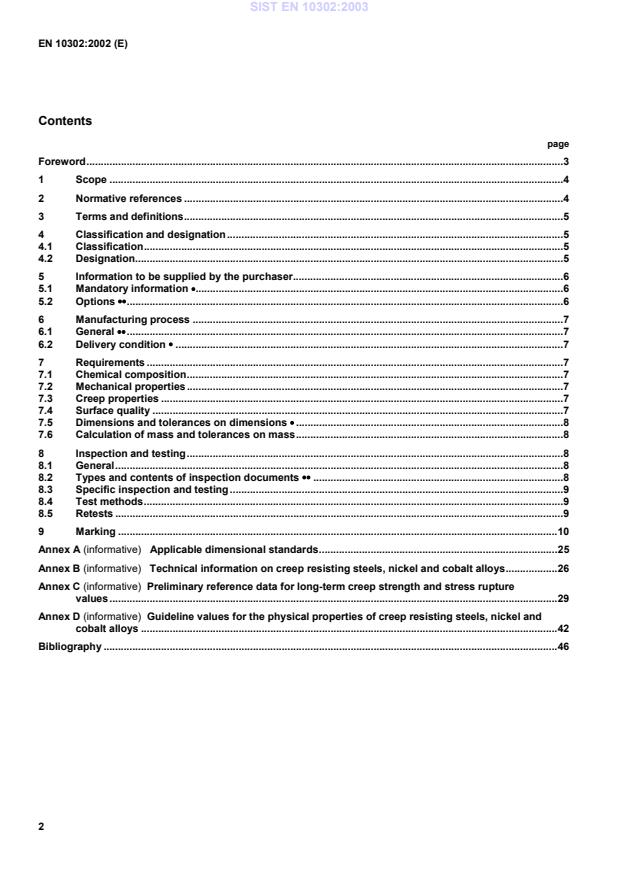
Applicable dimensional standards.25Annex B (informative)
Technical information on creep resisting steels, nickel and cobalt alloys.26Annex C (informative)
Preliminary reference data for long-term creep strength and stress rupturevalues.29Annex D (informative)
Guideline values for the physical properties of creep resisting steels, nickel andcobalt alloys.42Bibliography.46SIST EN 10302:2003
The clauses marked with a point () contain information relating to agreements which are to be made at the time ofordering. The clauses marked with two points () contain information relating to agreements which may be made at the time ofordering.The annexes A to D are informative.This European Standard contains a Bibliography.According to the CEN/CENELEC Internal Regulations, the national standards organizations of the followingcountries are bound to implement this European Standard: Austria, Belgium, Czech Republic, Denmark, Finland,France, Germany, Greece, Iceland, Ireland, Italy, Luxembourg, Malta, Netherlands, Norway, Portugal, Spain,Sweden, Switzerland and the United Kingdom.SIST EN 10302:2003
For supplementary information on creep resisting steels and alloys see annex B.4 Classification and designation4.1ClassificationMaterials covered in this European Standard are classified according to their structure into: martensitic steels; austenitic steels; nickel alloys; and cobalt alloys.4.2DesignationThe names and numbers of the steels (see Table 1) were formed in accordance with EN 10027-1 andEN 10027-2 respectively.NOTE
Explanation on the designation of nickel and cobalt alloys (see Table 2). name: The preceding chemical symbols indicate the main alloy elements and the figure immediatelyfollowing indicates the average content of these alloys subsequently followed by the symbol for the otheradded important alloy elements. material number: The structure is set out according to EN 10027-2 with the number 2 for the materialgroup number. This material group comprises chemically resistant and high temperature or heatresistant nickel and cobalt alloys.SIST EN 10302:2003
160 mm diameter or thickness(longitudinal test pieces)SIST EN 10302:2003
3 mm.For products with a thickness t < 3 mm, non proportional test pieces with a gauge length of 80 mm and a width of 20 mm shall be used, but test pieceswith a gauge length of 50 mm and a width of 12,5 mm may also be applied. For products with a thickness t of 3 mm to 10 mm (or to 8 mm in case ofalloys) flat proportional test pieces with two rolled surfaces and a maximum width of 30 mm shall be used. For products with a thickness t > 10 mm (or >8 mm in case of alloy
...