

EN 4618:2009
(Main)Aerospace series - Aircraft internal air quality standards, criteria and determination methods
- Abstract
This standard specifies requirements and determination methods for newly certificated commercial passenger aircraft programmes.
This standard applies to newly certificated commercial passenger aircraft programmes. It may also apply to current production aircraft if it does not carry significant penalties, i.e. if it can be shown to be technically feasible and economically justifiable.
This standard covers the period from first crew embarkation to last crew disembarkation.
NOTE 1 During embarkation and disembarkation, reduced temperatures in the cabin may be desirable due to increased metabolic activity of the occupants. In some ground cases, the aircraft environmental control system (ECS) may not be able to compensate for the external conditions influencing the cabin comfort conditions, such as open doors, extreme hot/cold ground/air temperatures or radiant heat. In this case, external air-conditioning systems, for example conditioned low-pressure ground air or high-pressure supply, may be used to supplement the aircraft ECS. If the temperature range stated in this standard is regularly exceeded (either above or below the stated range), changes to airline and/or airport procedures and/or aircraft design should be introduced.
NOTE 2 During ground operations, the external air quality may adversely influence the air quality within the aircraft cabin. Contamination produced as a result of servicing activities or ground operations vehicles may enter the aircraft directly, for example via open doors, and the ECS may not be able to effectively control contaminant levels in the cabin. Airline and airport operational procedures should be organised so as to avoid direct contamination of the cabin from these pollutant sources. If the contaminant ranges stated in this standard are regularly exceeded, changes to airline and/or airport procedures and/or aircraft design should be introduced.
Outside air quality levels would usually be regulated by national authorities.(...)
- Status
- Withdrawn
- Publication Date
- 15-Sep-2009
- Withdrawal Date
- 15-Oct-2013
- Technical Committee
- ASD-STAN - Aerospace
- Drafting Committee
- ASD-STAN/D 1 - General
- Current Stage
- 9960 - Withdrawal effective - Withdrawal
- Start Date
- 16-Oct-2013
- Completion Date
- 16-Oct-2013

Relations
- Effective Date
- 25-Aug-2026
- Effective Date
- 25-Aug-2026
- Effective Date
- 25-Aug-2026
- Effective Date
- 28-Jan-2026
- Effective Date
- 28-Jan-2026
- Effective Date
- 28-Jan-2026
- Effective Date
- 28-Jan-2026
- Effective Date
- 28-Jan-2026
- Refers
EN 14181:2004 - Stationary source emissions - Quality assurance of automated measuring systems - Effective Date
- 28-Jan-2026
- Effective Date
- 28-Jan-2026
Get Certified
Connect with accredited certification bodies for this standard

BUREAU VERITAS Certification Germany
Bureau Veritas certification in Germany.

Element Materials Technology
Materials testing and product certification.

AQMS Ltd.
AQMS provides ISO certification to SMEs across the UK.
Sponsored listings
Frequently Asked Questions
EN 4618:2009 is a standard published by the European Committee for Standardization (CEN). Its full title is "Aerospace series - Aircraft internal air quality standards, criteria and determination methods". This standard covers: This standard specifies requirements and determination methods for newly certificated commercial passenger aircraft programmes. This standard applies to newly certificated commercial passenger aircraft programmes. It may also apply to current production aircraft if it does not carry significant penalties, i.e. if it can be shown to be technically feasible and economically justifiable. This standard covers the period from first crew embarkation to last crew disembarkation. NOTE 1 During embarkation and disembarkation, reduced temperatures in the cabin may be desirable due to increased metabolic activity of the occupants. In some ground cases, the aircraft environmental control system (ECS) may not be able to compensate for the external conditions influencing the cabin comfort conditions, such as open doors, extreme hot/cold ground/air temperatures or radiant heat. In this case, external air-conditioning systems, for example conditioned low-pressure ground air or high-pressure supply, may be used to supplement the aircraft ECS. If the temperature range stated in this standard is regularly exceeded (either above or below the stated range), changes to airline and/or airport procedures and/or aircraft design should be introduced. NOTE 2 During ground operations, the external air quality may adversely influence the air quality within the aircraft cabin. Contamination produced as a result of servicing activities or ground operations vehicles may enter the aircraft directly, for example via open doors, and the ECS may not be able to effectively control contaminant levels in the cabin. Airline and airport operational procedures should be organised so as to avoid direct contamination of the cabin from these pollutant sources. If the contaminant ranges stated in this standard are regularly exceeded, changes to airline and/or airport procedures and/or aircraft design should be introduced. Outside air quality levels would usually be regulated by national authorities.(...)
This standard specifies requirements and determination methods for newly certificated commercial passenger aircraft programmes. This standard applies to newly certificated commercial passenger aircraft programmes. It may also apply to current production aircraft if it does not carry significant penalties, i.e. if it can be shown to be technically feasible and economically justifiable. This standard covers the period from first crew embarkation to last crew disembarkation. NOTE 1 During embarkation and disembarkation, reduced temperatures in the cabin may be desirable due to increased metabolic activity of the occupants. In some ground cases, the aircraft environmental control system (ECS) may not be able to compensate for the external conditions influencing the cabin comfort conditions, such as open doors, extreme hot/cold ground/air temperatures or radiant heat. In this case, external air-conditioning systems, for example conditioned low-pressure ground air or high-pressure supply, may be used to supplement the aircraft ECS. If the temperature range stated in this standard is regularly exceeded (either above or below the stated range), changes to airline and/or airport procedures and/or aircraft design should be introduced. NOTE 2 During ground operations, the external air quality may adversely influence the air quality within the aircraft cabin. Contamination produced as a result of servicing activities or ground operations vehicles may enter the aircraft directly, for example via open doors, and the ECS may not be able to effectively control contaminant levels in the cabin. Airline and airport operational procedures should be organised so as to avoid direct contamination of the cabin from these pollutant sources. If the contaminant ranges stated in this standard are regularly exceeded, changes to airline and/or airport procedures and/or aircraft design should be introduced. Outside air quality levels would usually be regulated by national authorities.(...)
EN 4618:2009 is classified under the following ICS (International Classification for Standards) categories: 49.025.10 - Steels; 49.095 - Passenger and cabin equipment. The ICS classification helps identify the subject area and facilitates finding related standards.
EN 4618:2009 has the following relationships with other standards: It is inter standard links to ISO 7726:1998, ISO 16000-6:2004, ISO 16000-3:2001, EN ISO 7730:2025, EN 13317:2002, EN ISO 16017-1:2000, EN 12941:1998/A2:2008, EN 481:1993, EN 14181:2004, EN 15004-2:2008. Understanding these relationships helps ensure you are using the most current and applicable version of the standard.
EN 4618:2009 is available in PDF format for immediate download after purchase. The document can be added to your cart and obtained through the secure checkout process. Digital delivery ensures instant access to the complete standard document.
Standards Content (Sample)
2003-01.Slovenski inštitut za standardizacijo. Razmnoževanje celote ali delov tega standarda ni dovoljeno.Luft- und Raumfahrt - Qualitätsstandards für Kabinenluft, Kriterien und MessverfahrenSérie aérospatiale - Norme de qualité d'air intérieur pour les cabines d'avion, critères et méthodes d'évaluationAerospace series - Aircraft internal air quality standards, criteria and determination methods49.095Oprema za potnike in oprema kabinPassenger and cabin equipment13.040.01Kakovost zraka na splošnoAir quality in generalICS:Ta slovenski standard je istoveten z:EN 4618:2009SIST EN 4618:2009en01-november-2009SIST EN 4618:2009SLOVENSKI
STANDARD
EUROPEAN STANDARD NORME EUROPÉENNE EUROPÄISCHE NORM
EN 4618
September 2009 ICS 49.095 English Version
Aerospace series - Aircraft internal air quality standards, criteria and determination methods
Série aérospatiale - Norme de qualité d'air intérieur pour les cabines d'avion, critères et méthodes d'évaluation
Luft- und Raumfahrt - Qualitätsstandards für Kabinenluft, Kriterien und Messverfahren This European Standard was approved by CEN on 8 August 2009.
CEN members are bound to comply with the CEN/CENELEC Internal Regulations which stipulate the conditions for giving this European Standard the status of a national standard without any alteration. Up-to-date lists and bibliographical references concerning such national standards may be obtained on application to the CEN Management Centre or to any CEN member.
This European Standard exists in three official versions (English, French, German). A version in any other language made by translation under the responsibility of a CEN member into its own language and notified to the CEN Management Centre has the same status as the official versions.
CEN members are the national standards bodies of Austria, Belgium, Bulgaria, Cyprus, Czech Republic, Denmark, Estonia, Finland, France, Germany, Greece, Hungary, Iceland, Ireland, Italy, Latvia, Lithuania, Luxembourg, Malta, Netherlands, Norway, Poland, Portugal, Romania, Slovakia, Slovenia, Spain, Sweden, Switzerland and United Kingdom.
EUROPEAN COMMITTEE FOR STANDARDIZATION
COMITÉ EUROPÉEN DE NORMALISATION EUROPÄISCHES KOMITEE FÜR NORMUNG
Management Centre:
Avenue Marnix 17,
B-1000 Brussels © 2009 CEN All rights of exploitation in any form and by any means reserved worldwide for CEN national Members. Ref. No. EN 4618:2009: ESIST EN 4618:2009
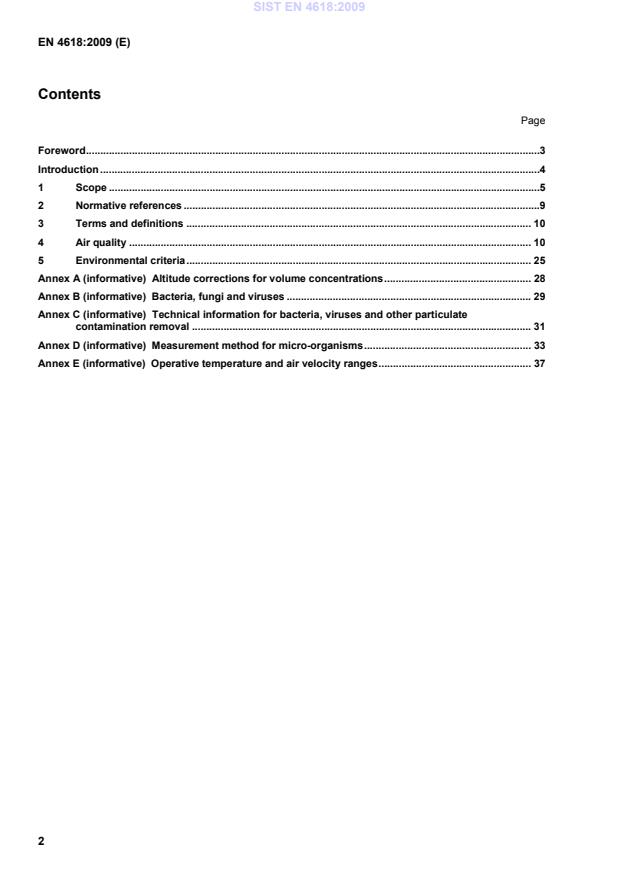
Altitude corrections for volume concentrations . 28Annex B (informative)
Bacteria, fungi and viruses . 29Annex C (informative)
Technical information for bacteria, viruses and other particulate contamination removal . 31Annex D (informative)
Measurement method for micro-organisms . 33Annex E (informative)
Operative temperature and air velocity ranges . 37 SIST EN 4618:2009
Regulatory bodies may apply this standard or parts thereof. SIST EN 4618:2009
The presence of marker compounds in concentrations that exceed the cabin air quality comfort, health or safety limits set in the standard may indicate that maintenance, procedural or operational change or design change is required to bring the air quality back within the limits set in this standard. Several sources have been considered to identify contaminants produced during normal operation. The possible sources have been analysed to identify which chemical groupings are related to each one. At least one compound from each grouping identified for each potential source has been chosen as representative of that source.
Balanced across the chemical groupings of the potential contamination sources. The selected marker compounds may occur in several of the selected potential sources. A full list of all compounds considered is given for completeness. Some of the compounds were subsequently disregarded because they were: Expected to appear only in very low concentrations, and/or Have low toxicity for given TLVs, and/or Below the quantification limit of measurement method. Where this is the case is marked in Table 1. Additionally, while some compounds may be present in many of the identified potential sources, they are only relevant (under the guidelines given above) for some of the potential sources. In this case this is also marked in Table 1. The potential sources under consideration are described below: Bio-effluents – compounds produced by the occupants; Cabin Interior – compounds that may be used during cabin servicing and cleaning; Solvents – compounds that may be present in the cabin due to, for example, cabin furnishing off-gassing;
External Conditions – compounds likely to be present in the environment, specifically near the airport, either from natural or man made sources; Exhaust – compounds likely to be present in the engine or APU exhaust, which under certain environmental conditions may be ingested into the outside air intake; Oils, lubricants and hydraulic fluids – compounds present in these fluids, and/or their thermal breakdown products, that may enter the cabin under certain conditions; Fuel – compounds present in fuels that may enter the cabin under certain conditions. Contaminants indicative of engine/APU lubricant or fuel leaks would enter the cabin through the bleed air system. The bleed air system may also carry ingested exhaust fumes, hydraulic fluid leaks and environmental pollution in to the cabin. On the ground, exhaust fumes and environmental pollution may also enter through open aircraft doors.
Table 1 — Marker compounds and their potential sources in the cabin Category Group Compound CAS No. Bio- effluents Cabin Interior Solvents External ConditionsExhaust Oils, Lubricants & HydraulicsFuel Inorganic Compounds
Carbon Dioxide 124-38-9 ⌧
⌧ a ⌧ a
Carbon Monoxide a 630-08-0
⌧ ⌧ ⌧
Nitrogen Oxides b 10102-44-0
⌧ ⌧
Ozonea 10028-15-6
⌧
Inorganic / Organic Particles
Particles, aerosols
⌧ a ⌧ a, c
⌧ ⌧ ⌧ ⌧ Micro- organisms
⌧ a ⌧ a
⌧
Endotoxins
⌧ a ⌧ a
⌧
Aliphatic Compounds Alkanes Methane b 74-82-8 ⌧
⌧
⌧ Ketones Acetone a 67-64-1 d
⌧
⌧
Methyl Ethyl Ketone a 78-93-3
⌧
⌧
Aldehydes Acetaldehyde a75-07-0
⌧ ⌧ ⌧ Acrolein a 107-02-8
⌧ ⌧ ⌧ Formaldehyde a50-00-0
⌧ e ⌧
⌧ ⌧ ⌧ Halogen Derivatives Methylene Chloride a 74-87-3
⌧
⌧
continued SIST EN 4618:2009
Table 1 — Marker compounds and their potential sources in the cabin (concluded) Category Group Compound CAS No. Bio- effluents Cabin Interior Solvents External ConditionsExhaust Oils, Lubricants & HydraulicsFuel Aromatic Compounds
Benzene a 71-43-2
⌧
⌧ Tricresyl Phosphate b 1330-78-5
⌧
Toluene 108-88-3
⌧ a
⌧ ⌧ ⌧ Polycyclic Aromatic Hydrocarbons
Benzo (alpha) Pyrene b 50-32-8
⌧
⌧ Naphthalene b 91-20-3
⌧ ⌧ ⌧ a Identified compound linked to source as marker compound (measured), this may include aerosols, vapour phase and thermal decomposition products. b Identified compound linked to source but not as marker compound (no measurement), this may include aerosols, vapour phase and thermal decomposition products. c If ozone is present in the cabin it may react with plastics in the cabin to form particles; Reference: CONCISE INTERNATIONAL CHEMICAL ASSESSMENT DOCUMENT N° 5. d Acetone is normally produced only in very minor quantities by the human body. Some health problems do lead to significant synthesis of acetone, however this is not considered by this standard (reference to be provided). e If ozone is present in the cabin it may react with plastics in the cabin to synthesise formaldehyde; Reference: CONCISE INTERNATIONAL CHEMICAL ASSESSMENT DOCUMENT N° 5.
2 Normative references The following referenced documents are indispensable for the application of this document. For dated references, only the edition cited applies. For undated references, the latest edition of the referenced document (including any amendments) applies. EN 481, Workplace atmospheres — Size fraction definitions for measurement of airborne particles. EN 14181:2004, Stationary source emissions — Quality assurance of automated measuring systems. EN ISO 7730, Ergonomics of the thermal environment — Analytical determination and interpretation of thermal comfort using calculation of the PMV and PPD indices and local thermal comfort criteria
(ISO 7730:2005). EN ISO 16017-1, Indoor, ambient and workplace air — Sampling and analysis of volatile organic compounds by sorbent tube/thermal desorption/capillary gas chromatography — Part 1: Pumped sampling
(ISO 16017-1:2000). ISO 7726, Ergonomics of the thermal environment — Instruments for measuring physical quantities. ISO 16000-3, Indoor air — Part 3: Determination of formaldehyde and other carbonyl compounds — Active sampling method. ISO 16000-6, Indoor air — Part 6: Determination of volatile organic compounds in indoor and test chamber air by active sampling on Tenax TA sorbent, thermal desorption and gas chromatography using MS/FID. FAR 25, Airworthiness standards — Transport category airplanes. JAR 25, Large aeroplanes. SIST EN 4618:2009
For the purpose of this standard, the sea-level equivalent reference conditions are 101,3 kPa and 20 °C. This choice is based on the European guidelines for threshold values definition for contaminants in spaces with human occupancy. It should be noted that the ICAO standard conditions are 101,3 kPa and 15 °C, and that current FAR/JAR use 101,3 kPa and 25 °C as reference conditions. NOTE For any given contaminant and class (Safety, Health or Comfort), where there exist two or more exposure limits defined by cognizant authorities, the most conservative value has been retained. 1) This standard is published by: American Society for Testing and Materials (ASTM), 100 Barr Harbor Drive, West Conshohocken, PA 19428-2959, USA. SIST EN 4618:2009
Limits Rationale Safety 9 130 mg.m-3 (5 000 ppmv) 1 Health 36 520 mg.m-3 (20 000 ppmv) (15 min exposure) 2 Comfort 3 650 mg.m-3 (2 000 ppmv) 3 Rationale: 1 No cumulative effect to be expected for breathing carbon dioxide but only acute effects. Although there is evidence that concentrations approaching 20 000 ppmv will cause no symptoms, in the light of the relative ease in maintaining compliance with a 5 000 ppmv maximum limit, it is considered reasonable to retain the lower value, as currently set by FAR/JAR 25. 2 Extracted from the EU TLV, see ‘Technical rules for hazardous substances (TRGS) 402 and 900, Germany’. Extracted from the short time exposure factor that is equal to 4 for carbon dioxide in EU rules. 3 Although carbon dioxide concentration may be used as a ‘Comfort Surrogate’, it is only one such parameter (others may include temperature, humidity and pressure). Current FAR regulations specify 0,55 lb/mn/pers (equivalent to 0,004 2 kg/s/pers and a flow rate at sea level of 3,4 l/s/pers or 7,2 cfm at sea level). This corresponds to a steady state metabolic carbon dioxide level of about 1 850 ppmv (assuming an ambient carbon dioxide level of 350 ppmv). In the absence of specific bio-effluents control measures, an outside air ventilation rate of 5 cfm per person is normally recognised for bio-effluents control for satisfying greater than 80 % of occupants (Ref ASHRAE 62 N). This corresponds to a carbon dioxide level of 2 500 ppmv, in an occupied pressurised aircraft cabin. In this specific instance for aircraft cabin environment, it is assumed that the carbon dioxide emission is solely due to metabolic activity, and that the ambient carbon dioxide concentration is 350 ppmv. If, on the other hand, specific bio-effluent reduction measures are available, carbon dioxide concentration should not be considered as a comfort surrogate, but solely under health and safety considerations as defined in rationales 1 and 2. For flight conditions, the CabinAir flight measurement programme has consistently indicated an absolute carbon dioxide level below 2 000 ppmv. The results of the analysis of the data collected with the subjective comfort questionnaire further demonstrate that carbon dioxide levels do not affect comfort. A comfort limit of 2 000 ppmv has thus been chosen. Reduced ventilation rate for passengers can be considered provided that it can be demonstrated that the air-quality is equivalent to a currently ventilated compartment. 4.2.3 Measurement method CAS-No. 124-38-9 Measurement: Non-dispersive infrared adsorption. Quantification limit: ≤ 2 % related to upper limit of measurement. SIST EN 4618:2009
4.3.2 Requirements and rationale
Limits Rationale Safety 58,1 mg.m-3 (50 ppmv) peak value (JAR, FAR) 1 Health 29,1 mg.m-3 (25 ppmv) TWA 1 h (WHO/LQL) 11,6 mg.m-3 (10 ppmv) TWA 8 h (WHO/LQL) 2 Comfort – 3 Rationale: 1 Regulatory safety JAR
Although there are data available regarding human performance degradation, the additive effects of altitude have not been fully researched, particularly in respect to factors such as exposure over several hours and exercise. However, except during a contaminated air event resulting due to a system failure, malfunction or contamination, the known sources of carbon monoxide in aircraft operations are limited to the ground phase. Although concentrations of up to around 100 ppmv would be expected to induce no symptoms, the ease by which compliance to a lower limit can be achieved, combined with the incompleteness of research, has led to the conclusion that the current regulatory limit of 50 ppmv (JAR and FAR 25) should be retained in this standard. 2 World Health Organisation Guidelines for Air Quality, Geneva, 2 000 limits are set in order to not exceed the 2,5 % for carboxyhaemoglobin level. 3 Comfort limits are not defined because within the health limits there are no effects on comfort. 4.3.3 Measurement method Same as for carbon dioxide. SIST EN 4618:2009
Limits Rationale Safety — 1 Health 0,50 mg.m-3 (0,25 ppmv), peak value (FARs) 0,20 mg.m-3 (0,1 ppmv) TWA 3 h (FARs) TWA 8 h < 0,12 mg.m-3 (0,06 ppmv) (WHO guidelines/ EC directive) 2 Comfort — 3 Rationale: 1 — 2 FAR 25.832 determines ozone concentrations for different flight levels: not to exceed 0,25 ppmv, sea level equivalent, at any time above 32 000 feet altitude (9 800 m).
0,1 ppmv, time-weighed average during any 3-hr interval above 27 000 feet altitude (8 200 m). 3 Comfort limits cannot be defined. Comfort is covered by the health limit and there is much individual variability. 4.4.3 Measurement method Measurements should be taken in the cabin and not in incoming air.
Analytical methods are also available to calculate the ozone concentration in the cabin (see AC120/38- FAR document). Take information about measurement facility CAS-No. 10028-15-6 Method: Measurement: Chemiluminescence method; Quantification limit: 0,001 5 ml/m3; Accuracy: ± 20 % related to upper limit of measurement. Reference: VDI (Association of Engineers, Germany), clean air guideline No. 2468 (1978)
Limits Rationale Safety — 1 Health 100 µg.m-3 (TWA 1 h) 40 µg.m-3 (continuous) 2 Comfort — 3 Rationale: 1 There is no evidence to suggest that particulate matter up to a size of 2,5 µm constitutes a safety issue. 2 Health Canada – Exposure guidelines for residential air quality, 1995. High levels of particles may be linked to respiratory difficulties. On non-smoking flights, occupants and food are the main emitters of particles in the cabin during flight. 3 Comfort limits cannot be defined. Comfort is covered by the health limit and there is much individual variability. 4.6.2 Measurement method ASTM D6699 SIST EN 4618:2009
Limits Rationale Safety — 1 Health 150 µg.m-3 (TWA 24 h) 2 Comfort — 3 Rationale: 1 There is no evidence to suggest that particulate matter up to a size of 10 µm constitutes a safety issue. 2 American Society of Heating, Refrigerating and Air-Conditioning Engineers – Ventilation for acceptable air quality, ANSI/ASHRAE 62-1999.
High levels of particles may be linked to respiratory difficulties. On non-smoking flights, occupants and food are the main emitters of particles in the cabin during flight. For ground conditions (doors opened and/or ECS AC packs off), the level of particles in the cabin may be affected by external conditions. Outside air contamination levels would usually be regulated by national authorities.
3 Comfort limits cannot be defined. Comfort is covered by the health limit and there is much individual variability. 4.7.2 Measurement Method ASTM D6399–04 Method: Sampler: Cyclone + Filter; Measurement: Gravimetric (Filter weight); Quantification limit: 0,5 mg/m3 (sampling volume: 200 l); Accuracy: Depends on dust size distributions. Reference: NIOSH, No. 0600 (1994) Method: Sampler: BIA-Dustsampler (according to EN 481 – size fraction definitions) + Filter; Measurement: Gravimetric (filter weight); Quantification limit: 0,3 mg/m3 (900 l); Accuracy: Depends on dust size distributions. Reference: BIA (Institute for Occupational Safety, Germany), No.6068 (2003) SIST EN 4618:2009
Limits Rationale Safety 3 630 mg.m-3 (1 500 ppmv) (15 min exposure) 1 210 mg.m-3 (500 ppmv) (TWA 8 h) 1 Health 1 188 mg.m-3 (500 ppmv) (TWA 8 h) 1 782 mg.m-3 (750 ppmv) (STEL 15’) 2 Comfort 240 mg.m-3 (99 ppmv) 3 Rationale: 1 UK short-term exposure limit (15 min reference period) and long-term exposure limit (8 hr reference period). 2 AGCIH TLVs 2001, Guide to occupational exposure values. No WHO guideline for acceptable concentration for general population for protection against health effects. 3 Odour threshold reported in Guidelines for Air Quality, WHO, Geneva, 2000. 4.8.3 Measurement methods
CAS-No 67-64-1 Method: Sampling: Solid sorbent tube
(charcoal); Desorption: Carbon disulfide; Measurement: GC/FID; Quantification limit: 100 mg/m3 (sampling volume: 0,5 l); Accuracy: ± 8,2 %. Reference: NIOSH, No. 1300 (1994) Method: Sampling: Solid sorbent tube (charcoal); Desorption: Carbon disulfide; Measurement: GC/FID; Quantification limit: 0,5 mg/m3 (sampling volume: 40 l); Accuracy: ± 8,8 %. Reference: BIA (Institute for Occupational Safety, Germany) No. 6032 (1991) SIST EN 4618:2009
Limits Rationale Safety 897,8 mg.m-3 (300 ppmv) (15 min exposure) 1 795,5 mg.m-3 (600 ppmv) (TWA 8 h) 1 Health 598,5 mg.m-3 (200 ppmv) (TWA, 8 h) 897,8 mg.m-3 (300 ppmv) (STEL 15’) 2 Comfort — 3 Rationale: 1 UK short-term exposure limit (15 min reference period) and long-term exposure limit (8 hr reference period). 2 ACGIH TLVs 2001, Guide to occupational exposure values.ACGIH was chosen to be used for health as it is more conservative than the UK exposure limits 3 Comfort limits cannot be defined. Comfort is covered by the health limit. 4.9.3 Measurement methods CAS-No. 78-93-3 Method: Sampling: Solid sorbent tube (coconut shell charcoal); Desorption: Carbon disulfide; Measurement: GC/FID; Quantification limit: 50 mg/m3 (sampling volume: 3 l); Accuracy: ± 17,8 %. Reference: NIOSH, No. 2500 (1994) SIST EN 4618:2009
...