

EN 13016-1:2007
(Main)Liquid petroleum products - Vapour pressure - Part 1: Determination of air saturated vapour pressure (ASVP) and calculated dry vapour pressure equivalent (DVPE)
- Abstract
This European Standard specifies a method for the determination of the total pressure, exerted in vacuo, by volatile, low viscosity petroleum products, components, and feedstocks containing air. A dry vapour pressure equivalent (DVPE) can be calculated from the air containing vapour pressure (ASVP) measurement.
The conditions used in the test described in this standard are a vapour-to-liquid ratio of 4:1 and a test temperature of 37,8 °C.
For referee testing the requirement to employ 1 l sample containers is mandatory. However, due to sample container size restrictions in taking automatic samples from vapour-locks either onboard a ship or from some land based storage tanks, the precision for 250 ml containers forms part of this standard and shall be used for referee purposes.
NOTE 1 This standard states precision for both 1 l and 250 ml sample containers. Annex A provides information on the precision values when using 50 ml at 37,8 °C or using 1 l samples at a test temperature of 50,0 °C.
The equipment is not wetted with water during the test, and the method described is therefore suitable for testing samples with or without oxygenates; no account is taken of dissolved water in the sample.
This method described is suitable for testing air-saturated samples that exert an air-saturated vapour pressure of between 9,0 kPa and 150,0 kPa at 37,8 °C.
This document is applicable to fuels containing oxygenated compounds up to the limits stated in the relevant EC Directive 85/536/EEC [4].
NOTE 2 For the purposes of this European Standard, the term "% (m/m)"and “% (V/V)” are used to represent the mass, respectively the volume fraction.
WARNING Use of this standard may involve hazardous materials, operations and equipment. This standard does not purport to address all of the safety problems associated with its use. It is the responsibility of the user of this standard to establish appropriate safety and health practices and to determine the applicability of regulator
- Status
- Withdrawn
- Publication Date
- 11-Sep-2007
- Withdrawal Date
- 06-Oct-2026
- Technical Committee
- CEN/TC 19 - Petroleum products, lubricants and related products
- Drafting Committee
- CEN/TC 19/WG 15 - Vapour pressure methods
- Current Stage
- 9960 - Withdrawal effective - Withdrawal
- Start Date
- 04-Apr-2018
- Completion Date
- 07-Oct-2026

Relations
- Effective Date
- 22-Dec-2008
- Effective Date
- 11-Apr-2018
- Effective Date
- 25-Aug-2026
- Effective Date
- 28-Jan-2026
- Effective Date
- 28-Jan-2026
- Effective Date
- 28-Jan-2026
- Referred By
CEN/TS 15293:2011 - Automotive fuels - Ethanol (E85) automotive fuel - Requirements and test methods - Effective Date
- 28-Jan-2026
- Effective Date
- 28-Jan-2026
Get Certified
Connect with accredited certification bodies for this standard

Element Materials Technology
Materials testing and product certification.

ABS Group Brazil
ABS Group certification services in Brazil.

ABS Quality Evaluations Inc.
American Bureau of Shipping quality certification.
Sponsored listings
Frequently Asked Questions
EN 13016-1:2007 is a standard published by the European Committee for Standardization (CEN). Its full title is "Liquid petroleum products - Vapour pressure - Part 1: Determination of air saturated vapour pressure (ASVP) and calculated dry vapour pressure equivalent (DVPE)". This standard covers: This European Standard specifies a method for the determination of the total pressure, exerted in vacuo, by volatile, low viscosity petroleum products, components, and feedstocks containing air. A dry vapour pressure equivalent (DVPE) can be calculated from the air containing vapour pressure (ASVP) measurement. The conditions used in the test described in this standard are a vapour-to-liquid ratio of 4:1 and a test temperature of 37,8 °C. For referee testing the requirement to employ 1 l sample containers is mandatory. However, due to sample container size restrictions in taking automatic samples from vapour-locks either onboard a ship or from some land based storage tanks, the precision for 250 ml containers forms part of this standard and shall be used for referee purposes. NOTE 1 This standard states precision for both 1 l and 250 ml sample containers. Annex A provides information on the precision values when using 50 ml at 37,8 °C or using 1 l samples at a test temperature of 50,0 °C. The equipment is not wetted with water during the test, and the method described is therefore suitable for testing samples with or without oxygenates; no account is taken of dissolved water in the sample. This method described is suitable for testing air-saturated samples that exert an air-saturated vapour pressure of between 9,0 kPa and 150,0 kPa at 37,8 °C. This document is applicable to fuels containing oxygenated compounds up to the limits stated in the relevant EC Directive 85/536/EEC [4]. NOTE 2 For the purposes of this European Standard, the term "% (m/m)"and “% (V/V)” are used to represent the mass, respectively the volume fraction. WARNING Use of this standard may involve hazardous materials, operations and equipment. This standard does not purport to address all of the safety problems associated with its use. It is the responsibility of the user of this standard to establish appropriate safety and health practices and to determine the applicability of regulator
This European Standard specifies a method for the determination of the total pressure, exerted in vacuo, by volatile, low viscosity petroleum products, components, and feedstocks containing air. A dry vapour pressure equivalent (DVPE) can be calculated from the air containing vapour pressure (ASVP) measurement. The conditions used in the test described in this standard are a vapour-to-liquid ratio of 4:1 and a test temperature of 37,8 °C. For referee testing the requirement to employ 1 l sample containers is mandatory. However, due to sample container size restrictions in taking automatic samples from vapour-locks either onboard a ship or from some land based storage tanks, the precision for 250 ml containers forms part of this standard and shall be used for referee purposes. NOTE 1 This standard states precision for both 1 l and 250 ml sample containers. Annex A provides information on the precision values when using 50 ml at 37,8 °C or using 1 l samples at a test temperature of 50,0 °C. The equipment is not wetted with water during the test, and the method described is therefore suitable for testing samples with or without oxygenates; no account is taken of dissolved water in the sample. This method described is suitable for testing air-saturated samples that exert an air-saturated vapour pressure of between 9,0 kPa and 150,0 kPa at 37,8 °C. This document is applicable to fuels containing oxygenated compounds up to the limits stated in the relevant EC Directive 85/536/EEC [4]. NOTE 2 For the purposes of this European Standard, the term "% (m/m)"and “% (V/V)” are used to represent the mass, respectively the volume fraction. WARNING Use of this standard may involve hazardous materials, operations and equipment. This standard does not purport to address all of the safety problems associated with its use. It is the responsibility of the user of this standard to establish appropriate safety and health practices and to determine the applicability of regulator
EN 13016-1:2007 is classified under the following ICS (International Classification for Standards) categories: 75.160.20 - Liquid fuels. The ICS classification helps identify the subject area and facilitates finding related standards.
EN 13016-1:2007 has the following relationships with other standards: It is inter standard links to EN 13016-1:2000, EN 13016-1:2018, ISO 3007:1999, EN ISO 3170:2025, ENV 843-4:1994, EN 228:2012+A1:2017, CEN/TS 15293:2011, EN 228:2012. Understanding these relationships helps ensure you are using the most current and applicable version of the standard.
EN 13016-1:2007 is available in PDF format for immediate download after purchase. The document can be added to your cart and obtained through the secure checkout process. Digital delivery ensures instant access to the complete standard document.
Standards Content (Sample)
2003-01.Slovenski inštitut za standardizacijo. Razmnoževanje celote ali delov tega standarda ni dovoljeno.Liquid petroleum products - Vapour pressure - Part 1: Determination of air saturated vapour pressure (ASVP) and calculated dry vapour pressure equivalent (DVPE)'93(Produits pétroliers liquides - Pression de vapeur - Partie 1 : Détermination de la pression de vapeur saturée en air (PVSA) et de la pression de vapeur seche équivalente calculée (PVSE)Flüssige Mineralölerzeugnisse - Dampfdruck - Teil 1: Bestimmung des luftgesättigten Dampfdruckes (ASVP) und Berechnung des trockenen Dampfdruckäquivalentes (DVPE)Ta slovenski standard je istoveten z:EN 13016-1:2007SIST EN 13016-1:2007en,fr,de75.160.20Liquid fuelsICS:SIST EN 13016-1:20001DGRPHãþDSLOVENSKI
STANDARDSIST EN 13016-1:200701-december-2007
EUROPEAN STANDARDNORME EUROPÉENNEEUROPÄISCHE NORMEN 13016-1September 2007ICS 75.160.20 English VersionLiquid petroleum products - Vapour pressure - Part 1:Determination of air saturated vapour pressure (ASVP) andcalculated dry vapour pressure equivalent (DVPE)Produits pétroliers liquides - Pression de vapeur - Partie 1 :Détermination de la pression de vapeur saturée en air(PVSA) et de la pression de vapeur sèche équivalentecalculée (PVSE)Flüssige Mineralölerzeugnisse - Dampfdruck - Teil 1:Bestimmung des luftgesättigten Dampfdruckes (ASVP) undBerechnung des trockenen Dampfdruckäquivalentes(DVPE)This European Standard was approved by CEN on 28 July 2007.CEN members are bound to comply with the CEN/CENELEC Internal Regulations which stipulate the conditions for giving this EuropeanStandard the status of a national standard without any alteration. Up-to-date lists and bibliographical references concerning such nationalstandards may be obtained on application to the CEN Management Centre or to any CEN member.This European Standard exists in three official versions (English, French, German). A version in any other language made by translationunder the responsibility of a CEN member into its own language and notified to the CEN Management Centre has the same status as theofficial versions.CEN members are the national standards bodies of Austria, Belgium, Bulgaria, Cyprus, Czech Republic, Denmark, Estonia, Finland,France, Germany, Greece, Hungary, Iceland, Ireland, Italy, Latvia, Lithuania, Luxembourg, Malta, Netherlands, Norway, Poland, Portugal,Romania, Slovakia, Slovenia, Spain, Sweden, Switzerland and United Kingdom.EUROPEAN COMMITTEE FOR STANDARDIZATIONCOMITÉ EUROPÉEN DE NORMALISATIONEUROPÄISCHES KOMITEE FÜR NORMUNGManagement Centre: rue de Stassart, 36
B-1050 Brussels© 2007 CENAll rights of exploitation in any form and by any means reservedworldwide for CEN national Members.Ref. No. EN 13016-1:2007: E
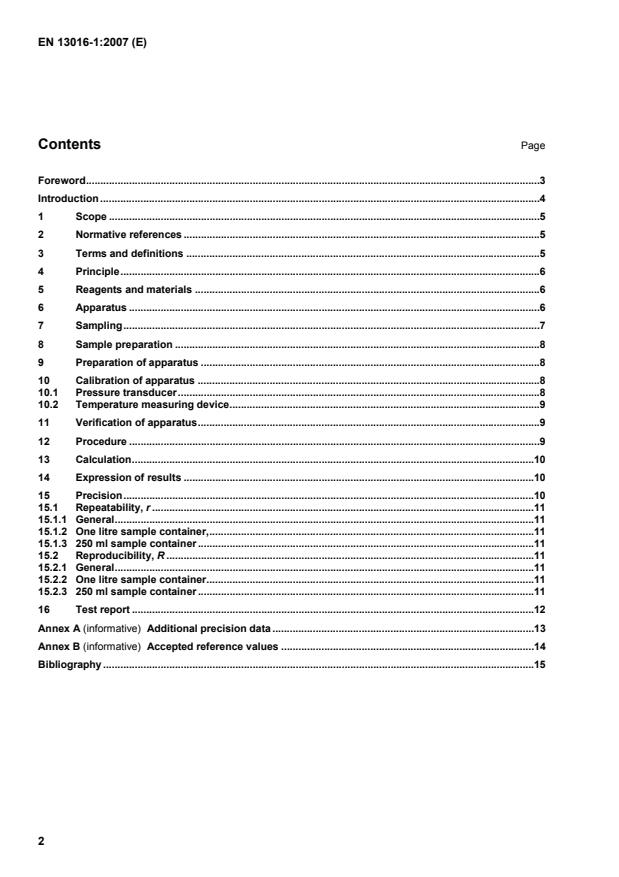
Additional precision data.13 Annex B (informative)
Accepted reference values.14 Bibliography.15
NOTE 1 This standard states precision for both 1 l and 250 ml sample containers. Annex A provides information on the precision values when using 50 ml at 37,8 °C or using 1 l samples at a test temperature of 50,0 °C. The equipment is not wetted with water during the test, and the method described is therefore suitable for testing samples with or without oxygenates; no account is taken of dissolved water in the sample. This method described is suitable for testing air-saturated samples that exert an air-saturated vapour pressure of between 9,0 kPa and 150,0 kPa at 37,8 °C. This document is applicable to fuels containing oxygenated compounds up to the limits stated in the relevant EC Directive 85/536/EEC [4]. NOTE 2 For the purposes of this European Standard, the term "% (m/m)"and “% (V/V)” are used to represent the mass, respectively the volume fraction. WARNING — Use of this standard may involve hazardous materials, operations and equipment. This standard does not purport to address all of the safety problems associated with its use. It is the responsibility of the user of this standard to establish appropriate safety and health practices and to determine the applicability of regulatory limitations prior to use. 2 Normative references The following referenced documents are indispensable for the application of this document. For dated references, only the edition cited applies. For undated references, the latest edition of the referenced document (including any amendments) applies. EN ISO 3170, Petroleum liquids - Manual sampling (ISO 3170:2004) ISO 3007, Petroleum products and crude petroleum - Determination of vapour pressure - Reid method 3 Terms and definitions For the purposes of this European Standard, the following terms and definitions apply. 3.1 air-saturated vapour pressure total pressure ASVP observed pressure exerted in vacuo consisting of the partial pressure of petroleum products, components and feedstocks, in the absence on non-dissolved water, and the partial pressure of dissolved air
NOTE 2 Test chambers with capacities less than 5 ml or greater than 50 ml may be used but the precision of the method can be affected.
Pressure measuring device, having a minimum measuring range from 0 kPa to 177 kPa, calibrated and/or verified against an instrument certified by an authorized certification body. 6.6 Temperature measuring device, in the required temperature ranges, with a resolution of 0,1 °C and scale error of less than 0,1 °C, calibrated and/or verified against an instrument certified by an authorized certification body. 7 Sampling 7.1 Due to the extreme sensitivity of vapour pressure measurements to losses through evaporation and the resulting changes in composition, the utmost precaution and the most meticulous care shall be taken in the drawing and handling of samples. 7.2 Samples shall be drawn in accordance with EN ISO 3170 and/or in accordance with t
...