

EN 228:2012+A1:2017
(Main + Amendment)Automotive fuels - Unleaded petrol - Requirements and test methods
- Abstract
This European Standard specifies requirements and test methods for marketed and delivered unleaded petrol. It is applicable to unleaded petrol for use in petrol engine vehicles designed to run on unleaded petrol.
This European Standard specifies two types of unleaded petrol: one type with a maximum oxygen content of 3,7 % (m/m) and a maximum ethanol content of 10,0 % (V/V) in Table 1, and one type intended for older vehicles that are not warranted to use unleaded petrol with a high biofuel content, with a maximum oxygen content of 2,7 % (m/m) and a maximum ethanol content of 5,0 % (V/V) in Table 2.
NOTE 1 The two types are based on European Directive requirements [3], [4], ![11]".
NOTE 2 For the purposes of this European Standard, the terms "% (m/m)" and "% (V/V)" are used to represent respectively the mass fraction, µ, and the volume fraction, φ.
- Status
- Withdrawn
- Publication Date
- 30-May-2017
- Withdrawal Date
- 06-Oct-2026
- Technical Committee
- CEN/TC 19 - Petroleum products, lubricants and related products
- Drafting Committee
- CEN/TC 19/WG 21 - Specification for unleaded petrol
- Current Stage
- 9960 - Withdrawal effective - Withdrawal
- Start Date
- 23-Jul-2025
- Completion Date
- 07-Oct-2026
Buy Documents

Relations
- Effective Date
- 19-Jan-2023
- Effective Date
- 19-Jan-2023
- Effective Date
- 19-Apr-2023
- Effective Date
- 22-Jul-2026
- Effective Date
- 28-Jan-2026
- Refers
EN ISO 2160:1998 - Petroleum products - Corrosiveness to copper - Copper strip test (ISO 2160:1998) - Effective Date
- 28-Jan-2026
- Effective Date
- 28-Jan-2026
- Effective Date
- 28-Jan-2026
- Effective Date
- 28-Jan-2026
- Effective Date
- 28-Jan-2026
- Effective Date
- 28-Jan-2026
- Effective Date
- 28-Jan-2026
- Effective Date
- 28-Jan-2026
- Effective Date
- 28-Jan-2026
- Effective Date
- 28-Jan-2026
Buy Documents
Get Certified
Connect with accredited certification bodies for this standard

Element Materials Technology
Materials testing and product certification.

ABS Group Brazil
ABS Group certification services in Brazil.

ABS Quality Evaluations Inc.
American Bureau of Shipping quality certification.
Sponsored listings
Frequently Asked Questions
EN 228:2012+A1:2017 is a standard published by the European Committee for Standardization (CEN). Its full title is "Automotive fuels - Unleaded petrol - Requirements and test methods". This standard covers: This European Standard specifies requirements and test methods for marketed and delivered unleaded petrol. It is applicable to unleaded petrol for use in petrol engine vehicles designed to run on unleaded petrol. This European Standard specifies two types of unleaded petrol: one type with a maximum oxygen content of 3,7 % (m/m) and a maximum ethanol content of 10,0 % (V/V) in Table 1, and one type intended for older vehicles that are not warranted to use unleaded petrol with a high biofuel content, with a maximum oxygen content of 2,7 % (m/m) and a maximum ethanol content of 5,0 % (V/V) in Table 2. NOTE 1 The two types are based on European Directive requirements [3], [4], ![11]". NOTE 2 For the purposes of this European Standard, the terms "% (m/m)" and "% (V/V)" are used to represent respectively the mass fraction, µ, and the volume fraction, φ.
This European Standard specifies requirements and test methods for marketed and delivered unleaded petrol. It is applicable to unleaded petrol for use in petrol engine vehicles designed to run on unleaded petrol. This European Standard specifies two types of unleaded petrol: one type with a maximum oxygen content of 3,7 % (m/m) and a maximum ethanol content of 10,0 % (V/V) in Table 1, and one type intended for older vehicles that are not warranted to use unleaded petrol with a high biofuel content, with a maximum oxygen content of 2,7 % (m/m) and a maximum ethanol content of 5,0 % (V/V) in Table 2. NOTE 1 The two types are based on European Directive requirements [3], [4], ![11]". NOTE 2 For the purposes of this European Standard, the terms "% (m/m)" and "% (V/V)" are used to represent respectively the mass fraction, µ, and the volume fraction, φ.
EN 228:2012+A1:2017 is classified under the following ICS (International Classification for Standards) categories: 75.160.20 - Liquid fuels. The ICS classification helps identify the subject area and facilitates finding related standards.
EN 228:2012+A1:2017 has the following relationships with other standards: It is inter standard links to EN 228:2012/FprA1, EN 228:2012, EN 228:2025, EN 13132:2000, EN 237:2004, EN ISO 2160:1998, EN 13016-1:2007, EN ISO 3170:2004, EN 12177:1998, EN ISO 20884:2011, EN 14275:2013, EN ISO 22854:2016, EN ISO 3171:1999, EN 15553:2007, EN 16135:2011. Understanding these relationships helps ensure you are using the most current and applicable version of the standard.
EN 228:2012+A1:2017 is associated with the following European legislation: EU Directives/Regulations: 98/70/EC. When a standard is cited in the Official Journal of the European Union, products manufactured in conformity with it benefit from a presumption of conformity with the essential requirements of the corresponding EU directive or regulation.
EN 228:2012+A1:2017 is available in PDF format for immediate download after purchase. The document can be added to your cart and obtained through the secure checkout process. Digital delivery ensures instant access to the complete standard document.
Standards Content (Sample)
2003-01.Slovenski inštitut za standardizacijo. Razmnoževanje celote ali delov tega standarda ni dovoljeno.PHWRGHKraftstoffe für Kraftfahrzeuge - Unverbleite Ottokraftstoffe - Anforderungen und PrüfverfahrenCarburants pour automobiles - Essence sans plomb - Exigences et méthodes d'essaiAutomotive fuels - Unleaded petrol - Requirements and test methods75.160.20Liquid fuelsICS:Ta slovenski standard je istoveten z:EN 228:2012+A1:2017SIST EN 228:2012+A1:2017en,fr,de01-november-2017SIST EN 228:2012+A1:2017SLOVENSKI
STANDARD
EUROPEAN STANDARD NORME EUROPÉENNE EUROPÄISCHE NORM
EN 228:2012+A1
May
t r s y ICS
y wä s x rä t r Supersedes EN
t t zã t r s tEnglish Version
Automotive fuels æ Unleaded petrol æ Requirements and test methods Carburants pour automobiles æ Essence sans plomb æ Exigences et méthodes d 5essai
Kraftstoffe für Kraftfahrzeuge æ Unverbleite Ottokraftstoffe æ Anforderungen und Prüfverfahren This European Standard was approved by CEN on
s September
t r s t and includes Amendment
s approved by CEN on
s y March
t r s yä
egulations which stipulate the conditions for giving this European Standard the status of a national standard without any alterationä Upætoædate lists and bibliographical references concerning such national standards may be obtained on application to the CENæCENELEC Management Centre or to any CEN memberä
translation under the responsibility of a CEN member into its own language and notified to the CENæCENELEC Management Centre has the same status as the official versionsä
CEN members are the national standards bodies of Austriaá Belgiumá Bulgariaá Croatiaá Cyprusá Czech Republicá Denmarká Estoniaá Finlandá Former Yugoslav Republic of Macedoniaá Franceá Germanyá Greeceá Hungaryá Icelandá Irelandá Italyá Latviaá Lithuaniaá Luxembourgá Maltaá Netherlandsá Norwayá Polandá Portugalá Romaniaá Serbiaá Slovakiaá Sloveniaá Spainá Swedená Switzerlandá Turkey and United Kingdomä
EUROPEAN COMMITTEE FOR STANDARDIZATION COMITÉ EUROPÉEN DE NORMALISATION EUROPÄISCHES KOMITEE FÜR NORMUNG
CEN-CENELEC Management Centre:
Avenue Marnix 17,
B-1000 Brussels
t r s y CEN All rights of exploitation in any form and by any means reserved worldwide for CEN national Membersä Refä Noä EN
t t zã t r s t ªA sã t r s y ESIST EN 228:2012+A1:2017
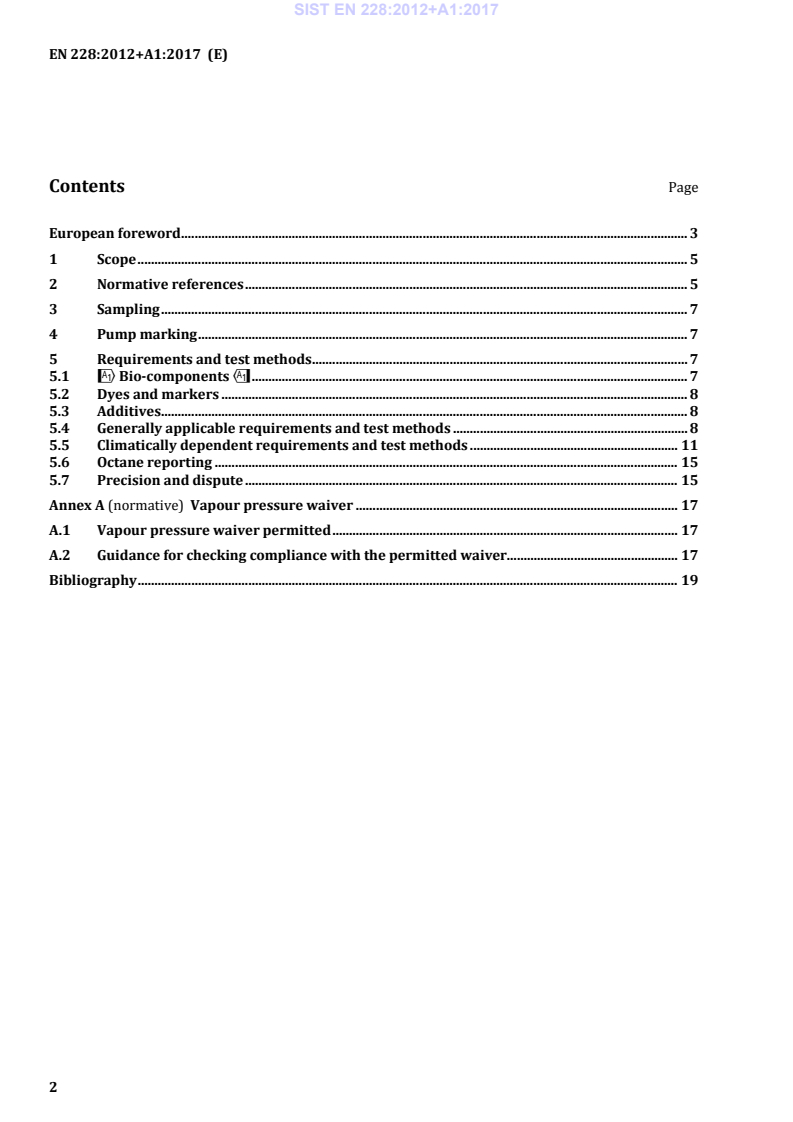
(E) 2 Contents Page European foreword . 3 1 Scope . 5 2 Normative references . 5 3 Sampling . 7 4 Pump marking . 7 5 Requirements and test methods . 7 5.1 !Bio-components" . 7 5.2 Dyes and markers . 8 5.3 Additives . 8 5.4 Generally applicable requirements and test methods . 8 5.5 Climatically dependent requirements and test methods . 11 5.6 Octane reporting . 15 5.7 Precision and dispute . 15 Annex A (normative)
Vapour pressure waiver . 17 A.1 Vapour pressure waiver permitted . 17 A.2 Guidance for checking compliance with the permitted waiver . 17 Bibliography . 19
(E) 4 EN 228:2004, with the requirement that updated analytical methods shall be shown to give at least the same accuracy and at least the same precision as the methods they replace. — Removal of the allowance for 50 mg/kg sulfur content. — Reference to the revised ethanol specification EN 15376. !The marking at the pump of this product is in line with the requirements of the Fuels Quality Directive and the Alternative Fuels Infrastructure Directive [12]." According to the CEN/CENELEC Internal Regulations, the national standards organisations of the following countries are bound to implement this European Standard: Austria, Belgium, Bulgaria, Croatia, Cyprus, Czech Republic, Denmark, Estonia, Finland, Former Yugoslav Republic of Macedonia, France, Germany, Greece, Hungary, Iceland, Ireland, Italy, Latvia, Lithuania, Luxembourg, Malta, Netherlands, Norway, Poland, Portugal, Romania, Serbia Slovakia, Slovenia, Spain, Sweden, Switzerland, Turkey and the United Kingdom. SIST EN 228:2012+A1:2017
1 Under revision. SIST EN 228:2012+A1:2017
(E) 6 EN 16135:2011, Automotive fuels — Determination of manganese content in unleaded petrol — Flame atomic absorption spectrometric method (FAAS) !EN 16136:2015, Automotive fuels — Determination of manganese content in unleaded petrol — Inductively coupled plasma optical emission spectrometry (ICP OES) method" !EN 16942:2016, Fuels – Identification of vehicle compatibility – Graphical expression for consumer information" EN ISO 2160:1998, Petroleum products — Corrosiveness to copper — Copper strip test (ISO 2160:1998) EN ISO 3170:2004, Petroleum liquids — Manual sampling (ISO 3170:2004) EN ISO 3171:1999, Petroleum liquids — Automatic pipeline sampling (ISO 3171:1988) !EN ISO 3405:20111, Petroleum products — Determination of distillation characteristics at atmospheric pressure (ISO 3405:2011)" EN ISO 3675:1998, Crude petroleum and liquid petroleum products — Laboratory determination of density — Hydrometer method (ISO 3675:1998) !EN ISO 4259:20061, Petroleum products — Determination and application of precision data in relation to methods of test (ISO 4259:2006)" !EN ISO 5163:2014, Petroleum products — Determination of knock characteristics of motor and aviation fuels — Motor method (ISO 5163:2014)" !EN ISO 5164:20141, Petroleum products — Determination of knock characteristics of motor fuels — Research method (ISO 5164:2014)" !EN ISO 6246:2017, Petroleum products — Gum content of light and middle distillate fuels — Jet evaporation method (ISO 6246:2017)" EN ISO 7536:1996, Petroleum products — Determination of oxidation stability of gasoline — Induction period method (ISO 7536:1994) !EN ISO 12185:19961, Crude petroleum and petroleum products — Determination of density — Oscillating U-tube method (ISO 12185:1996)" EN ISO 13032:2012, Petroleum products — Determination of low concentration of sulfur in automotive fuels — Energy-dispersive X-ray fluorescence spectrometric method (ISO 13032:2012) EN ISO 20846:2011, Petroleum products — Determination of sulfur content of automotive fuels — Ultraviolet fluorescence method (ISO 20846:2011) EN ISO 20884:2011, Petroleum products — Determination of sulfur content of automotive fuels — Wavelength-dispersive X-ray fluorescence spectrometry (ISO 20884:2011) !EN ISO 22854:2016, Liquid petroleum products - Determination of hydrocarbon types and oxygenates in automotive-motor gasoline and in ethanol (E85) automotive fuel - Multidimensional gas chromatography method (ISO 22854:2016)" SIST EN 228:2012+A1:2017
2 For clarification of renewable, see [13]. SIST EN 228:2012+A1:2017
(E) 8 requirements of EN 228. The co-processing of renewable feedstock at refineries is also allowed provided that the final fuel meets the requirements of EN 228." 5.2 Dyes and markers The use of dyes and markers is allowed provided they do not cause harmful side effects to vehicle and fuel distribution systems. 5.3 Additives 5.3.1 General In order to improve performance quality, the use of additives is allowed. Suitable fuel additives without known harmful side effects are recommended in the appropriate amount to help avoid deterioration of driveability and emissions control durability. Other technical means with equivalent effects may also be used. !Deleted text." NOTE Deposit forming tendency test methods suitable for routine control purposes have not yet been
...
SLOVENSKI SIST EN 228:2012+A1
STANDARD
november 2017
Goriva za motorna vozila – Neosvinčeni motorni bencin –
Zahteve in preskusne metode
Automotive fuels – Unleaded petrol – Requirements and test methods
Carburants pour automobiles – Essence sans plomb – Exigences et méthodes
d'essai
Kraftstoffe für Kraftfahrzeuge – Unverbleite Ottokraftstoffe – Anforderungen
und Prüfverfahren
Referenčna oznaka
ICS 75.160.20 SIST EN 228:2012+A1:2017 (sl)
Nadaljevanje na straneh od II do IV ter od 1 do 18
© 2018-07. Slovenski inštitut za standardizacijo. Razmnoževanje celote ali delov ni dovoljeno.
SIST EN 228:2012+A1 : 2017
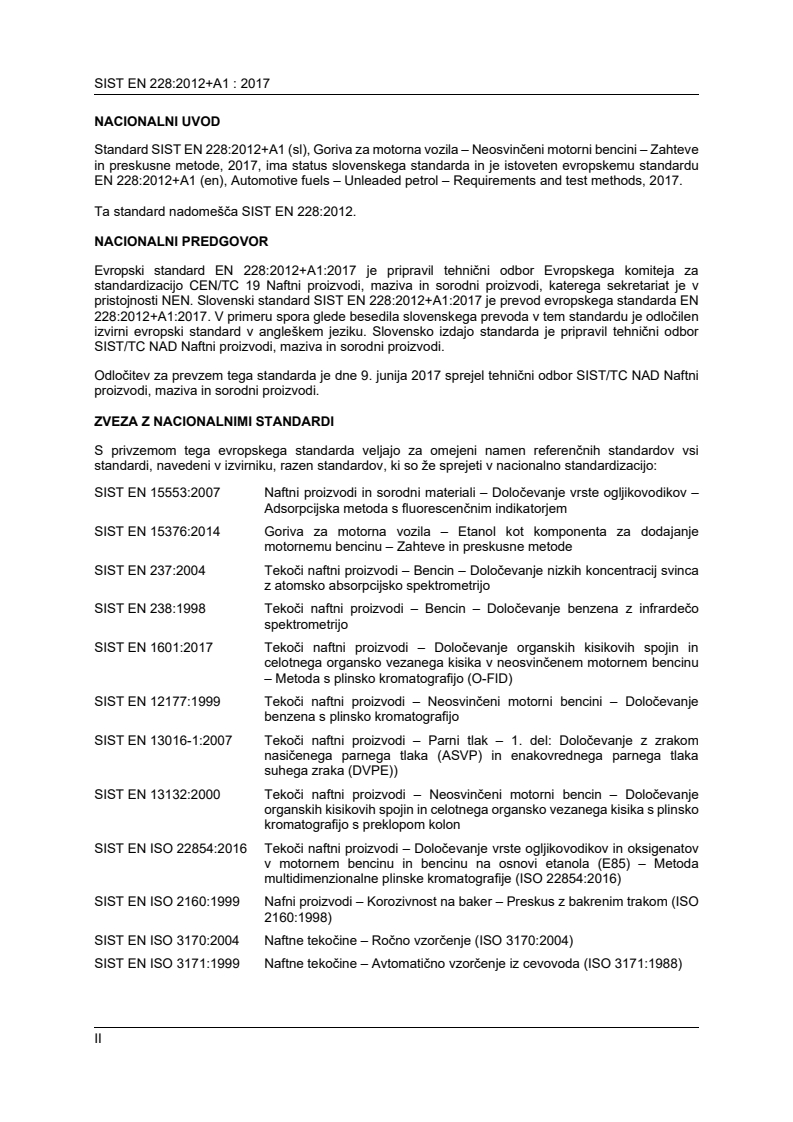
NACIONALNI UVOD
Standard SIST EN 228:2012+A1 (sl), Goriva za motorna vozila – Neosvinčeni motorni bencini – Zahteve
in preskusne metode, 2017, ima status slovenskega standarda in je istoveten evropskemu standardu
EN 228:2012+A1 (en), Automotive fuels – Unleaded petrol – Requirements and test methods, 2017.
Ta standard nadomešča SIST EN 228:2012.
NACIONALNI PREDGOVOR
Evropski standard EN 228:2012+A1:2017 je pripravil tehnični odbor Evropskega komiteja za
standardizacijo CEN/TC 19 Naftni proizvodi, maziva in sorodni proizvodi, katerega sekretariat je v
pristojnosti NEN. Slovenski standard SIST EN 228:2012+A1:2017 je prevod evropskega standarda EN
228:2012+A1:2017. V primeru spora glede besedila slovenskega prevoda v tem standardu je odločilen
izvirni evropski standard v angleškem jeziku. Slovensko izdajo standarda je pripravil tehnični odbor
SIST/TC NAD Naftni proizvodi, maziva in sorodni proizvodi.
Odločitev za prevzem tega standarda je dne 9. junija 2017 sprejel tehnični odbor SIST/TC NAD Naftni
proizvodi, maziva in sorodni proizvodi.
ZVEZA Z NACIONALNIMI STANDARDI
S privzemom tega evropskega standarda veljajo za omejeni namen referenčnih standardov vsi
standardi, navedeni v izvirniku, razen standardov, ki so že sprejeti v nacionalno standardizacijo:
SIST EN 15553:2007 Naftni proizvodi in sorodni materiali – Določevanje vrste ogljikovodikov –
Adsorpcijska metoda s fluorescenčnim indikatorjem
SIST EN 15376:2014 Goriva za motorna vozila – Etanol kot komponenta za dodajanje
motornemu bencinu – Zahteve in preskusne metode
SIST EN 237:2004 Tekoči naftni proizvodi – Bencin – Določevanje nizkih koncentracij svinca
z atomsko absorpcijsko spektrometrijo
SIST EN 238:1998 Tekoči naftni proizvodi – Bencin – Določevanje benzena z infrardečo
spektrometrijo
SIST EN 1601:2017 Tekoči naftni proizvodi – Določevanje organskih kisikovih spojin in
celotnega organsko vezanega kisika v neosvinčenem motornem bencinu
– Metoda s plinsko kromatografijo (O-FID)
SIST EN 12177:1999 Tekoči naftni proizvodi – Neosvinčeni motorni bencini – Določevanje
benzena s plinsko kromatografijo
SIST EN 13016-1:2007 Tekoči naftni proizvodi – Parni tlak – 1. del: Določevanje z zrakom
nasičenega parnega tlaka (ASVP) in enakovrednega parnega tlaka
suhega zraka (DVPE))
SIST EN 13132:2000 Tekoči naftni proizvodi – Neosvinčeni motorni bencin – Določevanje
organskih kisikovih spojin in celotnega organsko vezanega kisika s plinsko
kromatografijo s preklopom kolon
SIST EN ISO 22854:2016 Tekoči naftni proizvodi – Določevanje vrste ogljikovodikov in oksigenatov
v motornem bencinu in bencinu na osnovi etanola (E85) – Metoda
multidimenzionalne plinske kromatografije (ISO 22854:2016)
SIST EN ISO 2160:1999 Nafni proizvodi – Korozivnost na baker – Preskus z bakrenim trakom (ISO
2160:1998)
SIST EN ISO 3170:2004 Naftne tekočine – Ročno vzorčenje (ISO 3170:2004)
SIST EN ISO 3171:1999 Naftne tekočine – Avtomatično vzorčenje iz cevovoda (ISO 3171:1988)
II
SIST EN 228:2012+A1 : 2017
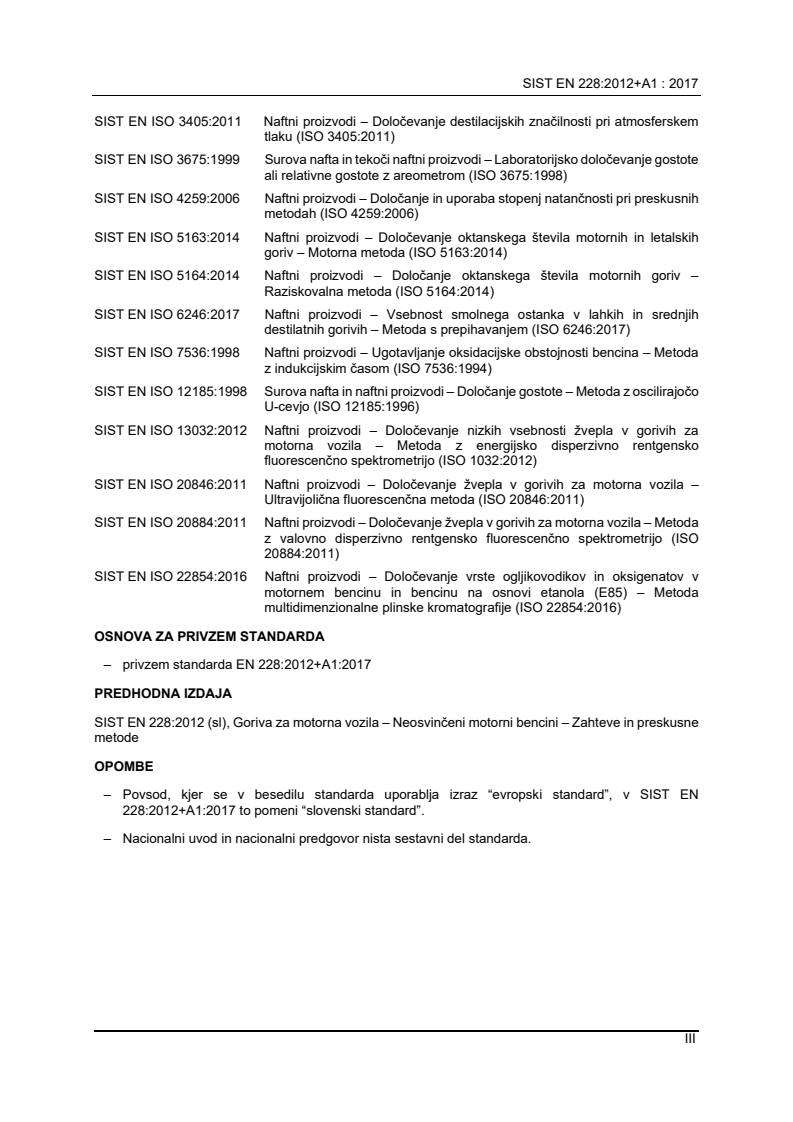
SIST EN ISO 3405:2011 Naftni proizvodi – Določevanje destilacijskih značilnosti pri atmosferskem
tlaku (ISO 3405:2011)
SIST EN ISO 3675:1999 Surova nafta in tekoči naftni proizvodi – Laboratorijsko določevanje gostote
ali relativne gostote z areometrom (ISO 3675:1998)
SIST EN ISO 4259:2006 Naftni proizvodi – Določanje in uporaba stopenj natančnosti pri preskusnih
metodah (ISO 4259:2006)
SIST EN ISO 5163:2014 Naftni proizvodi – Določevanje oktanskega števila motornih in letalskih
goriv – Motorna metoda (ISO 5163:2014)
SIST EN ISO 5164:2014 Naftni proizvodi – Določanje oktanskega števila motornih goriv –
Raziskovalna metoda (ISO 5164:2014)
SIST EN ISO 6246:2017 Naftni proizvodi – Vsebnost smolnega ostanka v lahkih in srednjih
destilatnih gorivih – Metoda s prepihavanjem (ISO 6246:2017)
SIST EN ISO 7536:1998 Naftni proizvodi – Ugotavljanje oksidacijske obstojnosti bencina – Metoda
z indukcijskim časom (ISO 7536:1994)
SIST EN ISO 12185:1998 Surova nafta in naftni proizvodi – Določanje gostote – Metoda z oscilirajočo
U-cevjo (ISO 12185:1996)
SIST EN ISO 13032:2012 Naftni proizvodi – Določevanje nizkih vsebnosti žvepla v gorivih za
motorna vozila – Metoda z energijsko disperzivno rentgensko
fluorescenčno spektrometrijo (ISO 1032:2012)
SIST EN ISO 20846:2011 Naftni proizvodi – Določevanje žvepla v gorivih za motorna vozila –
Ultravijolična fluorescenčna metoda (ISO 20846:2011)
SIST EN ISO 20884:2011 Naftni proizvodi – Določevanje žvepla v gorivih za motorna vozila – Metoda
z valovno disperzivno rentgensko fluorescenčno spektrometrijo (ISO
20884:2011)
SIST EN ISO 22854:2016 Naftni proizvodi – Določevanje vrste ogljikovodikov in oksigenatov v
motornem bencinu in bencinu na osnovi etanola (E85) – Metoda
multidimenzionalne plinske kromatografije (ISO 22854:2016)
OSNOVA ZA PRIVZEM STANDARDA
– privzem standarda EN 228:2012+A1:2017
PREDHODNA IZDAJA
SIST EN 228:2012 (sl), Goriva za motorna vozila – Neosvinčeni motorni bencini – Zahteve in preskusne
metode
OPOMBE
– Povsod, kjer se v besedilu standarda uporablja izraz “evropski standard”, v SIST EN
228:2012+A1:2017 to pomeni “slovenski standard”.
– Nacionalni uvod in nacionalni predgovor nista sestavni del standarda.
III
SIST EN 228:2012+A1 : 2017
– Ta nacionalni dokument je istoveten EN 228:2012+A1:2017 in je objavljen z dovoljenjem
CEN-CENELEC
Upravni center
Avenue Marnix 17
B-1000 Bruselj
This national document is identical with EN 228:2012+A1:2017 and is published with the permission
of
CEN-CENELEC
Management Centre
Avenue Marnix 17
B-1000 Bruxelles
IV
EVROPSKI STANDARD EN 228:2012+A1
EUROPEAN STANDARD
NORME EUROPÉENNE
EUROPÄISCHE NORM maj 2017
ICS 75.160.20 Nadomešča EN 228:2012
Slovenska izdaja
Goriva za motorna vozila – Neosvinčeni motorni bencini –
Zahteve in preskusne metode
Automotive fuels – Unleaded petrol Carburants pour automobiles – Kraftstoffe für Kraftfahrzeuge –
– Requirements and test methods Essence sans plomb – Exigences Unverbleite Ottokraftstoffe –
et méthodes d'essai Anforderungen und Prüfverfahren
Ta evropski standard je CEN sprejel dne 1. septembra 2012 in vključuje dopolnilo 1, ki ga je CEN sprejel
17. marca 2017.
Člani CEN morajo izpolnjevati določila poslovnika CEN/CENELEC, s katerim je predpisano, da mora
biti ta standard brez kakršnihkoli sprememb sprejet kot nacionalni standard. Seznami najnovejših izdaj
teh nacionalnih standardov in njihovi bibliografski podatki so na voljo pri Upravnem centru CEN-
CENELEC ali članih CEN.
Evropski standardi obstajajo v treh izvirnih izdajah (nemški, angleški in francoski). Izdaje v drugih jezikih,
ki jih člani CEN na lastno odgovornost prevedejo in izdajo ter prijavijo pri Upravnem centru CEN-
CENELEC, veljajo kot uradne izdaje.
Člani CEN so nacionalni organi za standarde Avstrije, Belgije, Bolgarije, Cipra, Češke republike,
Danske, Estonije, Finske, Francije, Grčije, Hrvaške, Irske, Islandije, Italije, Latvije, Litve, Luksemburga,
Madžarske, Malte, Nekdanje jugoslovanske republike Makedonije, Nemčije, Nizozemske, Norveške,
Poljske, Portugalske, Romunije, Slovaške, Slovenije, Španije, Švedske, Švice, Turčije in Združenega
kraljestva.
CEN
Evropski komite za standardizacijo
European Committee for Standardisation
Europäisches Komitee für Normung
Comité Européen de Normalisation
Upravni center: Avenue Marnix 17, B-1000 Bruselj
© 2017 Lastnice avtorskih pravic so vse države članice CEN Ref. oznaka EN 228:2012+A1:2017 E
SIST EN 228:2012+A1 : 2017
VSEBINA Stran
Evropski predgovor .3
1 Področje uporabe .5
2 Zveza s standardi .5
3 Vzorčenje .6
4 Označevanje naprav za izdajo goriva .7
5 Zahteve in preskusne metode .7
5.1 (Bio)komponente .7
5.1.1 Etanol .7
5.1.2 Druge (bio)komponente .7
5.2 Barvila in snovi za označevanje .7
5.3 Dodatki (aditivi) .7
5.3.1 Splošno .7
5.3.2 Fosfor .8
5.3.3 Metilciklopentadienil manganov trikarbonil (MMT) .8
5.4 Splošno veljavne zahteve in preskusne metode .8
5.5 Zahteve, odvisne od podnebnih razmer, in preskusne metode .11
5.5.1 Zahteve glede prisotnosti vode .11
5.5.2 Zahteve glede hlapnosti .11
5.6 Poročanje o oktanskem številu .16
5.7 Natančnost in sporni primeri .16
5.7.1 Reševanje spornih primerov .16
5.7.2 Preskusne metode v spornih primerih .16
Dodatek A (normativni): Dovoljeno odstopanja parnega tlaka .17
A.1 Dovoljeno odstopanje parnega tlaka .17
A.2 Navodilo za preverjanje skladnosti dovoljenih odstopanj . 17
Literatura.18
SIST EN 228:2012+A1 : 2017
Evropski predgovor
Ta dokument (EN 228:2012+A1:2017) je pripravil tehnični odbor CEN/TC 19 Plinasta in tekoča goriva,
maziva in sorodni proizvodi iz goriv sintetičnega in biološkega izvora, katerega tajništvo je v pristojnosti
NEN.
Ta evropski standard mora dobiti status nacionalnega standarda bodisi z objavo istovetnega besedila
ali z razglasitvijo najpozneje do novembra 2017. Nacionalni standardi, ki so z njim v nasprotju, morajo
biti razveljavljeni do istega datuma.
Opozoriti je treba na možnost, da je lahko nekaj elementov tega dokumenta predmet patentnih pravic.
CEN (in/ali CENELEC) ne prevzema odgovornosti za identifikacijo katerihkoli ali vseh takih patentnih
pravic.
Ta dokument nadomešča EN 228:2012 .
Ta dokument vključuje Dopolnilo 1, ki ga je CEN odobril 17. marca 2017.
Začetek in konec besedila, dodanega ali spremenjenega z dopolnilom, sta označena z oznakama .
Ta dokument je bil pripravljen v okviru mandata, ki sta ga Evropska komisija in Evropsko združenje za
prosto trgovino dala CEN. Skupaj z drugimi standardi naj bi dopolnil ureditvene ukrepe iz različnih direktiv
EU.
Pomembne tehnične spremembe med to in predhodno izdajo tega evropskega standarda so naslednje:
– upoštevane so nove zahteve v skladu s dopolnili 2009/30/ES [3], 2011/63/EU [4] in 2014/77/EU
[11] k evropski Direktivi o gorivih 98/70/ES (1). Preglednice 1, 2, 3, 4 in A.1 vsebujejo natančne
razlike med zahtevami v evropski Direktivi o gorivih 98/70/ES [1], vključno z dopolnili [2], [3] in [4],
ki so sledila, ter z drugimi zahtevami;
– vključene so bile posebne zahteve glede omejitev uporabe metilciklopentadienil manganovega
trikarbonila (MMT), kot je zahtevala Evropska komisija;
– glede na to, da vpeljava 10 % (V/V) etanola v neosvinčeni bencin vpliva na rafinerijske postopke
in postopke namešavanja, so bile upoštevane posodobljene destilacijske lastnosti. Dodana je bila
nova preglednica 3 s prilagojenimi razredi hlapnosti (E70, E100 in VLI). Nadaljujejo se
prizadevanja za pridobitev podatkov, da te spremembe ne bodo vplivale na hladen zagon motorja
ter na delovanje pri visokih zunanjih temperaturah. Vse te posodobitve so bile sprejete z zadržkom
in se lahko tudi spremenijo glede na razmere na trgu;
– za starejša vozila, ki ne morejo uporabljati neosvinčenega bencina z visoko vsebnostjo biogoriva,
so podane dodatne specifikacije v preglednicah za neosvinčeni bencin. V pripravi je CEN/TR z
navodilom o namešavanju oksigenatov [5];
– v dodatku A je navodilo, kako določati odstopanja parnega tlaka pri neosvinčenem bencinu, ki
vsebuje etanol in je na trgu dovoljen pod posebnimi pogoji. Odstopanje je definirano na točno
število decimalnih mest [4];
– vpeljanih je več novih oziroma revidiranih preskusnih metod. Evropska Direktiva o gorivih
98/70/ES [1], vključno z dopolnili [2], [3], [4] in [11] , se nanaša na preskusne metode v EN
228:2004. Posodobljene analitske metode morajo dokazovati najmanj enako točnost in natančnost
kot metode, ki jih nadomeščajo;
– umaknjeno je dovoljenje za vsebnost 50 mg/kg žvepla;
– sklicevanje na revidirano specifikacijo/vsebnost etanola v EN 15376.
Označitev točilnih naprav z oznako tega proizvoda je skladna z zahtevami Direktive o kakovosti goriv
in Direktive o alternativnih gorivih [12].
SIST EN 228:2012+A1 : 2017
Po notranjih predpisih CEN/CENELEC so dolžne ta evropski standard privzeti nacionalne organizacije
za standarde naslednjih držav: Avstrije, Belgije, Bolgarije, Cipra, Češke republike, Danske, Estonije,
Finske, Francije, Grčije, Hrvaške, Irske, Islandije, Italije, Latvije, Litve, Luksemburga, Madžarske, Malte,
Nekdanje jugoslovanske republike Makedonije, Nemčije, Nizozemske, Norveške, Poljske, Portugalske,
Romunije, Slovaške, Slovenije, Španije, Švedske, Švice, Turčije in Združenega kraljestva.
SIST EN 228:2012+A1 : 2017
1 Področje uporabe
Ta evropski standard določa zahteve in preskusne metode za lastnosti neosvinčenih motornih bencinov
pri prodaji in dobavi. Namenjen je za neosvinčene bencine, ki se uporabljajo v motorjih na neosvinčeni
motorni bencin.
Ta standard določa dva tipa neosvinčenega bencina: enega z največjo vsebnostjo kisika 3,7 % (m/m)
in največjo vsebnostjo etanola 10 % (V/V), kot je navedeno v preglednici 1, in drugega, ki je namenjen
starejšim vozilom, ki ne morejo uporabljati neosvinčenega bencina z visoko vsebnostjo biogoriva, in
sicer z največjo vsebnostjo kisika 2,7 % (m/m) ter največjo vsebnostjo etanola 5,0 % (V/V), kot je
navedeno v preglednici 2.
OPOMBA 1: Oba tipa temeljita na zahtevah evropske direktive [3, 4, [11] ].
OPOMBA 2: Za potrebe tega standarda sta bili uporabljeni oznaki % (m/m) in % (V/V), ki predstavljata delež mase, μ, oziroma
prostornine, φ.
2 Zveza s standardi
Spodaj navedeni standardi so nujno potrebni pri uporabi tega dokumenta. Pri datiranem sklicevanju se
upoštevajo samo navedene izdaje. Pri nedatiranem sklicevanju se upoštevajo zadnje izdaje navedenih
dokumentov (vključno z morebitnimi dopolnili).
EN 237:2004 Tekoči naftni proizvodi – Bencin – Določevanje nizkih koncentracij svinca
z atomsko absorpcijsko spektrometrijo
EN 238:1996/A1:2003 Tekoči naftni proizvodi – Bencin – Določevanje benzena z infrardečo
spektrometrijo
1)
EN 1601:2014 Tekoči naftni proizvodi – Neosvinčeni motorni bencin – Določevanje
organskih kisikovih spojin in celotnega organsko vezanega kisika s plinsko
kromatografijo (O-FID)
EN 12177:1998 Tekoči naftni proizvodi – Neosvinčeni motorni bencini – Določevanje
benzena s plinsko kromatografijo
1)
EN 13016-1:2007 Tekoči naftni proizvodi – Parni tlak – 1. del: Določevanje z zrakom
nasičenega parnega tlaka (ASVP) in enakovrednega parnega tlaka
suhega zraka (DVPE)
EN 13132:2000 Tekoči naftni proizvodi – Neosvinčeni motorni bencin – Določevanje
organskih kisikovih spojin in celotnega organsko vezanega kisika s plinsko
kromatografijo s preklopom kolon
EN 14275:2003 Goriva za motorna vozila – Ocenjevanje kakovosti bencina in dizelskega
goriva – Vzorčenje na bencinskih servisih in komercialnih razdelilnih
točkah
EN 15376:2014 Goriva za motorna vozila – Etanol kot komponenta za dodajanje
motornemu bencinu – Zahteve in preskusne metode
EN 15553:2007 Naftni proizvodi in sorodni materiali – Določevanje vrste ogljikovodikov –
Adsorpcijska metoda s fluorescenčnim indikatorjem
EN 16135:2011 Goriva za motorna vozila – Določevanje vsebnosti mangana v
neosvinčenem bencinu – Plamenska atomska absorpcijska spektrometrija
EN 16136:2015 Goriva za motorna vozila – Določevanje mangana in železa v
neosvinčenem motornem bencinu – Metoda z optično emisijsko
spektrometrijo z induktivno sklopljeno plazmo
1)
V reviziji.
SIST EN 228:2012+A1 : 2017
EN 16942:2016 Goriva – Identifikacija združljivosti vozil – Grafični prikaz informacij za
potrošnika
EN ISO 2160:1998 Naftni proizvodi – Korozivnost na baker – Preskus z bakrenim trakom (ISO
2160:1998)
EN ISO 3170:2004 Naftne tekočine – Ročno vzorčenje (ISO 3170:2004)
EN ISO 3171:1999 Naftne tekočine – Avtomatično vzorčenje iz cevovoda (ISO 3171:1988)
1)
EN ISO 3405:2011 Naftni proizvodi – Določevanje destilacijskih značilnosti pri atmosferskem
tlaku (ISO 3405:2011)
EN ISO 3675:1998 Surova nafta in tekoči naftni proizvodi – Laboratorijsko določevanje gostote
ali relativne gostote z areometrom (ISO 3675:1998)
1)
EN ISO 4259:2006 Naftni proizvodi – Določanje in uporaba stopenj natančnosti pri preskusnih
metodah (ISO 4259:2006)
EN ISO 5163:2014 Naftni proizvodi – Določevanje oktanskega števila motornih in letalskih
goriv – Motorna metoda (ISO 5163:2014)
1)
EN ISO 5164:2014 Naftni proizvodi – Določanje oktanskega števila motornih goriv –
Raziskovalna metoda (ISO 5164:2014)
EN ISO 6246:2017 Naftni proizvodi – Vsebnost smolnega ostanka v lahkih in srednjih
destilatnih gorivih – Metoda s prepihavanjem (ISO 6246:2017)
EN ISO 7536:1996 Naftni proizvodi – Ugotavljanje oksidacijske obstojnosti bencina – Metoda
z indukcijskim časom (ISO 7536:1994)
1)
EN ISO 12185:1996 Surova nafta in naftni proizvodi – Določanje gostote – Metoda z oscilirajočo
U-cevjo (ISO 12185:1996)
EN ISO 13032:2012 Naftni proizvodi – Določevanje nizkih vsebnosti žvepla v gorivih za
motorna vozila – Metoda z energijsko disperzivno rentgensko
fluorescenčno spektrometrijo (ISO 13032:2012)
EN ISO 20846:2011 Naftni proizvodi – Določevanje žvepla v gorivih za motorna vozila –
Ultravijolična fluorescenčna metoda (ISO 20846:2011)
EN ISO 20884:2011 Naftni proizvodi – Določevanje žvepla v gorivih za motorna vozila – Metoda
z valovno disperzivno rentgensko fluorescenčno spektrometrijo (ISO
2088:2011)
EN ISO 22854:2016 Tekoči naftni proizvodi – Določevanje vrste ogljikovodikov in oksigenatov
v motornem bencinu in bencinu na osnovi etanola (E85) – Metoda
multidimenzionalne plinske kromatografije (ISO 22854:2016)
3 Vzorčenje
Vzorčenje mora potekati v skladu z opisom v EN ISO 3170 ali EN ISO 3171 in/ali v skladu z zahtevami
nacionalnih standardov ali predpisov o vzorčenju neosvinčenih motornih bencinov. Nacionalne zahteve
morajo biti podrobno določene ali navedene s sklicevanjem v nacionalnem dopolnilu k temu standardu.
Glede na občutljivost nekaterih preskusnih metod, navedenih v tem standardu, je potrebna posebna
pozornost, da posode za vzorce ustrezajo navodilom, vključenim v standarde preskus
...