


EN 14658:2005+A1:2010
(Main)Continuous handling equipment and systems - General safety requirements for continuous handling equipment for opencast lignite mining
Continuous handling equipment and systems - General safety requirements for continuous handling equipment for opencast lignite mining
This European Standard applies to mechanical continuous handling equipment used in opencast lignite mines and the particular mechanical continuous handling equipment used:
- to convey lignite or overburden from opencast mines;
- to convey residuals and tailings from lignite processing to opencast mines;
- to convey lignite, overburden or lignite treatment processing residuals and tailings from one opencast mine to another.
This standard applies to continuous handling equipment operating in delimited site areas that are off-limits to the public and accessible only to authorized persons.
It specifies the safety requirements for stationary, mobile and shiftable continuous handling equipment designed to transport bulk goods by continuous movement from a loading point to a discharge point.
The standard considers the significant hazards that arise during the use, movement and shifting of continuous handling equipment, as well as the measures for eliminating or reducing these hazards provided the continuous handling equipment is used as intended and the remaining risk is foreseen and taken into account by the manufacturer. A complete list of all the hazards specified in EN 1050 is given in Annex A (normative).
The requirements of this standard do not apply to equipment and systems manufactured and put into operation before the publication date of this standard.
This standard does not cover:
a) safety requirements of wireless remote control systems;
b) hazards generated by noise;
c) hazards generated by vibration;
d) hazards generated by explosion;
e) hazards generated by electromagnetic interference (EMC).
NOTE Directive 94/9/EC concerning equipment and protective systems intended for use in potentially explosive atmospheres and Directive 89/336/EEC.relating to electromagnetic compatibility may be applicable to equipment or components covered by this European Standard.
Stetigförderer und Systeme - Allgemeine Sicherheits-Anforderungen an Stetigförderer im Braunkohlentagebau
Diese Europäische Norm gilt für mechanische Stetigförderer in Braunkohlentagebauen und diejenigen
mechanischen Stetigförderer:
⎯ mit denen Braunkohle oder Abraum aus dem Tagebau herausgefördert werden oder
⎯ mit denen die Reststoffe der Braunkohlenverarbeitung in den Tagebau zurück gefördert werden,
⎯ mit denen Braunkohle, Abraum oder Reststoffe der Braunkohleverarbeitung von einem Tagebau in einen
anderen Tagebau gefördert werden.
Diese Norm gilt für Stetigförderer, die in einem abgegrenzten Betriebsgelände, das der Öffentlichkeit nicht
zugänglich ist, betrieben werden und nur für befugte Personen zugänglich ist.
Sie legt Anforderungen an die Sicherheit für ortsfeste, fahrbare und rückbare Stetigförderer fest, die für den
Transport von Schüttgütern durch stetige Bewegung von einer Aufgabestelle zu einer Abwurfstelle
vorgesehen sind.
Die Norm behandelt die signifikanten Gefährdungen, die bei der Anwendung sowie beim Fahren und Rücken
von Stetigförderern entstehen, und Maßnahmen zur Beseitigung dieser Gefährdungen oder ihrer
Verminderung, sofern die Stetigförderer bestimmungsgemäß eingesetzt werden und die verbleibende
Restgefahr vom Hersteller vorhergesehen und in Kauf genommen wurde. Eine vollständige Liste aller
Gefährdungen nach EN 1050 ist im Anhang A (normativ) wiedergegeben.
Die Anforderungen dieser Norm gelten nicht für Einrichtungen und Systeme, die vor dem Erscheinungsdatum
dieser Norm hergestellt und in Verkehr gebracht wurden.
In dieser Norm sind nicht behandelt:
a) Sicherheitsanforderungen an kabellose Fernsteuerungen;
b) Gefährdungen durch Lärm;
c) Gefährdungen durch Vibration;
d) Gefährdungen durch Explosion;
e) Gefährdungen durch elektromagnetische Störungen (EMV).
(...)
Équipements et systèmes de manutention continue - Prescriptions générales de sécurité applicables aux équipements de manutention continue utilisés dans les mines de lignite à ciel ouvert
La présente norme européenne s'applique aux équipements mécaniques de manutention continue utilisés dans les mines de lignite à ciel ouvert et aux équipements mécaniques de manutention continue permettant :
— d’extraire le lignite ou les morts-terrains à ciel ouvert ou
— de ramener les résidus du traitement du lignite dans la mine,
— de transporter le lignite, les déblais ou les résidus du traitement du lignite d’une mine dans une autre.
La présente norme s'applique aux équipements de manutention continue utilisés sur un site délimité et inaccessible au grand public et dont l’accès est réservé aux personnes autorisées.
Elle définit les prescriptions relatives à la sécurité pour les équipements de manutention continue fixes, mobiles et déplaçables, prévus pour le transport de produits en vrac par manutention continue entre un point de chargement et un point de déchargement.
La présente norme traite des phénomènes dangereux significatifs encourus lors de l'utilisation et du déplacement des équipements de manutention continue ainsi que des mesures permettant d'éliminer ou de réduire ces risques, à condition que les équipements mécaniques de manutention continue aient été utilisés comme prévu et que le constructeur ait prévu et pris en compte le risque résiduel. L'Annexe A (normative) donne une liste complète de tous les phénomènes dangereux conformément à l’EN 1050.
Les prescriptions de la présente norme ne s’appliquent pas aux équipements et systèmes fabriqués et mis sur le marché avant la date de publication de la présente norme.
La présente norme ne traite pas :
a) des prescriptions de sécurité relatives aux télécommandes sans fil ;
b) des risques dus aux bruits ;
c) des risques dus aux vibrations ;
d) des risques dus aux explosions ;
e) des risques dus aux interférences électromagnétiques (CEM).
(...)
Naprave in sistemi za kontinuirni transport - Splošne varnostne zahteve za kontinuirne transporterje pri dnevnih kopih rjavega premoga in lignita
Ta evropski standard se uporablja za strojne naprave za kontinuirni transport, ki se uporabljajo pri dnevnih kopih rjavega premoga in lignita in posebne naprave za kontinuirni transport, ki se uporabljajo: za pošiljanje lignita ali krovne plasti iz dnevnih kopov rudnikov; za pošiljanje ostankov in jalovine iz predelave lignita v dnevne kope rudnikov; za pošiljanje lignita, krovne plasti ali jalovine in ostankov postopka obdelave lignita iz enega dnevnega kopa rudnika v drugega. Ta standard se uporablja za naprave za kontinuirni transport, ki obratujejo v razmejenih področjih, kjer je javnosti dostop prepovedan in so dostopna samo pooblaščenim osebam. Določa varnostne zahteve za nepremične, premične in premestljive naprave za kontinuirni transport, ki so zasnovane za transport razsutega tovora s kontinuirnim gibanjem od točke nakladanja do točke raztovora. Standard upošteva velike nevarnosti, do katerih pride med uporabo, gibanjem in premeščanjem naprav za kontinuirni transport, kot tudi ukrepe za preprečevanje ali zmanjševanje teh nevarnosti, pod pogojem da se naprave za kontinuirni transport uporabljajo v skladu z namembnostjo in je proizvajalec predvidel in upošteval preostalo tveganje. Popoln spisek vseh nevarnosti, opredeljenih v EN 1050, je podan v Dodatku A (normativni). Zahteve tega standarda se ne uporabljajo za opremo in sisteme, ki so proizvedeni in dani v obratovanje pred datumom objave tega standarda. Ta standard ne zajema: a) varnostnih zahtev za brezžične sisteme daljinskega upravljanja; b) nevarnosti, ki jih povzroči hrup; c) nevarnosti, ki jih povzročijo tresljaji; d) nevarnosti, ki jih povzroči eksplozija; e) nevarnosti, ki jih povzročijo elektromagnetne motnje (EMC).
General Information
- Status
- Published
- Publication Date
- 16-Feb-2010
- Technical Committee
- CEN/TC 196 - Machines for undergroung mines - Safety
- Drafting Committee
- CEN/TC 196 - Machines for undergroung mines - Safety
- Current Stage
- 9093 - Decision to confirm - Review Enquiry
- Start Date
- 10-Jun-2021
- Completion Date
- 14-Apr-2025
- Directive
- 98/37/EC - Machinery
Relations
- Effective Date
- 19-Dec-2009
Overview
EN 14658:2005+A1:2010 is a CEN standard that defines general safety requirements for mechanical continuous handling equipment used in opencast lignite (brown coal) mining. It covers stationary, mobile and shiftable continuous conveyors designed to move bulk goods (lignite, overburden, residuals, tailings) between loading and discharge points within delimited site areas accessible only to authorized personnel. The standard addresses significant hazards arising from normal use, movement and shifting of conveyors and specifies measures manufacturers must take to eliminate or reduce risk when equipment is used as intended.
Key Topics and Requirements
- Scope and applicability: Applies to new equipment and systems put into operation after the standard’s publication; not retroactive to earlier installations. Operates in controlled mine sites (off-limits to public).
- Hazard identification: Lists significant hazards (mechanical, electrical, thermal, radiation, material-related, ergonomic, energy-failure and combinations) and references EN 1050 for a comprehensive hazard list (Annex A).
- Mechanical safety: Requirements to prevent crushing, shearing, entanglement, drawing-in, trapping, fracturing/rupturing, slipping/tripping and stability issues.
- Access and guarding: Design of fixed and movable guards, safe access routes, platforms and ladders per permanent access principles.
- Electrical safety: Electrical equipment requirements including start/stop, emergency stop, prevention of unintended start-up and compliance with machine electrical standards.
- Operational controls and information: Requirements for signals, warning devices, marking and comprehensive documentation (operating instructions, maintenance guidance).
- Verification and conformity: Guidance on design/manufacture documentation, on-site verification, and marking to demonstrate compliance.
- Exclusions: Does not cover wireless remote control systems, hazards from noise, vibration, explosion or electromagnetic interference (EMC) - related directives may still apply.
Practical Applications and Users
This standard is essential for:
- Manufacturers and designers of conveyors and continuous handling systems for opencast lignite mining
- Mine operators and site safety managers specifying procurement and safe installation
- Safety engineers and maintenance teams implementing guarding, access and emergency procedures
- Compliance and certification bodies verifying conformity with EU directives
Using EN 14658 helps reduce operational risks, improve equipment design for safe maintenance and support regulatory compliance in mining contracts and tenders.
Related Standards
EN 14658 is intended to be used alongside other machinery safety and electrical standards, for example:
- EN ISO 12100 (machine safety - risk assessment principles)
- EN 60204-1 (electrical equipment of machines)
- EN 1037 / EN 1037 (prevention of unexpected start-up)
- EN 1050 (hazard listing)
- Relevant EN ISO 14122 series for permanent access
Keywords: EN 14658, continuous handling equipment, opencast lignite mining, conveyor safety, lignite conveyors, mining equipment standards, CEN, safety requirements.


Frequently Asked Questions
EN 14658:2005+A1:2010 is a standard published by the European Committee for Standardization (CEN). Its full title is "Continuous handling equipment and systems - General safety requirements for continuous handling equipment for opencast lignite mining". This standard covers: This European Standard applies to mechanical continuous handling equipment used in opencast lignite mines and the particular mechanical continuous handling equipment used: - to convey lignite or overburden from opencast mines; - to convey residuals and tailings from lignite processing to opencast mines; - to convey lignite, overburden or lignite treatment processing residuals and tailings from one opencast mine to another. This standard applies to continuous handling equipment operating in delimited site areas that are off-limits to the public and accessible only to authorized persons. It specifies the safety requirements for stationary, mobile and shiftable continuous handling equipment designed to transport bulk goods by continuous movement from a loading point to a discharge point. The standard considers the significant hazards that arise during the use, movement and shifting of continuous handling equipment, as well as the measures for eliminating or reducing these hazards provided the continuous handling equipment is used as intended and the remaining risk is foreseen and taken into account by the manufacturer. A complete list of all the hazards specified in EN 1050 is given in Annex A (normative). The requirements of this standard do not apply to equipment and systems manufactured and put into operation before the publication date of this standard. This standard does not cover: a) safety requirements of wireless remote control systems; b) hazards generated by noise; c) hazards generated by vibration; d) hazards generated by explosion; e) hazards generated by electromagnetic interference (EMC). NOTE Directive 94/9/EC concerning equipment and protective systems intended for use in potentially explosive atmospheres and Directive 89/336/EEC.relating to electromagnetic compatibility may be applicable to equipment or components covered by this European Standard.
This European Standard applies to mechanical continuous handling equipment used in opencast lignite mines and the particular mechanical continuous handling equipment used: - to convey lignite or overburden from opencast mines; - to convey residuals and tailings from lignite processing to opencast mines; - to convey lignite, overburden or lignite treatment processing residuals and tailings from one opencast mine to another. This standard applies to continuous handling equipment operating in delimited site areas that are off-limits to the public and accessible only to authorized persons. It specifies the safety requirements for stationary, mobile and shiftable continuous handling equipment designed to transport bulk goods by continuous movement from a loading point to a discharge point. The standard considers the significant hazards that arise during the use, movement and shifting of continuous handling equipment, as well as the measures for eliminating or reducing these hazards provided the continuous handling equipment is used as intended and the remaining risk is foreseen and taken into account by the manufacturer. A complete list of all the hazards specified in EN 1050 is given in Annex A (normative). The requirements of this standard do not apply to equipment and systems manufactured and put into operation before the publication date of this standard. This standard does not cover: a) safety requirements of wireless remote control systems; b) hazards generated by noise; c) hazards generated by vibration; d) hazards generated by explosion; e) hazards generated by electromagnetic interference (EMC). NOTE Directive 94/9/EC concerning equipment and protective systems intended for use in potentially explosive atmospheres and Directive 89/336/EEC.relating to electromagnetic compatibility may be applicable to equipment or components covered by this European Standard.
EN 14658:2005+A1:2010 is classified under the following ICS (International Classification for Standards) categories: 53.040.10 - Conveyors. The ICS classification helps identify the subject area and facilitates finding related standards.
EN 14658:2005+A1:2010 has the following relationships with other standards: It is inter standard links to EN 14658:2005. Understanding these relationships helps ensure you are using the most current and applicable version of the standard.
EN 14658:2005+A1:2010 is associated with the following European legislation: EU Directives/Regulations: 2006/42/EC, 98/37/EC; Standardization Mandates: M/079, M/396. When a standard is cited in the Official Journal of the European Union, products manufactured in conformity with it benefit from a presumption of conformity with the essential requirements of the corresponding EU directive or regulation.
You can purchase EN 14658:2005+A1:2010 directly from iTeh Standards. The document is available in PDF format and is delivered instantly after payment. Add the standard to your cart and complete the secure checkout process. iTeh Standards is an authorized distributor of CEN standards.
Standards Content (Sample)
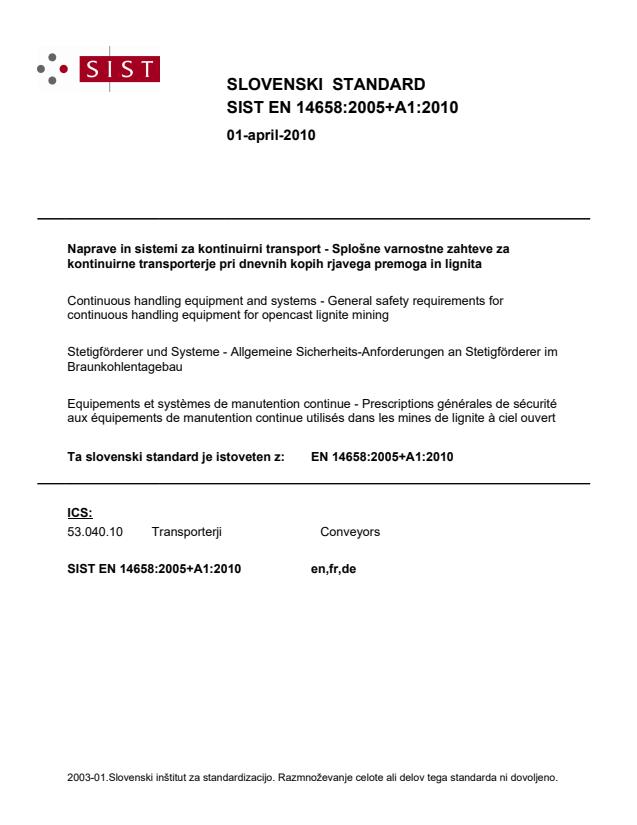
2003-01.Slovenski inštitut za standardizacijo. Razmnoževanje celote ali delov tega standarda ni dovoljeno.Naprave in sistemi za kontinuirni transport - Splošne varnostne zahteve za kontinuirne transporterje pri dnevnih kopih rjavega premoga in lignitaStetigförderer und Systeme - Allgemeine Sicherheits-Anforderungen an Stetigförderer im BraunkohlentagebauEquipements et systèmes de manutention continue - Prescriptions générales de sécurité aux équipements de manutention continue utilisés dans les mines de lignite à ciel ouvertContinuous handling equipment and systems - General safety requirements for continuous handling equipment for opencast lignite mining53.040.10TransporterjiConveyorsICS:Ta slovenski standard je istoveten z:EN 14658:2005+A1:2010SIST EN 14658:2005+A1:2010en,fr,de01-april-2010SIST EN 14658:2005+A1:2010SLOVENSKI
STANDARD
EUROPEAN STANDARD NORME EUROPÉENNE EUROPÄISCHE NORM
EN 14658:2005+A1
February 2010 ICS 53.040.10 Supersedes EN 14658:2005English Version
Continuous handling equipment and systems - General safety requirements for continuous handling equipment for opencast lignite mining
Equipements et systèmes de manutention continue - Prescriptions générales de sécurité aux équipements de manutention continue utilisés dans les mines de lignite à ciel ouvert
Stetigförderer und Systeme - Allgemeine Sicherheits-Anforderungen an Stetigförderer im Braunkohlentagebau This European Standard was approved by CEN on 25 March 2005 and includes Amendment 1 approved by CEN on 11 January 2010.
CEN members are bound to comply with the CEN/CENELEC Internal Regulations which stipulate the conditions for giving this European Standard the status of a national standard without any alteration. Up-to-date lists and bibliographical references concerning such national standards may be obtained on application to the CEN Management Centre or to any CEN member.
This European Standard exists in three official versions (English, French, German). A version in any other language made by translation under the responsibility of a CEN member into its own language and notified to the CEN Management Centre has the same status as the official versions.
CEN members are the national standards bodies of Austria, Belgium, Bulgaria, Croatia, Cyprus, Czech Republic, Denmark, Estonia, Finland, France, Germany, Greece, Hungary, Iceland, Ireland, Italy, Latvia, Lithuania, Luxembourg, Malta, Netherlands, Norway, Poland, Portugal, Romania, Slovakia, Slovenia, Spain, Sweden, Switzerland and United Kingdom.
EUROPEAN COMMITTEE FOR STANDARDIZATION
COMITÉ EUROPÉEN DE NORMALISATION EUROPÄISCHES KOMITEE FÜR NORMUNG
Management Centre:
Avenue Marnix 17,
B-1000 Brussels © 2010 CEN All rights of exploitation in any form and by any means reserved worldwide for CEN national Members. Ref. No. EN 14658:2005+A1:2010: ESIST EN 14658:2005+A1:2010
List of hazards according to EN 1050 and reference to the corresponding safety requirements to be met by continuous handling equipment in opencast lignite mining . 23Annex ZA (informative)
!!!!Relationship between this European Standard and the
Essential Requirements of EU Directive 98/37/EC amended by 98/79/EC"""" . 28Annex ZB (informative)
!!!!Relationship between this European Standard and the
Essential Requirements of EU Directive 2006/42/EC"""" . 30 SIST EN 14658:2005+A1:2010
!". This document has been prepared under a mandate given to CEN by the European Commission and the European Free Trade Association, and supports essential requirements of EU Directive(s). !For relationship with EU Directives, see informative Annexes ZA and ZB, which are integral parts of this document." According to the CEN/CENELEC Internal Regulations, the national standards organizations of the following countries are bound to implement this European Standard: Austria, Belgium, Bulgaria, Croatia, Cyprus, Czech Republic, Denmark, Estonia, Finland, France, Germany, Greece, Hungary, Iceland, Ireland, Italy, Latvia, Lithuania, Luxembourg, Malta, Netherlands, Norway, Poland, Portugal, Romania, Slovakia, Slovenia, Spain, Sweden, Switzerland and United Kingdom. SIST EN 14658:2005+A1:2010
maintain, inspect and repair the machinery and adapt it to the changeable requirements of opencast mining; the machinery components are kept in a good state of repair and working order so that the required characteristics related to health and safety are maintained despite wear and tear; the place of installation is adequately illuminated; the place of installation allows safe use of the machinery; the design of the loadbearing elements ensures safe operation of the machinery in the required load range and during testing; all parts of the machinery not subject to specific requirements: a) are made from materials of adequate strength and durability and of suitable quality; b) function in a sound manner mechanically; c) have been designed in accordance with standard engineering practice and calculation methods, taking account of all failure modes and appropriate safety factors. When provisions of this type C standard are different from those which are stated in type A or B standards, the provisions of this type C standard take precedence over the provisions of the other standards for machines that have been designed and built according to the provisions of this type C standard.
to convey lignite or overburden from opencast mines; to convey residuals and tailings from lignite processing to opencast mines; to convey lignite, overburden or lignite treatment processing residuals and tailings from one opencast mine to another.
This standard applies to continuous handling equipment operating in delimited site areas that are off-limits to the public and accessible only to authorized persons. It specifies the safety requirements for stationary, mobile and shiftable continuous handling equipment designed to transport bulk goods by continuous movement from a loading point to a discharge point. The standard considers the significant hazards that arise during the use, movement and shifting of continuous handling equipment, as well as the measures for eliminating or reducing these hazards provided the continuous handling equipment is used as intended and the remaining risk is foreseen and taken into account by the manufacturer. A complete list of all the hazards specified in EN 1050 is given in Annex A (normative). The requirements of this standard do not apply to equipment and systems manufactured and put into operation before the publication date of this standard. This standard does not cover: a) safety requirements of wireless remote control systems; b) hazards generated by noise; c) hazards generated by vibration; d) hazards generated by explosion; e) hazards generated by electromagnetic interference (EMC). NOTE Directive 94/9/EC concerning equipment and protective systems intended for use in potentially explosive atmospheres and Directive 89/336/EEC.relating to electromagnetic compatibility may be applicable to equipment or components covered by this European Standard. This Standard is not intended to provide means of complying with the essential health and safety requirements of the above Directives. 2 Normative references The following referenced documents are indispensable for the application of this European Standard.
For dated references, only the edition cited applies.
For undated references, the latest edition of the referenced document (including any amendments) applies. EN 294, Safety of machinery — Safety distances to prevent danger zones being reached by the upper limbs EN 349, Safety of machinery — Minimum gaps to avoid crushing of parts of the human body EN 418, Safety of machinery — Emergency stop equipment, functional aspects — Principles for design SIST EN 14658:2005+A1:2010
EN ISO 12100-2:2003 and the following terms and definitions apply. 3.1 delimited operating site area delimited by man-made or natural barriers (embankments, dams, distances, etc.) from public areas and accessible only to authorized persons 3.2 scraper device used to distribute the material handled or to remove adherent residual materials 3.3 discharge point unloading point of continuous handling equipment SIST EN 14658:2005+A1:2010
3.16 idler roller which supports and/or guides the conveyor belt SIST EN 14658:2005+A1:2010
locations or facilities designed and suitable for recurring access to continuous handling equipment for operating, control, inspection, maintenance and repair purposes and at or via which persons can approach the continuous handling equipment without particular physical exertion or risk (climbing over/underneath), or move along, over or under it 4 List of significant hazards 4.1 General This clause lists all the significant hazards, dangerous situations and circumstances which have been identified in a risk assessment as relevant for the area defined in the scope and require definition in order to eliminate or reduce the risk. A complete list of all the hazards mentioned in EN 1050 is given in Annex A. Their precise descriptions form the basis for the safety precautions stipulated in clause 5. Before applying this standard, it is necessary to consider the hazards relating to the continuous handling equipment and its planned use in order to ensure that all hazards have been identified. 4.2 Mechanical hazards 4.2.1 Crushing and shearing Crushing and shearing may occur where components move towards or closely past one another. 4.2.2 Entanglement, drawing-in and trapping Hazards generated by the entanglement, drawing-in and trapping of persons, body parts or clothing may arise in proximity to circulating belts, pulleys, idlers, shafts and couplings, chains and sprockets or other circulating or rotating components. Trapping and entanglement hazards occur in particular due to protruding sharp edges, teeth, bolts/screws, lubricating nipples and other projecting parts or rough surfaces of circulating or rotating components. Belt conveyors involve drawing-in hazards, in particular at nip points where the belt runs onto pulleys or idlers, or narrow passages are formed between the belt and fixed parts, and where persons' body parts or limbs may be drawn in. It shall be remembered that belt conveyors with reversible direction of movement have two in-running nips at each pulley, idler or narrow passage. 4.2.3 Stability Stability may be lost due to: a) overloading; b) insufficient anchoring; SIST EN 14658:2005+A1:2010
4.2.4 Hazards generated by fracturing and rupturing during operation Fracturing of the drum shaft (e.g. following bearing damage) may cause the belt drive to fall off, generating a hazard for equipment parts or persons. Rupturing of pressurized hydraulic lines can generate a hazard for equipment parts or persons. 4.2.5 Hazards generated by slipping, tripping and falling Hazards may occur in the form of slipping, tripping and falling, e.g. as a result of poorly designed walkways. 4.3 Electrical equipment hazards Hazards may occur due to: a) direct contact with electrically active parts as a result of damage to insulation or sheathing; b) faulty disconnection of electrical power; c) ingress of handled material or moisture into electrical systems. 4.4 Thermal hazards Hazards may arise due to:
a) heat generated by the movement of defective components of the continuous handling equipment; b) heat generated by a relative movement (e.g. slip) between components of the continuous handling equipment; c) the temperature of the handled material. 4.5 Radiation hazards Continuous handling equipment may also use radiating devices (e.g. laser measuring instruments, X-ray equipment or measuring apparatus operating with radioactive beams) for measuring and monitoring purposes The operation of such devices may generate hazards. 4.6 Hazards due to handled materials Hazards may arise due to the spillage, caking, ejection or falling-off of handled materials or due to dust.
4.7 Hazards due to neglect of ergonomic principles The neglect of ergonomic principles may lead to persons having to work in an unhealthy posture at continuous handling equipment (e.g. in the control station), involving excessive physical effort or mental overload or underload. SIST EN 14658:2005+A1:2010
Access to the space beneath gravity take-up devices is permitted for repair purposes only. If the lowermost part of the gravity take-up device is accessible, a safeguard is required as protection against the mass falling. The safeguard shall be effective during access beneath the gravity take-up device. 5.2.2 Entanglement, drawing-in and trapping In working areas, in-running nips and other points generating hazards shall be fitted with guards in accordance with EN 953 or the safety distances shall be observed in accordance with EN 294. 5.2.3 Stability The manufacturer of the continuous handling equipment shall ensure through suitable design that no loss of stability occurs due to overloading, e.g. as a result of overfilling the conveying element.
To avoid overloading with the handled material, a conveying element cross-section filled to the edges in addition to an overlying triangular cross-section corresponding to the angle of repose of the handled material shall be assumed in the design calculation of the continuous handling equipment. Furthermore, the manufacturer shall provide devices to be able to anchor the continuous handling equipment or its components so that any unintended movements, e.g. as a result of the forces acting in the conveying element, are precluded. Where unintended movements of the continuous handling equipment may occur due to excessively strong wind, the manufacturer shall provide devices to anchor the continuous handling equipment in place. In the case of railbound, mobile continuous handling equipment, devices shall be provided which reliably prevent derailment or the continuous handling equipment shall be designed so that its stability is not impaired by derailment. 5.2.4 Hazards generated by fracturing and rupturing during operation Where belt drives arranged on the drum shaft may generate hazards for equipment parts or persons as a result of the drum shaft fracturing, arresting devices shall be provided which prevent the belt drive from falling off. The arresting devices shall withstand the dynamic loads occurring during such falling-off, the latter being dependent on the belt drive mass, height of fall and arresting device rigidity. Pressure and drain lines of hydraulic cylinders holding continuous handling equipment components in position during operation shall be provided with a pipe rupture check valve. 5.2.5 Access 5.2.5.1 Access in general
EN ISO 14122-1, EN ISO 14122-2, EN ISO 14122-3 and EN ISO 14122-4 shall generally be applicable.
Continuous handling equipment shall have emergency stop devices that conform to stop category 0 or 1 in accordance with EN 418.
Exceptions from this are belt conveyors used in opencast mining, unless they are an integral part of a continuous handling equipment system. An emergency stop device cannot reduce a hazard for belt conveyors in opencast mining. These shall have local stop devices that meet the requirements of 5.3.3.2. 5.3.3.2 Stop device requirements
Stop devices for deactivation of the continuous handling equipment shall be installed in the areas provided for local inspection during operation. Pull-cord operated switches or push-button operated switches may be used as operating elements for the stop devices. It is also possible to use other solutions instead of pull-cord or push-button operated switches that ensure equal safety The spacing between the stop devices shall not be more than 150 m. Furthermore, stop devices shall be provided at all locations from which the belt conveyor can be activated. Where pull-cord systems are used, the pull cord shall be designed as a corrosion-proof and adequately dimensioned wire rope, in keeping with the expected ambient conditions. Upon actuation of a stop device, the stopping process shall be initiated immediately; in the case of linked continuous handling equipment units, delayed stopping of the downstream units receiving material is permissible to avoid spillage. Stopping shall take place in controlled or uncontrolled mode, with or without power disconnection. Unauthorized restarting of the continuous handling equipment shall not be possible after actuation of a stop device. Spillage conveyors that form part of a belt conveyor and can only be started up together with the belt conveyor in interlocking operating mode do not require a stop device of their own if, in the unlocked operating mode, the spillage conveyor can be overlooked from the control station. Drives of associated equipment shall have local control devices for their activation/deactivation. The control devices shall conform to the requirements applicable to stop devices, and the operating element shall remain in the "off" position until it is intentionally returned to the "on" position.
The unlocking of one or more continuous handling equipment unit(s) shall not render the stop devices ineffective.
5.3.4 Unexpected or unintended start-up It shall be possible to safeguard continuous handling equipment against unauthorized start-up in accordance with the requirements of EN 1037. It shall be ensured that the stop devices are clearly identified, that they clearly indicate the switching position, and that it is clearly defined in which part of the equipment the disconnection is effective. For this purpose, continuous handling equipment shall be fitted with devices allowing all-pole interruption. Appropriate arrangements to preclude unintended start-up shall be provided. Where the device is freely accessible, it shall have a locking mechanism. If it is located in a closed electrical operating area, warning signs will be sufficient. A stop device and, if required, a brake system and/or arresting device shall be provided to prevent the risk of any unforeseen start-up during maintenance and cleaning activities. SIST EN 14658:2005+A1:2010
The manufacturer shall take into consideration the characteristics of the materials handled. The occurrence of spillage and caking shall be taken into account when designing and specifying the continuous handling equipment. In working areas where there is the risk of handled material being ejected from the sides and this cannot be avoided through primary measures such as chuting, deflector guides or rope arrangements, for example, secondary precautions shall be taken, such as protective roofing or catch nets. The hazardous areas shall be identified, taking into consideration the properties of the handled material (granular material, lumps or similar), the conveying speed and inclination of the conveyor. At passageways and thoroughfares, precautions in the form of protective roofing or catch nets, for example, shall be taken to safeguard against falling materials. Spillage from linked continuous handling equipment shall be prevented by means of interlocking operation. The removal of spillage and caking shall be possible without any risk, particularly in the feed hoppers. Where hazards are generated by dust, appropriate technical and/or organizational measures shall ensure that the values admissible for workplaces are not exceeded. 5.7 Hazards due to neglect of ergonomic principles Continuous handling equipment shall be designed and constructed in such a way as to avoid inadmissible physical stress during i
...
The article discusses the European Standard EN 14658:2005+A1:2010, which pertains to the safety requirements for continuous handling equipment used in opencast lignite mining. The standard applies to equipment that is involved in conveying lignite or overburden from mines, as well as residuals and tailings from lignite processing. It also covers equipment used to transport materials between different opencast mines. The standard applies to equipment operating in restricted areas and outlines the safety measures for stationary, mobile, and shiftable equipment used to transport bulk goods continuously. It considers the hazards associated with the use and movement of the equipment and provides guidelines for reducing these risks. The standard does not apply to equipment manufactured before its publication and does not cover safety requirements related to wireless remote control systems, noise, vibration, explosion, or electromagnetic interference. It notes that other directives, such as Directive 94/9/EC for equipment used in explosive atmospheres and Directive 89/336/EEC for electromagnetic compatibility, may be applicable to equipment covered by this standard.
기사 제목: EN 14658:2005+A1:2010 - 연속 처리 장비 및 시스템 - 오픈캐스트 흑연 채굴용 연속 처리 장비의 일반 안전 요구 사항 기사 내용: 이 유럽 표준은 오픈캐스트 흑연 광산에서 사용되는 기계식 연속 처리 장비와 특정한 기계식 연속 처리 장비에 적용됩니다: - 오픈캐스트 광산에서 흑연이나 토목을 운반하기 위한 장비 - 흑연 처리의 잔류물과 꼬리매를 오픈캐스트 광산으로 운반하기 위한 장비 - 하나의 오픈캐스트 광산에서 다른 오픈캐스트 광산으로 흑연, 토목 또는 흑연 처리 잔여물 및 꼬리매를 운반하려는 장비 이 표준은 일반인에게 통제되지 않는 제한된 지역에서 운영되는 연속 처리 장비에 적용됩니다. 이는 권한이 있는 사람들만 출입할 수 있는 지역입니다. 이 표준은 하중지점에서 배출지점까지 연속 운동에 의해 대량의 재료를 운송하기 위해 설계된 정지, 이동식 및 이동 가능한 연속 처리 장비에 대한 안전 요구 사항을 규정합니다. 이 표준은 연속 처리 장비의 사용, 이동, 이동에 따라 발생하는 중대한 위험 사항과, 이러한 위험을 제거하거나 줄이기 위한 조치에 대해 다룹니다. 다만, 연속 처리 장비가 의도된대로 사용되고 제조업체에 의해 남은 위험을 예측하고 고려할 수 있도록 하는 경우에만 해당됩니다. EN 1050에 명시된 모든 위험 사항의 전체 목록이 부록 A (규격)에 제공됩니다. 이 표준의 요구 사항은 이 표준의 게시 날짜 이전에 제조되고 가동된 장비 및 시스템에 적용되지 않습니다. 이 표준은 다음을 다루지 않습니다: a) 무선 원격 제어 시스템의 안전 요구 사항 b) 소음에 의해 발생하는 위험 c) 진동에 의해 발생하는 위험 d) 폭발에 의해 발생하는 위험 e) 전자기 장애(EMC)에 의해 발생하는 위험 주의: 잠재적으로 폭발성 대기 중에서 사용되는 장비 및 보호 시스템에 대한 94/9/EC 지침 및 전자기적 호환성에 관한 89/336/EEC 지침 등은 이 유럽 표준에 포함된 장비나 구성품에 해당할 수 있습니다.
記事タイトル:EN 14658:2005+A1:2010 - 連続処理機器およびシステム - 露天採掘用褐炭連続処理機器の一般的な安全要件 記事の内容:このヨーロッパ標準は、露天採掘用褐炭鉱山で使用される機械式連続処理機器と特定の機械式連続処理機器に適用されます: - 露天鉱山からの褐炭や盛り土の搬送に使用される機器 - 褐炭の加工からの残渣やテーリングを露天鉱山に搬送する機器 - 1つの露天鉱山から別の露天鉱山に褐炭、盛り土、または褐炭処理の残渣やテーリングを搬送する機器 この標準は、一般の人が立ち入ることができず、権限を持った者のみが利用できる制限されたサイトエリアで動作する連続処理機器に適用されます。 この標準は、積載地点から排出地点まで連続的な移動によってバルク貨物を輸送するための、固定、移動式、可動式の連続処理機器の安全要件を定めています。 この標準は、連続処理機器の使用、移動、シフト時に生じる主な危険性を考慮し、製造業者が意図どおりに使用され、残りのリスクが予見され、考慮される場合に、これらの危険性を排除または低減するための措置を提供します。EN 1050で指定されたすべての危険を含む完全なリストは、付録A(規範)に掲載されています。 この標準の要件は、この標準の発行日以前に製造および稼働された機器やシステムには適用されません。 この標準は以下の項目を対象としていません: a)無線遠隔制御システムの安全要件 b)ノイズによって生じる危険 c)振動によって生じる危険 d)爆発によって生じる危険 e)電磁干渉(EMC)によって生じる危険 注記:爆発性の大気中で使用する機器や保護システムに関連するディレクティブ94/9/ECや電磁的な互換性に関連するディレクティブ89/336/EECなど、このヨーロッパ標準に含まれる機器や部品に適用される場合があります。
Questions, Comments and Discussion
Ask us and Technical Secretary will try to provide an answer. You can facilitate discussion about the standard in here.
Loading comments...