


EN ISO/IEC 9646-5:1996
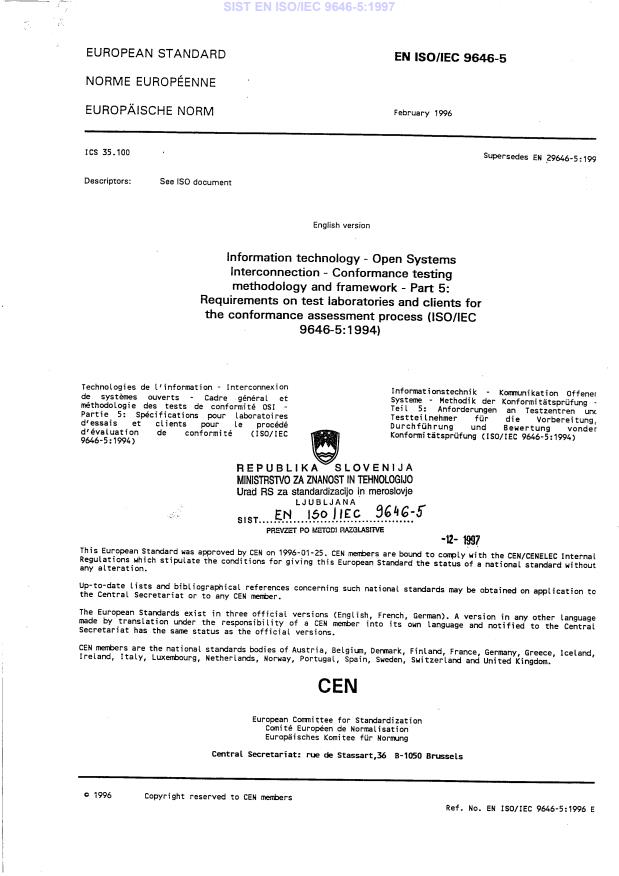
(Main)Information technology - Open Systems Interconnection - Conformance testing methodology and framework - Part 5: Requirements on test laboratories and clients for the conformance assessment process (ISO/IEC 9646-5:1994)
Information technology - Open Systems Interconnection - Conformance testing methodology and framework - Part 5: Requirements on test laboratories and clients for the conformance assessment process (ISO/IEC 9646-5:1994)
Informationstechnik - Kommunikation offener Systeme - Methodik der Konformitätsprüfung - Teil 5: Anforderungen an Testzentren und Testteilnehmer für die Vorbereitung, Durchführung und Bewertung der Konformitätsprüfung (ISO/IEC 9646-5:1994)
Technologies de l'information - Interconnexion de systèmes ouverts - Cadre général et méthodologie des tests de conformité OSI - Partie 5: Spécifications pour laboratoires d'essais et clients pour le procédé d'évaluation de conformité (ISO/IEC 9646-5:1994)
Information technology - Open Systems Interconnection - Conformance testing methodology and framework - Part 5: Requirements on test laboratories and clients for the conformance assessment process (ISO/IEC 9646-5:1994)
General Information
- Status
- Withdrawn
- Publication Date
- 20-Feb-1996
- Withdrawal Date
- 27-Oct-1998
- Technical Committee
- CEN/SS F12 - Information processing systems
- Drafting Committee
- CEN/SS F12 - Information processing systems
- Current Stage
- 9960 - Withdrawal effective - Withdrawal
- Start Date
- 28-Oct-1998
- Completion Date
- 28-Oct-1998
Relations
- Effective Date
- 09-Feb-2026
- Effective Date
- 09-Feb-2026
- Effective Date
- 09-Feb-2026
- Referred By
EN 61850-10:2005 - Communication networks and systems in substations - Part 10: Conformance testing - Effective Date
- 09-Feb-2026
- Effective Date
- 09-Feb-2026
- Effective Date
- 09-Feb-2026

Get Certified
Connect with accredited certification bodies for this standard

BSI Group
BSI (British Standards Institution) is the business standards company that helps organizations make excellence a habit.

NYCE
Mexican standards and certification body.
Sponsored listings
Frequently Asked Questions
EN ISO/IEC 9646-5:1996 is a standard published by the European Committee for Standardization (CEN). Its full title is "Information technology - Open Systems Interconnection - Conformance testing methodology and framework - Part 5: Requirements on test laboratories and clients for the conformance assessment process (ISO/IEC 9646-5:1994)". This standard covers: Information technology - Open Systems Interconnection - Conformance testing methodology and framework - Part 5: Requirements on test laboratories and clients for the conformance assessment process (ISO/IEC 9646-5:1994)
Information technology - Open Systems Interconnection - Conformance testing methodology and framework - Part 5: Requirements on test laboratories and clients for the conformance assessment process (ISO/IEC 9646-5:1994)
EN ISO/IEC 9646-5:1996 is classified under the following ICS (International Classification for Standards) categories: 35.100.01 - Open systems interconnection in general. The ICS classification helps identify the subject area and facilitates finding related standards.
EN ISO/IEC 9646-5:1996 has the following relationships with other standards: It is inter standard links to EN 61850-10:2013, EN 61375-3-1:2012, EN 61375-2-5:2015, EN 61850-10:2005, EN 61400-25-5:2017, EN 61375-2-1:2012. Understanding these relationships helps ensure you are using the most current and applicable version of the standard.
EN ISO/IEC 9646-5:1996 is available in PDF format for immediate download after purchase. The document can be added to your cart and obtained through the secure checkout process. Digital delivery ensures instant access to the complete standard document.
Standards Content (Sample)
SLOVENSKI STANDARD
01-december-1997
Information technology - Open Systems Interconnection - Conformance testing
methodology and framework - Part 5: Requirements on test laboratories and
clients for the conformance assessment process (ISO/IEC 9646-5:1994)
Information technology - Open Systems Interconnection - Conformance testing
methodology and framework - Part 5: Requirements on test laboratories and clients for
the conformance assessment process (ISO/IEC 9646-5:1994)
Informationstechnik - Kommunikation offener Systeme - Methodik der
Konformitätsprüfung - Teil 5: Anforderungen an Testzentren und Testteilnehmer für die
Vorbereitung, Durchführung und Bewertung der Konformitätsprüfung (ISO/IEC 9646-
5:1994)
Technologies de l'information - Interconnexion de systemes ouverts - Cadre général et
méthodologie des tests de conformité OSI - Partie 5: Spécifications pour laboratoires
d'essais et clients pour le procédé d'évaluation de conformité (ISO/IEC 9646-5:1994)
Ta slovenski standard je istoveten z: EN ISO/IEC 9646-5:1996
ICS:
35.100.01 Medsebojno povezovanje Open systems
odprtih sistemov na splošno interconnection in general
2003-01.Slovenski inštitut za standardizacijo. Razmnoževanje celote ali delov tega standarda ni dovoljeno.
INTERNATIONAL
ISO/IEC
STANDARD
Second edition
1994-l 2-15
Information technology - Open Systems
Interconnection - Conformance testing
methodology and framework -
Part 5:
Requirements on test laboratories and clients
for the conformance assessment process
Technologies de I’informa tion - Interconnexion de syst&mes ouverts -
Cadre g&&al et m&hodologie des tests de conformit OS/ -
Partie 5: Spkifications pour laboratoires d’essais et clients pour le
pro&d6 d’&alua tion de conformit
Reference number
ISO/lEC 9646-5:1994(E)
ISO/IEC 9646-5 : 1994 (E)
Contents
Page
Foreword. .i v
.......................................................
Introduction . . V
1 Scope.l .l
.....................................................
2 Nonnativereferences. .
..............................................
3 Definitions .2
......................................................
4 Abbreviations
...................................................... .
5 Overview of the conformance assessment process.
........................ .3
5.1 Introduction. .3
...................................................
5.2 Preparation for testing.
........................................... .3
5.3Testo~erations
............................................... ...4
5.4 Test report production.
.4
...........................................
6 Preparation for testing.
.............................................. .4
6.1 Introduction. .4
...................................................
6.2 Requirements for testability of the System Under Test . .4
6.3 Communication between the test laboratory and the client . .7
6.4 Documentation for conformance assessment . .9
7 Testoperations .ll
..................................................
7.1 Introduction .ll
..................................................
7.2 Static conformance review .ll
.......................................
7.3 Test selection .14
.................................................
7.4 Test parameterization .15
...........................................
7.5 Verification of Test Coordination Procedures .15
........................
7.6Testcampaign.l 6
7.7 Negotiated exits during the test campaign .18
...........................
8 Test report production. .19
.............................................
8.1 Conformance test reports
........................................ .19
8.2 System Conformance Test Report (SCTR).
.......................... .19
8.3 Protocol Conformance Test Report (PCTR). . .20
9 Comp~ance.2 1
9.1 Test laboratory role . .21
9.2 Client role. .21
...................................................
@ ISO/IEC 1994
All rights reserved. Unless otherwise specified, no part of this publication may be
reproduced or utilized in any form or by any means, electronic or mechanical, including
photocopying and microfilm, without permission in writing from the publisher.
ISO/IEC Copyright Office l Case Postale 56 l CH-1211 Geneve 20 l Switzerland
Printed in Switzerland
ii
0 ISOAEC ISO/.IEC 9646-5 : 1994 (E)
Annex
..................... .22
A System Conformance Test Report (SCTR) template.
A.1 Introduction.2 2
A.2Conformance.2 2
.22
A.3 SCTR proforma. .
..................... .26
B Protocol Conformance Test Report (PCTR) template
B.l Introduction.2 6
.26
B.2 Conformance. .
.26
B.3 PCTR proforma. .
C Skeleton IXIT Proforma. 30
............................................
C.l Introduction.3 0
C.2 IXIT proforma.
................................................
. . .
ISO/IEC 9646-5: 1994(E) @ ISOAEC
Foreword
IS0 (the International Organization for Standardization) and IEC (the Inter-
national Electrotechnical Commission) form the specialized system for worldwide
standardization. National bodies that are members of IS0 or IEC participate in the
development of International Standards through technical committees established
by the respective organization to deal with particular fields of technical activity.
IS0 and IEC technical committees collaborate in fields of mutual interest. Other
international organizations, governmental and non-governmental, in liaison with
IS0 and IEC, also take part in the work.
In the field of information technology, IS0 and IEC have established a joint
technical committee, ISO/IEC JTC 1. Draft International Standards adopted by the
joint technical committee are circulated to national bodies for voting. Publication
as an International Standard requires approval by at least 75 % of the national
bodies casting a vote.
International Standard ISO/IEC 9646-5 was prepared by Joint Technical
Committee ISO/IEC JTC 1, Information technology, Subcommittee 21, Open
Systems Interconnection, data management and open distributed processing.
This second edition cancels and replaces the first edition (ISOIIEC 9646-5: 1991)
which has been technically revised.
ISO/IEC 9646 consists of the following parts, under the general title Information
technology - Open Systems Interconnection - Conformance testing methodol-
ogy and framework:
- Part I: General concepts
- Part 2: Abstract Test Suite specification
- Part 3: The Tree and Tabular Combined Notation
- Part 4: Test realization
- Part 5: Requirements on test laboratories and clients for the conformance
assessment process
- Part 6: Protocol profile test specification
- Part 7: Implementation conformance statements
Annexes A and B form an integral part of this part of ISO/IEC 9646. Annex C is
for information only.
iv
ISO/IEC 9646-5 : 1994 (E)
0 ISO/IEC
Introduction
Conformance testing requires mutual understanding and agreement between the
test laboratory and the client. This part of ISO/IEC 9646 addresses the roles of both
the test laboratory and the client during the conformance assessment process, the
need to reach mutual agreements between them, and the requirements on each of
them.
The conformance assessment process is the most visible process of conformance
testing, where the results of test suite standardization are put to real use. This is also
the stage at which there is potentially the most scope for variations to occur. As this
part of ISO/IEC 9646 is concerned with the relatively formal process of testing
implementations, it is important that the number and nature of such variations is
very limited. One of the major objectives of standardizing the conformance testing
process is to achieve an acceptable and useful degree of comparability of results of
conformance assessments of similar implementations. If this is to be achieved, not
only should the same source of tests be used (i.e. as specified in appropriate stand-
ards), but also the methods of selecting and pararneterizing these tests, and present-
ing their results, should be, to a large extent, the same.
This part of ISO/IEC 9646 addresses the issues which should be taken into account,
by both the test laboratory and the client, if the necessary consistency of conform-
ance assessment is to be achieved. The target audiences for this part of ISO/IEC
9646 are the test laboratories and their clients. The test laboratory is responsible for
conducting the conformance assessment of an OS1 implementation at the request of
a client. Typically, test laboratories are
1) organizations developing or supplying OS1 implementations (first-party test
laboratories);
2) organizations willing to verify OS1 implementations themselves before
using them (second-party test laboratories);
3) organizations, independent of suppliers or users of OS1 implementations,
whose business is the testing of such implementations (third-party test labora-
tories).
Clients may be implementors or suppliers of real open systems or other OS1 sys-
tems, who are applying for their own implementations to be tested. Alternatively,
they may be procurers of those implementations, or any other interested party. The
applicability of this part of ISO/IEC 9646 is independent of the relationship
between the client and the implementation. During the conformance assessment
process, the client is responsible for the conformance statements accompanying the
System Under Test (SUT) and for the configuration of the SUT.
ISO/IEC 9646-5 : 1994 (E)
0 ISO/IEC
Secondary, but related, audiences to whom this part of ISO/IEC 9646 could also be
of interest
a) are test realizers;
b) organizations responsible for the accreditation of first-, second- or third-party
test laboratories;
organizations responsible for the issue of test certificates which are based upon
C)
the conformance test reports issued by test laboratories;
d) readers of conformance test reports.
Within this part of ISO/IEC 9646, the conformance assessment process relating to
both the test laboratory and the client is divided into three phases:
i) preparation for testing;
ii) test operation;
iii) production of test reports.
An overview of these three phases is given in clause 5. Clauses 6 to 9 state require-
ments on how to conduct these three phases.
For the purposes of this part of ISO/IEC 9646, it is assumed that a test laboratory is
available and is already organized to provide a conformance assessment service.
The test laboratory is assumed to have acquired from a test realizer (whether or not
the latter belongs to the sarne organization) Means of Testing IUTs, for one or more
OS1 protocols and according to one or more Abstract Test Methods (ATM)s. This
part of ISO/IEC 9646 specifies requirements 011 the test laboratory with respect to
the conduct of the conformance assessment process for a particular client.
Similarly, it is assumed that a client is ready to apply for conformance assessment
of an OS1 implementation. The client is assumed to be familiar with the appropriate
standards, with the concepts of conformance testing and Abstract Test Methods, and
to be ready to cooperate with the test laboratory. This part of ISO/IEC 9646 specifies
requirements on the client with respect to both the testability of the proposed SUT
and the conduct of the conformance assessment process.
It is recommended that this part of ISO/IEC 9646 be read in conjunction with ISO/
IEC 9646- 1.
This part of ISOLEC 9646 is also to be published as ITU-T Recommendation X.294
but not as identical text.
INTERNATIONAL STANDARD 0 ISOAEC ISOAEC 9646-S: 1994 (E)
Information technology - Open Systems Interconnection -
Conformance testing methodology and framework - Part 5:
Requirements on test laboratories and clients for the conformance
assessment process
1 Scope
1.1 This part of ISOLEC 9646 specifies requirements on both the test laboratory and the client, for the conduct of the
conformance assessment process. The requirements are those necessary to achieve comparability of results of tests on similar
implementations performed by different test laboratories. Implementations could support one base specification only,
multiple base specifications or one or more profile(s) based on one or more base specifications. This part of ISO/IEC 9646
also provides some guidance on the conformance assessment process.
1.2 The requirements include
a) requirements for the testability of the implementation with respect to Abstract Test Methods;
b) general requirements on the test laboratory and the client applicable to any conformance assessment process;
c) exchange of technical and administrative information, including a System Conformance Statement, an Implementation
Conformance Statement for each relevant base or profile specification, and Implementation extra Information for Testing
for each Abstract Test Suite (ATS) to be used for testing each base specification, combination of base specifications or
component of each profile, as appropriate, plus for profile testing the Profile Test Specification Summary for each profile;
d) cooperation between the test laboratory and the client to reach an agreement on the definition of the Implementation
Under Test), on the Abstract Test Methods and ATSs to be used and on the conditions under which testing will be per-
formed;
e) requirements for the structure and content of the conformance test reports that document the results of the conformance
assessment process.
1.3 This part of ISO/IEC 9646 is applicable equally to those test laboratories which are affiliated to suppliers or procurers,
and those which are independent.
1.4 This part of ISO/IEC 9646 is applicable to conformance assessment of implementations of
- OS1 and Integrated Services Digital Network (ISDN) base specifications that comply with the relevant requirements for
testability in ISO/IEC 9646-2, and/or
- OS1 and ISDN profile specifications that comply with the relevant requirements for testability in ISO/IEC 9646-6,
based on
- conformance testing specifications specified in compliance with ISO/IEC 9646-2,
- and if appropriate based on Profile Test Specification Summaries and Profile Specific Test Specifications specified in
compliance with ISO/IEC 9646-6,
and using Means of Testing (MOT) in compliance with ISO/IEC 9646-4.
1.5 The following are outside the scope of this part of ISO/IEC 9646:
a) the production of diagnostic trace information, additional to that in the conformance log, resulting from testing
performed by the test laboratory, and the supply to the client;
b) aspects of test laboratory operations which are not specific to conformance testing implementations of OS1 base speci-
fications and profiles;
c) accreditation of test laboratories;
d) certification of implementations of OS1 protocols.
0 ISO/IEC
ISO/IEC 9646-5: 1994 (E)
2 Normative references
The following standards contain provisions which, through reference in this text, constitute provisions of this part of ISO/IEC
9646. At the time of publication, the editions indicated were valid. All standards are subject to revision, and parties to agreements
based on this part of ISO/IEC 9646 are encouraged to investigate the possibility of applying the most recent editions of the
standards indicated below. Members of IEC and IS0 maintain registers of currently valid International Standards.
IS0 7498: 1984, Information processing systems - Open Systems Interconnection - Basic Reference Model.
(See also CCITT Recommendation X.200-( 1984)).
- Open Systems Interconnection - Service coszventions.
ISO/TR 8509: 1987, Information processing systems
(See also CCITT Recommendation X.210 (1988)).
Open Systems Interconnection - Conformance testing methodology and
ISO/IEC 9646- 1: 1994, Information technology -
flamework - Part I: General concepts.
(See also ITU-T Recommendation X.290 J))
Conformance testing methodology and
ISOIIEC 9646-2: 1994, Informution technology - Open Systems Interconnection -
framework - Part 2: Abstract Test Suite specification.
(See also ITU-T Recommendation X.291 J))
ISO/IEC 9646-3: 1992, Information technology - Open Systems Interconnectiolz - Cortformance testing methodology and
flamework - Part 3: The Tree and Tabular Combined Notation (TTCN).
(See also ITU-T Recommendation X.292 (1993))
J) Ir2formation technology - Open Systems Interconnection - Conformance testing methodology and
ISO/IEC 9646-3 Amd 1: ,
.
framework - Part 3: The Tree and Tabular Combined Notation - Amendment 1: ?TCN extensions.
ISO/IEC 9646-4: 1994, Information technology - Opel2 Systems Intercom2ectiorz - Col-lformarzce testing methodology and
-
Famework - Part 4: Test realization.
(See also ITU-T Recommendation X.293 J))
ISO/IEC 9646-6: 1994, Information technology - Open Systems Interconnection - Conformance testing methodology and
f?amework - Part 6: Protocol profile test specification.
(See also ITU-T Recommendation X.295 J)
- Conformance testing methodology andframework
ISO/IEC 9646-7: J), Information technology - Open Systems Interconnection
- Part 7: Implementation Conformance Statements.
(See also ITU-T Recommendation X.296 J))
3 Definitions
For the purposes of this part of ISO/IEC 9646, all the definitions given in ISO/IEC 9646-l apply. The definitions in this clause
also apply to this part of ISO/IEC 9646.
3.1 client checklist: A record of test-related information supplied to the test laboratory by the client during the test preparation
phase of the conformance assessment process.
3.2 client test manager: The person identified by the client organization as being responsible for all matters relating to the
confomlance testing of the IUT.
3.3 negotiated exit (from the conformance assessment process): A poirlt in time at which the test laboratory alld the client
can mutually decide to terminate the conformance assessment process.
being
3.4 operator of the system under test [SUT operator]: The person or persons designated by the client orgallizatioll as
responsible for operation of the SUT during coIlformame testing.
3.5 test laboratory checklist: A record of test-related information supplied to the client by the test laboratory during the test
preparation phase of the conformance assessment process.
3.6 test laboratory manager: The person identified by the test laboratory as being responsible for all matters relating to test
laboratory operations.
3.7 test operator: The person or persons designated by the test laboratory as being responsible for running conformance tests
against the IUT.
1) To be published.
0 ISO/IEC ISOAEC 9646-5: 1994 (E)
4 Abbreviations
For the purposes of this part of ISO/IEC 9646, the following abbreviations defined in ISO/IEC 9646-l: 1994, clause 4 apply:
ASP: abstract service primitive
ATM: abstract test method
ATS: abstract test suite
basic interconnection test
BIT:
ETS: executable test suite
implementation conformance statement
ICS:
IUT: implementation under test
implementation extra information for testing
IXIT:
MOT: means of testing
MPyT: multi-party testing
OSI: open systems interconnection
point of control and observation
PCO:
PCTR: protocol conformance test report
PETS: parameterized executable test suite
protocol implementation conformance statement
PIGS:
PIXIT: protocol implementation extra information for testing
profile specific test specification
PSTS:
profile test specification
PTS:
RL: requirements list
SATS: selected abstract test suite
scs: system conformance statement
system conformance test report
SCTR:
SPyT: single-party testing
SUT: system under test
TCP: test coordination procedures
TMP: test management protocol
TSS&TP: test suite structure and test purposes
TTCN: tree and tabular combined notation
XRL: IXIT requirements list
5 Overview of the conformance assessment process
5.1 Introduction
Figure 1 of ISO/IEC 9646-l illustrates the conformance assessment process. ISO/IEC 9646-1, subclause 6.3 provides an
overview of the conformance assessment process. An overview of the three phases (preparation for testing, test operations
and test report production) is given as guidance in the following subclauses.
5.2 Preparation for testing
The preparatory phase includes
a) general administrative steps, such as the application by the client, the provision of documents by the test laboratory
describing the general policy, terms and conditions to be followed during test operations, and the provision of information
about the System Under Test (SUT) by the client;
ISO/IEC 9646-5: 1994 (E) 0 ISOIIEC
b) checking the completeness of the documents provided by the test laboratory (~~~plenlentation extra Information for Testing
(IXIT) proforma(s)), of those provided by the client (Implementation Conformance Statements(s) (ICS(s)), IXIT(s), System
Conformance Statement (SCS), and also any other information exchanged between the test laboratory and the client; in partic-
ular, the preparatory phase for a profile also includes checking completeness of the profile related documents provided by the
test laboratory (profile IXIT proforma), and those provided by the client (profile ICS and profile IXIT, SCS);
c) analysis of the configuration of the SLIT and choice of a conformance testing specification(s) for the base specification(s)
and profiles, if any, to be tested, either agreeing that the SUT and the test laboratory’s Means of Testing (MOT) are both capa-
ble of supporting the test method(s), or using a negotiated exit if an agreement cannot be reached;
d) preparation of the SUT and the MOT for the testing configuration that results from the choice of test method(s).
Requirements for test preparation, on both the test laboratory and the client, are given in clause 6.
5.3 Test operations
During the second phase, the test operations are carried out. These include
a) the static conformance review, during which detailed analysis of the ICS(s) and IXIT(s) takes place;
b) test selection and parameterization, applied to the executable (or abstract) test suite(s); this determines the Parameterized
Executable Test Suite(s) (PETS(s)) that will be executed;
c) one or more test campaigns, running:
1) Basic Interconnection Tests (optional);
2) capability tests;
3) behaviour tests.
If difficulties are encountered during test operations, it is possible for the client and test laboratory to uegotiate a repetition of a
test campaign as a whole or in part. Alternatively, they can take a negotiated exit from the conformance assessment process.
NOTE - The reasons for the negotiated exit should be are documented in an informal test report.
Requirements for test operations, on both the test laboratory and the client, are given in clause 7.
5.4 Test report production
The third phase, which may begin before the test operations are complete, involves the presentation of the results of the
conformance assessment process. These results are recorded in Protocol Conformance Test Reports (PCTRs) with a summary in
a System Conformance Test Report (SCTR). Requirements for proformas for these test reports are specified in annexes B and A
respectively.
Requirements for test report production are given in clause 8.
6 Preparation for testing
6.1 Introduction
This clause specifies requirements for test preparation on both the test laboratory and the client. Figure 1 illustrates the
preparatory phase of the conformance assessment process. During this phase, both parties ensure that the required documentation
(including SCS, ICS(s) and IXIT(s)) is completed to their mutual satisfaction. Furthermore, checklists are provided for both
parties to help them ensure that they have all the information they need prior to beginning the test operation phase. Each party
shall provide the other with all the information indicated in their own checklist. In particular, the characteristics of the SUT which
determine its configurations and affect the choice of test method(s) shall have been precisely defined. It is assumed that the
requirements for SUT testability have been met by the client before approaching the test laboratory.
As a prerequisite to test operations, the client and the test laboratory agree on the test method(s) and the conditions for the test
campaign. If an agreement is reached, the test laboratory will select the MOT for the chosen test method, and proceed to the test
operations phase; otherwise, a negotiated exit may be taken.
6.2 Requirements for testability of the System Under Test
6.2.1 Client role
6.2.1.1 General
The client shall ensure that the SUT is testable using at least one test method for each base specification implemented in the
Implementation Under Test (IUT).
ISO/IEC 9646-5: 1994 (E)
0 ISO/IEC
Client Application
SUT Configuration
I
+, Client completes documents
and Testability
++
Client and
Test Laboratory
Test Laboratory
+ Checklist
agree on
test method(s) and ATS(s)
Test Laboratory
IXIT Proforma (s)
Test Laboratory
Client
identifies MOT
completes
and completes
I
IXIT( s)
IXIT proforma( s)
MOT
SUT
Preparation
Preparation
Key ,. . . . . . . . . . . . . . . . . . . . . . . . . . . . . . . . . . . . . . . . . . . . . . . . . . . . . . . . . . . . . . . . . . . . . . . . . . . . . . . . . . . . . . . . . . . . . . . . . . . . . . . . . . . . . . . .~
I.
111) Control Flow
f-~ Data Flow
Test operations (refer to figures 2, 3 & 5)
Decision Point
NE
Negotiated Exit
I
Figure 1 - Preparation for Testing
0 ISO/IEC
ISO/IEC 9646-5: 1994 (E)
If the IUT includes multi-party protocol(s), then the client shall ensure that the SUT is testable using appropriate Multi-Party
Testing (MPyT) test methods using the appropriate numbers of Lower Testers.
NOTE - This part of ISO/IEC 9646 does not constrain the client to agree to any particular test method(s), as long as at least one test method is
made possible by appropriately configuring the SUT.
Each of the Abstract Test Methods described in ISO/IEC 9646-2: 1994, clause 11, imposes particular requirements on the SUT
with respect to its testability. The requirements vary according to the test method.
For each test method by which the client claims the SUT can be tested, the client shall ensure that the SUT provides the necessary
means of control and observation and that it can enable the appropriate Test Coordination Procedures (TCP) to be performed.
Further requirements for SUT testability for each of the Single-Party Testing (SPyT) Abstract Test Methods are stated below.
The MPyT test methods may impose appropriate combinations of the requirements for the SPyT test methods, depending on the
nature of the Upper Tester(s) and TCP used in each MPyT test method.
6.2.1.2 Local test method
6.2.1.2.1 For the Local test method, the client shall ensure that the TUT upper interface is realized in hardware and can be con-
nected to a test system.
NOTE - The only requirements are that the interface is standardized and that there is a well-defined mapping between the relevant ASPS and
the hardware interface.
6.2.1.2.2 There are no requirements on the client for the TCP.
6.2.1.3 Distributed test method
6.2.1.3.1 For the Distributed test method, the client shall ensure that the SUT contains the means of generating, and indicating
the receipt of, the Abstract Service Primitives (ASPS) for the relevant Points of Control and Observation (PCOs), that are appro-
priate to the envisaged IUT.
NOTES
1 The on means be real ized within the SUT for the control and observation of the effects
ly requirements are that of the relevant ASPS and that
IUT is
the upper service boundary of the either a human-user interface or a standardized programming language interface.
2 Any realization will satisfy this requirement provided that the appropriate ASPS can be generated and detected unambiguously. Example
realizations are: pushing buttons, observing and controlling activities of OS1 protocols which use the service primitives concerned, observing
activity on peripherals and so on. There may be a one-to-one, one-to-many, or many-to-one correspondence between the means within the SUT
and ASPS provided that there is no ambiguity about which ASPS are detected and generated.
6.2.1.3.2 The client shall ensure that notification of the occurrence of ASP events within the SUT can be communicated by the
SUT operator to the test operator (at the test laboratory) when required by the TCP.
NOTE - The means for transferring notification of the occurrence of generated and observed ASP events to the test laboratory is outside the
scope of ISO/IEC 9646, but could be achieved by the use of a separate communication channel, e.g. voice, telephone call, data call, etc. The
way in which this communication takes place constitutes part of the informal TCP, and is stated by the client in the client checklist when
applying to the test laboratory for conformance assessment.
6.2.1.4 Coordinated test method
6.2.1.4.1 For the Coordinated test method, the client shall ensure that the SUT can support at least one Upper Tester that is an
implementation of the standardized Test Management Protocol (TMP) for the appropriate base specification(s).
NOTE - This requirement does not imply the implementation within the SUT of a real OS1 service boundary with real service primitives.
6.2.1.4.2 Once an Abstract Test Suite (ATS) specification for the Coordinated test method has been chosen during test prepara-
tion, the client shall ensure that the SUT supports an Upper Tester which realizes the TMP for this ATS specification.
NOTE - The client may use the assistance of the test laboratory during test preparation in order to meet this requirement. Alternatively, the
client may choose to implement the Upper Tester and TMP for a particular ATS specification within the envisaged IUT before approaching a
test laboratory for conformance assessment.
6.2.1.5 Remote test method
6.2.1.5.1 For the Remote test method, once an ATS specification is chosen during test preparation, the client shall document in
the IXIT(s) the degree of control and observation that is possible within the SUT to achieve the TCP that are stated informally
in the ATS specification.
NOTE - Of all the test methods, the Remote testing method imposes the fewest constraints on the SUT. The SUT, however, is expected to
perform in accordance with the claims made in the IXIT(s). These claims may implv some degree of control, for example, where the SUT is
d
required to initiate some event.
0 ISO/IEC ISO/IEC 9646-5: 1994 (E)
6.2.1.5.2 For those test events for which a claimed of degree of control or observation has been made in the IXIT(s), the client
shall ensure that notification of the occurrence of such test events within the SUT can be communicated by the SUT operator
to the test operator (at the test laboratory), when required by the TCP.
NOTE - The means for transferring notification of the occurrence of generated and observed test events to the test laboratory is outside the
scope of ISO/IEC 9646, but could be achieved by the use of a separate communication channel, e.g. voice, telephone call, data call, etc.
The way in which this communication takes place constitutes part of the informal TCP, and is stated by the client in the client checklist
when applying to the test laboratory for conformance assessment.
6.3 Communication between the test laboratory and the client
6.3.1 Test laboratory and client checklists
6.3.1.1 Introduction
During test preparation, the test laboratory and client exchange test-related information in order that they can agree on the
definition of the IUT and on the choice of test method(s) and ATS specification(s) to be used during testing. The information
to be provided, some of which may be assembled as a result of discussions, is specified in a test laboratory checklist and a
client checklist. Based on the exchange and review by both parties of the information indicated in the checklists, an agreement
can be reached on whether or not to proceed with the test preparation phase. An agreement might not be reached if the test
laboratory is unable to offer a testing service which is compatible with the client’s proposed IUT. If both parties agree to
continue, the documents required for conformance assessment are prepared (refer to 6.4).
6.3.1.2 Test laboratory role
During the test preparation phase of the conformance assessment process, the test laboratory shall provide the client with all
information indicated in the following test laboratory checklist:
a) requirements placed on the client by the test laboratory, concerning the provision of the SCS, ICS(s) and IXIT(s), plus
the relevant IXIT proformas;
b) statement of compliance with this part of ISO/IEC 9646;
c) Abstract Test Method(s) supported for each base specification or combination of base specifications for which a testing
service is offered;
d) statement of conformance with the conformance testing specifications and in the case of profile testing the Profile Test
Specification Summary (PTS-Summary) and Profile Specific Test Specification (PSTS), for which a testing service is
offered;
e) statement of whether or not the test laboratory offers a comprehensive conformance testing service as defined in each
of the applicable conformance testing specifications and in ISO/IEC 9646-2;
f) limitations, if any, of the Lower Tester(s), for the supported test methods that are relevant to the client’s SUT;
g) specifications of the upper tester, if applicable, and the TCP for the supported test methods that are relevant to the client’s
SUT;
h) description of the test laboratory procedures which are related to running the tests during the test campaign and which
are relevant to the client, particularly those to be performed by the SUT operator;
i) references to all laboratory during conformance
documentati on to be used and produced by the test the assessment proc-
ess.
NOTE - The test laboratory may provide the client with
a) information on the testing services offered relevant to the range of base specifications and profiles of interest to the client;
b) assistance in the implementation of an upper tester, if applicable for the chosen test method;
c) ICS proformas:
d) SCS proforma;
e) information on whom to contact to obtain any other necessary information;
f) estimates of the time required to complete the test operations and test report production phases of the conformance assessment process;
g) statement of test laboratory accreditation (if applicable).
6.3.1.3 Client role
During the test preparation phase of the conformance assessment process, the client shall provide the test laboratory with all
the information indicated in the following client checklist:
a) statement of compliance with this part of ISO/IEC 9646;
0 ISO/IEC
ISO/IEC 9646-5: 1994 (E)
b) specification of what part of the SUT is proposed to be the IUT and which base specification(s) and/or profile(s) are to be
tested;
c) a claim of SUT testability based on specific Abstract Test Method(s) and/or ATS specification(s);
d) a statement of the TCP that are suitable for use with this IUT, and which correspond to the proposed test method(s).
NOTE - The client may provide the test laboratory with
a) information on any physical requirements for the SUT (e.g. space, air conditioning, etc.) if relevant, and any other practical in formation
that may be needed during the conformance assessment process;
b) information on whom to contact during the conformance assessment process.
6.3.2 Agreement on test methods and selection of test suites
6.3.2.1 Test laboratory role
The test laboratory shall review the client checklist and shall determine if the test laboratory offers a testing service which is
applicable to the client’s proposed IUT. The test laboratory shall accommodate the client’s choice of test method for each base
specification or combination of base specifications in the proposed IUT (see 6.3.2.2) and shall select the corresponding reference
ATS specification (including if relevant the TMP specification and/or PSTS) to be used in the conformance assessment process.
For each PTS-Summary ATS specification selected, the test laboratory shall identify and use an MOT which conforms with that
ATS specification and for profile testing the PTS-Summary, and which complies with ISO/IEC 9646-4.
For each test case in a PSTS, the test laboratory shall identify and use an MOT which conforms with the requirements for that
test case and complies with ISO/IEC 9646-4.
NOTE - The conformance testing specification(s) used have the highest available standardi zation status (see ISO/IEC 9646-Z: 1994,
clause 5).
6.3.2.2 Client role
The client shall review the test laboratory checklist and shall make the choice of which test method(s) should be used for each
base specification or combination of base specifications in the proposed IUT in accordance with the claims for SUT testability
and the testing service offered by the test laboratory.
NOTES
1 The client may wish to select test method(s) which impose no additional requirements on the SUT other than those contained in the base
specifications or profiles to which the SUT claims to conform. In this case, the client should select a test laboratory which provides a compre-
hensive testing service. (See ISO/IEC 9646-Z: 1994, subclauses 11.6.2, and 9.1 of this part of ISO/IEC 9646.).
An IUT can consist of a single protocol entity or multiple protocol entities. If the IUT is multi-protocol, then embedded test methods should be
used incrementally. (See ISO/IEC 9646 1: 1994, subclause 7.6).
Several IUTs can be defined in the SUT if several conformance assessments are to be performed on the same SUT for different combinations
of base specifications and test methods.
6.3.2.3 Mutual role
viewed the information provided in the checklists, in order that the conformance assessment process
After both parties have re
can continue, both parties shall agree
a) the accuracy and sufficiency of the information provided in the checklists;
b) the definition of the IUT;
c) the test method(s) and the corresponding ATS specification(s) which will be used for the conformance assessment process.
If an agreement cannot be reached, a negotiated exit should be taken in order to temtinate the conformance assessment process.
If an agreement is reached, what has been agreed shall be recorded in the SCTR issued at the end of the conformance assessment
process.
6.3.3 Management of technical issues
There are no general requirements concerning procedures for the resolution of technical issues between the client and test
laboratory that may arise during the conformance assessment process. However, should differences be discovered between the
conformance testing specification and the base specification(s), the base specification(s) shall have precedence in problem
resolution.
NOTE - Unresolved issues of a technical nature, related to the interpretation of relevant specification, can be referred to the appropriate
specification defining group in ISO/IEC or ITU-T.
ISO/IEC 9646-5: 1994 (E)
0 ISO/IEC
6.4 Documentation for conformance assessment
6.4.1 Overview
After the test laboratory and client have agreed on the definition of the IUT and on the test method(s) and ATS specification(s)
to be used during the conformance assessment, they exchange detailed infomlation about the SUT. This information resides
in a set of documents related to test preparation: the ICS(s), IXIT(s), SCS and TMP Implementation Statement, if any. Thus,
for a profile, the information resides in the following set of documents related to test preparation: the profile ICS, the profile
IXIT, the SCS and the TMP implementation statement (if any). Requirements on both the client and test laboratory related to
the production and exchange of these documents are stated below.
6.4.2 Implementation Conformance Statement (ICS)
6.4.2.1 Content of the ICS
Detailed information on the role and scope of the ICS is given in ISO/IEC 9646-l: 1994,5.6 and basic guidance on the design
of the ICS profomla is given in ISO/IEC 9646-7.
A Protocol Implementation Conformance Statement (PICS) proforma is contained in each OS1 protocol specification which
complies with the requirements of ISO/IEC 9646-2 for testability. An information object ICS proforma should accompany
each information object specification. Requirements applicable to a transfer syntax (abstract syntax and encoding rules) are
stated in the specification of the protocol and hence should be covered in the relevant PICS.
6.4.2.2 Test laboratory role
aboratory for the provisio 11 of roformas for use by the client. However, the test
There is no requirement on the test 1 ICS 1)
laboratory may provide copies of the relevant ICS proformas if nece ssary.
6.4.2.3 Client role
The client shall provide a PICS for each OS1 protocol specification which is implemented in the IUT and for which
conformance is to be tested. The client shall provide an information object ICS for each information object which is
implemented in the IUT and for which conformance is to be tested.
The client shall complete the relevant ICS proformas from the relevant OS1 specifications. The requirements for the provision
of ICS information are stated in the relevant specifications.
6.4.3 Profile Implementation Conformance Statement
6.4.3.1 Content of the profile ICS
Detailed information on the role and scope of the profile ICS is given in ISO/IEC 9646-1, subclause 5.6.3 and basic guidance
on the construction and use of the profile ICS is given in ISO/IEC 9646-7.
The profile specific ICS profom?a, if any, and profile Requirements List (RL) are part of the profile specification.
6.4.3.2 Test laboratory role
There is no requirement on the test laboratory concerning the provision of the profile RL and related base specification ICS
proformas, on which the profile ICS will be based, for use by the client. However, the test laboratory may provide copies of
the relevant base specification and profile specific ICS proformas and profile RL if necessary.
6.4.3.3 Client role
The client shall provide a profile ICS for the profile which is implemented in the IUT and for which conformance is to be
tested.
The client shall complete the relevant profile ICS proforma. The requirements for the provision of the relevant I
...
Questions, Comments and Discussion
Ask us and Technical Secretary will try to provide an answer. You can facilitate discussion about the standard in here.
Loading comments...