

EN 16361:2013
(Main)Power operated pedestrian doors - Product standard, performance characteristics - Pedestrian doorsets, other than swing type, initially designed for installation with power operation without resistance to fire and smoke leakage characteristics
General Information
- Abstract
This European Standard specifies requirements and test/assessment/calculation methods for external and internal power operated pedestrian doorsets, other than swing type, initially designed for installation with power operation without resistance to fire and smoke leakage characteristics.
Such doorset constructions may be operated electro-mechanically, electro-hydraulically or pneumatically.
These doorsets include power operated pedestrian sliding doorsets, revolving doorsets, balanced (sliding/swing) doorsets and folding doorsets with one or more horizontally moving leaves.
This European Standard applies to power operated pedestrian doorsets with flush or panelled leaves, complete with:
- integral fanlights, if any;
NOTE 1 A fanlight is a panel over a door which is part of the doorset.
- side panels that are contained within a single frame for inclusion in a single aperture, if any.
The intended uses of the products covered by this European Standard are:
- doorsets for external use in escape routes and other declared specific uses and/or uses subject to other specific requirements, in particular noise, energy, tightness and safety-in-use in construction works;
- doorsets for internal use in escape routes, communication and other declared specific uses and/or uses subject to other specific requirements, in particular noise and safety-in-use in construction works;
- doorsets for internal use in escape routes, communication and other declared specific uses and/or uses subject to other specific requirements, in particular noise, energy and safety-in-use in construction works.
The products covered by this European Standard are not assessed for structural applications of the building.
This European Standard does not cover operation in environments where the electromagnetic disturbances
are outside the range of those specified in EN 61000-6-2.
This European Standard does not apply to:
- external pedestrian doorsets according to EN 14351-1;
- internal pedestrian doorsets according to prEN 14351-2;
- fire resistant and/or smoke control doorsets according to prEN 16034;
- industrial, commercial and garage doors and gates according to EN 13241-1;
- lifts doorsets;
- vehicles doorsets;
- doorsets used in industrial processes;
- doorsets in partition walls;
- doorsets outside the reach of people (such as crane gantry fences);
- turnstiles;
- platform doorsets.
This European Standard does not cover special functions of doorsets (e.g. security, fire aspects in banks, airports, etc.).
This European Standard does not deal with any specific requirements on noise emitted from power operated doorsets, other than swing type, initially designed for installation with power operation without resistance to fire and smoke leakage characteristics as their noise emission is not considered to be a relevant hazard.
NOTE 2 Noise emission of power operated doorsets, other than swing type, initially designed for installation with power operation without resistance to fire and smoke leakage characteristics is not a significant hazard for the users of these products. It is a comfort aspect.
- Status
- Withdrawn
- Publication Date
- 08-Oct-2013
- Withdrawal Date
- 29-Sep-2026
- Technical Committee
- CEN/TC 33 - Doors, windows, shutters and building hardware
- Drafting Committee
- CEN/TC 33/WG 9 - Powered Pedestian Doors (PPD)
- Current Stage
- 9960 - Withdrawal effective - Withdrawal
- Start Date
- 13-Jul-2016
- Completion Date
- 30-Sep-2026
- Directive
- 2004/108/EC - Directive 2004/108/EC of the European Parliament and of the Council of 15 December 2004 on the approximation of the laws of the Member States relating to electromagnetic compatibility and repealing Directive 89/336/EECOJ Ref: C, C 53 OJ Date: 25-Feb-2014
2004/108/EU - DIRECTIVE 2004/108/EC OF THE EUROPEAN PARLIAMENT AND OF THE COUNCIL of 15 December 2004 on the approximation of the laws of the Member States relating to electromagnetic compatibility and repealing Directive 89/336/EECOJ Ref: C, C 53 OJ Date: 25-Feb-2014

Relations
- Effective Date
- 16-Mar-2016
- Effective Date
- 02-Jun-2026
- Effective Date
- 09-Feb-2026
- Effective Date
- 09-Feb-2026
- Effective Date
- 28-Jan-2026
- Effective Date
- 28-Jan-2026
- Effective Date
- 28-Jan-2026
- Effective Date
- 28-Jan-2026
- Effective Date
- 28-Jan-2026
- Effective Date
- 28-Jan-2026
- Refers
EN 16005:2012 - Power operated pedestrian doorsets - Safety in use - Requirements and test methods - Effective Date
- 28-Jan-2026
- Effective Date
- 28-Jan-2026
- Effective Date
- 28-Jan-2026
- Effective Date
- 28-Jan-2026
- Effective Date
- 28-Jan-2026
Get Certified
Connect with accredited certification bodies for this standard

DIBt (Deutsches Institut für Bautechnik)
German Institute for Building Technology.
DIN CERTCO
DIN Group product certification.

Aboma Certification B.V.
Specialized in construction, metal, and transport sectors.
Sponsored listings
Frequently Asked Questions
EN 16361:2013 is a standard published by the European Committee for Standardization (CEN). Its full title is "Power operated pedestrian doors - Product standard, performance characteristics - Pedestrian doorsets, other than swing type, initially designed for installation with power operation without resistance to fire and smoke leakage characteristics". This standard covers: This European Standard specifies requirements and test/assessment/calculation methods for external and internal power operated pedestrian doorsets, other than swing type, initially designed for installation with power operation without resistance to fire and smoke leakage characteristics. Such doorset constructions may be operated electro-mechanically, electro-hydraulically or pneumatically. These doorsets include power operated pedestrian sliding doorsets, revolving doorsets, balanced (sliding/swing) doorsets and folding doorsets with one or more horizontally moving leaves. This European Standard applies to power operated pedestrian doorsets with flush or panelled leaves, complete with: - integral fanlights, if any; NOTE 1 A fanlight is a panel over a door which is part of the doorset. - side panels that are contained within a single frame for inclusion in a single aperture, if any. The intended uses of the products covered by this European Standard are: - doorsets for external use in escape routes and other declared specific uses and/or uses subject to other specific requirements, in particular noise, energy, tightness and safety-in-use in construction works; - doorsets for internal use in escape routes, communication and other declared specific uses and/or uses subject to other specific requirements, in particular noise and safety-in-use in construction works; - doorsets for internal use in escape routes, communication and other declared specific uses and/or uses subject to other specific requirements, in particular noise, energy and safety-in-use in construction works. The products covered by this European Standard are not assessed for structural applications of the building. This European Standard does not cover operation in environments where the electromagnetic disturbances are outside the range of those specified in EN 61000-6-2. This European Standard does not apply to: - external pedestrian doorsets according to EN 14351-1; - internal pedestrian doorsets according to prEN 14351-2; - fire resistant and/or smoke control doorsets according to prEN 16034; - industrial, commercial and garage doors and gates according to EN 13241-1; - lifts doorsets; - vehicles doorsets; - doorsets used in industrial processes; - doorsets in partition walls; - doorsets outside the reach of people (such as crane gantry fences); - turnstiles; - platform doorsets. This European Standard does not cover special functions of doorsets (e.g. security, fire aspects in banks, airports, etc.). This European Standard does not deal with any specific requirements on noise emitted from power operated doorsets, other than swing type, initially designed for installation with power operation without resistance to fire and smoke leakage characteristics as their noise emission is not considered to be a relevant hazard. NOTE 2 Noise emission of power operated doorsets, other than swing type, initially designed for installation with power operation without resistance to fire and smoke leakage characteristics is not a significant hazard for the users of these products. It is a comfort aspect.
This European Standard specifies requirements and test/assessment/calculation methods for external and internal power operated pedestrian doorsets, other than swing type, initially designed for installation with power operation without resistance to fire and smoke leakage characteristics. Such doorset constructions may be operated electro-mechanically, electro-hydraulically or pneumatically. These doorsets include power operated pedestrian sliding doorsets, revolving doorsets, balanced (sliding/swing) doorsets and folding doorsets with one or more horizontally moving leaves. This European Standard applies to power operated pedestrian doorsets with flush or panelled leaves, complete with: - integral fanlights, if any; NOTE 1 A fanlight is a panel over a door which is part of the doorset. - side panels that are contained within a single frame for inclusion in a single aperture, if any. The intended uses of the products covered by this European Standard are: - doorsets for external use in escape routes and other declared specific uses and/or uses subject to other specific requirements, in particular noise, energy, tightness and safety-in-use in construction works; - doorsets for internal use in escape routes, communication and other declared specific uses and/or uses subject to other specific requirements, in particular noise and safety-in-use in construction works; - doorsets for internal use in escape routes, communication and other declared specific uses and/or uses subject to other specific requirements, in particular noise, energy and safety-in-use in construction works. The products covered by this European Standard are not assessed for structural applications of the building. This European Standard does not cover operation in environments where the electromagnetic disturbances are outside the range of those specified in EN 61000-6-2. This European Standard does not apply to: - external pedestrian doorsets according to EN 14351-1; - internal pedestrian doorsets according to prEN 14351-2; - fire resistant and/or smoke control doorsets according to prEN 16034; - industrial, commercial and garage doors and gates according to EN 13241-1; - lifts doorsets; - vehicles doorsets; - doorsets used in industrial processes; - doorsets in partition walls; - doorsets outside the reach of people (such as crane gantry fences); - turnstiles; - platform doorsets. This European Standard does not cover special functions of doorsets (e.g. security, fire aspects in banks, airports, etc.). This European Standard does not deal with any specific requirements on noise emitted from power operated doorsets, other than swing type, initially designed for installation with power operation without resistance to fire and smoke leakage characteristics as their noise emission is not considered to be a relevant hazard. NOTE 2 Noise emission of power operated doorsets, other than swing type, initially designed for installation with power operation without resistance to fire and smoke leakage characteristics is not a significant hazard for the users of these products. It is a comfort aspect.
EN 16361:2013 is classified under the following ICS (International Classification for Standards) categories: 91.060.50 - Doors and windows. The ICS classification helps identify the subject area and facilitates finding related standards.
EN 16361:2013 has the following relationships with other standards: It is inter standard links to EN 16361:2013+A1:2016, EN IEC 61000-6-3:2026, EN IEC 61000-6-3:2021, EN IEC 61000-6-2:2019, EN ISO 12567-1:2010, EN 14179-2:2005, EN ISO 10140-2:2021, EN ISO 10077-1:2006, EN 1863-2:2004, EN 14351-1:2006+A1:2010, EN 16005:2012, EN 12211:2000, EN ISO 10077-2:2017, EN 12150-2:2004, EN 1627:2021. Understanding these relationships helps ensure you are using the most current and applicable version of the standard.
EN 16361:2013 is associated with the following European legislation: EU Directives/Regulations: 2004/108/EC, 2004/108/EU, 2006/42/EC, 2014/30/EU, 305/2011, 89/106/EEC; Standardization Mandates: M/101. When a standard is cited in the Official Journal of the European Union, products manufactured in conformity with it benefit from a presumption of conformity with the essential requirements of the corresponding EU directive or regulation.
EN 16361:2013 is available in PDF format for immediate download after purchase. The document can be added to your cart and obtained through the secure checkout process. Digital delivery ensures instant access to the complete standard document.
Standards Content (Sample)
2003-01.Slovenski inštitut za standardizacijo. Razmnoževanje celote ali delov tega standarda ni dovoljeno.Automatische Türsysteme - Produktnorm, Leistungseigenschaften - Türsysteme, mit Ausnahme von Schwingtüren und Drehflügeltüren, ohne Eigenschaften bezüglich Feuerschutz und RauchdichtheitPortes motorisées pour piétons - Norme de produit, caractéristiques de performance - Blocs-portes pour piétons, autres que de type battant, initialement conçus pour une installation avec un système de motorisation sans caractéristiques coupe-feu ni pare-fuméePower operated pedestrian doors - Product standard, performance characteristics - Pedestrian doorsets, other than swing type, initially designed for installation with power operation without resistance to fire and smoke leakage characteristics91.060.50Vrata in oknaDoors and windowsICS:Ta slovenski standard je istoveten z:EN 16361:2013SIST EN 16361:2013en,fr01-december-2013SIST EN 16361:2013SLOVENSKI
STANDARD
EUROPEAN STANDARD NORME EUROPÉENNE EUROPÄISCHE NORM
EN 16361
October 2013 ICS 91.060.50 English Version
Power operated pedestrian doors - Product standard, performance characteristics - Pedestrian doorsets, other than swing type, initially designed for installation with power operation without resistance to fire and smoke leakage characteristics
Portes motorisées pour piétons - Norme de produit, caractéristiques de performance - Blocs-portes pour piétons, autres que de type battant, initialement conçus pour une installation avec un système de motorisation sans caractéristiques résistance au feu ni pare-fumée
Kraftbetätigte Türen - Produktnorm, Leistungseigenschaften - Türsysteme, mit Ausnahme von Drehflügeltüren, ohne Eigenschaften bezüglich Feuerschutz und Rauchdichtheit This European Standard was approved by CEN on 26 July 2013.
CEN members are bound to comply with the CEN/CENELEC Internal Regulations which stipulate the conditions for giving this European Standard the status of a national standard without any alteration. Up-to-date lists and bibliographical references concerning such national standards may be obtained on application to the CEN-CENELEC Management Centre or to any CEN member.
This European Standard exists in three official versions (English, French, German). A version in any other language made by translation under the responsibility of a CEN member into its own language and notified to the CEN-CENELEC Management Centre has the same status as the official versions.
CEN members are the national standards bodies of Austria, Belgium, Bulgaria, Croatia, Cyprus, Czech Republic, Denmark, Estonia, Finland, Former Yugoslav Republic of Macedonia, France, Germany, Greece, Hungary, Iceland, Ireland, Italy, Latvia, Lithuania, Luxembourg, Malta, Netherlands, Norway, Poland, Portugal, Romania, Slovakia, Slovenia, Spain, Sweden, Switzerland, Turkey and United Kingdom.
EUROPEAN COMMITTEE FOR STANDARDIZATION
COMITÉ EUROPÉEN DE NORMALISATION EUROPÄISCHES KOMITEE FÜR NORMUNG
CEN-CENELEC Management Centre:
Avenue Marnix 17,
B-1000 Brussels © 2013 CEN All rights of exploitation in any form and by any means reserved worldwide for CEN national Members. Ref. No. EN 16361:2013: ESIST EN 16361:2013
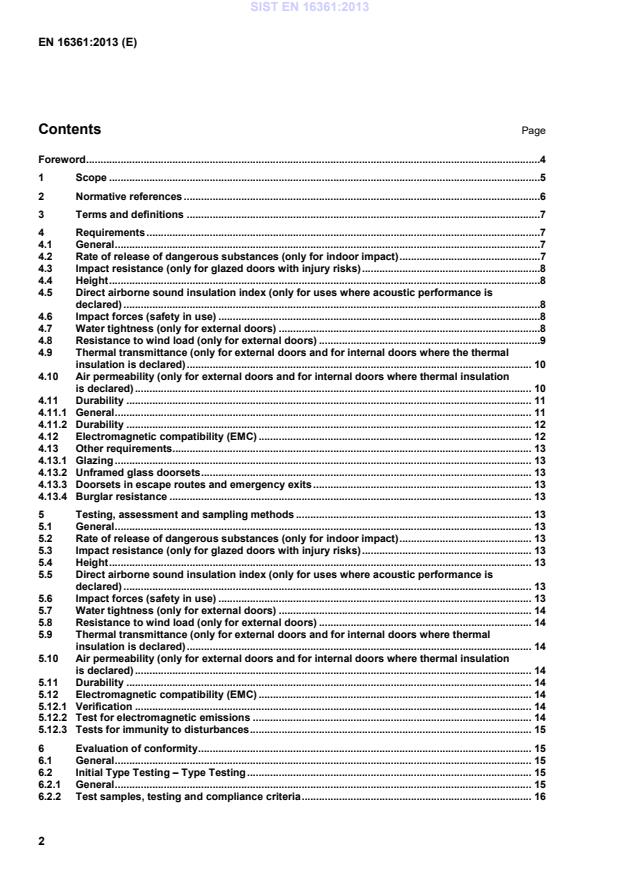
Standards and draft standards on glass . 24 Annex B (informative)
Summary of the characteristics . 25 B.1 Summary of the characteristics of power operated pedestrian doorsets, other than swing type, initially designed for installation with power operation without resistance to fire and smoke leakage characteristics . 25 Annex C (informative)
Handling, installation, maintenance and care . 27 Annex D (informative)
Summary of classification of characteristics . 28 Annex ZA (informative)
Clauses of this European Standard addressing the provisions of the EU Construction Products Directive . 32 ZA.1 Scope and relevant characteristics . 32 ZA.2 Procedure for the attestation of conformity of power operated doorsets, other than swing type, initially designed for installation with power operation without resistance to fire and smoke leakage characteristics . 36 ZA.2.1 System(s) of attestation of conformity. 36 ZA.2.2 EC Certificate and Declaration of conformity . 38 ZA.3 CE marking and labelling . 39 Annex ZB (informative)
Relationship between this European Standard and the Essential Requirements of the EMC Directive . 43 Bibliography . 44
integral fanlights, if any; NOTE 1 A fanlight is a panel over a door which is part of the doorset. side panels that are contained within a single frame for inclusion in a single aperture, if any. The intended uses of the products covered by this European Standard are: doorsets for external use in escape routes and other declared specific uses and/or uses subject to other specific requirements, in particular noise, energy, tightness and safety-in-use in construction works; doorsets for internal use in escape routes, communication and other declared specific uses and/or uses subject to other specific requirements, in particular noise and safety-in-use in construction works; doorsets for internal use in escape routes, communication and other declared specific uses and/or uses subject to other specific requirements, in particular noise, energy and safety-in-use in construction works. The products covered by this European Standard are not assessed for structural applications of the building. This European Standard does not cover operation in environments where the electromagnetic disturbances
are outside the range of those specified in EN 61000-6-2. This European Standard does not apply to: external pedestrian doorsets according to EN 14351-1; internal pedestrian doorsets according to prEN 14351-2; fire resistant and/or smoke control doorsets according to prEN 16034; industrial, commercial and garage doors and gates according to EN 13241-1; lifts doorsets; vehicles doorsets; doorsets used in industrial processes; doorsets in partition walls; doorsets outside the reach of people (such as crane gantry fences); turnstiles; SIST EN 16361:2013
4.2 Rate of release of dangerous substances (only for indoor impact) This test is applicable to all the intended uses of the products covered by this European Standard. National regulations on dangerous substances may require verification and declaration on release, and sometimes content, when construction products covered by this standard are placed on those markets. SIST EN 16361:2013
NOTE The height can be diminished due to projecting hardware and angle of opening. 4.5 Direct airborne sound insulation index (only for uses where acoustic performance is declared) The direct airborne sound insulation index is the ability of a doorset to protect an ambient from the noise coming from another one. This test is applicable to all the intended uses of the products covered by this European Standard when the acoustic performance is declared. The direct airborne sound insulation index, when declared, shall be determined in accordance with EN ISO 10140-2 (reference method). The test results shall be evaluated and expressed in accordance with EN ISO 717-1. 4.6 Impact forces (safety in use) Impact forces are the forces a user could be subject to when getting in contact with a moving door leaf. This test is applicable to all the intended uses of the products covered by this European Standard. Impact forces exerted by the door leaf of power operated doorsets, other than swing type, initially designed for installation with power operation without resistance to fire and smoke leakage characteristics, where crushing or impact hazards are safeguarded by limitation of forces, shall be in accordance with EN 16005:2012, 4.6.7. 4.7 Water tightness (only for external doors) Water tightness is the ability of a closed doorset to reduce penetration of water in the environment where the doorset is installed. SIST EN 16361:2013
The test shall be carried out in accordance with EN 1027:2000 with the following additions and modifications: Clause 1: Addition: revolving doorsets need not be fully assembled but shall include the relevant parts of the doorset for the test, e.g. night shield; Subclause 6.1: Addition: the test sample need not be fully functional but shall include the relevant parts of the doorset for the test, e.g. night shield for revolving doorset; Subclause 7.1: Modification: the minimum test pressure of 500 Pa is not required. The results shall be expressed in accordance with EN 12208:1999 with the following additions and modifications: Clause 4: Addition: water penetration through the gap between floor level and the door leaf shall not be considered for classification of the doorset; Clause 4, Table 1: Modification: classes are limited to 0 to 5A, 0 to 5B and Exxx for Pmax > 200 Pa. The test for water tightness of side panels shall be carried out on the side panel or on its individual parts. In the latter case, the designation of the side panel shall be determined by the part(s) with the most unfavourable performance. NOTE Installation of a weather shield or similar can reduce the need for water tightness of the doorset. 4.8 Resistance to wind load (only for external doors) Resistance to wind load is the ability of a closed doorset to withstand the load of the wind in the environment where the doorset is installed. This test is only applicable to doorsets for external use. Tests shall be carried out in accordance with EN 12211:2000 with the following modifications: Subclause 6.1: the test sample need not be fully functional but shall include the relevant parts of the doorset for the test, e.g. night shield for revolving doorset;
Subclause 7.1: the air permeability test according to EN 1026 (P1 and P2) shall not be performed; Subclause 7.3: the number of cycles shall be 20 and the air permeability test according to EN 1026 shall not be repeated. The deflection of frame elements (e.g. transoms and mullions) shall be determined by calculation or by test (reference method). The results shall be expressed in accordance with EN 12210:1999 with the following modifications: Clause 4: Table 1 is modified as follows: SIST EN 16361:2013
a This pressure is repeated 20 times. b xxxx is the actual test pressure P1 (e.g. 350, etc.).
Subclause 6.1: the air permeability requirement (after the P1 and P2 tests) is not applicable. When appropriate European Standards are in place, the determination of the load-bearing capacity should be carried out as prescribed in those European Standards. 4.9 Thermal transmittance (only for external doors and for internal doors where the thermal insulation is declared) Thermal transmittance is the ability of a doorset to avoid the temperature of an ambient is influenced by the temperature of another ambient next to it. The test is only applicable to doorsets for external use and to doorsets for internal use where thermal insulation is declared and shall be determined: a) by calculation using: 1) EN ISO 10077-1; or 2) EN ISO 10077-1 and EN ISO 10077-2. Calculation previously performed in accordance with EN ISO 10077-1 and tabulated values in accordance with EN ISO 10077-1:2006, Table F.1, may be taken into account with an addition of 0,1 W/m2K. or b) by hot box method using EN ISO 12567-1. The collective symbols for thermal transmittance is UD, i.e. the symbol Ust used in EN ISO 12567-1 is equivalent to UD. 4.10 Air permeability (only for external doors and for internal doors where thermal insulation is declared) Air permeability is the ability of a doorset to reduce unwanted air exchange between two ambients at different temperature. The test is only applicable to doorsets for external use and to doorsets for internal use where thermal insulation is declared. This test shall only be performed when thermal performance of the doorset is declared. Two air permeability tests shall be carried out in accordance with EN 1026 (reference method), one with positive test pressures and one with negative test pressures. SIST EN 16361:2013
32mhm× Maximum test pressure (Pa) PPD0 > 50 < 150 PPD1 50 150 PPD2 27 300 PPD(test pressure and measured air permeability) xxx
Table 3 — Reference air permeabilities at 100 Pa and maximum test pressures, related to joints length, for classes 1 to 4 (EN 12207:1999, Table 2) Class Reference air permeability 100 Pa
mhm×3 Maximum test pressure (Pa) PPD0 > 12,5 < 150 PPD 1 12,5 150 PPD 2 6,75 300 PPD(test pressure and measured air permeability) xxx
4.11 Durability 4.11.1 General The manufacturer shall provide information about maintenance and the replaceable parts. By means of adequate choice of materials (including coatings, preservations, composition and thickness), components and assembly methods, the manufacturer shall ensure the durability of his product(s) for an economically reasonable working life taking into account his published maintenance recommendations. NOTE The durability of power operated doorsets, other than swing type, initially designed for installation with power operation without resistance to fire and smoke leakage characteristics depends on the long-term performance of the individual components and materials as well as the assembly of the product and its maintenance. Specifications and classifications for individual materials and components can be found in their respective material and component standards. SIST EN 16361:2013
impact forces (safety in use): The durability against aging/degradation of this characteristic shall be tested according to EN 16005:2012, 5.8. The results shall be expressed according to the following classes: Class PPD1: 200 000 cycles
Class PPD2: 500 000 cycles Class PPD3: 1 000 000 cycles Class PPD(number of cycles performed): > 1 000 000 cycles After the durability test the impact forces test is repeated and the result shall be in accordance with 4.6.
4.12 Electromagnetic compatibility (EMC) Power operated pedestrian doorsets, other than swing type, initially designed for installation with power operation without resistance to fire and smoke leakage characteristics in accordance with this standard shall be designed so that they do not emit any harmful electromagnetic emissions when installed and are not adversely affected by electromagnetic emissions. Power operated doorsets shall satisfy the requirements of EN 61000-6-2 (for immunity to disturbances) and EN 61000-6-3 (for electromagnetic emissions). Measured values of the electromagnetic emission shall be within the limits specified in EN 61000-6-3. Compliance criteria of the immunity to disturbances shall be as specified in EN 61000-6-2 and, in addition, the following assessment criteria apply: Criterion A: The tests for electromagnetic compatibility do not affect any of the doorset functions; Criterion B: The tests for electromagnetic compatibility does not result in: speed in excess of 20 % of the specified performance; unexpected start of the movement; inhibition of operation of safety/interlocking devices; reduction in fault detection capability.
Criterion B is the minimum requirement for the immunity to disturbances of power operated pedestrian doorsets, other than swing type, initially designed for installation with power operation without resistance to fire and smoke leakage characteristics in accordance with this European Standard. SIST EN 16361:2013
The manufacturer shall always retain the overall control and shall have the necessary means to take responsibility for the product. 6.2 Initial Type Testing – Type Testing 6.2.1 General Initial Type Testing and Type Testing shall be performed to demonstrate compliance with this European Standard. All essential characteristics for which the manufacturer declares performances, are subject to Initial Type Testing. In addition, the need to perform Type Tests applies to all other characteristics included in a standard when the manufacturer claims compliance, unless the standard gives provisions (e.g. use of previously existing data, CWFT and conventionally accepted performance) for declaring performances without performing tests. Tests previously performed in accordance with the provisions of this European Standard, may be taken into account provided that they were made to the same or a more rigorous test method, under the same system of attestation of conformity on the same product or products of similar design, construction and functionality, such that the results are applicable to the product in question. NOTE 1 "Same system of attestation of conformity" means testing by an independent third party and, only for products covered by attestation of conformity system 1, under the responsibility of a product certification body. For the purposes of testing, the manufacturer’s products may be grouped into families, where it is considered that the results for one or more characteristics from any one product within the family are representative for that same characteristics for all products within that same family (a product may be in different families for different characteristics). NOTE 2 Products can be in different families for different characteristics. Reference to the test method standards should be made to allow the selection of a suitable representative sample. In addition, Type Tests or Initial Type Testing shall be performed for all characteristics included in the standard for which the manufacturer declares performances: at the beginning of the production of a new or modified power operated pedestrian doorset, other than swing type, initially designed for installation with power operation without resistance to fire and smoke leakage characteristics (unless a member of the same family); or SIST EN 16361:2013
...