

EN 13216-1:2004
(Main)Chimneys - Test methods for system chimneys - Part 1: General test methods
- Abstract
This document specifies material-independent general test methods for system chimneys.
- Status
- Withdrawn
- Publication Date
- 31-Aug-2004
- Withdrawal Date
- 06-Oct-2026
- Technical Committee
- CEN/TC 166 - Chimneys
- Drafting Committee
- CEN/TC 166/WG 1 - General requirements
- Current Stage
- 9960 - Withdrawal effective - Withdrawal
- Start Date
- 17-Apr-2019
- Completion Date
- 07-Oct-2026



Relations
- Replaced By
EN 13216-1:2019 - Chimneys - Test methods for system chimneys - Part 1: General test methods - Effective Date
- 18-Jun-2014
- Effective Date
- 09-Feb-2026
- Effective Date
- 28-Jan-2026
- Effective Date
- 28-Jan-2026
- Effective Date
- 28-Jan-2026
- Effective Date
- 10-Feb-2026
- Effective Date
- 28-Jan-2026
- Effective Date
- 28-Jan-2026
- Effective Date
- 28-Jan-2026
- Effective Date
- 28-Jan-2026
- Effective Date
- 28-Jan-2026
- Effective Date
- 28-Jan-2026
- Effective Date
- 28-Jan-2026
- Referred By
EN 14471:2005 - Chimneys - System chimneys with plastic flue liners - Requirements and test methods - Effective Date
- 28-Jan-2026
- Effective Date
- 28-Jan-2026
Get Certified
Connect with accredited certification bodies for this standard

DIBt (Deutsches Institut für Bautechnik)
German Institute for Building Technology.
DIN CERTCO
DIN Group product certification.

Aboma Certification B.V.
Specialized in construction, metal, and transport sectors.
Sponsored listings
Frequently Asked Questions
EN 13216-1:2004 is a standard published by the European Committee for Standardization (CEN). Its full title is "Chimneys - Test methods for system chimneys - Part 1: General test methods". This standard covers: This document specifies material-independent general test methods for system chimneys.
This document specifies material-independent general test methods for system chimneys.
EN 13216-1:2004 is classified under the following ICS (International Classification for Standards) categories: 91.060.40 - Chimneys, shafts, ducts. The ICS classification helps identify the subject area and facilitates finding related standards.
EN 13216-1:2004 has the following relationships with other standards: It is inter standard links to EN 13216-1:2019, EN 60529:1991, EN 10088-1:2023, EN 1443:2003, EN 13384-1:2015+A1:2019, EN 50465:2015, EN 14471:2013+A1:2015, EN 13063-2:2005+A1:2007, EN 13063-1:2005+A1:2007, EN 15502-2-1:2012+A1:2016, EN 17175:2019, EN 15502-2-1:2012, EN 13063-3:2007, EN 14471:2005, EN 416:2019. Understanding these relationships helps ensure you are using the most current and applicable version of the standard.
EN 13216-1:2004 is associated with the following European legislation: EU Directives/Regulations: 305/2011, 89/106/EEC; Standardization Mandates: M/105. When a standard is cited in the Official Journal of the European Union, products manufactured in conformity with it benefit from a presumption of conformity with the essential requirements of the corresponding EU directive or regulation.
EN 13216-1:2004 is available in PDF format for immediate download after purchase. The document can be added to your cart and obtained through the secure checkout process. Digital delivery ensures instant access to the complete standard document.
Standards Content (Sample)
2003-01.Slovenski inštitut za standardizacijo. Razmnoževanje celote ali delov tega standarda ni dovoljeno.PHWRGH7&Abgasanlagen - Prüfverfahren für System-Abgasanlagen - Teil 1: Allgemeine PrüfverfahrenConduits de fumée - Méthodes d'essai des conduits systemes de fumée - Partie 1: Méthodes d'essai généralesChimneys - Test methods for system chimneys - Part 1: General test methods91.060.40Dimniki, jaški, kanaliChimneys, shafts, ductsICS:Ta slovenski standard je istoveten z:EN 13216-1:2004SIST EN 13216-1:2004en,fr,de01-oktober-2004SIST EN 13216-1:2004SLOVENSKI
STANDARD
EUROPEAN STANDARDNORME EUROPÉENNEEUROPÄISCHE NORMEN 13216-1September 2004ICS 91.060.40 English versionChimneys - Test methods for system chimneys - Part 1: Generaltest methodsConduits de fumée - Méthodes d'essai pour les systèmesde conduits de fumée - Partie 1: Méthodes d'essaigénéralesAbgasanlagen - Prüfverfahren für System-Abgasanlagen -Teil 1: Allgemeine PrüfverfahrenThis European Standard was approved by CEN on 1 April 2004.CEN members are bound to comply with the CEN/CENELEC Internal Regulations which stipulate the conditions for giving this EuropeanStandard the status of a national standard without any alteration. Up-to-date lists and bibliographical references concerning such nationalstandards may be obtained on application to the Central Secretariat or to any CEN member.This European Standard exists in three official versions (English, French, German). A version in any other language made by translationunder the responsibility of a CEN member into its own language and notified to the Central Secretariat has the same status as the officialversions.CEN members are the national standards bodies of Austria, Belgium, Cyprus, Czech Republic, Denmark, Estonia, Finland, France,Germany, Greece, Hungary, Iceland, Ireland, Italy, Latvia, Lithuania, Luxembourg, Malta, Netherlands, Norway, Poland, Portugal, Slovakia,Slovenia, Spain, Sweden, Switzerland and United Kingdom.EUROPEAN COMMITTEE FOR STANDARDIZATIONCOMITÉ EUROPÉEN DE NORMALISATIONEUROPÄISCHES KOMITEE FÜR NORMUNGManagement Centre: rue de Stassart, 36
B-1050 Brussels© 2004 CENAll rights of exploitation in any form and by any means reservedworldwide for CEN national Members.Ref. No. EN 13216-1:2004: ESIST EN 13216-1:2004
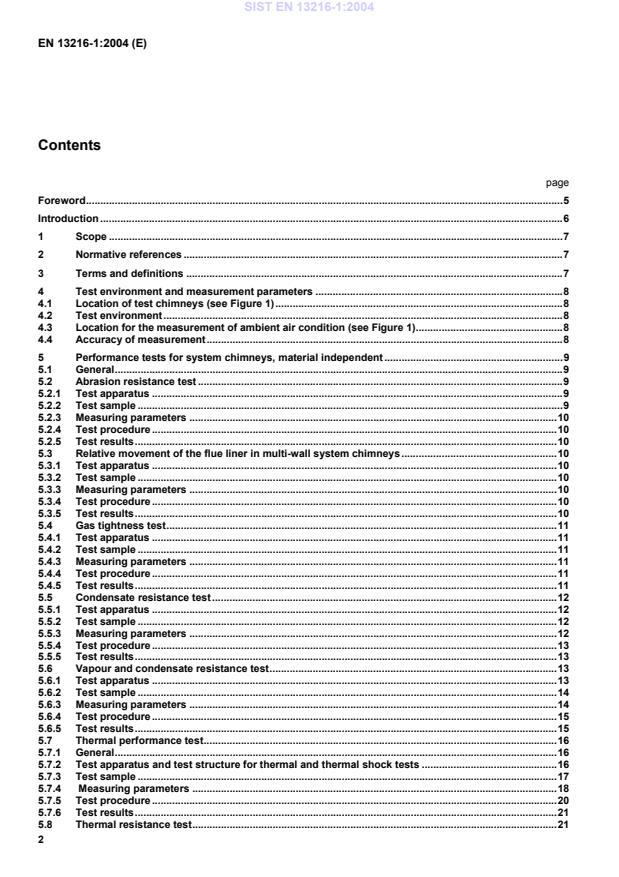
Measuring parameters.18 5.7.5 Test procedure.20 5.7.6 Test results.21 5.8 Thermal resistance test.21 SIST EN 13216-1:2004
Recommended test sequence.52 Annex B (normative)
Calculation method to predict condensation in multi-wall chimneys for different ambient air temperatures others than the test ambient air temperature.53 B.1 Dimensions of the chimney structure type.53 B.2 Calculation of the flue gas and inner wall temperatures.53 B.2.1 Calculation without taking account of condensation heat.53 B.2.2 Calculation with taking account of condensation heat.53 B.3 Calculation of layer temperatures.53 B.4 Thermal resistance, test chimney.54 B.5 Multi-wall chimney, back ventilated.54 B.5.1 General requirement.54 B.5.2 Removed moisture flow.54 B.5.3 Penetrating moisture flow.54 B.5.4 Maximum moisture flow.54 B.5.5 Layer temperatures.55 B.5.6 Calculation of the frictional and form resistance of the ventilation ducts, from a test chimney.55 B.5.7 Moisture flow at test chimney.55 B.5.8 Expression of results.55 B.6 Multi-wall chimneys without back-ventilation, designated W.55 B.6.1 General requirement.55 B.6.2 Partial pressures.55 B.6.3 Variations in partial pressure in critical planes.55 B.6.4 Penetrating moisture flow.55 B.6.5 Condensation water penetration.56 B.6.6 Layer temperatures.56 SIST EN 13216-1:2004
Methods of determining the effects of extract and air supply provisions.57 Annex D (normative)
Method of measuring the hot gas temperature.58 Annex E (informative)
Hot gas mass flow, heat capacity of the flue gas, example of air velocity for natural gas combustion.59 Annex F (informative)
Example of a test report.65 Bibliography.66
Introduction CEN/TC 166 intends to publish the test methods for system chimneys as separate parts of a series of standards. The first part of the series of EN 13216 includes material-independent test methods for system chimneys. For the purpose of this document, system chimneys are considered as kits in the meaning of Guidance Paper C (see Bibliography). Further parts of the multi-part standard include material-specific test methods, each material used for the inner wall being decisive. The material-specific test methods are based on the general material-independent test methods. Considering the various characteristics, the material tests can be carried out on deviating specimens or can include other test procedures which however have correlation to those given in this standard. It is intended to prepare further parts if further material-specific standards are published. SIST EN 13216-1:2004
5.2.3 Measuring parameters Measure the weight of material dislodged from the inner surface of the test assembly after 100 cycles with an accuracy of 1,0 g. The area for the inner surface of the test sample, exposed to abrasion shall be calculated. 5.2.4 Test procedure The brush shall be pushed down and up through the total length of the test sample with a maximum speed of 2 m/s and this represents one cycle. A test number of 100 cycles shall be completed. Record the weight of material dislodged and the dimensions of the inner surface. 5.2.5 Test results The recorded mass of material abraded from the inner surface of the test sample over 100 sweeping cycles shall be expressed in terms of kilograms per square meter of the total exposed area of the inner surface of the flue. 5.3 Relative movement of the flue liner in multi-wall system chimneys 5.3.1 Test apparatus A test apparatus which allows the measurement of deviations in the differential movement between the flue liner and the outer wall of multi-wall-system chimneys. The accuracy shall be ± 0,001 m. 5.3.2 Test sample The test sample shall be the test chimney used for the thermal performance tests, thermally conditioned according to the designation given in EN 1443. The test sample shall be assembled as specified in product standards. When the manufacturer claims for an opening, it shall be installed in Zone C (see Figure 1). 5.3.3 Measuring parameters Measure the surface temperature of the test chimney according to 5.7. Measure the change in position of the flue liner relative to the outer wall at the top of the test sample before and after the thermal performance tests. 5.3.4 Test procedure All measurements shall be made before and after the thermal performance test appropriate to the designation. Record the difference in length between the flue liner and the outer wall when all thermocouples have reached ambient air temperature within 5 °C. 5.3.5 Test results The results are expressed by the change in position of the flue liner relative to the outer wall after the test sample has cooled down to room temperature. SIST EN 13216-1:2004
5.4 Gas tightness test 5.4.1 Test apparatus Provide an air supply capable of delivering air at a rate sufficient to achieve and maintain the required test pressure at the leakage rate appropriate to the designation. Seal the flue inlet and the flue outlet of the test chimney with an air tight seal in a typical manner (see Figure 5). For measurement of pressure use: for chimneys designated N a device with the pressure to an accuracy of ± 1 Pa; for chimneys designated P a device with the pressure to an accuracy of ± 5 Pa; for chimneys designated H a device with the pressure to an accuracy of ± 50 Pa. For measurement of the gas leakage for negative and for positive pressure chimneys in accordance with EN 1443 use a device with an accuracy of ± 5 %. 5.4.2 Test sample The test sample shall be the test chimney used for the thermal performance tests, thermally conditioned according to the designation given in EN 1443. The test sample shall be assembled as specified in system chimney standards, (i.e. with an opening where appropriate) (see Figure 5). Where the products are not required to be thermally conditioned, the test sample (i.e. with an opening where appropriate) shall consist of at least two chimney sections or fittings with one joint where applicable. 5.4.3 Measuring parameters Measure and record: gas leakage and the pressure maintained during the test in accordance with EN 1443; inner dimensions of the test sample. Calculate the inner surface area. Record the air flow rate, the pressure and the inner dimensions of the test sample. 5.4.4 Test procedure Deliver air from the air supply to the flue at a rate necessary to achieve and maintain the required test pressure given in EN 1443. Measure the gas leakage at ambient temperature. Subject the test sample to thermal conditions appropriate to the designation or as stated in the product standards. Measure the gas leakage again at ambient temperature. 5.4.5 Test results The results are expressed by the leakage rate related to the inner surface area of the test sample. SIST EN 13216-1:2004
0,008 m3⋅h-1⋅m-1) during 4 h or until water appears on the outside of the test sample. Dry and weigh the test samples. When components of the test chimney are weighed, they have to be dried and then re-weighed. Record: spray temperature and the spray volume; detection of (coloured) water outside of fittings or chimney sections; change in weight of the test sample after spraying water in comparison to the dried sample. 5.5.5 Test results Record: location of any appearance of water on the outside of any fitting or chimney section of the test samples, and any change in weight of the test sample or components. 5.6 Vapour and condensate resistance test 5.6.1 Test apparatus A test apparatus which allows to deliver water vapour saturated air at a temperature of 52 °C ± 2 °C and a velocity of 1 m/s ± 0,2 m/s, consisting of a fan, a heater, a vapour steam vessel, and a flow rectifier (see Figure 7). Use a measurement equipment: for flue gas temperature with an accuracy of ± 1,5 °C, for layer temperature with an accuracy of ± 0,5 °C and for humidity with an accuracy of ± 2 % in the range of 0 % to 80 % and of ± 3 % in the range of 80 % to 100 %. The balance to weigh components of the test sample shall have an accuracy of ± 1 g up to 10 kg and ± 2 g for more than 10 kg. The balance shall be capable of weighing at least two flue liners or two chimney sections. For measurement of chimney draught use a device with an accuracy of ± 1 Pa. For measurement of flue gas velocity use a device with an accuracy of ± 0,1 m/s. SIST EN 13216-1:2004
...