


EN 1677-5:2001+A1:2008
(Main)Components for slings - Safety - Part 5: Forged steel lifting hooks with latch - Grade 4
Components for slings - Safety - Part 5: Forged steel lifting hooks with latch - Grade 4
This Part of EN 1677 specifies requirements for forged steel lifting hooks of grade 4 having latch and eye up to 31,5 t WLL, mainly for use in:
- chain slings according to EN 818-5
- steel wire rope slings according to prEN 13414-1:1998
- textile slings according to EN 1492-1, EN 1492-2.
intended for lifting objects, materials or goods.
This Part of EN 1677 does not apply to hand forged hooks.
The hazards covered by this Part of EN 1677 are identified in clause 4.
Annex A gives the bases for calculation of hook dimensions.
Annex B gives an example of a designation system for hooks of grade 4.
Einzelteile für Anschlagmittel - Sicherheit - Teil 5: Geschmiedete Haken mit Sicherungsklappe - Güteklasse 4
Dieser Teil von EN 1677 legt Anforderungen für geschmiedete Ösenhaken der Güteklasse 4 im Bereich bis 31,5 t Tragfähigkeit fest, die hauptsächlich Verwendung finden in:
Anschlagketten nach EN 818-5,
Anschlagseilen aus Stahldrahtseilen nach EN 13414-1 und
textilen Anschlagmitteln nach EN 1492-1 und EN 1492-2,
die zum Heben von Gegenständen, Materialien und Gütern vorgesehen sind.
Dieser Teil von EN 1677 gilt nicht für handgeschmiedete Haken.
Die Gefährdungen, die durch diesen Teil von EN 1677 abgedeckt werden, sind in Abschnitt 4 aufgeführt.
Anhang A enthält Grundlagen für die Berechnung der Hakenmaße.
Anhang B enthält ein Beispiel eines Bezeichnungssystems für Haken der Güteklasse 4.
Accessoires pour élingues - Sécurité - Partie 5: Crochets de levage en acier forgé à linguet - Classe 4
La présente partie de l'EN 1677 spécifie les prescriptions requises pour les crochets en acier forgé de classe 4 avec
linguet et oeil, de charge maximale d'utilisation inférieure ou égale à 31,5 tonnes, principalement utilisés avec :
- des élingues en chaînes selon l'EN 818-5 ;
- des élingues en câbles d'acier selon !l’EN 13414-1+A2:2008" ;
- des élingues textiles selon les EN 1492-1 et EN 1492-2.
prévues pour le levage d'objets, de matériels ou de marchandises.
La présente norme européenne ne s'applique pas aux crochets forgés à la main.
Les risques couverts par la présente partie de l'EN 1677 sont identifiés dans l'article 4.
L'annexe A indique les méthodes de calcul des dimensions des crochets.
L'annexe B donne un exemple de système de désignation des crochets de classe 4.
Sestavni deli obes - Varnost - 5. del: Kovani kavlji z varovalom - Kakovostni razred 4
General Information
- Status
- Published
- Publication Date
- 11-Nov-2008
- Technical Committee
- CEN/TC 168 - Chains, ropes, webbing, slings and accessories - safaty
- Drafting Committee
- CEN/TC 168/WG 4 - Hooks and other accessories
- Current Stage
- 9093 - Decision to confirm - Review Enquiry
- Start Date
- 17-Oct-2022
- Completion Date
- 14-Apr-2025
- Directive
- 98/37/EC - Machinery
Relations
- Effective Date
- 19-Jan-2023
Overview
EN 1677-5:2001+A1:2008 is a CEN safety standard for forged steel lifting hooks with latch – Grade 4. It specifies design, material, manufacturing, testing and marking requirements for forged hooks with an eye and spring-loaded latch, rated up to 31.5 t WLL (working load limit). The standard is intended primarily for hooks used in chain slings (EN 818-5), steel wire rope slings (prEN 13414-1:1998) and textile slings (EN 1492-1 / EN 1492-2). Hand-forged hooks are excluded.
Key topics and technical requirements
- Scope and hazards: Identifies hazards addressed (clause 4) including accidental release, incorrect fit and handling risks; references risk assessment principles (EN 1050 / EN 292).
- Design & dimensions: Eye-type upper end to ensure articulation; dimensional relationships tied to WLL; key dimension rules include point height B ≥ throat opening O and O ≤ 95% of seat diameter D; latch must close over maximum bar diameter for the throat opening.
- Materials & heat treatment: Steel must be produced by electric or oxygen process, fully killed and stabilized against strain-age embrittlement; minimum aluminium content (≥ 0.025 %) required. Chemical limits: sulfur and phosphorus ≤ 0.025% (cast) / ≤ 0.03% (check analysis). Silicon: 0.12–0.30% (cast) / 0.15–0.35% (check).
- Manufacturing & workmanship: Requirements for forging, heat treatment and surface finish to avoid cutting/abrasion hazards.
- Mechanical properties & testing: Defines mechanical property requirements and tests - type tests, manufacturing proof tests (MPF), static tensile/breaking force (BF) tests and lot acceptance criteria.
- Hook latches: Spring-loaded latch requirements and torque guidance for latch testing.
- Traceability, marking & documentation: Marking, manufacturer’s certificate, designation system (Annex B) and instructions for use are required to ensure correct selection and safe use.
- Informative annexes: Annex A gives calculation bases for hook dimensions; Annex B gives an example designation system. Annexes ZA/ZB relate the standard to EU Machinery Directive requirements.
Applications and users
Who uses EN 1677-5:
- Manufacturers of forged lifting hooks and sling accessories
- Sling assemblers and rigging equipment OEMs
- Lifting equipment designers and procurement/specification teams
- Safety managers, inspectors and test laboratories performing conformity and type testing
- Certification and conformity assessment bodies
Practical applications:
- Specifying compliant Grade 4 hooks for chain, wire rope or textile slings
- Ensuring correct hook fit, strength and traceability for lifting operations
- Supporting conformity with EU Machinery Directive when used in lifting assemblies
Related standards
- EN 1677 (other parts: Parts 1, 2, 3, 4, 6)
- EN 818-5 (chain slings)
- prEN 13414-1 (wire rope slings)
- EN 1492-1 / EN 1492-2 (textile slings)
- EN 292 / EN 1050 (safety and risk assessment)
- EN 10025 (steel delivery conditions)
Keywords: EN 1677-5, forged steel lifting hooks, Grade 4, WLL, latch, chain slings, wire rope slings, textile slings, CEN safety standard, hook dimensions, manufacturing proof test, traceability.



Frequently Asked Questions
EN 1677-5:2001+A1:2008 is a standard published by the European Committee for Standardization (CEN). Its full title is "Components for slings - Safety - Part 5: Forged steel lifting hooks with latch - Grade 4". This standard covers: This Part of EN 1677 specifies requirements for forged steel lifting hooks of grade 4 having latch and eye up to 31,5 t WLL, mainly for use in: - chain slings according to EN 818-5 - steel wire rope slings according to prEN 13414-1:1998 - textile slings according to EN 1492-1, EN 1492-2. intended for lifting objects, materials or goods. This Part of EN 1677 does not apply to hand forged hooks. The hazards covered by this Part of EN 1677 are identified in clause 4. Annex A gives the bases for calculation of hook dimensions. Annex B gives an example of a designation system for hooks of grade 4.
This Part of EN 1677 specifies requirements for forged steel lifting hooks of grade 4 having latch and eye up to 31,5 t WLL, mainly for use in: - chain slings according to EN 818-5 - steel wire rope slings according to prEN 13414-1:1998 - textile slings according to EN 1492-1, EN 1492-2. intended for lifting objects, materials or goods. This Part of EN 1677 does not apply to hand forged hooks. The hazards covered by this Part of EN 1677 are identified in clause 4. Annex A gives the bases for calculation of hook dimensions. Annex B gives an example of a designation system for hooks of grade 4.
EN 1677-5:2001+A1:2008 is classified under the following ICS (International Classification for Standards) categories: 53.020.30 - Accessories for lifting equipment. The ICS classification helps identify the subject area and facilitates finding related standards.
EN 1677-5:2001+A1:2008 has the following relationships with other standards: It is inter standard links to EN 1677-5:2001. Understanding these relationships helps ensure you are using the most current and applicable version of the standard.
EN 1677-5:2001+A1:2008 is associated with the following European legislation: EU Directives/Regulations: 2006/42/EC, 98/37/EC; Standardization Mandates: M/396. When a standard is cited in the Official Journal of the European Union, products manufactured in conformity with it benefit from a presumption of conformity with the essential requirements of the corresponding EU directive or regulation.
You can purchase EN 1677-5:2001+A1:2008 directly from iTeh Standards. The document is available in PDF format and is delivered instantly after payment. Add the standard to your cart and complete the secure checkout process. iTeh Standards is an authorized distributor of CEN standards.
Standards Content (Sample)
2003-01.Slovenski inštitut za standardizacijo. Razmnoževanje celote ali delov tega standarda ni dovoljeno.Sestavni deli obes - Varnost - 5. del: Kovani kavlji z varovalom - Kakovostni razred 4Einzelteile für Anschlagmittel - Sicherheit - Teil 5: Geschmiedete Haken mit Sicherungsklappe - Güteklasse 4Accessoires pour élingues - Sécurité - Partie 5: Crochets de levage en acier forgé à linguet - Classe 4Components for slings - Safety - Part 5: Forged steel lifting hooks with latch - Grade 453.020.30Pribor za dvigalno opremoAccessories for lifting equipmentICS:Ta slovenski standard je istoveten z:EN 1677-5:2001+A1:2008SIST EN 1677-5:2001+A1:2009en,fr,de01-januar-2009SIST EN 1677-5:2001+A1:2009SLOVENSKI
STANDARD
EUROPEAN STANDARD NORME EUROPÉENNE EUROPÄISCHE NORM
EN 1677-5:2001+A1
November 2008 ICS 53.020.30 Supersedes EN 1677-5:2001 English Version
Components for slings - Safety - Part 5: Forged steel lifting hooks with latch - Grade 4
Accessoires pour élingues - Sécurité - Partie 5: Crochets de levage en acier forgé à linguet - Classe 4
Einzelteile für Anschlagmittel - Sicherheit - Teil 5: Geschmiedete Haken mit Sicherungsklappe - Güteklasse 4This European Standard was approved by CEN on 18 February 2001 and includes Amendment 1 approved by CEN on 9 September 2008. CEN members are bound to comply with the CEN/CENELEC Internal Regulations which stipulate the conditions for giving this European Standard the status of a national standard without any alteration. Up-to-date lists and bibliographical references concerning such national standards may be obtained on application to the CEN Management Centre or to any CEN member.
This European Standard exists in three official versions (English, French, German). A version in any other language made by translation under the responsibility of a CEN member into its own language and notified to the CEN Management Centre has the same status as the official versions.
CEN members are the national standards bodies of Austria, Belgium, Bulgaria, Cyprus, Czech Republic, Denmark, Estonia, Finland, France, Germany, Greece, Hungary, Iceland, Ireland, Italy, Latvia, Lithuania, Luxembourg, Malta, Netherlands, Norway, Poland, Portugal, Romania, Slovakia, Slovenia, Spain, Sweden, Switzerland and United Kingdom.
EUROPEAN COMMITTEE FOR STANDARDIZATION
COMITÉ EUROPÉEN DE NORMALISATION EUROPÄISCHES KOMITEE FÜR NORMUNG
Management Centre: rue de Stassart, 36
B-1050 Brussels © 2008 CEN All rights of exploitation in any form and by any means reserved worldwide for CEN national Members. Ref. No. EN 1677-5:2001+A1:2008: ESIST EN 1677-5:2001+A1:2009
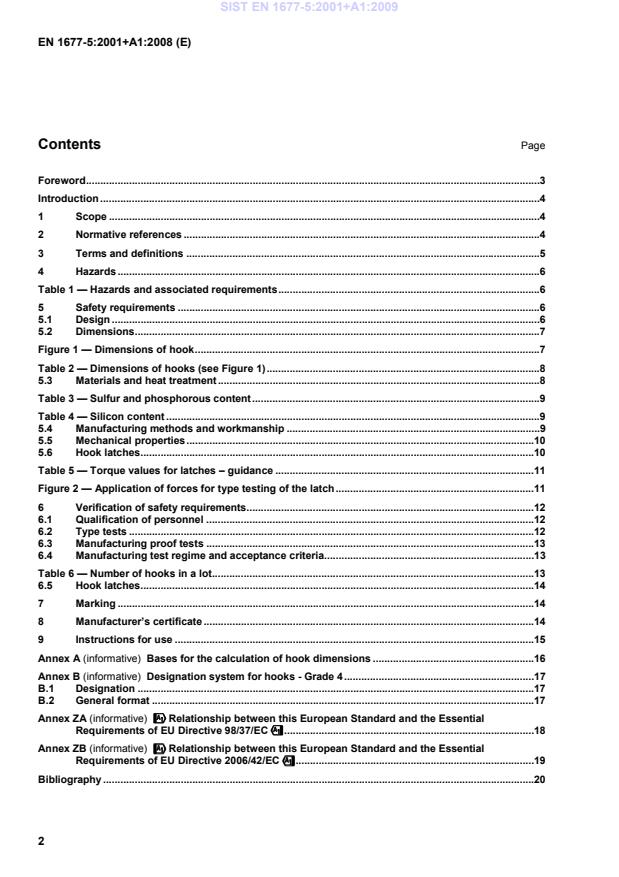
Bases for the calculation of hook dimensions.16 Annex B (informative)
Designation system for hooks - Grade 4.17 B.1 Designation.17 B.2 General format.17 Annex ZA (informative)
!!!!Relationship between this European Standard and the Essential Requirements of EU Directive 98/37/EC"""".18 Annex ZB (informative)
!!!!Relationship between this European Standard and the Essential Requirements of EU Directive 2006/42/EC"""".19 Bibliography.20
The other Parts of EN 1677 for components for slings are:
Part 1: Forged steel components - Grade 8 Part 2: Forged steel lifting hooks with latch - Grade 8 Part 3: Forged steel self-locking hooks - Grade 8 Part 4: Links - Grade 8 Part 6: Links - Grade 4
Annexes A and B of this European Standard are informative.
According to the CEN/CENELEC Internal Regulations, the national standards organizations of the following countries are bound to implement this European Standard: Austria, Belgium, Bulgaria, Cyprus, Czech Republic, Denmark, Estonia, Finland, France, Germany, Greece, Hungary, Iceland, Ireland, Italy, Latvia, Lithuania, Luxembourg, Malta, Netherlands, Norway, Poland, Portugal, Romania, Slovakia, Slovenia, Spain, Sweden, Switzerland and United Kingdom.
Part 2: Round slings made of man-made fibres EN 10002-2:1991, Metallic materials - Tensile testing - Part 2: Verification of the force measuring system of the tensile testing machines EN 10025:1990+A1:1993, Hot rolled products of non-alloy structural steels - Technical delivery - conditions prEN 13414-1:1998, Steel wire ropes for slings – Safety - Part 1: Wire rope slings EN 45012, General requirements for bodies operating assessment and certification/registration of quality systems (ISO/IEC Guide 62:1996) EN ISO 9002:1994, Quality systems - Model for quality assurance in production, installation and servicing ISO 643:1983, Steels - Micrographic determination of the ferritic or austenitic grain size 3 Terms and definitions For the purposes of this Part of EN 1677, the following terms and definitions apply. 3.1
working load limit (WLL) maximum mass that a hook is authorized to sustain in general lifting service, expressed as a code
NOTE This term has the same meaning as the term maximum working load used in annex A of EN 292-2:1991/A1:1995. 3.2
manufacturing proof force (MPF) force applied to the hook during the manufacturing proof test
3.3
breaking force (BF) maximum force reached during the static tensile test of the hook, at which the hook fails to retain the load
3.4
traceability code series of letters and/or numbers marked on a hook that enables its manufacturing history, including the identity of the cast of steel used, to be traced
3.5
competent person designated person, suitably trained, qualified by knowledge and practical experience, and with the necessary instruction to enable the required test and examination to be carried out
NOTE 4.18 of EN ISO 9002:1994 gives guidance on training.
3.6
lot specified number of hooks from which samples are selected for testing purposes, and that have been manufactured from the same cast of steel and subjected to the same heat treatment process
hazard due to 4.1.2.3 5
inadequacy of 4.1.2.5 5
strength 4.2.4 5
1.7.3 7 1.3 Cutting hazard 1.3.4 5.4 1.8 Friction or abrasion hazard 1.3.4 5.4 15 Errors of fitting hazard 1.5.4 5.2 17 Falling objects hazard 1.3.3 5.6
5 Safety requirements 5.1 Design The form of the upper end shall be of the eye type as indicated in Figure 1. The dimensions shall be such as to ensure articulation so that the force imposed is transmitted in the intended direction. SIST EN 1677-5:2001+A1:2009
...
Questions, Comments and Discussion
Ask us and Technical Secretary will try to provide an answer. You can facilitate discussion about the standard in here.
Loading comments...