

EN 12044:2005
(Main)Footwear, leather and imitation leather goods manufacturing machines - Cutting and punching machines - Safety requirements
- Abstract
1.1 This European Standard specifies safety requirements for design and operation of the machines defined in 1.2.
It takes account of intended use, foreseeable misuse, component and system failure.
1.2 This European Standard applies for cutting and punching machines used in the manufacture of footwear, leather and imitation leather goods and other related components. This European Standard applies to the following cutting and punching machines:
swing arm cutting presses with manual or powered swing arm;
manual and automatic travelling head cutting presses with powered travelling head;
manual and automatic beam cutting presses;
punching and perforating presses;
C-frame cutting presses.
1.3 This European Standard is not applicable to:
mechanical presses;
presses intended for working cold metal;
fastening, riveting, stitching, stapling, bending or folding machines;
guillotines, shears and similar machines;
shoe and leather presses as described in EN 12203.
1.4 This European Standard deals with all significant hazards, hazardous situations and events relevant to the footwear, leather and imitation leather goods manufacturing machinery, when it is used as intended and under the conditions foreseen by the manufacturer (see Clause 4) and is intended for operation in applications by trained persons.
1.5 This European Standard deals with material feeding and handling devices, when attached to the machine.
1.6 This European Standard is not applicable to the machines which are manufactured before the date of publication of this European Standard by CEN.
- Status
- Withdrawn
- Publication Date
- 23-Aug-2005
- Withdrawal Date
- 11-Aug-2009
- Technical Committee
- CEN/TC 201 - Leather and imitation leather goods and footwear manufacturing machinery - Safety
- Drafting Committee
- CEN/TC 201/WG 1 - Cutting and punching machines
- Current Stage
- 9960 - Withdrawal effective - Withdrawal
- Start Date
- 12-Aug-2009
- Completion Date
- 12-Aug-2009
- Directive
- 98/37/EC - MachineryOJ Ref: C, C 336 OJ Date: 31-Dec-2005

Relations
- Effective Date
- 18-Jan-2023
- Effective Date
- 22-Dec-2008
Get Certified
Connect with accredited certification bodies for this standard

Control Union Certifications
Global certification for agriculture and sustainability.

Hohenstein Institut
Textile testing and certification.

Bureau Veritas Bangladesh
Bureau Veritas certification services in Bangladesh.
Sponsored listings
Frequently Asked Questions
EN 12044:2005 is a standard published by the European Committee for Standardization (CEN). Its full title is "Footwear, leather and imitation leather goods manufacturing machines - Cutting and punching machines - Safety requirements". This standard covers: 1.1 This European Standard specifies safety requirements for design and operation of the machines defined in 1.2. It takes account of intended use, foreseeable misuse, component and system failure. 1.2 This European Standard applies for cutting and punching machines used in the manufacture of footwear, leather and imitation leather goods and other related components. This European Standard applies to the following cutting and punching machines: swing arm cutting presses with manual or powered swing arm; manual and automatic travelling head cutting presses with powered travelling head; manual and automatic beam cutting presses; punching and perforating presses; C-frame cutting presses. 1.3 This European Standard is not applicable to: mechanical presses; presses intended for working cold metal; fastening, riveting, stitching, stapling, bending or folding machines; guillotines, shears and similar machines; shoe and leather presses as described in EN 12203. 1.4 This European Standard deals with all significant hazards, hazardous situations and events relevant to the footwear, leather and imitation leather goods manufacturing machinery, when it is used as intended and under the conditions foreseen by the manufacturer (see Clause 4) and is intended for operation in applications by trained persons. 1.5 This European Standard deals with material feeding and handling devices, when attached to the machine. 1.6 This European Standard is not applicable to the machines which are manufactured before the date of publication of this European Standard by CEN.
1.1 This European Standard specifies safety requirements for design and operation of the machines defined in 1.2. It takes account of intended use, foreseeable misuse, component and system failure. 1.2 This European Standard applies for cutting and punching machines used in the manufacture of footwear, leather and imitation leather goods and other related components. This European Standard applies to the following cutting and punching machines: swing arm cutting presses with manual or powered swing arm; manual and automatic travelling head cutting presses with powered travelling head; manual and automatic beam cutting presses; punching and perforating presses; C-frame cutting presses. 1.3 This European Standard is not applicable to: mechanical presses; presses intended for working cold metal; fastening, riveting, stitching, stapling, bending or folding machines; guillotines, shears and similar machines; shoe and leather presses as described in EN 12203. 1.4 This European Standard deals with all significant hazards, hazardous situations and events relevant to the footwear, leather and imitation leather goods manufacturing machinery, when it is used as intended and under the conditions foreseen by the manufacturer (see Clause 4) and is intended for operation in applications by trained persons. 1.5 This European Standard deals with material feeding and handling devices, when attached to the machine. 1.6 This European Standard is not applicable to the machines which are manufactured before the date of publication of this European Standard by CEN.
EN 12044:2005 is classified under the following ICS (International Classification for Standards) categories: 59.140.40 - Machines and equipment for leather and fur production; 61.060 - Footwear. The ICS classification helps identify the subject area and facilitates finding related standards.
EN 12044:2005 has the following relationships with other standards: It is inter standard links to EN 12044:2005+A1:2009, EN 12044:2005/AC:2006. Understanding these relationships helps ensure you are using the most current and applicable version of the standard.
EN 12044:2005 is associated with the following European legislation: EU Directives/Regulations: 98/37/EC; Standardization Mandates: M/BC/CEN/88/13. When a standard is cited in the Official Journal of the European Union, products manufactured in conformity with it benefit from a presumption of conformity with the essential requirements of the corresponding EU directive or regulation.
EN 12044:2005 is available in PDF format for immediate download after purchase. The document can be added to your cart and obtained through the secure checkout process. Digital delivery ensures instant access to the complete standard document.
Standards Content (Sample)
SLOVENSKI STANDARD
01-december-2005
Footwear, leather and imitation leather goods manufacturing machines - Cutting
and punching machines - Safety requirements
Footwear, leather and imitation leather goods manufacturing machines - Cutting and
punching machines - Safety requirements
Maschinen zur Herstellung von Schuhen, Leder- und Kunstlederwaren - Stanzmaschinen
- Sicherheitsanforderungen
Machines de fabrication de chaussures et articles en cuir et en matériaux similaires -
Machines de coupe et de poinconnage - Prescriptions de sécurité
Ta slovenski standard je istoveten z: EN 12044:2005
ICS:
59.140.40 Stroji in oprema za Machines and equipment for
proizvodnjo usnja in krzna leather and fur production
61.060 Obuvala Footwear
2003-01.Slovenski inštitut za standardizacijo. Razmnoževanje celote ali delov tega standarda ni dovoljeno.
EUROPEAN STANDARD
EN 12044
NORME EUROPÉENNE
EUROPÄISCHE NORM
August 2005
ICS 59.140.40; 61.060
English Version
Footwear, leather and imitation leather goods manufacturing
machines - Cutting and punching machines - Safety
requirements
Machines de fabrication de chaussures et articles en cuir et Maschinen zur Herstellung von Schuhen, Leder- und
en matériaux similaires - Machines de coupe et de Kunstlederwaren - Stanzmacschinen -
poinconnage - Prescriptions de sécurité Sicherheitsanforderungen
This European Standard was approved by CEN on 17 June 2005.
CEN members are bound to comply with the CEN/CENELEC Internal Regulations which stipulate the conditions for giving this European
Standard the status of a national standard without any alteration. Up-to-date lists and bibliographical references concerning such national
standards may be obtained on application to the Central Secretariat or to any CEN member.
This European Standard exists in three official versions (English, French, German). A version in any other language made by translation
under the responsibility of a CEN member into its own language and notified to the Central Secretariat has the same status as the official
versions.
CEN members are the national standards bodies of Austria, Belgium, Cyprus, Czech Republic, Denmark, Estonia, Finland, France,
Germany, Greece, Hungary, Iceland, Ireland, Italy, Latvia, Lithuania, Luxembourg, Malta, Netherlands, Norway, Poland, Portugal, Slovakia,
Slovenia, Spain, Sweden, Switzerland and United Kingdom.
EUROPEAN COMMITTEE FOR STANDARDIZATION
COMITÉ EUROPÉEN DE NORMALISATION
EUROPÄISCHES KOMITEE FÜR NORMUNG
Management Centre: rue de Stassart, 36 B-1050 Brussels
© 2005 CEN All rights of exploitation in any form and by any means reserved Ref. No. EN 12044:2005: E
worldwide for CEN national Members.
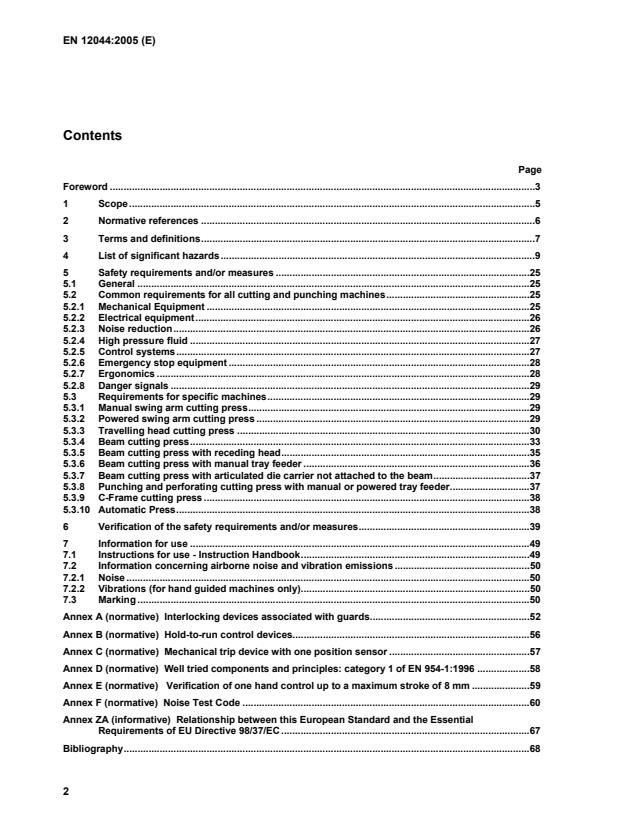
Contents
Page
Foreword .3
1 Scope .5
2 Normative references .6
3 Terms and definitions.7
4 List of significant hazards.9
5 Safety requirements and/or measures .25
5.1 General .25
5.2 Common requirements for all cutting and punching machines.25
5.2.1 Mechanical Equipment .25
5.2.2 Electrical equipment.26
5.2.3 Noise reduction.26
5.2.4 High pressure fluid .27
5.2.5 Control systems.27
5.2.6 Emergency stop equipment .28
5.2.7 Ergonomics .28
5.2.8 Danger signals .29
5.3 Requirements for specific machines.29
5.3.1 Manual swing arm cutting press.29
5.3.2 Powered swing arm cutting press .29
5.3.3 Travelling head cutting press .30
5.3.4 Beam cutting press.33
5.3.5 Beam cutting press with receding head.35
5.3.6 Beam cutting press with manual tray feeder .36
5.3.7 Beam cutting press with articulated die carrier not attached to the beam.37
5.3.8 Punching and perforating cutting press with manual or powered tray feeder.37
5.3.9 C-Frame cutting press .38
5.3.10 Automatic Press.38
6 Verification of the safety requirements and/or measures.39
7 Information for use .49
7.1 Instructions for use - Instruction Handbook.49
7.2 Information concerning airborne noise and vibration emissions .50
7.2.1 Noise .50
7.2.2 Vibrations (for hand guided machines only).50
7.3 Marking .50
Annex A (normative) Interlocking devices associated with guards.52
Annex B (normative) Hold-to-run control devices.56
Annex C (normative) Mechanical trip device with one position sensor .57
Annex D (normative) Well tried components and principles: category 1 of EN 954-1:1996 .58
Annex E (normative) Verification of one hand control up to a maximum stroke of 8 mm .59
Annex F (normative) Noise Test Code .60
Annex ZA (informative) Relationship between this European Standard and the Essential
Requirements of EU Directive 98/37/EC .67
Bibliography.68
Foreword
This European Standard (EN 12044:2005) has been prepared by Technical Committee CEN/TC 201 “Leather
and imitation leather goods and footwear manufacturing machinery - Safety”, the secretariat of which is held
by UNI.
This European Standard shall be given the status of a national standard, either by publication of an identical
text or by endorsement, at the latest by February 2006, and conflicting national standards shall be withdrawn
at the latest by February 2006.
This European Standard has been prepared under a mandate given to CEN by the European Commission
and the European Free Trade Association, and supports essential requirements of EU Directive(s).
For relationship with EU Directive(s), see informative Annex ZA, which is an integral part of this European
Standard.
According to the CEN/CENELEC Internal Regulations, the national standards organizations of the following
countries are bound to implement this European Standard: Austria, Belgium, Cyprus, Czech Republic,
Denmark, Estonia, Finland, France, Germany, Greece, Hungary, Iceland, Ireland, Italy, Latvia, Lithuania,
Luxembourg, Malta, Netherlands, Norway, Poland, Portugal, Slovakia, Slovenia, Spain, Sweden, Switzerland
and United Kingdom.
0 Introduction
This European Standard is a type C standard as stated in EN ISO 12100-1.
The machinery concerned and the extent to which hazards, hazardous situations and events are covered are
indicated in the scope of this European Standard.
When provisions of this type C standard are different from those which are stated in type A or B standards, the
provisions of this type C standard take precedence over the provisions of the other standards, for machines
that have been designed and built according to the provisions of this type C standard.
This European Standard contains safety requirements for cutting and punching machines. It is aimed at
designers, manufacturers, suppliers and importers.
1 Scope
1.1 This European Standard specifies safety requirements for design and operation of the machines
defined in 1.2.
It takes account of intended use, foreseeable misuse, component and system failure.
1.2 This European Standard applies for cutting and punching machines used in the manufacture of
footwear, leather and imitation leather goods and other related components. This European Standard applies
to the following cutting and punching machines:
swing arm cutting presses with manual or powered swing arm;
manual and automatic travelling head cutting presses with powered travelling head;
manual and automatic beam cutting presses;
punching and perforating presses;
C-frame cutting presses.
1.3 This European Standard is not applicable to:
mechanical presses;
presses intended for working cold metal;
fastening, riveting, stitching, stapling, bending or folding machines;
guillotines, shears and similar machines;
shoe and leather presses as described in EN 12203.
1.4 This European Standard deals with all significant hazards, hazardous situations and events relevant to
the footwear, leather and imitation leather goods manufacturing machinery, when it is used as intended and
under the conditions foreseen by the manufacturer (see Clause 4) and is intended for operation in applications
by trained persons.
1.5 This European Standard deals with material feeding and handling devices, when attached to the
machine.
1.6 This European Standard is not applicable to the machines which are manufactured before the date of
publication of this European Standard by CEN.
2 Normative references
The following referenced documents are indispensable for the application of this European Standard. For
dated references, only the edition cited applies. For undated references, the latest edition of the referenced
document (including any amendments) applies.
EN 294:1992, Safety of machinery – Safety distance to prevent danger zones being reached by the upper
limbs
EN 349:1993, Safety of machinery – Minimum gaps to avoid crushing of parts of the human body
EN 418:1992, Safety of machinery – Emergency stop equipment, functional aspects – Principles for design
EN 547-1:1996, Safety of machinery – Human body measurements – Part 1: Principles for determining the
dimensions required for openings for whole body access into machinery
EN 547-2:1996, Safety of machinery – Human body measurements – Part 2: Principles for determining the
dimensions required for access openings
EN 574:1996, Safety of machinery – Two-hand controls devices – Functional aspects – Principles for design
EN 894-1:1997, Safety of machinery – Ergonomics requirements for the design of displays and control
actuators – Part 1: General principles for human interactions with displays and control actuators
EN 894-2:1997, Safety of machinery – Ergonomics requirements for the design of displays and control
actuators – Part 2: Displays
EN 894-3:2000, Safety of machinery – Ergonomics requirements for the design of displays and control
actuators –- Part 3: Control actuators
EN 953:1997, Safety of machinery – Guards – General requirements for the design and construction of fixed
and movable guards
EN 954-1:1996, Safety of machinery – Safety-related parts of control systems – Part 1: General principles for
design
EN 981:1996, Safety of machinery – System of auditory and visual danger and information signals
EN 982:1996, Safety of machinery – Safety requirements for fluid power systems and their components –
Hydraulics
EN 983:1996, Safety of machinery – Safety requirements for fluid power systems and their components –
Pneumatics
EN 999:1998, Safety of machinery – The positioning of protective equipment in respect of approach speeds of
parts of the human body
EN 1005-3:2002, Safety of machinery – Human physical performance – Part 3: Recommended force limits for
machinery operation
EN 1088:1995, Safety of machinery – Interlocking devices associated with guards – Principles for design and
selection
EN 1837:1999 Safety of machinery – Integral lighting of machines
EN ISO 11688-1:1998, Acoustics - Recommended practice for the design of low-noise machinery and
equipment – Part 1: Planning (ISO/TR 11688-1:1995)
EN ISO 12100-1:2003, Safety of machinery – Basic concepts, general principles for design – Part 1: Basic
terminology, methodology (ISO 12100-1:2003).
EN ISO 12100-2:2003, Safety of machinery – Basic concepts, general principles for design - Part 2: Technical
principles (ISO 12100-2:2003).
EN 12545:2000, Footwear, leather and imitation leather goods manufacturing machines – Noise test code –
Common requirements
EN ISO 14122-2:2001, Safety of machinery – Permanent means of access to machinery – Part 2: Working
platforms and walkways (ISO 14122-2:2001)
EN 60204-1:1997, Safety of machinery – Electrical equipment of machines – Part 1: General requirements
(IEC 60204-1:1997
EN 60529:1991, Degrees of protection provided by enclosures (IP code) (IEC 60529:1989)
EN 60947-4-1, Low-voltage switchgear and controlgear – Part 4-1: Contactors and motor-starters -
Electromechanical contactors and motor-starters (IEC 60947-4-1:2000)
EN 60947-5-1: Low-voltage switchgear and controlgear - Part 5-1: Control circuit devices and switching
elements; Electro-mechanical control circuit devices (IEC 60947-5-1:2003
EN 61496-1:2004, Safety of machinery – Electro-sensitive protective equipment – Part 1: General
requirements and tests (IEC 61496-1:2004, modified)
prEN 61496-2:2004, Safety of machinery – Electro-sensitive protective equipment – Part 2: Particular
requirements of equipment using active opto-electronic protective devices (AOPDs)
3 Terms and definitions
For the purposes of this European Standard, the terms and definitions given in EN ISO 12100-1:2003 apply.
Additional definitions specifically needed for this European Standard are added below.
3.1
automatic cutting press
machine where the tool repeats continuously or intermittently all functions without manual intervention
between each cycle (see also Figures 11 and 12)
3.2
beam cutting press
machine in which the striking surface is attached to the beam which moves vertically and is supported at
either end (see also Figure 5)
NOTE In this type of machine the striking surface and the cutting surface are of approximately equal surface area.
3.3
beam cutting press with articulated die carrier not attached to the beam
beam cutting press equipped with an all-round movable cutting die support arm as well as a pivoted die
support with centering and clamping device for chucking single cavity cutting dies (see also Figure 8)
3.4
beam cutting press with receding head
beam cutting press where the beam at the top of its stroke is also capable of horizontal movement in order to
clear the cutting surface (see also Figure 6)
3.5
c-frame cutting press
machine having a striking surface and a cutting surface contained within a 'C' frame, which is capable of
vertical powered movement only (see also Figure 10)
3.6
cutting pad
machine part which provides the surface on which cutting takes place
3.7
cutting press
machine designed to transmit energy to a cutting tool for the purpose of cutting or punching material. When
the machine can execute a cycle of consecutive cuts without the need for additional operator commands, it is
defined as an "automatic cutting press"
3.8
cutting surface
total area available against which the tool can act when cutting
3.9
cutting tool
tool consisting of a blade or a die with one or two edges pre-shaped or a punch through which the press
transmits energy for cutting
3.10
feed system
equipment which can be part of a machine and which mechanically assists the presentation of material to be
cut at the press working area (see 3.13). This can include:
tray feeder (a powered or manually operated table used as a cutting surface in a beam or punching
press) See 3.22;
power driven feed rollers - usually on the feed side;
reciprocating clamping arrangements, for example: the gripper system.
3.11
material support area
flat surface outside the cutting area where the material is supported to be visually inspected to let the operator
optimise the cut position
3.12
press head
part of the machine carrying the striking element, or moving directly vertically during the cutting, carrying the
striking surface
3.13
press working area
zone of a machine between the striking surface and material supporting area, including the cutting tool, where
the cutting and punching operations take place
3.14
punching and perforating press
machine in which the striking surface, supported under a stationary cutting surface by a ring frame, is capable
of vertical powered movement only (see also Figure 9)
NOTE The striking surface and the cutting surface are of approximately equal surface area.
3.15
recurring access
access between striking plate and cutting pad between each normal working cycle
3.17
striking element
part of the press head in motion during cutting or punching
3.18
striking element return
return of the striking element to its rest position
3.19
striking surface
part of the press head in contact with the tool during cutting
3.20
swing arm cutting press
machine having a stationary lower cutting surface corresponding to the total available working area and an
arm, containing the moving striking surface, able to swing in an arc horizontally over the cutting surface
This includes two possible versions, namely:
manual swing arm (see also Figure 2);
powered swing arm (see also Figure 3).
3.21
travelling head cutting press
machine having a stationary lower cutting surface corresponding to the total available working area and a
smaller upper striking surface, mounted on a movable head, able to move horizontally across the cutting table
(see also Figure 4)
3.22
tray feeder
movable table used as a cutting surface in a beam or punching press (see also Figure 7)
3.23
working cycle
all the machine movements needed to make a single cut or punch
4 List of significant hazards
4.1 This clause contains all the significant hazards, hazardous situations and events, as far as they are
dealt with in this European Standard, identified by risk assessment as significant for this type of machinery
and which require action to eliminate or reduce the risk.
The significant hazards of cutting and punching machines are outlined in 4.3 to 4.8.
4.2 The danger zones that may lead to mechanical hazards are illustrated in Figures 2 to 13. The lay-out of
the machine is informative only. The list of significant hazards is based upon EN 1050. Before using this
European Standard it is important to carry out a risk assessment of shoe repair machines to check that its
significant hazards are identified in this clause.
Table 1 — List of significant hazards
Danger zone Source of hazard Type of hazard Machine with hazard; see
Figure
4.3 Mechanical hazards
4.3.1 The zone between The closing stroke of the Crushing 2, 3, 4, 5, 6, 7, 8, 9, 10, 11, 12,
striking and cutting striking surface onto the 13
surface (marked T in cutting surface
figures)
4.3.2 The zone of press The moving press head Impact 3, 4, 6, 11, 12
head movements
Drawing-in and 3, 4
(marked S1 in figures)
trapping
and the clearance
between head and
Crushing 3, 4, 11, 12
side frame (marked S2
in figures)
Abrasion 2, 3, 4
4.3.3 The zone of press The falling die Impact 6
head movement
(marked S1 in figures)
4.3.4 The zone between The closing movement of: Cutting or severing 2, 3, 4, 5, 6, 7, 8, 9, 10, 11, 12,
striking surface or - the striking surface onto the 13
cutting surface and tool
Crushing 2, 3, 4, 5, 6, 7, 9, 10
tool (marked L in or
figures) - the tool onto the cutting
Shearing 2, 3, 4, 5, 6, 7, 8, 9, 10, 11, 12,
surface
4.3.5 The drawing-in zone Transmission machinery and Entanglement 4, 5, 6, 9, 11, 12, 13
for rotating and feeding systems Drawing-in and
pinching parts trapping
Crushing
4.4 Electrical hazard
Electrical contact, direct or indirect caused by:
- Component failure
Electric shock, burns
- Insulation failure
- Incorrect design, installation or component
specification of electrical equipment
4.5 Noise
Noise generated by:
- action of the tool on the material or component
Hearing loss,
being worked
interference with
speech
- hydraulic unit
communication and
- pneumatic exhausts
acoustic signals,
physiological disorders
- press head movements
Table 1 — List of significant hazards (continued)
Danger zone Source of hazard Type of hazard Machine with hazard; see
Figure
4.6 Functional disorder
Fault in energy supply (irregularity, failure, unexpected Hazards generated by
reconnection) inadvertent movement
and/or process start
up
Failure of control system (malfunction of safety All possible hazards
devices and machine controls) generated by
unexpected
dangerous movement
(unexpected start or
closing movement)
Errors of fitting Unexpected
dangerous movement
4.7
High pressure fluid
High pressure fluid ejection or ejection of a burst Burns and injury from
component part due to failure of hydraulic unit (broken hot oil or tubing in
hoses, fittings and tubes) pressure
4.8 Neglecting ergonomic principles
Excessive efforts during loading/unloading Musculo-skeletal
injury/repetitive strain
injury
Incompatibility of machine design (in the working area) Musculo-skeletal
with human anatomy injury/repetitive strain
injury
Bad working posture Fatigue
Poor control, lay-out and graphics Fatigue (psychological
stress)
Poor lighting Fatigue of eyes
Key
1 control unit
2 swing arm
3 cutting surface
4 striking surface
Figure 1 — Swing arm cutting press
Key
a) TOP VIEW
b) SIDE VIEW
1 cutting surface
2 swing arm
3 striking surface
4 control device
5 tool
zone L
zone S1
zone T
Figure 2 — Danger zones for manual arm cutting press
Key
a) TOP VIEW
b) SIDE VIEW
1 cutting surface
2 powered swing arm
3 striking surface
4 control device
5 tool
6 reference point A
7 reference point B
8 electrosensitive protective device
zone L
zone S1 S2
zone T
Figure 3 — Danger zones for powered swing arm cutting press
Key
a) FRONT VIEW
b) SIDE VIEW
1 cutting surface
2 press head
3 striking surface
4 control device
5 tool
6 electrosensitive protective device
7 feeding system
zone L
zone S1 S2
zone T
Figure 4 — Danger zone for travelling head cutting press
Key
a) SIDE VIEW
b) FRONT VIEW
1 cutting surface
2 press head (beam)
3 striking surface
4 control device
5 tool
6 electrosensitive protective device
7 feeding system
zone L
zone T
Figure 5 — Danger zone for normal beam cutting press
Key
a) SIDE VIEW
b) FRONT VIEW
1 cutting surface
2 press head (receding beam)
3 striking surface
4 control device
5 tool
6 electrosensitive protective device
zone L
zone S1
zone S2
zone T
Figure 6 — Danger zone for receding beam cutting press
Key
a) SIDE VIEW
b) FRONT VIEW
1 cutting surface
2 press head (beam)
3 striking surface
4 control device
5 tool
6 tray feeder
7 electrosensitive protective device
zone L
zone S1 S2
zone T
Figure 7 — Danger zone for beam cutting press with manual tray feeder
Key
a) SIDE VIEW
b) TOP VIEW
1 cutting surface
2 press head (beam)
3 striking surface
4 control device
5 tool
6 articulated die carrier
7 electrosensitive protective device
zone L
zone T
Figure 8 — Danger zone for beam cutting press with articulated die carrier
Key
a) FRONT VIEW
b) SIDE VIEW
1 cutting surface
2 tray feeder
3 striking surface
4 control device
5 tool
6 back guard
zone L
zone T
Figure 9 — Danger zone for punching and perforating press
Key
a) SIDE VIEW
b) FRONT VIEW
1 cutting surface
2 tool
3 striking surface
4 control device
zone L
zone T
Figure 10 — Danger zone for C-frame cutting press
Key
a) FRONTAL VIEW
b) SIDE VIEW
1 cutting surface
2 rear movable protection
3 electrosensitive protective device or front movable protection
4 control device
zone L
zone S
zone T
Figure 11 — Danger zone for automatic travelling head press
Key
a) SIDE VIEW
b) FRONT VIEW
1 control device
2 electrosensitive protective device or front movable protection
3 rear movable protection
zone L
zone S
zone T
Figure 12 — Danger zone for automatic travelling head presses
Key
a) SIDE VIEW
b) FRONT VIEW
1 cutting surface
2 electrosensitive protective device
3 striking surface
4 control device
5 rear movable protection
zone L
zone T
Figure 13 — Danger zone for automatic beam press
5 Safety requirements and/or measures
5.1 General
Machinery shall comply with the safety requirements and/or protective measures of this clause.
In addition, the machine shall be designed according to the principles of EN 12100 for hazards relevant but
not significant which are not dealt with by this European Standard (e.g. sharp edges of structural parts).
For hazards which are reduced by application of a B-Level standard such as EN 294, EN 418, EN 60204-1
etc., the manufacturer shall carry out a risk assessment to establish the requirements of the B-standard to be
applied. This specific risk assessment shall be part of the general risk assessment of the machine.
5.2 Common requirements for all cutting and punching machines
NOTE Some specific requirements in 5.3 are deviating from the following common requirements.
5.2.1 Mechanical Equipment
5.2.1.1 Safeguarding against the hazards generated by moving transmissions parts (such as pulleys,
belts, gears, rack, etc.), shall be ensured by:
fixed enclosing guards in accordance with EN 953;
movable interlocking guards without guard locking in accordance with EN 953, EN 1088, and Annex A of
this European Standard (the specific subclauses will indicate if A1, A2 or A3 of Annex A will apply).
5.2.1.2 Hazardous motion of moving machinery parts, feed systems, tools and workpieces shall be
safeguarded by the following, on the basis of risk assessment in accordance with EN 1050 and taking into
consideration the highest level of protection available:
fixed enclosing guards or covers which satisfies EN 953;
fixed distance guards which satisfy 3.2.2 of EN 953:1997 and the distances given in the appropriate Table
(1, 3 or 4) of EN 294:1992.
Where it is impossible to provide these protective measures, devices shall be provided which will affect a
shutdown of the hazardous motion before the danger zone is reached.
Devices which will affect this are:
movable interlocking guards without guard locking which satisfy EN 953, EN 1088, and Annex A of this
European Standard;
NOTE For these machines, movable interlocking guards without guard locking are considered acceptable
because of the short stopping time of the moving parts.
trip devices, such as:
electrosensitive protective devices satisfying EN 61496-1, prEN 61496-2 and EN 999 or mec hanical
trip bars satisfying Annex C of this European Standard;
two-hand control devices which satisfy EN 574 and EN 999.
Specific applications, if necessary, are given in the relevant subclause for each machine in 5.3.
5.2.1.3 On travelling head cutting presses or beam cutting presses with double tray feeder which may be
operated alternately by two persons, one at the front and the other at the rear, front and rear safeguarding
arrangements shall be identical; the design shall ensure that any motion can be actuated only by the operator
engaged in the working cycle, while the safeguarding arrangement on the side of the other operator is
operational.
5.2.2 Electrical equipment
5.2.2.1 Electrical systems and equipment shall be in accordance with EN 60204-1.
With respect to some clauses of EN 60204-1:1997, stated hereafter, the following shall apply:
4.3:
A.C. supplies: in accordance with 4.3.2; D.C. supplies: in accordance with 4.3.3;
6.2:
Protection in accordance with 6.2.2 or 6.2.3 and, where applicable 6.2.4;
9.2.5.3/4:
Stop function and emergency stop function: stop category 0 or 1;
9.4:
the safety related parts of the control system shall meet the requirements of this European Standard;
12.3: degree of protection: at least IP 54.
5.2.2.2 All operating controls requiring routine adjustment for changing the working process shall be
located outside the electrical cabinet.
NOTE Controls for routine electrical adjustment are for example feed, speed, time, temperature or pressure variation.
5.2.3 Noise reduction
5.2.3.1 Noise reduction at source by design
Noise reduction shall be carried out by incorporating, as an integral part of the design, one or more of the
following features:
a) reduction of vibration through static and dynamic balancing of rotating parts;
b) reduction of vibration within the machine by reducing both the mass of the moving parts and their
acceleration;
c) reduction of impactive overclearance of rotational bearings by application of positive preloading;
d) proper choice and design of the energy-transfer components to eliminate bouncing;
e) proper choice and design of transmission components (gears, pulleys, belts, bearings and so on);
f) proper design of machine structures taking into account vibration damping and avoidance of structural
resonance.
This list of technical measures for noise reduction at source gives only examples and is not meant to be
complete. These measures are recommended but not compulsory. Other appropriate measures with identical
or greater efficacy can be selected taking into account EN ISO 11688-1.
NOTE EN ISO 11688-2 gives useful information on noise generation mechanisms in machinery.
5.2.3.2 Noise reduction by protective devices
If it is not possible to achieve the noise reduction at the source by design methods, then the following shall be
considered:
a) antivibration mountings should be fitted to reduce vibration transmission to the floor;
b) sound deadening of pneumatic discharges, vibration damping of hydraulic circuits.
Other devices with identical or greater efficacy may be used by the manufacturers.
5.2.3.3 Noise reduction by information
If consideration of noise reduction at the design stage shows that noise emission levels, after taking all
possible technical measures, will be so high that further protection of the operator will be necessary, the
information for use shall contain additional information (see 7.2).
5.2.4 High pressure fluid
To prevent high pressure ejection of fluid or ejection of a part of a burst component, hydraulic and pneumatic
systems shall satisfy 4.10 of EN ISO 12100-2:2003, EN 982 and EN 983.
5.2.5 Control systems
5.2.5.1 All machines shall have a start control and a stop control fitted at the working zone. The control
system shall automatically adopt a safe condition if any of the energy inputs are unavailable.
Hydraulic control equipment shall be in accordance with EN 982.
Pneumatic control equipment shall be in accordance with EN 983.
Electrical control equipment shall be in accordance with 5.2.2 and specific control requirements of individual
machines (see 5.3).
Design of display and control actuators shall comply with the ergonomic requirements included in EN 894-1,
EN 894-2 and EN 894-3.
5.2.5.2 On machines which are equipped with electrosensitive protective devices, cycle re-start may be
initiated automatically by this device under the following conditions:
device detects the reestablishment of a safe condition;
recurring access is required for each working cycle;
it is not possible to stand inside the guarded area;
working cycle time of the machine does not exceed one minute.
The protective device shall satisfy EN 61496-1 type 4 and shall have a control system complying with
category 4 of EN 954-1:1996.
5.2.5.3 On machines where recurring access is required for working, two hand controls which satisfy EN
574 type IIIC and trip devices which satisfy Annex C of this European Standard may only be used as a
safeguard provided:
parts of the electrical control system relevant for start or restart are designed in accordance with EN
954-1:1996 category 4;
pneumatic or hydraulic controls designed in such a manner that failure of a component cannot initiate
hazardous motion automatically in accordance with EN 954-1:1996 category 1 and Annex D.
5.2.5.4 On machines where recurring access is not required for normal operation, the parts of the control
system relevant for start or restart shall be not less than EN 954-1:1996 category 3.
If electrical position sensors are used, they shall satisfy EN 60947-5-1.
Pressure, time or programme controlled commands alone are not permitted.
5.2.5.5 Non-electrical safety-related parts of control systems shall:
have the same level of category as the safeguarding used;
have a control system complying with not less than category 1 of EN 954-1:1996. Annex D of this
European Standard shall be respected.
5.2.5.6 The electrical safety-related parts of control systems shall be designed in such a manner that the
failure of any electrical component cannot initiate automatic closing movement, in accordance with category 3
of EN 954-1:1996.
The use of programmable electronic systems (PES) shall not reduce any level of safety laid down in this
European Standard. Safety related functions sha ll not rely solely on single channel PES.
This requirement is met by the use of, for example:an additional hardwired control system;
duplicated solid state channels (not programmable);
programmable electronic system with established safety level.
5.2.5.7 The requirements of 5.2.5.4, 5.2.5.5 and 5.2.5.6 do not apply if access to the danger zone is
possible only after hazardous motion has been positively blocked by mechanical means, independent of the
controls.
5.2.5.8 Machines designed for several operating modes, and which can be operated by means of various
safety devices, shall be equipped with mode selection devices in accordance with 4.11.9 and 4.11.10 of EN
ISO 12100-2:2003.
Operating modes are e.g. automatic operation, manual operation, tool changing, adjustment.
Mode selection by itself shall not initiate operation. A subsequent action by the operator shall be required.
5.2.6 Emergency stop equipment
For all machines, except those listed in 5.3.10, the supply disconnecting device can serve the function of
emergency stop (see 10.7.5 of EN 60204-1:1997).
5.2.7 Ergonomics
Machine design shall take into account the ergonomic principles described in 4.8 of EN ISO 12100-2:2003. In
particular the design shall take account of:
operating height;
operator posture and movement;
operator physical strength, especially during setting, in accordance with EN 1005-3;
easy reach and compatibility of control actuators in accordance with EN 894-1;
operator access to the working area in accordance with EN 547-1 and EN 547-2. If necessary, a suitable
platform in accordance with EN ISO 14122-2 shall be provided; the platform shall be non-sloping and the
surface shall be made of non-slip material;
possible need for integral lighting in accordance with EN 1837.
5.2.8 Danger signals
Danger and functional auditory and visual signals adopted shall satisfy the requirements listed in EN 981.
They shall be placed in order to satisfy the ergonomic requirements of Clause 4 of EN 981:1996.
5.3 Requirements for specific machines
5.3.1 Manual swing arm cutting press
Mechanical hazards referring to danger zones T and L (see Figure 2) shall be safeguarded in accordance
with:
- combination of 5.3.1.1 and 5.3.1.2 and 5.3.1.4 and 5.3.1.5;
- combination of 5.3.1.1 and 5.3.1.3 and 5.3.1.4 and 5.3.1.5.
5.3.1.1 A two-hand control device type III A in accordance with EN 574 shall be provided, located on the
swing arm, with the related parts of the control system in accordance with not less than category 1 of EN 954-
1:1996 and Annex D of this European Standard, and positioned in accordance with EN 999.
5.3.1.2 One hand control shall be permitted up to a maximum stroke of 8 mm at the positive selection by
the operator (in accordance with 5.2.5.8) and subject to the machine conforming to the following additional
criteria:
a) control system shall incorporate an automatic changeover to two hand control for strokes exceeding
8mm;
b) no single fault shall initiate a cutting stroke;
c) no single fault shall cause a changeover from two hand control to one hand control;
d) no single fault shall prevent change from one hand control to two hand control;
e) single fault in the stroke sensing arrangement shall cause the system to adopt a two hand control;
f) there shall be an automatically activated indicator visible to the operator showing the machine to be in a
one hand or two hand control condition.
5.3.1.3 There shall be a 3 mm x 45° chamfer on the outer edges of the striking surface or, as an
alternative, a padding strip with hardness equal to 20 + 5 A shore on 3 sides flush with lower edge of the
striking plate of thickness greate r than or equal to 12 mm x 12 mm.
5.3.1.4 The arm shall be capable of being moved by a force not exceeding 5 N measured at the handle.
5.3.1.5 The height from floor to table-top (not including cutting pad) shall be equal to (1000 +/- 30) mm.
5.3.2 Powered swing arm cutting press
Access to the danger zones T, S and L (see Figure 3) shall be protected in accordance with 5.3.2.1 and
5.3.2.2 and 5.3.2.3 and 5.3.2.4 and 5.3.2.5.
5.3.2.1 A two hand control device type III A in accordance with EN 574 shall be provided, located outside
the danger zone, with the related parts of the control system in accordance with not less then category 1 of
EN 954-1:1996 and Annex D of this European Standard, and positioned in accordance with EN 999.
5.3.2.2 If, at the front of the machine, the width of the opening between the elements of the fixed guards
referred to in 5.3.2.3, exceeds 800 mm, an electro-sensitive protective device of type 2 in accordance with EN
61496-1 and prEN 61496-2 shall be provided, safeguarding the front of the working area, with the related
parts of the control system not less than category 1 of EN 954-1:1996 and Annex D of this European Standard,
and positioned in accordance with EN 999.
5.3.2.3 Fixed distance guards shall be provided at the sides, rear and the front of the machine, except for
the area between the two operating elements of the two-hand control device.
NOTE If the distance between the two operating elements of the two-hand control device is not exceeding 800 mm, no
electro-sensitive protective device is required (see also 5.3.2.2).
The guards shall satisfy the appropriate Tables (2, 3 or 4) of EN 294:1992, EN 349 and EN 953.
In verifying the height "a" in Table 2 of EN 294:1992, the reference plane shall be the floor (see Figure.3 of
this European Standard, reference point A) on which the machine stands and danger zone shall be the arc of
the radius prescribed by the leading edge of the beam in its uppermost position (see Figure. 3 of this
European Standard, reference point B).
5.3.2.4 The material support area shall be equal to or lower than the level of the cutting pad.
5.3.2.5 The movements of the swing arm shall be confined within the guarded area as defined in 5.3.2.3
e.g. by means
...