


EN 288-1:1992
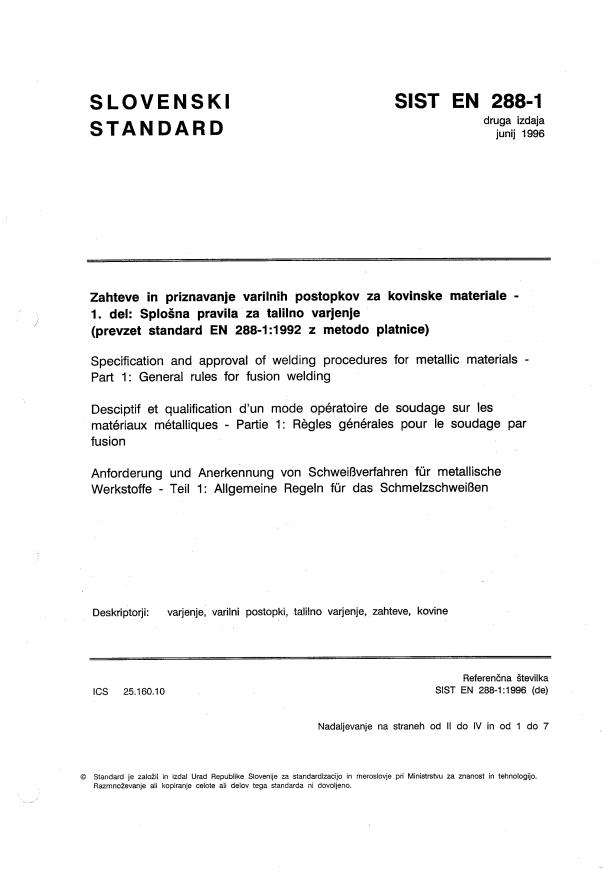
(Main)Specification and qualification of welding procedures for metallic materials - Part 1: General rules for fusion welding
Specification and qualification of welding procedures for metallic materials - Part 1: General rules for fusion welding
This standard defines general rules for the specification and approval of welding procedures for metallic materials. This standard also refers to several other standards as regards detailed rules for specific applications. It is assumed that the welding procedure specifications are used in production by competent welders, approved in accordance with the relevant part of EN 287. (.)1) This standards applies when approval of the welding procedure is required e.g. by either contract, standards, rules or legal requirements. The use of a particular method of approval of a welding procedure is often a mandatory requirement of an application standard. In the absence of such a requirement the method of approval shall be agreed between the contracting parties at the enquiry or at the order stage. 1) This paragraph in EN 288-1 :1992 was deleted by Amendment A1 :1997
Anforderung und Anerkennung von Schweißverfahren für metallische Werkstoffe - Teil 1: Allgemeine Regeln für das Schmelzschweißen
Diese Norm legt allgemeine Regeln für die Anforderung und Anerkennung von Schweissverfahren für metallische Werkstoffe fest. Diese Norm nimmt auch Bezug auf verschiedene andere Normen hinsichtlich ins einzelne gehende Regelungen bei besonderen Anwendungen. Es wird vorausgesetzt, dass die Schweissanwendungen in der Fertigung von befähigten Schweissern angewendet werden, die nach dem entsprechenden Teil von prEN 287 anerkannt sind.
Descriptif et qualification d'un mode opératoire de soudage sur les matériaux métalliques - Partie 1: Règles générales; soudage par fusion
La présente norme définit les règles générales pour l'établissement du descriptif et la qualification d'un mode opératoire de soudage. Elle fait référence à d'autres normes pour mettre en oeuvre des règles détaillées concernant des applications spécifiques. On présume que les déscriptifs des modes opératoires de soudage sont utilisés en production par des soudeurs compétents, qualifiés en conformité avec les parties appropriées du EN 287.
Popis in odobritev varilnih postopkov za kovinske materiale - 1. del: Splošna pravila za talilno varjenje
General Information
- Status
- Withdrawn
- Publication Date
- 25-Feb-1992
- Withdrawal Date
- 14-Dec-2003
- Technical Committee
- CEN/TC 121 - Welding
- Current Stage
- 9960 - Withdrawal effective - Withdrawal
- Start Date
- 15-Dec-2003
- Completion Date
- 15-Dec-2003
- Directive
- 87/404/EEC - Simple pressure vessels
- Directive
- 97/23/EC - Pressure equipment
Relations
- Effective Date
- 22-Dec-2008
- Effective Date
- 28-Jan-2026
- Effective Date
- 28-Jan-2026
- Referred By
EN ISO 21049:2004 - Pumps - Shaft sealing systems for centrifugal and rotary pumps (ISO 21049:2004) - Effective Date
- 28-Jan-2026
- Effective Date
- 22-Dec-2008

EN 288-1:1996
Get Certified
Connect with accredited certification bodies for this standard

National Aerospace and Defense Contractors Accreditation Program (NADCAP)
Global cooperative program for special process quality in aerospace.
CARES (UK Certification Authority for Reinforcing Steels)
UK certification for reinforcing steels and construction.
DVS-ZERT GmbH
German welding certification society.
Sponsored listings
Frequently Asked Questions
EN 288-1:1992 is a standard + national annex and/or foreword published by the European Committee for Standardization (CEN). Its full title is "Specification and qualification of welding procedures for metallic materials - Part 1: General rules for fusion welding". This standard covers: This standard defines general rules for the specification and approval of welding procedures for metallic materials. This standard also refers to several other standards as regards detailed rules for specific applications. It is assumed that the welding procedure specifications are used in production by competent welders, approved in accordance with the relevant part of EN 287. (.)1) This standards applies when approval of the welding procedure is required e.g. by either contract, standards, rules or legal requirements. The use of a particular method of approval of a welding procedure is often a mandatory requirement of an application standard. In the absence of such a requirement the method of approval shall be agreed between the contracting parties at the enquiry or at the order stage. 1) This paragraph in EN 288-1 :1992 was deleted by Amendment A1 :1997
This standard defines general rules for the specification and approval of welding procedures for metallic materials. This standard also refers to several other standards as regards detailed rules for specific applications. It is assumed that the welding procedure specifications are used in production by competent welders, approved in accordance with the relevant part of EN 287. (.)1) This standards applies when approval of the welding procedure is required e.g. by either contract, standards, rules or legal requirements. The use of a particular method of approval of a welding procedure is often a mandatory requirement of an application standard. In the absence of such a requirement the method of approval shall be agreed between the contracting parties at the enquiry or at the order stage. 1) This paragraph in EN 288-1 :1992 was deleted by Amendment A1 :1997
EN 288-1:1992 is classified under the following ICS (International Classification for Standards) categories: 25.160.10 - Welding processes. The ICS classification helps identify the subject area and facilitates finding related standards.
EN 288-1:1992 has the following relationships with other standards: It is inter standard links to EN ISO 15607:2003, EN 13814:2004, EN ISO 13710:2004, EN ISO 21049:2004, EN 288-1:1992/A1:1997. Understanding these relationships helps ensure you are using the most current and applicable version of the standard.
EN 288-1:1992 is associated with the following European legislation: EU Directives/Regulations: 87/404/EEC, 97/23/EC; Standardization Mandates: M/071, M/BC/CEN/89/2. When a standard is cited in the Official Journal of the European Union, products manufactured in conformity with it benefit from a presumption of conformity with the essential requirements of the corresponding EU directive or regulation.
EN 288-1:1992 is available in PDF format for immediate download after purchase. The document can be added to your cart and obtained through the secure checkout process. Digital delivery ensures instant access to the complete standard document.
Questions, Comments and Discussion
Ask us and Technical Secretary will try to provide an answer. You can facilitate discussion about the standard in here.
Loading comments...