

CEN/TS 17699:2022
(Main)Guidelines for developing ICT Professional Curricula as scoped by EN 16234-1 (e-CF)
- Abstract
This document provides guidance and inspiration on how to design/redesign, develop, maintain, adjust, and compare ICT Professional curricula and learning programmes as scoped by EN 16234 1:2019 and related documents.
EN 16234 1:2019 (e-CF) is the starting guiding point for this document, for a shared European language for ICT professional development. Other framework sources can be used to apply the methodology outlined in this document.
This document is for application by educational institutions, learning programmes and certification providers of all types (public and private), providing ICT Professional education and training including:
• Higher Education (HE);
• Vocational Education and Training (VET);
• Any other educational or training institution or provider in professional ICT, e.g. Continuous Professional Development (CPD).
This document is focused on guiding education providers on how to align curricula and learning programmes with the structure and principles of EN 16234 1 (e-CF) e-Competences and CWA 16458 1 ICT Professional Role Profiles. It applies to all forms of education, supporting educational providers who plan to use a shared European language on knowledge, skills, competences and roles, as ingredients for the successful provision of ICT Professional education and training.
The guidelines, provided by this document, include formal, non-formal and industry developed education and training through the provision of high-level, consistent recommendations and guidance for ICT curriculum or learning programme design by any education provider.
In this document, a distinction is made between a learning programme and a curriculum. The term “curriculum” is strongly associated with formal educational institutions and degrees, the term “learning programme” indicates a broader, more encompassing concept, also incorporating training and other learning programmes, not restricted to only “curricula”. As the proposed methodology in this document relates to both curricula and learning programmes, the term ‘learning programme’ is used throughout the text. If the term ‘curriculum’ is used, then that narrower meaning is explicitly applicable in that situation.
- Status
- Published
- Publication Date
- 15-Mar-2022
- Technical Committee
- CEN/TC 428 - Project Committee - Professions for Information and Communication Technology (ICT)
- Drafting Committee
- CEN/TC 428/WG 3 - Education and Training
- Current Stage
- 9060 - Closure of 2 Year Review Enquiry - Review Enquiry
- Start Date
- 02-Sep-2025
- Completion Date
- 02-Sep-2025



Overview
CEN/TS 17699:2022 - Guidelines for developing ICT Professional Curricula as scoped by EN 16234‑1 (e‑CF) - provides a practical, Europe‑focused methodology for designing, redesigning, maintaining and comparing ICT professional curricula and learning programmes. Built on the EN 16234‑1:2019 (e‑Competence Framework, e‑CF), this CEN Technical Specification helps education and training providers translate workplace competences into programme learning outcomes, unit outcomes and assessment strategies.
Key topics and requirements
- Alignment with e‑CF: Guidance on mapping programme content to the e‑Competence Framework (EN 16234‑1) and maintaining compliance or alignment levels.
- Educational profile model: A step‑by‑step methodology to create “educational profiles” that link professional role profiles and e‑CF competences to programme and unit learning outcomes.
- Competence‑based learning: Advice on constructing competence‑based curricula across education types (HE, VET, CPD) and EQF‑related proficiency considerations.
- Programme design and implementation: Recommendations for curriculum (formal degrees) and broader learning programmes (short courses, MOOCs, certifications), including localization, staff training, accreditation and assessment alignment.
- Operational guidance: Practical sections on organizational issues, communication/marketing, cooperation with industry and sustaining e‑CF compliance.
- Supporting resources: Annexes provide templates, examples, mapping use‑cases (e.g., project management), e‑Competence levels, and links to related standards and BoK materials.
Practical applications and who uses it
This standard is intended for:
- Higher Education institutions designing or updating ICT degrees to reflect professional competences.
- Vocational Education & Training (VET) providers aligning short‑cycle qualifications and apprenticeships with e‑CF.
- Continuous Professional Development (CPD) and private training organisations creating industry‑relevant courses and certifications.
- Certification bodies and accreditors seeking templates and metrics to measure programme alignment with European ICT professionalism.
Practical uses include curriculum mapping, creating programme learning outcomes from role profiles, designing assessments tied to competence levels, and ensuring transparency for employers and learners.
Related standards and keywords
- Core reference: EN 16234‑1:2019 (e‑CF) - e‑Competence Framework
- Complementary materials: CWA 16458‑1 (ICT Professional Role Profiles), prEN 17748‑1 (ICT Body of Knowledge), professional ethics and metrics drafts.
Keywords: CEN/TS 17699:2022, ICT Professional Curricula, e‑CF, EN 16234‑1, competence‑based curriculum, educational profile, HE, VET, certification, curriculum alignment.
CEN/TS 17699:2022 is a practical tool for educators and training providers seeking a shared European language for ICT competences and a repeatable method to design industry‑relevant, competence‑aligned learning programmes.
Relations
- Effective Date
- 28-Jan-2026
- Effective Date
- 28-Jan-2026
- Referred By
CEN/TS 17834:2022 - European Professional Ethics Framework for the ICT Profession (EU ICT Ethics) - Effective Date
- 28-Jan-2026
Get Certified
Connect with accredited certification bodies for this standard

BSI Group
BSI (British Standards Institution) is the business standards company that helps organizations make excellence a habit.

Bureau Veritas
Bureau Veritas is a world leader in laboratory testing, inspection and certification services.

DNV
DNV is an independent assurance and risk management provider.
Sponsored listings
Frequently Asked Questions
CEN/TS 17699:2022 is a technical specification published by the European Committee for Standardization (CEN). Its full title is "Guidelines for developing ICT Professional Curricula as scoped by EN 16234-1 (e-CF)". This standard covers: This document provides guidance and inspiration on how to design/redesign, develop, maintain, adjust, and compare ICT Professional curricula and learning programmes as scoped by EN 16234 1:2019 and related documents. EN 16234 1:2019 (e-CF) is the starting guiding point for this document, for a shared European language for ICT professional development. Other framework sources can be used to apply the methodology outlined in this document. This document is for application by educational institutions, learning programmes and certification providers of all types (public and private), providing ICT Professional education and training including: • Higher Education (HE); • Vocational Education and Training (VET); • Any other educational or training institution or provider in professional ICT, e.g. Continuous Professional Development (CPD). This document is focused on guiding education providers on how to align curricula and learning programmes with the structure and principles of EN 16234 1 (e-CF) e-Competences and CWA 16458 1 ICT Professional Role Profiles. It applies to all forms of education, supporting educational providers who plan to use a shared European language on knowledge, skills, competences and roles, as ingredients for the successful provision of ICT Professional education and training. The guidelines, provided by this document, include formal, non-formal and industry developed education and training through the provision of high-level, consistent recommendations and guidance for ICT curriculum or learning programme design by any education provider. In this document, a distinction is made between a learning programme and a curriculum. The term “curriculum” is strongly associated with formal educational institutions and degrees, the term “learning programme” indicates a broader, more encompassing concept, also incorporating training and other learning programmes, not restricted to only “curricula”. As the proposed methodology in this document relates to both curricula and learning programmes, the term ‘learning programme’ is used throughout the text. If the term ‘curriculum’ is used, then that narrower meaning is explicitly applicable in that situation.
This document provides guidance and inspiration on how to design/redesign, develop, maintain, adjust, and compare ICT Professional curricula and learning programmes as scoped by EN 16234 1:2019 and related documents. EN 16234 1:2019 (e-CF) is the starting guiding point for this document, for a shared European language for ICT professional development. Other framework sources can be used to apply the methodology outlined in this document. This document is for application by educational institutions, learning programmes and certification providers of all types (public and private), providing ICT Professional education and training including: • Higher Education (HE); • Vocational Education and Training (VET); • Any other educational or training institution or provider in professional ICT, e.g. Continuous Professional Development (CPD). This document is focused on guiding education providers on how to align curricula and learning programmes with the structure and principles of EN 16234 1 (e-CF) e-Competences and CWA 16458 1 ICT Professional Role Profiles. It applies to all forms of education, supporting educational providers who plan to use a shared European language on knowledge, skills, competences and roles, as ingredients for the successful provision of ICT Professional education and training. The guidelines, provided by this document, include formal, non-formal and industry developed education and training through the provision of high-level, consistent recommendations and guidance for ICT curriculum or learning programme design by any education provider. In this document, a distinction is made between a learning programme and a curriculum. The term “curriculum” is strongly associated with formal educational institutions and degrees, the term “learning programme” indicates a broader, more encompassing concept, also incorporating training and other learning programmes, not restricted to only “curricula”. As the proposed methodology in this document relates to both curricula and learning programmes, the term ‘learning programme’ is used throughout the text. If the term ‘curriculum’ is used, then that narrower meaning is explicitly applicable in that situation.
CEN/TS 17699:2022 is classified under the following ICS (International Classification for Standards) categories: 03.100.30 - Management of human resources; 35.020 - Information technology (IT) in general. The ICS classification helps identify the subject area and facilitates finding related standards.
CEN/TS 17699:2022 has the following relationships with other standards: It is inter standard links to EN 16234-1:2019, EN 17748-1:2022, CEN/TS 17834:2022. Understanding these relationships helps ensure you are using the most current and applicable version of the standard.
CEN/TS 17699:2022 is available in PDF format for immediate download after purchase. The document can be added to your cart and obtained through the secure checkout process. Digital delivery ensures instant access to the complete standard document.
Standards Content (Sample)
SLOVENSKI STANDARD
01-maj-2022
Smernice za izdelavo strokovnih učnih načrtov IKT v skladu s standardom EN
16234-1 (e-CF)
Guidelines for developing ICT Professional Curricula as scoped by EN16234-1 (e-CF)
Richtlinien für die Entwicklung von Lehrplänen für IKT-Fachkräften nach EN16234-1 (e-
CF)
Ta slovenski standard je istoveten z: CEN/TS 17699:2022
ICS:
03.100.30 Vodenje ljudi Management of human
resources
35.020 Informacijska tehnika in Information technology (IT) in
tehnologija na splošno general
2003-01.Slovenski inštitut za standardizacijo. Razmnoževanje celote ali delov tega standarda ni dovoljeno.
CEN/TS 17699
TECHNICAL SPECIFICATION
SPÉCIFICATION TECHNIQUE
March 2022
TECHNISCHE SPEZIFIKATION
ICS 03.100.30; 35.020
English Version
Guidelines for developing ICT Professional Curricula as
scoped by EN 16234-1 (e-CF)
Richtlinien für die Entwicklung von Lehrplänen für
IKT-Fachkräften nach EN16234-1 (e-CF)
This Technical Specification (CEN/TS) was approved by CEN on 3 January 2022 for provisional application.
The period of validity of this CEN/TS is limited initially to three years. After two years the members of CEN will be requested to
submit their comments, particularly on the question whether the CEN/TS can be converted into a European Standard.
CEN members are required to announce the existence of this CEN/TS in the same way as for an EN and to make the CEN/TS
available promptly at national level in an appropriate form. It is permissible to keep conflicting national standards in force (in
parallel to the CEN/TS) until the final decision about the possible conversion of the CEN/TS into an EN is reached.
CEN members are the national standards bodies of Austria, Belgium, Bulgaria, Croatia, Cyprus, Czech Republic, Denmark, Estonia,
Finland, France, Germany, Greece, Hungary, Iceland, Ireland, Italy, Latvia, Lithuania, Luxembourg, Malta, Netherlands, Norway,
Poland, Portugal, Republic of North Macedonia, Romania, Serbia, Slovakia, Slovenia, Spain, Sweden, Switzerland, Turkey and
United Kingdom.
EUROPEAN COMMITTEE FOR STANDARDIZATION
COMITÉ EUROPÉEN DE NORMALISATION
EUROPÄISCHES KOMITEE FÜR NORMUNG
CEN-CENELEC Management Centre: Rue de la Science 23, B-1040 Brussels
© 2022 CEN All rights of exploitation in any form and by any means reserved Ref. No. CEN/TS 17699:2022 E
worldwide for CEN national Members.
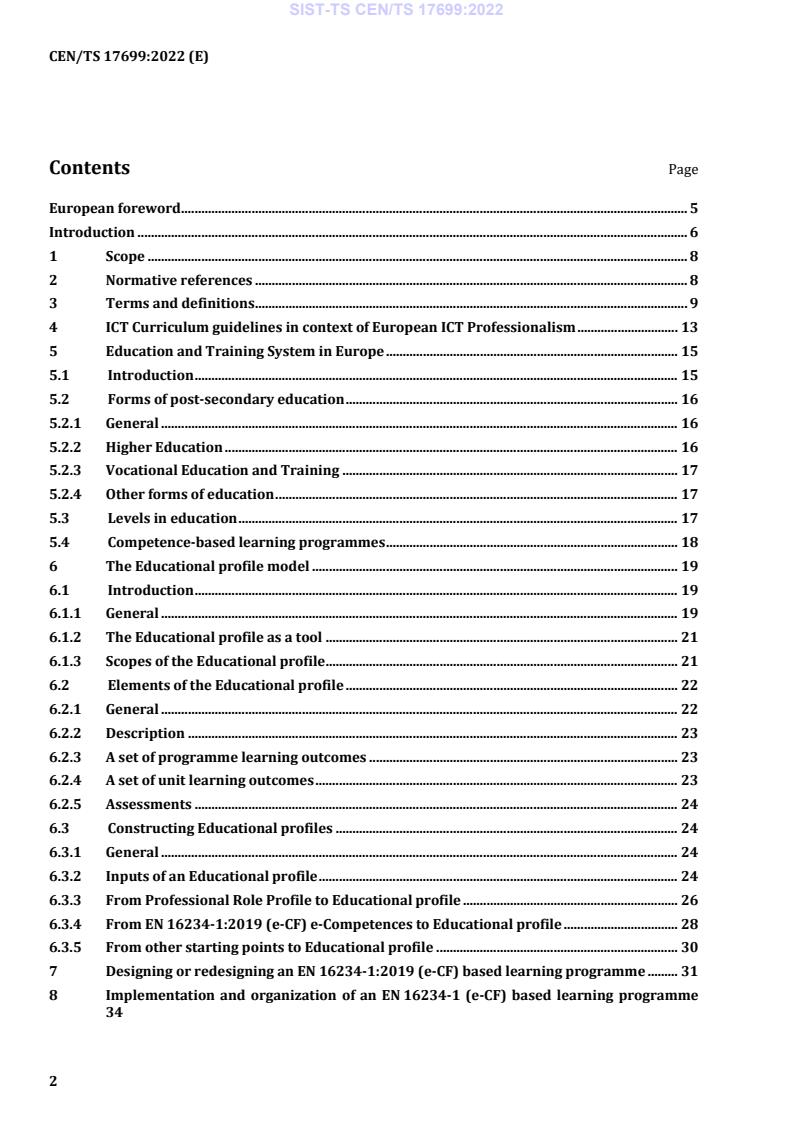
Contents Page
European foreword . 5
Introduction . 6
1 Scope . 8
2 Normative references . 8
3 Terms and definitions . 9
4 ICT Curriculum guidelines in context of European ICT Professionalism . 13
5 Education and Training System in Europe . 15
5.1 Introduction . 15
5.2 Forms of post-secondary education . 16
5.2.1 General . 16
5.2.2 Higher Education . 16
5.2.3 Vocational Education and Training . 17
5.2.4 Other forms of education . 17
5.3 Levels in education . 17
5.4 Competence-based learning programmes . 18
6 The Educational profile model . 19
6.1 Introduction . 19
6.1.1 General . 19
6.1.2 The Educational profile as a tool . 21
6.1.3 Scopes of the Educational profile . 21
6.2 Elements of the Educational profile . 22
6.2.1 General . 22
6.2.2 Description . 23
6.2.3 A set of programme learning outcomes . 23
6.2.4 A set of unit learning outcomes . 23
6.2.5 Assessments . 24
6.3 Constructing Educational profiles . 24
6.3.1 General . 24
6.3.2 Inputs of an Educational profile . 24
6.3.3 From Professional Role Profile to Educational profile . 26
6.3.4 From EN 16234-1:2019 (e-CF) e-Competences to Educational profile . 28
6.3.5 From other starting points to Educational profile . 30
7 Designing or redesigning an EN 16234-1:2019 (e-CF) based learning programme . 31
8 Implementation and organization of an EN 16234-1 (e-CF) based learning programme
8.1 EN 16234-1 (e-CF) compliancy . 34
8.1.1 Degrees of alignment . 34
8.1.2 EN 16234-1:2019 (e-CF) and the T-shaped professional. 35
8.1.3 How to stay EN 16234-1:2019 (e-CF) compliant . 35
8.2 Localization . 35
8.2.1 Local needs . 35
8.2.2 Linking to professional practice . 36
8.2.3 Cooperation with other educational institutes . 36
8.3 Staff training . 37
8.4 Accreditation and certification. 37
8.4.1 Accreditation . 37
8.4.2 Certification . 37
8.5 Communication and marketing. 37
8.5.1 External . 37
8.5.2 Internal . 37
Annex A (informative) ICT Professionalism for Europe underpinning references and standards 38
A.1 EN 16234-1:2019 (e-Competence Framework) . 38
A.2 CWA 16458-1:2018 European ICT Professional Role Profiles. 42
A.3 prEN 17748-1, Foundational Body of Knowledge for the ICT Profession (ICT BoK) . 45
A.4 FprCEN/TS 17834 European Professional Ethics Framework for the ICT Profession . 49
A.5 FprCEN/TR 17802 e-Competence performance indicators and common metrics . 50
Annex B (informative) e-Competence levels e-1 to e-5 from EN 16234-1:2019 (e-CF) . 51
Annex C (informative) EN 16234-1 (e-CF) and European ICT Professional Role Profiles Use Cases –
overview . 53
Annex D (informative) e-CF proficiency levels versus EQF and types of education . 57
Annex E (normative) The educational profile template . 58
Annex F (informative) Creating an Educational profile related to ICT Project management based
on different market needs and starting points . 60
F.1 Introduction . 60
F.2 ICT Project Management course within the existing bachelor programme . 61
F.3 A single ICT Project Management course as a short separate programme . 65
F.4 Full master programme for Junior project manager role based on ICT professional profile
F.5 MOOC that will provide learners basic theoretical knowledge related to ICT project
management . 72
F.6 Examples of educational profiles . 74
Annex G (informative) Example: Translating EN 16234-1 (e-CF) competence into Programme
Learning Outcome . 82
Annex H (informative) Example: Translating e-CF-based Programme Learning Outcome into
Learning Outcomes . 89
Annex I (informative) Questions and answers related to the development of an Educational profile
Bibliography . 147
European foreword
This document (CEN/TS 17699:2022) has been prepared by Technical Committee CEN/TC 428 “ICT
Professionalism and Digital Competences”, the secretariat of which is held by UNI.
Attention is drawn to the possibility that some of the elements of this document may be the subject of
patent rights. CEN shall not be held responsible for identifying any or all such patent rights.
Any feedback and questions on this document should be directed to the users’ national standards body.
A complete listing of these bodies can be found on the CEN website.
According to the CEN/CENELEC Internal Regulations, the national standards organisations of the
following countries are bound to announce this Technical Specification: Austria, Belgium, Bulgaria,
Croatia, Cyprus, Czech Republic, Denmark, Estonia, Finland, France, Germany, Greece, Hungary, Iceland,
Ireland, Italy, Latvia, Lithuania, Luxembourg, Malta, Netherlands, Norway, Poland, Portugal, Republic of
North Macedonia, Romania, Serbia, Slovakia, Slovenia, Spain, Sweden, Switzerland, Turkey and the United
Kingdom.
Introduction
To underpin the development of a European Professional ICT workforce there is an imperative to provide
education and training fit to meet the requirements of the ICT professional community. Enhanced
approaches to address the education of new ICT entrants and for existing practitioner continuous
professional development needs are required.
EN 16234-1:2019 e-Competence Framework (e-CF) - A common European Framework for ICT
Professionals in all sectors - Part 1: Framework incorporates a common language articulating key ICT
competences as required and applied in the ICT professional workplace. It offers a multifaceted
background of the required essential knowledge, skills and attitudes applicable to ICT professionals
across the breadth of ICT disciplines. It therefore follows that applying EN 16234-1 (e-CF) principles to
education provision offers a route map to the realization of a genuinely professional ICT community.
This document is designed to address ICT professionalism through education provision. It guides
curriculum and learning programme developers through the process of forming ICT practitioner courses
and/or programmes, along a pathway to support the development of a competent, professional European
ICT workforce.
This document provides guidance on the design/redesign, development and maintenance of a curriculum
or learning programme to achieve alignment or compliance with EN 16234-1:2019 (e-CF). A
methodology, deploying the application of educational profiles is provided as a step-by-step approach for
verifying programme content alignment with EN 16234-1 (e-CF) articulated competences.
The application of EN 16234-1:2019 (e-CF) and its intrinsic links to CWA 16458:2018 series European
ICT Professional Role Profiles and prEN 17748-1 - European Foundational Body of the Knowledge for the
ICT Profession (ICT BoK), for the purpose of guiding curriculum and learning programme design, has
been commissioned as an essential building block to support the vision of a European ICT Professional
community.
This document is neutral and directly linked to EN 16234-1:2019 (e-CF) and does not follow the specific
interests of a minority of major influencers.
This document is for application by educational institutions, learning programmes and certification
providers of all types, public and private, that provide ICT Professional education and training.
This document is informed and framed by the scope of EN 16234-1:2019 (e-CF) and thus covers the
entire ICT Professional process lifecycle.
This document provides:
• a methodological approach to linking EN 16234 (e-CF) and related documents with new or existing
learning programmes;
• a model relating ICT learning outcomes to EN 16234 (e-CF) related competences;
• an overview of strategic and operational aspects related to the implementation of an e-CF based
learning programme;
• a comprehensive overview of ICT professionalism documents and references providing a shared
European language for ICT Professional competences, knowledge, skills, attitudes and roles.
This document enhances and complements existing learning programme development and design
practice in the following ways:
• It embeds the context of European ICT Professionalism through compatibility with its four
cornerstones comprising EN 16234-1 (e-CF), prEN 17748-1 (ICT BoK), FprCEN/TS 17834 (European
Professional Ethics Framework for the ICT Profession) and by complementing the guidelines on e-
CF performance indicators and common metrics to form the Education and Training cornerstone.
• It facilitates translation of workplace competence needs into an education and learning environment.
• It supports transparency of education and training content through the application of EN 16234-1
(e-CF) common language and therefore influences learning programme currency and quality.
This document is structured by 8 Clauses, as described in Figure 1.
Clauses 1, 2 and 3 describe the scope, the normative references and the relevant terms and definitions
used.
Clauses 4 and 5 place the document in its European context. These items are dedicated to ICT
professionalism and the education and training system. Clause 4 introduces the European ICT
Professionalism Framework with its four building blocks and underlying reference publications. This
document is an important contribution for developing ICT Professionalism in Europe and provided as
part of a series, all related to this broader ICT Professionalism Framework. Clause 5 highlights the
different forms of education to which these ICT curriculum guidelines are relevant. It also relates the
European Qualification Framework and the concept of competences to the construct of the e-CF.
Clauses 6, 7 and 8 form the core of the document. They describe the (re)design of a learning programme
or curriculum based on EN 16234-1 (e-CF) and related documents. In Clause 6 the concept of educational
profiles is introduced, as a structure that enables a competence-oriented learning programme design and
development, thus providing a link between competences needed in a professional environment and the
learning outcomes of education and training. Clause 7 explains how to use this educational profile in the
design or redesign of an ICT curriculum or learning programme. Clause 8 focuses on specific
implementation and organization issues, related to the practical realization of an e-CF based ICT-
curriculum or learning programme in a concrete context.
Figure 1 — Navigation aid for Clauses 4 to 8 of this document
1 Scope
This document provides guidance and inspiration on how to design/redesign, develop, maintain, adjust,
and compare ICT Professional curricula and learning programmes as scoped by EN 16234-1:2019 and
related documents.
EN 16234-1:2019 (e-CF) is the starting guiding point for this document, for a shared European language
for ICT professional development. Other framework sources can be used to apply the methodology
outlined in this document.
This document is for application by educational institutions, learning programmes and certification
providers of all types (public and private), providing ICT Professional education and training including:
• Higher Education (HE);
• Vocational Education and Training (VET);
• Any other educational or training institution or provider in professional ICT, e.g. Continuous
Professional Development (CPD).
This document is focused on guiding education providers on how to align curricula and learning
programmes with the structure and principles of EN 16234-1 (e-CF) e-Competences and CWA 16458-1
ICT Professional Role Profiles. It applies to all forms of education, supporting educational providers who
plan to use a shared European language on knowledge, skills, competences and roles, as ingredients for
the successful provision of ICT Professional education and training.
The guidelines, provided by this document, include formal, non-formal and industry developed education
and training through the provision of high-level, consistent recommendations and guidance for ICT
curriculum or learning programme design by any education provider.
In this document, a distinction is made between a learning programme and a curriculum. The term
“curriculum” is strongly associated with formal educational institutions and degrees, the term “learning
programme” indicates a broader, more encompassing concept, also incorporating training and other
learning programmes, not restricted to only “curricula”. As the proposed methodology in this document
relates to both curricula and learning programmes, the term ‘learning programme’ is used throughout
the text. If the term ‘curriculum’ is used, then that narrower meaning is explicitly applicable in that
situation.
2 Normative references
The following documents are referred to in the text in such a way that some or all of their content
constitutes requirements of this document. For dated references, only the edition cited applies. For
undated references, the latest edition of the referenced document (including any amendments) applies.
EN 16234-1:2019, e-Competence Framework (e-CF) - A common European Framework for ICT
Professionals in all sectors - Part 1: Framework
prEN 17748-1, Foundational Body of Knowledge for the ICT Profession (ICT BoK) - Part 1: Body of
Knowledge
CWA 16458:2018 (all parts), European ICT professional role profiles
3 Terms and definitions
For the purposes of this document, the following terms and definitions apply.
3.1
Information and Communication Technology
ICT
digital computers and internet (communication) systems, including software, hardware, and
networks
[SOURCE: EN 16234-1:2019, definition 3.1]
3.2
Information and Communication Technology
ICT
cross sector of enterprises, including manufacturers, product suppliers or
service providers relating to the ICT field
[SOURCE: EN 16234-1:2019, definition 3.2]
3.3
ICT professional
person having the competence to plan, build, run, enable and/or manage ICT and having a professional
ICT qualification and/or ICT occupational experience; they include both employees of ICT companies and
ICT employees of organizations in all other sectors; they are all in the scope of this document
[SOURCE: EN 16234-1:2019, definition 3.3]
3.4
competence
demonstrated ability to apply knowledge, skills, and attitudes for achieving observable results
[SOURCE: EN 16234-1:2019, definition 3.5]
3.5
knowledge
body of facts which can be applied in a field of work or study (know what to do)
[SOURCE: EN 16234-1:2019, definition 3.6]
3.6
knowledge
theoretical or practical understanding and awareness of phenomena such as facts,
terminology, concepts, models or theories
[SOURCE: EN 17748-1:— , definition 3.6]
Note 1 to entry: Knowledge as defined in EN 16234-1 (e-CF) is rooted in the competence and work-based focus
of the ICT professional competence. Building on this for the educational and training sector a revised definition of
knowledge is included to incorporate the more theoretical aspects of knowledge which are covered in education
and to emphasize the importance of understanding.
Under preparation. Stage at the time of publication: prEN 17748-1:2021.
3.7
common knowledge
knowledge shared by all ICT professionals
[SOURCE: EN 17748-1:— , definition 3.7]
3.8
base knowledge
knowledge required for a particular area of ICT expertise as represented by CWA 16458-1
[SOURCE: EN 17748-1:— , definition 3.8]
3.9
specialised knowledge
detailed knowledge required at a high level of proficiency for an area of ICT expertise as represented by
CWA 16458-1
[SOURCE: EN 17748-1:— , definition 3.9]
3.10
body of knowledge
structured set of facts, terminology, concepts, models, and theories which represent the accepted and
agreed upon core knowledge base required by a particular profession with the aim of fostering
professional cohesion and encouraging a shared vision
[SOURCE: EN 17748-1:— , definition 3.15]
3.11
skill
ability to carry out managerial or technical activities and tasks, and this may be cognitive or practical
(know how to do it)
[SOURCE: EN 16234-1:2019, definition 3.7]
3.12
attitude
representing the human element of an e-competence and reflecting the way a person integrates
knowledge and skills and applies them in a contextually appropriate manner
[SOURCE: EN 16234-1:2019, definition 3.8]
3.13
transversal aspects
cross-cutting topics that are relevant to all competences defined by EN 16234-1 (e-CF); each transversal
aspect is provided by a title and a generic description that may be applied, dependent upon context by,
‘being aware of’ or ‘behaving proactively’ with regard to the transversal aspect description; awareness
and proactivity influence attitude linking with knowledge and skills as applied in the definition of
competence in EN 16234-1
[SOURCE: EN 16234-1:2019, definition 3.9]
3.14
transversal knowledge
knowledge that is coupled to one of the transversal aspects as distinguished in EN 16234-1 “e-CF”: T1
Accessibility, T2 Ethics, T3 ICT legal issues, T4 Privacy, T5 Security, T6 Sustainability and T7 Usability
[SOURCE: EN 17748-1:— , definition 3.19]
3.15
behavioural skills
interactive skills used to successfully engage with situations in the workplace, they may refer to work
quality, social interaction or emotion
EXAMPLES Communication, empathy, attention to detail and integrity.
[SOURCE: EN 16234-1:2019, definition 3.10]
3.16
behavioural knowledge
non-technical knowledge in support of behavioural skills concerning successful engagement in
workplace situations which may refer to work quality, social interaction, or emotions; examples include,
communication, collaboration and problem solving
[SOURCE: EN 17748-1:— , definition 3.21]
3.17
proficiency level
level indicating the degree of mastery that allows a person to meet requirements in the performance of a
competence
Note 1 to entry: Proficiency levels in the e-CF are characterized by a combination of levels of influence within a
community, context complexity, autonomy, and typical behaviour expressed by examples of action verbs.
EN 16234-1 (e-CF) incorporates proficiency levels e-1 through to e-5.
[SOURCE: EN 16234-1:2019, definition 3.11]
3.18
educational profile
structure that provides a link between competences needed in a professional environment and learning
outcomes of education and training
3.19
learning level
level indicating a grading and may be represented by a formal qualification; they generally derive from
an education system or indicate a grading in a taxonomy of intellectual or learning behaviours (like
memorising, applying, interpreting) and have a relationship with proficiency levels but are to be
distinguished from these
[SOURCE: EN 16234-1:2019, definition 3.12]
3.20
learning context
general, overall context in which the learner performs his/her learning activities; it is composed of
elements that influence learning activities of learners in general or of an individual learner, such as
national and international regulations and cultural, social, and economic factors
3.21
learning environment
any environment that allows a person to learn in providing certain conditions or procedures to do so;
this can be an educational institute, a training facility or a workplace, as well as a face-to-face, hybrid or
a virtual environment
3.22
learning programme
coherent set of learning activities with the aim of providing learners with certain knowledge, skills or
behaviour over a certain period of time
3.23
degree programme
type of learning programme resulting in a formal degree, such as a bachelor or a master programme
3.24
curriculum
type of learning programme, based on a predefined selection and organization of content, offered in a
certain way by an educational institution, such as a school, college, or university
3.25
learning process
transformative process of acquiring new understanding, knowledge, skills, behaviours, values, attitudes,
and preferences
3.26
learner
person who acquires knowledge, skills or behaviour, and by internalizing this informing his/her future
thinking and behaviour
3.27
student
person who is learning at an educational institution, such as a school, college, or university
3.28
learning path
specific route that reflects a person’s subsequent learning activities undertaken in a specific learning
environment throughout his/her life, career, or study
3.29
learning unit
elements of which a learning programme is composed of, e.g. a course, a module, an assignment
3.30
learning activity
activity specifically designed or arranged in a way to support learning
3.31
learning situation
specific set of circumstances specifically designed or arranged in a way to enable a learner to perform
learning activities
3.32
learning objective
statement of the teacher’s or instructor’s purpose for creating and teaching a specific learning unit or a
learning activity
3.33
learning outcome
statement of what a person knows, understands, and is able to do on completion of a learning process
[SOURCE: EQF]
3.34
programme learning outcome
statement that describes what a person knows, understands, and is able to do on completion of a learning
programme
[SOURCE: adapted from ECTS User’s guide]
3.35
deliverable
tangible or intangible result of a process of development, meant to be provided to another person
3.36
assessment
act of judging or deciding the amount, value, quality, or importance of something
3.37
summative assessment
assessment that indicates whether a learner has acquired the learning outcomes to an adequate level,
usually resulting in a reward such as credits, a certificate, or a diploma
3.38
formative assessment
assessment that provides insight into the learner’s progress and serves as an opportunity to give
directions on further development
4 ICT Curriculum guidelines in context of European ICT Professionalism
This document, although a stand-alone document, is part of a broader picture that supports the vision for
a European ICT Professional workforce. By adopting this document, educational providers will be able to
create or adapt existing learning programme in alignment with EN 16234-1 (e-CF). By adopting the
common language articulated in EN 16234-1 (e-CF), learning programmes will naturally embrace the
concept of competence. Furthermore, a communication bridge is established between education
providers, employers and ICT professionals, enabling all parties to engage in a shared mission to enhance
ICT professional capability and advance the establishment of digital leadership.
In the above context, this document is a key element of the four building blocks that are required for the
establishment of an ICT European profession:
• ICT professional Competences applied at the workplace as articulated by EN 16234-1:2019 (e-CF)
and its closely interrelated CWA 16458:2018 series ICT Professional Role Profiles,
• ICT professional knowledge as articulated by Bodies of Knowledge and the European Foundational
Body of Knowledge for the ICT Profession (ICT BoK),
• A shared understanding of Ethics foundations and principles,
• Education, Training, Assessment and Recognition providing the context for acquiring and getting
evidences of ICT professional knowledge, skills and competences.
Figure 2 illustrate the positioning of this document with regard to the four building blocks.
Figure 2 — The ICT Professional Curriculum Guidelines within the four building blocks of ICT
Professionalism for Europe
Deploying a shared European language on knowledge, skills, competences and roles, by using common
reference frameworks, is an essential ingredient for successful ICT professional education and training
provision.
Competences, as required at the ICT Professional workplace, are at the heart of the European ICT
Professionalism concept. They are expressed by EN 16234-1 (e-CF) and in the interdependent
CWA 16458-1 (European Professional Role Profiles), both are explained in more detail in the following
Clauses. Founded on the basis of ICT Professional workplace competence, EN 16234-1 (e-CF) establishes
a natural connection between practical activities and the education and training required to support and
develop the wide range of specialisms represented by CWA 16458-1 (European ICT Professional Role
Profiles). Each publication is accompanied by user support materials.
Education, training, assessment and recognition are essential for the establishment of a dynamic
profession and the organic growth of digital leadership.
Body of Knowledge (BoK) building block is closely related to this document as it articulates, in detail, the
knowledge components required by the ICT professional workforce. Expressed in knowledge units,
prEN 17748-1 (ICT BoK) provides linkage between workplace competence and essential education
incorporated within e-CF based learning programmes.
Ethics form another building block of professionalism and ensure a consistent and predictable
application of legal and moral principles which guide, influence and set standards for the attitude and
behaviour of ICT Professionals in the workplace.
The main documents and references in support of the ICT Professionalism Framework for Europe are
briefly outlined in Annex A.
5 Education and Training System in Europe
5.1 Introduction
The following Clause describes the context and environment within which this document resides.
The application of ICT continues to exert a growing influence and importance on the socio-economic
growth of society especially through digitalisation and globalization. For years, many relevant reports
show a high productivity within information industries, comparing to other business sectors. The ICT
sector is of high importance across the total economy, with the potential of more growth. These trends
determine a need for more skilled workers to fuel further growth.
There is a high demand for ICT specialists and their deployment across the economy represents a high
proportion of total employment. However, enterprises in most EU countries report difficulties in
recruiting ICT specialists. Predictions for the growth in demand for ICT specialists is also positive and
most European countries are expected to generate further demand for ICT professional jobs.
Therefore, there is pressure on education and training systems to align with demand from the job market
and to contribute to the continuous development of ICT professionals with the appropriate set of
competences.
Worldwide, there are many initiatives designed to produce ICT-related learning programmes. These
include Curriculum Development Guidelines by CEDEFOP [1] and the latest Computing Curricula 2020
resulting from long-term cooperation of the ACM and IEEE-CS in producing ICT-related curricula [2]. In
Europe, initiatives have commenced on the development of the ICT profession, as described in Annex A.
These initiatives are centred upon the development of the e-Competence Framework (EN 16234-1),
which provides a foundational base for further development of the ICT profession and supporting ICT
education.
The European Skills Agenda [3] aims to mobilize stakeholders to take concrete action for upskilling and
reskilling of people of working age. The four key principles of this Agenda can play an important role in
e-CF based learning programme development:
• Promoting a culture of lifelong learning for all,
• Building strong skills partnerships,
• Monitoring skills supply/demand and anticipating skills needs,
• Working against discrimination and for gender equality and equal opportunities.
This document, along with other initiatives, supports the European Skills Agenda for sustainable
competitiveness, social fairness and resilience that focuses on upskilling and reskilling of European
workforce.
5.2 Forms of post-secondary education
5.2.1 General
The European education system incorporates many forms of post-secondary education, including higher
education, vocational education and training and adult learning. It also includes further training from
within or outside of organizations, often referred to as continuous professional development [4]. This
clause includes a short description of three different forms of post-secondary education.
As stated in the introduction, this document is for application by education institutions, learning
programme and certification providers of all types, including public and private, providing ICT
Professional education and training with focus on:
• Higher Education (HE),
• Vocational and Educational Training (VET),
• Any other form of education or training in professional ICT e.g. Continuous Professional
Development (CPD).
5.2.2 Higher Education
The higher education system in Europe is regulated through a unique international collaboration
established through the European Higher Education Area (EHEA). The work of EHEA was defined as a
result of the Bologna process, launched with the Bologna Declaration of 1999. The future development of
Higher Education Area and vision for 2025 were discussed at the Gothenburg Social Summit 2017 which
resulted in a communication “Strengthening European Identity through Education and Culture” [5]. This
strategic document indicates a need for better connection between education and the world of work as:
“education and training equip people with the skills they need on the labour market and enable them
to respond to changing circumstances and structural change or disruption; education, training, re-
and up-skilling help to smoothen the transition between jobs; education and training give people the
chance to create jobs themselves”;
The renewed EU agenda for higher education [6], adopted by the Commission in May 2017, identifies four
key goals for European cooperation in higher education that, among others, consider “tackling future
skills mismatches and promoting excellence in skills development, building inclusive and connected
higher education systems and ensuring higher education institutions contribute to innovation”.
Curriculum guidelines, in support of one of the four building blocks of ICT professionalisms in Europe,
provide a connection between higher education and the labour market by applying the principles of the
European e-Competence Framework.
Although each country has different higher education systems, as part of EHEA they share some common
characteristics, including use of the European Qualification Framework and European Credit Transfer
and Accumulation System (ECTS) [7]. The ECTS is a tool of the EHEA that makes studies and courses more
transparent by helping students to move between countries and to have their academic qualifications
and study periods abroad recognized. One notable player within EHEA is The European Association for
Quality Assurance in Higher Education (ENQA), which promotes European co-operation in the field of
quality assurance in higher education, especially through the proposed Standards and guidelines for
quality assurance in the European Higher Education Area (ESG).
5.2.3 Vocational Education and Training
The VET educational system in Europe demonstrates a rich diversity of national systems and stakeholder
engagement. The Copenhagen process also encourages European cooperation in this field [8]. The
European credit system for vocational education and training (ECVET) [9] helps individuals in transfer,
recognition and accumulation of their assessed learning outcomes in VET and it is related to the EQF like
the European Credit Transfer Systems (ECTS) for HE. Furthermore, with the EQAVET Framework [10]
member states improve the quality assurance in VET.
Europass [11] also supports the comparability of vocational qualifications and facilitates access to
employment. Above all, Europass supports individuals changing employment across national borders,
enabling them to document their qualifications and experience. A personal record of all skills,
qualifications and accumulated experience is covered by the most important document, which may be
accompanied by additional Europass Certificate Supplements. Supplements describe country-specific
standards of the respective occupation and provide a brief description of the knowledge, skills and
competences acquired through vocational training. In addition, they provide information on the duration,
type and level of training as well as the course of education/type of educational institution at which this
was achieved. Europass also facilitates and enables the recognition of qualifications, competences and
experience for further learning and education.
5.2.4 Other forms of education
Within ICT Professional education and training many kinds of non-formal, informal and random learning
are important and relevant. The rapid rise of the ICT sector and continuous dynamic change require and
enable many forms of permanent ‘lifelong learning’ from within and outside the formal education system.
New and alternative forms of education have been created to address this need. Adult education, through
the provision of further training from within or outside of organizations and continuous professional
development are highly relevant to ICT professionals, including many engaged in the ‘digital
transformation’ of organizations outside of the ICT industry sector. To recognize and incorporate
acquired knowledge and skills, education providers have implemented accredita
...