

prEN 14492-1
(Main)Cranes - Power driven winches and hoists - Part 1: Power driven winches
General Information
- Abstract
This document is applicable to the design, information for use, maintenance and testing of power-driven winches for which the prime mover is an electric motor, hydraulic motor, or pneumatic motor. Winches are designed for the movement or manipulation of loads supported on level or inclined planes in situations where risks resulting from a failure of the winding mechanism or pulling medium are mitigated by external measures.
This document is not applicable to devices which handle suspended loads.
Generally, a winch is used without any additional transport movement, except in cases where a winch is used on a stranded vehicle for self-recovery of the vehicle.
Applications of winches covered are for example, but not limited to:
a) rope winches;
b) belt winches, except steel belts used as pulling media;
c) traction winches, including double capstan and traction sheave winches.
These types of winches a) to c) also include the following specific applications:
— vehicle recovery winches;
— winches for boat trailers;
— winches for stationary offshore applications.
NOTE Examples are shown in Annex H.
This document does not apply to:
— power-driven hoists in accordance with EN 14492-2;
— forestry winches in accordance with EN ISO 19472-1;
— winches for seagoing vessels and mobile offshore units;
— winches for the lifting of persons;
— NGL building hoists in accordance with EN 14492-2;
— winches for the handling of hot molten masses.
This document deals with the significant hazards, hazardous situations or hazardous events relevant to power driven winches when used as intended and under conditions of misuse which are reasonably foreseeable, identified in Annex A.
This document does not specify additional requirements for hazards related to the use of power driven winches in explosive atmospheres in underground mines.
- Status
- Not Published
- Publication Date
- 12-May-2027
- Technical Committee
- CEN/TC 147 - Cranes - Safety
- Drafting Committee
- CEN/TC 147/WG 17 - Power driven winches and hoists
- Current Stage
- 4060 - Closure of enquiry - Enquiry
- Start Date
- 20-Aug-2026
- Due Date
- 19-Mar-2026
- Completion Date
- 20-Aug-2026

Overview
prEN 14492-1 is a draft European Standard developed by CEN, addressing the safety and technical requirements for power-driven winches used with cranes and similar equipment. Specifically, this standard applies to winches powered by electric, hydraulic, or pneumatic motors, intended for moving or manipulating loads situated on level or inclined planes. The standard covers essential aspects such as design, safe operation, maintenance, and testing. Importantly, prEN 14492-1 does not apply to devices handling suspended loads, nor to winches used for lifting people, on seagoing vessels, or in hazardous mining environments.
By establishing harmonized guidelines, prEN 14492-1 helps manufacturers, users, and maintenance professionals ensure that power-driven winches meet the relevant health and safety requirements under the EU Machinery Regulation 2023/1230.
Key Topics
Scope and Exclusions
- Winches covered:
- Rope winches
- Belt winches (excluding steel belts as pulling media)
- Traction winches (including double capstan and traction sheave types)
- Typical applications addressed:
- Vehicle recovery winches
- Winches for boat trailers
- Winches for stationary offshore use
- Excluded equipment:
- Power-driven hoists (EN 14492-2)
- Forestry winches (EN ISO 19472-1)
- Winches for lifting people
- Winches for building hoists and handling hot molten materials
- Marine and offshore mobile unit winches
- Equipment designed for hazardous mining or explosive atmospheres
Safety and Performance Requirements
- Structural integrity: strength, fatigue resistance, and proof of competence for pulling media and hooks
- Safety devices: control mechanisms, pull force limiters, emergency stop functions, motion limiters, and braking systems
- Protective measures: electrical, pneumatic, and hydraulic safety (including overload protection, supply disconnects, and environmental protection)
- Noise control: engineering guidelines for noise reduction
- Cybersecurity and electromagnetic compatibility (EMC) for modern, remotely controlled winches
- Specialized requirements for vehicle recovery and boat trailer winches
Verification and Testing
- Procedures for verifying design and safety measures for both series-manufactured and custom winches
- Marking and user information requirements to support safe installation, operation, and maintenance
- Compliance with noise emission measurement and declaration
Applications
prEN 14492-1 provides practical value for a broad range of industries and scenarios involving movement or pulling of loads:
- Vehicle Recovery: Winches designed to pull or reposition vehicles stranded or stuck, ensuring controlled recovery operations.
- Boat Trailers: Specialized winches for pulling boats on or off trailers, suitable for marine environments.
- Industrial and Construction: Moving heavy loads across factory floors, construction sites, or inclined surfaces.
- Stationary Offshore Installations: Handling heavy machinery, equipment, or structural components safely and efficiently.
- General Rope and Belt Winching: Any setting where controlled pulling or positioning of loads is required, excluding suspended lifting.
The standard is crucial for manufacturers, safety assessors, service providers, and end users seeking to ensure winching equipment is robust, safe, and compliant with European safety legislation.
Related Standards
For comprehensive safety and compliance, prEN 14492-1 should be understood alongside the following related standards:
- EN 14492-2: Power-driven hoists (requirements specific to lifting suspended loads)
- EN ISO 12100: General principles for risk assessment and safety of machinery
- EN 13001 series: Design and structural integrity for cranes and related lifting machinery
- EN ISO 4413 / 4414: Safety requirements for hydraulic and pneumatic systems
- EN 62745: Safety for cableless (wireless) control of machinery
- EN IEC 61000 series: Electromagnetic compatibility (EMC) for industrial equipment
- EN ISO 13849-1 / 13850: Safety-related control systems and emergency stop functions
- ISO 16625: Selection and verification of wire ropes, drums, and sheaves for cranes and hoists
Adherence to these standards helps organizations achieve optimal safety and legal compliance for winching operations in the European context.
Relations
- Revises
EN 14492-1:2006+A1:2009 - Cranes - Power driven winches and hoists - Part 1: Power driven winches - Effective Date
- 19-Jan-2023
Frequently Asked Questions
prEN 14492-1 is a draft published by the European Committee for Standardization (CEN). Its full title is "Cranes - Power driven winches and hoists - Part 1: Power driven winches". This standard covers: This document is applicable to the design, information for use, maintenance and testing of power-driven winches for which the prime mover is an electric motor, hydraulic motor, or pneumatic motor. Winches are designed for the movement or manipulation of loads supported on level or inclined planes in situations where risks resulting from a failure of the winding mechanism or pulling medium are mitigated by external measures. This document is not applicable to devices which handle suspended loads. Generally, a winch is used without any additional transport movement, except in cases where a winch is used on a stranded vehicle for self-recovery of the vehicle. Applications of winches covered are for example, but not limited to: a) rope winches; b) belt winches, except steel belts used as pulling media; c) traction winches, including double capstan and traction sheave winches. These types of winches a) to c) also include the following specific applications: — vehicle recovery winches; — winches for boat trailers; — winches for stationary offshore applications. NOTE Examples are shown in Annex H. This document does not apply to: — power-driven hoists in accordance with EN 14492-2; — forestry winches in accordance with EN ISO 19472-1; — winches for seagoing vessels and mobile offshore units; — winches for the lifting of persons; — NGL building hoists in accordance with EN 14492-2; — winches for the handling of hot molten masses. This document deals with the significant hazards, hazardous situations or hazardous events relevant to power driven winches when used as intended and under conditions of misuse which are reasonably foreseeable, identified in Annex A. This document does not specify additional requirements for hazards related to the use of power driven winches in explosive atmospheres in underground mines.
This document is applicable to the design, information for use, maintenance and testing of power-driven winches for which the prime mover is an electric motor, hydraulic motor, or pneumatic motor. Winches are designed for the movement or manipulation of loads supported on level or inclined planes in situations where risks resulting from a failure of the winding mechanism or pulling medium are mitigated by external measures. This document is not applicable to devices which handle suspended loads. Generally, a winch is used without any additional transport movement, except in cases where a winch is used on a stranded vehicle for self-recovery of the vehicle. Applications of winches covered are for example, but not limited to: a) rope winches; b) belt winches, except steel belts used as pulling media; c) traction winches, including double capstan and traction sheave winches. These types of winches a) to c) also include the following specific applications: — vehicle recovery winches; — winches for boat trailers; — winches for stationary offshore applications. NOTE Examples are shown in Annex H. This document does not apply to: — power-driven hoists in accordance with EN 14492-2; — forestry winches in accordance with EN ISO 19472-1; — winches for seagoing vessels and mobile offshore units; — winches for the lifting of persons; — NGL building hoists in accordance with EN 14492-2; — winches for the handling of hot molten masses. This document deals with the significant hazards, hazardous situations or hazardous events relevant to power driven winches when used as intended and under conditions of misuse which are reasonably foreseeable, identified in Annex A. This document does not specify additional requirements for hazards related to the use of power driven winches in explosive atmospheres in underground mines.
prEN 14492-1 is classified under the following ICS (International Classification for Standards) categories: 53.020.20 - Cranes; 53.020.99 - Other lifting equipment. The ICS classification helps identify the subject area and facilitates finding related standards.
prEN 14492-1 has the following relationships with other standards: It is inter standard links to EN 14492-1:2006+A1:2009. Understanding these relationships helps ensure you are using the most current and applicable version of the standard.
prEN 14492-1 is associated with the following European legislation: EU Directives/Regulations: 2006/42/EC, 2023/1230; Standardization Mandates: M/396, M/605. When a standard is cited in the Official Journal of the European Union, products manufactured in conformity with it benefit from a presumption of conformity with the essential requirements of the corresponding EU directive or regulation.
prEN 14492-1 is available in PDF format for immediate download after purchase. The document can be added to your cart and obtained through the secure checkout process. Digital delivery ensures instant access to the complete standard document.
Standards Content (Sample)
SLOVENSKI STANDARD
01-maj-2026
Dvigala (žerjavi) - Motorni vitli in dvižni mehanizmi - 1. del: Motorni vitli
Cranes - Power driven winches and hoists - Part 1: Power driven winches
Krane - Kraftgetriebene Winden und Hubwerke - Teil 1: Kraftgetriebene Winden
Appareils de levage à charge suspendue - Treuils et palans motorisés - Partie 1 : Treuils
de traction motorisés
Ta slovenski standard je istoveten z: prEN 14492-1
ICS:
53.020.20 Dvigala Cranes
2003-01.Slovenski inštitut za standardizacijo. Razmnoževanje celote ali delov tega standarda ni dovoljeno.
DRAFT
EUROPEAN STANDARD
NORME EUROPÉENNE
EUROPÄISCHE NORM
May 2026
ICS 53.020.20; 53.020.99 Will supersede EN 14492-1:2006+A1:2009
English Version
Cranes - Power driven winches and hoists - Part 1: Power
driven winches
Appareils de levage à charge suspendue - Treuils et Krane - Kraftgetriebene Winden und Hubwerke - Teil
palans motorisés - Partie 1 : Treuils de traction 1: Kraftgetriebene Winden
motorisés
This draft European Standard is submitted to CEN members for enquiry. It has been drawn up by the Technical Committee
CEN/TC 147.
If this draft becomes a European Standard, CEN members are bound to comply with the CEN/CENELEC Internal Regulations
which stipulate the conditions for giving this European Standard the status of a national standard without any alteration.
This draft European Standard was established by CEN in three official versions (English, French, German). A version in any other
language made by translation under the responsibility of a CEN member into its own language and notified to the CEN-CENELEC
Management Centre has the same status as the official versions.
CEN members are the national standards bodies of Austria, Belgium, Bulgaria, Croatia, Cyprus, Czech Republic, Denmark, Estonia,
Finland, France, Germany, Greece, Hungary, Iceland, Ireland, Italy, Latvia, Lithuania, Luxembourg, Malta, Netherlands, Norway,
Poland, Portugal, Republic of North Macedonia, Romania, Serbia, Slovakia, Slovenia, Spain, Sweden, Switzerland, Türkiye and
United Kingdom.
Recipients of this draft are invited to submit, with their comments, notification of any relevant patent rights of which they are
aware and to provide supporting documentation.
Warning : This document is not a European Standard. It is distributed for review and comments. It is subject to change without
notice and shall not be referred to as a European Standard.
EUROPEAN COMMITTEE FOR STANDARDIZATION
COMITÉ EUROPÉEN DE NORMALISATION
EUROPÄISCHES KOMITEE FÜR NORMUNG
CEN-CENELEC Management Centre: Rue de la Science 23, B-1040 Brussels
© 2026 CEN All rights of exploitation in any form and by any means reserved Ref. No. prEN 14492-1:2026 E
worldwide for CEN national Members.
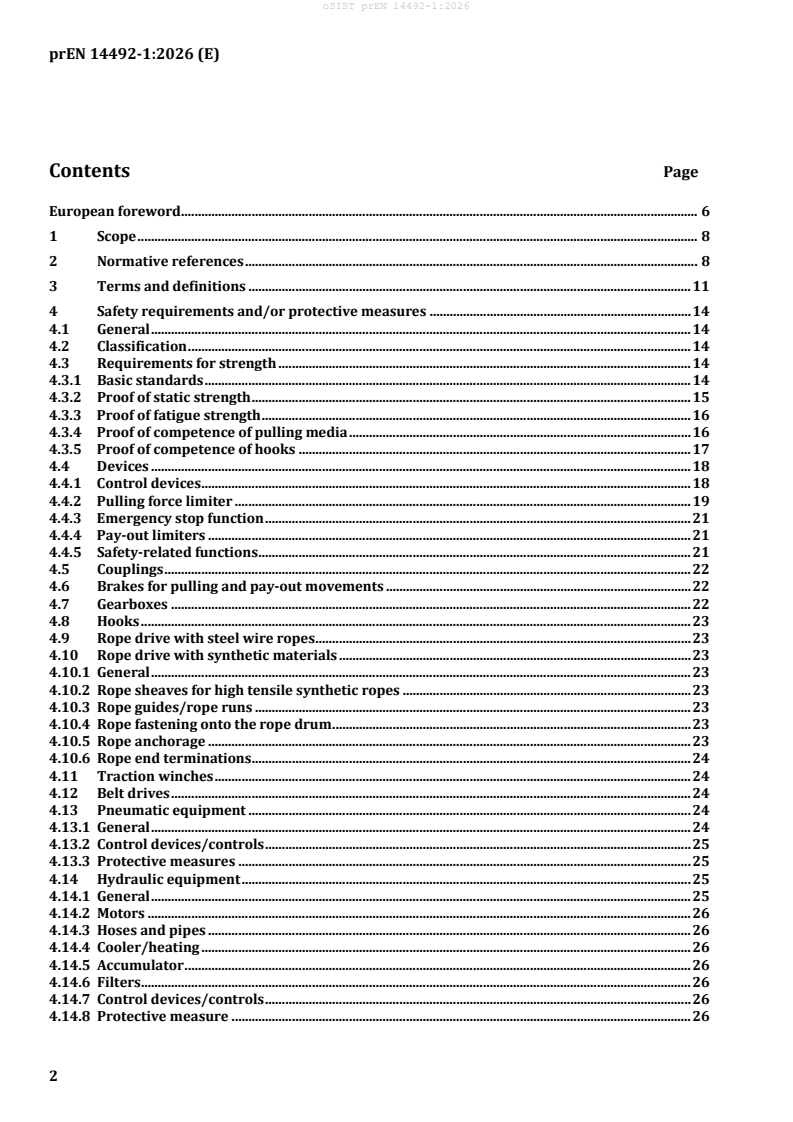
Contents Page
European foreword . 6
1 Scope . 8
2 Normative references . 8
3 Terms and definitions . 11
4 Safety requirements and/or protective measures . 14
4.1 General . 14
4.2 Classification . 14
4.3 Requirements for strength . 14
4.3.1 Basic standards . 14
4.3.2 Proof of static strength . 15
4.3.3 Proof of fatigue strength . 16
4.3.4 Proof of competence of pulling media . 16
4.3.5 Proof of competence of hooks . 17
4.4 Devices . 18
4.4.1 Control devices . 18
4.4.2 Pulling force limiter . 19
4.4.3 Emergency stop function . 21
4.4.4 Pay-out limiters . 21
4.4.5 Safety-related functions . 21
4.5 Couplings . 22
4.6 Brakes for pulling and pay-out movements . 22
4.7 Gearboxes . 22
4.8 Hooks . 23
4.9 Rope drive with steel wire ropes . 23
4.10 Rope drive with synthetic materials . 23
4.10.1 General . 23
4.10.2 Rope sheaves for high tensile synthetic ropes . 23
4.10.3 Rope guides/rope runs . 23
4.10.4 Rope fastening onto the rope drum . 23
4.10.5 Rope anchorage . 23
4.10.6 Rope end terminations . 24
4.11 Traction winches . 24
4.12 Belt drives . 24
4.13 Pneumatic equipment . 24
4.13.1 General . 24
4.13.2 Control devices/controls . 25
4.13.3 Protective measures . 25
4.14 Hydraulic equipment . 25
4.14.1 General . 25
4.14.2 Motors . 26
4.14.3 Hoses and pipes . 26
4.14.4 Cooler/heating . 26
4.14.5 Accumulator . 26
4.14.6 Filters . 26
4.14.7 Control devices/controls . 26
4.14.8 Protective measure . 26
4.15 Electrical equipment of winches . 27
4.15.1 General . 27
4.15.2 Electrical supply . 27
4.15.3 Ambient and operating conditions . 27
4.15.4 Supply disconnecting and switching devices . 27
4.15.5 Communications network . 27
4.15.6 Overload protection of motors . 28
4.15.7 Emergency stop function . 28
4.15.8 Cableless control . 28
4.15.9 Electromagnetic compatibility. 28
4.15.10 Cybersecurity . 28
4.16 Electric motors. 28
4.16.1 General . 28
4.16.2 Degrees of protection . 29
4.17 Electric motion limiters . 29
4.17.1 General . 29
4.17.2 Temperature . 29
4.18 Reduction of noise by design . 29
4.18.1 General . 29
4.18.2 Main noise sources on winch units . 29
4.18.3 Measures for noise reduction at source . 30
4.18.4 Protective measures . 30
4.19 Additional requirements for vehicle recovery winches and winches on boat trailers . 30
4.19.1 General . 30
4.19.2 Motion limiters . 30
4.19.3 Auxiliary brake . 30
4.19.4 Rope drives . 30
4.19.5 Electrical supply . 31
5 Verification of the safety requirements and/or protective measures . 31
5.1 Winches manufactured in series . 31
5.2 Winches designed individually . 32
6 User information . 40
6.1 General . 40
6.2 Special requirements . 40
6.3 Marking . 42
Annex A (informative) List of significant hazards . 44
Annex B (informative) Additional requirements for operation in aggressive environments and
outdoors . 48
B.1 General . 48
B.2 Ropes . 48
Annex C (informative) Additional requirements for operation at low temperatures . 50
Annex D (normative) Noise test code . 51
D.1 Scope . 51
D.2 General . 51
D.3 Determination of the emission sound pressure level at the operator’s position by
measurement . 51
D.3.1 General . 51
D.3.2 Measurement for winches . 51
D.4 Determination of the sound power level . 52
D.4.1 General . 52
D.4.2 Measurement . 52
D.5 Mounting and operating conditions . 52
D.5.1 General . 52
D.5.2 Operating conditions . 52
D.6 Uncertainties . 52
D.7 Information to be recorded . 53
D.8 Information to be reported . 53
D.9 Declaration and verification of noise emission values . 53
Annex E (normative) Power driven series winch mechanisms — Test procedure for verification of
the classification . 54
E.1 Introduction . 54
E.2 Application . 54
E.3 Implementation of the test . 54
E.3.1 Framework conditions . 54
E.3.2 Configurations . 55
E.3.3 Test program . 56
E.4 Acceptance criteria . 58
E.5 Determination of load variation factor according to reeving . 59
Annex F (informative) Conversion of classification for winches which are classified according to
previous standards . 61
Annex G (informative) Overview of standards published by CEN/TC 147 . 63
G.1 General . 63
G.2 Selecting a suitable standard . 63
Annex H (informative) Examples of winches . 65
H.1 General . 65
H.2 Drum winches . 65
H.3 Traction winches . 66
H.4 Vehicle recovery winches . 68
H.5 Winches for boat trailers . 68
Annex ZA (informative) Relationship between this document and the essential requirements of
Regulation (EU) 2023/1230 aimed to be covered . 69
Figures
Figure 1 — Undercut groove base profile . 24
Figure E.1 — Opposed winding arrangement . 55
Figure E.2 — Symmetrical rope lead-off about the drum centre . 56
Figure E.3 — Normal operation during the test (Cycle I) . 58
th
Figure E.4 — Every 16 pick up from the floor at rated pulling speed, if possible (Cycle II) . 58
Figure H.1 — Drum winch, manufactured in series . 65
Figure H.2 — Drum winch, manufactured individually . 65
Figure H.3 — Drum winch, pneumatically driven . 66
Figure H.4 — Traction winch, standard type . 66
Figure H.5 — Traction winch with 2 load bearing ropes and storage drum . 66
Figure H.6 — Traction winch with a rope storage . 66
Figure H.7 — Traction winch . 67
Figure H.8 — Traction winch with storage drum . 67
Figure H.9 — Vehicle recovery winch with electrical drive. 68
Figure H.10 — Vehicle recovery winch with hydraulic drive . 68
Figure H.11 — Winch for boat trailers with electrical drive . 68
Tables
Table 1 — Classification of winches by number of pulling cycles . 14
Table 2 — Classification of winches by pulling distance . 14
Table 3 — Typical values of parameters for proof of competence of ropes . 16
Table 4 — design factor of synthetic rope by classification of winch . 17
Table 5 — Force history parameter for Formula (3) . 18
Table 6 — Methods to be used to verify conformity with the safety requirements and/or measures . 33
Table A.1 — List of significant hazards and associated requirements . 44
Table F.1 — Table of max load path [P] during test according to previous standards . 61
Table G.1 — Product standards for lifting machinery . 63
Table G.2 — Subject specific and component specific standards . 64
European foreword
This document has been prepared by Technical Committee CEN/TC 147 “Cranes – Safety”, the secretariat of
which is held by SFS.
This document will supersede EN 14492-1:2006+A1:2009.
This document has been prepared under a standardization request addressed to CEN by the European
Commission. The Standing Committee of the EFTA States subsequently approves these requests for its Member
States.
For the relationship with EU Legislation, see informative Annex ZA, which is an integral part of this document.
This is the first part of the standard “Cranes — Power driven winches and hoists”. The parts of the standard are:
— Part 1: Power driven winches [the present document]
— Part 2: Power driven hoists
For the relationship with other European Standards for cranes, see informative Annex G.
CEN/TC 147 WG17 has reviewed EN 14492-1:2006+A1:2009 to adapt the standard to the technical progress,
new requirements and changes in standards referenced; the main topics are:
— winches are re-defined as: “machine designed for the movement or manipulation of a load supported on
level or inclined planes using a pulling medium (e.g. rope or chain) and winding mechanism”;
— the scope will exclude forestry winches which are covered by EN ISO 19472-1;
— the scope will clarify that internal combustion motor as prime mover are not covered;
— the design and calculation reference to EN 13001-1, EN 13001−2 and EN 13001−3-1. The design according
to the FEM-documents: FEM 1.001, FEM 9.901 does not apply any longer;
— the design and calculation to ISO 16625:2025 is incorporated. The standards ISO 4308-1:2003, 5.7 Rope
drives does not apply any longer;
— the design and calculation to EN 13001-3-5:2025 “Hook” is in-cooperated;
— the EN 14492-1 references to FprEN 13135:2026 ;
— new requirements for the use of high-tensile synthetic ropes;
— new requirements for cyber-security;
— new requirements for cable-less controls;
— new requirements for electromagnetic compatibility (EMC);
— a guidance of relationships between the FEM and ISO-Classification (Winch Classification) and the new
Classification in accordance with EN 13001 series is added; see Annex G.
Introduction
This document is a harmonized standard to provide one means for power driven winches to conform to the
essential health and safety requirements of the EU Regulation 2023/1230 (Machinery). The machinery
concerned and the extent to which hazards, hazardous situations and events are covered are indicated in the
scope of this document.
This document is a type-C standard as stated in EN ISO 12100:2010.
This document is of relevance, in particular, for the following stakeholder groups representing the market
players with regard to machinery safety:
— machine manufacturers (small, medium and large enterprises);
— health and safety bodies (regulators, accident prevention organizations, market surveillance etc.).
Others can be affected by the level of machinery safety achieved with the means of the document by the above-
mentioned stakeholder groups:
— machine users/employers (small, medium and large enterprises);
— machine users/employees (e.g. trade unions, organizations for people with special needs);
— service providers, e.g. for maintenance (small, medium and large enterprises);
— consumers (in case of machinery intended for use by consumers).
The above-mentioned stakeholder groups have been given the possibility to participate at the drafting process
of this document. The machinery concerned and the extent to which hazards, hazardous situations or hazardous
events are covered are indicated in the Scope of this document.
When requirements of this type-C standard are different from those which are stated in type-A or type-B
standards, the requirements of this type-C standard take precedence over the requirements of the other
standards for machines that have been designed and built according to the requirements of this type-C standard.
1 Scope
This document is applicable to the design, information for use, maintenance and testing of power-driven winches
for which the prime mover is an electric motor, hydraulic motor, or pneumatic motor. Winches are designed for
the movement or manipulation of loads supported on level or inclined planes in situations where risks resulting
from a failure of the winding mechanism or pulling medium are mitigated by external measures.
This document is not applicable to devices which handle suspended loads.
Generally, a winch is used without any additional transport movement, except in cases where a winch is used on
a stranded vehicle for self-recovery of the vehicle.
Applications of winches covered are for example, but not limited to:
a) rope winches;
b) belt winches, except steel belts used as pulling media;
c) traction winches, including double capstan and traction sheave winches.
These types of winches a) to c) also include the following specific applications:
— vehicle recovery winches;
— winches for boat trailers;
— winches for stationary offshore applications.
NOTE Examples are shown in Annex H.
This document does not apply to:
— power-driven hoists in accordance with EN 14492-2;
— forestry winches in accordance with EN ISO 19472-1;
— winches for seagoing vessels and mobile offshore units;
— winches for the lifting of persons;
— NGL building hoists in accordance with EN 14492-2;
— winches for the handling of hot molten masses.
This document deals with the significant hazards, hazardous situations or hazardous events relevant to power
driven winches when used as intended and under conditions of misuse which are reasonably foreseeable,
identified in Annex A.
This document does not specify additional requirements for hazards related to the use of power driven winches
in explosive atmospheres in underground mines.
2 Normative references
The following documents are referred to in the text in such a way that some or all of their content constitutes
requirements of this document. For dated references, only the edition cited applies. For undated references, the
latest edition of the referenced document (including any amendments) applies.
EN 12077-2:2024, Cranes safety — Requirements for health and safety — Part 2: Limiting and indicating devices
EN 13001-1:2015, Cranes — General design — Part 1: General principles and requirements
EN 13001-2:2021, Crane safety — General design — Part 2: Load actions
EN 13001-3-1:2025, Cranes — General Design — Part 3-1: Limit States and proof competence of steel structure
EN 13001-3-5:2025, Cranes — General design — Part 3-5: Limit states and proof of competence of forged and cast
hooks
FprEN 13135:2026, Cranes — Safety — Requirements for equipment
EN 13557:2024, Cranes — Control devices and control stations
EN 60529:1991, Degrees of protection provided by enclosures (IP Code) (IEC 60529:1989)
EN 61000-6-7:2015, Electromagnetic compatibility (EMC) — Part 6-7: Generic standards — Immunity
requirements for equipment intended to perform functions in a safety-related system (functional safety) in industrial
locations (IEC 61000-6-7:2014)
EN 62745:2017, Safety of machinery — Requirements for cableless control systems of machinery
(IEC 62745:2017)
EN ISO 3744:2010, Acoustics — Determination of sound power levels and sound energy levels of noise sources using
sound pressure — Engineering methods for an essentially free field over a reflecting plane (ISO 3744:2010)
EN ISO 4413:2010, Hydraulic fluid power — General rules and safety requirements for systems and their
components (ISO 4413:2010)
EN ISO 4414:2010, Pneumatic fluid power — General rules and safety requirements for systems and their
components (ISO 4414:2010)
EN ISO 4871:2009, Acoustics — Declaration and verification of noise emission values of machinery and equipment
(ISO 4871:1996)
EN ISO 7010:2020, Graphical symbols — Safety colours and safety signs — Registered safety signs
(ISO 7010:2019)
EN ISO 11201:2010, Acoustics — Noise emitted by machinery and equipment — Determination of emission sound
pressure levels at a work station and at other specified positions in an essentially free field over a reflecting plane
with negligible environmental corrections (ISO 11201:2010)
Under preparation on CEN/TC 147/WG 3.
As impacted by EN 60529:1991/A1:2000, EN 60529:1991/A2:2013 and EN 60529:1991/A2:2013/AC:2019-02, EN
60529:1991/AC:2016-12 and EN 60529:1991/corrigendum May 1993.
As impacted by EN 62745:2017/A11:2020.
As impacted by EN ISO 7010:2020/A1:2020; EN ISO 7010:2020/A2:2022; EN ISO 7010:2020/A3:2022; EN ISO
7010:2020/A4:2023; EN ISO 7010:2020/A5:2023; EN ISO 7010:2020/A6:2023; EN ISO 7010:2020/A7:2024; EN ISO
7010/A8:2024.
EN ISO 11688-1:2009, Acoustics — Recommended practice for the design of low-noise machinery and
equipment — Part 1: Planning (ISO/TR 11688-1:1995)
EN ISO 12100:2010, Safety of machinery — General principles for design — Risk assessment and risk reduction
(ISO 12100:2010)
EN ISO 13849-1:2023, Safety of machinery — Safety-related parts of control systems — Part 1: General principles
for design (ISO 13849-1:2023)
EN ISO 13850:2015, Safety of machinery — Emergency stop function — Principles for design (ISO 13850:2015)
EN ISO 20607:2019, Safety of machinery — Instruction handbook — General drafting principles (ISO 20607:2019)
EN IEC 60034-5:2020, Rotating electrical machines — Part 5: Degrees of protection provided by the integral
design of rotating electrical machines (IP code) Classification (IEC 60034-5:2020)
EN IEC 60204-32:2025, Safety of machinery — Electrical equipment of machines — Part 32: Requirements for
hoisting machines (IEC 60204-32:2023)
EN IEC 61000-6-2:2019, Electromagnetic compatibility (EMC) — Part 6-2: Generic standards — Immunity for
industrial environments (IEC 61000-6-2:2016)
EN IEC 61000-6-4:2019, Electromagnetic compatibility (EMC) — Part 6-4: Generic standards — Emission
standard for industrial environments (IEC 61000-6-4:2018)
EN IEC 61800-3:2023, Adjustable speed electrical power drive systems — Part 3: EMC requirements and specific
test methods for PDS and machine tools (IEC 61800-3:2022)
EN IEC 62443-3-3:2019, Industrial communication networks — Network and system security — Part 3-3: System
security requirements and security levels (IEC 62443-3-3:2013)
EN IEC 62443-4-2:2019, Security for industrial automation and control systems — Part 4-2: Technical security
requirements for IACS components (IEC 62443-4-2:2019)
ISO 3864-2:2016, Graphical symbols — Safety colours and safety signs — Part 2: Design principles for product
safety labels
ISO 12482:2014, Cranes — Monitoring for crane design working period
ISO 16625:2025, Cranes and hoists — Selection of wire ropes, drums and sheaves
As impacted by EN IEC 60034-5:2020/AC:2024-01.
As impacted by EN IEC 61800-3:2023/AC:2025-04.
As impacted by EN IEC 62443-3-3:2019/AC:2019-10.
As impacted by EN IEC 62443-4-2:2019/AC:2022-09.
3 Terms and definitions
For the purposes of this document, the following terms and definitions given in EN ISO 12100:2010 and the
following apply.
ISO and IEC maintain terminology databases for use in standardization at the following addresses:
— IEC Electropedia: available at http://www.electropedia.org/
— ISO Online browsing platform: available at http://www.iso.org/obp
3.1
winch
machine which is designed for the movement or manipulation of loads supported on level or inclined planes in
situations where risks resulting from a failure of the winding mechanism or pulling medium are mitigated by
external measures
Note 1 to entry: Machines handling suspended loads are excluded.
Note 2 to entry: Examples are given in Annex H.
3.2
anchorage
complete device to anchor the pulling media to a fixed point
3.3
belt drive
system of belts, belt pulleys, belt drums and belt anchorages
3.4
direct control
main power supply to the winch is directly controlled by a hand-controlled actuator without additional means
between the actuator and the main power circuit
3.5
hydraulic component
element (e.g. valve, filter) interconnected and forming an operational hydraulic system
3.6
hydraulic overpressure
pressure exceeding the rated pressure
3.7
hydraulic system
fluid power system, where power is transmitted and controlled through a fluid (relates only to hydraulic
technology) under pressure within a circuit
3.8
indirect control
main power supply to the winch is not directly controlled by a hand-controlled actuator but uses additional
means between the hand-controlled actuator and the main power circuit
3.9
raising
lowering
movement of the load supported on an inclined plane which results in a change to its horizontal and vertical
position
3.10
maximum speed
maximum speed of the pulling medium which can be achieved by the winch
3.11
power source
provider of the energy to drive the prime mover of a winch is either electrical, hydraulic, pneumatic
3.12
pulling
moving of loads supported on level planes where the removal of the pulling force or a failure of the pulling
mechanism or pulling medium results either in no movement of the load, or a movement that cannot result in a
significant hazard
3.13
pulling medium
part of the winch by which the drive mechanism of the winch is connected to the load
3.14
pulling force limiter
device that automatically prevents the winch from pulling loads in excess of its maximum pulling force,
considering the dynamic effects occurring during normal operational use
3.15
required maximum pressure
maximum required pressure in hydraulic or pneumatic systems at which the component is intended to operate
for a number of repetitions to assure service life and achieving the specified maximum performance data
3.16
rated pulling force
F
RP
maximum force the winch is designed to operate at rated speed; in the case of winches with multi –layer winding,
this is the value on the bottom layer of the drum
3.17
rated speed
linear speed of the pulling medium when pulling at rated pulling force - of the winch; in the case of winches with
multi –layer winding, this is the value on the bottom layer of the drum:
— in case of electric motors, the rated voltage and rated frequency applies;
— in case of hydraulic motors, the rated flow applies;
— in case of pneumatic motors, the rated pressure applies
3.18
rope anchorage
arrangement comprising the parts which connect the rope termination to the major load bearing structure
EXAMPLE Pins, bolts, compensating levers, tension rods.
3.19
rope drive
system of ropes running on rope drums or traction sheaves and over rope sheaves, and rope attachment parts
3.20
rope end termination
arrangement that has direct contact with the rope in order to allow its connection to e.g. rope anchorage and
hook
3.21
rope fastening onto the rope drum
all parts with which the rope is fastened onto the rope drum
3.22
traction winch
winch where a rope is not stored on a drum but passes through a rope drive in order to achieve the necessary
traction required for rated pulling force
3.23
vehicle recovery winch
winch installed on a vehicle or a trailer for the purpose of self-recovery, recovery and loading and unloading of
inoperative and operational vehicles, machinery, caravans and boats onto the carrying platform or other
supporting structures
3.24
winch for a boat trailer
winch fitted to a boat trailer and used for lowering the boat from the trailer into the water, or pulling the boat
out of the water onto the trailer
3.25
working coefficient
ratio of the minimum breaking force of the pulling medium divided by the rated pulling force
3.26
maximum pulling force
F
max
force which can be achieved by the winch when the pulling force limiter is triggered which, in the case of winches
with multi –layer winding, is the value on the bottom layer of the drum
3.27
design factor
ratio between the minimum breaking force of the pulling medium divided by the maximum pulling force
3.28
working cycle
for the purpose of
...