

EN 17066-2:2025
(Main)Insulated means of transport for temperature sensitive goods - Requirements and testing - Part 2: Equipment
- Abstract
The document is applicable to thermally insulated means of transport used for temperature sensitive goods equipped with a cooling and/or heating device.
This document is applicable to the terminology, the requirements for thermal insulation, air tightness, dimensioning of equipment with cooling and/or heating device for long distance and distribution transport.
This document does not apply to further land transport requirements with regard to dimensions, weights, etc. Further this document does not apply to safety requirements or special requirements for thermal containers covered by ISO 1496-2.
- Status
- Published
- Publication Date
- 30-Sep-2025
- Current Stage
- 6060 - Definitive text made available (DAV) - Publishing
- Start Date
- 01-Oct-2025
- Due Date
- 10-Oct-2025
- Completion Date
- 01-Oct-2025

Overview
EN 17066-2:2025 - "Insulated means of transport for temperature sensitive goods - Requirements and testing - Part 2: Equipment" (CEN) specifies requirements for thermally insulated transport equipment that are fitted with a cooling and/or heating device. It covers terminology, thermal insulation and air tightness requirements, and the dimensioning and testing of equipment used for both long‑distance and distribution transport of temperature‑sensitive goods. The standard does not cover vehicle dimensions/weights, general safety requirements or special thermal container rules already given in ISO 1496-2.
Key topics and technical requirements
- Scope & terminology: definitions for compartment types, mechanically and non‑mechanically refrigerated equipment, eutectic elements, distribution versus long‑distance transport.
- Thermal insulation & air tightness: requirements and guidance to minimise heat gain and energy consumption (see informative Annex C).
- Cooling/heating device dimensioning: required capacity to maintain product temperatures during transport including compensation for door openings and multiple stops. Addresses mechanically refrigerated systems and non‑mechanical cold sources (dry ice, liquefied gases, eutectic elements).
- Internal air circulation & airflow design: forced‑ventilation design rules, minimum air velocity (minimum 1.0 m/s at a specified location), use of air ducts for compartments >6 m, duct length and cross‑section guidance (20–75% of compartment length), and roof outlet positioning for units >8 m (minimum 2.5 m from front wall). Start/stop operation guidance (less critical under −18 °C; not recommended for sensitive chilled goods or multi‑stop distribution).
- Temperature recording & sensor locations: requirements for monitoring (referenced standards EN 12830, EN 13485, EN 13486) and sensor placement (Annex A).
- Testing processes: cooling‑down/heating‑up methods, conditioned room testing, ageing (Annex E) and normative temperature conditions (Annex B).
- Instructions for use: mandatory manufacturer instructions for both the container and the cooling/heating device.
Practical applications
- Design, selection and validation of refrigerated trailers, rigid trucks, vans and insulated containers equipped with cooling or heating systems.
- Cold chain compliance and verification for food, pharmaceuticals, flowers and other temperature‑sensitive goods.
- Optimisation of airflow and energy efficiency in distribution routes with multiple stops or long‑distance transports.
- Test laboratories and manufacturers performing thermal performance and airtightness testing.
Who should use EN 17066-2:2025
- Refrigerated transport manufacturers and system integrators
- Cold chain logistics operators and fleet managers
- Product designers and HVAC/thermal engineers for transport equipment
- Quality assurance, testing laboratories and conformity assessors
- Procurement teams specifying refrigerated equipment for distribution or long‑haul transport
Related standards
- EN 12830 (temperature recorders)
- EN 13485 / EN 13486 (thermometers and recorders)
- ISO 1496-2 (thermal container special requirements - not covered by EN 17066-2)
Using EN 17066-2:2025 helps ensure reliable thermal performance, product safety and energy‑efficient operation of insulated means of transport for temperature sensitive goods.
Relations
- Effective Date
- 28-Jan-2026
- Effective Date
- 28-Jan-2026
- Effective Date
- 28-Jan-2026
Get Certified
Connect with accredited certification bodies for this standard

DNV
DNV is an independent assurance and risk management provider.

Lloyd's Register
Lloyd's Register is a global professional services organisation specialising in engineering and technology.
DNV Energy Systems
Energy and renewable energy certification.
Sponsored listings
Frequently Asked Questions
EN 17066-2:2025 is a standard published by the European Committee for Standardization (CEN). Its full title is "Insulated means of transport for temperature sensitive goods - Requirements and testing - Part 2: Equipment". This standard covers: The document is applicable to thermally insulated means of transport used for temperature sensitive goods equipped with a cooling and/or heating device. This document is applicable to the terminology, the requirements for thermal insulation, air tightness, dimensioning of equipment with cooling and/or heating device for long distance and distribution transport. This document does not apply to further land transport requirements with regard to dimensions, weights, etc. Further this document does not apply to safety requirements or special requirements for thermal containers covered by ISO 1496-2.
The document is applicable to thermally insulated means of transport used for temperature sensitive goods equipped with a cooling and/or heating device. This document is applicable to the terminology, the requirements for thermal insulation, air tightness, dimensioning of equipment with cooling and/or heating device for long distance and distribution transport. This document does not apply to further land transport requirements with regard to dimensions, weights, etc. Further this document does not apply to safety requirements or special requirements for thermal containers covered by ISO 1496-2.
EN 17066-2:2025 is classified under the following ICS (International Classification for Standards) categories: 27.200 - Refrigerating technology; 55.180.10 - General purpose containers. The ICS classification helps identify the subject area and facilitates finding related standards.
EN 17066-2:2025 has the following relationships with other standards: It is inter standard links to EN 13486:2023, EN 13485:2023, EN 12830:2018. Understanding these relationships helps ensure you are using the most current and applicable version of the standard.
EN 17066-2:2025 is available in PDF format for immediate download after purchase. The document can be added to your cart and obtained through the secure checkout process. Digital delivery ensures instant access to the complete standard document.
Standards Content (Sample)
SLOVENSKI STANDARD
01-december-2025
Izolirana prevozna sredstva za prevoz temperaturno občutljivega blaga - Zahteve
in preskušanje - 2. del: Oprema
Insulated means of transport for temperature sensitive goods - Requirements and testing
- Part 2: Equipment
Wärmegedämmte Transportmittel für temperaturempfindliche Produkte - Anforderungen
und Prüfung - Teil 2: Einrichtungen
Moyens de transport isothermes pour les marchandises sensibles à la température -
Exigences et essais - Partie 2 : Equipement
Ta slovenski standard je istoveten z: EN 17066-2:2025
ICS:
27.200 Hladilna tehnologija Refrigerating technology
55.180.10 Večnamenski kontejnerji General purpose containers
2003-01.Slovenski inštitut za standardizacijo. Razmnoževanje celote ali delov tega standarda ni dovoljeno.
EN 17066-2
EUROPEAN STANDARD
NORME EUROPÉENNE
October 2025
EUROPÄISCHE NORM
ICS 27.200; 55.180.10
English Version
Insulated means of transport for temperature sensitive
goods - Requirements and testing - Part 2: Equipment
Moyens de transport isothermes pour les Wärmegedämmte Transportmittel für
marchandises sensibles à la température - Exigences et temperaturempfindliche Produkte - Anforderungen
essais - Partie 2: Equipement und Prüfung - Teil 2: Einrichtungen
This European Standard was approved by CEN on 13 July 2025.
CEN members are bound to comply with the CEN/CENELEC Internal Regulations which stipulate the conditions for giving this
European Standard the status of a national standard without any alteration. Up-to-date lists and bibliographical references
concerning such national standards may be obtained on application to the CEN-CENELEC Management Centre or to any CEN
member.
This European Standard exists in three official versions (English, French, German). A version in any other language made by
translation under the responsibility of a CEN member into its own language and notified to the CEN-CENELEC Management
Centre has the same status as the official versions.
CEN members are the national standards bodies of Austria, Belgium, Bulgaria, Croatia, Cyprus, Czech Republic, Denmark, Estonia,
Finland, France, Germany, Greece, Hungary, Iceland, Ireland, Italy, Latvia, Lithuania, Luxembourg, Malta, Netherlands, Norway,
Poland, Portugal, Republic of North Macedonia, Romania, Serbia, Slovakia, Slovenia, Spain, Sweden, Switzerland, Türkiye and
United Kingdom.
EUROPEAN COMMITTEE FOR STANDARDIZATION
COMITÉ EUROPÉEN DE NORMALISATION
EUROPÄISCHES KOMITEE FÜR NORMUNG
CEN-CENELEC Management Centre: Rue de la Science 23, B-1040 Brussels
© 2025 CEN All rights of exploitation in any form and by any means reserved Ref. No. EN 17066-2:2025 E
worldwide for CEN national Members.
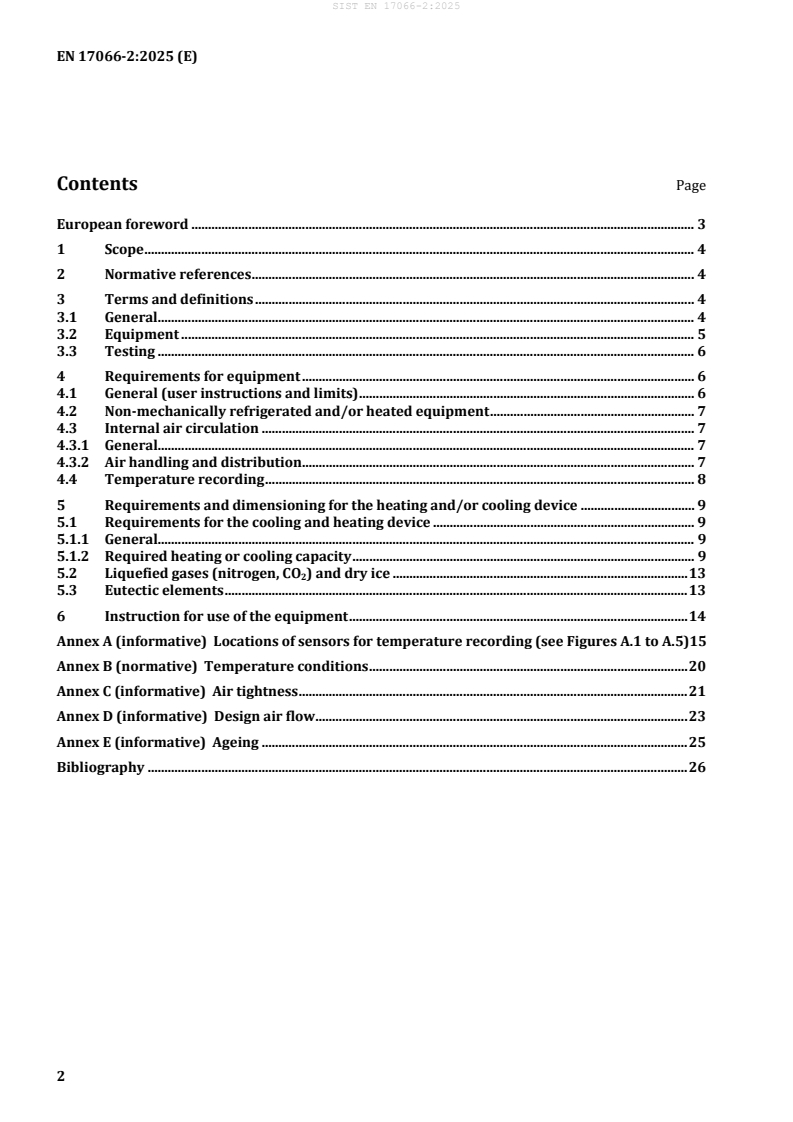
Contents Page
European foreword . 3
1 Scope . 4
2 Normative references . 4
3 Terms and definitions . 4
3.1 General. 4
3.2 Equipment . 5
3.3 Testing . 6
4 Requirements for equipment . 6
4.1 General (user instructions and limits) . 6
4.2 Non-mechanically refrigerated and/or heated equipment . 7
4.3 Internal air circulation . 7
4.3.1 General. 7
4.3.2 Air handling and distribution . 7
4.4 Temperature recording . 8
5 Requirements and dimensioning for the heating and/or cooling device . 9
5.1 Requirements for the cooling and heating device . 9
5.1.1 General. 9
5.1.2 Required heating or cooling capacity . 9
) and dry ice . 13
5.2 Liquefied gases (nitrogen, CO2
5.3 Eutectic elements . 13
6 Instruction for use of the equipment . 14
Annex A (informative) Locations of sensors for temperature recording (see Figures A.1 to A.5)15
Annex B (normative) Temperature conditions . 20
Annex C (informative) Air tightness . 21
Annex D (informative) Design air flow . 23
Annex E (informative) Ageing . 25
Bibliography . 26
European foreword
This document (EN 17066-2:2025) has been prepared by Technical Committee CEN/TC 413 “Insulated
means of transport for temperature sensitive goods with or without cooling and/or heating device”, the
secretariat of which is held by DIN.
This European Standard shall be given the status of a national standard, either by publication of an
identical text or by endorsement, at the latest by April 2026, and conflicting national standards shall be
withdrawn at the latest by April 2026.
Attention is drawn to the possibility that some of the elements of this document may be the subject of
patent rights. CEN shall not be held responsible for identifying any or all such patent rights.
Any feedback and questions on this document should be directed to the users’ national standards body.
A complete listing of these bodies can be found on the CEN website.
According to the CEN-CENELEC Internal Regulations, the national standards organisations of the
following countries are bound to implement this European Standard: Austria, Belgium, Bulgaria, Croatia,
Cyprus, Czech Republic, Denmark, Estonia, Finland, France, Germany, Greece, Hungary, Iceland, Ireland,
Italy, Latvia, Lithuania, Luxembourg, Malta, Netherlands, Norway, Poland, Portugal, Republic of North
Macedonia, Romania, Serbia, Slovakia, Slovenia, Spain, Sweden, Switzerland, Türkiye and the United
Kingdom.
1 Scope
This document is applicable to thermally insulated means of transport used for temperature sensitive
goods equipped with a cooling and/or heating device.
This document is applicable to the terminology, the requirements for thermal insulation, air tightness,
dimensioning of equipment with cooling and/or heating device for long distance and distribution
transport.
This document does not apply to further land transport requirements with regard to dimensions,
weights, etc. Further this document does not apply to safety requirements or special requirements for
thermal containers covered by ISO 1496-2.
2 Normative references
The following documents are referred to in the text in such a way that some or all of their content
constitutes requirements of this document. For dated references, only the edition cited applies. For
undated references, the latest edition of the referenced document (including any amendments) applies.
EN 12830, Temperature recorders for the transport, storage and distribution of temperature sensitive
goods — Tests, performance, suitability
EN 13485, Thermometers for measuring the ambient or internal temperature for the transport, storage and
distribution of temperature sensitive goods — Tests, performance, suitability
EN 13486, Temperature recorders and thermometers for measuring the ambient or internal temperature
for the transport, storage and distribution of temperature sensitive goods — Periodic verification
3 Terms and definitions
For the purposes of this document, the following terms and definitions apply.
ISO and IEC maintain terminology databases for use in standardization at the following addresses:
— ISO Online browsing platform: available at https://www.iso.org/obp
— IEC Electropedia: available at https://www.electropedia.org/
3.1 General
3.1.1
compartment
insulated part of a container built for the carriage of the goods equipped or not with a cooling and/or
heating device
3.1.2
unconditioned compartment
compartment considered to have no evaporator or other cooling and/or heating devices or for which they
are inactive
3.1.3
distribution transport
tour including at least 2 locations of delivery and/or collection of goods
3.1.4
long-distance transport
uninterrupted transport of goods from a collection point to a delivery point without intermediate loading
and unloading
3.1.5
eutectic elements
elements (e.g. plates, tubes, etc.) intended for cold or heat charging, containing an inside eutectic solution
having the characteristic to change phase at a specific temperature
Note 1 to entry: Fixed eutectic elements are cooled or heated with a cooling and/or heating device.
Note 2 to entry: Movable eutectic elements are cooled or heated in a temperature-controlled space at a
temperature sufficient to achieve the phase change.
3.1.6
goods
temperature sensitive products to be transported within a defined temperature range
3.2 Equipment
3.2.1
equipment
container equipped with a cooling and/or heating device in one or more compartments
3.2.2
multi-temperature equipment
container divided by insulated partition walls in two or more compartments and equipped with a cooling
and/or heating device for maintaining different temperatures
3.2.3
non-mechanically refrigerated equipment
equipment which, using a source of cold (natural ice, with or without the addition of salt, eutectic plates,
dry ice, with or without sublimation control, liquefied gases, with or without evaporation control, etc.)
other than a mechanical or absorption cooling device is capable of lowering the inside temperature at a
nominal outside temperature of a compartment, and thereafter maintaining it, at the required inside
temperature
Note 1 to entry: Some nominal outside and inside temperature are proposed in in Annex B.
3.2.4
mechanically refrigerated equipment
equipment either fitted with a cooling device, or served jointly with other units of transport equipment
by such an appliance, (fitted with either a mechanical compressor, or an absorption cooling device etc.)
which is capable of lowering the inside temperature at a nominal outside temperature of a compartment,
and thereafter maintaining it, at the required inside temperature
3.2.5
heated equipment
equipment fitted with a heating device, which is capable of raising the inside temperature of a
compartment to, and thereafter maintaining it at a positive minimum temperature, with a nominal
outside temperature
Note 1 to entry: Inside and outside temperatures are indicated in Annex B, Table B.1.
3.2.6
cooling device
system which lowers and/or maintains temperature in a compartment
3.2.7
heating device
system which increases and/or maintains temperature in a compartment
3.2.8
start/stop operation
automatic and usually electronic process which stops the thermal engine of the refrigeration system
when one temperature limit is reached and starts when the other one is exceeded
Note 1 to entry: In this mode besides the controller the refrigeration compressor, fans of the condenser and
evaporator are stopped.
3.2.9
mean surface area
S
m
i
geometrical mean of the projected internal surface area S and the projected external surface area S in
e
m
S SS⋅ (1)
m i e
Note 1 to entry: See EN 17066-1.
3.3 Testing
3.3.1
cooling down
heating up
process by which the mean internal temperature of the equipment, including the internal surface layer
and half of the insulation thickness, is cooled down or heated up to the specified temperature
3.3.2
conditioned room
room where the test conditions can be maintained at a constant level
4 Requirements for equipment
4.1 General (user instructions and limits)
Instructions for use shall be prepared and supplied by the manufacturer of the container and by the
manufacturer of the cooling and/or heating device which may be mechanically refrigerated equipment
or non-mechanically refrigerated equipment.
In order to prevent the goods temperature from exceeding the permitted limit values, the load space and
goods shall be brought to the required temperature prior to loading. Depending on goods and
temperature limits, modulation of the air circulation including start/stop operation is possible.
The dimensioning of the cooling and/or heating devices for transport equipment in accordance with this
document intends to maintain the goods concerned during transport at the required temperature. This
shall compensate for heat transfer including door openings for multiple loading and unloading.
For certain goods the required minimum and maximum limiting temperature has to be considered.
=
To minimize energy consumption the air leakage rate should be considered taking into account the
recommendations in the informative Annex C.
4.2 Non-mechanically refrigerated and/or heated equipment
For non-mechanically refrigerated and/or heated equipment, except those built for small containers,
including one or more compartments, the cooling and/or heating device should be filled and/or charged
without affecting the temperature of the goods.
4.3 Internal air circulation
4.3.1 General
The following requirement does not apply to natural convection cooling or heating devices.
In order to ensure proper air distribution, equipment with forced ventilation requires defined air
circulation. The design air flow V should be selected in consideration to the required temperature and
a
product type as indicated in the informative Annex D.
Heated cargo may require alternative air flow and/or air distribution system to ensure warm air is forced
uniformly throughout the load space.
Start/stop operation of the unit when the evaporator fans are not in use is less critical for goods
transported at temperatures lower than −18 °C.
Start/stop operation is not recommended under any of the following circumstances:
— sensitive chilled goods (flowers, cheese, ….);
— high temperature difference between ambient and goods;
— low temperature tolerance of goods;
— low mass and/or low specific heat capacity of the goods;
— distribution transport with multiple door openings.
Under these circumstances the air flow has to be maintained. During cooling down or heating up a
continuous air flow is recommended.
As indicated in Annex D the air flow rate can be modulated if the indicated temperature range has been
reached except for certain sensitive goods.
The delivered air pressure of the forced ventilation shall be designed so that the additional pressure loss
to be expected due to loading, any internal equipment (e.g. air duct) and evaporator should be
compensated for.
4.3.2 Air handling and distribution
4.3.2.1 General
A container with a cooling and/or heating device shall provide air circulation around the goods, a
minimum air flow and shall avoid air short cycling and hot spots with additional accessories:
4.3.2.2 Air supply
The air supply, roof mounted or roof/floor incorporated, shall ensure the air distribution to reach all
parts of the container. A minimum air velocity of 1,0 m/s at a distance no more than 10 % of internal
length measured from the rear end of the container (compartment) and not less than 80 % of the internal
height shall be provided.
Air ducts should be used for containers (compartment) exceeding 6 m in length.
The design of the air ducts should be in accordance with the recommendations of the manufacturer of the
cooling and/or heating devices.
To prevent excessive pressure drops the cross-sectional area of the air ducting shall be greater than the
air outlet of the above-mentioned device, the length should not be less than 20 % and no more than 75 %
of the length of the compartment. For flexible air duct systems, the cross-sectional area shall be provided
over the complete length of the duct by design measures in order to reach the objective in 4.3.2.1.
The air-ducting system should generate the minimum pressure-drop (compatible with cooling or heating
device). For semitrailers and rigid trucks exceeding 8 m internal length the roof mounted air duct should
have air outlets located with a minimum distance of 2,5 m from the front wall to avoid short circuits.
Any transversal partitioning stored in an upper position shall not restrict the air flow either.
4.3.2.3 Air return
Air return panel or grid/bulkhead shall be designed so to facilitate the air return to the cooling or heating
device. The cross-sectional area shall correlate the free space beneath the load. The design of the air ducts
should be in accordance with the recommendations of the manufacturer of the cooling and/or heating
devices. Particular attention should be paid to avoid blocking the air return and to allow easy physical
regular inspection and maintenance for any potential blockage. The air return panel or grid should cover
the entire inner width of the container and generate the minimum pressure-drop (compatible with the
cooling or heating device). When vertical distance profiles are used, the air flow shall be maintained
homogeneous along the width of the air return due to air flow in transverse direction ensured by design
features like for example perforated or interrupted distance profiles.
4.4 Temperature recording
Transport equipment for any temperature sensitive goods should be fitted with a suitable recording
instrument to monitor, at frequent and regular intervals, the air temperatures to which the goods are
subjected to. In this case the temperature recorder should be according to EN 12830 and for thermometer
to EN 13485. The measuring instrument should be periodically validated according to the EN 13486.
Transport equipment for deep-/quick frozen foodstuffs shall be fitted with a suitable recording
instrument to monitor, at frequent and regular intervals, the air temperatures to which the foodstuffs are
subjected to. In this case the temperature recorder shall be according to EN 12830 and for thermometer
to EN 13485. The measuring instrument shall be periodically validated according to the EN 13486.
NOTE National and international regulations in force are indicating further recommendations.
If there is temperature recording, in each conditioned compartment, at least one temperature sensor shall
be placed at a location representing the warmest air temperature for cooling and the coolest air
temperature for heating. Measures should be taken to avoid any damage to temperature sensors during
goods handling.
For forced air convection systems one temperature sensor shall be placed at the air inlet of the device.
The temperature sensor(s) should be in the air stream but shall not be in direct contact with:
— the surface of the container;
— the cooling or heating device;
— fitting accessories.
For the validation according to EN 13486 the temperature sensors shall be easily accessible. Therefore
all connected sensors should be installed to allow a free cable length of at least 0,25 m to facilitate periodic
calibrations.
Examples for typical sensor positions are given in informative Annex A.
The temperature sensor(s) and the recorder shall be protected against any mechanical damage that may
occur during cargo handling operations or carriage.
5 Requirements and dimensioning for the heating and/or cooling device
5.1 Requirements for the cooling and heating device
5.1.1 General
For the consideration of the cooling and heating capacities the following requirements shall be fulfilled
for mono-temperature equipment only.
5.1.2 Required heating or cooling capacity
5.1.2.1 General
In order to
...