

EN 14034-3:2006
(Main)Determination of explosion characteristics of dust clouds - Part 3: Determination of the lower explosion limit LEL of dust clouds
- Abstract
This standard describes a test method for the determination of the lower explosion limit of dust clouds in a closed vessel under defined initial conditions of pressure and temperature.
This method is not suitable for use with recognised explosives, like gunpowder and dynamite, explosives which do not require oxygen for combustion, pyrophoric substances, or substances or mixtures of substances which may under some circumstances behave in a similar manner. Where any doubt exists about the existence of hazard due to explosive properties, expert advice should be sought.
- Status
- Withdrawn
- Publication Date
- 23-May-2006
- Withdrawal Date
- 11-Jan-2011
- Current Stage
- 9960 - Withdrawal effective - Withdrawal
- Start Date
- 12-Jan-2011
- Completion Date
- 12-Jan-2011
- Directive
- 94/9/EC - Equipment and protective systems intended for use in potentially explosive atmospheres (ATEX)OJ Ref: C, C 36 OJ Date: 04-Feb-2011

Relations
- Effective Date
- 19-Jan-2023
- Effective Date
- 28-Jan-2026
Get Certified
Connect with accredited certification bodies for this standard

CIS Institut d.o.o.
Personal Protective Equipment (PPE) certification body. Notified Body NB-2890 for EU Regulation 2016/425 PPE.

Kiwa BDA Testing
Building and construction product certification.
Kmetijski inštitut Slovenije
Agricultural Institute of Slovenia. Soil testing, plant health, agricultural product analysis.
Sponsored listings
Frequently Asked Questions
EN 14034-3:2006 is a standard published by the European Committee for Standardization (CEN). Its full title is "Determination of explosion characteristics of dust clouds - Part 3: Determination of the lower explosion limit LEL of dust clouds". This standard covers: This standard describes a test method for the determination of the lower explosion limit of dust clouds in a closed vessel under defined initial conditions of pressure and temperature. This method is not suitable for use with recognised explosives, like gunpowder and dynamite, explosives which do not require oxygen for combustion, pyrophoric substances, or substances or mixtures of substances which may under some circumstances behave in a similar manner. Where any doubt exists about the existence of hazard due to explosive properties, expert advice should be sought.
This standard describes a test method for the determination of the lower explosion limit of dust clouds in a closed vessel under defined initial conditions of pressure and temperature. This method is not suitable for use with recognised explosives, like gunpowder and dynamite, explosives which do not require oxygen for combustion, pyrophoric substances, or substances or mixtures of substances which may under some circumstances behave in a similar manner. Where any doubt exists about the existence of hazard due to explosive properties, expert advice should be sought.
EN 14034-3:2006 is classified under the following ICS (International Classification for Standards) categories: 13.230 - Explosion protection. The ICS classification helps identify the subject area and facilitates finding related standards.
EN 14034-3:2006 has the following relationships with other standards: It is inter standard links to EN 14034-3:2006+A1:2011, EN 14373:2005. Understanding these relationships helps ensure you are using the most current and applicable version of the standard.
EN 14034-3:2006 is associated with the following European legislation: EU Directives/Regulations: 94/9/EC, 98/37/EC; Standardization Mandates: M/079, M/BC/CEN/92/46. When a standard is cited in the Official Journal of the European Union, products manufactured in conformity with it benefit from a presumption of conformity with the essential requirements of the corresponding EU directive or regulation.
EN 14034-3:2006 is available in PDF format for immediate download after purchase. The document can be added to your cart and obtained through the secure checkout process. Digital delivery ensures instant access to the complete standard document.
Standards Content (Sample)
2003-01.Slovenski inštitut za standardizacijo. Razmnoževanje celote ali delov tega standarda ni dovoljeno.Determination of explosion characteristics of dust clouds - Part 3: Determination of the lower explosion limit LEL of dust cloudsDétermination des caractéristiques d'explosion des nuages de poussiere - Partie 3: Détermination de la limite inférieure d'explosivité LIE des nuages de poussiereBestimmung der Explosionskenngrößen von Staub/Luft-Gemischen - Teil 3: Bestimmung der unteren Explosionsgrenze UEG von Staub/Luft-GemischenTa slovenski standard je istoveten z:EN 14034-3:2006SIST EN 14034-3:2006en13.230ICS:SLOVENSKI
STANDARDSIST EN 14034-3:200601-september-2006
EUROPEAN STANDARDNORME EUROPÉENNEEUROPÄISCHE NORMEN 14034-3May 2006ICS 13.230 English VersionDetermination of explosion characteristics of dust clouds - Part3: Determination of the lower explosion limit LEL of dust cloudsDétermination des caractéristiques d'explosion des nuagesde poussière - Partie 3: Détermination de la limite inférieured'explosivité LIE des nuages de poussièreBestimmung der Explosionskenngrößen von Staub/Luft-Gemischen - Teil 3: Bestimmung der unterenExplosionsgrenze UEG von Staub/Luft-GemischenThis European Standard was approved by CEN on 20 April 2006.CEN members are bound to comply with the CEN/CENELEC Internal Regulations which stipulate the conditions for giving this EuropeanStandard the status of a national standard without any alteration. Up-to-date lists and bibliographical references concerning such nationalstandards may be obtained on application to the Central Secretariat or to any CEN member.This European Standard exists in three official versions (English, French, German). A version in any other language made by translationunder the responsibility of a CEN member into its own language and notified to the Central Secretariat has the same status as the officialversions.CEN members are the national standards bodies of Austria, Belgium, Cyprus, Czech Republic, Denmark, Estonia, Finland, France,Germany, Greece, Hungary, Iceland, Ireland, Italy, Latvia, Lithuania, Luxembourg, Malta, Netherlands, Norway, Poland, Portugal, Romania,Slovakia, Slovenia, Spain, Sweden, Switzerland and United Kingdom.EUROPEAN COMMITTEE FOR STANDARDIZATIONCOMITÉ EUROPÉEN DE NORMALISATIONEUROPÄISCHES KOMITEE FÜR NORMUNGManagement Centre: rue de Stassart, 36
B-1050 Brussels© 2006 CENAll rights of exploitation in any form and by any means reservedworldwide for CEN national Members.Ref. No. EN 14034-3:2006: E
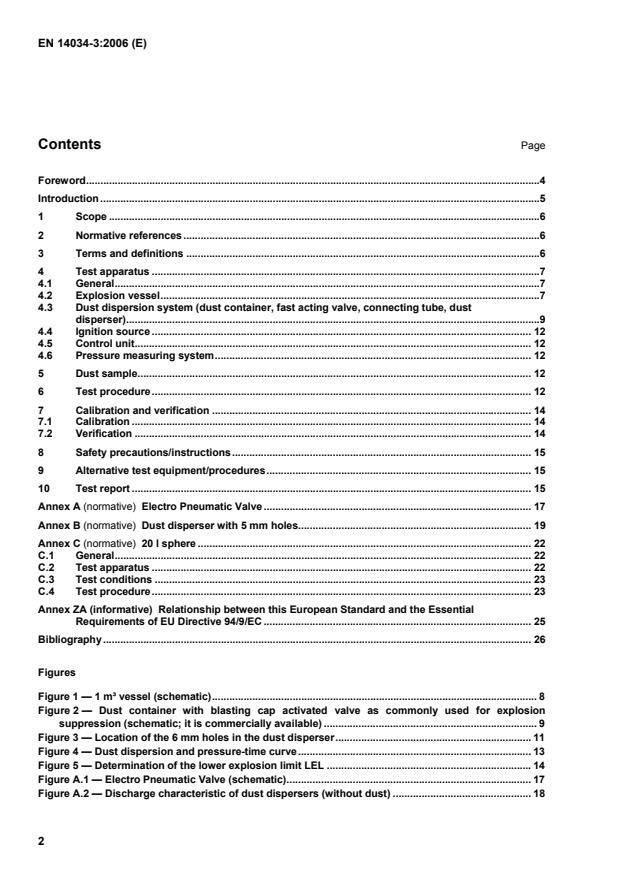
Electro Pneumatic Valve.17 Annex B (normative)
Dust disperser with 5 mm holes.19 Annex C (normative)
20 l sphere.22 C.1 General.22 C.2 Test apparatus.22 C.3 Test conditions.23 C.4 Test procedure.23 Annex ZA (informative)
Relationship between this European Standard and the Essential Requirements of EU Directive 94/9/EC.25 Bibliography.26 Figures Figure 1 — 1 m³ vessel (schematic).8 Figure 2 — Dust container with blasting cap activated valve as commonly used for explosion suppression (schematic; it is commercially available).9 Figure 3 — Location of the 6 mm holes in the dust disperser.11 Figure 4 — Dust dispersion and pressure-time curve.13 Figure 5 — Determination of the lower explosion limit LEL.14 Figure A.1 — Electro Pneumatic Valve (schematic).17 Figure A.2 — Discharge characteristic of dust dispersers (without dust).18
Annex II, Clause 1.0.1 Directive 98/37/EC of the European Parliament and the Council of June 22, 1998 on the approximation of the laws of the member states relating to machinery Annex I, Clause 1.5.7
This method is not suitable for use with recognised explosives, like gunpowder and dynamite, explosives which do not require oxygen for combustion, pyrophoric substances, or substances or mixtures of substances which may under some circumstances behave in a similar manner. Where any doubt exists about the existence of hazard due to explosive properties, expert advice should be sought. 2 Normative references The following referenced documents are indispensable for the application of this document. For dated references, only the edition cited applies. For undated references, the latest edition of the referenced document (including any amendments) applies. EN 14460, Explosion resistant equipment 3 Terms and definitions For the purposes of this document, the following terms and definitions apply. 3.1 dust small solid particles in the atmosphere which settle out under their own weight, but which may remain suspended in air for some time (includes dust and grit, as defined in ISO 4225) NOTE Generally maximum particle size will not exceed 500 µm. 3.2 combustible dust dust able to undergo an exothermic reaction with air when ignited NOTE The terms “flammable” and “combustible” are used synonymously. 3.3 explosion pressure pex highest overpressure occurring during an explosion of a dust cloud in a closed vessel 3.4 explosive atmosphere mixture with air, under atmospheric conditions, of flammable (combustible) substances in the form of gases, vapours, mists or dusts, in which, after ignition has occurred, combustion spreads to the entire unburned mixture 3.5 ignition delay tv time between the initiation of the dust dispersion and the activation of the ignition source 3.6 initial pressure pi pressure in the explosion vessel at the moment of ignition
Key 1 pressure sensor
5 dust container 2 chemical igniters
6 fast acting valve 3 inlet for purge air
7 connecting tube 4 dust disperser
8 outlet for exhaust gas Figure 1 — 1 m³ vessel (schematic)
Key 1 dust container
5 protective hood 2 mushroom shaped seal
6 protective hood 3 seal housing
7 blasting cap 4 support ring
8 connecting tube Figure 2 — Dust container with blasting cap activated valve as commonly used for explosion suppression (schematic; it is commercially available)
For dispersing the dust, a perforated semicircular spray pipe (dust disperser) is mounted inside the explosion vessel, concentric with its wall. The spray pipe, with an internal diameter of 21,7 mm1) is fitted with 13 holes of a diameter of 6 mm (incl. one hole in each end cap) which are located as shown in Figure 3 (see also Figure 1).
1) (e.g. EN ISO 1127, DN 20, 3/4")
...