


EN 29692:1994
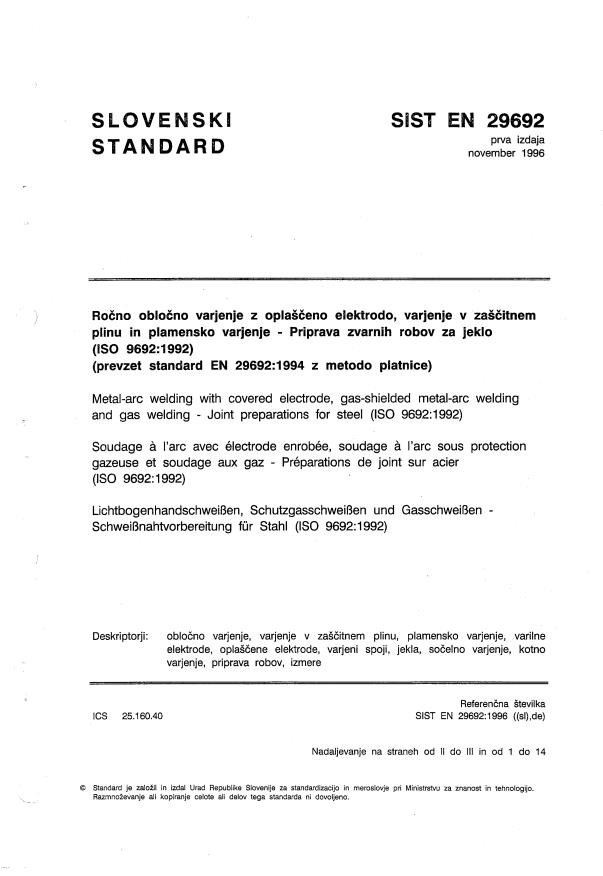
(Main)Metal-arc welding with covered electrode, gas-shielded metal-arc welding and gas welding - Joint preparations for steel (ISO 9692:1992)
Metal-arc welding with covered electrode, gas-shielded metal-arc welding and gas welding - Joint preparations for steel (ISO 9692:1992)
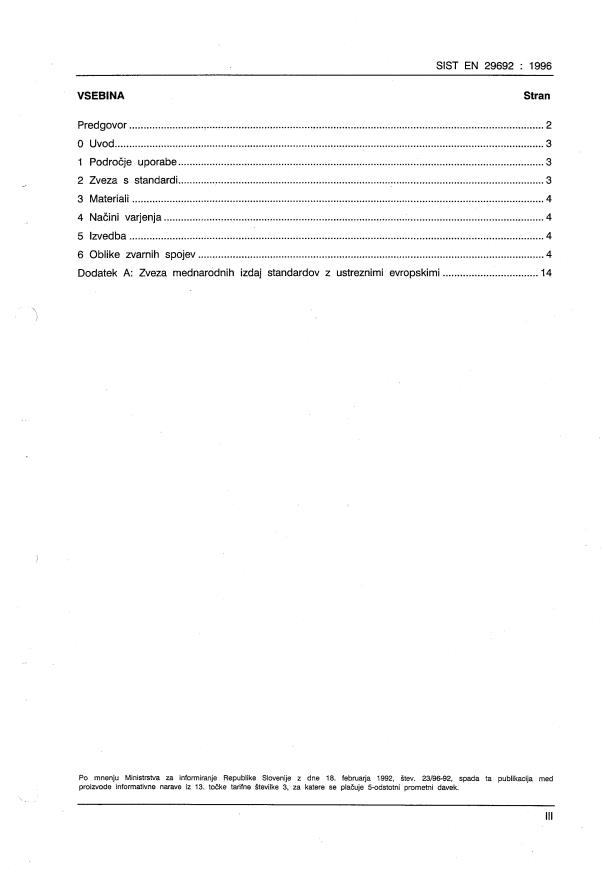
This International Standard pertains to types of joint preparation for metal-arc welding with covered eectrode, gas-shielded metal-arc welding and gas welding on steel ( see clause 3 and 4). It applies to joint preparation for fully-penetrated butt welds, except in the case of some recommended types of joint preparation (reference numbers 3.10A, 3.10B and 4.10.10C); if a butt weld is not possible or necessary, special arrangements need to be made. For not-fully-penetrated butt welds, types of joint preparation and dimensions welds, types of joint preparation and dimensions differing from those specified in this International Standard may be stipulated. The root gaps referred to in this International Stadard are those gaps presented after tack welding, if used. Consideration should be given to altering the joint preparation details (where appropriate) to facilitate temporary backing, ® one-sided welding ¯, etc.
Lichtbogenhandschweißen, Schutzgasschweißen und Gasschweißen, Schweißnahtvorbereitung für Stahl (ISO 9692:1992)
Diese Internationale Norm enthält Fugenformen an Stahl für Lichtbogenhandschweissen, Metallschutzgasschweissen und Gasschweissen. Sie gilt für Fugenformen für vollangeschlossen Querschnitte an Stumpfnähten, ausgenommen einige empfohlene Formen (Kennzahlen 3.10A, 3.10B und 4.10.10C), falls eine Stumpfnaht nicht möglich oder notwendig ist, sind besondere Vereinbarungen zu treffen. Für nicht vollangeschlossene Querschnitte können die Fugenformen und Masse abweichend von dieser Internationalen Norm festgelegt werden.
Soudage à l'arc avec électrode enrobée, soudage à l'arc sous protection gazeuse et soudage aux gaz - Préparations de joint sur acier (ISO 9692:1992)
Ročno obločno varjenje z oplaščeno elektrodo, varjenje v zaščitnem plinu in plamensko varjenje - Priprava zvarnih robov za jeklo (ISO 9692:1992)
General Information
- Status
- Withdrawn
- Publication Date
- 27-Feb-1994
- Withdrawal Date
- 31-Mar-1998
- Technical Committee
- CEN/TC 121 - Welding
- Drafting Committee
- CEN/TC 121/WG 18 - Terminology
- Current Stage
- 9093 - Decision to confirm - Review Enquiry
- Start Date
- 01-May-2000
- Completion Date
- 01-May-2000
- Directive
- 97/23/EC - Pressure equipment
Relations
- Effective Date
- 22-Dec-2008
- Effective Date
- 28-Jan-2026
- Effective Date
- 28-Jan-2026
- Effective Date
- 28-Jan-2026
- Effective Date
- 28-Jan-2026
- Effective Date
- 28-Jan-2026
- Effective Date
- 28-Jan-2026

EN 29692:1996
Get Certified
Connect with accredited certification bodies for this standard

National Aerospace and Defense Contractors Accreditation Program (NADCAP)
Global cooperative program for special process quality in aerospace.
CARES (UK Certification Authority for Reinforcing Steels)
UK certification for reinforcing steels and construction.
DVS-ZERT GmbH
German welding certification society.
Sponsored listings
Frequently Asked Questions
EN 29692:1994 is a standard + national annex and/or foreword published by the European Committee for Standardization (CEN). Its full title is "Metal-arc welding with covered electrode, gas-shielded metal-arc welding and gas welding - Joint preparations for steel (ISO 9692:1992)". This standard covers: This International Standard pertains to types of joint preparation for metal-arc welding with covered eectrode, gas-shielded metal-arc welding and gas welding on steel ( see clause 3 and 4). It applies to joint preparation for fully-penetrated butt welds, except in the case of some recommended types of joint preparation (reference numbers 3.10A, 3.10B and 4.10.10C); if a butt weld is not possible or necessary, special arrangements need to be made. For not-fully-penetrated butt welds, types of joint preparation and dimensions welds, types of joint preparation and dimensions differing from those specified in this International Standard may be stipulated. The root gaps referred to in this International Stadard are those gaps presented after tack welding, if used. Consideration should be given to altering the joint preparation details (where appropriate) to facilitate temporary backing, ® one-sided welding ¯, etc.
This International Standard pertains to types of joint preparation for metal-arc welding with covered eectrode, gas-shielded metal-arc welding and gas welding on steel ( see clause 3 and 4). It applies to joint preparation for fully-penetrated butt welds, except in the case of some recommended types of joint preparation (reference numbers 3.10A, 3.10B and 4.10.10C); if a butt weld is not possible or necessary, special arrangements need to be made. For not-fully-penetrated butt welds, types of joint preparation and dimensions welds, types of joint preparation and dimensions differing from those specified in this International Standard may be stipulated. The root gaps referred to in this International Stadard are those gaps presented after tack welding, if used. Consideration should be given to altering the joint preparation details (where appropriate) to facilitate temporary backing, ® one-sided welding ¯, etc.
EN 29692:1994 is classified under the following ICS (International Classification for Standards) categories: 25.160.10 - Welding processes. The ICS classification helps identify the subject area and facilitates finding related standards.
EN 29692:1994 has the following relationships with other standards: It is inter standard links to EN ISO 9692-2:1998, EN 378-3:2016+A1:2020, EN 378-3:2016, EN 1473:2021, EN 378-3:2008+A1:2012, EN 12255-12:2024, EN 12063:1999. Understanding these relationships helps ensure you are using the most current and applicable version of the standard.
EN 29692:1994 is associated with the following European legislation: EU Directives/Regulations: 97/23/EC; Standardization Mandates: M/071. When a standard is cited in the Official Journal of the European Union, products manufactured in conformity with it benefit from a presumption of conformity with the essential requirements of the corresponding EU directive or regulation.
EN 29692:1994 is available in PDF format for immediate download after purchase. The document can be added to your cart and obtained through the secure checkout process. Digital delivery ensures instant access to the complete standard document.
Questions, Comments and Discussion
Ask us and Technical Secretary will try to provide an answer. You can facilitate discussion about the standard in here.
Loading comments...