


EN 729-1:1994
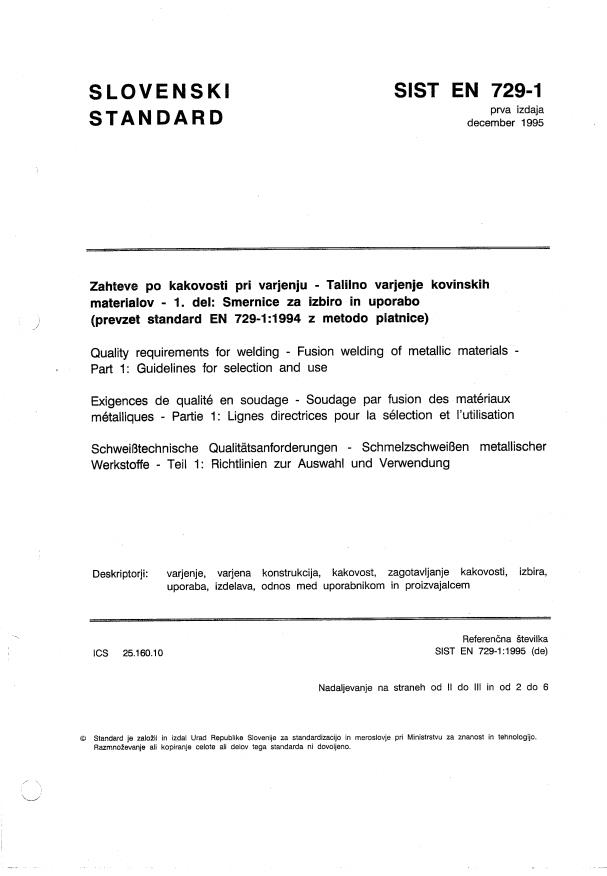
(Main)Quality requirements for welding - Fusion welding of metallic materials - Part 1: Guidelines for selection and use
Quality requirements for welding - Fusion welding of metallic materials - Part 1: Guidelines for selection and use
These guidelines have been prepared to describe welding quality requirements suitable for application by manufacturers using welding as a means of fabrication. They are structured such that they can be used for fabrication of any type of fusion welded construction. These guidelines relate only to those aspects of the quality of the final construction which may be influenced by welding and allied processes. These guidelines define various approaches to quality requirements for welding fabrication, both in workshops and on sites and provide guidance for describing the capability of a manufacturer to be able to produce welded constructions of the specified quality. They can also be used by any interested party as a basis for assessing a manufacturer's welding quality arrangements. These guidelines are intended to be used for the following purposes: a) providing interpretation of the requirements in the EN 29000 series of standards, as a guideline for specification and establishment of the part of the quality system related to control of welding as a 'Special Process'; b) providing guidelines to establish specifications and welding quality requirements, where a quality system according to EN 29001 and EN 29002 is not involved; c) assessment of the welding quality requirements mentioned in a) or b) above. The application of this standard would typically occur in the following circumstances: - in contractual situations: specification of welding requirements for quality systems; - by manufacturers: establishment and maintenance of welding quality requirements; - by committees preparing structural codes or other application standards: specification of welding quality requirements; - by interested parties, e.g. third parties, customers or the manufacturers management: assessment of welding quality requirements.
Schweißtechnische Qualitätsanforderungen - Schmelzschweißen metallischer Werkstoffe - Teil 1: Richtlinien zur Auswahl und Verwendung
Diese Richtlinien sind erstellt worden, um Qualitätssicherungssysteme für Hersteller zu entwickeln, die die Schweisstechnik in der Fertigung einsetzen. Sie sind so gegliedert, dass sie im wesentlichen für jede Art geschweisster Bauteile angewendet werden können. Diese Richtlinien beziehen sich nur auf die Qualitätsaspekte des fertigen Bauteils, die durch das Schweissen und verwandte Prozesse beeinflusst werden.
Exigences de qualité en soudage - Soudage par fusion des matériaux métalliques - Partie 1: Lignes directrices pour la sélection et l'utilisation
Les présentes lignes directives ont été mises au point dans le but de décrire des systèmes qualité appropriés pour les fabricants ayant recours au soudage comme moyen de fabrication. Ces lignes directives ont été structurées de manière à en permettre l'utilisation dans la fabrication de quasiment tous les types de construction soudée. Ces lignes directives se rapportent aux seuls aspects de la qualité de la construction finale qui sont susceptibles d'être influencées par le soudage et par les processus apparentés.
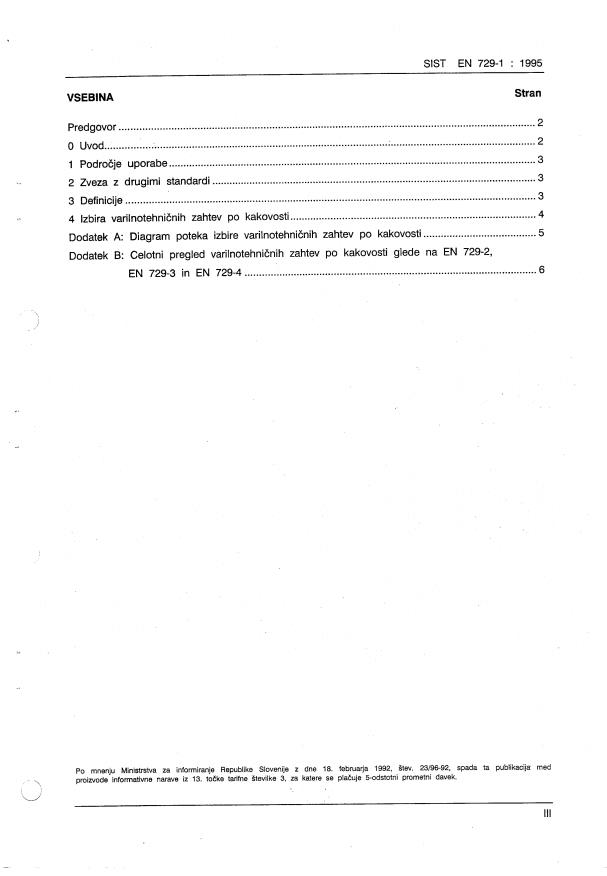
Zahteve po kakovosti pri varjenju - Talilno varjenje kovinskih materialov - 1. del: Smernice za izbiro in uporabo
General Information
- Status
- Withdrawn
- Publication Date
- 29-Sep-1994
- Withdrawal Date
- 14-Dec-2005
- Technical Committee
- CEN/TC 121 - Welding
- Drafting Committee
- CEN/TC 121/SC 4 - Quality management in the field of welding
- Current Stage
- 9960 - Withdrawal effective - Withdrawal
- Start Date
- 15-Dec-2005
- Completion Date
- 15-Dec-2005
- Directive
- 87/404/EEC - Simple pressure vessels
Relations
- Effective Date
- 22-Dec-2008
- Effective Date
- 28-Jan-2026

EN 729-1:1995
Get Certified
Connect with accredited certification bodies for this standard

National Aerospace and Defense Contractors Accreditation Program (NADCAP)
Global cooperative program for special process quality in aerospace.
CARES (UK Certification Authority for Reinforcing Steels)
UK certification for reinforcing steels and construction.
DVS-ZERT GmbH
German welding certification society.
Sponsored listings
Frequently Asked Questions
EN 729-1:1994 is a standard + national annex and/or foreword published by the European Committee for Standardization (CEN). Its full title is "Quality requirements for welding - Fusion welding of metallic materials - Part 1: Guidelines for selection and use". This standard covers: These guidelines have been prepared to describe welding quality requirements suitable for application by manufacturers using welding as a means of fabrication. They are structured such that they can be used for fabrication of any type of fusion welded construction. These guidelines relate only to those aspects of the quality of the final construction which may be influenced by welding and allied processes. These guidelines define various approaches to quality requirements for welding fabrication, both in workshops and on sites and provide guidance for describing the capability of a manufacturer to be able to produce welded constructions of the specified quality. They can also be used by any interested party as a basis for assessing a manufacturer's welding quality arrangements. These guidelines are intended to be used for the following purposes: a) providing interpretation of the requirements in the EN 29000 series of standards, as a guideline for specification and establishment of the part of the quality system related to control of welding as a 'Special Process'; b) providing guidelines to establish specifications and welding quality requirements, where a quality system according to EN 29001 and EN 29002 is not involved; c) assessment of the welding quality requirements mentioned in a) or b) above. The application of this standard would typically occur in the following circumstances: - in contractual situations: specification of welding requirements for quality systems; - by manufacturers: establishment and maintenance of welding quality requirements; - by committees preparing structural codes or other application standards: specification of welding quality requirements; - by interested parties, e.g. third parties, customers or the manufacturers management: assessment of welding quality requirements.
These guidelines have been prepared to describe welding quality requirements suitable for application by manufacturers using welding as a means of fabrication. They are structured such that they can be used for fabrication of any type of fusion welded construction. These guidelines relate only to those aspects of the quality of the final construction which may be influenced by welding and allied processes. These guidelines define various approaches to quality requirements for welding fabrication, both in workshops and on sites and provide guidance for describing the capability of a manufacturer to be able to produce welded constructions of the specified quality. They can also be used by any interested party as a basis for assessing a manufacturer's welding quality arrangements. These guidelines are intended to be used for the following purposes: a) providing interpretation of the requirements in the EN 29000 series of standards, as a guideline for specification and establishment of the part of the quality system related to control of welding as a 'Special Process'; b) providing guidelines to establish specifications and welding quality requirements, where a quality system according to EN 29001 and EN 29002 is not involved; c) assessment of the welding quality requirements mentioned in a) or b) above. The application of this standard would typically occur in the following circumstances: - in contractual situations: specification of welding requirements for quality systems; - by manufacturers: establishment and maintenance of welding quality requirements; - by committees preparing structural codes or other application standards: specification of welding quality requirements; - by interested parties, e.g. third parties, customers or the manufacturers management: assessment of welding quality requirements.
EN 729-1:1994 is classified under the following ICS (International Classification for Standards) categories: 25.160.10 - Welding processes. The ICS classification helps identify the subject area and facilitates finding related standards.
EN 729-1:1994 has the following relationships with other standards: It is inter standard links to EN ISO 3834-1:2005, EN ISO 14554-1:2000. Understanding these relationships helps ensure you are using the most current and applicable version of the standard.
EN 729-1:1994 is associated with the following European legislation: EU Directives/Regulations: 87/404/EEC; Standardization Mandates: M/BC/CEN/89/2. When a standard is cited in the Official Journal of the European Union, products manufactured in conformity with it benefit from a presumption of conformity with the essential requirements of the corresponding EU directive or regulation.
EN 729-1:1994 is available in PDF format for immediate download after purchase. The document can be added to your cart and obtained through the secure checkout process. Digital delivery ensures instant access to the complete standard document.
Questions, Comments and Discussion
Ask us and Technical Secretary will try to provide an answer. You can facilitate discussion about the standard in here.
Loading comments...