

EN ISO 14607:2025
(Main)Non-active surgical implants - Mammary implants - Specific requirements (ISO 14607:2024)
- Abstract
This document specifies specific requirements for mammary implants. With regard to safety, this document specifies requirements for intended performance, design attributes, materials, design evaluation, manufacturing, packaging, sterilization and information supplied by the manufacturer.
- Status
- Published
- Publication Date
- 26-Aug-2025
- Technical Committee
- CEN/TC 285 - Non-active surgical implants
- Drafting Committee
- CEN/TC 285 - Non-active surgical implants
- Current Stage
- 6060 - Definitive text made available (DAV) - Publishing
- Start Date
- 27-Aug-2025
- Completion Date
- 27-Aug-2025

Overview
EN ISO 14607:2025 - titled Non-active surgical implants - Mammary implants - Specific requirements (ISO 14607:2024) - specifies safety and performance requirements for mammary (breast) implants. Adopted by CEN as EN ISO 14607:2025 and replacing the 2018 edition, this standard addresses intended performance, design attributes, materials, design evaluation, manufacturing, packaging, sterilization and the information supplied by the manufacturer. It is intended to support conformity with Regulation (EU) 2017/745 where applicable.
Key topics and technical requirements
The standard focuses on technical topics that determine implant safety and performance, including:
- Intended performance and design attributes - definition of functional requirements specific to mammary implants.
- Materials and biocompatibility - requirements for silicone gel and shell materials with emphasis on:
- Cytotoxicity and biological evaluation within a risk management process (references to ISO 10993 series).
- Residual low molecular weight silicone oligomers and confirmation of material specifications.
- Trace elements (impurities and intentionally added elements) and limits for safety assessment.
- Design evaluation and mechanical integrity - tests and criteria for shell integrity, fatigue, impact resistance, cohesion and endurance (see Annexes B, C, E).
- Silicone gel properties - cohesion, penetration and surface classification tests (Annexes E, F, G).
- Manufacturing, sterilization and packaging - sterile barrier and packaging requirements aligned with ISO 11607; processes to ensure consistent product quality.
- Information supplied by the manufacturer - labeling, risk information and patient/clinician instructions consistent with ISO 20417 and regulatory expectations.
- Risk management and clinical considerations - linkage to ISO 14971 for risk control and ISO 14155 for clinical investigation where applicable.
Practical applications - who uses this standard
EN ISO 14607:2025 is used by:
- Breast implant manufacturers for design controls, material selection and product specifications.
- Quality and regulatory affairs teams to demonstrate conformity with MDR (EU) 2017/745 and harmonized requirements.
- Notified bodies and conformity assessment organizations when assessing device dossiers and test evidence.
- Testing and contract laboratories performing mechanical, chemical and biological tests referenced by the standard.
- Packaging and sterilization engineers, and clinical researchers conducting pre‑clinical and clinical evaluations.
Related standards (normative references)
Key referenced standards include:
- ISO 10993-1 / -5 / -6 / -18 (biological evaluation)
- ISO 14971 (risk management)
- ISO 11607-1 (packaging for terminally sterilized devices)
- ISO 20417 (information supplied by the manufacturer)
- ISO 14630 (general requirements for non-active surgical implants)
- ISO 21920-2 (surface texture parameters)
EN ISO 14607:2025 is essential for stakeholders seeking clear technical requirements for safe design, testing and market conformity of mammary implants. Keywords: EN ISO 14607:2025, mammary implants, breast implants, silicone gel, implant design, sterilization, biocompatibility, EU MDR.
Relations
- Effective Date
- 04-Nov-2020
- Effective Date
- 04-Mar-2026
- Effective Date
- 04-Mar-2026
- Effective Date
- 04-Mar-2026
- Effective Date
- 04-Mar-2026
- Effective Date
- 04-Mar-2026
- Effective Date
- 04-Mar-2026
- Effective Date
- 04-Mar-2026
- Effective Date
- 04-Mar-2026
- Effective Date
- 04-Mar-2026
- Effective Date
- 09-Feb-2026
- Effective Date
- 09-Feb-2026
- Effective Date
- 09-Feb-2026
- Effective Date
- 09-Feb-2026
- Effective Date
- 09-Feb-2026
Get Certified
Connect with accredited certification bodies for this standard

BSI Group
BSI (British Standards Institution) is the business standards company that helps organizations make excellence a habit.

TÜV Rheinland
TÜV Rheinland is a leading international provider of technical services.

TÜV SÜD
TÜV SÜD is a trusted partner of choice for safety, security and sustainability solutions.
Sponsored listings
Frequently Asked Questions
EN ISO 14607:2025 is a standard published by the European Committee for Standardization (CEN). Its full title is "Non-active surgical implants - Mammary implants - Specific requirements (ISO 14607:2024)". This standard covers: This document specifies specific requirements for mammary implants. With regard to safety, this document specifies requirements for intended performance, design attributes, materials, design evaluation, manufacturing, packaging, sterilization and information supplied by the manufacturer.
This document specifies specific requirements for mammary implants. With regard to safety, this document specifies requirements for intended performance, design attributes, materials, design evaluation, manufacturing, packaging, sterilization and information supplied by the manufacturer.
EN ISO 14607:2025 is classified under the following ICS (International Classification for Standards) categories: 11.040.40 - Implants for surgery, prosthetics and orthotics. The ICS classification helps identify the subject area and facilitates finding related standards.
EN ISO 14607:2025 has the following relationships with other standards: It is inter standard links to EN ISO 14607:2018, ISO 14155:2020, ISO 34-1:2022, ISO 10993-6:2016, ISO 21920-2:2021, ISO 10993-5:2009, ISO/TS 10993-20:2006, ISO 14971:2019, ISO 10993-1:2018, ISO 10993-18:2020, ISO 20417:2021, ISO 14630:2024, ISO 11607-1:2019, ISO 48-4:2018, ISO 37:2024. Understanding these relationships helps ensure you are using the most current and applicable version of the standard.
EN ISO 14607:2025 is associated with the following European legislation: EU Directives/Regulations: 2017/745; Standardization Mandates: M/575, M/575 AMD 2. When a standard is cited in the Official Journal of the European Union, products manufactured in conformity with it benefit from a presumption of conformity with the essential requirements of the corresponding EU directive or regulation.
EN ISO 14607:2025 is available in PDF format for immediate download after purchase. The document can be added to your cart and obtained through the secure checkout process. Digital delivery ensures instant access to the complete standard document.
Standards Content (Sample)
SLOVENSKI STANDARD
01-oktober-2025
Nadomešča:
SIST EN ISO 14607:2018
Neaktivni kirurški vsadki (implantati) - Prsni vsadki - Posebne zahteve (ISO
14607:2024)
Non-active surgical implants - Mammary implants - Specific requirements (ISO
14607:2024)
Nichtaktive chirurgische Implantate - Mammaimplantate - Besondere Anforderungen
(ISO 14607:2024)
Implants chirurgicaux non actifs - Implants mammaires - Exigences particulières (ISO
14607:2024)
Ta slovenski standard je istoveten z: EN ISO 14607:2025
ICS:
11.040.40 Implantanti za kirurgijo, Implants for surgery,
protetiko in ortetiko prosthetics and orthotics
2003-01.Slovenski inštitut za standardizacijo. Razmnoževanje celote ali delov tega standarda ni dovoljeno.
EN ISO 14607
EUROPEAN STANDARD
NORME EUROPÉENNE
August 2025
EUROPÄISCHE NORM
ICS 11.040.40 Supersedes EN ISO 14607:2018
English Version
Non-active surgical implants - Mammary implants -
Specific requirements (ISO 14607:2024)
Implants chirurgicaux non actifs - Implants Nichtaktive chirurgische Implantate -
mammaires - Exigences particulières (ISO Mammaimplantate - Besondere Anforderungen (ISO
14607:2024) 14607:2024)
This European Standard was approved by CEN on 17 October 2024.
CEN members are bound to comply with the CEN/CENELEC Internal Regulations which stipulate the conditions for giving this
European Standard the status of a national standard without any alteration. Up-to-date lists and bibliographical references
concerning such national standards may be obtained on application to the CEN-CENELEC Management Centre or to any CEN
member.
This European Standard exists in three official versions (English, French, German). A version in any other language made by
translation under the responsibility of a CEN member into its own language and notified to the CEN-CENELEC Management
Centre has the same status as the official versions.
CEN members are the national standards bodies of Austria, Belgium, Bulgaria, Croatia, Cyprus, Czech Republic, Denmark, Estonia,
Finland, France, Germany, Greece, Hungary, Iceland, Ireland, Italy, Latvia, Lithuania, Luxembourg, Malta, Netherlands, Norway,
Poland, Portugal, Republic of North Macedonia, Romania, Serbia, Slovakia, Slovenia, Spain, Sweden, Switzerland, Türkiye and
United Kingdom.
EUROPEAN COMMITTEE FOR STANDARDIZATION
COMITÉ EUROPÉEN DE NORMALISATION
EUROPÄISCHES KOMITEE FÜR NORMUNG
CEN-CENELEC Management Centre: Rue de la Science 23, B-1040 Brussels
© 2025 CEN All rights of exploitation in any form and by any means reserved Ref. No. EN ISO 14607:2025 E
worldwide for CEN national Members.
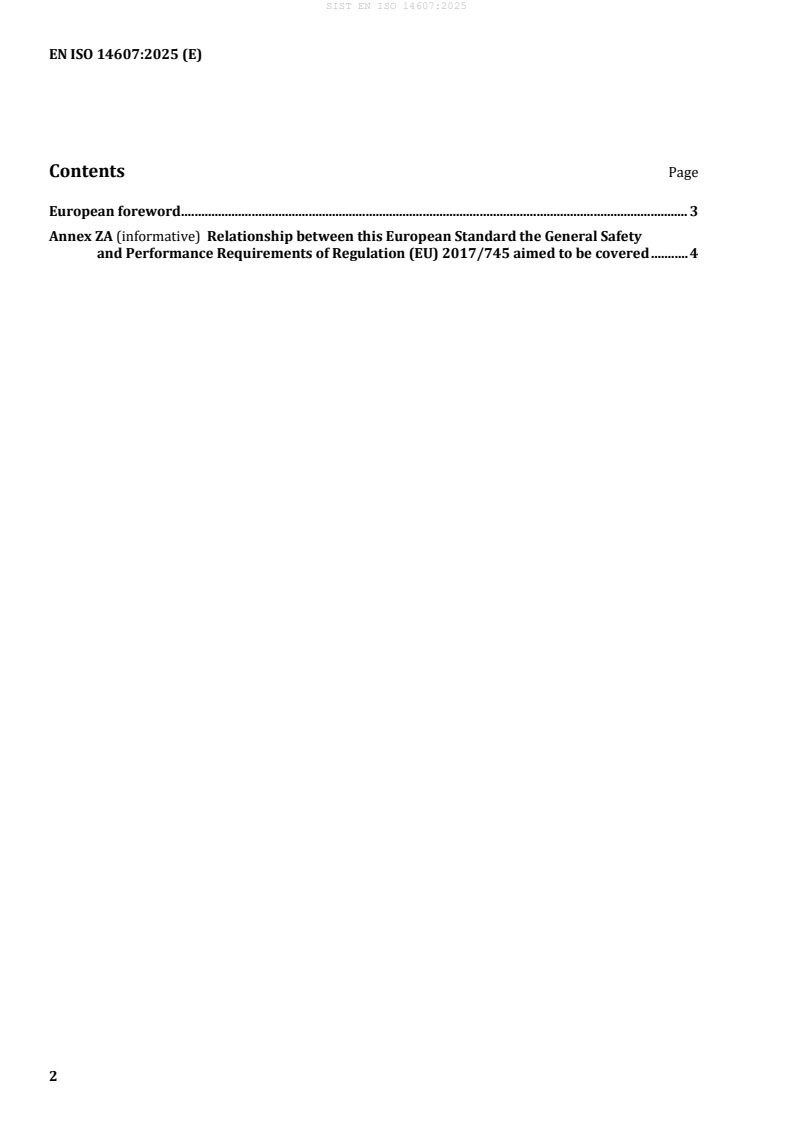
Contents Page
European foreword . 3
Annex ZA (informative) Relationship between this European Standard the General Safety
and Performance Requirements of Regulation (EU) 2017/745 aimed to be covered . 4
European foreword
This document (EN ISO 14607:2025) has been prepared by Technical Committee ISO/TC 150 "Implants
for surgery" in collaboration with Technical Committee CEN/TC 285 “Non-active surgical implants” the
secretariat of which is held by DIN.
This European Standard shall be given the status of a national standard, either by publication of an
identical text or by endorsement, at the latest by February 2026, and conflicting national standards
shall be withdrawn at the latest by February 2026.
Attention is drawn to the possibility that some of the elements of this document may be the subject of
patent rights. CEN shall not be held responsible for identifying any or all such patent rights.
This document supersedes EN ISO 14607:2018.
This document has been prepared under a standardization request addressed to CEN by the European
Commission. The Standing Committee of the EFTA States subsequently approves these requests for its
Member States.
For the relationship with EU Legislation, see informative Annex ZA, which is an integral part of this
document.
Any feedback and questions on this document should be directed to the users’ national standards
body/national committee. A complete listing of these bodies can be found on the CEN website.
According to the CEN-CENELEC Internal Regulations, the national standards organizations of the
following countries are bound to implement this European Standard: Austria, Belgium, Bulgaria,
Croatia, Cyprus, Czech Republic, Denmark, Estonia, Finland, France, Germany, Greece, Hungary, Iceland,
Ireland, Italy, Latvia, Lithuania, Luxembourg, Malta, Netherlands, Norway, Poland, Portugal, Republic of
North Macedonia, Romania, Serbia, Slovakia, Slovenia, Spain, Sweden, Switzerland, Türkiye and the
United Kingdom.
Endorsement notice
The text of ISO 14607:2024 has been approved by CEN as EN ISO 14607:2025 without any modification.
Annex ZA
(informative)
Relationship between this European Standard the General Safety and
Performance Requirements of Regulation (EU) 2017/745 aimed to be
covered
This European standard has been prepared under M/575 to provide one voluntary means of
conforming to the General Safety and Performance Requirements of Regulation (EU) 2017/745 of 5
April 2017 concerning medical devices [OJ L 117] and to system or process requirements including
those relating to quality management systems, risk management, post-market surveillance systems,
clinical investigations, clinical evaluation or post-market clinical follow-up.
Once this standard is cited in the Official Journal of the European Union under that Regulation,
compliance with the normative clauses of this standard given in Table ZA.1 and application of the
edition of the normatively referenced standards as given in Table ZA.2 confers, within the limits of the
scope of this standard, a presumption of conformity with the corresponding General Safety and
Performance Requirements of that Regulation, and associated EFTA Regulations.
Where a definition in this harmonized standard differs from a definition of the same term set out in
Regulation (EU) 2017/745, the differences are indicated in the Annex Z. For the purpose of using this
standard in support of the requirements set out in Regulation (EU) 2017/745, the definitions set out in
this Regulation prevail.
Where the European standard is an adoption of an International Standard, the scope of this document
can differ from the scope of the European Regulation that it supports. As the scope of the applicable
regulatory requirements differ from nation to nation and region to region the standard can only
support European regulatory requirements to the extent of the scope of the European Regulation for
medical devices ((EU) 2017/745).
NOTE 1 Where a reference from a clause of this standard to the risk management process is made, the risk
management process needs to be in compliance with Regulation (EU) 2017/745. This means that risks have to be
‘reduced as far as possible’, ‘reduced to the lowest possible level’, ‘reduced as far as possible and appropriate’,
‘removed or reduced as far as possible’, ‘eliminated or reduced as far as possible’, ’removed or minimized as far as
possible’, or ‘minimized’, according to the wording of the corresponding General Safety and Performance
Requirement.
NOTE 2 The manufacturer’s policy for determining acceptable risk must be in compliance with General Safety
and Performance Requirements 1, 2, 3, 4, 5, 8, 9, 10, 11, 14, 16, 17, 18, 19, 20, 21 and 22 of the Regulation.
NOTE 3 When a General Safety and Performance Requirement does not appear in Table ZA.1, it means that it is
not addressed by this European Standard.
Table ZA.1 — Correspondence between this European Standard and Annex I of
Regulation (EU) 2017/745 [OJ L 117] and to system or process requirements including those
relating to quality management systems, risk management, post-market surveillance systems,
clinical investigations, clinical evaluation or post-market clinical follow-up
General Safety and
Performance Clause(s) /
Requirements of subclause(s) of Remarks / Notes
Regulation (EU) this EN
2017/745
10.1(a) 6.3, 6.4.1 10.1(a) is covered with respect to the choice of
silicone gel materials based on their combined
residual oligomers, regarding toxicity by 6.3.
10.1(a) is covered with respect to the choice of raw
materials based on unintentional trace elements in
them, regarding toxicity by 6.4.1.
10.1(b) 7.2.1, 7.2.5 10.1(b) is covered with respect to the pre-clinical
biological evaluation of compatibility of the breast
implants with biological tissues by 7.2.1 and 7.2.5.
However, some parts of 7.2.1 and 7.2.5 contain
recommendations rather than requirements, which
limits their usefulness for the coverage of 10.1(b).
10.1(f) 7.2.2.1, Annex B 10.1(f) is covered with respect to shell integrity by
7.2.2.1 and Annex B.
7.2.2.2, Annex C 10.1(f) is covered with respect to implant resistance
by 7.2.2.2 and Annex C.
7.2.3.3.2, 10.1(f) is covered with respect to silicone gel
Annex E cohesion by 7.2.3.3.2 and Annex E.
10.1(g) 7.2.3.7, Annex G 10.1(g) is covered by 7.2.3.7 and Annex G.
10.1(h) Annex A 10.1(h) is covered with respect to the confirmation
that the raw silicone gel meets specifications
regarding combined residual oligomers by Annex A.
Annex B 10.1(h) is covered with respect to the confirmation
that implant meets specifications regarding shell
.
integrity by Annex B
Annex C 10.1(h) is covered with respect to the confirmation
that the implant meets specifications regarding
implant fatigue, impact resistance, and endurance
load level by Annex C.
Annex E 10.1(h) is covered with respect to the confirmation
that the silicone gel meets specifications regarding
silicone gel cohesion by Annex E.
Annex F 10.1(h) is covered with respect to the confirmation
that the silicone gel meets specifications regarding
.
silicone gel penetration by Annex F
Annex G 10.1(h) is covered with respect to the confirmation
that the silicone gel meets specifications regarding
General Safety and
Performance Clause(s) /
Requirements of subclause(s) of Remarks / Notes
Regulation (EU) this EN
2017/745
surface classification by Annex G.
23.1(g) Annex I e), 23.1(g) is covered with respect to information and
Annex I g)
warnings supplied by the manufacturer to patients
regarding residual risks, potential harm, and adverse
effects by Annex I e) and Annex I g).
Table ZA.2 — Normative references from clause 2 of this document and their corresponding
European publications
Reference in International Title Corresponding European
Clause 2 Standard Edition Standard Edition
ISO 34-1:2022 ISO 34-1:2022 Rubber, vulcanized or For applicable standard
thermoplastic — edition see Column 2
Determination of tear
strength — Part 1: Trouser,
angle and crescent test pieces
ISO 37:2017 ISO 37:2017 Rubber, vulcanized or For applicable standard
thermoplastic — edition see Column 2
Determination of tensile
stress-strain properties
ISO 48-4 ISO 48-4:2018 Rubber, vulcanized or For applicable standard
thermoplastic — edition see Column 2
Determination of hardness —
Part 4: Indentation hardness
by durometer method (Shore
hardness)
ISO 10993-1 ISO 10993-1:2018 Biological evaluation of EN ISO 10993-1:2020
medical devices — Part 1:
Evaluation and testing within
a risk management process
ISO 10993-5 ISO 10993-5:2009 Biological evaluation of EN ISO 10993-5:2009
medical devices — Part 5:
Tests for in vitro cytotoxicity
ISO 10993-6 ISO 10993-6:2016 Biological evaluation of EN ISO 10993-6:2016
medical devices — Part 6:
Tests for local effects after
implantation
ISO 10993-18 ISO 10993-18:2020 Biological evaluation of EN ISO 10993-
and medical devices — Part 18: 18:2020+A1:2023
ISO 10993- Chemical characterization of
18:2020/Amd 1:2022 medical device materials
within a risk management
process
Reference in International Title Corresponding European
Clause 2 Standard Edition Standard Edition
ISO/TS 10993- ISO/TS 10993-20: Biological evaluation of For applicable standard
20 2006 medical devices — Part 20: edition see Column 2
Principles and methods for
immunotoxicology testing of
medical devices
ISO 11607-1 ISO 11607-1:2019 Packaging for terminally EN ISO 11607-1:2020
sterilized medical devices —
Part 1: Requirements for
materials, sterile barrier
systems and packaging
systems
ISO 14155 ISO 14155:2020 Clinical investigation of EN ISO 14155:2020
medical devices for human
subjects — Good clinical
practice
ISO ISO 14630:2024 Non-active surgical implants EN ISO 14630:2024
14630:2024 — General requirements
ISO 14971 ISO 14971:2019 Medical devices — EN ISO 14971:2019 +
Application of risk A11:2021
management to medical
devices
ISO 20417 ISO 20417:2021 Medical devices — EN ISO 20417:2021
Information to be supplied by
the manufacturer
ISO 21920-2 ISO 21920-2:2021 Geometrical product EN ISO 21920-2:2022
specifications (GPS) —
Surface texture: Profile —
Part 2: Terms, definitions and
surface texture parameters
ASTM D412 None Standard Test Methods for None
Vulcanized Rubber and
Thermoplastic Elastomers —
Tension
ASTM D624-00 None Standard guide for evaluation None
(2020) of thermoplastic
polyurethane solids and
solutions for biomedical
applications
ASTM D792 None Standard Test Methods for None
Density and Specific Gravity
(Relative Density) of Plastics
by Displacement
ASTM D2240 None Standard Test Method for None
Rubber Property —
Reference in International Title Corresponding European
Clause 2 Standard Edition Standard Edition
Durometer Hardness
The documents listed in the Column 1 of Table ZA.2, in whole or in part, are normatively referenced in
this document, i.e. are indispensable for its application. The achievement of the presumption of
conformity is subject to the application of the edition of Standards as listed in Column 4 or, if no
European Standard Edition exists, the International Standard Edition given in Column 2 of Table ZA.2.
WARNING 1 Presumption of conformity stays valid only as long as a reference to this European
standard is maintained in the list published in the Official Journal of the European Union. Users of this
standard should consult frequently the latest list published in the Official Journal of the European
Union.
WARNING 2 Other Union legislation may be applicable to the product(s) falling within the scope of this
standard.
International
Standard
ISO 14607
Fourth edition
Non-active surgical implants —
2024-12
Mammary implants — Specific
requirements
Implants chirurgicaux non actifs — Implants mammaires —
Exigences particulières
Reference number
ISO 14607:2024(en) © ISO 2024
ISO 14607:2024(en)
© ISO 2024
All rights reserved. Unless otherwise specified, or required in the context of its implementation, no part of this publication may
be reproduced or utilized otherwise in any form or by any means, electronic or mechanical, including photocopying, or posting on
the internet or an intranet, without prior written permission. Permission can be requested from either ISO at the address below
or ISO’s member body in the country of the requester.
ISO copyright office
CP 401 • Ch. de Blandonnet 8
CH-1214 Vernier, Geneva
Phone: +41 22 749 01 11
Email: copyright@iso.org
Website: www.iso.org
Published in Switzerland
ii
ISO 14607:2024(en)
Contents Page
Foreword .v
Introduction .vii
1 Scope . 1
2 Normative references . 1
3 Terms and definitions . 2
4 Intended performance . 3
5 Design attributes . 3
6 Materials . 4
6.1 General .4
6.2 Cytotoxicity .4
6.3 Silicone gel residual low molecular weight oligomers .4
6.4 Trace elements .4
6.4.1 General .4
6.4.2 Limits on trace elements present as impurities .4
6.4.3 Intentionally added trace elements .4
6.5 Physico-mechanical properties and characterization .5
6.6 Documentation of materials .5
7 Design evaluation . 5
7.1 General .5
7.2 Pre-clinical evaluation . .6
7.2.1 General .6
7.2.2 Mechanical tests .6
7.2.3 Physical evaluation.7
7.2.4 Chemical evaluation .8
7.2.5 Biological evaluation.9
7.3 Clinical evaluation .9
7.4 Post-market surveillance .9
8 Manufacturing . 9
8.1 General .9
9 Sterilization . 10
10 Packaging. 10
11 Information supplied by the manufacturer . 10
11.1 General .10
11.2 Marking on implants .10
11.3 Label .10
11.4 Instructions for use .10
11.5 Patient record label(s) .10
11.6 Additional information for the user.11
11.7 Information on expected lifetime .11
11.8 Information for the patient .11
11.8.1 General .11
11.8.2 Patient information brochure . 12
11.8.3 Implant card . 12
Annex A (normative) Determination of D4, D5 and D6 in silicone gels .13
Annex B (normative) Tests of shell integrity . 17
Annex C (normative) Mechanical tests on a mammary implant in its implantable state .20
Annex D (normative) Tests of valve competence and injection site competence .29
Annex E (normative) Test of silicone gel cohesion for silicone filling materials only .31
iii
ISO 14607:2024(en)
Annex F (normative) Test of silicone gel penetration for silicone filling materials only .33
Annex G (normative) Surface classification .38
Annex H (normative) Information for the user .44
Annex I (normative) Patient information brochure .46
Annex J (normative) Tests of surface particulate contamination .49
Bibliography .53
iv
ISO 14607:2024(en)
Foreword
ISO (the International Organization for Standardization) is a worldwide federation of national standards
bodies (ISO member bodies). The work of preparing International Standards is normally carried out through
ISO technical committees. Each member body interested in a subject for which a technical committee
has been established has the right to be represented on that committee. International organizations,
governmental and non-governmental, in liaison with ISO, also take part in the work. ISO collaborates closely
with the International Electrotechnical Commission (IEC) on all matters of electrotechnical standardization.
The procedures used to develop this document and those intended for its further maintenance are described
in the ISO/IEC Directives, Part 1. In particular, the different approval criteria needed for the different types
of ISO document should be noted. This document was drafted in accordance with the editorial rules of the
ISO/IEC Directives, Part 2 (see www.iso.org/directives).
ISO draws attention to the possibility that the implementation of this document may involve the use of (a)
patent(s). ISO takes no position concerning the evidence, validity or applicability of any claimed patent
rights in respect thereof. As of the date of publication of this document, ISO had not received notice of (a)
patent(s) which may be required to implement this document. However, implementers are cautioned that
this may not represent the latest information, which may be obtained from the patent database available at
www.iso.org/patents. ISO shall not be held responsible for identifying any or all such patent rights.
Any trade name used in this document is information given for the convenience of users and does not
constitute an endorsement.
For an explanation of the voluntary nature of standards, the meaning of ISO specific terms and expressions
related to conformity assessment, as well as information about ISO's adherence to the World Trade
Organization (WTO) principles in the Technical Barriers to Trade (TBT), see www.iso.org/iso/foreword.html.
This document was prepared by Technical Committee ISO/TC 150, Implants for surgery, in collaboration
with the European Committee for Standardization (CEN) Technical Committee CEN/TC 285, Non-active
surgical implants, in accordance with the Agreement on technical cooperation between ISO and CEN (Vienna
Agreement).
This fourth edition cancels and replaces the third edition (ISO 14607:2018), which has been technically
revised.
The main changes are as follows:
— trace elements subclause (6.4) has been revised;
— language regarding biological evaluation and risk management has been revised and expanded in the
general part of the pre-clinical evaluation subclause (7.2.1);
— contamination subclause has been renamed to particulate contamination (7.2.3.8) and completely
revised;
— requirements regarding implantation studies have been added (7.2.5);
— clinical evaluation requirements have been expanded (7.3);
— surface category has been added to the label requirements (11.3);
— Annex C “Mechanical tests on a mammary implant in its implantable state” has been expanded and
revised;
— the fatigue resistance testing method (Clauses C.1 and C.3) has been revised and expanded;
— Annex F “Test for silicone gel penetration (silicone filling materials only)” has been re-structured and the
language has been clarified;
— Annex G “Assessment of silicone diffusion from mammary implants using an in vitro method” has been
deleted as the test method given in the annex did not accomplish its purpose;
v
ISO 14607:2024(en)
— Annex H “Test for surface characteristics” has been re-numbered as Annex G and has been renamed
“Surface classification”, its status has been changed to normative, it has completely revised and an
expanded surface classification has been added;
— Annex J “Tests for surface particulate contamination” has been newly added;
— the language of test report subclauses in all annexes has been harmonized as much as possible.
Any feedback or questions on this document should be directed to the user’s national standards body. A
complete listing of these bodies can be found at www.iso.org/members.html.
vi
ISO 14607:2024(en)
Introduction
There are three levels of International Standards dealing with non-active surgical implants. These are as
follows (with level 1 being the highest):
— level 1: General requirements for non-active surgical implants;
— level 2: Particular requirements for families of non-active surgical implants;
— level 3: Specific requirements for types of non-active surgical implants.
This document is a level 3 standard and contains specific requirements for mammary implants.
The level 1 standard, ISO 14630, contains requirements that apply to all non-active surgical implants. It also
indicates that there are additional requirements in the level 2 and level 3 standards.
To address all requirements, the lowest available level is the level to start with.
vii
International Standard ISO 14607:2024(en)
Non-active surgical implants — Mammary implants —
Specific requirements
1 Scope
This document specifies specific requirements for mammary implants. With regard to safety, this
document specifies requirements for intended performance, design attributes, materials, design evaluation,
manufacturing, packaging, sterilization and information supplied by the manufacturer.
2 Normative references
The following documents are referred to in the text in such a way that some or all of their content constitutes
requirements of this document. For dated references, only the edition cited applies. For undated references,
the latest edition of the referenced document (including any amendments) applies.
ISO 34-1:2022, Rubber, vulcanized or thermoplastic — Determination of tear strength — Part 1: Trouser, angle
and crescent test pieces
ISO 37:2024, Rubber, vulcanized or thermoplastic — Determination of tensile stress-strain properties
ISO 48-4, Rubber, vulcanized or thermoplastic — Determination of hardness — Part 4: Indentation hardness by
durometer method (Shore hardness)
ISO 10993-1, Biological evaluation of medical devices — Part 1: Evaluation and testing within a risk
management process
ISO 10993-5, Biological evaluation of medical devices — Part 5: Tests for in vitro cytotoxicity
ISO 10993-6, Biological evaluation of medical devices — Part 6: Tests for local effects after implantation
ISO 10993-18, Biological evaluation of medical devices — Part 18: Chemical characterization of medical device
materials within a risk management process
ISO/TS 10993-20, Biological evaluation of medical devices — Part 20: Principles and methods for
immunotoxicology testing of medical devices
ISO 11607-1, Packaging for terminally sterilized medical devices — Part 1: Requirements for materials, sterile
barrier systems and packaging systems
ISO 14155, Clinical investigation of medical devices for human subjects — Good clinical practice
ISO 14630:2024, Non-active surgical implants — General requirements
ISO 14971, Medical devices — Application of risk management to medical devices
ISO 20417:2021, Medical devices — Information to be supplied by the manufacturer
ISO 21920-2, Geometrical product specifications (GPS) — Surface texture: Profile — Part 2: Terms, definitions
and surface texture parameters
ASTM D412, Standard Test Methods for Vulcanized Rubber and Thermoplastic Elastomers — Tension
ASTM D624-00 (2020), Standard guide for evaluation of thermoplastic polyurethane solids and solutions for
biomedical applications
ISO 14607:2024(en)
ASTM D792, Standard Test Methods for Density and Specific Gravity (Relative Density) of Plastics by
Displacement
ASTM D2240, Standard Test Method for Rubber Property — Durometer Hardness
3 Terms and definitions
For the purposes of this document, the terms and definitions given in ISO 10993-1, ISO 14155 and ISO 14630
and the following apply.
ISO and IEC maintain terminology databases for use in standardization at the following addresses:
— ISO Online browsing platform: available at https:// www .iso .org/ obp
— IEC Electropedia: available at https:// www .electropedia .org/
3.1
anterior projection
maximum height of the implant when placed with its base on a flat horizontal surface
Note 1 to entry: For inflatable and adjustable implants, this applies to the implant's nominal volume.
3.2
base dimension
length of the major axis and the length of the minor axis when the implant is placed with its base on a flat
horizontal surface
Note 1 to entry: For inflatable and adjustable implants, this applies to the implant's nominal volume.
3.3
cure
process of cross-linking silicone polymers (3.17)
3.4
diffusion
movement of material in and/or out of an implant through an intact shell (3.13)
3.5
filling volume
volume of the material contained within the shell (3.13) or volume of the solution necessary to fill an
inflatable or adjustable mammary implant (3.8)
3.6
implant volume
volume of the shell (3.13) and filler material together
3.7
injection site
component designed to be penetrated by a needle to alter the volume of the implant
3.8
mammary implant
implant with a shell (3.13) which has been filled by the manufacturer (3.9) or is designed to be filled by the
surgeon, and is intended to add or replace the volume of the breast
3.9
manufacturer
natural or legal person who manufactures or fully refurbishes a medical device, or has a device designed,
manufactured, or fully refurbished, and markets that medical device under its name or trademark
[SOURCE: ISO 10993-18:2020, 3.23]
ISO 14607:2024(en)
3.10
orientation means
mark in or on the implant to assist the surgeon in positioning the implant
3.11
particle-free water
purified water that has been passed through a suitable filter of 0,22 µm pore size
[8]
[SOURCE: USP 43-NF 38 – Reagent Specifications ]
3.12
particulate contamination
extraneous particles that are unintentionally present on the surface of an implant
Note 1 to entry: Particulate contamination can come from many sources during the manufacturing process.
3.13
shell
envelope of the mammary implant (3.8)
3.14
seam
seal junction of implant materials fused or adhered together
3.15
silicone elastomer
synthetic rubber obtained by the cross-linking of silica-reinforced silicone polymer (3.17) chains essentially
made of repeated diorganosiloxane units
3.16
silicone gel
semi-solid material consisting of cross-linked silicone polymer (3.17) and liquid silicone polymer [silicone oil
or polydimethylsiloxane (PDMS)]
3.17
silicone polymer
polymer chains essentially made of repeated organosiloxane units
Note 1 to entry: The silicone polymers can be presented in many levels of viscosity.
3.18
supplier
company which manufactures and/or supplies the raw materials and components used for the production of
mammary implants (3.8)
3.19
tensile set
tensile elongation remaining after a specimen has been stretched and allowed to relax in a controlled manner
3.20
valve
shell (3.13) component allowing inflation of mammary implant (3.8) with variable volumes of liquids when
needed and providing a tight closure the rest of the time
4 Intended performance
The requirements of ISO 14630:2024, Clause 4, shall apply.
5 Design attributes
The requirements of ISO 14630:2024, Clause 5, shall apply.
ISO 14607:2024(en)
6 Materials
6.1 General
The requirements of ISO 14630:2024, Clause 6, shall apply.
Materials should be manufactured and tested under an appropriate quality management system.
NOTE ISO 13485 is an example of quality management standard, which can be appropriate depending on local or
regional regulation.
When materials other than silicone are used, the manufacturer shall establish suitable test methods and
acceptance criteria to demonstrate the appropriate performance and safety of the implant.
6.2 Cytotoxicity
Each raw material lot shall be tested for cytoxicity in accordance with ISO 10993-5. The test specimens shall
be representative of the materials used in the manufacture of mammary implants and should be cured as
appropriate in advance of testing. No cytotoxic effects, as defined in ISO 10993-5, shall occur.
6.3 Silicone gel residual low molecular weight oligomers
The combined residual oligomers, octamethylcyclotetrasiloxane (D4), decamethylcyclopentasiloxane (D5)
and dodecamethylcyclohexasiloxane (D6), in uncured or cured silicone gel shall be tested in accordance
with Annex A. These shall be reported in mg/kg and the total concentration of D4, D5, D6 combined shall not
exceed 150 mg/kg (see also Clause A.9).
6.4 Trace elements
6.4.1 General
The presence of trace elements in raw materials can have two distinct sources.
— The first source is unintentional; they generally are residual substances entrapped into the ingredients
used to formulate the raw materials. As such, they can be considered as impurities and shall not be
present above a defined content limit, as reported in Table 1.
— The second source is intentional, that is, they are part of the product formulation. Typical examples
of such intentional elements are some metals, like platinum (Pt), used under the form of a complex to
catalyse the curing reaction of some silicones. In this case, they shall not be considered as impurities and
shall rather be taken into account in the larger context of the toxicological evaluation of the implant.
6.4.2 Limits on trace elements present as impurities
Table 1 — Unintentional trace elements impurities limit content
Content limit per element
Element
mg/kg
As, Ba, Cd, Co, Cr, Cu, Hg, Mo, Ni, Pb, Pt, Sb, Se, Sn, V ≤10
6.4.3 Intentionally added trace elements
If one of these trace elements is part of the formulation component, it is not considered an impurity.
Two trace elements which are commonly added are platinum (Pt) and tin (Sn).
ISO 14607:2024(en)
If the cross-linking reaction of some silicones used for breast implants is catalysed by a platinum complex,
the concentration of platinum in the final silicone component after the cross-linking reaction should not
exceed 30 mg/kg.
If the cross-linking reaction of some silicones used for breast implants is catalysed by a tin complex, the
concentration of tin in the final silicone component after the cross-linking reaction should not exceed
450 mg/kg.
6.5 Physico-mechanical properties and characterization
The following mechanical characteristics of the shell material (e.g. silicone elastomers, after cure) shall be
available for every raw material lot:
— elongation at break, in percentage (%), in accordance with ISO 37 or ASTM D412;
— tensile strength at break, in megapascals (MPa), in accordance with to ISO 37 or ASTM D412;
— modulus at 100 % elongation, in megapascals (MPa), in accordance with ISO 37 or ASTM D412;
— hardness, in accordance with ASTM D2240 or ISO 48-4;
— relative density or specific gravity, in accordance with ASTM D792;
— tear strength, in kilonewtons per meter (kN/m), in accordance with ISO 34-1:2022, Method C, or
ASTM D624-00 (2020), Die B.
Every raw material lot of silicone gel shall be tested in accordance with Annex F and shall comply with the
specifications of the raw material manufacturer.
6.6 Documentation of materials
For each type of material, the manufacturer shall have available a certificate of analysis including at least
the following information:
a) supplier’s name, address and contact details;
b) material reference;
c) test result including test methods applied for 6.2;
d) for silicone gels test results including sample preparation (e.g. cure condition) for 6.3;
e) test results including the test methods and sample preparation applied for 6.4;
f) test results including defined acceptance criteria, test methods applied and sample preparation (e.g.
cure condition) for 6.5.
NOTE This information can typically be obtained from the raw material supplier.
7 Design evaluation
7.1 General
The requirements of ISO 14630:2024, 7.1, shall apply.
An appropriate risk management process in accordance with ISO 14971 shall be established for all stages in
the life cycle
...