

EN ISO 5832-1:2024
(Main)Implants for surgery - Metallic materials - Part 1: Wrought stainless steel (ISO 5832-1:2024, Corrected version 2025-06)
- Abstract
This document specifies the characteristics of, and corresponding test methods for, wrought stainless steel for use in the manufacture of surgical implants.
NOTE 1 The mechanical properties of a sample obtained from a finished product made of this alloy can differ from those specified in this document.
NOTE 2 The alloy described in this document corresponds to UNS S31673 in ASTM F138 and ASTM F139.
- Status
- Published
- Publication Date
- 09-Apr-2024
- Technical Committee
- CEN/TC 285 - Non-active surgical implants
- Drafting Committee
- CEN/TC 285 - Non-active surgical implants
- Current Stage
- 6060 - Definitive text made available (DAV) - Publishing
- Start Date
- 10-Apr-2024
- Completion Date
- 10-Apr-2024
Overview
EN ISO 5832-1:2024 (Corrected version 2025-06) specifies the chemical, microstructural and mechanical characteristics - and the corresponding test methods - for wrought stainless steel intended for the manufacture of surgical implants. The alloy corresponds to UNS S31673 in ASTM F138 / F139. The standard covers raw material requirements (not finished-device design), with referenced test methods for chemical analysis, microstructure and tensile testing.
Key topics and technical requirements
- Scope: Characteristics and test methods for wrought stainless steel used in surgical implants.
- Chemical composition: Limits given for main elements (examples from Table 1):
- Carbon ≤ 0.030%
- Silicon ≤ 0.75%
- Manganese ≤ 2.0%
- Phosphorus ≤ 0.025%
- Sulfur ≤ 0.010%
- Nitrogen ≤ 0.10%
- Chromium 17.0–19.0%
- Molybdenum 2.25–3.00%
- Nickel 13.0–15.0%
- Copper ≤ 0.50%
- Cobalt < 0.10%
- Iron: balance
- The molybdenum and chromium contents must satisfy the C-value requirement from Formula (1); the computed C shall be not less than 26.
- Microstructure:
- Austenitic grain size shall be no coarser than grain size No. 5.
- Steel shall be free from delta ferrite, chi or sigma phases.
- Non‑metallic inclusion limits specified (Table 2) for sulfides, aluminates, silicates and oxides (thin ≤ 1.5, thick ≤ 1). Vacuum or electroslag melting may be needed to meet cleanliness.
- Mechanical properties & testing:
- Tensile properties specified for bars, wires, sheet and strip (refer to Tables 3–5 in the standard).
- Sample preparation and tensile testing referenced to ISO 377, ISO 6892-1 and ISO 404.
- Original gauge length (Lo) requirements and retest rules are defined; note that mechanical properties of a finished product can differ from raw‑material values.
Applications and users
- Primary application: non‑active surgical implants (orthopaedic and dental implants, prosthetics components made from wrought stainless steel).
- Typical users: implant manufacturers, medical device material suppliers, metallurgical and quality laboratories, regulatory and conformity-assessment bodies, purchasing/specification engineers.
- Practical value: ensures consistent alloy chemistry, cleanliness, microstructure and mechanical performance to support biocompatibility, corrosion resistance and mechanical reliability of implant components.
Related standards and references
- ISO 5832 series (harmonized parts)
- ASTM F138 / F139 (UNS S31673 equivalence)
- Test method references: ISO 377, ISO 404, ISO 4967, ISO 643, ISO 6892-1, ISO 439, ISO 629, ISO 671, ISO 10714.
Keywords: EN ISO 5832-1:2024, ISO 5832-1, wrought stainless steel, surgical implants, UNS S31673, ASTM F138, implant material standards, microstructure, chemical composition, tensile test.
Relations
- Effective Date
- 19-Jan-2023
- Effective Date
- 25-Aug-2026
- Effective Date
- 25-Aug-2026
- Effective Date
- 25-Aug-2026
- Effective Date
- 25-Aug-2026
- Effective Date
- 25-Aug-2026
- Refers
ISO 629:1982 - Steel and cast iron — Determination of manganese content — Spectrophotometric method - Effective Date
- 25-Aug-2026
- Refers
ISO 6892-1:2019 - Metallic materials — Tensile testing — Part 1: Method of test at room temperature - Effective Date
- 09-Feb-2026
- Effective Date
- 09-Feb-2026
- Effective Date
- 09-Feb-2026
- Refers
CEN/CLC/TR 17603-31-13:2021 - Space Engineering - Thermal design handbook - Part 13: Fluid Loops - Effective Date
- 28-Jan-2026
- Effective Date
- 28-Jan-2026
- Effective Date
- 28-Jan-2026
- Consolidated By
ISO 5832-1:2024 - Implants for surgery — Metallic materials — Part 1: Wrought stainless steel - Effective Date
- 12-Feb-2026
Get Certified
Connect with accredited certification bodies for this standard

BSI Group
BSI (British Standards Institution) is the business standards company that helps organizations make excellence a habit.

TÜV Rheinland
TÜV Rheinland is a leading international provider of technical services.

TÜV SÜD
TÜV SÜD is a trusted partner of choice for safety, security and sustainability solutions.
Sponsored listings
Frequently Asked Questions
EN ISO 5832-1:2024 is a standard published by the European Committee for Standardization (CEN). Its full title is "Implants for surgery - Metallic materials - Part 1: Wrought stainless steel (ISO 5832-1:2024, Corrected version 2025-06)". This standard covers: This document specifies the characteristics of, and corresponding test methods for, wrought stainless steel for use in the manufacture of surgical implants. NOTE 1 The mechanical properties of a sample obtained from a finished product made of this alloy can differ from those specified in this document. NOTE 2 The alloy described in this document corresponds to UNS S31673 in ASTM F138 and ASTM F139.
This document specifies the characteristics of, and corresponding test methods for, wrought stainless steel for use in the manufacture of surgical implants. NOTE 1 The mechanical properties of a sample obtained from a finished product made of this alloy can differ from those specified in this document. NOTE 2 The alloy described in this document corresponds to UNS S31673 in ASTM F138 and ASTM F139.
EN ISO 5832-1:2024 is classified under the following ICS (International Classification for Standards) categories: 11.040.40 - Implants for surgery, prosthetics and orthotics. The ICS classification helps identify the subject area and facilitates finding related standards.
EN ISO 5832-1:2024 has the following relationships with other standards: It is inter standard links to EN ISO 5832-1:2019, ISO 4967:2013, ISO 439:2020, ISO 671:1982, ISO 377:2017, ISO 643:2019, ISO 629:1982, ISO 6892-1:2019, ISO 404:2013, ISO 10714:1992, CEN/CLC/TR 17603-31-13:2021, EN ISO 7010:2020/A3:2022, EN 14583:2004, ISO 5832-1:2024. Understanding these relationships helps ensure you are using the most current and applicable version of the standard.
EN ISO 5832-1:2024 is available in PDF format for immediate download after purchase. The document can be added to your cart and obtained through the secure checkout process. Digital delivery ensures instant access to the complete standard document.
Standards Content (Sample)
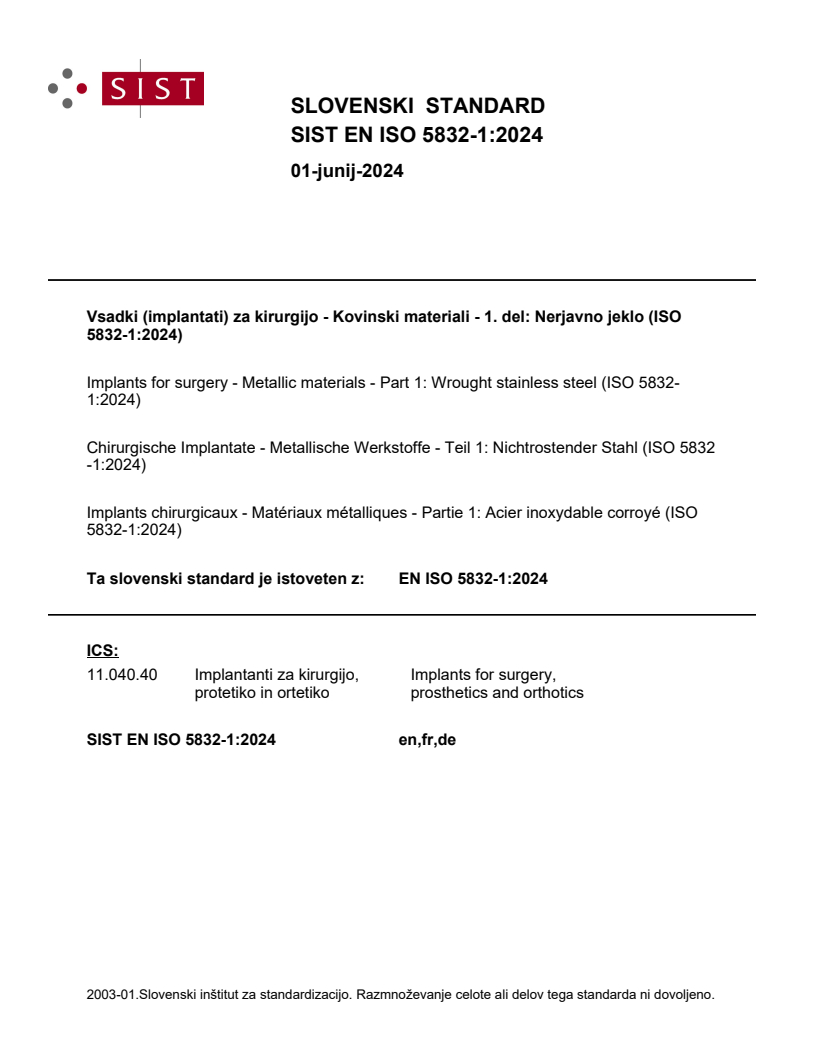
SLOVENSKI STANDARD
01-junij-2024
Vsadki (implantati) za kirurgijo - Kovinski materiali - 1. del: Nerjavno jeklo (ISO
5832-1:2024)
Implants for surgery - Metallic materials - Part 1: Wrought stainless steel (ISO 5832-
1:2024)
Chirurgische Implantate - Metallische Werkstoffe - Teil 1: Nichtrostender Stahl (ISO 5832
-1:2024)
Implants chirurgicaux - Matériaux métalliques - Partie 1: Acier inoxydable corroyé (ISO
5832-1:2024)
Ta slovenski standard je istoveten z: EN ISO 5832-1:2024
ICS:
11.040.40 Implantanti za kirurgijo, Implants for surgery,
protetiko in ortetiko prosthetics and orthotics
2003-01.Slovenski inštitut za standardizacijo. Razmnoževanje celote ali delov tega standarda ni dovoljeno.
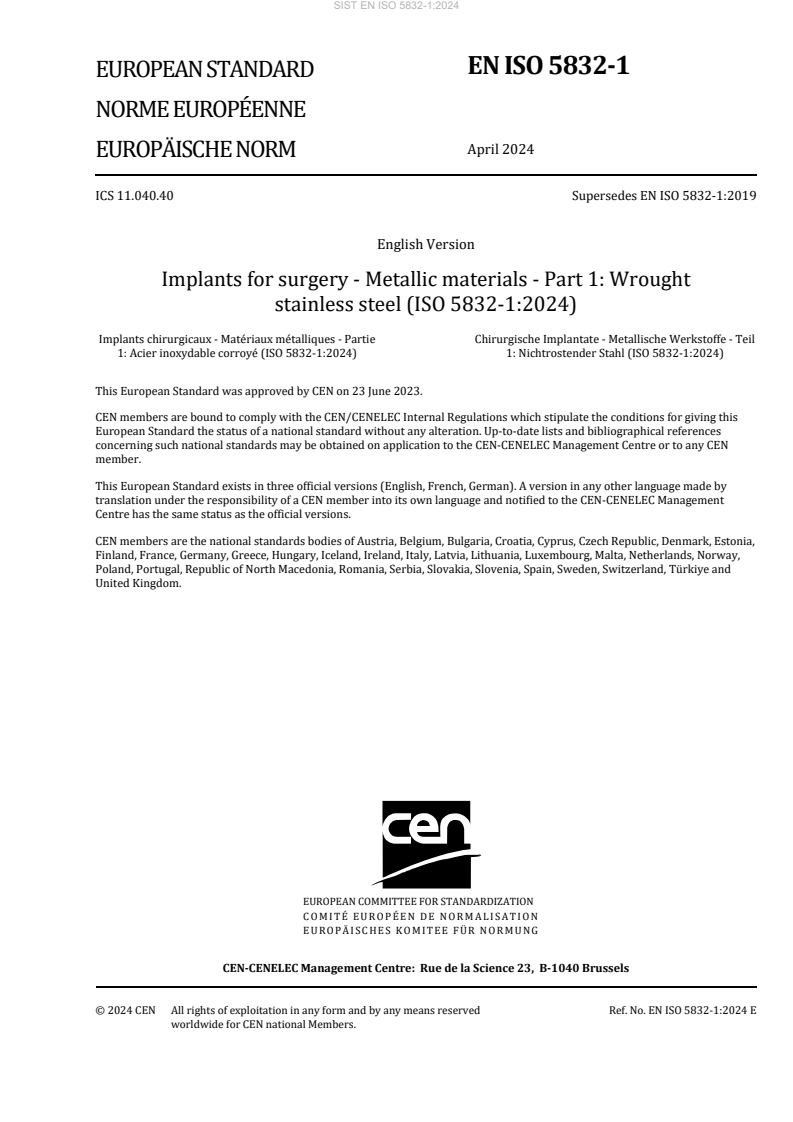
EN ISO 5832-1
EUROPEAN STANDARD
NORME EUROPÉENNE
April 2024
EUROPÄISCHE NORM
ICS 11.040.40 Supersedes EN ISO 5832-1:2019
English Version
Implants for surgery - Metallic materials - Part 1: Wrought
stainless steel (ISO 5832-1:2024)
Implants chirurgicaux - Matériaux métalliques - Partie Chirurgische Implantate - Metallische Werkstoffe - Teil
1: Acier inoxydable corroyé (ISO 5832-1:2024) 1: Nichtrostender Stahl (ISO 5832-1:2024)
This European Standard was approved by CEN on 23 June 2023.
CEN members are bound to comply with the CEN/CENELEC Internal Regulations which stipulate the conditions for giving this
European Standard the status of a national standard without any alteration. Up-to-date lists and bibliographical references
concerning such national standards may be obtained on application to the CEN-CENELEC Management Centre or to any CEN
member.
This European Standard exists in three official versions (English, French, German). A version in any other language made by
translation under the responsibility of a CEN member into its own language and notified to the CEN-CENELEC Management
Centre has the same status as the official versions.
CEN members are the national standards bodies of Austria, Belgium, Bulgaria, Croatia, Cyprus, Czech Republic, Denmark, Estonia,
Finland, France, Germany, Greece, Hungary, Iceland, Ireland, Italy, Latvia, Lithuania, Luxembourg, Malta, Netherlands, Norway,
Poland, Portugal, Republic of North Macedonia, Romania, Serbia, Slovakia, Slovenia, Spain, Sweden, Switzerland, Türkiye and
United Kingdom.
EUROPEAN COMMITTEE FOR STANDARDIZATION
COMITÉ EUROPÉEN DE NORMALISATION
EUROPÄISCHES KOMITEE FÜR NORMUNG
CEN-CENELEC Management Centre: Rue de la Science 23, B-1040 Brussels
© 2024 CEN All rights of exploitation in any form and by any means reserved Ref. No. EN ISO 5832-1:2024 E
worldwide for CEN national Members.
Contents Page
European foreword . 3
European foreword
This document (EN ISO 5832-1:2024) has been prepared by Technical Committee ISO/TC 150
"Implants for surgery" in collaboration with Technical Committee CEN/TC 285 “Non-active surgical
implants” the secretariat of which is held by DIN.
This European Standard shall be given the status of a national standard, either by publication of an
identical text or by endorsement, at the latest by October 2024, and conflicting national standards shall
be withdrawn at the latest by October 2024.
Attention is drawn to the possibility that some of the elements of this document may be the subject of
patent rights. CEN shall not be held responsible for identifying any or all such patent rights.
This document supersedes EN ISO 5832-1:2019.
Any feedback and questions on this document should be directed to the users’ national standards
body/national committee. A complete listing of these bodies can be found on the CEN website.
According to the CEN-CENELEC Internal Regulations, the national standards organizations of the
following countries are bound to implement this European Standard: Austria, Belgium, Bulgaria,
Croatia, Cyprus, Czech Republic, Denmark, Estonia, Finland, France, Germany, Greece, Hungary, Iceland,
Ireland, Italy, Latvia, Lithuania, Luxembourg, Malta, Netherlands, Norway, Poland, Portugal, Republic of
North Macedonia, Romania, Serbia, Slovakia, Slovenia, Spain, Sweden, Switzerland, Türkiye and the
United Kingdom.
Endorsement notice
The text of ISO 5832-1:2024 has been approved by CEN as EN ISO 5832-1:2024 without any
modification.
International
Standard
ISO 5832-1
Sixth edition
Implants for surgery — Metallic
2024-04
materials —
Part 1:
Wrought stainless steel
Implants chirurgicaux — Matériaux métalliques —
Partie 1: Acier inoxydable corroyé
Reference number
ISO 5832-1:2024(en) © ISO 2024
ISO 5832-1:2024(en)
© ISO 2024
All rights reserved. Unless otherwise specified, or required in the context of its implementation, no part of this publication may
be reproduced or utilized otherwise in any form or by any means, electronic or mechanical, including photocopying, or posting on
the internet or an intranet, without prior written permission. Permission can be requested from either ISO at the address below
or ISO’s member body in the country of the requester.
ISO copyright office
CP 401 • Ch. de Blandonnet 8
CH-1214 Vernier, Geneva
Phone: +41 22 749 01 11
Email: copyright@iso.org
Website: www.iso.org
Published in Switzerland
ii
ISO 5832-1:2024(en)
Contents Page
Foreword .iv
Introduction .v
1 Scope . 1
2 Normative references . 1
3 Terms and definitions . 1
4 Chemical composition . 2
4.1 Test samples .2
4.2 Cast analysis .2
5 Microstructure in the fully annealed condition . 2
5.1 Grain size .2
5.2 Microstructure .3
5.3 Inclusion content .3
6 Mechanical properties . 3
6.1 Test pieces . .3
6.2 Tensile test .3
6.3 Gauge length .3
7 Test methods . 3
Bibliography . 6
iii
ISO 5832-1:2024(en)
Foreword
ISO (the International Organization for Standardization) is a worldwide federation of national standards
bodies (ISO member bodies). The work of preparing International Standards is normally carried out through
ISO technical committees. Each member body interested in a subject for which a technical committee
has been established has the right to be represented on that committee. International organizations,
governmental and non-governmental, in liaison with ISO, also take part in the work. ISO collaborates closely
with the International Electrotechnical Commission (IEC) on all matters of electrotechnical standardization.
The procedures used to develop this document and those intended for its further maintenance are described
in the ISO/IEC Directives, Part 1. In particular, the different approval criteria needed for the different types
of ISO document should be noted. This document was drafted in accordance with the editorial rules of the
ISO/IEC Directives, Part 2 (see www.iso.org/directives).
ISO draws attention to the possibility that the implementation of this document may involve th
...