

ISO 14630:2024
(Main)Non-active surgical implants — General requirements
General Information
- Abstract
This document specifies general requirements for non-active surgical implants, hereafter referred to as implants. This document is not applicable to dental implants, dental restorative materials, transendodontic and transradicular implants, intra-ocular lenses and implants utilizing viable animal or human tissue. With regard to safety, this document specifies requirements for intended performance, design attributes, materials, design evaluation, manufacture, sterilization, packaging and information supplied by the manufacturer, and tests to demonstrate compliance with these requirements. Additional requirements applicable to specific implants or implant families are given or referred to in Level 2 and Level 3 standards. NOTE 1 This document does not require that the manufacturer have a quality management system in place. However, many regulatory authorities require the application of a quality management system, such as that described in ISO 13485, to ensure that the implant achieves its intended performance and safety. NOTE 2 In this document, when not otherwise specified, the term "implant" refers to each individual component of a system or a modular implant, provided separately or as a set of components, as well as to all ancillary implants or associated implants designed for improving the intended performance.
- Status
- Published
- Publication Date
- 03-Sep-2024
- Technical Committee
- ISO/TC 150 - Implants for surgery
- Drafting Committee
- ISO/TC 150/WG 7 - Fundamental standards
- Current Stage
- 6060 - International Standard published
- Start Date
- 04-Sep-2024
- Due Date
- 20-Jun-2023
- Completion Date
- 04-Sep-2024
Buy Documents
ISO 14630:2024 - Non-active surgical implants — General requirements Released:4. 09. 2024

ISO 14630:2024 - Implants chirurgicaux non actifs — Exigences générales Released:4. 09. 2024
Overview
ISO 14630:2024 - "Non‑active surgical implants - General requirements" is the Level 1 ISO standard specifying baseline safety and performance requirements for non‑active surgical implants. It defines requirements for intended performance, design attributes, materials, design evaluation, manufacture, sterilization, packaging and information supplied by the manufacturer. It does not apply to dental implants, dental restorative materials, transendodontic/transradicular implants, intra‑ocular lenses or implants that utilize viable animal or human tissue.
This fifth edition updates and expands the 2012 edition to clarify scope, add clinical‑evaluation definitions, strengthen material selection and risk analysis expectations, expand design evaluation (pre‑clinical, clinical, post‑market) and introduce patient record labels and implant cards.
Key topics and requirements
- Intended performance: define indications, contraindications and target patient population as part of device specification.
- Design attributes: systematic consideration of mechanical, dimensional, interface and safety characteristics during design.
- Selection of materials: use of a risk‑based approach (aligned with ISO 14971) to justify materials and assess biocompatibility and toxicological risk.
- Design evaluation: expanded coverage of pre‑clinical testing, clinical evaluation/clinical investigation and post‑market surveillance requirements.
- Manufacture and cleanliness: manufacturing controls to ensure implant cleanliness and conformity with design.
- Sterilization: requirements for implants supplied sterile, non‑sterile and re‑sterilizable devices; references to validated sterilization methods and control of sterilization residuals.
- Packaging: protection from damage, maintenance of sterility, and determination of use‑by dates.
- Information supplied: marking, labeling, instructions for use, patient record labels and implant cards to support traceability and safe use.
- Testing and demonstration: tests needed to demonstrate compliance with the above requirements and conformity to applicable Level 2/3 standards.
Practical applications and users
ISO 14630:2024 is used by:
- Medical device manufacturers for design controls, material selection, sterilization strategy and labelling requirements for non‑active implants.
- Regulatory affairs and quality managers to align dossiers with international expectations (often used alongside ISO 13485 and ISO 14971).
- Test laboratories and contract sterilizers to understand required validations and residual controls.
- Notified bodies and regulators when assessing conformity and clinical evidence.
- Clinicians and procurement specialists to verify manufacturer information (IFU, implant cards) needed for safe implantation and traceability.
Related standards (commonly referenced)
- ISO 14971 (risk management)
- ISO 10993 series (biological evaluation)
- ISO 11135 / ISO 11137 (sterilization validation)
- ISO 11607 (packaging for terminally sterilized devices)
- ISO 14155 (clinical investigation)
- ISO 13485 (quality management systems)
By applying ISO 14630:2024 together with applicable Level 2/Level 3 standards, stakeholders can ensure robust, risk‑based development and safe clinical use of non‑active surgical implants.
Relations
- Effective Date
- 09-Feb-2026
- Referred By
EN ISO 7197:2024 - Neurosurgical implants - Sterile, single-use hydrocephalus shunts (ISO 7197:2024) - Effective Date
- 09-Feb-2026
- Consolidates
EN ISO 14630:2024 - Non-active surgical implants - General requirements (ISO 14630:2024) - Effective Date
- 12-Feb-2026
- Effective Date
- 06-Jun-2022
- Effective Date
- 23-Apr-2020
Buy Documents
ISO 14630:2024 - Non-active surgical implants — General requirements Released:4. 09. 2024
ISO 14630:2024 - Implants chirurgicaux non actifs — Exigences générales Released:4. 09. 2024
Get Certified
Connect with accredited certification bodies for this standard

BSI Group
BSI (British Standards Institution) is the business standards company that helps organizations make excellence a habit.

TÜV Rheinland
TÜV Rheinland is a leading international provider of technical services.

TÜV SÜD
TÜV SÜD is a trusted partner of choice for safety, security and sustainability solutions.
Sponsored listings
Frequently Asked Questions
ISO 14630:2024 is a standard published by the International Organization for Standardization (ISO). Its full title is "Non-active surgical implants — General requirements". This standard covers: This document specifies general requirements for non-active surgical implants, hereafter referred to as implants. This document is not applicable to dental implants, dental restorative materials, transendodontic and transradicular implants, intra-ocular lenses and implants utilizing viable animal or human tissue. With regard to safety, this document specifies requirements for intended performance, design attributes, materials, design evaluation, manufacture, sterilization, packaging and information supplied by the manufacturer, and tests to demonstrate compliance with these requirements. Additional requirements applicable to specific implants or implant families are given or referred to in Level 2 and Level 3 standards. NOTE 1 This document does not require that the manufacturer have a quality management system in place. However, many regulatory authorities require the application of a quality management system, such as that described in ISO 13485, to ensure that the implant achieves its intended performance and safety. NOTE 2 In this document, when not otherwise specified, the term "implant" refers to each individual component of a system or a modular implant, provided separately or as a set of components, as well as to all ancillary implants or associated implants designed for improving the intended performance.
This document specifies general requirements for non-active surgical implants, hereafter referred to as implants. This document is not applicable to dental implants, dental restorative materials, transendodontic and transradicular implants, intra-ocular lenses and implants utilizing viable animal or human tissue. With regard to safety, this document specifies requirements for intended performance, design attributes, materials, design evaluation, manufacture, sterilization, packaging and information supplied by the manufacturer, and tests to demonstrate compliance with these requirements. Additional requirements applicable to specific implants or implant families are given or referred to in Level 2 and Level 3 standards. NOTE 1 This document does not require that the manufacturer have a quality management system in place. However, many regulatory authorities require the application of a quality management system, such as that described in ISO 13485, to ensure that the implant achieves its intended performance and safety. NOTE 2 In this document, when not otherwise specified, the term "implant" refers to each individual component of a system or a modular implant, provided separately or as a set of components, as well as to all ancillary implants or associated implants designed for improving the intended performance.
ISO 14630:2024 is classified under the following ICS (International Classification for Standards) categories: 11.040.40 - Implants for surgery, prosthetics and orthotics. The ICS classification helps identify the subject area and facilitates finding related standards.
ISO 14630:2024 has the following relationships with other standards: It is inter standard links to EN ISO 14607:2025, EN ISO 7197:2024, EN ISO 14630:2024, ISO/IEC 19086-4:2019, ISO 14630:2012. Understanding these relationships helps ensure you are using the most current and applicable version of the standard.
ISO 14630:2024 is available in PDF format for immediate download after purchase. The document can be added to your cart and obtained through the secure checkout process. Digital delivery ensures instant access to the complete standard document.
Standards Content (Sample)
International
Standard
ISO 14630
Fifth edition
Non-active surgical implants —
2024-09
General requirements
Implants chirurgicaux non actifs — Exigences générales
Reference number
© ISO 2024
All rights reserved. Unless otherwise specified, or required in the context of its implementation, no part of this publication may
be reproduced or utilized otherwise in any form or by any means, electronic or mechanical, including photocopying, or posting on
the internet or an intranet, without prior written permission. Permission can be requested from either ISO at the address below
or ISO’s member body in the country of the requester.
ISO copyright office
CP 401 • Ch. de Blandonnet 8
CH-1214 Vernier, Geneva
Phone: +41 22 749 01 11
Email: copyright@iso.org
Website: www.iso.org
Published in Switzerland
ii
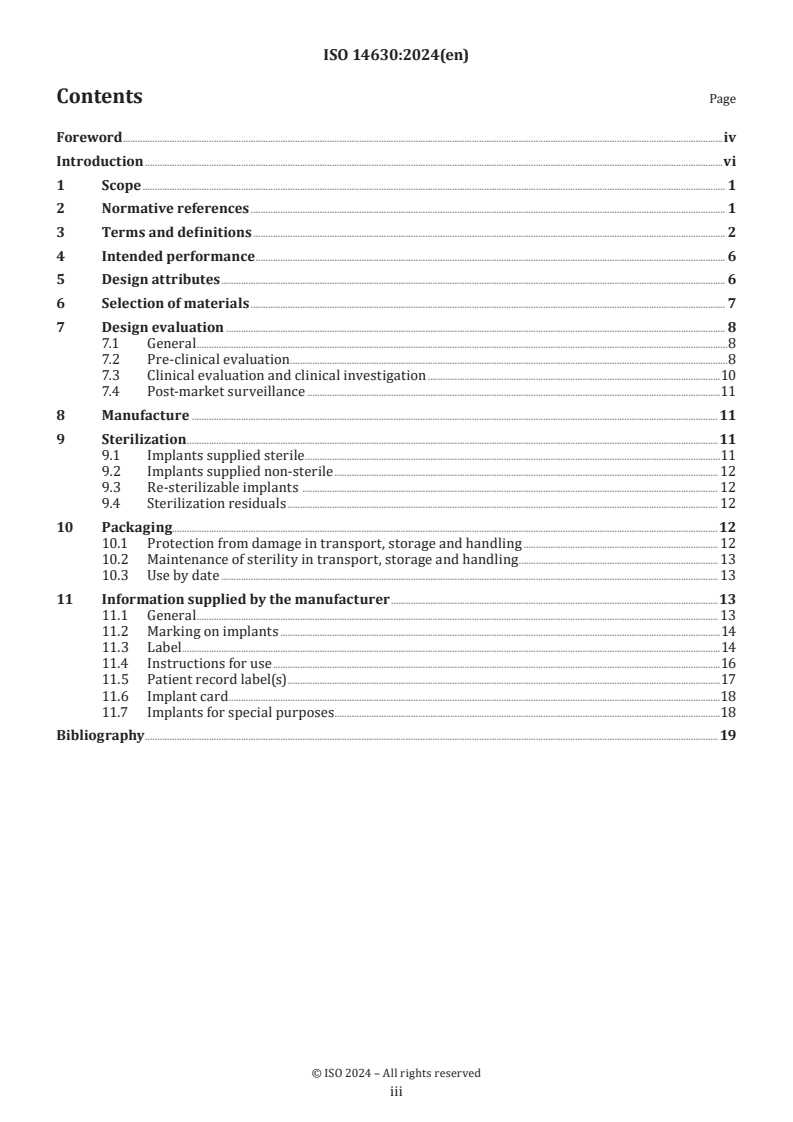
Contents Page
Foreword .iv
Introduction .vi
1 Scope . 1
2 Normative references . 1
3 Terms and definitions . 2
4 Intended performance . 6
5 Design attributes . 6
6 Selection of materials . 7
7 Design evaluation . 8
7.1 General .8
7.2 Pre-clinical evaluation . .8
7.3 Clinical evaluation and clinical investigation .10
7.4 Post-market surveillance .11
8 Manufacture .11
9 Sterilization .11
9.1 Implants supplied sterile .11
9.2 Implants supplied non-sterile . 12
9.3 Re-sterilizable implants . 12
9.4 Sterilization residuals . 12
10 Packaging.12
10.1 Protection from damage in transport, storage and handling . 12
10.2 Maintenance of sterility in transport, storage and handling . 13
10.3 Use by date . 13
11 Information supplied by the manufacturer .13
11.1 General . 13
11.2 Marking on implants .14
11.3 Label .14
11.4 Instructions for use .16
11.5 Patient record label(s) .17
11.6 Implant card . .18
11.7 Implants for special purposes.18
Bibliography . 19
iii
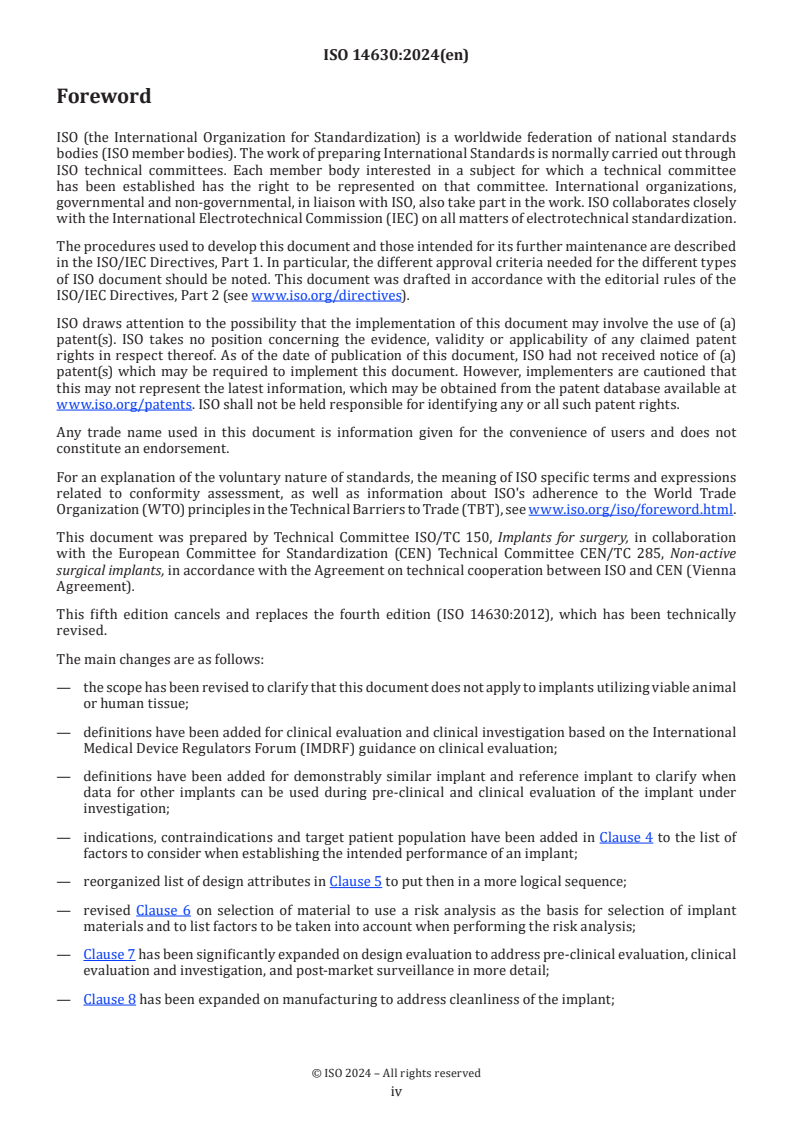
Foreword
ISO (the International Organization for Standardization) is a worldwide federation of national standards
bodies (ISO member bodies). The work of preparing International Standards is normally carried out through
ISO technical committees. Each member body interested in a subject for which a technical committee
has been established has the right to be represented on that committee. International organizations,
governmental and non-governmental, in liaison with ISO, also take part in the work. ISO collaborates closely
with the International Electrotechnical Commission (IEC) on all matters of electrotechnical standardization.
The procedures used to develop this document and those intended for its further maintenance are described
in the ISO/IEC Directives, Part 1. In particular, the different approval criteria needed for the different types
of ISO document should be noted. This document was drafted in accordance with the editorial rules of the
ISO/IEC Directives, Part 2 (see www.iso.org/directives).
ISO draws attention to the possibility that the implementation of this document may involve the use of (a)
patent(s). ISO takes no position concerning the evidence, validity or applicability of any claimed patent
rights in respect thereof. As of the date of publication of this document, ISO had not received notice of (a)
patent(s) which may be required to implement this document. However, implementers are cautioned that
this may not represent the latest information, which may be obtained from the patent database available at
www.iso.org/patents. ISO shall not be held responsible for identifying any or all such patent rights.
Any trade name used in this document is information given for the convenience of users and does not
constitute an endorsement.
For an explanation of the voluntary nature of standards, the meaning of ISO specific terms and expressions
related to conformity assessment, as well as information about ISO's adherence to the World Trade
Organization (WTO) principles in the Technical Barriers to Trade (TBT), see www.iso.org/iso/foreword.html.
This document was prepared by Technical Committee ISO/TC 150, Implants for surgery, in collaboration
with the European Committee for Standardization (CEN) Technical Committee CEN/TC 285, Non-active
surgical implants, in accordance with the Agreement on technical cooperation between ISO and CEN (Vienna
Agreement).
This fifth edition cancels and replaces the fourth edition (ISO 14630:2012), which has been technically
revised.
The main changes are as follows:
— the scope has been revised to clarify that this document does not apply to implants utilizing viable animal
or human tissue;
— definitions have been added for clinical evaluation and clinical investigation based on the International
Medical Device Regulators Forum (IMDRF) guidance on clinical evaluation;
— definitions have been added for demonstrably similar implant and reference implant to clarify when
data for other implants can be used during pre-clinical and clinical evaluation of the implant under
investigation;
— indications, contraindications and target patient population have been added in Clause 4 to the list of
factors to consider when establishing the intended performance of an implant;
— reorganized list of design attributes in Clause 5 to put then in a more logical sequence;
— revised Clause 6 on selection of material to use a risk analysis as the basis for selection of implant
materials and to list factors to be taken into account when performing the risk analysis;
— Clause 7 has been significantly expanded on design evaluation to address pre-clinical evaluation, clinical
evaluation and investigation, and post-market surveillance in more detail;
— Clause 8 has been expanded on manufacturing to address cleanliness of the implant;
iv
— subclause 9.1 has been revised to list the methods of sterilizing the implant in a tabular form rather than
as running text;
— a new subclause 10.3 has been added to address the determination of the use by date;
— Clause 11 has been revised on information supplied by the manufacturer to include new subclauses
addressing patient record labels (11.5) and implant card (11.6);
— the subclause on restrictions on combinations (formerly 11.4) has been deleted because the safety of
combinations is addressed in Clause 5 l).
Any feedback or questions on this document should be directed to the user’s national standards body. A
complete listing of these bodies can be found at www.iso.org/members.html.
v
Introduction
There are three levels of standards dealing with non-active surgical implants and related instrumentation.
For the implants themselves, they are as follows, with Level 1 being the highest:
— Level 1: general requirements for non-active surgical implants;
— Level 2: particular requirements for families of non-active surgical implants;
— Level 3: specific requirements for types of non-active surgical implants.
Level 1 standards include this document which contains requirements that apply to all non-active surgical
implants, and ISO 16061, which contains requirement for instruments associated with non-active surgical
implants. They also anticipate that there are additional requirements in the Level 2 and Level 3 standards.
Level 2 standards (see References [2], [12], [23], [27] and [42]) apply to a more restricted set or family of
non-active surgical implants, such as those designed for use in neurosurgery, cardiovascular surgery or joint
replacement.
Level 3 standards (see References [3], [13], [24] and [25]) apply to specific types of implants within a family
of non-active surgical implants, such as hip joints or arterial stents.
To address the requirements for a specific implant, all related Level 1, 2 and 3 standards should be applied.
vi
International Standard ISO 14630:2024(en)
Non-active surgical implants — General requirements
1 Scope
This document specifies general requirements for non-active surgical implants, hereafter referred to as
implants.
This document is not applicable to dental implants, dental restorative materials, transendodontic and
transradicular implants, intra-ocular lenses and implants utilizing viable animal or human tissue.
With regard to safety, this document specifies requirements for intended performance, design attributes,
materials, design evaluation, manufacture, sterilization, packaging and information supplied by the
manufacturer, and tests to demonstrate compliance with these requirements.
Additional requirements applicable to specific implants or implant families are given or referred to in
Level 2 and Level 3 standards.
NOTE 1 This document does not require that the manufacturer have a quality management system in place.
However, many regulatory authorities require the application of a quality management system, such as that described
in ISO 13485, to ensure that the implant achieves its intended performance and safety.
NOTE 2 In this document, when not otherwise specified, the term "implant" refers to each individual component
of a system or a modular implant, provided separately or as a set of components, as well as to all ancillary implants or
associated implants designed for improving the intended performance.
2 Normative references
The following documents are referred to in the text in such a way that some or all of their content constitutes
requirements of this document. For dated references, only the edition cited applies. For undated references,
the latest edition of the referenced document (including any amendments) applies.
ISO 10993-1, Biological evaluation of medical devices — Part 1: Evaluation and testing within a risk
management process
ISO 10993-7, Biological evaluation of medical devices — Part 7: Ethylene oxide sterilization residuals
ISO 10993-17, Biological evaluation of medical devices — Part 17: Toxicological risk assessment of medical
device constituents
ISO 11135, Sterilization of health-care products — Ethylene oxide — Requirements for the development,
validation and routine control of a sterilization process for medical devices
ISO 11137-1, Sterilization of health care products — Radiation — Part 1: Requirements for development,
validation and routine control of a sterilization process for medical devices
ISO 11137-2, Sterilization of health care products — Radiation — Part 2: Establishing the sterilization dose
ISO 11137-3, Sterilization of health care products — Radiation — Part 3: Guidance on dosimetric aspects of
development, validation and routine control
ISO 11607-1, Packaging for terminally sterilized medical devices — Part 1: Requirements for materials, sterile
barrier systems and packaging systems
ISO 11607-2, Packaging for terminally sterilized medical devices — Part 2: Validation requirements for forming,
sealing and assembly processes
ISO 13408-1, Aseptic processing of health care products — Part 1: General requirements
ISO 14155, Clinical investigation of medical devices for human subjects — Good clinical practice
ISO 14160, Sterilization of health care products — Liquid chemical sterilizing agents for single-use medical
devices utilizing animal tissues and their derivatives — Requirements for characterization, development,
validation and routine control of a sterilization process for medical devices
ISO 14937, Sterilization of health care products — General requirements for characterization of a sterilizing
agent and the development, validation and routine control of a sterilization process for medical devices
ISO 14971, Medical devices — Application of risk management to medical devices
ISO 17664-1, Processing of health care products — Information to be provided by the medical device
manufacturer for the processing of medical devices — Part 1: Critical and semi-critical medical devices
ISO 17665, Sterilization of health care products — Moist heat — Requirements for the development, validation
and routine control of a sterilization process for medical devices
ISO 20857, Sterilization of health care products — Dry heat — Requirements for the development, validation
and routine control of a sterilization process for medical devices
ISO 22442-1, Medical devices utilizing animal tissues and their derivatives — Part 1: Application of risk
management
ISO 22442-2, Medical devices utilizing animal tissues and their derivatives — Part 2: Controls on sourcing,
collection and handling
ISO 22442-3, Medical devices utilizing animal tissues and their derivatives — Part 3: Validation of the elimination
and/or inactivation of viruses and transmissible spongiform encephalopathy (TSE) agents
ISO 25424, Sterilization of health care products — Low temperature steam and formaldehyde — Requirements
for development, validation and routine control of a sterilization process for medical devices
ISO 80000-1, Quantities and units — Part 1: General
3 Terms and definitions
For the purposes of this document, the terms and definitions given in ISO 14971 and the following apply.
ISO and IEC maintain terminology databases for use in standardization at the following addresses:
— ISO Online browsing platform: available at https:// www .iso .org/ obp
— IEC Electropedia: available at https:// www .electropedia .org/
3.1
ancillary implant
implant, not included as a component of an implant system, but without which the system cannot be
surgically inserted
EXAMPLE Cement for cemented stem of a hip joint replacement or screws for orthopaedic plates.
[SOURCE: ISO 16054:2019, 3.4, modified — “implantable device” has been replaced by “implant”.]
3.2
associated implant
implant, included as a component of a modular implant (3.13) or supplied separately, that is surgically
inserted for the specific clinical condition to facilitate the use of the primary implant
EXAMPLE An augmentation device used to stabilise the tibial tray of a knee joint replacement or the acetabular
cup of a hip joint replacement; sleeves applied to the stem of a hip or knee joint prosthesis to fill canal defects and
prevent rotation; a cement restrictor used in hip joint replacement to occlude the intramedullary canal.
[SOURCE: ISO 16054:2019, 3.5, modified — “implantable device” has been replaced by “implant”.]
3.3
B hazard area
space around the magnetic resonance equipment where the static magnetic field can cause harm
Note 1 to entry: The B hazard area is not identical to the special environment as defined in IEC 60601-1-2.
Note 2 to entry: The B hazard area is not identical to the magnetic resonance environment (3.10) as defined in
IEC 62570.
[SOURCE: IEC 60601-2-33:2022, 201.3.202, modified — the abbreviation "MR" in the definition and Note 2
to entry has been replaced by "magnetic resonance".]
3.4
clinical evaluation
set of ongoing activities that use scientifically sound methods for the assessment and analysis of clinical
data to verify the safety, clinical performance and/or effectiveness of the device when used as intended by
the manufacturer
[SOURCE: IMDRF MDCE WG/N56FINAL: 2019, 4.0]
3.5
clinical investigation
systematic investigation or study in or on one or more human subjects, undertaken to assess the safety,
clinical performance and/or effectiveness of a medical device
[SOURCE: IMDRF MDCE WG/N56FINAL: 2019, 4.0]
3.6
coating
layer of material covering or partially covering a surface of an implant
3.7
final implant
implant that has been subjected to all manufacturing processes including packaging, and if applicable,
sterilization, and that is ready to be marketed
Note 1 to entry: The final implant (i.e. implant to be evaluated) is the final product referred to in ISO 10993-1:2018, 3.8.
3.8
demonstrably similar implant
legally-marketed implant with the same intended use to the implant under evaluation for which similarity can
be demonstrated in technical, biological and clinical characteristics based on proper scientific justification
and to the extent that there is no clinically significant difference in the safety and clinical performance of the
implants under evaluation
Note 1 to entry: Manufacturers shall have sufficient levels of access to the data relating to implants with which they
are claiming similarity in order to justify their claims of similarity.
Note 2 to entry: In a demonstrably similar implant, most of the performance parameters (technical, biological and
clinical) under consideration are similar to the implant under evaluation whereas in a reference implant (3.15) as few
as one performance parameter may be considered.
Note 3 to entry: A demonstrably similar implant is one which can be used to avoid some technical or biological tests or
a clinical investigation of the implant under evaluation.
Note 4 to entry: Some regulatory authorities can require that a demonstrably similar implant is one that is legally
marketed in their own country or jurisdiction.
Note 5 to entry: For a demonstrably similar implant, there shall be evidence of successful clinical use in sufficient
numbers, for a sufficient period of time, and, at a minimum, without known or reasonably known evidence of design or
performance-related recalls.
Note 6 to entry: The manufacturer is responsible for identifying the demonstrably similar implant according to the
regulatory requirements in the jurisdictions where the implant under evaluation will be marketed.
3.9
leakage
unintended movement of fluid, including body fluids, into or out of an implant
Note 1 to entry: An unintended diffusion phenomenon is an example of leakage for the purposes of this document.
3.10
magnetic resonance environment
MR environment
three-dimensional volume surrounding the magnetic resonance magnet that contains both the special
environment (Faraday shielded volume) and the B hazard area (3.3)
Note 1 to entry: This volume is the region in which an item can pose a hazard from exposure to the electromagnetic
fields produced by the magnetic resonance equipment and accessories, and for which access control is part of the risk
mitigation.
Note 2 to entry: The entrance to the magnetic resonance environment is controlled by the responsible organization.
The area to which entry is controlled is sometimes referred to as the magnetic resonance controlled access area.
[SOURCE: IEC 60601-2-33:2022, 201.3.224]
3.11
magnetic resonance imaging
MRI
imaging technique that uses a static magnetic field, time-varying gradient magnetic fields and radio
frequency fields to provide images of tissue by the magnetic resonance of nuclei
[SOURCE: ASTM F2182-19e2, 3.1.6]
3.12
manufacturer
natural or legal person with responsibility for design and/or manufacture of an implant with the intention
of making the implant available for use, under their name, whether or not such an implant is designed and/
or manufactured by that person or on their behalf by another person(s)
Note 1 to entry: This natural or legal person has the ultimate legal responsibility for ensuring compliance with all
applicable regulatory requirements for the implant in the countries or jurisdictions where it is intended to be made
available or sold, unless this responsibility is specifically imposed on another person by the regulatory authority (RA)
within that jurisdiction.
Note 2 to entry: The manufacturer’s responsibilities are described in other Global Harmonization Task Force (GHTF)
guidance documents. These responsibilities include meeting both pre-market requirements and post-market
requirements, such as adverse event reporting and notification of corrective actions.
Note 3 to entry: “Design and/or manufacture” can include specification development, production, fabrication,
assembly, processing, packaging, repackaging, labelling, relabelling, sterilization, installation or remanufacturing of
an implant; or putting a collection of devices, and possibly other products, together for a medical purpose.
Note 4 to entry: Any person who assembles or adapts an implant that has already been supplied by another person
for an individual patient, according to the instructions for use, is not the manufacturer, provided the assembly or
adaptation does not change the intended use of the implant.
Note 5 to entry: Any person who changes the intended use of or modifies an implant without acting on behalf of
the original manufacturer and who makes it available for use under their own name, should be considered the
manufacturer of the modified implant.
Note 6 to entry: An authorised representative, distributor or importer who only adds its own address and contact
details to the implant or the packaging, without covering or changing the existing labelling, is not considered a
manufacturer.
Note 7 to entry: To the extent that an accessory is subject to the regulatory requirements of an implant, the person
responsible for the design and/or manufacture of that accessory is considered to be a manufacturer.
[SOURCE: ISO 14971:2019, 3.9, modified — "medical device" has been replaced by "implant".]
3.13
modular implant
implant system which is supplied, provided separately or as a procedure pack/convenience kit, as a number
of components and which is intended to be assembled by the intended user
EXAMPLE Femoral stem, modular femoral head, acetabular cup and liner are each separate components of a
modular hip prosthesis.
3.14
non-active surgical implant
surgical implant (3.16), the operation of which does not depend on a source of electrical energy or any source
of power other than that directly generated by the human body or gravity
Note 1 to entry: For the purpose of this document, the term "non-active surgical implant" is hereafter referred to as
"implant".
3.15
reference implant
legally-marketed implant which, when compared to the implant under evaluation, satisfies both of the
following conditions:
a) it has the same intended use, similar materials and a similar design with regard to the specific
dimensional or performance criteria under evaluation to address the same clinical and technical
requirements;
b) there is evidence of successful clinical use in sufficient numbers: for a sufficient period of time, and, at a
minimum, without known or reasonably known evidence of design or performance-related recalls with
regard to the specific dimensional or performance criteria under evaluation
Note 1 to entry: The term “reference” is not intended to imply that the implant under evaluation and the reference
implant are “equivalent” or that the reference implant is a “predicate” implant. This is because for some regulatory
authorities, the terms “equivalent” and “predicate” have a meaning which is beyond that intended by the term
“reference” as used in this document.
Note 2 to entry: A reference implant is the comparison implant for dimensional or performance parameter(s) under
evaluation. Other characteristics of the reference implant shall be considered in order for the comparison to be
suitable, as in some situations there can be cross-effects. Ideally, for the majority of dimensional and performance
parameters, a single reference implant should be used for comparison to the implant under evaluation. However, more
than one reference implant may be used for comparison purposes, with adequate scientific and clinical justification.
Note 3 to entry: Some regulatory authorities require that a reference implant is one that is legally marketed in their
own country or jurisdiction. This fact can be taken into account when selecting a reference implant for the purposes of
this document.
Note 4 to entry: There is no agreed upon interpretation for what constitutes “sufficient numbers” or a “sufficient
period of time” in the above definition. Typically, a determination of what constitutes “sufficient numbers” and a
“sufficient period of time” is demonstrated by using statistical methods and clinical judgement in the evaluation of
implant performance.
Note 5 to entry: A justification for a “similar material” may include information that although the materials are not the
same, the material(s) used for the implant under evaluation can be shown to perform similarly with regard to the test
or its underlying clinical concern.
Note 6 to entry: Examples of design features that can be taken into consideration when evaluating whether an implant
has a ‘similar design’ to the implant under evaluation include means of fixation, modularity, constraint, key dimensions
and shape, processing, surface topography, surface treatment, etc. A justification for a “similar design” therefore may
include information that although the designs are not the same, the design of the implant under evaluation can be
shown to perform similarly with regard to the test or its underlying clinical concern.
Note 7 to entry: The manufacturer is responsible for identifying the reference implant(s) according to the regulatory
requirements in the jurisdictions where the implant under evaluation is to be marketed.
3.16
surgical implant
device that is intended to be totally introduced into the human body or to replace an epithelial surface
or the surface of the eye, by means of surgical intervention and that is intended to remain in place after
the procedure, or any device that is intended to be partially introduced into the human body by means of
surgical intervention and that is intended to remain in place after the procedure for at least 30 d
4 Intended performance
The intended performance of an implant shall be described and documented by addressing the following
points with regard to safety:
a) intended purpose(s);
b) indications, contraindications and target patient population;
c) functional characteristics;
d) intended conditions of use, including details of required ancillary implants and associated implants
designed to achieve the intended performance;
e) intended lifetime.
NOTE Information to support the description of the intended performance can be found in sources such as:
— published standards such as the Level 2 and Level 3 standards listed in the Introduction, and
— published clinical and scientific literature.
Implants shall be evaluated to demonstrate that the intended performance is achieved (see Clause 7).
5 Design attributes
The design attributes to meet the intended performance shall take into account at least the following:
a) biocompatibility of materials for their intended use, including the influence of material by-products
from manufacturing and chemical residuals;
b) physical, mechanical, biological and chemical properties of materials, including endurance properties
and ageing;
c) wear characteristics of materials and the effects of wear and wear products on the implant and the body;
d) degradation characteristics of materials and the effects of degradation, and degradation products and
leachables on the implant and the body;
e) extent and effect of leakage of substances from the implant (e.g. fillers used in a cosmetic prosthesis);
f) compatibility with any drug or biological product incorporated into the implant including non-viable
tissues or cells of human or animal origin, or their derivatives;
g) shape, dimensions and surface characteristics of the implant, including their possible effects on tissues
and body fluids;
h) biocompatibility of all components of the implant including non-implantable components that can have
direct or indirect tissue contact in their clinical use conditions;
i) safety, with respect to viruses and other transmissible agents (unclassified pathogenic entities, prions
and similar entities), of animal tissues or derivatives of animal tissue utilized in the implant or during
its manufacture;
j) the effect of manufacturing processes (including sterilization) on material characteristics and intended
performance;
k) possible effects on the implant and its function due to interactions between its constituent materials
and between its constituent materials and other materials and substances;
l) interconnections and their effects on the intended performance, including connections with ancillary or
associated implants, and with any necessary instrumentation for use in association with the implant;
NOTE 1 The shape, dimensions and tolerances of the interconnections, as well as potential wear, degradation,
corrosion and electrolytic effects can affect the intended performance of interconnections.
NOTE 2 Interconnections can include the connections with ancillary implants as well as the associated
implants required for achieving the intended performance and safety.
m) interface(s) between the implant and body tissue(s), particularly relative to fixation, connection, surface
characteristics and the potential for the implant to move from its intended position or orientation;
n) physical and chemical effects of the body and external environment on the implant;
o) effects of ionizing radiation, electromagnetic and magnetic fields on the implant and its function, and
any consequential effects on the body;
p) the feasibility for an implant to be implanted and, where applicable, to be removed or replaced;
q) the feasibility for an implant's position and orientation to be visualized through radiological or other
imaging procedures;
r) the ability to remove microbiological and particulate contamination from manufacturing;
s) the effect of a nanomaterial;
t) the suitability and effectiveness of packaging;
u) where appropriate, the anthropometric and anatomical features of the population for whom the implant
is intended;
v) the condition and pathology of the host tissue;
w) required operative techniques and the appropriate care and handling of the implant to reduce the risk
of use error while not impairing the intended use and performance of the implant;
x) where applicable, the nature and type of any radioactive substances incorporated in or used with the
implant to achieve the intended performance while reducing or eliminating the risk of exposure of
patients, intended users and other persons to unintended radiation.
The design attributes to meet the intended performance shall be documented. Where any of the above are
not considered to be relevant, the reason shall be documented and justified.
6 Selection of materials
The selection of materials to be used for the manufacture of implants shall be based on a risk analysis, which
shall take into account at least the following:
a) the properties required for the intended purpose considering factors such as anatomical location,
dimensions, geometry, conditions for use and the intended lifetime of the implant;
b) any intended treatment to the material or to the surface of the implant (chemical, electro-chemical,
thermal, mechanical, etc.) or coating applied to the surface or a part of the surface of the implant
material;
c) the effects of implant manufacturing, handling, cleaning, disinfection, packaging, sterilization and
storage;
d) possible adverse reactions of implant materials with:
— human tissues and body fluids;
— medicinal products incorporated into the implant;
— non-viable tissues or cells of human or animal origin, or their derivatives incorporated into the
implant;
— other implants, substances and gases.
In addition, the selection of materials shall be based on their demonstrated biocompatibility.
NOTE 1 The demonstrated biocompatibility of the materials does not assure the biocompatibility of the final
implant (see 7.2).
Possible effects of ionizing radiation and of magnetic and electromagnetic fields on the material, as well as
the effect of the material on image quality in magnetic resonance imaging (MRI) and computed tomography
(CT), shall also be considered.
The performance of the medicinal product used in combination with the implant shall not be affected by the
material and the medicinal product shall not affect the performance of the material.
For implants utilizing materials of animal origin or their derivatives that are non-viable or have been
rendered non-viable either in the implant or in its manufacture, these materials shall be evaluated and their
safety with respect to viruses and other transmissible agents shall be in accordance with the requirements
of ISO 22442-1, ISO 22442-2 and ISO 22442-3.
NOTE 2 See ISO 22442-1 for the definition of the terms “animal” and “tissue”.
7 Design evaluation
7.1 General
Implants shall be evaluated to demonstrate that their safety and intended performance is achieved (see
Clause 4). Safety and intended performance shall be demonstrated by pre-clinical evaluation (see 7.2)
followed by clinical evaluation including any clinical investigations (see 7.3) and post-market surveillance
(see 7.4).
When the manufacturer’s risk analysis indicates that there is a significant risk to the patient as the result of
failure or incompatibility between the implant and the patient during its intended lifetime, the manufacturer
shall take steps to make sure that the safety and intended performance of the implant are maintained.
An appropriate risk management process in accordance with ISO 14971 shall be established for all stages in
the life cycle of the implant.
7.2 Pre-clinical evaluation
Implants shall undergo pre-clinical evaluation to demonstrate the safety and intended performance of
the implant under the intended use conditions. This can include evaluation of dimensional, mechanical,
biological and chemical properties, cleanability, sterilizability, packaging, the effect of storage conditions,
shelf-life, or other characteristics as applicable. Unless an adequate justification is provided, the pre-clinical
evaluation shall be based on all of the following:
a) relevant scientific and clinical literature relating to the safety, performance, design characteristics and
intended use of the implant or of a demonstrably similar implant(s);
b) applicable standards;
c) all available field data, safety reports, relevant complaint information and adverse event data for the
implant or a demonstrably similar implant(s);
d) data obtained from:
1) testing of the implant against established performance requirements, and/or
2) testing of the implant as compared to an existing reference implant, and/or
3) a demonstrably similar implant(s).
Data shall be obtained using test methods that are demonstrated to be fit for their intended purpose.
If comparing data obtained from testing of the implant and either a reference implant or a demonstrably
similar implant, testing shall be performed using the same methods and test conditions unless any
differences can be justified.
Pre-clinical testing of implants should simulate conditions of intended use. Test methods and related
limits for specific types of implants shall be defined and justified by the manufacturer and shall include,
as appropriate, in vitro handling tests to verify the intended interaction between the implant and any
instruments to be used in association with the implant and, if applicable, between interconnecting implants.
Tests should take into account anticipated loading, and the impact of shelf-life and/or the in situ environment.
Where appropriate, test specimens should represent as closely as possible the final implant. If static and/or
dynamic loading tests are relevant for the evaluation of the implant, either accepted test standards when
available or customized test models taking into account the characteristics of the implant shall be applied.
Testing should also evaluate any deterioration of the implant in its packaging under the storage conditions
specified by the manufacturer, and the effect of this deterioration on the intended performance of the
implant. Because of the wide variation in implants and their features, testing standards can be non-existent
or may be modified as needed.
In instances when implantation and, where appropriate, removal cannot be evaluated by direct comparison
with existing implants, cadaveric evaluation or simulated cadaveric evaluation should be performed where
possible.
Some pre-clinical tests, such as some dimensional and mechanical tests, can be comparison tests where the
implant under evaluation and an existing reference implant are tested in order to evaluate the performance
of the implant under evaluation for the parameter(s) under investigation.
Test methods and limits for particular implants can be described in related standards, such as those listed
in the Bibliography.
Testing to demonstrate the implant usability is required unless the implant usability can be evaluated by
direct comparison with the usability engineering file of existing implants.
NOTE 1 Further information on a process for demonstrating the usability of an implant can be found in IEC 62366-1.
Assessment of the possible effects of ionizing radiation, electromagnetic and magnetic fields on the final
implant and its function and any consequential effects on the body shall be conducted.
NOTE 2 The test methods in ASTM F2052 (induced displacement force), ASTM F2213 (induced torque), ASTM F2182
(radio frequency induced heating) and ISO/TS 10974 (gradient heating and gradient vibration) can be used to evaluate
the safety of an implant in the magnetic resonance environment. According to IEC 60601-2-33, B1+rms is used on MR
equipment to provide control of radio frequency exposure and can be used for the most accurate evaluation of and
labelling for radio frequency induced heating.
The biocompatibility of the final implant shall be established as part of the pre-clinical evaluation. The
biological evaluation of the final implant shall be p
...
Norme
internationale
ISO 14630
Cinquième édition
Implants chirurgicaux non actifs —
2024-09
Exigences générales
Non-active surgical implants — General requirements
Numéro de référence
DOCUMENT PROTÉGÉ PAR COPYRIGHT
© ISO 2024
Tous droits réservés. Sauf prescription différente ou nécessité dans le contexte de sa mise en œuvre, aucune partie de cette
publication ne peut être reproduite ni utilisée sous quelque forme que ce soit et par aucun procédé, électronique ou mécanique,
y compris la photocopie, ou la diffusion sur l’internet ou sur un intranet, sans autorisation écrite préalable. Une autorisation peut
être demandée à l’ISO à l’adresse ci-après ou au comité membre de l’ISO dans le pays du demandeur.
ISO copyright office
Case postale 401 • Ch. de Blandonnet 8
CH-1214 Vernier, Genève
Tél.: +41 22 749 01 11
E-mail: copyright@iso.org
Web: www.iso.org
Publié en Suisse
ii
Sommaire Page
Avant-propos .iv
Introduction .vi
1 Domaine d'application . 1
2 Références normatives . 1
3 Termes et définitions . 2
4 Performances prévues . 6
5 Caractéristiques de conception . 7
6 Sélection des matériaux . 8
7 Évaluation de la conception . 9
7.1 Généralités .9
7.2 Évaluation préclinique .9
7.3 Évaluation clinique et investigation clinique .11
7.4 Surveillance après commercialisation .11
8 Fabrication .12
9 Stérilisation .12
9.1 Implants fournis à l'état stérile . 12
9.2 Implants fournis à l'état non stérile . 13
9.3 Implants restérilisables . 13
9.4 Résidus de stérilisation . . 13
10 Emballage .13
10.1 Protection contre les dommages au cours du transport, du stockage et de la
manipulation . 13
10.2 Maintien de l'état stérile au cours du transport, du stockage et de la manipulation .14
10.3 Date limite d'utilisation .14
11 Informations fournies par le fabricant . 14
11.1 Généralités .14
11.2 Marquage des implants . 15
11.3 Étiquette . 15
11.4 Notice d'utilisation .17
11.5 Étiquette(s) pour dossier du patient .19
11.6 Carte d'implant .19
11.7 Implants pour usages spéciaux. 20
Bibliographie .21
iii
Avant-propos
L'ISO (Organisation internationale de normalisation) est une fédération mondiale d'organismes nationaux
de normalisation (comités membres de l'ISO). L'élaboration des Normes internationales est en général
confiée aux comités techniques de l'ISO. Chaque comité membre intéressé par une étude a le droit de faire
partie du comité technique créé à cet effet. Les organisations internationales, gouvernementales et non
gouvernementales, en liaison avec l'ISO participent également aux travaux. L'ISO collabore étroitement avec
la Commission électrotechnique internationale (IEC) en ce qui concerne la normalisation électrotechnique.
Les procédures utilisées pour élaborer le présent document et celles destinées à sa mise à jour sont
décrites dans les Directives ISO/IEC, Partie 1. Il convient, en particulier, de prendre note des différents
critères d'approbation requis pour les différents types de documents ISO. Le présent document
a été rédigé conformément aux règles de rédaction données dans les Directives ISO/IEC, Partie 2
(voir www.iso.org/directives).
L'ISO attire l'attention sur le fait que la mise en application du présent document peut entraîner l'utilisation
d'un ou de plusieurs brevets. L'ISO ne prend pas position quant à la preuve, à la validité et à l'applicabilité
de tout droit de propriété revendiqué à cet égard. À la date de publication du présent document, l'ISO
n'avait pas reçu notification qu'un ou plusieurs brevets pouvaient être nécessaires à sa mise en application.
Toutefois, il y a lieu d'avertir les responsables de la mise en application du présent document que des
informations plus récentes sont susceptibles de figurer dans la base de données de brevets, disponible à
l'adresse www.iso.org/brevets. L'ISO ne saurait être tenue pour responsable de ne pas avoir identifié tout ou
partie de tels droits de brevet.
Les appellations commerciales éventuellement mentionnées dans le présent document sont données pour
information, par souci de commodité, à l'intention des utilisateurs et ne sauraient constituer un engagement.
Pour une explication de la nature volontaire des normes, la signification des termes et expressions
spécifiques de l'ISO liés à l'évaluation de la conformité, ou pour toute information au sujet de l'adhésion de
l'ISO aux principes de l'Organisation mondiale du commerce (OMC) concernant les obstacles techniques au
commerce (OTC), voir www.iso.org/avant-propos.
Le présent document a été élaboré par le comité technique ISO/TC 150, Implants chirurgicaux, en collaboration
avec le comité technique CEN/TC 285, Implants chirurgicaux non actifs, du Comité européen de normalisation
(CEN), conformément à l'Accord de coopération technique entre l'ISO et le CEN (Accord de Vienne).
Cette cinquième édition annule et remplace la quatrième édition (ISO 14630:2012), qui a fait l'objet d'une
révision technique.
Les principales modifications sont les suivantes:
— révision du domaine d'application pour préciser le fait que le présent document ne s'applique pas aux
implants intégrant des tissus animaux ou humains viables;
— ajout des définitions relatives aux termes «évaluation clinique» et «investigation clinique» sur la base des
recommandations de l'International Medical Device Regulators Forum (IMDRF) portant sur l'évaluation
clinique;
— ajout des définitions relatives aux termes «implant manifestement similaire» et «implant de référence»
pour préciser les conditions dans lesquelles les données relatives aux autres implants peuvent être
utilisées au cours de l'évaluation préclinique et clinique de l'implant faisant l'objet d'une investigation;
— ajout des indications, des contre-indications et de la population cible de patients à l'Article 4 à la liste des
facteurs à prendre en compte pour établir les performances prévues d'un implant;
— réorganisation de la liste des caractéristiques de conception dans l'Article 5 pour les placer dans un
ordre plus logique;
— révision de l'Article 6 sur la sélection du matériau pour s'appuyer sur une analyse des risques pour
sélectionner les matériaux de l'implant, et pour énumérer les facteurs à prendre en compte lors de la
réalisation de l'analyse des risques;
iv
— développement significatif de l'Article 7 sur l'évaluation de la conception pour aborder plus en détail
l'évaluation préclinique, l'évaluation et l'investigation cliniques, et la surveillance après commercialisation;
— développement de l'Article 8 sur la fabrication pour aborder la propreté de l'implant;
— révision du Paragraphe 9.1 pour énumérer les méthodes de stérilisation de l'implant sous forme de
tableau plutôt que sous forme de texte;
— ajout d'un nouveau Paragraphe 10.3 pour traiter de la détermination de la date limite d'utilisation;
— révision de l'Article 11 relatif aux informations fournies par le fabricant dans le but d'inclure des
paragraphes traitant de l'étiquette pour dossier du patient (11.5) et de la carte d'implant (11.6);
— suppression du paragraphe concernant les restrictions relatives aux combinaisons (précédemment le
paragraphe 11.4), car la sécurité des combinaisons est abordée dans l'Article 5 l).
Il convient que l'utilisateur adresse tout retour d'information ou toute question concernant le présent
document à l'organisme national de normalisation de son pays. Une liste exhaustive desdits organismes se
trouve à l'adresse www.iso.org/fr/members.html.
v
Introduction
Il existe trois niveaux de normes relatives aux implants chirurgicaux non actifs et aux instruments associés.
Pour les implants eux-mêmes, ces niveaux sont les suivants, le niveau 1 étant le plus élevé:
— niveau 1: Exigences générales relatives aux implants chirurgicaux non actifs;
— niveau 2: Exigences particulières relatives aux différentes familles d'implants chirurgicaux non actifs;
— niveau 3: Exigences spécifiques relatives aux différents types d'implants chirurgicaux non actifs.
Les normes de niveau 1 comprennent le présent document qui contient les exigences relatives à tous les
implants chirurgicaux non actifs, et l'ISO 16061 qui contient les exigences relatives aux instruments associés
aux implants chirurgicaux non actifs. Elles prévoient également que des exigences supplémentaires soient
données dans les normes de niveaux 2 et 3.
Les normes de niveau 2 (voir Références [2], [12], [23], [27] et [42]) s'appliquent à une famille ou à un ensemble
plus restreint d'implants chirurgicaux non actifs, tels que ceux destinés à être utilisés en neurochirurgie, en
chirurgie cardiovasculaire ou en arthroplastie.
Les normes de niveau 3 (voir Références [3], [13], [24] et [25]) s'appliquent aux types spécifiques d'implants
d'une même famille d'implants chirurgicaux non actifs, tels que les prothèses de hanche ou les endoprothèses
artérielles.
Pour aborder les exigences relatives à un implant spécifique, il convient d'appliquer toutes les normes de
niveaux 1, 2 et 3 qui s'y rapportent.
vi
Norme internationale ISO 14630:2024(fr)
Implants chirurgicaux non actifs — Exigences générales
1 Domaine d'application
Le présent document spécifie les exigences générales relatives aux implants chirurgicaux non actifs, ci-après
appelés implants.
Le présent document ne s'applique ni aux implants dentaires, ni aux produits utilisés en médecine dentaire
restauratrice, ni aux implants transendodontiques et transradiculaires, ni aux lentilles intraoculaires, ni aux
implants utilisant des tissus animaux ou humains viables.
En matière de sécurité, le présent document spécifie les exigences relatives aux performances prévues,
aux caractéristiques de conception, aux matériaux, à l'évaluation de la conception, à la fabrication, à la
stérilisation, à l'emballage et aux informations fournies par le fabricant, de même qu'aux essais destinés à
faire la preuve de la conformité à ces exigences.
Les exigences supplémentaires applicables à des implants ou familles d'implants spécifiques sont données
ou citées dans les normes de niveaux 2 et 3.
NOTE 1 Le présent document n'exige pas la mise en place par le fabricant d'un système de management de la qualité.
Cependant, de nombreux organismes réglementaires exigent la mise en œuvre d'un système de management de la
qualité selon l'ISO 13485 pour assurer que l'implant atteint les performances et la sécurité prévues.
NOTE 2 Dans le présent document, sauf indication contraire, le terme «implant» désigne chaque composant distinct
d'un système ou d'un implant modulaire, qu'il soit fourni séparément ou sous la forme d'un ensemble de composants,
ainsi que tout implant auxiliaire ou implant associé destiné à améliorer les performances prévues.
2 Références normatives
Les documents suivants sont cités dans le texte de sorte qu’ils constituent, pour tout ou partie de leur
contenu, des exigences du présent document. Pour les références datées, seule l’édition citée s’applique. Pour
les références non datées, la dernière édition du document de référence s'applique (y compris les éventuels
amendements).
ISO 10993-1, Évaluation biologique des dispositifs médicaux — Partie 1: Évaluation et essais au sein d’un
processus de gestion du risque
ISO 10993-7, Évaluation biologique des dispositifs médicaux — Partie 7: Résidus de stérilisation à l’oxyde
d’éthylène
ISO 10993-17, Évaluation biologique des dispositifs médicaux — Partie 17: Appréciation du risque toxicologique
des constituants des dispositifs médicaux
ISO 11135, Stérilisation des produits de santé — Oxyde d’éthylène — Exigences de développement, de validation
et de contrôle de routine d’un processus de stérilisation pour des dispositifs médicaux
ISO 11137-1, Stérilisation des produits de santé — Irradiation — Partie 1: Exigences relatives à la mise au point,
à la validation et au contrôle de routine d’un procédé de stérilisation pour les dispositifs médicaux
ISO 11137-2, Stérilisation des produits de santé — Irradiation — Partie 2: Établissement de la dose stérilisante
ISO 11137-3, Stérilisation des produits de santé — Irradiation — Partie 3: Directives relatives aux aspects
dosimétriques de développement, la validation et le contrôle de routine
ISO 11607-1, Emballages des dispositifs médicaux stérilisés au stade terminal — Partie 1: Exigences relatives
aux matériaux, aux systèmes de barrière stérile et aux systèmes d'emballage
ISO 11607-2, Emballages des dispositifs médicaux stérilisés au stade terminal — Partie 2: Exigences de validation
pour les procédés de formage, scellage et assemblage
ISO 13408-1, Traitement aseptique des produits de santé — Partie 1: Exigences générales
ISO 14155, Investigation clinique des dispositifs médicaux pour sujets humains — Bonne pratique clinique
ISO 14160, Stérilisation des produits de santé — Agents stérilisants chimiques liquides pour dispositifs
médicaux non réutilisables utilisant des tissus animaux et leurs dérivés — Exigences pour la caractérisation, le
développement, la validation et le contrôle de routine d'un procédé de stérilisation de dispositifs médicaux
ISO 14937, Stérilisation des produits de santé — Exigences générales pour la caractérisation d'un agent
stérilisant et pour la mise au point, la validation et la vérification de routine d'un processus de stérilisation pour
dispositifs médicaux
ISO 14971, Dispositifs médicaux — Application de la gestion des risques aux dispositifs médicaux
ISO 17664-1, Traitement de produits de soins de santé — Informations relatives au traitement des dispositifs
médicaux à fournir par le fabricant du dispositif — Partie 1: Dispositifs médicaux critiques et semi-critiques
ISO 17665, Stérilisation des produits de santé — Chaleur humide — Exigences pour le développement, la
validation et le contrôle de routine d’un procédé de stérilisation des dispositifs médicaux
ISO 20857, Stérilisation des produits de santé — Chaleur sèche — Exigences pour l'élaboration, la validation et le
contrôle de routine d'un processus de stérilisation pour dispositifs médicaux
ISO 22442-1, Dispositifs médicaux utilisant des tissus animaux et leurs dérivés — Partie 1: Application de la
gestion des risques
ISO 22442-2, Dispositifs médicaux utilisant des tissus animaux et leurs dérivés — Partie 2: Contrôles de l'origine,
de la collecte et du traitement
ISO 22442-3, Dispositifs médicaux utilisant des tissus animaux et leurs dérivés — Partie 3: Validation de
l'élimination et/ou de l'inactivation des virus et autres agents responsables d'encéphalopathie spongiforme
transmissible (EST)
ISO 25424, Stérilisation des produits de santé — Formaldéhyde et vapeur à faible température — Exigences pour
le développement, la validation et le contrôle de routine d'un procédé de stérilisation pour dispositifs médicaux
ISO 80000-1, Grandeurs et unités — Partie 1: Généralités
3 Termes et définitions
Pour les besoins du présent document, les termes et les définitions de l'ISO 14971 ainsi que les suivants
s'appliquent.
L'ISO et l'IEC tiennent à jour des bases de données terminologiques destinées à être utilisées en normalisation,
consultables aux adresses suivantes:
— ISO Online browsing platform: disponible à l'adresse https:// www .iso .org/ obp
— IEC Electropedia: disponible à l'adresse https:// www .electropedia .org/
3.1
implant auxiliaire
implant, qui ne fait pas partie intégrante d'un système d'implant, mais sans lequel le système ne peut pas
être inséré par voie chirurgicale
EXEMPLE Ciment pour tige cimentée d'une prothèse de la hanche, ou vis pour plaques orthopédiques.
[SOURCE: ISO 16054:2019, 3.4, modifié — «dispositif implantable» a été remplacé par «implant».]
3.2
implant associé
implant, qui fait partie intégrante d'un implant modulaire (3.13) ou qui est fourni séparément, qui est inséré
par voie chirurgicale pour l'état clinique considéré afin de faciliter l'utilisation de l'implant principal
EXEMPLE Dispositif utilisé pour stabiliser l'embase tibiale d'une prothèse du genou ou le cotyle prothétique
d'une prothèse de la hanche; gaine placée sur la tige d'une prothèse de la hanche ou du genou pour combler les défauts
de canal et empêcher la rotation; obturateur à ciment utilisé dans une prothèse de la hanche pour occlure le canal
intramédullaire.
[SOURCE: ISO 16054:2019, 3.5, modifié — «dispositif implantable» a été remplacé par «implant».]
3.3
zone de danger B
espace autour de l'appareil à RM dans lequel le champ magnétique statique peut occasionner un dommage
Note 1 à l'article: La zone de danger B n'est pas identique à l'environnement spécial tel qu'il est défini dans
l'IEC 60601-1-2.
Note 2 à l'article: La zone de danger B n'est pas identique à l'environnement de résonance magnétique (3.10) tel qu'il est
défini dans l'IEC 62570.
[SOURCE: IEC 60601-2-33:2022, 201.3.202, modifié — l'abréviation «RM» dans la définition et la Note 2 à
l'article a été remplacé par «résonance magnétique».]
3.4
évaluation clinique
ensemble d'activités en cours qui utilisent des méthodes scientifiquement fondées pour l'évaluation et
l'analyse des données cliniques pour vérifier la sécurité, les performances cliniques et/ou l'efficacité du
dispositif lorsqu'il est utilisé comme prévu par le fabricant
[SOURCE: IMDRF MDCE WG/N56FINAL: 2019, 4.0]
3.5
investigation clinique
investigation ou étude systématique menée sur un ou plusieurs sujets humains, dans le but d'évaluer la
sécurité, les performances cliniques et/ou l'efficacité d'un dispositif médical
[SOURCE: IMDRF MDCE WG/N56FINAL: 2019, 4.0]
3.6
revêtement
couche de matériau recouvrant entièrement ou partiellement la surface d'un implant
3.7
implant fini
implant qui a été soumis à tous les processus de fabrication, y compris l'emballage et le cas échéant la
stérilisation, et qui est prêt à être commercialisé
Note 1 à l'article: L'implant fini (c'est-à-dire l'implant à évaluer) est le produit fini visé dans l'ISO 10993-1:2018, 3.8.
3.8
implant manifestement similaire
implant ayant obtenu une autorisation de mise sur le marché et dont l'usage prévu est le même que
celui de l'implant soumis à évaluation, pour lequel une similarité peut être prouvée du point de vue des
caractéristiques techniques, biologiques et cliniques sur la base d'une justification scientifique appropriée et
dans la mesure où il n'existe aucune différence cliniquement significative dans la sécurité et la performance
clinique des implants évalués
Note 1 à l'article: Les fabricants doivent bénéficier de niveaux d'accès suffisants aux données relatives aux implants
par rapport auxquels ils revendiquent une similarité afin de justifier leurs revendications de similarité.
Note 2 à l'article: Dans un implant manifestement similaire, la plupart des paramètres de performance (techniques,
biologiques et cliniques) pris en compte sont similaires à l'implant évalué, tandis que dans un implant de référence
(3.15), il est admis de ne prendre en compte qu'un seul paramètre de performance.
Note 3 à l'article: Un implant manifestement similaire est un implant qui peut être utilisé pour éviter certains essais
techniques ou biologiques ou une investigation clinique de l'implant évalué.
Note 4 à l'article: Certains organismes réglementaires peuvent exiger qu'un implant manifestement similaire ait
obtenu une autorisation de mise sur le marché dans leur propre pays ou juridiction.
Note 5 à l'article: Pour un implant manifestement similaire, il doit exister des preuves d'utilisation clinique réussie en
nombre suffisant, pendant une période de temps suffisante et, au minimum, sans preuve connue ou raisonnablement
connue de rappels liés à la conception ou aux performances.
Note 6 à l'article: Il incombe au fabricant d'identifier l'implant manifestement similaire conformément aux exigences
réglementaires des juridictions dans lesquelles l'implant soumis à évaluation sera mis sur le marché.
3.9
fuite
passage non prévu de fluide, y compris les liquides organiques, vers l'intérieur ou vers l'extérieur de l'implant
Note 1 à l'article: Pour les besoins du présent document, un phénomène intempestif de diffusion est un exemple de fuite.
3.10
environnement de résonance magnétique
environnement RM
volume tridimensionnel autour de l'aimant à résonance magnétique qui englobe à la fois l'environnement
spécial (la cage de Faraday) et la zone de danger B (3.3)
Note 1 à l'article: Ce volume correspond à la zone dans laquelle un élément peut représenter un danger du fait de
l'exposition aux champs électromagnétiques générés par l'appareil à résonance magnétique et ses accessoires, et pour
lequel le contrôle d'accès fait partie intégrante de l'atténuation du risque.
Note 2 à l'article: L'entrée dans l'environnement de résonance magnétique est contrôlée par l'organisme responsable.
La zone dont l'entrée est contrôlée est parfois désignée comme la zone à accès contrôlé de résonance magnétique.
[SOURCE: IEC 60601-2-33:2022, 201.3.224]
3.11
imagerie par résonance magnétique
IRM
technique d'imagerie utilisant un champ magnétique statique, des gradients de champs magnétiques
variables dans le temps et des champs de radiofréquence pour donner des images de tissus grâce à la
résonance magnétique des noyaux
[SOURCE: ASTM F2182-19e2, 3.1.6]
3.12
fabricant
personne physique ou morale responsable de la conception et/ou de la fabrication d'un implant dans le but
de le rendre disponible pour utilisation, en son nom, que cet implant soit ou non conçu et/ou fabriqué par
cette personne ou en son nom par une ou plusieurs autres personnes
Note 1 à l'article: Cette personne physique ou morale a la responsabilité légale finale d'assurer que l'implant respecte
l'ensemble des exigences réglementaires applicables dans les pays ou juridictions où celui-ci doit être rendu disponible
ou vendu, à moins que l'autorité réglementaire (AR) au sein de cette juridiction impose spécifiquement cette
responsabilité à une autre personne.
Note 2 à l'article: Les responsabilités du fabricant sont décrites dans d'autres documents d'orientation du GHTF, le
groupe de travail sur l'harmonisation mondiale. Ces responsabilités comprennent la satisfaction des exigences avant
et après commercialisation, telles que le signalement de tout événement indésirable et la notification de mesures
correctives.
Note 3 à l'article: La conception et/ou la fabrication peuvent inclure l'élaboration de spécifications, la production,
la fabrication, l'assemblage, le traitement, l'emballage, le réemballage, l'étiquetage, le réétiquetage, la stérilisation,
l'installation ou la remise à neuf d'un implant; ou le regroupement d'un ensemble de dispositifs, et éventuellement
d'autres produits, à des fins médicales.
Note 4 à l'article: Toute personne qui assemble ou adapte un implant ayant déjà été fourni par une autre personne
pour un patient en particulier, et ce, conformément à la notice d'utilisation, n'est pas le fabricant, sous réserve que
l'assemblage ou l'adaptation ne modifie en rien l'usage prévu de l'implant.
Note 5 à l'article: Il convient que toute personne qui modifie l'usage prévu ou apporte des changements à un implant
sans avoir été mandatée par le fabricant d'origine et qui le rend disponible pour utilisation en son nom propre soit
considérée comme le fabricant de l'implant modifié.
Note 6 à l'article: Un représentant autorisé, un distributeur ou un importateur qui ajoute uniquement sa propre adresse
et ses coordonnées à l'implant ou à l'emballage sans recouvrir ou modifier l'étiquetage existant n'est pas considéré
comme un fabricant.
Note 7 à l'article: Dans la mesure où un accessoire est assujetti aux exigences réglementaires d'un implant, la personne
responsable de sa conception et/ou de sa fabrication est considérée comme un fabricant.
[SOURCE: ISO 14971:2019, 3.9, modifié — «dispositif médical» a été remplacé par «implant».]
3.13
implant modulaire
système d'implant livré, mis à disposition séparément ou sous forme de nécessaire ou de kit, en pièces
détachées et destiné à être assemblé par l'utilisateur prévu
EXEMPLE La tige fémorale, la tête fémorale modulaire, le cotyle prothétique et l'insert cotyloïdien forment des
composants distincts d'une prothèse modulaire de la hanche.
3.14
implant chirurgical non actif
implant chirurgical (3.16) dont le fonctionnement ne dépend pas d'une source d'énergie électrique ou de
toute source d'énergie autre que celle générée directement par le corps humain ou par la pesanteur
Note 1 à l'article: Aux fins du présent document, le terme «implant chirurgical non actif» est ci-après dénommé
«implant».
3.15
implant de référence
implant ayant obtenu une autorisation de mise sur le marché qui, lorsqu'il est comparé à l'implant évalué,
satisfait aux deux conditions ci-dessous:
a) il présente le même usage prévu, des matériaux similaires et une conception similaire concernant les
critères dimensionnels ou de performance spécifiques évalués en vue de répondre aux mêmes exigences
cliniques et techniques;
b) il existe des preuves d'utilisation clinique réussie en nombre suffisant, pendant une période de
temps suffisante et, au minimum, sans preuve connue ou raisonnablement connue de rappels liés à la
conception ou aux performances concernant les critères dimensionnels ou de performance spécifiques
évalués.
Note 1 à l'article: Le terme «référence» n'implique en aucun cas que l'implant soumis à évaluation et l'implant
de référence sont «équivalents» ou que l'implant de référence est un implant «prédicat». En effet, pour certains
organismes réglementaires, les termes «équivalent» et «prédicat» ont une signification qui va au-delà de celle prévue
par le terme «référence» tel qu'il est utilisé dans le présent document.
Note 2 à l'article: L'implant de référence est l'implant de comparaison pour le ou les paramètres dimensionnels ou de
performance soumis à évaluation. D'autres caractéristiques de l'implant de référence doivent être prises en compte
pour que la comparaison soit appropriée, étant donné qu'il peut y avoir des effets croisés dans certains cas. Idéalement,
pour la majorité des paramètres dimensionnels et de performance, il convient d'utiliser un seul implant de référence à
comparer à l'implant soumis à évaluation. Cependant, on peut utiliser plusieurs implants de référence dans le cadre de
la comparaison, avec une justification scientifique et clinique adéquate.
Note 3 à l'article: Certains organismes réglementaires exigent qu'un implant de référence ait obtenu une autorisation
de mise sur le marché dans leur propre pays ou juridiction. Cet élément peut être pris en compte lors de la sélection
d'un implant de référence aux fins du présent document.
Note 4 à l'article: Il n'existe pas d'interprétation unanime de ce qui constitue un «nombre suffisant» ou une «période
de temps suffisante» dans la définition ci-dessus. En règle générale, la détermination de ce qui constitue un «nombre
suffisant» et une «période de temps suffisante» est démontrée en utilisant des méthodes statistiques et un jugement
clinique dans l'évaluation des performances de l'implant.
Note 5 à l'article: La justification d'un «matériau similaire» peut inclure des informations selon lesquelles, bien que
les matériaux ne soient pas les mêmes, il peut être démontré que le ou les matériaux utilisés pour l'implant soumis
à évaluation présentent des performances similaires en ce qui concerne l'essai ou sa préoccupation clinique sous-
jacente.
Note 6 à l'article: Les moyens de fixation, la modularité, les contraintes, les dimensions clés et la forme, le traitement,
la topographie de surface, le traitement de surface, etc., sont des exemples de caractéristiques de conception pouvant
être pris en compte pour évaluer si un implant possède une «conception similaire» à l'implant soumis à évaluation. La
justification d'une «conception similaire» peut donc inclure des informations selon lesquelles, bien que les conceptions
ne soient pas les mêmes, il peut être démontré que la conception de l'implant soumis à évaluation présente des
performances similaires en ce qui concerne l'essai ou sa préoccupation clinique sous-jacente.
Note 7 à l'article: Il incombe au fabricant d'identifier l'implant ou les implants de référence conformément aux
exigences réglementaires des juridictions dans lesquelles l'implant soumis à évaluation doit être mis sur le marché.
3.16
implant chirurgical
dispositif destiné à être implanté en totalité dans le corps humain ou à remplacer une surface épithéliale
ou la surface de l'œil au moyen d'une intervention chirurgicale et qui est destiné à demeurer en place après
l'intervention, ou tout dispositif destiné à être introduit partiellement dans le corps humain au moyen d'une
intervention chirurgicale et qui est destiné à demeurer en place après l'intervention pendant une période
d'au moins 30 jours
4 Performances prévues
Les performances prévues d'un implant donné doivent être décrites et consignées en tenant compte plus
particulièrement des points suivants en matière de sécurité:
a) l'application ou les applications prévues;
b) les indications, les contre-indications et la population de patients visée;
c) les caractéristiques fonctionnelles;
d) les conditions d'utilisation prévues, notamment les détails des implants auxiliaires et des implants
associés requis conçus pour atteindre les performances prévues;
e) la durée de vie prévue.
NOTE Les informations qui appuient la description des performances prévues sont disponibles dans des sources
telles que:
— les normes publiées, telles que les normes de niveau 2 et de niveau 3 énumérées dans l'introduction; et
— la littérature clinique et scientifique publiée.
Les implants doivent être évalués afin de démontrer que les performances prévues sont atteintes
(voir Article 7).
5 Caractéristiques de conception
Les caractéristiques de conception définies en vue de satisfaire aux performances prévues doivent tenir
compte au moins des points suivants:
a) biocompatibilité des matériaux pour leur usage prévu, y compris l'influence des sous-produits des
matériaux issus de la fabrication et des résidus chimiques;
b) propriétés physiques, mécaniques, biologiques et chimiques des matériaux, y compris leurs propriétés
d'endurance et d'aptitude au vieillissement;
c) caractéristiques d'usure des matériaux et effets de l'usure et des produits de l'usure sur l'implant et le corps;
d) caractéristiques de dégradation des matériaux et effets de la dégradation, des produits de dégradation
et des substances relargables sur l'implant et l'organisme;
e) étendue et effets des fuites de substances de l'implant (par exemple matériaux de remplissage utilisés
dans une prothèse cosmétique);
f) compatibilité avec tout produit médicamenteux ou biologique incorporé dans l'implant, y compris tissus
non viables ou cellules d'origine humaine ou animale, ou leurs dérivés;
g) forme, dimensions et caractéristiques de la surface de l'implant, y compris leurs effets possibles sur les
tissus et les liquides corporels;
h) biocompatibilité de tous les composants de l'implant, y compris les composants non implantables
pouvant se trouver en contact direct ou indirect avec les tissus dans leurs conditions d'utilisation
clinique;
i) sécurité par rapport aux virus et autres agents transmissibles (entités pathogènes non classées, prions
et entités similaires) de tissus animaux ou de dérivés de tissus animaux utilisés dans l'implant, ou
pendant sa fabrication;
j) effet des procédés de fabrication (y compris la stérilisation) sur les caractéristiques du matériau et ses
performances prévues;
k) effets éventuels sur l'implant et sa fonction dus aux interactions entre les matériaux constitutifs et entre
les matériaux constitutifs et les autres matériaux et substances;
l) éléments de raccordement et leurs effets sur les performances prévues, y compris raccordements avec
des implants auxiliaires ou associés, et avec toute instrumentation dont l'utilisation est nécessaire en
association avec l'implant;
NOTE 1 La forme, les dimensions et les tolérances des éléments de raccordement ainsi que les effets potentiels
de l'usure, de la dégradation, de la corrosion et des effets d'électrolyse peuvent affecter les performances prévues
des éléments de raccordement.
NOTE 2 Les éléments de raccordement peuvent comprendre les raccordements avec les implants auxiliaires
ainsi qu'avec les implants associés requis pour atteindre les performances et la sécurité prévues.
m) interface entre l'implant et le ou les tissus du corps, en particulier relative à la fixation, au raccordement,
aux caractéristiques de la surface et à la possibilité que l'implant se déplace par rapport à la position ou
à l'orientation prévue;
n) effets physiques et chimiques du corps et de l'environnement extérieur sur l'implant;
o) effets des rayonnements ionisants et des champs électromagnétiques et magnétiques sur l'implant et sa
fonction, et effets en résultant sur le corps;
p) faisabilité de l'implantation d'un implant et, s'il y a lieu, de son retrait ou de son remplacement;
q) possibilité de déterminer la position et l'orientation d'un implant grâce à des procédés radiologiques ou
à d'autres procédés d'imagerie;
r) capacité à éliminer la contamination microbiologique et particulaire lors de la fabrication;
s) effet d'un nanomatériau;
t) adéquation et qualité de l'emballage;
u) le cas échéant, caractéristiques anatomiques et anthropométriques de la population à laquelle les
implants sont destinés;
v) état et pathologie du tissu-hôte;
w) techniques opératoires requises et précautions appropriées à la manipulation de l'implant pour réduire
le risque d'erreur d'utilisation sans compromettre l'utilisation prévue et les performances de l'implant;
x) s'il y a lieu, la nature et le type de toutes substances radioactives incorporées ou utilisées avec l'implant
pour obtenir les performances prévues en réduisant ou en éliminant le risque d'exposition des patients,
des utilisateurs prévus et des autres personnes à un rayonnement involontaire.
Les caractéristiques de conception visant à atteindre les performances prévues doivent être consignées.
Lorsque, parmi les caractéristiques susmentionnées, certaines ne sont pas jugées pertinentes, la raison
retenue doit être consignée et justifiée.
6 Sélection des matériaux
La sélection des matériaux à utiliser pour la fabrication des implants doit s'appuyer sur une analyse des
risques, qui doit au moins prendre en compte les éléments suivants:
a) propriétés requises selon l'application prévue compte tenu de facteurs tels que l'emplacement
anatomique, les dimensions, la géométrie, les conditions d'utilisation et la durée de vie prévue de
l'implant;
b) tout traitement prévu du matériau ou de la surface de l'implant (chimique, électrochimique, thermique,
mécanique, etc.) ou revêtement appliqué à la surface ou à une partie de la surface du matériau de
l'implant;
c) effets induits par la fabrication, la manipulation, le nettoyage, la désinfection, l'emballage, la stérilisation
et le stockage;
d) réactions indésirables possibles des matériaux constitutifs des implants avec:
— les tissus humains et les liquides corporels;
— les produits médicamenteux incorporés dans l'implant;
— les tissus non viables ou cellules d'origine humaine ou animale, ou leurs dérivés, incorporés dans
l'implant;
— d'autres implants, substances et gaz.
En outre, la sélection des matériaux doit être basée sur leur biocompatibilité prouvée.
NOTE 1 La biocompatibilité prouvée des matériaux ne garantit pas la biocompatibilité de l'implant fini (voir 7.2).
Il faut également prendre en compte les effets possibles des rayonnements ionisants et des champs
magnétiques et électromagnétiques sur le matériau, ainsi que l'influence du matériau sur la qualité d'image
d'une coupe d'imagerie par résonance magnétique (IRM) ou tomographique.
Les performances des produits pharmaceutiques utilisés en combinaison avec l'implant ne doivent pas être
modifiées par le matériau, et le produit pharmaceutique ne doit pas modifier les performances du matériau.
Lorsque des tissus d'origine animale, ou leurs dérivés, qui ne sont pas viables ou qui ont été rendus non
viables sont utilisés dans l'implant lui-même ou dans le cadre de sa fabrication, ces matériaux doivent être
évalués et leur sécurité par rapport aux virus et autres agents transmissibles doit satisfaire aux exigences de
l'ISO 22442-1, l'ISO 22442-2 et l'ISO 22442-3.
NOTE 2 Voir l'ISO 22442-1 pour la définition des termes «animal» et «tissu».
7 Évaluation de la conception
7.1 Généralités
Les implants doivent être évalués afin de démontrer que leur sécurité et les performances prévues
sont atteintes (voir Article 4). La sécurité et les performances prévues doivent être démontrées par une
évaluation préclinique (voir 7.2) suivie d'une évaluation clinique, comprenant des investigations cliniques
(voir 7.3) et une surveillance après commercialisation (voir 7.4).
Lorsque l'analyse des risques réalisée par le fabricant indique qu'il existe un risque significatif pour le
patient en raison d'une défaillance ou d'une incompatibilité entre l'implant et le patient pendant la durée de
vie prévue de l'implant, le fabricant doit prendre des mesures pour assurer le maintien de la sécurité et des
performances prévues de l'implant.
Un processus de gestion des risques approprié doit être mis en place conformément à l'ISO 14971 à tous les
stades du cycle de vie de l'implant.
7.2 Évaluation préclinique
Les implants doivent faire l'objet d'une évaluation préclinique visant à démontrer la sécurité et les
performances prévues de l'implant dans les conditions d'utilisation prévues. Cela peut comprendre
l'évaluation des caractéristiques dimensionne
...